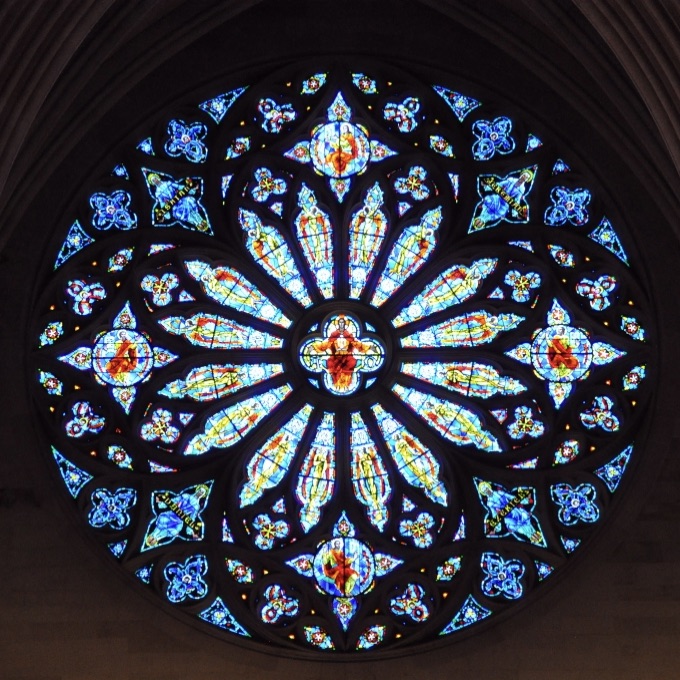
Spirtituality

The Elusive Biblical Idea of Ransom

If reading this by email, please tap the title at the top to open your browser for the best experience. Then, clicking individual pictures will reveal higher resolution images.


In late 1987, two American college students were exploring the jungles of Columbia. After obtaining a canoe, they embarked upon the Putumayo River and strayed into territory held by a Marxist rebel army. Formally known as FARC, these guerrilla soldiers abducted the students and held them captive for ten months in various jungle camps.

At first, the FARC guerrillas thought the two men were CIA agents, though the students corrected this. But then their captors came to see them as hostages having economic value. Soon, their parents hired an American explorer, who found the hostages and their captors. After four months of negotiations, conducted by a Roman Catholic Bishop, the students were released and taken to the American Embassy in Bogata.

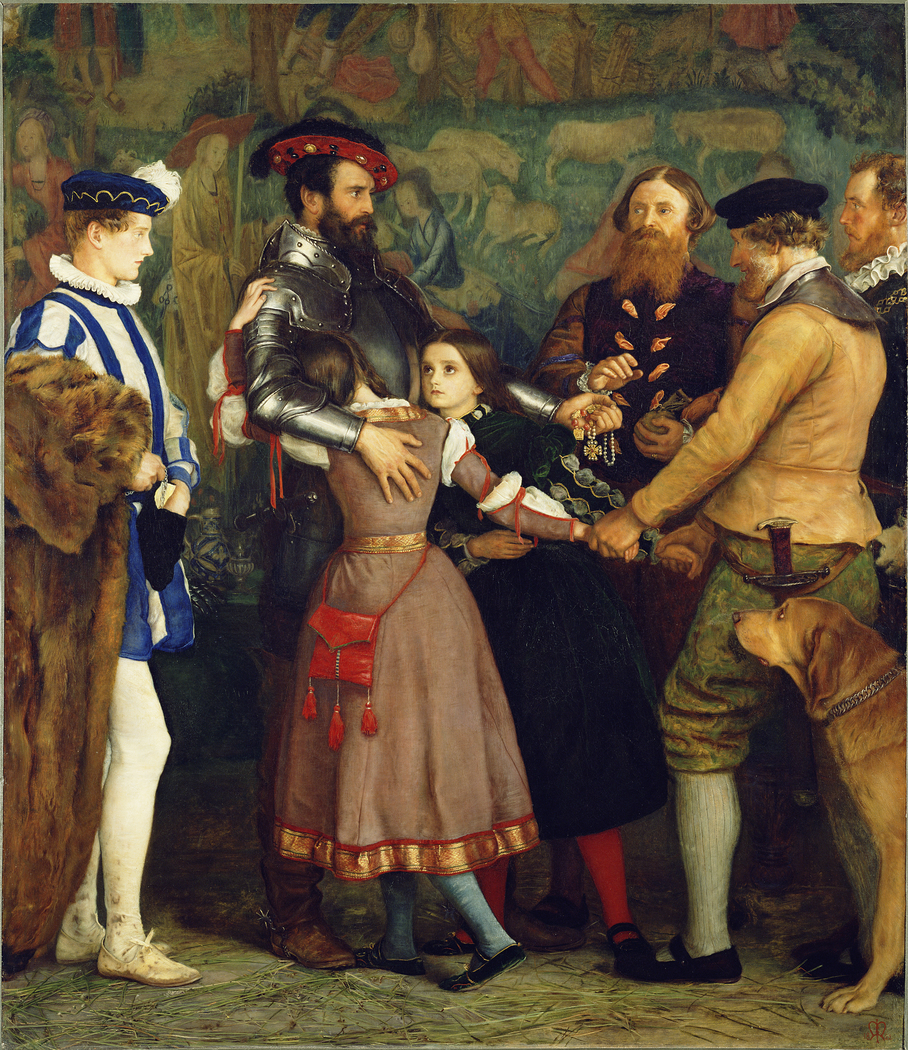
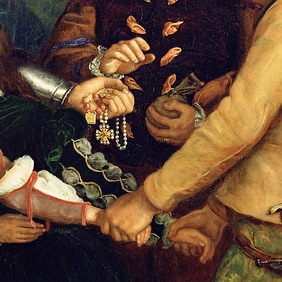
Release for the young explorers surely came about through the payment of money, probably a lot of it. Ransom is a way to describe this kind of payment, where something valuable is exchanged for the freedom of captives. John Everett Millais’ painting (above), The Ransom, depicts a father handing over of fistful of jewelry and a bag of coins to some men who have taken his daughters hostage. Revolutionaries, terrorists, and criminals have long used ransom as an efficient means of fund-raising, especially when their captives come from wealthy families or are politically well-connected.

Clearly, when payments are made to captors, the purpose is not to honor or reward the hostage-takers. Instead, these payments reflect an abiding concern for those who are held-captive, awaiting redemption.

This concept of ransom is deeply rooted in our Judeo-Christian tradition, and it shapes how we understand redemption. Think of the beloved Advent hymn, which begins this way: “O come, O come, Emmanuel, and ransom captive Israel…” In the Old Testament, in many passages like Psalm 49; Isaiah 35, 43, and 51; Jeremiah 31; and Hosea 13, we hear about how God’s promises inspire hope for the possibility of ransom from the power of death.

These insights help us understand Jesus’ words about ransom in Mark’s Gospel (in 10:45; parallel in Mt. 20:28). After predicting his suffering and death three times, Jesus tells the oblivious disciples that “the Son of Man came not to be served but to serve, and to give his life as a ransom for many.”

Yet, instead of a ransom-based understanding of Jesus’ sacrifice and death, many Christians think of Jesus’ saving work in a largely legal or juridical way. In this view, our sin involves a degree of corruption and guilt so bad that it’s beyond what we can make right. And so, human captivity to sin means that ‘a penalty must be paid, and punishment meted out.’ By this reckoning, only a ‘sinless one’ could pay the uncountable price, and bear the penalty for all. Therefore, Christ as a substitute for us, paid the price and endured the punishment so that we, ourselves, don’t have to, even though we are the ones who deserve it. Yet, according to this very common theory, the ‘price’ was paid to God, to satisfy God’s justice!

This legal or ‘punishment-substitution’ understanding of Jesus’ death did not become widespread for at least a thousand years after his crucifixion. Instead, during the first millennium, a different concept of Jesus’ mission was preeminent. It springs from the ransom words in Mark, as well as from 1st Timothy 2:5, where Paul writes, “…there is … one mediator between God and human kind, Christ Jesus… who gave himself [as] a ransom for all.”

According to this ransom view, ever since Creation, we have placed ourselves in the hands of Satan, by refusing to ‘delight in God’s will or walk in God’s ways.’ In effect, we have strayed into ‘the jungles of sin,’ and have allowed ourselves to be taken hostage by the Devil. We are held captive by our sin, and by our inclination to follow our own will. Like the two student hostages, we might have ‘paid’ our way to freedom ~ if we and they had had the means to do so. But we did not.

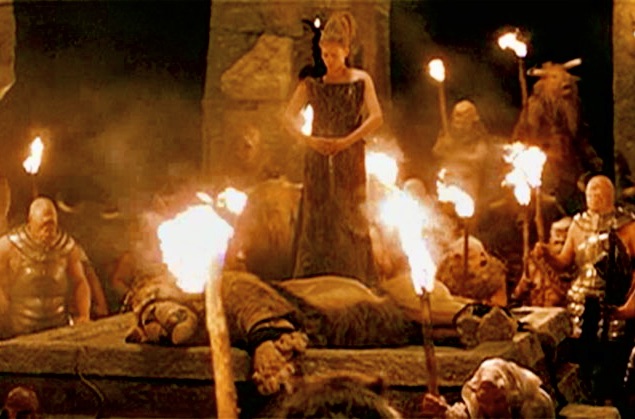
And so, showing his great love for us, Jesus offered himself to the Devil, as a ransom for our freedom. Jesus allowed the Devil to take him, as someone of even greater value than all of us. For Satan received as a ransom the sinless One, God’s own son. C.S. Lewis employs a similar ransom metaphor in The Lion, the Witch, and the Wardrobe. In this biblically-derived approach, the ‘price to be paid’ was a concession to the power of an enemy, and compensation for a loss, rather than (as in the later and more prevalent legal view) a payment to satisfy God’s sense of justice.

An image of Aslan’s self-sacrifice, from a film version of The Lion, the Witch, and the Wardrobe


This post is adapted from some material previously published in this space, with some additional imagery. It is based on my homily for Sunday, Oct. 20, 2024, which may be accessed by clicking here.

St John the Divine – A Building and a Gospel


In the summer of 1974, I left my Massachusetts prep school as one of the few graduates not intending to go on to college. I moved to Manhattan in a youthfully naive venture to try and replicate an aspect of the life of my hero, Frank Lloyd Wright. I wanted to follow his career path of eventually obtaining architectural licensing through practicing in the field, something that was and may still be possible.

Unfortunately, as a career move this was at an improvident time, largely due to what was then called “the oil crisis,” and its effect upon the economy. No architectural office was hiring beginning draftsmen, and some were taking on licensed architects to do the kind of basic drafting work for which I wanted to be hired. The former Frank Lloyd Wright associate, Edgar Tafel, was most gracious in allowing me to come to his New York City office for an interview and then by how he tolerantly responded to my youthful exuberance and evident lack of preparedness for the work. Philip Johnson was less patient with me. When I managed somehow to reach him by phone, he said, “Look – I don’t do the hiring around here. Talk to my associate!”

I had found a room a block and a half from the Cathedral of St. John the Divine, which was a prominent local landmark and soon became a welcome place to visit. Only years later did I discover that the house in which I had been able to rent my room, the former Alpha Delta Phi fraternity house, on 114th St, opposite the Columbia University Library, was where Thomas Merton had lived when he was a student there.

I would walk over to St. John’s, an alluring place to stop and rest. Now, at this point in my life, I would say it was ‘to pray.’ But I would not have said that then. Yet, as one beautiful phrase in The Book of Common Prayer Catechism puts it, “Prayer is responding to God.” Those are profound words. If taken seriously, we can recognize how many, many people in this world ‘respond to God,’ quite spontaneously and quite naturally – and aside from doctrine or ritual.

The magnificent space and architectural achievement of the unfinished cathedral of St. John the Divine was a profoundly converting space for me, in ways I did not realize then, and in ways that would not really make sense to me until much later.

Drawn to this place, absorbed with my intuitions about its architecture, and visiting frequently with inquiries, I volunteered to become a docent, a kind of tour guide for visitors before places like this cathedral became commercially oriented, leading to the charging of fees and the like. In the process of my time as a guide, I learned many arcane and obscure things, among them the size and height of the granite columns surrounding the main altar (54’ tall, 6’ in diameter); the number and architecturally significant variations among the chapels adjacent to the ambulatory surrounding the apse that encloses the high altar; as well as significant features of other side chapels in addition to the crypt.

If you had asked me then about the nature of my interest in that building, I would have said it was purely of architectural significance. Ask me now and I will tell you that I was seeking a closer experience of what St John the Divine shares with us in his Gospel. I was – as we say in a paradoxical way – unconsciously looking for God. But what I was really looking for, as we all do, is the experience of being found… and of feeling found, by God.

I think it is also providential that my year in New York, and the brief time I served as an occasional volunteer guide at the Cathedral, was when Canon Edward West was Sub-Dean, and Madeleine L’Engle was officially the cathedral librarian. I may have had only passing contact with either of them, but both were exemplars of how the arts may draw people into a more direct experience of what our Christian faith is all about. The Cathedral of St. John the Divine has represented this vision and value for decades.

Where St. John the Divine as a building nurtured my nascent spiritual awareness, the Gospel given to us through St. John the Divine, and the hymn-poems in his Revelation, have been for me a key, a doorway, and a beckoning gateway into a greater fullness of life.


Finding Beauty in the Most Unexpected Places

If reading this by email, please tap the title at the top to open your browser for the best experience. Then, clicking individual pictures will reveal higher resolution images.

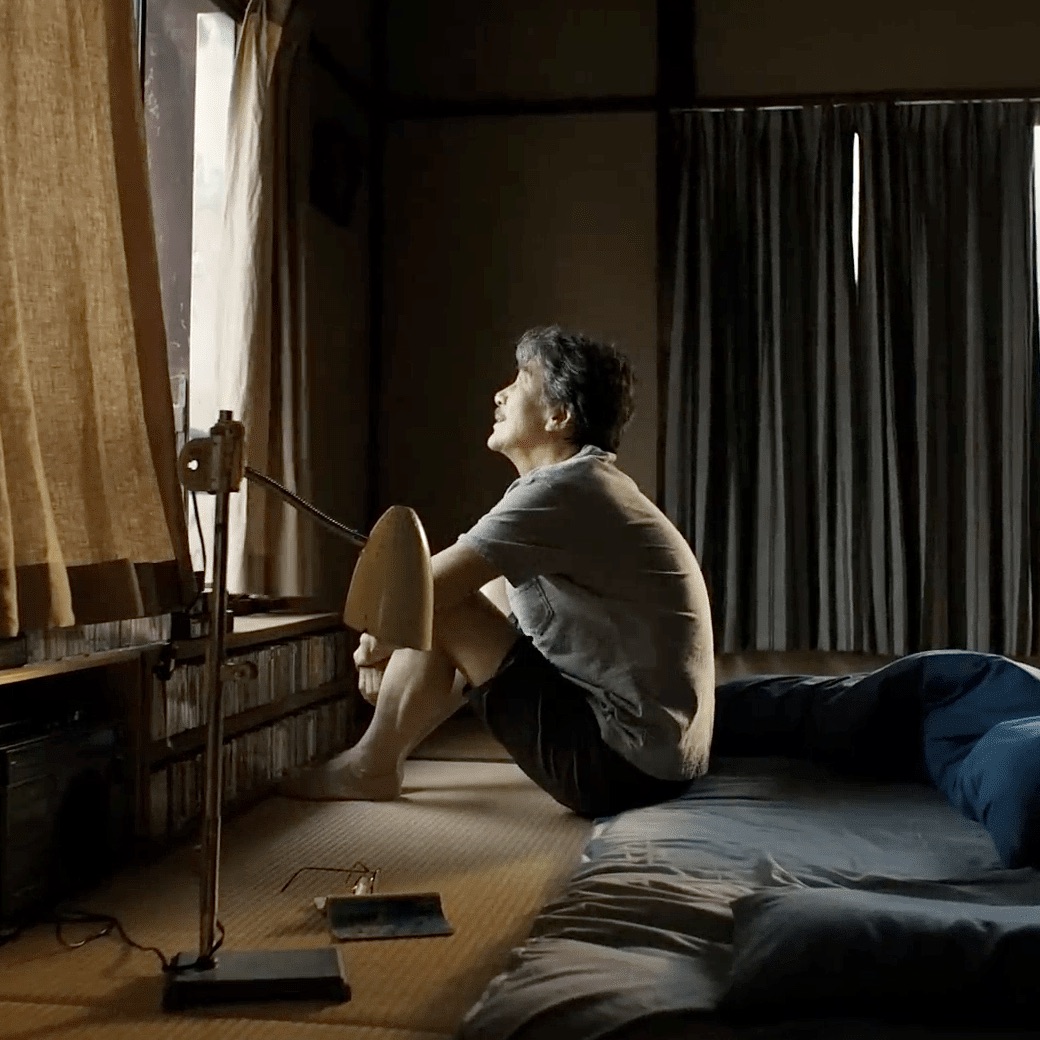
Actor Koji Yakusho portraying Hirayama looking upwards, in the film Perfect Days


An improbable premise underlies the remarkable film, Perfect Days, and it is displayed in two principal ways. A Tokyo public toilet cleaner has a positive attitude, even a cheerful spirit, as he approaches his daily routine of attending to places where other people leave their waste. And yet, the primary places where this man is lucky to work are the architecturally significant public toilets commissioned and built for the 2020 Tokyo Olympics. The film portrays these places well. Some have suggested that the architectural features of these structures may have inspired the movie’s production. Nevertheless, the film is centered upon one man’s approach to how he lives every day.

He is a man about whom we know only his surname, and we learn more about his daily routine than we do about his inner life. The latter, his interests and perhaps aspirations, are suggested by the books he reads and the music to which he listens while driving. Many scenes depict him at his work. But the film does this in ways that do not romanticize his occupation, while he is shown cleaning and polishing toilet bowls and seats, as well as sinks and other aspects of plumbing. The film skillfully negotiates the ambiguous terrain lying between a heroic portrayal of an apparently righteous man, and a sentimental celebration of an unreal figure.

A montage of some of the public toilets featured in Perfect Days

The approach to life epitomized by Hirayama in the film is one of contentment. He models someone who accepts the limitations presented by the contexts in which many of us live, and he displays an openness to unexpected moments of discovered and quiet beauty. The film is not overtly spiritual. Yet, these qualities may represent – to some Western viewers like me – compelling reflections of Japanese culture as it has been shaped by Buddhism.

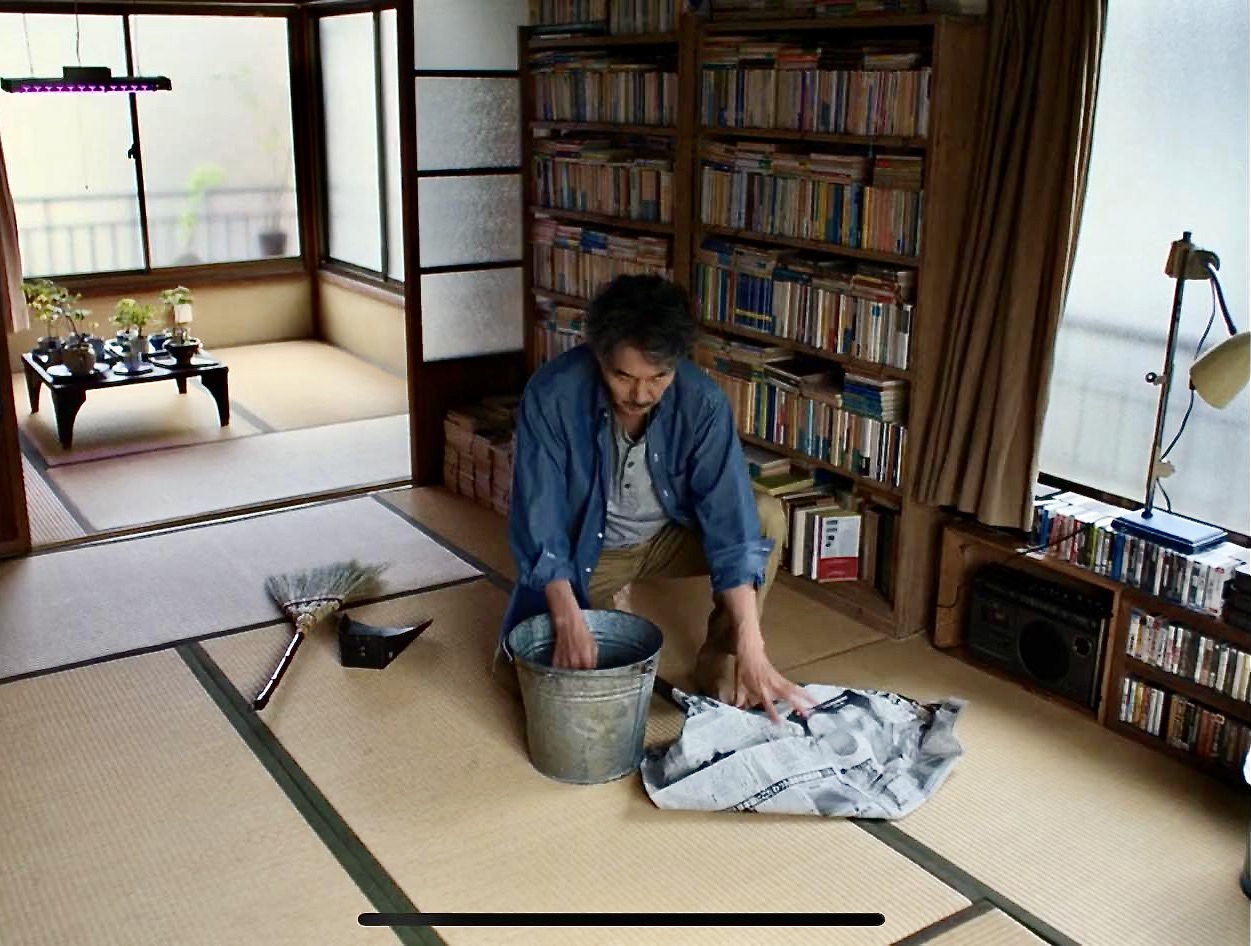
Hirayama at work on a hobby, Bonsai

In addition to the overt paradoxes at the heart of the film – a happy toilet cleaner and beautiful public toilets – the film subtly presents other aspects of Japanese society that Western visitors might notice. In what may surprise many who are not of Japanese heritage, regarding a very private culture where people typically meet one another in commercial establishments rather than in personal dwelling places, public baths with full nudity are common. I experienced occasional visits to public baths in my youth, growing up in Japan.

Hirayama in the neighborhood bath house

And within the context of this very private culture, some Tokyo public restrooms were created with transparent glass walls, appearing to risk users to full disclosure (the glass walls magically become opaque when the doors are locked).

Three motifs or tropes in the film are memorable. Hirayama is portrayed as always looking up to the sky when emerging from his home in the morning on his way to work, and is also seen gazing upwards (as in the photo at the top of this post). This suggests that he unconsciously senses a connection with something bigger than himself, and this may be the source of his frequently displayed habit of smiling at others.

Another motif, surely related to the first, is the employment of black and white sequences that portray flickering images, usually of dappled sunlight glimpsed through tree limbs, which Hirayama captures with his old-fashioned film camera. Most often, he seems to take these photos during his lunch breaks in a local park. In relation to these images, the movie highlights the Japanese word, and concept, of komorebi, which in a single word expresses the idea of sunshine filtering through the leaves of trees overhead.

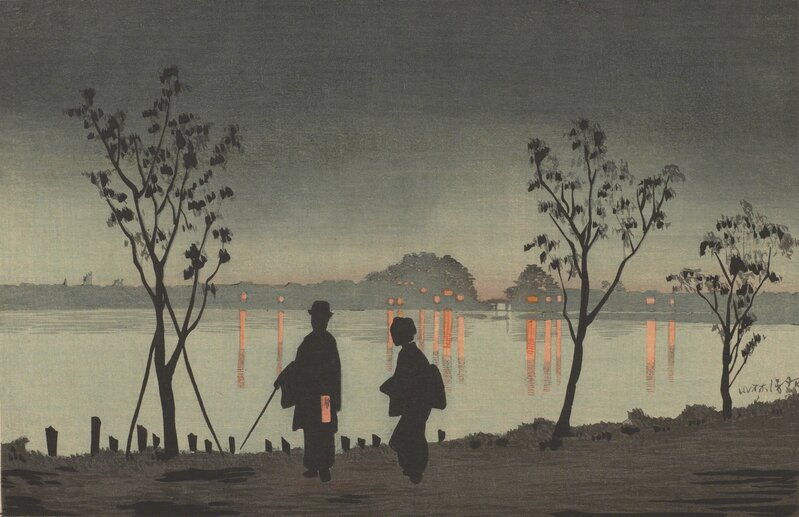
The third is the employment by the movie makers of the Sumida River in Tokyo, long celebrated in Japanese art, over which we see Hirayama cross while walking, driving, or biking. The river appears to symbolize a form of divide between the part of the city where his small apartment is located, and the more elegant commercial district where he usually works.

My favorite image of Tokyo’s Sumida River in art, a woodblock print by Kobayashi, Kiyochika ({1847-1915} name in traditional Japanese order)

These juxtapositions in Perfect Days of contrasting details, color versus black and white, and interior privacy and public life, along with the harmony in which they are presented, distinguish this film. To me, it is remarkable that this movie was made by a Western filmmaker, regardless of the assistance provided by Japanese colleagues. A studied sensitivity to what I know about Japanese culture is evident in the film’s portrayal of this fictional character in improbable circumstances, as it invites us to discover – along with Hirayama – beauty in the most unexpected places.

Hirayama, gazing upwards, holding his old-fashioned film camera


Chora Church: A Byzantine Treasure

If reading this by email, please tap the title at the top to open your browser for the best experience. Then, clicking individual pictures will reveal higher resolution images.

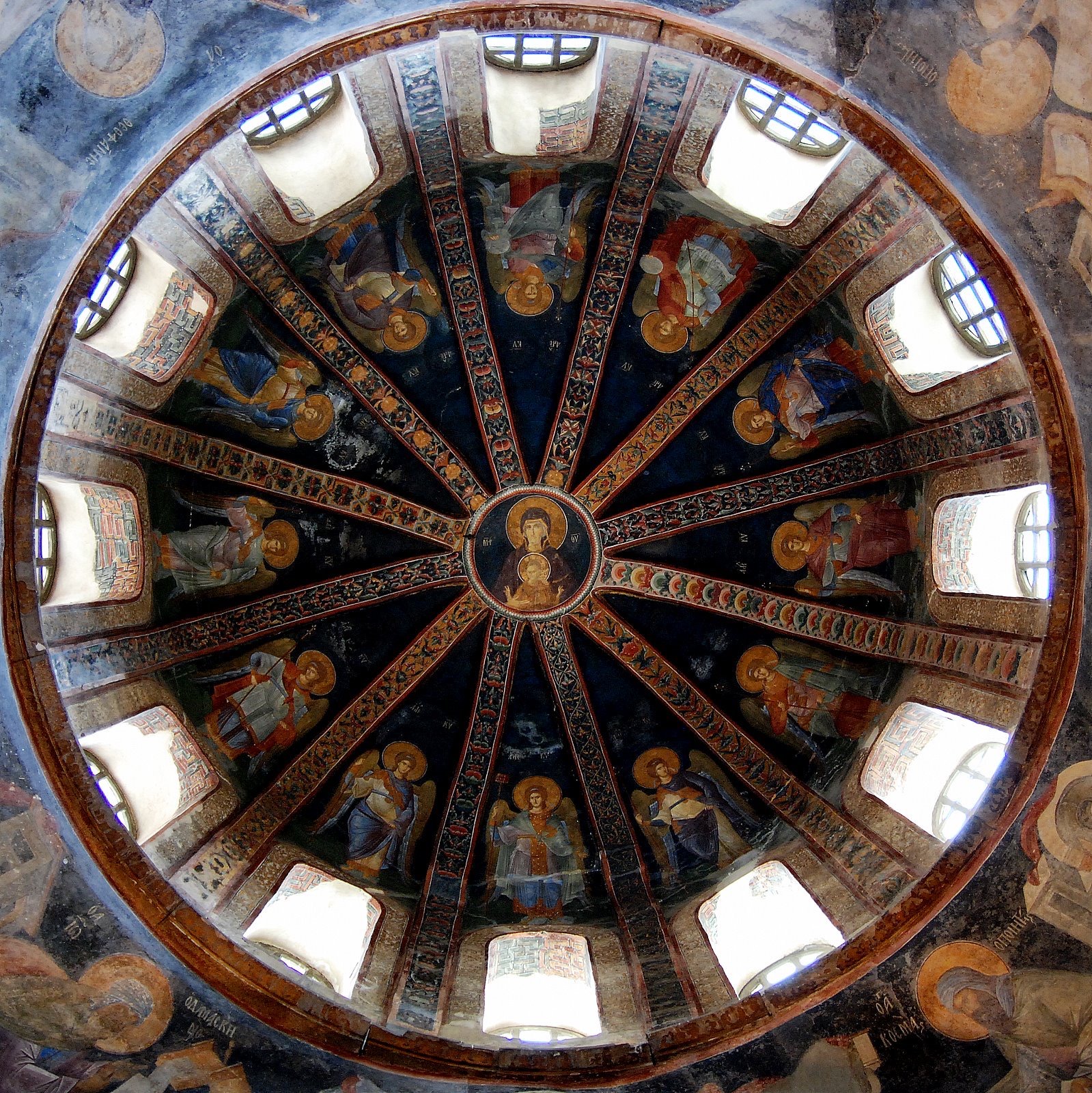
Dome over the Side Church (or parecclesion), Chora Church


We missed being able to visit this remarkable place by a day! Sadly, after staying in Istanbul for four nights, the historic Chora Church that had undergone four years of renovation would not reopen until the day after our departure.

Dating back to the time of Constantine in the early fourth-century, the Chora Church was built as part of a monastary outside the walls that were constructed when Constantinople became the new capitol of the Roman Empire in 330 A.D. Its rural location led to its formal title, Church of the Holy Savior in the Country (or Chorai, in Greek).

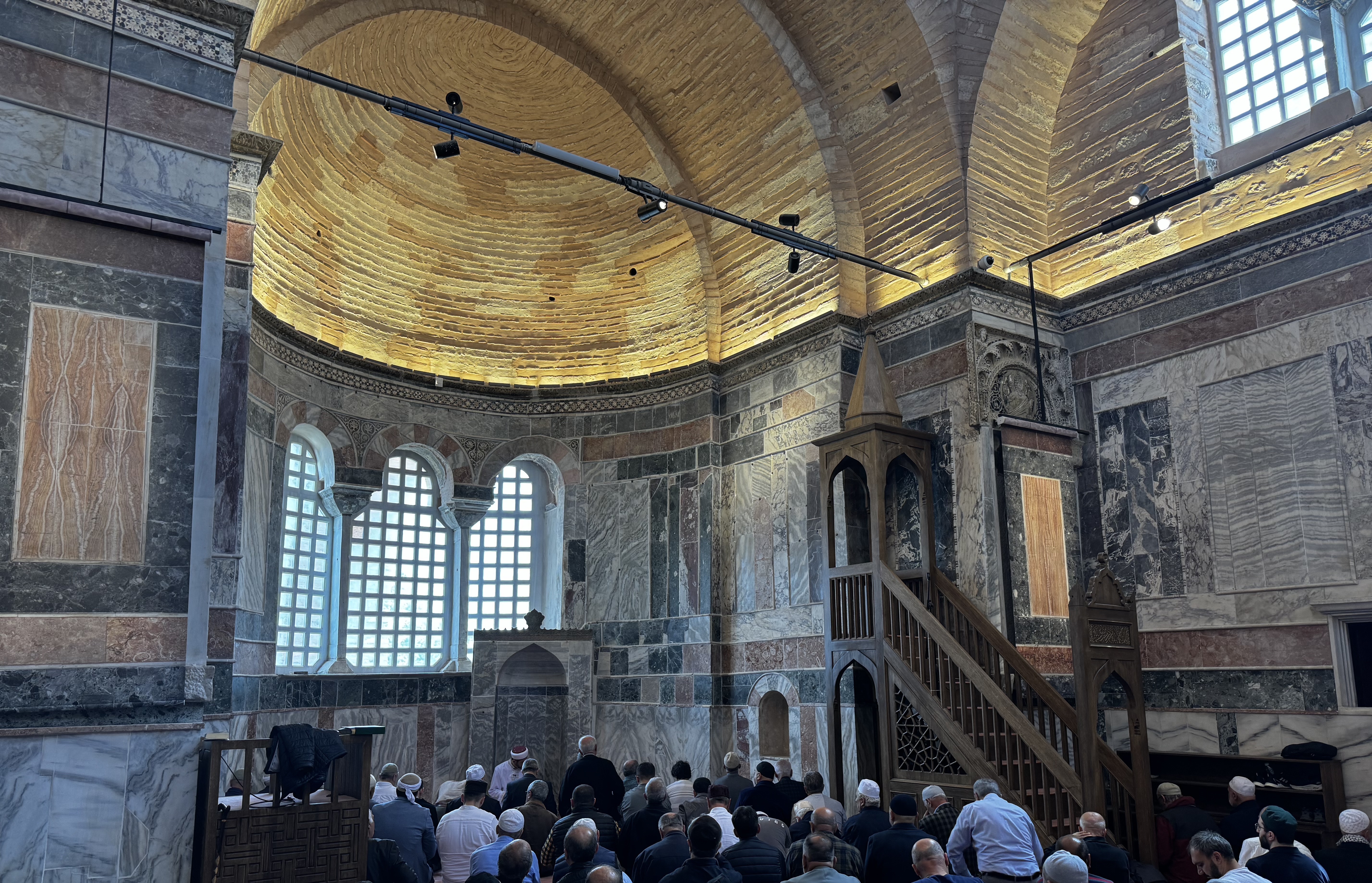
Interior of the original central nave (naos) in use as a mosque, with Christian mosaics and frescoes covered over

Chora, like the later Hagia Sophia, has over its history served as a church, a mosque, a museum, and now once again as a mosque. As I have noted in prior posts, the fact that buildings like Hagia Sophia and Chora have been able to transition from church to mosque without significant structural change helps us perceive how what became normative in mosque architecture had its origins in churches from the early Christian, pre-Islamic era. As a precursor to Hagia Sophia, the original walls of Chora may provide one of the earliest examples of what would develop into the cruciform plan for churches, a design pattern that became predominant in the Christian East. This approach to design for worship spaces is centered on a square, covered by a dome, a departure from the early rectangular basilica plan favored in the western Roman region.

Floor plan of the Chora Church

In the floor plan above, note the subtle Greek Cross pattern of the central nave (or naos) below the large dome. As this plan indicates, the original, late Classical period Chora was significantly expanded during the Byzantine period, between the 11th century and the 14th century.

Section drawings of Chora Church showing the location of some murals and frescoes

In addition to its cruciform plan, and the church’s great antiquity, another feature that distinguishes Chora is its impressive collection of well-preserved Byzantine mosaics and frescoes, largely from the early fourteenth-century.

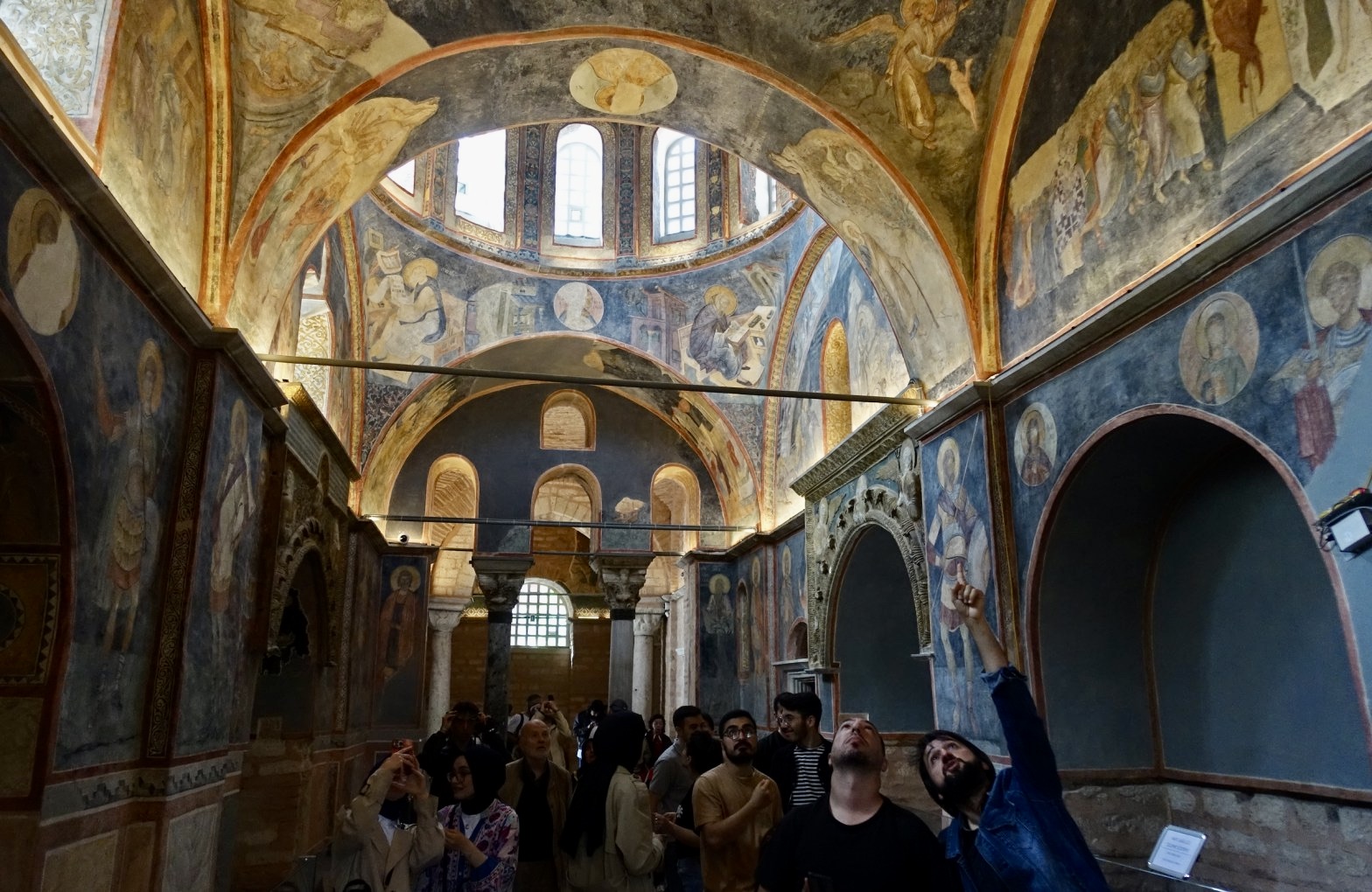
Visitors to Chora admiring the murals in the Byzantine-added “side church”

The bulk of the surviving mosaics and frescoes are located primarily in the side church (or parecclesion). This may be due to the central nave or naos having been used for Islamic worship during a significant portion of the building’s history. One of the many beautiful frescoes depicts a common theme found in works of art from the Christian East, that of the Harrowing of Hell. Images based on this theme depict the Christian belief concerning the first saving actions of the Risen Christ: pulling Adam and Eve out of their tombs and the clutches of the underworld (image below).

A fresco in the Side Church – Anastasis (or Resurrection): The Harrowing of Hell

A beautiful example of the Chora mosaics depicting Joseph and Mary’s enrollment for taxation in Bethlehem

Interior view of the side church

Like the later Hagia Sophia, Chora Church – for a time as a museum and now a mosque – still serves as an edifying spiritual place for Christians and people of other faiths to visit. For Orthodox Christians in the East, Chora’s numerous mosaics and frescoes provide multiple opportunities to (re)engage with biblical stories and with articles of faith in a way that the contemporaneous art in the much larger Arena (or Scrovegni) Chapel in Padua, Italy, provides enrichment for Western, Latin, Christians.

Exterior view of the southeast corner of Chora Church (note the later addition of a ‘flying buttress’)

A 1903 photograph of the west entrance to Chora in the late Ottoman period


The Beauty of Bonsai

If reading this by email, please tap the title at the top to open your browser for the best experience. Then, clicking individual pictures will reveal higher resolution images.


A local plant and garden center recently offered an introductory workshop on Bonsai, the Japanese and originally Chinese art of propagating and arranging miniature versions of living plants and trees. Upon registration for this workshop (and for a relatively modest fee), participants would be provided with a starter plant, a container for the project, and the basic tools and materials with which to begin their own Bonsai arrangement. With my childhood in Japan, and my interest in the arts, I jumped at the opportunity to learn some basic principles of Bonsai, an art which I have admired for many years. Nevertheless, I have been largely ignorant of the mechanics of this aesthetically-pleasing horticultural practice. Attending the workshop, I was not disappointed by the learning opportunity offered.

Upon going to our assigned places after arriving, each of us found a potted portulacaria afra, a succulent commonly called dwarf jade plant or elephant bush (photo below). We also found a glazed ceramic container, plant medium, and basic tools with which to create our first attempt at a genuine Bonsai arrangement. My potted starter plant was in a 6” plastic pot, about 18” – 24” in height, and root-bound in its container.

An example of portulacaria afra

Our first step in the process was to prepare the pot or container to receive the plant. I learned that the most useful plant containers have two drain holes, as well as two very small holes for upright wires. The photo below shows my pot after attaching the wires and screens.

Wires secure small mesh screens over drain holes, while a longer U-shaped wire emerges from below, to help secure the plant

Our next step was to remove the plant from its plastic pot, and determine where the upper primary roots lay. We were then asked to remove almost all of the former potting soil material (identified as pine bark mulch), and then to anticipate trimming the roots. Here, I found my first challenge. As an amateur gardener, disturbing the roots of a plant – much less removing the planting medium in which it has been nurtured – hit me as strongly counter-intuitive. Yet, this was actively encouraged.

A participant’s plant after removal of most of the original planting medium, before cutting extraneous roots

After initial preparation of the plant, we had our third challenge. This was to cut and shape the remaining exposed roots in such a way that the plant might sit well in the provided pot. The overall natural shape of the plant provided a starting point. But an aesthetic judgment was also needed for how this particular plant would best sit in this particular container. Here, I was beginning to discern how at first seemingly mysterious Bonsai practices become compelling to so many people. There appeared to be at least thirty or more participants in this workshop, on a Tuesday evening before the 4th of July!

So, how might my particular plant best fit in my provided pot?

How I situated my plant in the pot, secured by the upright wires

My plant before I trimmed the upper stems

Then came the most challenging aspect of Bonsai for me as a beginner. How should I trim the top of the plant, and to what extent should I prune back the stems and leaves? The main lesson I received here was this: do not be afraid of pruning!

Indeed, with the art of Bonsai, and apparently according to recognized horticultural principles, the more we prune our Bonsai plants, we will find a real diminishment in the size of the leaves as the organism grows!

Here, below, is a photo of my Bonsai plant project at home, after some significant pruning.

The ‘windswept’ natural posture of the potted plant appealed to me, and I want to accentuate this by continuing to allow for the lean of the plant (to the right, in this photo), while counter-balancing this lean by promoting growth toward the opposite direction. As my recent mentors stressed, pruning will be everything!

What my portulacaria afra might look like some day


Note: as mysterious as this art-form may seem to Westerners, it is accessible to beginners in terms of method, materials, and technique. Ask your local plant and garden store about it!

Fully Alive: The Beauty of Human Nature

A photo of a print given to us years ago


Those familiar with my writing and ministry may not be surprised by how I choose to address the theme of beauty in relation to the human nature we all share.

My response is captured in a quote with words I have long loved and have frequently cited. The quote is from the second century Christian theologian and Bishop of Lyons (in present-day France), Irenaeus. “The glory of God is the human person fully alive.” To which he added, “and to be alive consists in beholding God.”

What an audacious statement! I believe that the fundamental insight here, latent within Irenaeus’s words, stems from the Gospel of John, with whose author Irenaeus likely had a personal connection. That would have been through Polycarp, Bishop of Smyrna (presently, Izmir, Turkey), the city where Ireaneaus was born. One writer has described Irenaeus as the spiritual grandson of the apostle John.

Another calligraphy print, this one featured on the website of Holy Cross Monastery

What does it mean for any one of us to be ‘fully alive’? I believe that the Gospel writer, John, would respond by echoing words from Paul, whose letters frequently employ the phrase, “in Christ.” Through Baptism, we come to be in Christ. Through Baptism, we are re-born in Christ; we live in Christ – and he in us – and we will leave this mortal life in Christ. Indeed, in John’s  compelling witness to Jesus’ teaching, we are told that those who believe in Jesus have already died, and now, will never die! All of the Gospel readings appointed for funerals in The Book of Common Prayer are from John. This is the Gospel that is so centered upon the themes of God’s incarnation within our shared human nature, giving us God-given light, and eternal life.

Words found in the daily pattern for Morning and Evening Prayer, as well as in the Eucharistic pattern used on most Sundays in Episcopal Churches, help amplify this point but in a subtle way. These several patterns for corporate and individual prayer include forms for confession. Using these forms, and after we acknowledge our sin, we pray that we may delight in God’s will , and walk in God’s ways. In the absolution that follows, we hear these remarkable words:

Almighty God, have mercy on you, forgive you all your sins through our Lord Jesus Christ, strengthen you in all goodness, and by the power of the Holy Spirit keep you in eternal life.

In words that may be easy to overlook, we pray that by Holy Spirit power, God will “keep us in eternal life”! Being fully alive involves delighting in God’s will, walking in God’s ways, and being kept by God in eternal life.

Christians believe that the beauty of our human nature was and is found in the Gospel Jesus, and as the Risen Christ comes to be found in us. Our human nature, created in the image and likeness of God, and transformed to become an icon of Christ, is therefore all about the fulfillment of our divinely-given and imbued potential. When by grace we see it happen in people’s lives, it is a beautiful thing to behold.

Yet, human nature, being still what it is, prompts us to look for beauty in outward terms when we view others, as well as ourselves. Jesus, as the Gospels imply, always looked for beauty within – the kind of beauty it was his vocation to share and re-enable in us. This is what we should be looking for, both within ourselves and in others.

The archetypal biblical example of the glory of God beautifully manifest in human nature is found in the Gospel Transfiguration stories. James Tissot, one of my favorite painters, offers us glimpses of Jesus manifesting this same glory on several occasions, a glory that was otherwise often hidden within him.

James Tissot, Jesus Goes Up Onto A Mountain to Pray

Tissot, Jesus Being Ministered to by the Angels

Paul’s remarkable words to the Corinthians bring these themes together nicely. For we want to be among those who are:

seeing the light of the gospel of the glory of Christ, who is the image of God… For God, who said, “Let light shine out of darkness,” has shone in our hearts to give the light of the knowledge of the glory of God in the face of Jesus Christ.”

And, by God’s generous grace, the same may be seen in our faces, as well.


Note: Kenneth Kirk, the esteemed 20th century Bishop of Oxford, and former Regius Professor of Moral Theology at the historic university in that city, titled one of his still-used books (The Vision of God) based on the Irenaeus quote, featured above. Kirk presents Irenaeus’ words in this (now dated) way: “The glory of God is a living man, and the life of man is the vision of God.”

Beauty, Transcendence, and Personal Transparency


In preparing to offer an autumn class through an LSU seniors learning forum, I have been reflecting on the general themes that animate this blog website — art, beauty, and transcendence. The link between art and transcendence is intriguing, and for many of us, it is something we experience. Yet, the alluring and knowable significance of beauty – linked here with art and transcendence – is harder for us to get at. Relying upon a famous historical quote that some will recognize, I will paraphrase the matter this way: I can’t define Beauty; but I know it when I see it!

Readers of this blog will have noticed my prior exploration of what may be a common sequence or pattern in life experience. Through it, we move from encounters with Beauty, on to reflection about what may be Good. This then can lead to a search for, and reflection upon, what is True. These three facets of this transitional sequence, Beauty, Goodness, and Truth, are also referred to as the “Three Transcendentals.” They have  been portrayed in art history as the Three Graces, in the form of three young women appearing together as in a dance.

We may infer something from this common association between Beauty, Goodness, and Truth, in relation to the further category of that which is transcendent. The three so-called ‘Transcendentals’ at least verbally have something to do with our human interest in the compelling category of transcendence. [Note: transcendental and transcendence obviously come from the same root word.] For our experiential encounter with some objects and or events can lead us to describe them as having been memorably beautiful, very good, and or compellingly true. Why? Because when remembering these encounters as occasions in which we glimpsed, sensed, and or apprehended something real and beyond sense experience, we have had an engagement with what we may best describe as having a ‘transcendental’ quality.

One way to help account for the above is to recognize that we are ‘spiritual’ beings, and not merely animate beings whose significance can be explained solely in terms of bio-physical data and analysis. To help get at the questions we are exploring, we can refer to the long-recognized brain-mind question. Does human conscious experience terminate with brain function? That is the blunt way to put a matter that can be so much more suggestive and evocative. Our human experience – here and now, in our conscious awareness – clearly depends upon brain function. But what if it also transcends brain function?

Here, we can fall back upon a basic principle of received Christian doctrine: we are embodied. In life beyond, if it is granted to us, the New Testament tells us that we will remain ‘embodied,’ though not in the same form as we are now. So, if brain function demonstrably ceases upon physical death, and if consciousness may transcend the cessation of brain function, what might we make of this?

My reflections on these ideas have led me to a further perception, which may call for additional consideration. When we have encounters with objects, experiences, and or events, that we describe as highly beautiful, movingly good, and or compellingly true, we have experiences of not only what is here and now, but also of what may be transcendent. In having such experiences, we often feel more true to our selves, to who we are, and to whom we hope to become. And the world feels more real and true in an expanded way. In the process, we may become more transparent to ourselves.

Stemming from such experiences, I find that I am also more open to being transparent with others. How? Sensing I have encountered something truly beautiful, genuinely good, and or fundamentally true, I feel more alive, and more in touch with the way the world really is. These experiences leave me more sure about my perceptions of what I have sensed. I then find I am more confident about these experiences, and more willing to share them – and myself – with others.

Experiencing Beauty, apprehending Goodness, and discerning Truth, may therefore open the doors of communication we yearn to have with others.


My thanks to a longtime friend, Chip Prehn, and to my brother, Greg, for the above photos. The first three come from Sassafras Farm, during haying season in Virginia, and the latter photo was taken while my brother was recently completing his fourth Camino de Santiago.

A Beautiful Place Where I Went to School

A view from the campus farm across the Connecticut River valley


In the fall of 1971, I was truly fortunate to be able to head off to Northfield Mt. Hermon School for my sophomore year of high school. After growing up mostly in Japan, and returning to the States for a couple of years, I was ready for a new challenge. I was yearning for an educational opportunity that would build upon my earlier experience at the Yokohama International School. When I arrived at Northfield Mt. Hermon (NMH) as a scholarship student, this inviting place opened the world for me, and changed my life.

Rooflines of a dorm, faculty house, and the student center in early evening light

Recently, I attended the 50th reunion of my NMH high school graduation class, which numbered about 365 in May of 1974. After graduating from this wonderful place for learning and formation, many of us at our reunion had not seen one another in fifty years! Anticipating being with school friends after such a length of time was a bit unsettling for me, given my awareness that – like others, as I came to see – I was not the same person I was when we last saw each other. I soon felt more at ease when greeted graciously by fellow members of my class and by our school hosts.

Two of the remodeled “Cottages” that serve as dorms

A theme periodically voiced during our weekend together was how troubling were the years in which we were students at NMH. The Vietnam War was still a concern; our President was in political if not legal trouble; the society around us was deeply divided and appeared to be coming apart; and large numbers of our fellow citizens seemed either unaware of or uncaring about the precarious state of the air, water, and food supply in the world around us. [In some ways, the world has not changed!]

Being the largest class in NMH’s history, at such a time, provided another challenge. Could we – from our multiple and differing backgrounds – find or make a community built of more than passing relationships upon arriving at a place that was – for some of us – far from home? To my astonishment, my first roommate was a former Yokohama classmate with whom I had last attended 7th grade, halfway around the world. And yet, I also remember my surprise at how I felt when observing the sudden absence of everyone from campus on graduation afternoon, many of whom I would not see again until our recent weekend together.

A wonderfully large green space at the center of campus

Here are a few things that distinguished my (and our) experience at NMH during those years, which are strong features of our school. The legacy of our founder, the 19th century evangelist, D.L. Moody, continues to be manifest in a strong emphasis upon spiritual and ethical values that have the power to transform both individuals and the world in which we live. Moody’s own commitment, to address not only the spiritual needs but also the social and educational needs of marginalized youth, remains central to our school’s mission. For we as alumni are rightly proud that among the first NMH students after our 1879 founding were 16 Indigenous Americans and a freed African-American from a formerly enslaved family.

The new science building

These themes are evident in our school’s mission statement, in words regarding an education that seeks to form the head, the heart, and the hands, of all those who share life together in the beautiful surroundings of the Connecticut River Valley. Fundamental to this commitment is the requirement for every student to have a work job, 3 – 5 hours per week, participating in dish crew, cleaning dorms or classrooms, or working on the school farm. These work jobs save the school a considerable amount of money that is directed toward the substantial scholarship funds that enable many students from a modest financial background to be at NMH.

Again and again during our reunion weekend I found myself saying to Martha, “I was so lucky to go here!”

Our Head of School, Brian Hargrove, speaking to us at the Alumni Convocation, in the chapel also featured in the recent film, The Holdovers

A welcome sign in the nearby historic town of Northfield, Massachusetts


Note: NMH provided a fitting setting for the movie, The Holdovers, and for many of its memorable scenes. The film was set in the time period when my fellow classmates and I were in attendance at NMH. One fellow alumnus at the Reunion was celebrating the 75th anniversary of his graduation!

Memorial Day: Finding Beauty in Remembering

For this Memorial Day, I am re-posting part of a piece first published in January.

The grave of Hamilton Sawyer, U.S.C.T. (a Civil War casualty)


A few months ago, I found an unanticipated beauty in a wintry place a short drive from my home. Port Hudson National Cemetery is easy to overlook, though one of many created by the Federal government during the Civil War to provide for proper burial of the Union dead. It helps us remember those who lost their lives during a prolonged siege along the Mississippi River in 1863.

Among several thousand headstones, some include the initials, U.S.C.T. Wondering about them, I discovered they signify membership in a former United States Colored Troops regiment. Hamilton Sawyer (died 2 Feb 1864), and Samuel Daniels (died 19 Jan 1864), were two of many young men about whom history seems to have preserved only these bare facts. And yet, as a nation we remember them. Away from home and family at the time of their deaths, they surrendered their lives to help secure freedoms already declared, yet far from actualized in the lives of so many. Obviously, no contemporary visitor to the cemetery could have known either of these men. But we can – if we choose to – remember their names, and for what they died. The beauty of remembering lies in how we make present what we value.

Not everyone appreciates the beauty we find in a National Cemetery. Though these burial grounds were created and are maintained to honor those who have served in our nation’s military, these settings do not celebrate armed conflict. Instead, they venerate the commitment of many fellow Americans to serve our country and its founding principles, and commemorate their willingness to put the interests of the wider community before those of self. Most of us can recognize this commitment and willingness, even if we are not all moved to prioritize these things among our choices.

Praiseworthy themes often characterize eulogies offered at funerals. On such occasions, people usually identify and highlight the admirable traits of those who have died, whose lives we seek to honor through acts of remembrance. When done well, eulogies provide portraits of people’s lives conveying an appreciation for ways that certain moral principles and spiritual values have been lived out by them. These occasions would be drab and shallow if they merely recalled how a person consistently obeyed civil laws or always observed proper manners and social etiquette. By contrast, we touch upon beauty as we seek to remember people when they were at their best. For as Irenaeus put it, “The glory of God is the human person fully alive.” This is how we desire to be remembered.

Here is something to notice. There is a discernible symmetry between the way different baptismal candidates wear similar white robes, the way that variously styled caskets are covered at separate events by the same pall, and the way our burial liturgies – sacred and secular – ‘clothe’ our departed with the same words, on occasion after occasion. We find a pattern similar to these examples at our National Cemeteries, in how formerly high ranking officers and the lowest ranking enlisted men and women all have essentially the same headstones. In life and in death, we are – in the end – all one. Remembering the people whom the stones commemorate, even those we did not know, makes bigger our appreciation for the beauty of God’s world, and our own place within it.

To remember, and be remembered, can be holy acts. In remembering – even with regret-tinged memories – we reflect our desire for things to become whole, and brought to their fulfillment by God.
 

Historical note regarding Port Hudson:

From the above information plaque: “In May 1963, Union Gen. Nathaniel Banks landed 30,000 soldiers at Bayou Sara north of Port Hudson {at St. Francisville}. A force of 7,500 men commanded by Confederate Gen. Franklin Gardner held the Mississippi River stronghold. General Banks’ May 27 assault on Port Hudson failed and nearly 2,000 soldiers died. Among them were 600 men from two black regiments–the 1st and 3rd Louisiana Native Guards.* The Port Hudson engagement was among the first opportunities for black soldiers to fight in the Civil War. Their determination proved to the North that they could and would ably serve the Union Cause.”

“Among those buried {at Port Hudson} are 256 men who served in the United States Colored Troops (USCT).”

*Additional note from an informative Wikipedia article: “The 1st Louisiana Native Guard was one of the first all-black regiments in the Union Army. Based in New Orleans, Louisiana, it played a prominent role in the Siege of Port Hudson. Its members included a minority of free men of color from New Orleans; most were African-American former slaves who had escaped to join the Union cause and gain freedom.”

Port Hudson National Cemetery on a summer day

Note: blog settings have been changed to provide more opportunity to offer comments, using the link below.

Pentecost: The Beauty of Unity Amidst Diversity

Peter Warden, Pentecost (1985)


Paul’s stirring words to the Ephesians assert an abiding truth: “There is one Body and one Spirit; there is one hope in God’s call to us; One Lord, One Faith, One Baptism, One God and Father of all.” Paul was focused on the God-given and true things that unite us, that hold us together, and which give us life. Yet, in contemporary American culture, everything now seems to center on how we differ from one another. How might we hold both insights together?

Some years ago, I discovered Peter Warden’s wonderful contemporary painting about the post-Resurrection Pentecost event, which reflects the presence of such differences among us as people. Warden’s painting is based on the well-know story from Acts, chapter 2. The painter portrays the disciples together in their upper room retreat. But, in this case, the first Christian community is gathered in a 20th Century Scottish attic! The painting seems to capture the disciples just at the moment when the mighty Spirit-wind and tongues of fire appear. In other words, the disciples – as Warden depicts them – are not yet bound together, and not yet ready for mission.

Though they are in the same room, these disciples show few signs of unity. They react against one another, as much as they may talk together. Notice how this is suggested by the alternating warm/cool color palette that Warden has used. We also want to notice the suggestively peeling wallpaper behind the group. Can you see the pattern that the artist has created with the lower part of the rendering of the wallpaper?

If you look closely, you can see how Warden has used his depiction of that scrappy wallpaper to suggest Leonardo Da Vinci’s famous painting of the last supper. Da Vinci’s painting has also suffered the fate of being on a peeling wall. Peter Warden portrays a group of people with a shared history, who were brought together by Jesus at their earlier supper with him. But now, after his death, they find themselves regressing, regressing to their before-knowing-Jesus identities, and falling back upon their differences from one another.

Yet, as the painting’s title suggests, in just this moment God’s Holy Spirit finds them. Just as, through the Church, God’s Spirit finds us. When God’s Spirit finds us, we are grafted into the Body of Christ. In the process, we come to perceive who we really are. For we receive a new baptismal identity in Christ.

Our new identity builds upon and transforms the uniqueness of our natural, biological-identity. Our baptismal-identity emphasizes a new way of seeing ourselves in relation to others. Now, we also celebrate what we share and have in common, rather than simply emphasize our practical awareness regarding how we are unique and different from others.

Through hearing and reading Scripture, and in our fellowship with others in Jesus’ beloved community, we learn something very important. It has to do with this matter of our identity. We learn that the “Who am I?” question cannot rightly be answered apart from the “Who are we?” question. And, in turn, the “Who are we?” question cannot rightly be answered apart from another question: “Who are we made to be?” Once we ask, “Who are we made to be?”, we are on the threshold of discovering, perhaps for the first time in our lives, who we are meant to be and become, both as individuals, and in community.

Here is the truth of the great feast of Pentecost: God’s Spirit has come down! God’s Spirit has come down upon, and within, people who are sometimes alienated, and who often fall short of God’s mission. Preoccupied with ourselves and our own pursuits, we are gifted with the experience of transformation. We are drawn into relationship. As we are, we find meaning and we find purpose. We discover who we are, as we discern what we are called to be and do together. The mission of God brings both mercy and meaning. In it, we discover a shared life in God’s Spirit-shaped Kingdom.

John Nava, Pentecost, 2012


The quote from Ephesians is from the Book of Common Prayer Baptismal Rite adaptation of Ephesians 4:4-6. I have featured Peter Warden’s Pentecost painting once before, though without reflective comment, in a post offering Family Devotions during Covid, on May 30, 2020.

Further note: last week I was fortunate to walk down the same central street in ancient Ephesus upon which Paul surely often walked, while – according to Acts – he was there for two years. In writing the words quoted above, Paul was likely responding to the Ephesians’ devotion to the fertility mother goddess, Artemis, and the great temple they had built in dedication to her.