Spirtituality

In a Time of Darkness

[If reading this by email, please tap the title at the top to open your browser for the best experience. Then, clicking individual pictures will reveal higher resolution images.]

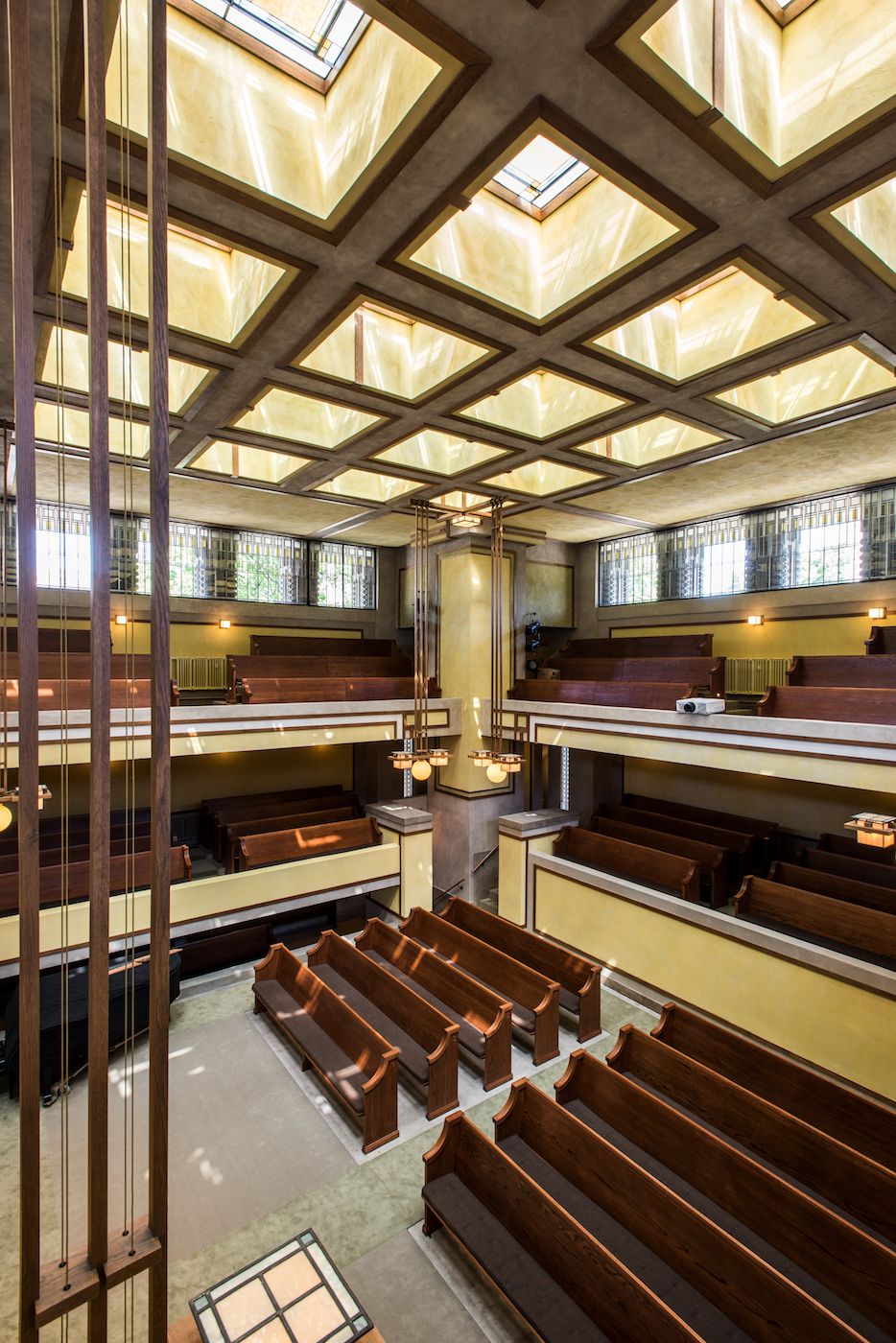
Chicago’s Unity Temple, by Frank Lloyd Wright (1908)


In a time of darkness, we seek light from above.

A couple of days after offering my reflection on “A Desecrated Beauty,” I heard the terrible news from the Holy Land with its many troubling details.

The desecration of beauty can rightly be seen as a violation of what is sacred. If we can associate this idea of violation with the greedy despoliation of an old-growth forest, or the thoughtless pollution of a tranquil waterway, what greater offense against the wisdom and love of the Creator exists than atrocious barbarity unleashed upon human persons made in the image of God?

Human warfare, whether justified on occasion through acts of reasoning that seek some form of the good, or abhorred as an absolutely unconscionable choice, always involves some evil. Hate does not reflect our better nature, unless perhaps it is hate for the ultimate source of all that is not of God. Yet, paradoxically, we so often embody evil through violent acts against people whose views and behavior we refuse to recognize, not only by damaging things that other people value, but by hurting them, even fatally, as well.

In spite of this, following Augustine and Aquinas, I accept the premise that acts of violence can in some circumstances and on some occasions be justified as acts in the service of justice and even of love. The view that the defense of other human beings can be a justifiable expression of our love for our neighbor, even if that defense may involve the use of force and acts of violence, is and has been a formative strand of biblically informed Christian moral reasoning. Therefore, I offer no judgment upon Israel and its leaders who are presently involved in responding militarily to the large-scale acts of terrorism against their nation and people.

Whether for decisions made in haste, or acts undertaken after due deliberation, Israel’s leaders and people will have occasion to judge themselves, their reasoning, and what they have done or not done. History, and others not directly involved, will certainly call them to account.

People impacted by the present conflict may find it difficult or even impossible to seek ‘light from above.’ Yet, in the midst of darkness, those who seek beauty, goodness, and truth, will best be prepared to receive that light, and the healing that comes with it. For the divine light is not absent and can be found.

Whether the divine presence is known and named as revealed, or unknown, or even secretly sought, Christ is the center of all that exists, the one in whom all things hold together, and through him God’s Providence is enacted. Evil will be vanquished, and all that is good or open to God’s redeeming guidance will be brought by him to its intended fulfillment and bliss (see Colossians 1:9-20).

For “the people dwelling in darkness have seen a great light, and for those dwelling in the region and shadow of death, on them a light has dawned” (Isaiah 9:2 & Matthew 4:16).


A Desecrated Beauty

[If reading this by email, please tap the title at the top to open your browser for the best experience. Then, clicking individual pictures will reveal higher resolution images.]

An encounter with beauty may provide a gateway to what is holy. For beauty often embodies and expresses something sacred. When this is so, a violation or desecration of beauty can strike us as having the character of evil.

When apparent destruction befell Notre Dame cathedral in Paris, or earlier upon the Golden Spruce tree in the Queen Charlotte Islands, British Columbia, people learning about these events were shocked and in mourning. In the case of Notre Dame, a devastating fire accidentally accompanied repair work on the building. But with the Golden Spruce, a  willful human act destroyed a spiritually significant tree.

The several hundred year old Golden Spruce became widely known based on news reports of its loss, and through a subsequent book by John Vaillant. An extremely rare genetic mutation occurred in one of a very large species of trees common to the Pacific Northwest, the Sitka spruce. Vaillant tells the story of this beautiful tree, which was known as Kiidk’yaas to the First Nation Haida people. The Golden Spruce was revered through a mythical spiritual story retold over countless generations in Haida oral tradition.

The author draws us in to the significance of this particular tree for the Haida and for many others, including the person who figures principally in his narrative, Grant Hadwin. He was a forester and logger who developed a reputation for having extraordinary skills as a woodsman who possessed seemingly superhuman physical strength and endurance. Paradoxically for someone whose livelihood depended upon employment by forest product companies, Hadwin over time developed an increasing antipathy toward the detrimental effects of commercial logging and the forest clear-cutting with which he and the industry were associated. Over time he became known as a radical environmental activist, whose views may have been inspired by some remarkable spiritual experiences.

Vaillant lays the groundwork for his story about the Golden Spruce by offering a compelling introduction to the ecosystem of the Pacific Northwest coast and its islands. The reader comes to appreciate the unique habitat within which early European explorers and traders found the huge trees of the old growth forests. These trees include Douglass Fir, Western Red Cedar, and the Sitka Spruce, which in diminishing numbers are still seen today. The reader also learns about the history and culture of the Haida, and the detrimental impact caused first by Sea Otter pelt traders, and then by foresters, upon what became British Columbia, its islands, lands and first peoples. Given this background, one might expect that Grant Hadwin would somehow be the hero of the story, given his abilities, integrity, and emerging commitments.

The central irony of the narrative centers on Hadwin’s concern about the rapacious devastation of the old growth forests by commercial interests and their professional employees, who generally approach the land’s natural endowments as resources to be exploited, quickly and extensively. Yet, Hadwin himself targeted the Golden Spruce, seeing it as a corporate ‘pet,’ falsely preserved by a company in a park-like artificial island of nature, surrounded by lands violated by those who had no care for them. In the process, Hadwin – through an apparent combination of correctable ignorance and oversight – seemed surprised and defensive when he learned about the Golden Spruce’s significance for the Haida, on whose lands it had long stood.

In this book, the author accomplishes several things that taken together may seem incongruous. We gain a regard for the immense scale of the old growth forests of the Pacific Northwest, the towering size of their tall trees, and the hundreds or even thousand years over which some of them have grown undisturbed. We become aware of the astonishing danger and rate of mortality associated with tree felling, while coming to admire something of loggers’ courage and tenacity. And our righteous anger is stirred by the corporate appropriation of natural resources for commercial benefit at the expense of the cultural and spiritual significance of forests. For forests number among special places that have long reminded people of our higher values, and are a context where we can rediscover deeper purpose and meaning for our lives.

Vaillant  leaves us with another unresolved sense of paradox. It is prompted by the knowledge we gain of how the Haida, long feared as brutal victimizers and enslavers of other First Nation peoples, themselves became victims of hostile social, economic and geographical forces. Against this backdrop, we learn how a well-liked man, who was regarded as having extraordinary skills and integrity, and who might once have been defended by the Haida, perpetrated a bewildering act of environmental desecration and came to be seen by them as an enemy of their spiritual history and culture.

Kiidk’yaas, the Golden Spruce may be gone. The transcending beauty it had, and which it still represents, will last.

A sapling from Kiidk’yaas

A Beautiful Garden: Nitobe Memorial (Part II)

[If reading this by email, please tap the title at the top to open your browser for the best experience. Then, clicking individual pictures will reveal higher resolution images.]


In Part I, I closed with this observation: one does not visit a Japanese garden in the way one might go to a park, as a context to pursue some activity like an exercise walk, but as a place to experience simply being.

Here we encounter a paradox, perhaps one of many associated with traditional Japanese gardens. At first, for many Western visitors, the elements within such a garden, and their arrangement, catch the eye and draw one in further to an encounter with what is seen there. Yet, what is seen within a Japanese garden exists less to provide an object of attention, and more to facilitate and enhance how one sees. A journey around the garden therefore encourages a journey within. The “spirit that informs [the] spaces” found in “a garden created and maintained in the Japanese tradition,” to which the UBC website alludes, is a spirit or quality of experience to be nurtured within the viewer who encounters this intangible element of the garden.

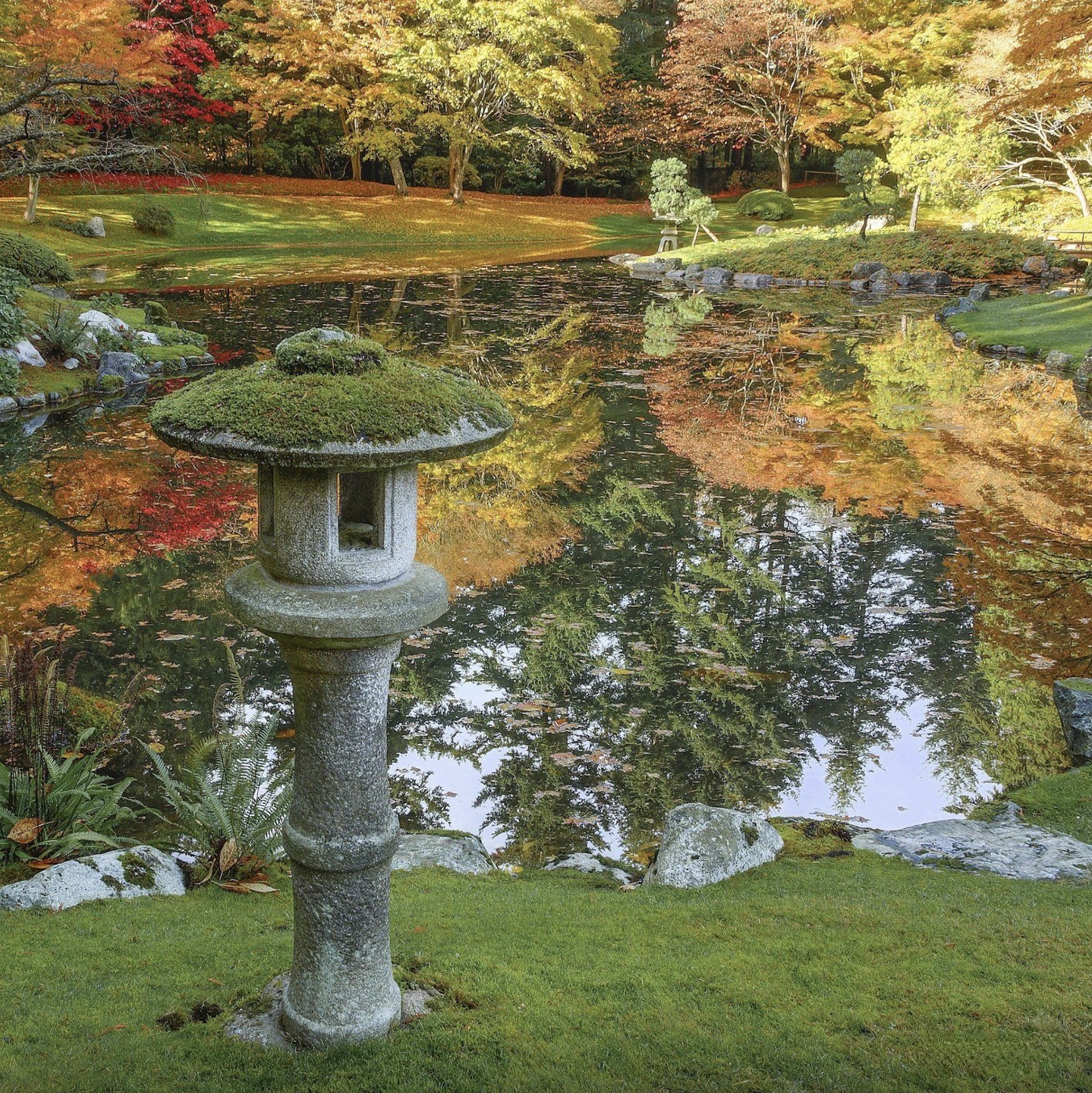
A carefully arranged sense of space therefore forms a prominent feature of traditional Japanese gardens, where plantings and structural objects both near and further away are placed deliberately. Except for the surrounding walls, there are no straight lines in a Japanese garden, and formal symmetry is strenuously avoided. Plantings and objects are more often placed singly or in three’s, given how two points often suggest a line and three suggest a circle. The spatial interrelationship between such things as large stones, trees, and water features is not accidental, and for the Japanese has a spiritual as well as visual significance.

In Japanese garden design, each particular feature, whether alive and growing or humanly made, has a distinct significance and is purposely chosen for its location. Perception of this is enhanced when a visitor becomes aware of how the elements of a garden’s composition are selected with an appreciation for seasonal viewing, such as at the annual cherry blossom time. Throughout the year plantings in the garden draw attention to themselves through an occasional heightened display of color, or by contributing to a muted harmony of differing tones and textures. On successive visits, a familiar place somehow can seem different.

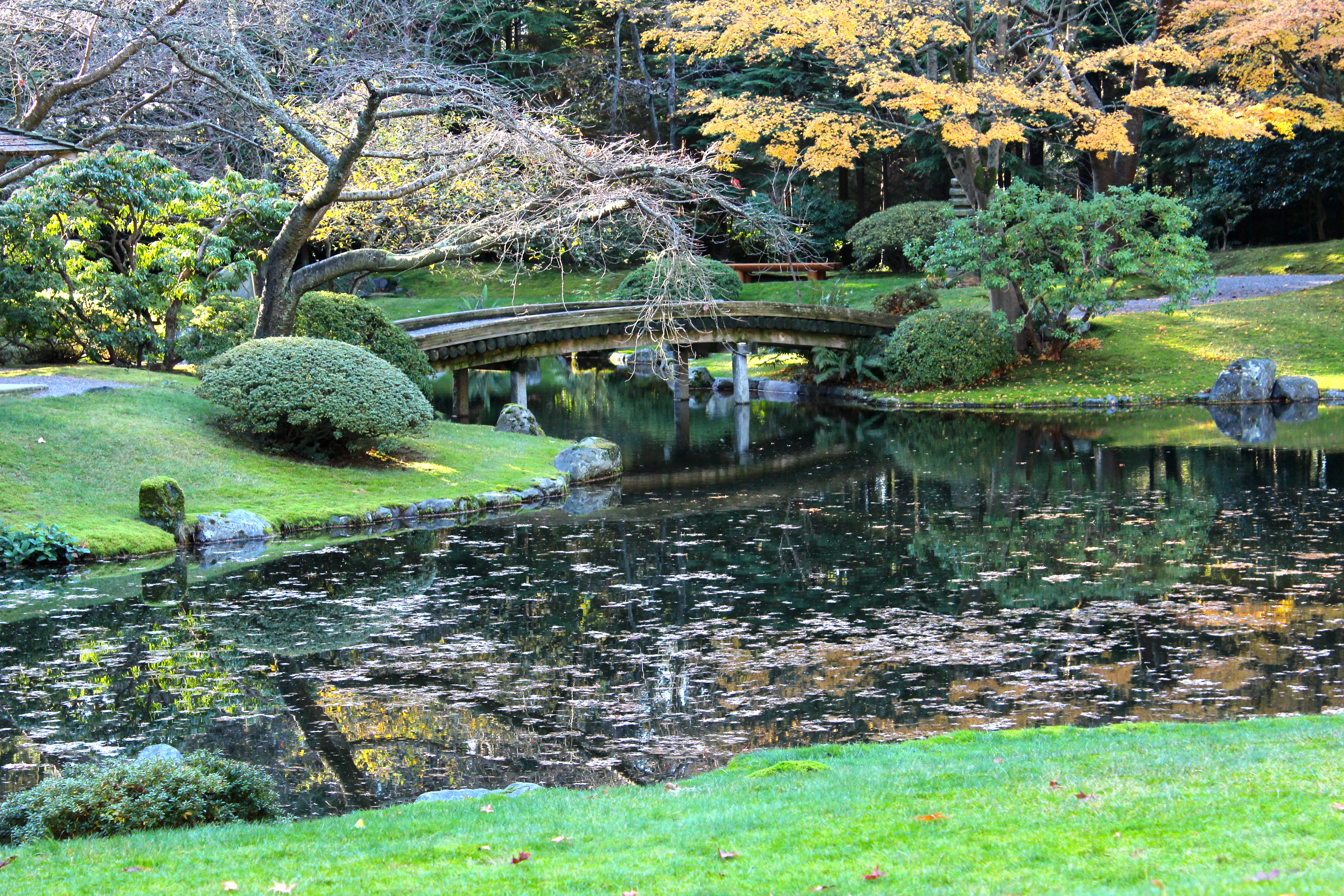
Plants, shrubs, and trees in Japanese gardens are cut and trimmed so as to appear manicured  just as European topiary is studiously tended, albeit with very different results. Whereas gardeners in the Southern U.S. might allow azaleas to grow unevenly to avoid looking like a hedge, ornamental shrubs such as holly and cedar, and the branches of evergreens, are painstakingly shaped by the Japanese-trained gardener, often into softly rounded forms. These provide contrast to the smooth sculptural shapes of tree trunks, while also standing out against the flat reflective surface of ponds.

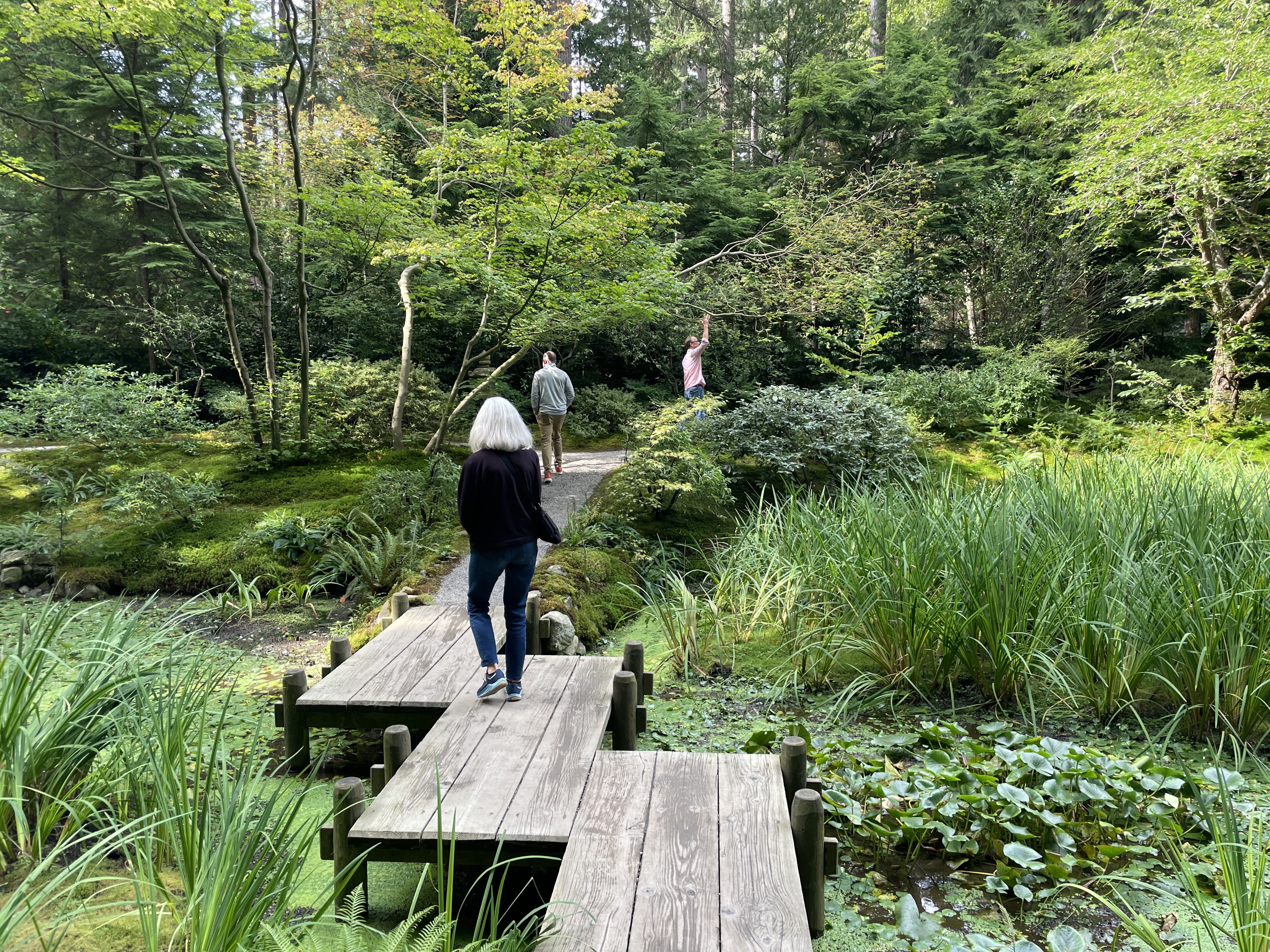
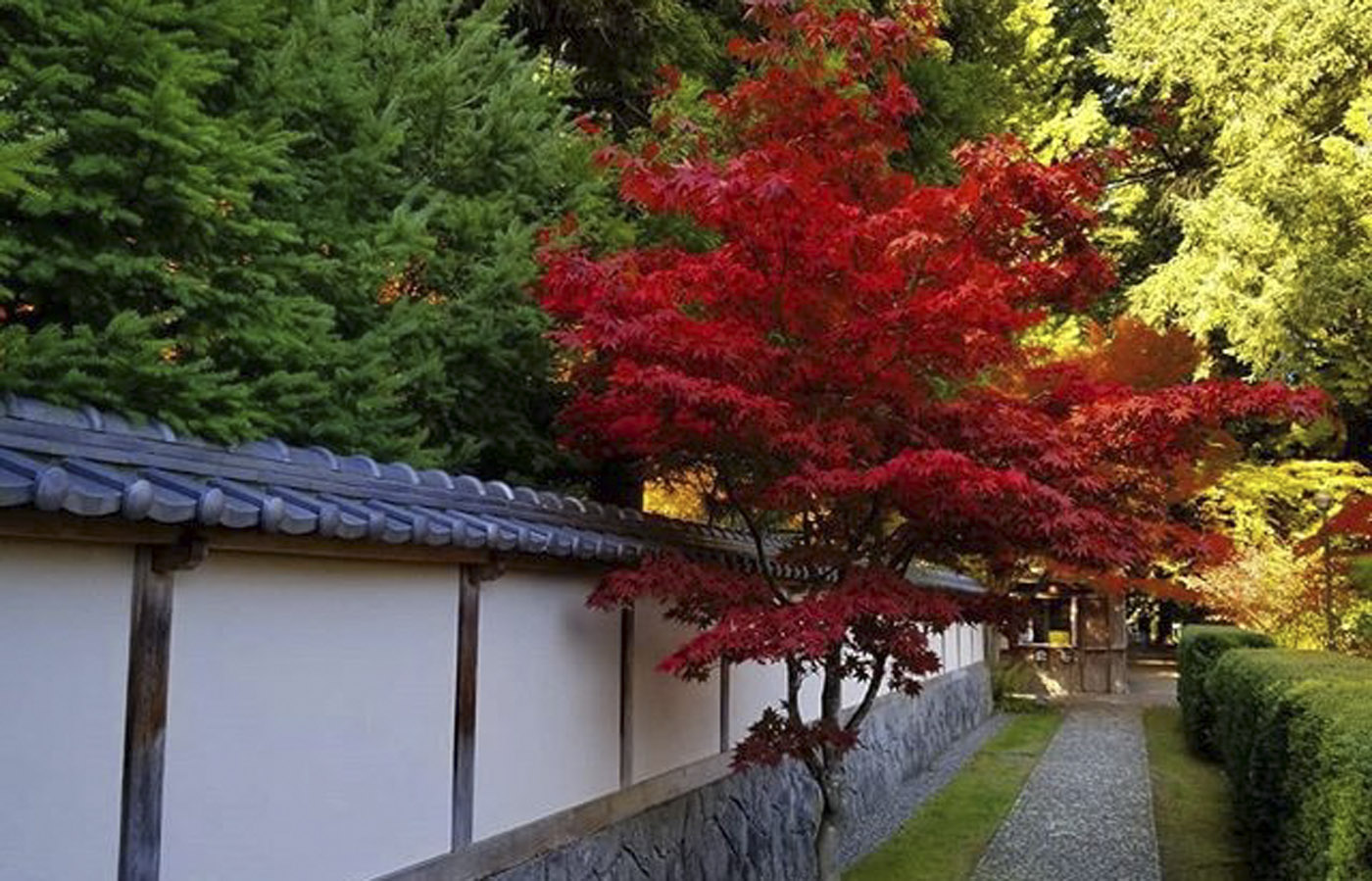
Traditional Japanese gardens usually contains a pathway, a design element not unique to such gardens, though its treatment in this context draws attention to itself. For the pathway through the garden can be just as important as what is viewed from it, so that the experience of the journey becomes in some sense its destination. Even in a relatively compact space, a consideration important in Japan, a pathway in a garden can make a small area seem much larger than it is, as the visitor is prompted to slow down and live into the present moment.

Padding along the soft pea gravel between areas of green covered by multiple textures from soft moss to tall bladed plant spikes, one gains glimpses and then temporarily loses sight of what lies ahead. Views include garden features such as a teahouse awaiting encounter, or a low-arching bridge from which Koi might be observed below the still water’s surface.

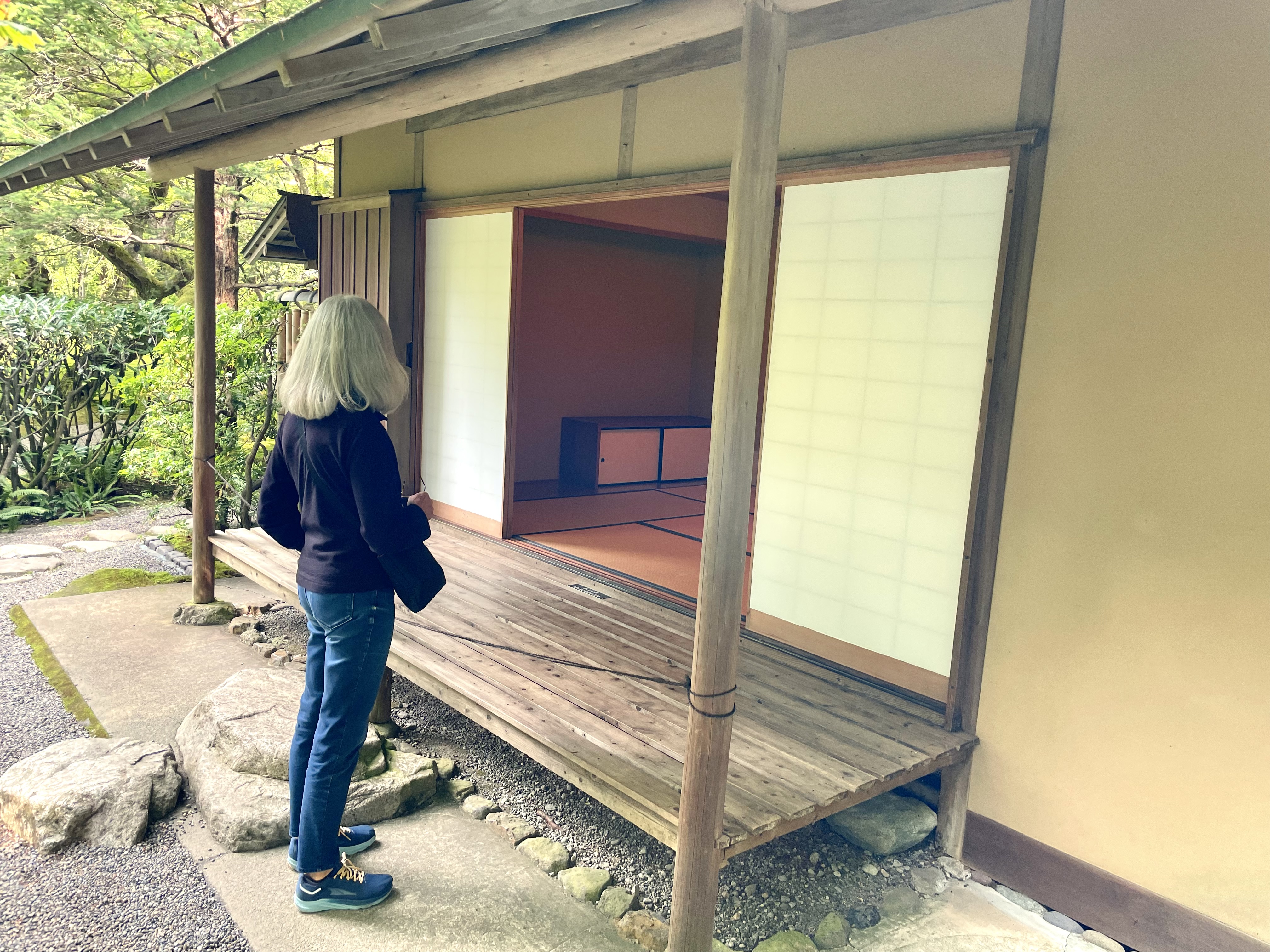
The UBC website says that “Nitobe Memorial Garden is considered one of the most authentic Japanese gardens outside of Japan.” A testament to this perception was provided by Emperor Akihito during a visit there. He said that, while in this garden, “I am in Japan.” Enhancing this sense of being in Japan is the presence of a traditional Japanese house in which opportunities to experience the ‘tea ceremony’ are seasonally available.


A Beautiful Garden: Nitobe Memorial (Part I)

[If reading this by email, please tap the title at the top to open your browser for the best experience. Then, clicking individual pictures will reveal higher resolution images.]


The Nitobe Memorial Garden on the grounds of the University of British Columbia (UBC) is readily recognizable as a traditional Japanese garden. Like other gardens of this type, it provides an experience of tranquility. Even in an urban area such as Vancouver, Nitobe Garden offers a quiet refuge from daily life concerns and tensions that visitors might carry with them.

An interpretive guide to “understanding Japanese Gardens,” found on the UBC Botanical Garden website, asserts the following:

… it is almost impossible to clearly state what defines a Japanese garden. Many Japanese resist classifying and categorizing the various features of Japanese gardens.

The website attributes this reluctance to the idea that beauty “not explained allows the viewer to remain in a state of wonder.” This worthy observation applies as much to modern abstract painting as it does to historic patterns of landscape arrangement. Yet, in this and in the next post, I will articulate characteristics that enable us to distinguish a traditional Japanese garden from, for example, a casual English cottage garden or a formal French garden.

The UBC website acknowledges how “most visitors can tell when they have entered a garden created and maintained in the Japanese tradition,” crediting this perception to people who “are sensing the Japanese spirit that informs these spaces.” This may be due to how various strands within Japan’s cultural history have coalesced to form a recognizable ‘style’ manifest in its gardens. Among the results of such a melding process, we can identify and describe several features in the Nitobe Garden that are common to other well-known Japanese gardens.

We can begin by observing how gardens and parks found in the East and in the West have a number of shared attributes. Among them, most gardens and parks around the world feature a scheme for the arrangement of their various parts even if it is not readily evident to visitors. Many such places appear to promote and preserve a ‘natural’ quality among the things growing in them, even in formal gardens. Some gardens and parks accentuate this natural element, perhaps in deliberate contrast to surrounding urban areas. This fosters an impression that the plants, shrubs, and trees have grown where they are of their own accord, and in their own way, regardless of any horticultural tending they have received. Especially in the West, ‘nature’ and that which is ‘natural’ are seen as what does not readily bear the imprint of human interaction, and as emerging more from its roots than from our planning.

Western gardens and parks may have gates, but often their entrance designs accentuate pubic access, providing a continuity of experience for visitors who may have potted plants or flowers where they live and work. In this sense, these garden and park entranceways draw people in from what is less into what is more. In the process, visitors are likely to encounter familiar though markedly larger and more extensively planted shrubs and trees, many of which do not appear to have been shaped or altered by human hands.

Formal gardens both East and West usually have marked boundaries and even barriers between what is within and that which is outside. Traditional Japanese gardens are typically surrounded by view-blocking walls topped by a ceramic tile parapet. These indicate a formal boundary between the transient outside world of energy-charged daily activity and the stillness available within, where visitors are subtly bidden to release their grasp upon time and their surroundings.

Imposing entrance gates mark a portal to a different realm lying beyond, as much as they appear to provide a barrier protecting what is within. Though these gates and the walls around a Japanese garden may serve to keep out intruders and foraging animals, they exist primarily for the sake of those who enter and take time there. For one does not visit a Japanese garden in the way one might go to a park, as a context to pursue some activity like an exercise walk, but as a place to experience simply being.

In the next post we will continue to explore what is identifiably distinctive about traditional Japanese gardens like the Nitobe Memorial.


Transfigured By Beauty

[If reading this by email, please tap the title at the top to open your browser for the best experience. Then, clicking individual pictures will reveal higher resolution images.]

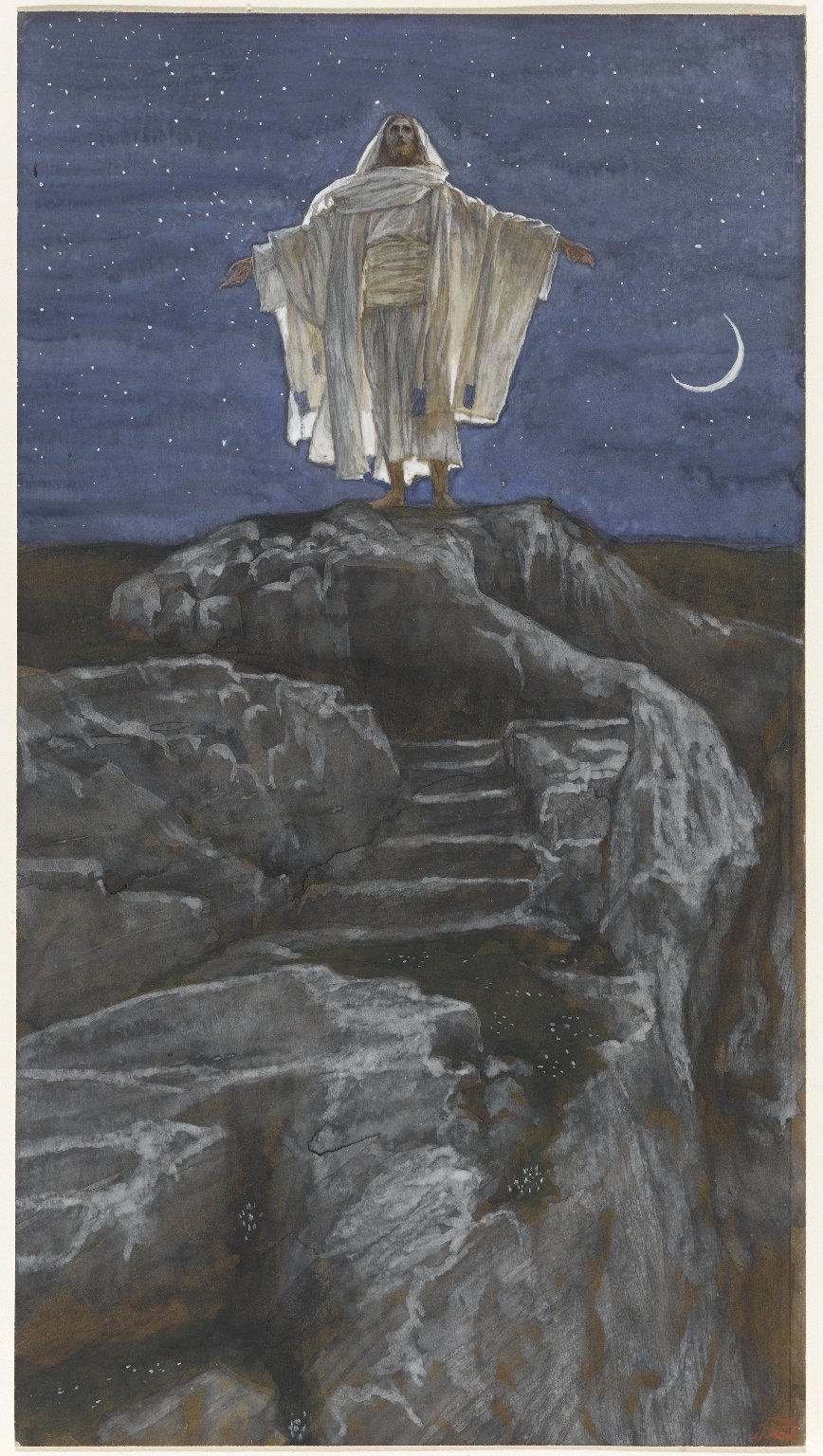
James Tissot, Jesus Goes Up Alone Onto A Mountain To Pray


In a painting whose title refers to one of Jesus’ common practices, James Tissot portrays him as caught up in prayer, an involvement he widely encouraged his followers to pursue. Regarding prayer, the Catechism in The Book of Common Prayer may surprise us. To the question, what is prayer, we find an answer which begins with these words: “Prayer is responding to God…” Jesus modeled a life wholly centered on responding to God, in heart and mind, in soul and body. On one occasion, he appeared transformed while at prayer. Over time, his followers discerned how God was fully present within him.

The story of his Transfiguration on a high mountain, reported in the first three Gospels and commemorated this past Sunday, provides a narrative demonstration of this truth. What Tissot depicts regarding Jesus when alone at prayer was later revealed semi-publicly on that mountain in the company of Peter, James, and John, as well as with the heavenly apparitions of Moses and Elijah. It was then fully revealed in Jesus’ Resurrection appearances.

Exodus 24 provides the background for this, and tells us something astonishing: “Moses and Aaron, Nadab and Abihu, and seventy of the elders of Israel went up {Mt. Sinai}, and they saw the God of Israel.” In Exodus 34, we learn that when Moses came down from the summit, “the skin of his face shone because he had been talking with God. When Aaron and all the Israelites saw Moses… they were afraid to come near him.” The text suggests that Moses then started putting a veil over his face for the sake of those who were unused to, or unprepared for, the glory and power of God’s immediate presence.

Paul, in 2 Corinthians, extends and also alters this idea of the veil. Instead of it being a means to protect people from a direct encounter with divine glory, the veil has become in Paul’s letter a kind of impediment. When our hearts and minds are not open to God, nor sensitive to God’s power, we become hardened. We become hardened in such a way that our hearts and minds are veiled, preventing us from perceiving God’s glory.

But Christ has set aside this veil. As a result, “all of us, with unveiled faces, {see} the glory of the Lord as though reflected in a mirror (2 Cor. 3:18).” And weare being transformed into the same image from one degree of glory to another, for this comes from the Lord, the Spirit.” Through prayer, we also are transformed.

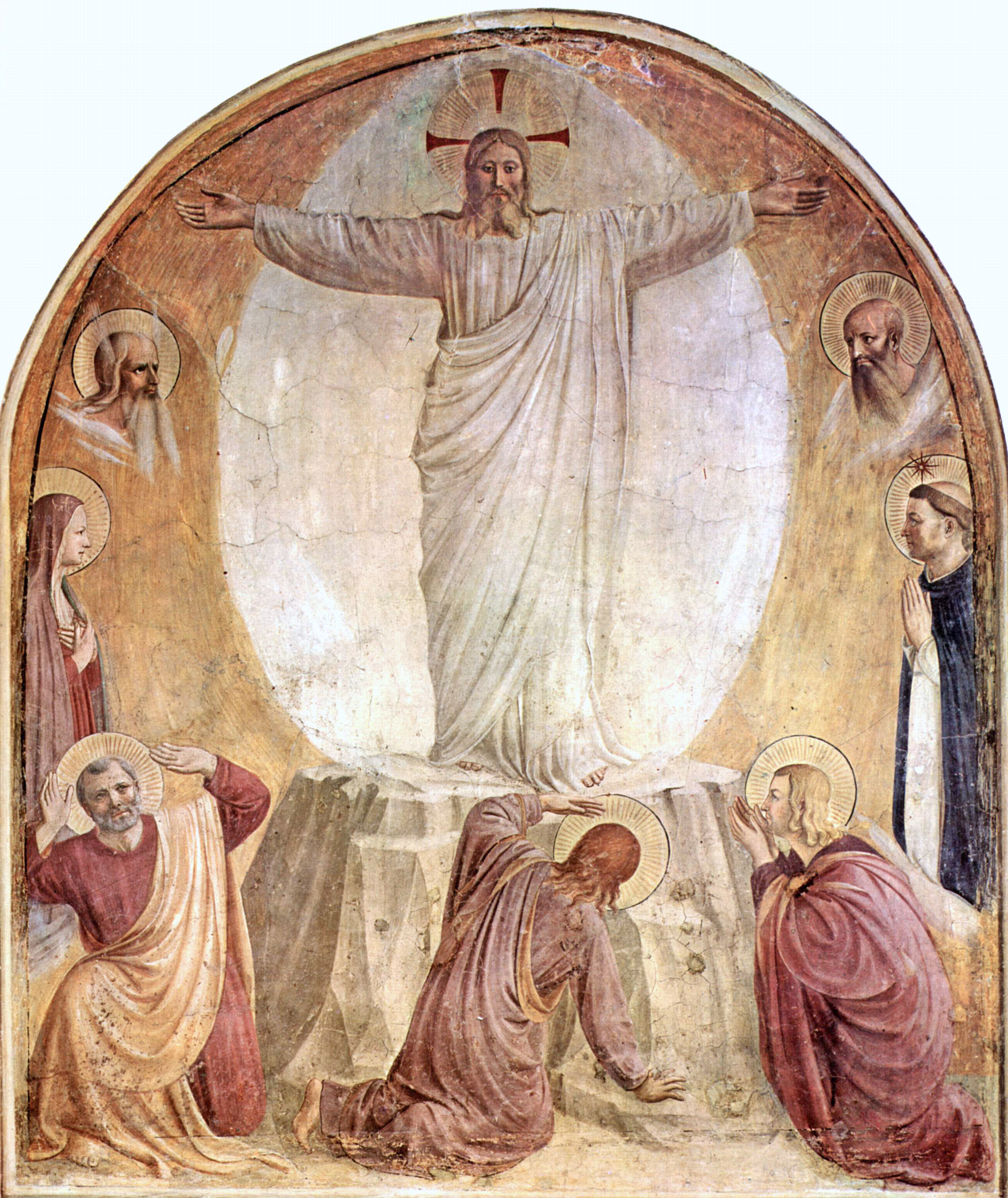
Fra Angelico, The Transfiguration (San Marco, Florence)

The Transfiguration of Jesus is all about the unveiling of God’s glory. Jesus takes Peter, John and James up with him on a mountain to pray. While he is praying, the appearance of his face changes, as does his clothing. In contrast with the Exodus and Pauline images of light shining on a surface, Luke presents God’s glory as coming from within Jesus. In other words, he radiates God’s glory rather than reflecting it. Luke tells us that Moses and Elijah, who appear with him, appear in his glory. This may mean that Jesus has shared his glory with them in a way that prefigures what he will share with all of his followers after his Resurrection.

This should lead us to ask a good question: If we feel like there is a veil between us and the divine presence, where does this veil lie? Does God ‘hide’ behind a veil, either to protect us, or challenge us? Or is the veil within ourselves, formed by our spiritual blindness and our lack of openness to how the Holy Spirit imparts glory? Paul suggests that our experience may be like that of the earlier Israelites, for whom hard-heartedness caused them to be blind to the bright light of God’s glorious presence, whether in Moses’ face or when reading and hearing the Law. Hard-heartedness can be equally blinding for us, veiling the glory that is all around us.

And where, according to Paul, do we find this glory? We find it in the faces of everyone who has been open to God’s transforming Spirit. In other words, we can find it in each other, as well as in ourselves. For this reason it can be like looking into a mirror, as the glory that we will perceive in others is the same glory that they can perceive within us.

And He Sent Out the Twelve

[If reading this by email, please tap the title at the top to open your browser for the best experience.]

James Tissot, The Ordaining of the Twelve Disciples


As Matthew tells the story, those who are called to follow Jesus are then sent out. Before they go, they are not only commissioned to represent him and his message; he shares with them portion of his remarkable power. According to Matthew, “… Jesus summoned his twelve disciples and gave them authority over unclean spirits, to cast them out, and to cure every disease and every sickness.” They have witnessed his teaching in what we know of as the Sermon on the Mount, which in the first Gospel runs over several chapters. Yet this moment is relatively early in the Gospel narrative, and it should surprise us that Jesus is so willing to let them go out on his behalf, and apart from him.

It is sometimes observed that with certain vocations one never really ‘retires” even if one ceases to be engaged in remunerated employment. This bears witness to the fact that through the calling that underlies all other callings, our baptismal vocation never has a terminus though it may come to greater fulfillment in life. Yet as we go through successive stages in our lives, we may be more open to being ‘sent out’ when we are younger even if we continue to be open to being ‘called’ – and, indeed, called anew – through our later years. My parents were relatively young when they were sent out as missionaries to Japan, living into a pattern that we can recognize in many spheres of our human communities such as in the Peace Corps and in Teach for America. Having myself been more recently retired, I find that I am now less inclined toward the opportunity of being sent out in and for the mission of the Kingdom though I still experience being called.

For reasons like these I tend to think that the twelve whom Jesus first called to be his disciples were  more likely to have been young rather than middle-aged. In that they may have had a greater openness to discipleship formation; they may have had a greater degree of idealism and more energy for a new kind of work; and they may simply have had the prospect of more years ahead with which to share with others what they would perceive and learn about God’s mission in and to his Creation.

It is a subtle point, but this may be why Tissot – following Matthew – portrays what is titled The Ordaining of the Twelve Disciples separately from a depiction of their initial experiences of being called. For this moment in their lives and in their time with him became the occasion of their formal participation in Jesus’ mission, even when they were not in proximity to him and his work. Jesus, as Matthew tells us,  had already gone “about all the cities and villages, teaching in their synagogues and proclaiming the good news of the kingdom, and curing every disease and every sickness.” And having commissioned the twelve, and given them his own authority, Jesus sent them “out with the following instructions: ‘… go to the lost sheep of the house of Israel. As you go, proclaim the good news, The Kingdom of heaven has come near. Cure the sick, raise the dead, cleanse the lepers, cast out demons’.”

When doing this, Jesus not only equips them for the mission upon which they are sent. He also forewarns them of the adversity they are likely to face, adversity which might involve betrayal, trials and flogging, being hated, and even being put to death. This is yet another reason why I tend to think of the disciples, at this point in their lives, as generally younger than older, just as we saw with Caravaggio’s likely portray of Matthew’s calling, last week.

As we get older, some but not all of us may be less open to being sent out, and less inclined to seek such an opportunity. But we should never cease to be open to ‘the call,’ and the varying ways it may be ever-renewed in our lives.


This posting is offered in relation to the readings appointed for Proper 6, Year A, in the Revised Common Lectionary for Sunday, June 18, 2023.

The Call of Matthew

[If reading this by email, please tap the title at the top to open your browser for the best experience.]

Caravaggio, The Call of St. Matthew (1619-1620)


Artists who portray biblical figures and events – particularly those who approach their work in a self-consciously Christian way – often feel free to explore the dynamics of Gospel scenes in a personal and imaginative manner. Some Gospel stories lend themselves to such an explorative approach. Other stories seem to prompt a portrayal of biblical persons and their circumstances in a more literal, text-dependent way.

The call of the tax collector in Matthew 9 provides a good basis for both, especially at the hands of the great early 17th century Italian painter, Caravaggio. Above, we see his painting of The Call of St Matthew, based on what may be a brief narrative self-portrait provided by the Gospel writer about his decision to respond to Jesus’ summons to follow him. Here, Caravaggio displays a fidelity to the biblical story even though the artist depicts the event with figures clothed in garments characteristic of his own time and place.

Several aspects of the painting should attract our attention. For they have the power to draw us into the scene and its place in the broader sweep of what some have called ‘the great story.’ The figure on the right side of the picture is obviously that of Jesus, who with bare feet has entered the place where the tax collector Matthew may be both entertaining himself as well as conducting his business. The room where the group of men are sitting is darkened, a detail that is surely symbolic given how light enters the room from the direction of Christ’s arrival. As Matthew’s Gospel quotes Isaiah (in chapter 5), “the people who sat in darkness have seen a great light, and for those who sat in the region and shadows of death light has dawned.”

Notice also Caravaggio’s sensitive rendering of Jesus’ outstretched hand. It is highly reminiscent of Michelangelo’s nearby Sistine Chapel ceiling panel depicting God’s act of creation and gift of life to Adam through a similarly depicted outstretched arm.

But which of the sitting men portrays Matthew? The answer is by no means obvious, and may be intentionally ambiguous. A ready candidate is the gentleman facing us, seated in the middle of the group, who appears to point to himself. By his gesture, he seems to ask in response to Christ’s summons, “Do you mean me?” His pointing hand, a visual echo of the pointing hand of Jesus, and the look on his face call attention to himself. Further, this bearded man bears a resemblance to the older-looking Matthew depicted in Caravaggio’s, The Inspiration of St Matthew (shown below).

Yet, another possible candidate for an identification with Matthew in this picture is the young man portrayed on the left side of the painting, whose head is bowed over and who is focused on some coins before him. In support of this identification is the presence of two other young men sitting at the opposite end of the table, whose gaze is fixed upon the unexpected visitor. By contrast with all three, Caravaggio may instead have intended to portray the mature Matthew in his accompanying The Inspiration of St Matthew painting, as well as in his The Martyrdom of St Matthew, both of which are located in the same church in Rome as The Call painting. For in the ‘call’ image, a young man is invited to leave his dubious present occupation and circumstances in order to follow Jesus, which seems most fitting. This invitation leads to a subsequent application of the maturing man’s talents in support of God’s mission, centered on the One whom he would come to recognize as the Messiah. As Caravaggio may have depicted in this scene, the potential consequences of accepting Jesus’ summons may just be dawning upon the young man.

Caravaggio’s paintings display a remarkable skill in rendering people and places in a most realistic way. His paintings are also highly regarded in recognition of his flair for dramatic pictorial compositions that feature a strong contrast between light and dark. He might have applied these skills primarily in the pursuit of fame and material wealth. Such intentions are likely to have numbered among his goals. Yet, Caravaggio’s work exhibits an undeniable spiritual sensitivity. This makes it most appropriate that we can view and appreciate his three St Matthew paintings together in a church in Rome rather than in a museum.

The Beauty of Trinitarian Life

[If reading this by email, please tap the title at the top to open your browser for the best experience.]

Brother Robert Lentz, Holy Trinity


Here is a Robert Lentz icon-styled painting that blends an historic approach to portraying the Holy Trinity with an inclusion of modern astronomical imagery. The facial depiction of the first two members of the Holy Trinity are presented in a very traditional way, while the images of the galaxies very obviously depend upon telescopic photography.

The most significant truth expressed within this composition by Lentz is that all three members of the Holy Trinity were and are involved in Creation, both in terms of the primal event, as well as in an ongoing divine presence within the whole of the cosmos, a theme found in John’s Gospel as well as in Paul’s letter to the Colossians among other biblical texts.

If there is any drawback to Lentz’s composition it is one shared with just about every Trinity-themed painting of which I am aware. To put it plainly, Lentz depicts the members of the Holy Trinity as ‘them,’ as objects of our subjectivity, as divine persons we contemplate, hold in regard, and with whom we contemplate or entertain relational involvement.

What this approach lacks, perhaps of necessity in a two dimensional medium, is an expression of the equally important and sometimes non-experiential truth that we are also the objects of the divine subjectivity, and how – after Baptism – we are inseparable from involvement with and in the Trinitarian life of God.

The simplest way to help make this evident can be found in all six of the Eucharistic Prayers in The Book of Common Prayer, as well as in many of the Collects. We pray to the Father, through the Son, in the Holy Spirit. And so, whether we are conscious of it or not, we are to live as we pray, to the Father, through the Son, in the Holy Spirit.

We should no longer try to depict the Holy Trinity through two dimensional imagery, much less with diagrams, or with objects like a three-leaf clover. For in each of these cases, we render the grace-filled context of our new and relational, post-Baptismal, life as if the grounding source for our being, and our life in Christ, was somehow external to us, and something which we might still have a need to approach.

Yet, through Christ and in the Holy Spirit, the Father is now in us, and we are in him. He is closer to us than we are to ourselves. This is the great mystery, the paradox, and the beauty of Trinitarian life in Christ after Baptism.

The Mystery of Pentecost

[If reading this by email, please tap the title at the top to open your browser for the best experience.]

Giotto, Pentecost (Scrovegni (or Arena) Chapel, Padua)


Once again we turn to Giotto, who helps put a ‘human face’ on a supernaturally-charged event. As we observed with his fresco depicting the Ascension of Jesus, Giotto’s Pentecost painting evidences the influence of medieval and Eastern Orthodox iconography (e.g., the gold-leaf halos). Yet, his work distinctively moved away from a primary absorption with portraying aspects of the eternal so as to display an appreciation for daily human life and activity. One mark of this is his employment of architectural perspective in his composition of the scene. In addition, each of the faces in this Scrovegni Chapel fresco are recognizably distinct from one another, with some of them reflecting a genuine regard for individual personality and temperament.

Here we can also notice Giotto’s attention to the biblical text. This scene portraying the gift of the Holy Spirit follow’s Luke rather than John. In John’s Gospel, on the evening of the day of the discovery of his Resurrection – the Risen Jesus enters the private room where the disciples are hiding fearfully behind a locked door. He breathes on them his Holy Spirit and implies that his Ascension has already occurred.

Luke, as Giotto faithfully portrays, describes the disciples being gathered together 50 days after the Resurrection on the Jewish feast of Pentecost. As Luke reports in the last two verses of his Gospel, after witnessing Jesus’ Ascension the disciples “worshiped him and returned to Jerusalem with great joy, and were continually in the temple blessing God.” Luke then commences his second book, Acts, with a parallel account of Jesus’ Ascension, and the selection process of Matthias as a replacement for the traitor, Judas. Having returned joyfully to Jerusalem, the disciples have been visiting the Temple daily, where they blessed and worshipped God in a public setting.

Luke’s Pentecost assembly differs markedly from John’s account of the fearful disciples on the afternoon of the first day of the new week, forty nine days before. For on Pentecost, into their midst and visibly upon their heads, came the Holy Spirit filling each of them with its power and presence.

Many visitors to Jerusalem for the great feast became aware of what had occurred, and were perplexed, marveling at the unexpected spectacle of how each of them heard the men from the north country speak in their own separate and distinct languages. The legacy of the tower of Babel had been overcome.

Peter quickly helped account for what was happening in light of Scriptures familiar to those gathered, which were fulfilled in and through Jesus’ death and resurrection. God was now doing a new thing, yet something promised long before.

How contrary to the spirit of Jesus’ ‘high priestly prayer, in John 17, and to the witness to the power and presence of the Holy Spirit at Pentecost, is our frequent experience of the Church throughout the world in our present day. Despite moving words centered on unity and a commonality of mission that we hear and recite in the baptismal rite, we are more often confronted with evidence of difference and division among Christians of varying denominations and cultural backgrounds. Perhaps it is because we let our own concepts of our mission and ministries take precedence over our awareness of and belief in the primacy of Christ’s continuing mission and ministry.

And so, we forget to marvel at what came about through the embodied presence of God. A divinely appointed and inspired country rabbi, who had recruited 12 unlikely followers, met persecution and a tragic death at the hands of a corrupt earthly empire. Yet, in the power of the Holy Spirit, over the course of a few centuries he transformed a sizable portion of the known world into the New Israel, his beloved community and family.


The Beauty of the Ascension

[If reading this by email, please tap the title at the top to open your browser for the best experience.]

Giotto, The Ascension of Jesus


The way that we envision the Ascension of Jesus is largely shaped by Luke’s Gospel, as well as by his book of Acts. As the Church’s liturgy observes and celebrates Luke’s presentation of this event, it occurs on the fortieth day after Easter Sunday, which always falls on a Thursday. With diminished weekday worship attendance in most churches, the feast of the Ascension is often observed on the following Sunday, on the Seventh Sunday of Easter. As Luke’s Gospel records the event,

[Jesus] led [the disciples] out as far as Bethany, and lifting up his hands he blessed them. While he blessed them, he parted from them and was carried up into heaven. And they worshiped him and returned to Jerusalem with great joy, and were continually in the temple blessing God.

In Acts, Luke presents a fuller account of

… the day when he was taken up…, [when] he presented himself alive to them… [H]e said to them, “… you will receive power when the Holy Spirit has come upon you, and you will be my witnesses in Jerusalem and in all Judea and Samaria, and to the end of the earth.” And when he had said these things, as they were looking on, he was lifted up, and a cloud took him out of their sight. And while they were gazing into heaven as he went, behold, two men stood by them in white robes, and said, “Men of Galilee, why do you stand looking into heaven? This Jesus, who was taken up from you into heaven, will come in the same way as you saw him go into heaven.”

Giotto beautifully portrays Jesus’ Ascension in a fresco found within the Scrovegni Chapel (also known as the Arena Chapel) in Padua, Italy. Giotto’s approach to painting proved pivotal in the transition within Western art from dependence upon Eastern Christian iconographic imagery toward a greater realism and sensitivity to ‘ordinary’ human life in this world. Unlike medieval and eastern Christian icons, which tend to be absorbed with expressing dimensions of the eternal, Giotto portrays a real event in the temporal lives of real people. Nevertheless, Giotto’s Ascension is clearly also attentive and faithful to the supernatural elements of the Luke-Acts descriptions of Jesus’ Ascension.

It has been observed that in these modern times, among the most neglected aspects of traditional Christian doctrine is a proper understanding of Jesus’ Ascension. This may be due to a contemporary proclivity to read the New Testament as if its significance is primarily ethical, while shying away from engagement with the metaphysical and the miraculous elements of the Gospel narratives.

A collect from The Book of Common Prayer helps us appreciate why the Ascension of Jesus continues to be a major feast of Our Lord on the Church’s calendar:

Almighty God, whose blessed Son our Savior Jesus Christ ascended far above all heavens that he might fill all things: Mercifully give us faith to perceive that, according to his promise, he abides with his Church on earth, even to the end of the ages; through Jesus Christ our Lord, who lives and reigns with you and the Holy Spirit, one God, in glory everlasting. (BCP:226)

Jesus ascended not so that he might withdraw from the world, making room as it were for the mission of the Holy Spirit. Instead, his Ascension marked his transition from being present at one time and in one place, to becoming present in all places all the time. Before his death, there were countless places where he was not. After his Ascension, there is no place where he is not. From being with only some of those who lived during his earthly years, he is with all of us now. And from having a particular presence and context for his ministry, Jesus in his Ascension transitioned to a universal presence for his continuing mission, so “that he might fill all things.”

Alleluia. Christ is Risen and Ascended! And in the Holy Spirit he is present everywhere and to all who might welcome him into our lives.