Graphic Design

The Challenge Posed by Eric Gill

If reading this by email, please tap the title at the top to open your browser for the best experience. Then, clicking individual pictures will reveal higher resolution images.

Eric Gill, Christ Crowned


To my mind, some of the most beautiful work in the area of graphic art was created by the British artist and craftsman, Eric Gill. The intractable problem posed by Eric Gill is not a legacy of his artistic output, but of his personal life. Largely unknown to those outside his family until about 50 years after his death, Eric Gill – by admission in his own unpublished writings – had engaged in personal behavior of a kind that most people would find not only abhorrent but, increasingly, as also criminal.

This is related to the larger problem posed by the work of artists, musicians, and architects whose work is seen as having been collaborative with tyrannical regimes (eg., the Third Reich, the Soviet Union). How do we view beauty in art that either depicts or is simply associated in some way with sin or with evil? (This is a matter I have previously tried to understand in relation to Picasso’s great painting, Guernica.)

To cite Scripture to the effect that “all have sinned,” may help us begin to locate the terrain upon which we need to address the problems stemming from Eric Gill’s biography, but it is not in any way to excuse his conduct. Though all sin is bad, and equally problematic in the eyes of God, not all sin is equal in its damaging effect upon others, and upon ourselves. The traditional distinction in moral theology between mortal and venial sins provides one way to try to parse some of these differences, while not excusing any forms or examples of sin, whether in ourselves or among others.

My purpose here is to invite reflection upon how we might appreciate Eric Gill’s religious art, as many did for several generations, without having our view of the merit of his work diminished by our moral evaluation of troubling ethical choices he made, and the lapses from good moral judgment they represent. In other words, and as an amateur student of the arts while also being a retired parish priest and former professor of moral theology, I wish to present some examples of Eric Gill’s art, letting his work speak for itself apart from ethical consideration of his personal life, and without ignoring the problems associated with the latter.

Perhaps my theme here can be summed up in this way: I invite you to benefit from the beauty of what Eric Gill created without asking you to overlook what we have learned about his private life. And I offer this invitation aware that some will not find it possible to accept.
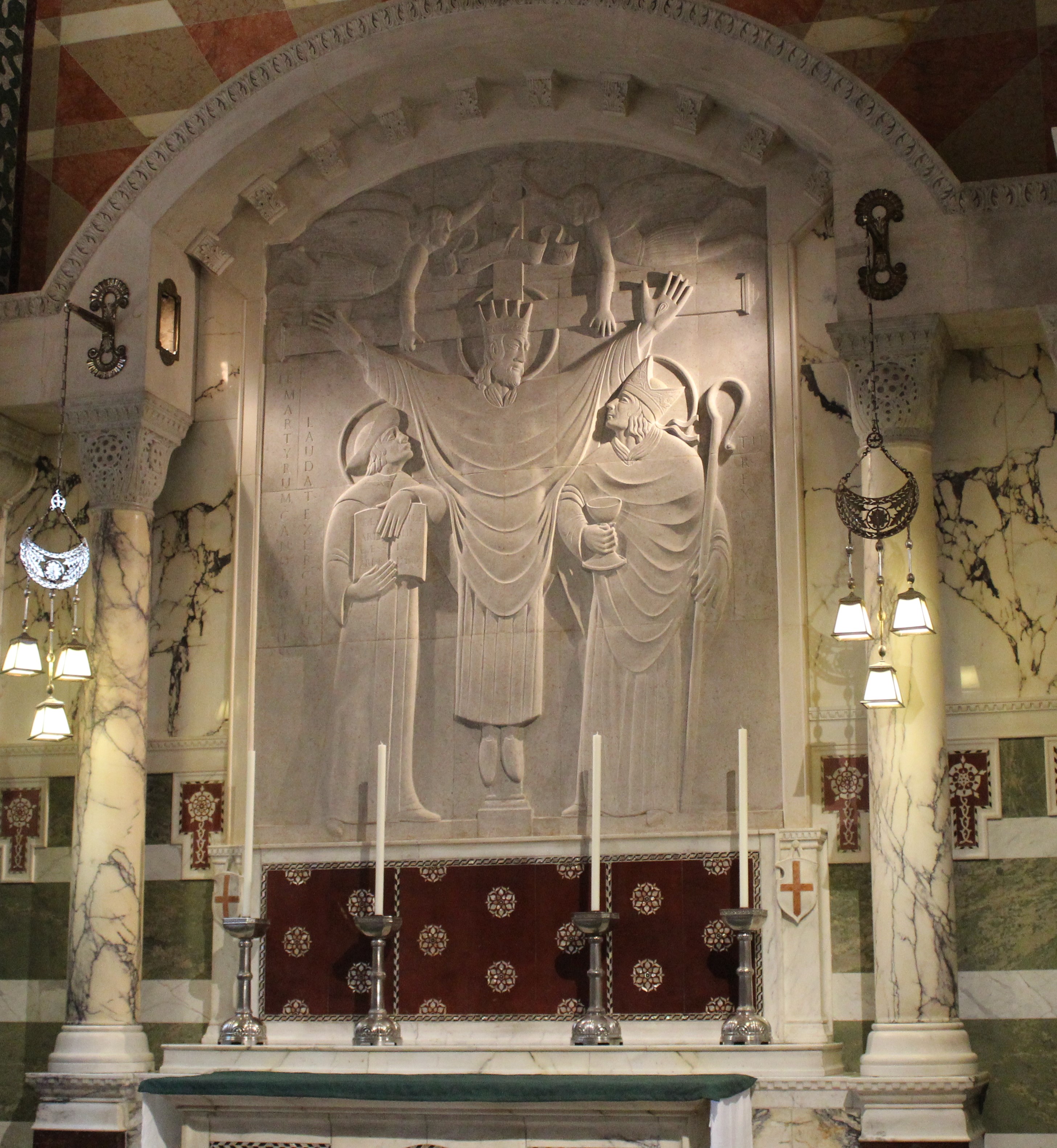
A sculpted carving by Eric Gill above the altar of the Chapel of St George and the English Martyrs, Westminster Cathedral, London
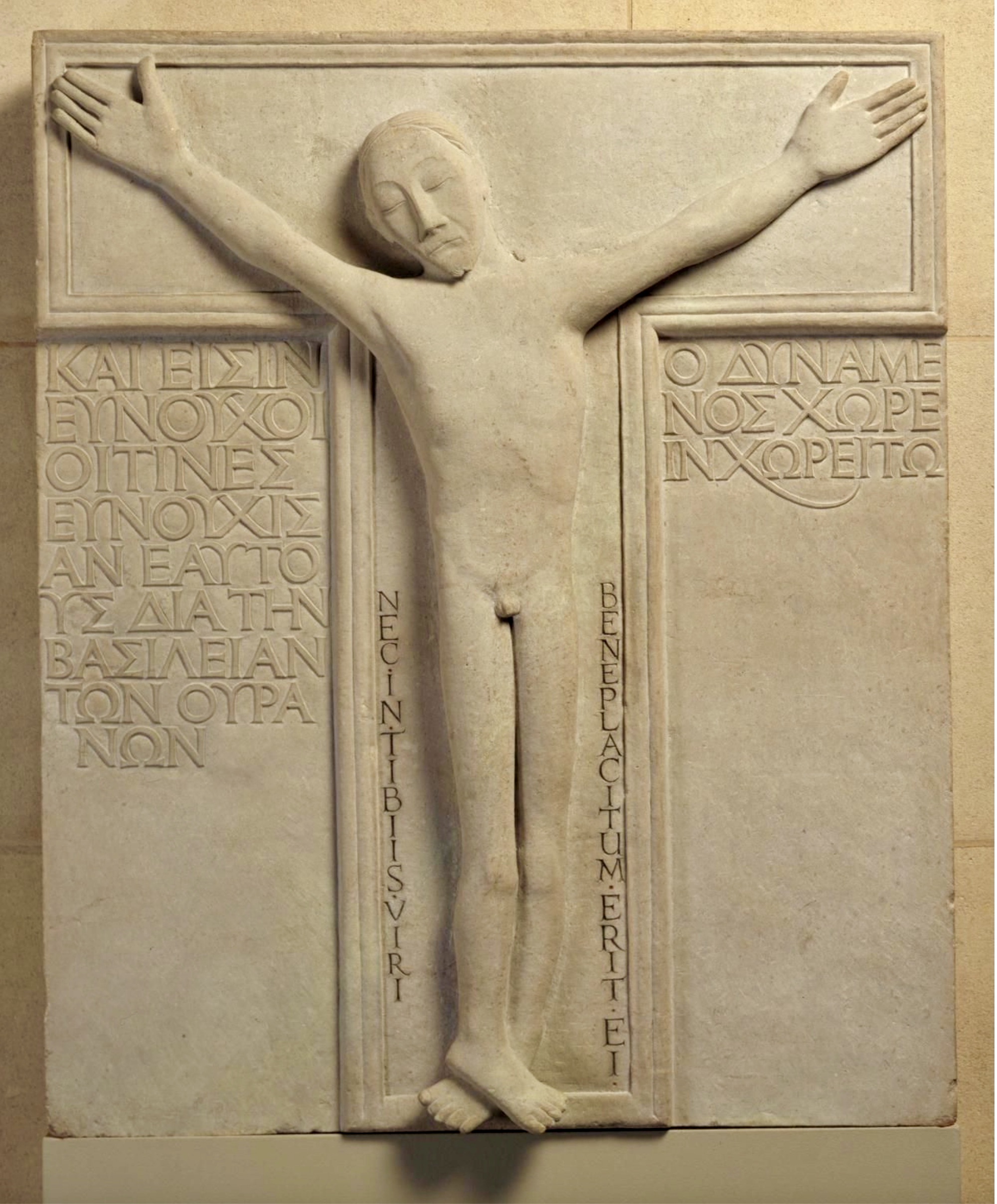
Eric Gill, Crucifixion
Eric Gill, sculpted relief panel from a series of the Stations of the Cross, Westminster Cathedral, London

As we consider some of his art, we should not overlook Eric Gill’s impact, at least indirectly, upon much of the daily life of the population of Great Britain (and elsewhere), in the form of three type faces he created. The most well-known is Gill Sans, named after its designer, and evident at almost every Tube stop in London. An effort to erase his work from the public eye, and replace it with alternatives, would require removing virtually every train station sign in Britain. It could be done. Should it?

Three fonts designed by Eric Gill

To put the problem I have raised here most bluntly, how can we appreciate the beauty in the holy art created by someone who behaved in a way most people would describe as sinful? I do not have a ready answer to this question. Note that, in what I have written above about Gill’s behavior, I have not gone into detail. Would that make a difference? If so, in what way?

And even if we refuse to give any amount of attention to Eric Gill’s artwork, we must still grapple with a timeless question: are there any unforgivable sins? Is anyone, because of his or her behavior, beyond the power of God’s redeeming love? Is it not likely that someone having Gill’s religious inclination also possesses a glimmer of moral awareness such that he or she might be open to repentance when – at the end of life – the person faces the awesome and undiminished light of God’s truth-seeking love?

Here is one thing that we can do: pray for the repose of the soul of Eric Gill, and for God’s Providential mercy.

In beginning to approach the questions I have raised here, I would start with some of the distinctions I shared above. I do not think we can deny this reality – that we, as people who are created in the image and likeness of God, and who have lost that likeness through the Fall and human sin, still bear God’s image however marred it may be by the corruption resulting from our sins. And, that we are still capable while in this life of acts and works of uplifting beauty.

The Beauty of the Song of Solomon, or the Song of Songs


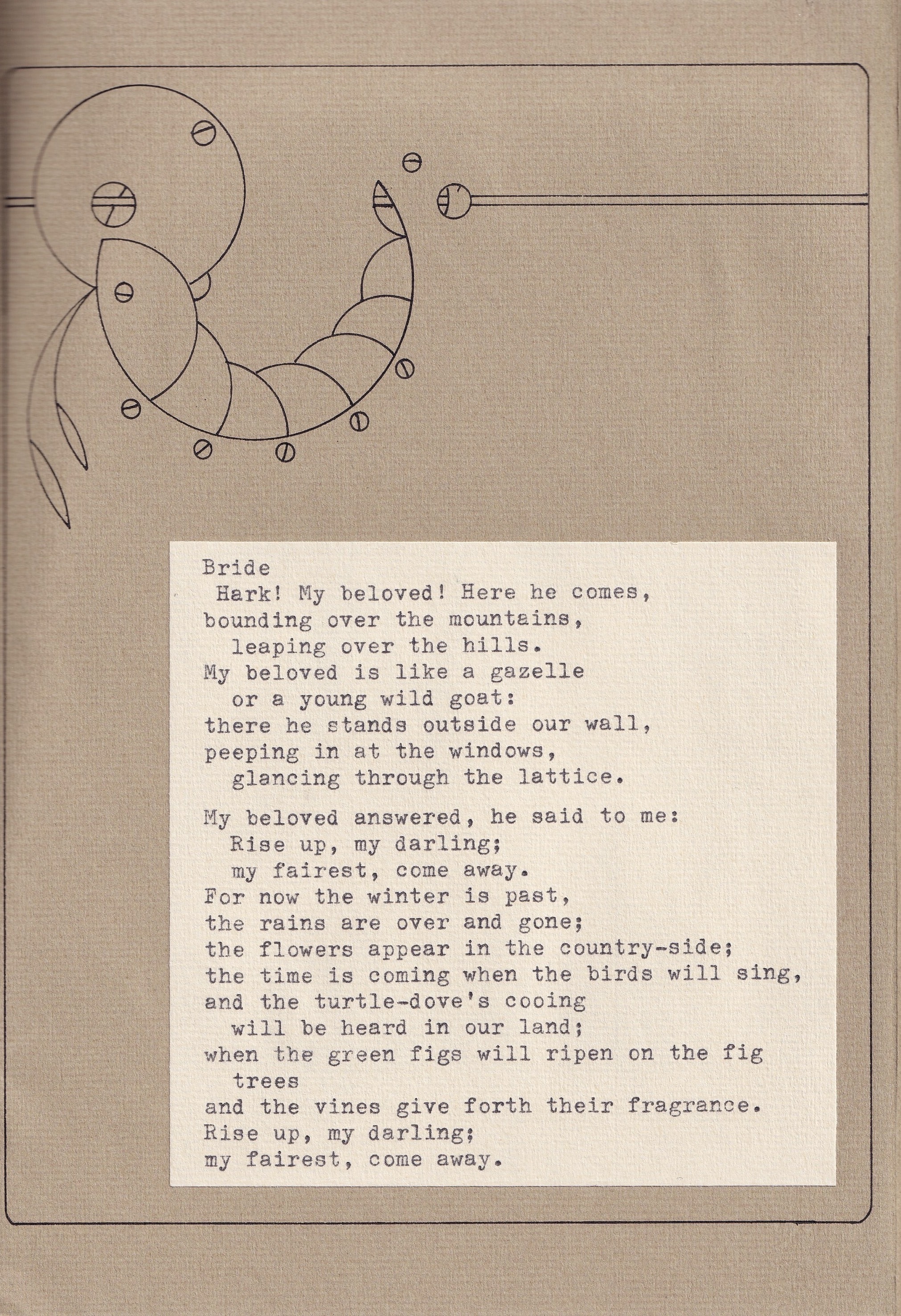
Here, I offer something most personal. Below are some pages from a project I prepared for and then sent to my beloved, in the autumn of 1977 (© Stephen Holmgren 2023), about 45 years ago. She was someone who I very much hoped might in the future be my betrothed. She was and is, Martha, to whom I sent this booklet in the autumn of 1977. Designed and composed in a pension in Florence, Italy, assisted by access to a manual typewriter at St James, the local Episcopal / Anglican parish in Florence, I prepared this multipage document, and sent it to Martha who was pursuing a study year in Taipei. Amazingly, it got there through international mail, and equally amazing is the fact that we still have the physical original of the little  booklet today. (God is good / all the time)

Of course, like all proponents of eternal love and affection, I have fallen short of living into the ideal. But, I still believe in it! Those of us who have entered into this particular covenant can admit this. Why? Because in the covenantal reality of Judaism, and then within Christianity, what we do, and perhaps more importantly what we have failed to do, is not the real issue. The real thing is the the One who grasps us, holds us, and saves us, always. And, the One who holds us together.

More Early Graphic Design

[If reading this by email, please tap the title at the top to open your browser for the best experience.]

An ink and water color design for the cover of a small pamphlet


Above, an additional cover design for a small pamphlet

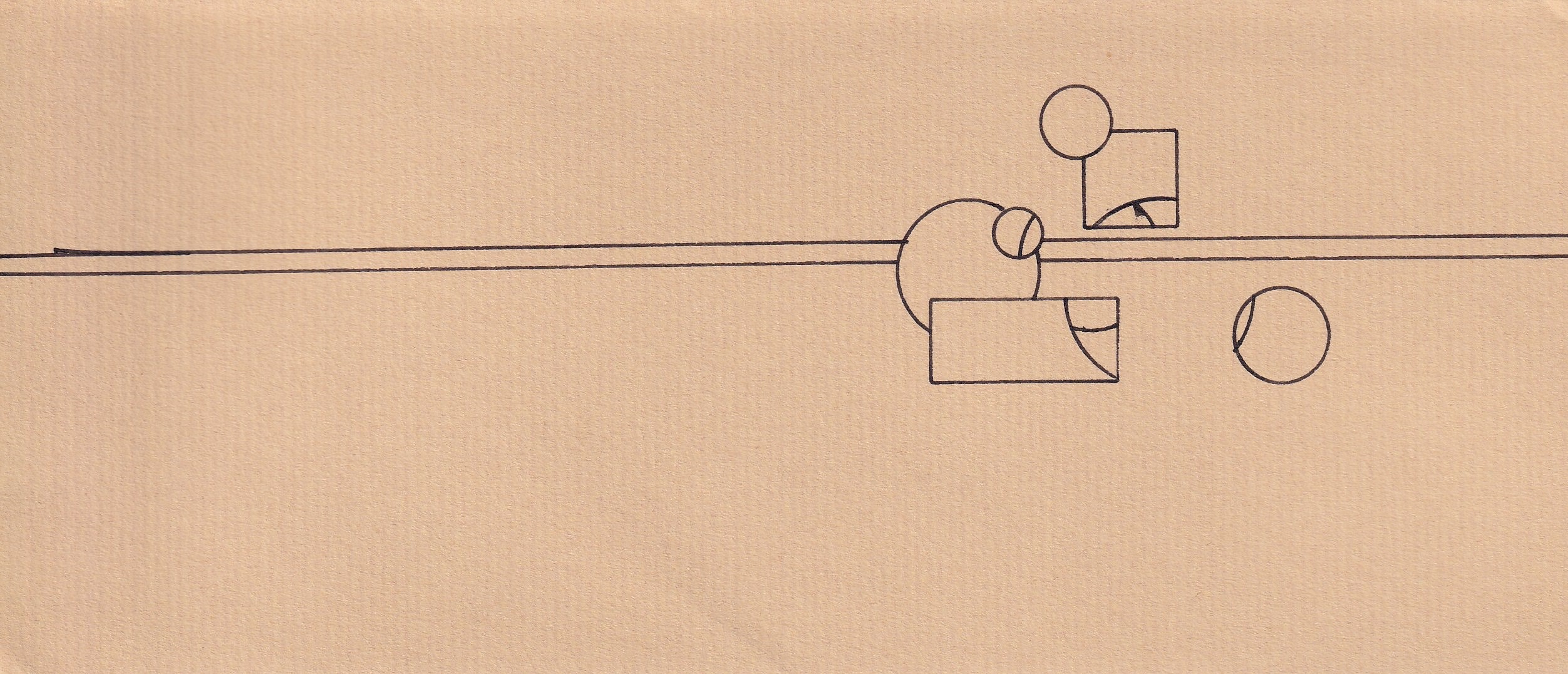
Below, I share the top third of a number of designs for tri-folded office or home stationary, suitable for insertion in a business size envelope. When the whole page is unfolded, a blank area occupies the lower two thirds of the page, allowing space for either typing or hand writing.

Obviously, Frank Lloyd Wright has loomed large in my aesthetic formation as an aspirant to architectural and graphic design. The designs I share here are just short of fifty years old.

I have learned much from FL Wright and his work, and while enduringly appreciative of his vision I am not blind to the problems and challenges that his self-confidence sometimes led him to encounter. My favorite (perhaps anecdotal) FLW quote: “I am, by my own admission, the world’s greatest architect!”

And my favorite FLW story involves Johnson Company scion, ‘Hib’ Johnson. He commissioned Wright to design the now world-famous SC Johnson Company headquarters and research facility in Racine, Wisconsin, in the latter 1930’s. At the same time, Hib also commissioned Wright to design a grand residence for himself, later known as Wingspread. Apparently, one evening, with Mr. Johnson hosting a formal dinner party, the roof began to leak (a not-unknown aspect of some challenging Wright designs). Johnson took to the phone and called Wright, complaining that water was dripping on his head at the dining table. FLW cooly replied by saying, “Well, Hib, move your chair!”

Yet, I have an abiding sense that FL Wright’s now somewhat dated, but totally relevant, sensitivity to what he called organic design principles still has much to teach us. As much as I admire the modernist work of Le Corbusier, Mies van der Rohe, and so many others, I am so grateful for what I have learned from and through engagement with the life, work, writings, and designs of Frank Lloyd Wright.


The designs presented here are copyrighted (© Stephen Holmgren 2023).


The Beauty of Psalm 139

[If reading this by email, please tap the title at the top to open your browser for the best experience.]


Frank Lloyd Wright is known primarily for the huge scope of his architectural work, and perhaps secondarily for the furnishings he designed for his buildings, which include everything from furniture to lamps to tableware. Less well-known are Wright’s graphic designs which were materialized in tapestries, wall panels, carpets, and in stained glass windows.

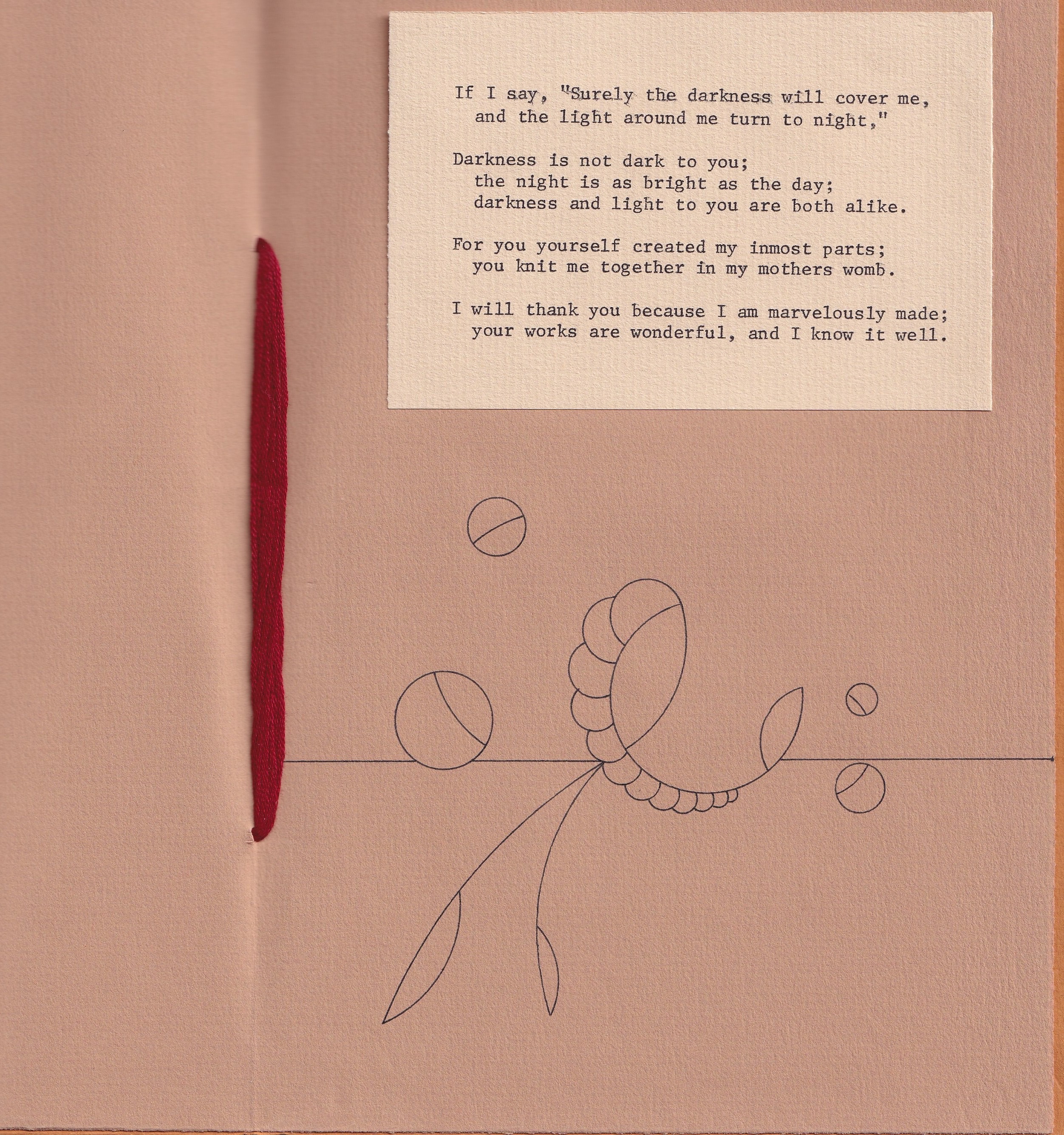
Just as I was strongly influenced by Wright’s architectural work when I aspired to follow him into the practice of his vocation, my design vision was just as impacted by his graphic work. In my case, this influence was not manifest in plans for such things as tapestries or windows, but in designs for paper products such as cards and stationary, and for handmade pamphlets. Among these were one featuring text from Psalm 139 (:1-17), and another text from the Song of Songs.

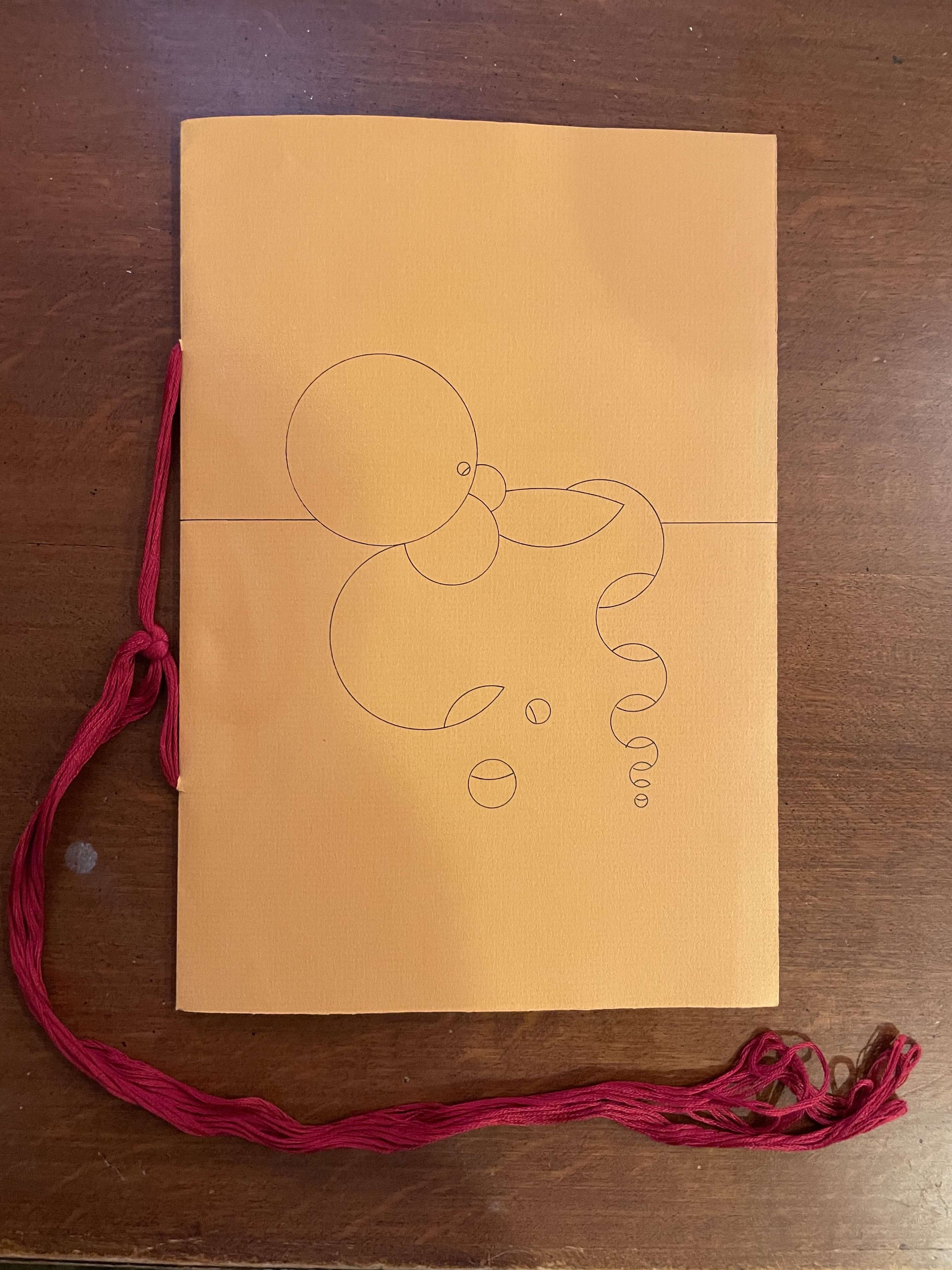
Above and below are some images of the little Psalm 139 pamphlet I created in the autumn of 1977 using a circle template, a rapidograph pen, an old-fashioned typewriter, and charcoal paper, along with a binding of stranded thread.


The above images are copyright, © Stephen Holmgren 2023. This post is based on a little pamphlet featuring Psalm 139:1-17, which I made while staying at the Pension Colorado in central Florence during the fall semester of 1977 while on a study abroad program through St Olaf College, in my sophomore year. I also acknowledge the probable influence of Alexander Calder’s mobiles.

Celebrating the 12 Days

Brother Martin Erspamer, OSB


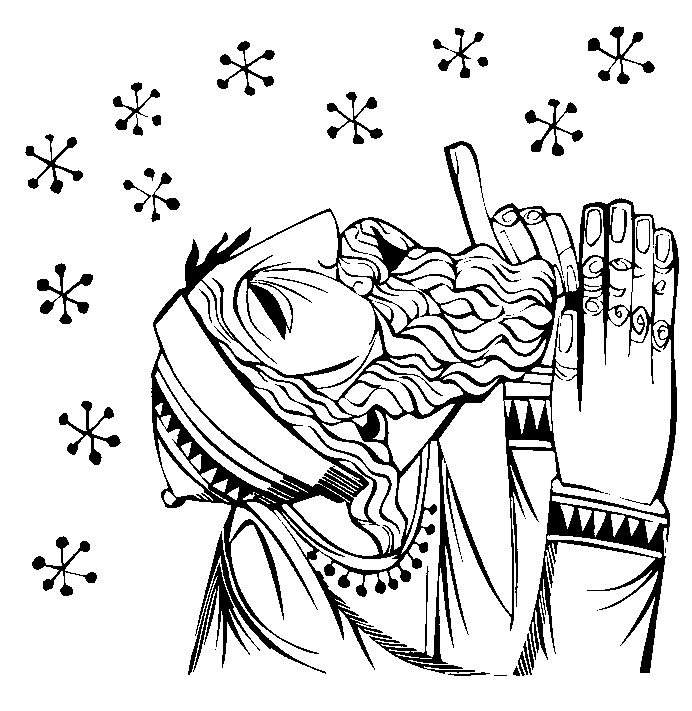
Having driven through my neighborhood yesterday and seeing two Christmas trees already put out onto the road edge, I am once again mindful of how the traditional Church calendar observes the Feast of the Incarnation of our Lord, or Christmas, for a full 12 days. I am therefore especially appreciative of the above image by Brother Martin Erspamer.

Martin Erspamer is a member of the Benedictine community at St. Meinrad’s Abbey in Indiana. His evocative black and white prints, sometimes referred to as ‘clip art,’ have been widely used on worship bulletins and in Sunday school materials.

The popularity of his images, and their widespread use in media such as Sunday bulletins, should not lead us to devalue the beauty of his handiwork, which evidences a studied sensitivity to medieval imagery as much as it does to the possession of a modern graphic artist’s temperament.

I especially like his image of Abram counting the stars, based on Genesis 15 (below). The image and its theme arises from God’s challenge to Abram to go out into the dark of the night and count the stars in the heavens – if he can. For one of God’s promises is that, while Abram is despairing of being without an heir, he will eventually have as many descendants as he can count the stars in the night sky.

Genesis presents three covenants between God and Abram, in chapters 12, 15, and 17, each of which is relevant to our celebration of these 12 Days of Christmas. In various ways, God promises Abram many descendants, a new land for him and those that would follow, and that through him a blessing would come to all the people of the world. This third promise, fulfilled for us in the child born in Bethlehem, is the most relevant to our observance of this holy time of the year.

From Psalm 147:

1 Hallelujah! How good it is to sing praises to our God! * how pleasant it is to honor him with praise!

2 The LORD rebuilds Jerusalem; * he gathers the exiles of Israel.

3 He heals the brokenhearted * and binds up their wounds.

4 He counts the number of the stars * and calls them all by their names.

5 Great is our LORD and mighty in power; * there is no limit to his wisdom.

6 The LORD lifts up the lowly, * but casts the wicked to the ground.


For those able to visit the Abbey, St. Meinrad’s has an exhibit of art by Brother Erspamer in the Archabbey Library Gallery until January 15: