Film and Movies

The Gift of Joy and Wonder

I have long been captivated by some words offered in our Prayer Book for the newly baptized, that they might receive the gift of joy and wonder in all of God’s works. These 12 Days of Christmas are surely the time of the year when hopes for joy and wonder are most honored by people all over the world.

While we focus on the gift of the long-promised Prince of Peace, and Wonderful Counselor, we also engage in what we might think of as a widespread indulgence in sentimentality. Our celebration of the Promised One can become overwhelmed by the secular accoutrements of ‘the season,’ with various permutations of the legacy of St Nicholas of Myra morphed into an attractive mythic figure we call Santa Claus, or Father Christmas as folks in the U.K. like to call him. His popular name in America, diminutively reduced to Santa or Saint Nick, masks the religious history of his churchly origins as a figure numbered among those on the Calendar and in the Lectionary. Elves in Santa’s fabled workshop take the place of saints and un-named believers whose works of faith are not remembered with specifics, while the lore of the mythic figure who comes to visit children’s’ homes with gifts occupies public attention.

We love reminders like this of the joy to be found at Christmas

Among others who have led parish church congregations, I have done my share of encouraging observance of a traditional Advent, stressing the significance of St Nicholas’ feast day (December 6), and urging retention of Advent hymns and restraint in home and church decorations characteristic of our culture’s ways of anticipating Christmas. For me and others, the 12 Days of Christmas would be our time of celebrating our Lord’s Nativity by lighting trees, sharing gifts, and treating ourselves to special foods, right through the feast days of St Stephen, St. John, Holy Innocents, and The Holy Name, to Twelfth Night and a proper regard for the Magi’s visit on the Epiphany, January 6. Preferring such an emphasis has caused some of us to appear to be in quiet conflict with the patterns of our wider culture. For the world around us has more and more begun its anticipation of Christmas by playing ‘music of the season’ early in November, long before Thanksgiving, while also decorating homes and public spaces with Christmas-related lights, poinsettia, and objects related to our enjoyment of gift-giving and receiving. At the heart of all these outward signs of anticipation is our longing for a recovery and enjoyment of what we celebrate as ‘the most wonderful time of the year.’

My adult children like to gently rib me that I have ‘gone soft’ on Advent. And that I have slowly succumbed to the influence of ‘secular culture’ upon what I think should properly be seen as a religious holiday – as if the two emphases are in some way counterposed, and in tension. With my predilection for retaining our Anglican heritage’s rightly attributed but oft-caricatured principle of taking a “both-and” approach to many aspects of our faith and beliefs, I prefer to think that I have broadened my outlook in my search for forms of a deeper synthesis that lies within ‘reality.’ Perhaps these changes in me are due to having grandchildren who live nearby. Yet, as I remember Oliver O’Donovan encouraging us to perceive, compromise is not always ‘of the Truth,’ but can also be ‘in relation to the Truth.’

Hence, my continued fascination with joy and wonder. Joy and wonder might be two of the best words to describe what we think of, and may remember as, a child’s view of what Christmas is all about. And if there is any substance to the perception that our transition from childhood through adolescence to adulthood is often marked by our loss of genuine engagement in imagination, fantasy, and therefore with wonder, it is surely reflected in our thinking that Christmas is primarily significant for children. And therefore something that we enjoy cheerfully when we participate in social occasions where we temporarily suspend our disbelief in fantasy for the sake of the merriment we can enjoy with others.

Christmas inspires us to seek stories of places filled with wonder

All this has deeper significance. What if the world we live in is truly animated by the Holy Spirit, thoroughly infused with divine Grace and Wisdom, and permeated by a wellspring of joy that is godly? What if our culture’s pattern of anticipating and celebrating Christmas is an example of what Jesus had in mind when he encouraged his adult listeners to become like the children he embraced and held up as an example of Kingdom-participation and life?

As when he placed a child in the midst of them, and said, “Truly, … unless you turn and become like children, you will never enter the kingdom of heaven. Whoever humbles himself like this child is the greatest in the kingdom of heaven.” Has it occurred to us that he may have been speaking first about himself (He who humbled himself to become an infant and then a child)?

Childish and child-like are, of course, not necessarily the same. And by distinguishing the terms, we may begin to recover something. That we don’t necessarily need to pare down features of our cultural approach to Christmas to get our celebration back to being something Jesus might want us to enjoy. But that we could also see our patterns of Christmas celebration as involving the kinds of gatherings and events at which he would have enjoyed himself, identifying with our delight in such moments, and where he would encourage us to embody his spirit of discernment of how God is present and at work in all that is around us.

It is all about him. And he is all about us.


Note: the quoted words of Jesus, above, are from Matthew 18:2-4. Christmas Story (filmed in Finland/Lapland, and A Boy Called Christmas are movies currently streaming.

Beauty & “The God of Wes Anderson”

This is a reprint of a review article by Germẚn Saucedo, titled “The God of Wes Anderson.” It is reprinted here with permission from the author, and from the publisher of the journal, First Things, where it first appeared.

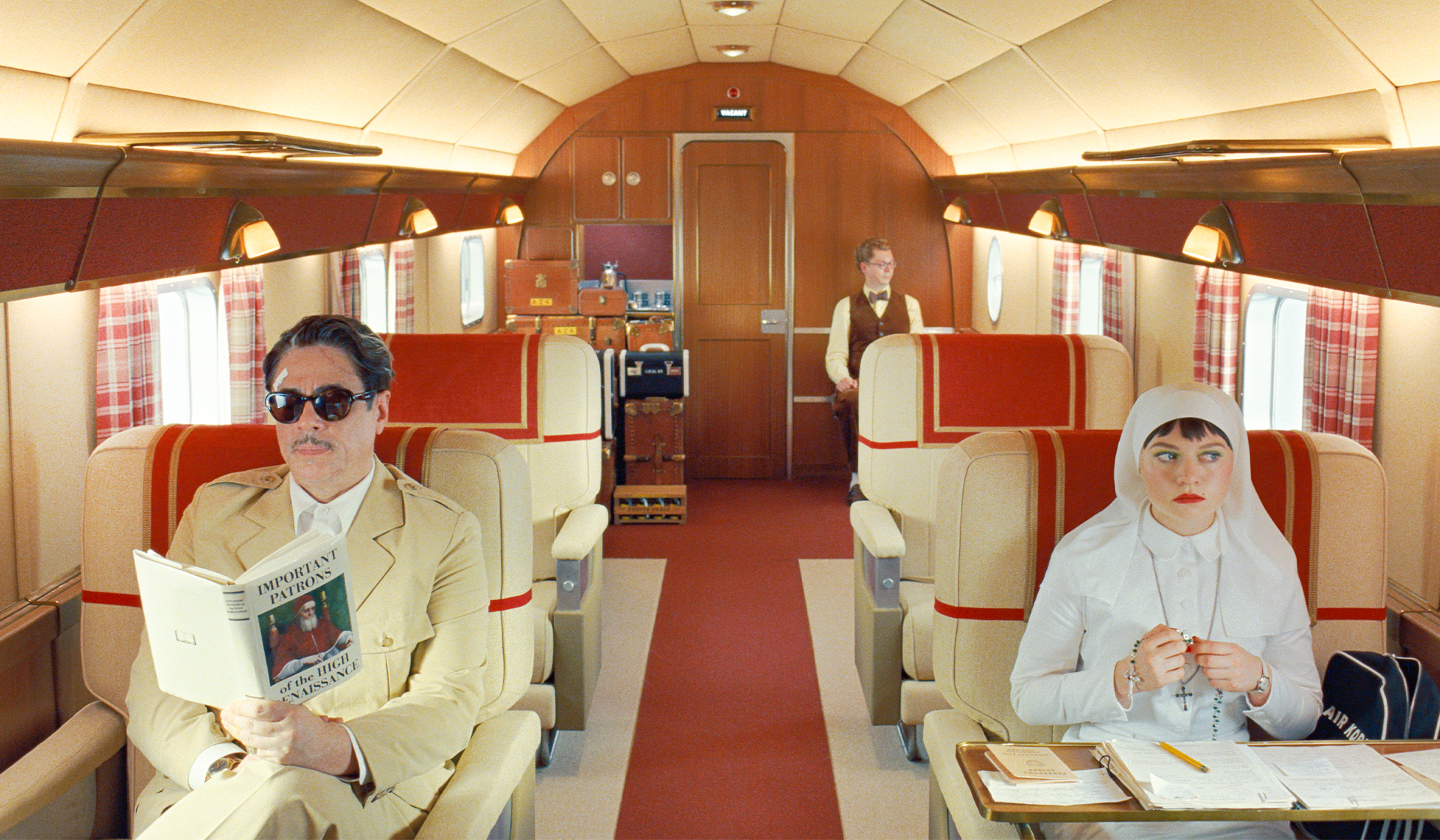
A scene from Wes Anderson’s new film, The Phoenician Scheme

The God of Francis Thompson is a stubborn God. In his seminal poem “The Hound of Heaven,” a soul is on the run from God: “I fled Him, down the nights and down the days; / I fled Him, down the arches of the years.” The “hound” is persistent, however, and is always pursuing with “unhurrying chase, / And unperturbèd pace, / Deliberate speed, majestic instancy.” Who is this God whose love for us is so passionate and resolute, who will forgive even the gravest of sins and chase us to the ends of the world?

The God of Francis Thompson is the God that operates in Wes Anderson’s latest feature, The Phoenician Scheme. The film follows Anatole “Zsa-Zsa” Korda (Benicio del Toro), an industrialist and morally bankrupt magnate in the style of J. Paul Getty or Aristotle Onassis who, after surviving yet another mysterious assassination attempt, decides to call upon his estranged daughter Liesl (Mia Threapleton), a novice “sister of the cloth.” He intends not only to bequeath his vast fortune to her, but also to enlist her in completing the “most important project of [his] lifetime,” the “Korda Land and Sea Phoenician Infrastructure Scheme.”

Many films have been accused of being “God-haunted,” hinting at the presence of God through the subtleties of the plot or the visuals. The Phoenician Scheme is more than “God-haunted”; he is very much present in the film. He is, in fact, played by Bill Murray. After a plane crash at the beginning of the movie, Korda briefly finds himself in heaven. There, he runs into his grandmother, who fails to recognize the man he has become. Time and time again, as assassins seek to end his life, Korda finds himself at the pearly gates. Each time, he is found lacking.

In the Confessions, St. Augustine famously recounts his youthful desire for the Lord to “Give me chastity and continence, but not yet.” While amusing, this sentiment is spiritually disordered. Many of us live lives apart from God, hoping we can outmaneuver him at the last second, “lest he come suddenly and find you asleep.” Similarly, Korda realizes that he has delayed repentance and conversion until the last minute.

The “hound” is never far away, however. He manifests himself through Liesl who, despite practically being abandoned by Korda, has managed to become a pious nun. While reluctant to enter her father’s world of opulence and luxury, she nevertheless decides to play the role Korda has set for her, seeing potential spiritual fruits from the venture, and quickly begins the work of saving Korda’s soul. She easily forgives his past injustices toward her, brings love to the lives of Korda’s nine neglected sons, and attempts to humanize his enterprise. Liesl also attempts to evangelize the children’s tutor and her father’s new administrative assistant, Bjørn.

Korda’s journey to save his infrastructure project brings him ever closer to God. Liesl’s influence and example, as well as a confrontation with his past (and some amount of self-interest), leads him—along with his nine sons—to be baptized into the Catholic Church. In a defining act of selflessness, Korda gives up his fortune to cover the funding deficit of his major project and save it.

Wes Anderson’s films are often dismissed as mere aesthetic exercises, lacking narrative substance. His protagonists are usually “bourgeois with bourgeois problems,” while his visuals are frequently labeled as “twee” and “quirky.” Unlike the realism of directors like Ermanno Olmi, whose slow and contemplative style focused on the material reality of the lower classes, Anderson’s work is often seen as overly stylized and detached from reality.

But this surface-level reading could not be further from the truth. For Anderson, it seems, beauty is reality. To borrow Keats’s famous verse, “Beauty is truth, truth beauty”; and it is through beauty that God makes himself known to us. When Liesl attempts to exit her father’s opulent world and take her vows as a nun, her mother superior declines, pointing to her love of lavishness—including a bejeweled pipe and diamond-encrusted rosary gifted by Korda, which Anderson commissioned from Dunhill and Cartier—as evidence of her lack of religious vocation. But she does not scold her for loving beautiful things. In fact, she comforts Liesl by saying that God glorifies himself with the lavish and palatial, as not everyone was meant to live in poverty.

In a Q&A at a New York screening of the film, Wes Anderson reflected briefly on the ability of rich magnates to do good, especially in today’s world. The artist has a similar potential. In Thompson’s poem, the “hound” claims that “[N]one but I makes much of naught.” While our riches and our art may amount to nothing, once offered up to God, they can become instruments of his love and mercy. God will never stop his pursuit of us in part because he, unlike the world, knows our full potential. Korda—like us—is thrown lifeline after lifeline, which can only be taken on God’s terms, not ours.

Unlike Korda, we should not wait for brushes with death and brief visits to the pearly gates to turn around and deliver the “hound” from his incessant chase. Every moment is an opportunity to do so. The curious and wonderful thing about the God of Francis Thompson, the God of Wes Anderson, is that he’s real, and he is always seeking us.

A promotional poster for Anderson’s new film

Note: Germẚn Saucedo serves as a Junior Fellow at First Things. I requested permission to reprint his review article because it seems so fitting to the material I explore on this website. I am grateful for this fine piece. I particularly appreciate Saucedo’s statement, based on a quote from Keats: “For Anderson, it seems, beauty is reality… and it is through beauty that God makes himself known to us.”

Reconciliation is Always Possible

If reading this by email, please tap the title at the top to open your browser for the best experience. Then, clicking individual pictures will reveal higher resolution images.


A recent LA Times article was titled, “Hello Simon, my old friend…” Those of us who can remember the late 1960’s surely have clear memories of hearing tunes from Simon and Garfunkel’s milestone album, Bookends, and especially of the way their music was featured in the December, 1967, release of the movie, The Graduate. Even those born years later may have in their minds an inescapable link between the names of the two artists, whose cooperative work remains so memorable. Despite their ‘Oh, so beautiful’ recordings, the two broke up their musical partnership in January of 1970, shortly before the release of their best-selling and perhaps providentially titled album, Bridge Over Troubled Water.

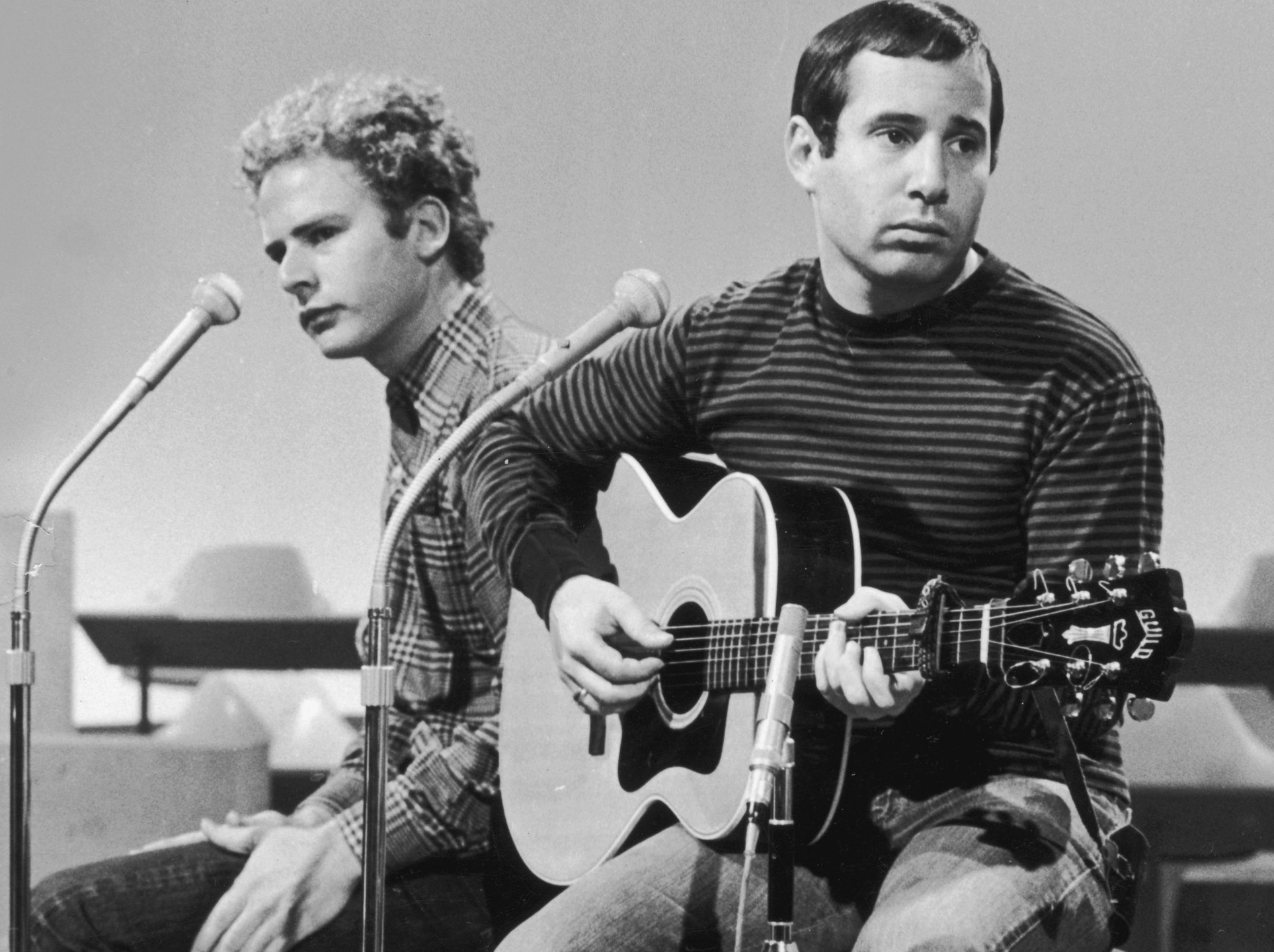
Simon and Garfunkel performing in the earlier days of their musical partnership

Many of us who remember hearing their music when it was first released, or who have come to love and appreciate it since those years, don’t realize the extent of their difficult creative relationship as artists. All too soon, they drifted apart, speaking only occasionally with one another, though in subsequent years they did perform together on a few occasions, including at Jazz Fest in New Orleans in the spring of 2010. To his later regret, Art Garfunkel made some unwise and unguarded comments during an interview in 2016, that were hurtful to Paul Simon.

At Jazz Fest, New Orleans, 2010, with Garfunkel singing with a damaged voice adding to the strain in their relationship

Art Garfunkel has now spoken to the press about his regret concerning those prior comments, and shared what he had said to Paul Simon at a recent lunch together: “First time we’d been together in many years. I looked at Paul and said, ‘What happened? Why haven’t we seen each other?’” Garfunkel then shared this: “I cried when he told me how much I had hurt him.” “Looking back,” with obvious regret, he reflected that he had perhaps “wanted to shake up that nice guy image of Simon & Garfunkel.”

An early photo of the duo which may suggest some of the tensions in their partnership

Their reconciliation came at that long overdue lunch, which Garfunkel said, “…was about wanting to make amends before it’s too late.” Having acted upon his desire to reconnect with Simon, Garfunkel offered that “it felt like we were back in a wonderful place. As I think about it now, tears are rolling down my cheeks. I can still feel his hug.”

This recent reconciliation between Paul Simon and Art Garfunkel is heartwarming and a beautiful thing. It can be a source of hope for all of us regardless of who we are, or our place in this often confused and fast-paced world.

Simon and Garfunkel at a reunion concert in Central Park, NYC, in 1981

Reconciliation, especially following upon things we have done to hurt and impair a relationship with another person, is perhaps one of the most difficult things for us to contemplate doing, and then to try and enact. Surely, we can all acknowledge this based on personal experience. Especially when we are aware that this reality has the potential to be a shadow presence at some Thanksgiving gatherings this week, whether among family members or groups of friends.

Achieving reconciliation with another person in this life is never assured, no matter how much we may desire it. And what such a desired result may require is an openness to that hoped-for resolve happening between us, even if the circumstances surrounding that possibility seem remote and uncertain. Yet, though this kind of openness is necessary, it is not in itself sufficient for the desired result. Forgiveness by one or both parties plays a key role in the process. And forgiveness usually requires an acknowledgement rather than a dismissal of what may have happened to cause the breach in the relationship.

This is how and why memories, even of hurts, injury, and injustice, have the potential to be holy, and why forgetting (especially willful forgetting) may limit the extent to which we experience reconciliation. To forgive is an act of will, whether or not feelings of forgiveness arise within us or abide. And once forgiveness is willed, and then expressed, the reconciliation that follows upon openness might -and even may – in time happen.

There are grounds for hope, at least with regard to Simon and Garfunkel. They appear to be planning a series of reunion concerts in 2025. We can look forward to enjoying once again the fruit of this most creative musical collaboration.


Finding Beauty in the Most Unexpected Places

If reading this by email, please tap the title at the top to open your browser for the best experience. Then, clicking individual pictures will reveal higher resolution images.

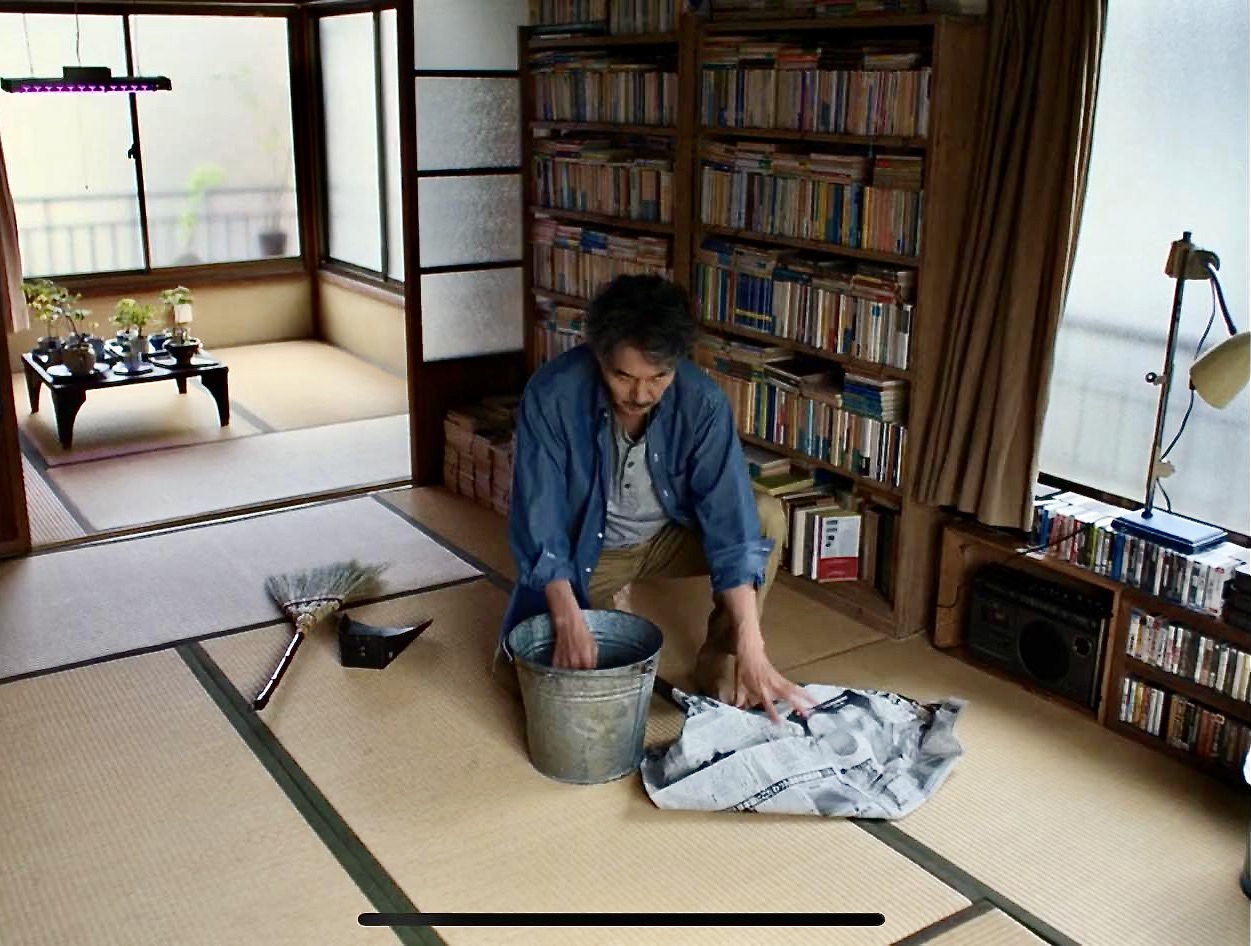
Actor Koji Yakusho portraying Hirayama looking upwards, in the film Perfect Days


An improbable premise underlies the remarkable film, Perfect Days, and it is displayed in two principal ways. A Tokyo public toilet cleaner has a positive attitude, even a cheerful spirit, as he approaches his daily routine of attending to places where other people leave their waste. And yet, the primary places where this man is lucky to work are the architecturally significant public toilets commissioned and built for the 2020 Tokyo Olympics. The film portrays these places well. Some have suggested that the architectural features of these structures may have inspired the movie’s production. Nevertheless, the film is centered upon one man’s approach to how he lives every day.

He is a man about whom we know only his surname, and we learn more about his daily routine than we do about his inner life. The latter, his interests and perhaps aspirations, are suggested by the books he reads and the music to which he listens while driving. Many scenes depict him at his work. But the film does this in ways that do not romanticize his occupation, while he is shown cleaning and polishing toilet bowls and seats, as well as sinks and other aspects of plumbing. The film skillfully negotiates the ambiguous terrain lying between a heroic portrayal of an apparently righteous man, and a sentimental celebration of an unreal figure.

A montage of some of the public toilets featured in Perfect Days

The approach to life epitomized by Hirayama in the film is one of contentment. He models someone who accepts the limitations presented by the contexts in which many of us live, and he displays an openness to unexpected moments of discovered and quiet beauty. The film is not overtly spiritual. Yet, these qualities may represent – to some Western viewers like me – compelling reflections of Japanese culture as it has been shaped by Buddhism.

Hirayama at work on a hobby, Bonsai

In addition to the overt paradoxes at the heart of the film – a happy toilet cleaner and beautiful public toilets – the film subtly presents other aspects of Japanese society that Western visitors might notice. In what may surprise many who are not of Japanese heritage, regarding a very private culture where people typically meet one another in commercial establishments rather than in personal dwelling places, public baths with full nudity are common. I experienced occasional visits to public baths in my youth, growing up in Japan.

Hirayama in the neighborhood bath house

And within the context of this very private culture, some Tokyo public restrooms were created with transparent glass walls, appearing to risk users to full disclosure (the glass walls magically become opaque when the doors are locked).

Three motifs or tropes in the film are memorable. Hirayama is portrayed as always looking up to the sky when emerging from his home in the morning on his way to work, and is also seen gazing upwards (as in the photo at the top of this post). This suggests that he unconsciously senses a connection with something bigger than himself, and this may be the source of his frequently displayed habit of smiling at others.

Another motif, surely related to the first, is the employment of black and white sequences that portray flickering images, usually of dappled sunlight glimpsed through tree limbs, which Hirayama captures with his old-fashioned film camera. Most often, he seems to take these photos during his lunch breaks in a local park. In relation to these images, the movie highlights the Japanese word, and concept, of komorebi, which in a single word expresses the idea of sunshine filtering through the leaves of trees overhead.

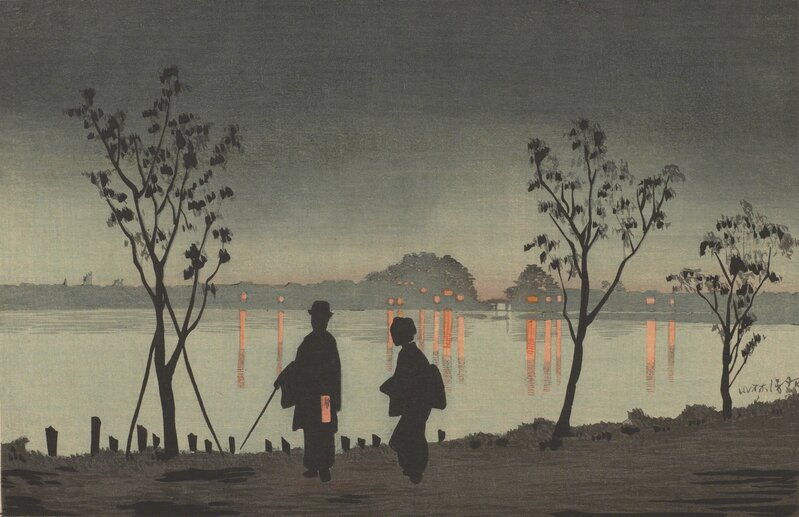
The third is the employment by the movie makers of the Sumida River in Tokyo, long celebrated in Japanese art, over which we see Hirayama cross while walking, driving, or biking. The river appears to symbolize a form of divide between the part of the city where his small apartment is located, and the more elegant commercial district where he usually works.

My favorite image of Tokyo’s Sumida River in art, a woodblock print by Kobayashi, Kiyochika ({1847-1915} name in traditional Japanese order)

These juxtapositions in Perfect Days of contrasting details, color versus black and white, and interior privacy and public life, along with the harmony in which they are presented, distinguish this film. To me, it is remarkable that this movie was made by a Western filmmaker, regardless of the assistance provided by Japanese colleagues. A studied sensitivity to what I know about Japanese culture is evident in the film’s portrayal of this fictional character in improbable circumstances, as it invites us to discover – along with Hirayama – beauty in the most unexpected places.

Hirayama, gazing upwards, holding his old-fashioned film camera