Christmas

Advent Annunciations: Joseph

[If reading this by email, please tap the title at the top to open your browser for the best experience. Then, clicking individual pictures will reveal higher resolution images.
James Tissot, The Anxiety of Saint Joseph


I often turn to Annunciation scenes during Advent. This may seem curious since we celebrate the Feast of the Annunciation on March 25, nine months before Christmas Day. Yet, the season of Advent marks the beginning of a new church year, which may signal a time for other new beginnings.

The Annunciation to Mary was of course unique. Yet, it is also symbolic of God’s self-disclosure and God’s loving communication of hopes and wishes to every one of us. God becomes present to us, and in us, so that we might begin a new life, and begin it again. “Always, we begin again” is a saying oft-attributed to St. Benedict. It can become true for every mindful believer.

For obvious reasons, the Annunciation to Mary has received an overwhelming amount of attention in the history of art. Less frequently explored for its artistic potential is God’s self-disclosure through an Angel to Joseph, in a dream, even though it is with this Joseph story that Matthew launches his extended narrative. Mary gave birth to Jesus, whereas Joseph is remembered for having had a less prominent role in the circumstances of our Lord’s arrival. Joseph then largely disappears from the Gospel narrative. Perhaps because God’s revelation came to him in a dream while asleep as compared with Mary’s conscious, apparently daytime reception of the angelic visitation, Joseph’s receipt of an annunciation has been easier to overlook.

Yet, Joseph must have played a more-than-passing role in the coming of the Messiah. He did this by his willing marriage to Mary, and by initially providing a safe deliverance for his family from the wicked Herod, to and from Egypt. Undoubtedly, he gave Jesus significant mentoring, though Scripture leaves any details about that for us to imagine. Communities certainly have a part in the formation and education of children and youth, often in unrecognized and unrewarded ways. But why do we so easily overlook what was surely Joseph’s pivotal role in helping the young Jesus learn so much about Scripture, and in acquainting the youth with the material for so many of his later parables?

If these things may be inferred from the Gospels regarding Joseph’s significant role in the circumstances of the birth and early life of Jesus, we should reflect on what may have accompanied Joseph’s readiness to act upon the angel’s annunciation to him. As he positively responded to the angel’s words, he is likely to have considered what heeding those words might entail.

James Tissot’s painting, titled The Anxiety of Joseph, suggests that Joseph’s acceptance of his calling may have involved thoughtful deliberation. Indeed, Joseph may have sincerely weighed in his mind the degree of hazard that might arise from acting in accord with God’s revealed will, especially when such action might defy religious and social convention. That he, like Mary, in effect said yes to his angelic instructions, and followed through affirmatively, does not necessarily mean he did so without hesitation.

Most of us are called by God to accept unheralded and easy-to-overlook roles in God’s still unfolding plan of redemption for the world. Inspiration regarding our calling might even come to us in a dream, making us more prone to discount its potential significance, or too quickly assess its likely merit and value in a misguided and worldly way. After all, who are we to think that we could have an impact upon the world in relation to God’s sovereign purposes?

It is often said that Mary is the ‘mother’ of the Church. Perhaps Joseph, in a similar way, can be said to be the ‘father’ of all believers, especially those like you and me.


The Beauty of John’s Revelation

[If reading this by email, please tap the title at the top to open your browser for the best experience. Then, clicking individual pictures will reveal higher resolution images.

Christ Pantocrator ceiling mosaic from the Hagia Sophia, Istanbul


Advent beckons! Or does it? Isn’t something profoundly new lying just around the corner? Or shall we simply drift into another season of the old and familiar that might or might not live up to our expectations?

This calendar year, with a full week between Thanksgiving weekend and Advent Sunday, we have an ample opportunity to ponder questions like these. If such have recently occurred to you – or seem relevant now – I have a suggestion. It is prompted by a question recently put to me. What book or devotional might I recommend for Advent? My suggestion for Advent reading is John’s Revelation! It is the last book of the Bible, but arguably the first book for a new era, as we begin a new church year. And Revelation makes for unexpectedly good reading during these days of increasing darkness, at least as daylight hours are typically reckoned.

The best way that I know for begining to appreciate John’s Revelation, and read it for personal enrichment, is to engage it guided by Eugene Peterson, translator of The Message version of the Bible. Peterson helps us by making the texts of Scripture accessible and familiar-sounding. He is especially helpful in steering us around or away from what is ironically a rather modern and limited way of reading the biblical text. With him, we can avoid a literalism overlaid by misguided assumptions regarding prophecy and history. For Revelation does not contain a code to be deciphered but a message of love to be received, however strange John’s language and imagery may strike us at first.

John’s Revelation is metaphorical poetry that speaks truth, rather than something like a roadmap conveying predicted facts about what lies ahead. And so, it is not about how or when ‘the End’ will come, as if John’s book was and is about the terminus or stopping point of history and of all that we know. Instead, and in a rather more profound way, we might with John begin to see something new: how the end or point of fulfillment for all of history and of God’s purposes have in some sense already arrived!

In these weeks of shortened daylight hours and increasing chill, the prospect of reading Revelation may seem antithetical to a hopeful anticipation of Christmas. Cheerful music, warm lighting on dark and cold evenings, and holiday treats on the table, are all attractive and good things for us to enjoy at this time of the year.

But if we have any sense that there is something wrong with the present state of our world, whether with things near or far away, ignoring or being in denial about such are not our only alternatives when it comes to how we might approach each new day. A new phase in salvation history has dawned, and does not simply lie ahead in an undefinable future that is beyond our grasp. Yet begining to see this new phase in God’s ongoing work of Redemption may take the work of imagination, a praying imagination as Peterson puts it, in order to see the real beauty that now surrounds us, and which can be found within.

The beauty of the face of ‘the coming One’ is already here to be seen. We don’t have to travel back in history to a stable in Bethlehem, nor do we need to try and peer ahead to some kind of future cosmic crisis to see his arrival. For he is here with everyone. And he can be seen in the faces of those who through their Baptism bear the intimacy of his beautiful presence.


Eugene Peterson’s book on John’s Revelation, Reversed Thunder: The Revelation of John & the Praying Imagination, is in print and available from book sellers. I am pleased that Amazon has announced the future release of a Kindle (ebook) as well as an audio version from Audible.


Surprised by God

[If reading this by email, please tap the title at the top to open your browser for the best experience.]

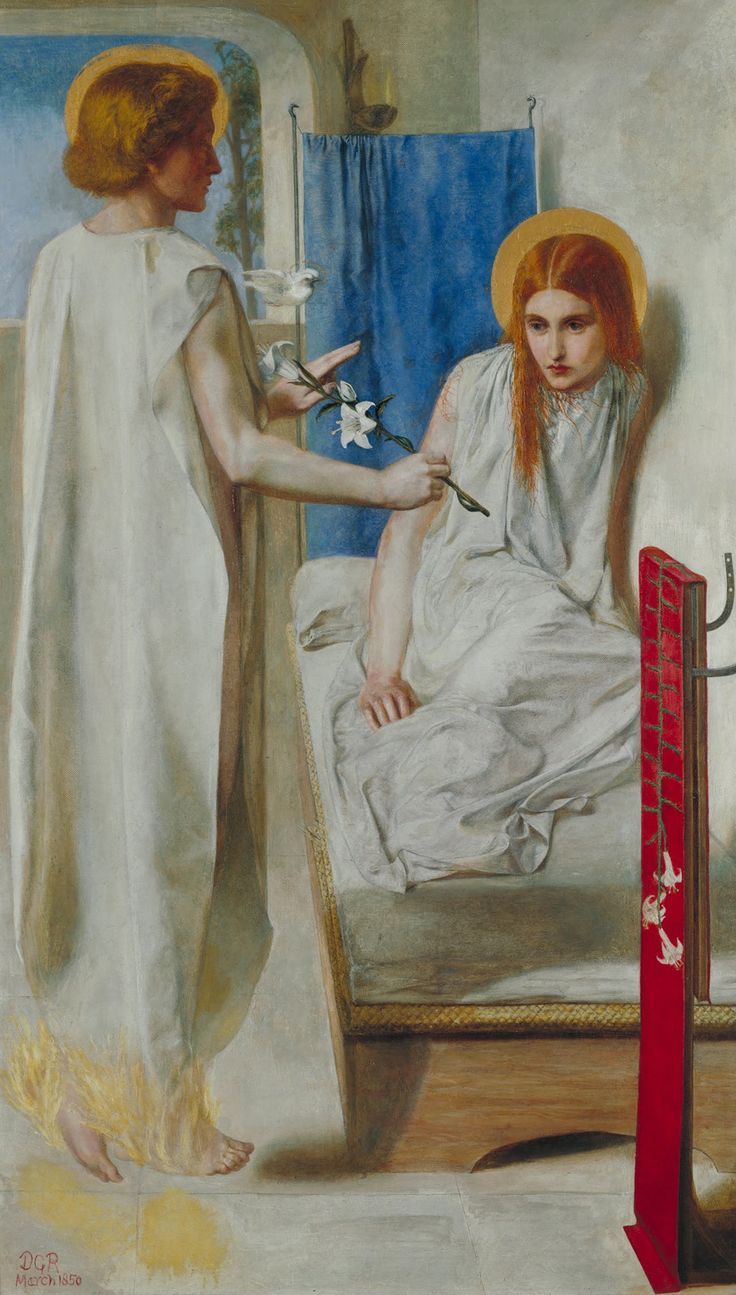
Dante Gabriel Rossetti, Annunciation (1850)


During the remaining of these 12 Days of Christmas, I plan to share with you further images of the Annunciation to Mary, moving on from yesterday’s post featuring the theme of Holy Fear. We might refer to these as four moments of God’s decisive intervention in human history in the Incarnation of our Lord. And in each of these four moments we may find a personal connection with our own spiritual journeys, especially as Mary prefigures the church in some very significant ways.

Yesterday, we began with the unexpected moment of Mary’s encounter with the divine presence through the holy angel, and the holy fear that such a meeting might bring. Today, we consider what may often happen next, which is introspection prompted by being surprised by such an encounter.

One of the first things that strikes me about this painting by Rossetti is how Mary’s gaze is fixed on the middle distance. And this suggests that she is focussed more upon the potential significance of what she has just been told, than upon the prior object of her attention, the angelic visitor. She is now focussed on the possible meaning of the angel’s message. And so, as she abstractly looks outward, apparently not focussed on the stem of lilies held by the angel, she looks within.

Not only does she not appear to register the significance of the lilies, suggestive as we have noted both of her purity but also of the future resurrection of her son. She also seems to overlook the potential significance of the red colored, draped, fabric upon which perhaps she may have been applying needlework, placed so prominently by the artist in the foreground. Suggestive of both a priest’s or a deacon’s stole, as well as of altar fabrics, red is traditionally the color used for Holy Week as well as for saints days commemorating martyrs. And, once again, we notice the emblem of the lilies upon the needlework.

Four details briefly worth noting: the dove depicted above the angel’s left hand, symbolic of the Holy Spirit; that Mary is draped in white, in purity and resurrection motifs; the blue color of the fabric hanging behind Mary, in what is often referred to as Marian blue; and, the way that Rossetti depicts the angelic messenger hovering above the floor.

But note her gaze! I find it arresting. Especially as we consider the reality of God having come to us, to share our nature, our being, and our lives.

Celebrating the 12 Days

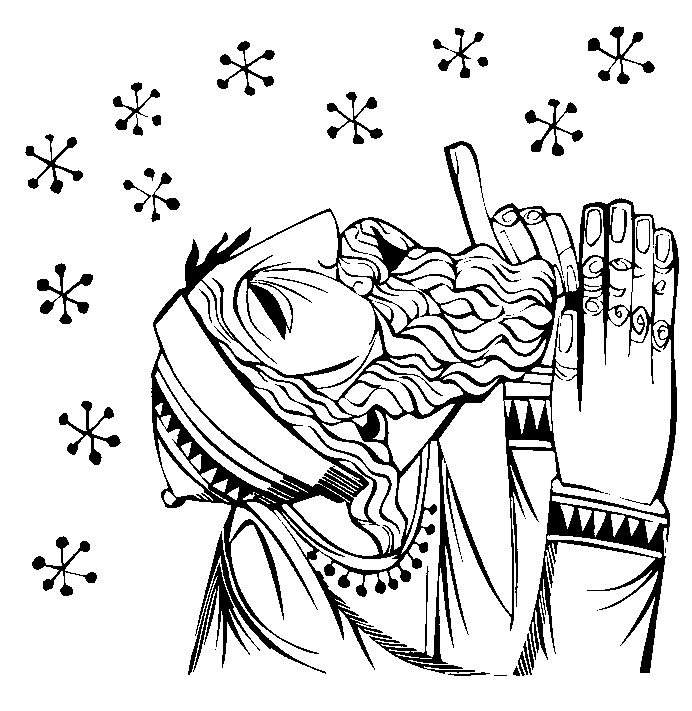
Brother Martin Erspamer, OSB


Having driven through my neighborhood yesterday and seeing two Christmas trees already put out onto the road edge, I am once again mindful of how the traditional Church calendar observes the Feast of the Incarnation of our Lord, or Christmas, for a full 12 days. I am therefore especially appreciative of the above image by Brother Martin Erspamer.

Martin Erspamer is a member of the Benedictine community at St. Meinrad’s Abbey in Indiana. His evocative black and white prints, sometimes referred to as ‘clip art,’ have been widely used on worship bulletins and in Sunday school materials.

The popularity of his images, and their widespread use in media such as Sunday bulletins, should not lead us to devalue the beauty of his handiwork, which evidences a studied sensitivity to medieval imagery as much as it does to the possession of a modern graphic artist’s temperament.

I especially like his image of Abram counting the stars, based on Genesis 15 (below). The image and its theme arises from God’s challenge to Abram to go out into the dark of the night and count the stars in the heavens – if he can. For one of God’s promises is that, while Abram is despairing of being without an heir, he will eventually have as many descendants as he can count the stars in the night sky.

Genesis presents three covenants between God and Abram, in chapters 12, 15, and 17, each of which is relevant to our celebration of these 12 Days of Christmas. In various ways, God promises Abram many descendants, a new land for him and those that would follow, and that through him a blessing would come to all the people of the world. This third promise, fulfilled for us in the child born in Bethlehem, is the most relevant to our observance of this holy time of the year.

From Psalm 147:

1 Hallelujah! How good it is to sing praises to our God! * how pleasant it is to honor him with praise!

2 The LORD rebuilds Jerusalem; * he gathers the exiles of Israel.

3 He heals the brokenhearted * and binds up their wounds.

4 He counts the number of the stars * and calls them all by their names.

5 Great is our LORD and mighty in power; * there is no limit to his wisdom.

6 The LORD lifts up the lowly, * but casts the wicked to the ground.


For those able to visit the Abbey, St. Meinrad’s has an exhibit of art by Brother Erspamer in the Archabbey Library Gallery until January 15:

The Holy Innocents


Peter Bruegel the Younger, The Massacre of the Innocents, late 1500’s


During these twelve days commemorating biblical events that we associate with Christmas, we return to another winter image from Peter Bruegel, in this case probably by Peter the Younger. Like the Bruegel painting of the Census at Bethlehem, shared with you previously, this is another favorite of mine.

Today, December 28, is the day on which the western Church remembers the event recorded by Matthew in his Gospel (2:13-18), wherein the wicked King Herod turned his fearful wrath upon the children of Bethlehem in Judea.

Herod was rightfully insecure about his throne and reign, having been propped up in the role by the Romans and others, and apprehensive about potential rivals. Imagine his anxiety when apparently wealthy astrologers arrived from a foreign land bearing reports regarding one who would be born “King of the Jews,” especially when these visitors expressed a desire to worship this anticipated newborn.

Once again we marvel that in our calendar for the 12 Days of Christmas the Church should commemorate those, like St. Stephen and the Holy Innocents, whose death gave tribute to the Lord of Life and the King of kings.

From the Book of Common Prayer:

“We remember today, O God, the slaughter of the holy innocents of Bethlehem by King Herod. Receive, we pray, into the arms of your mercy all innocent victims; and by your great might frustrate the designs of evil tyrants and establish your rule of justice, love, and peace; through Jesus Christ our Lord, who lives and reigns with you, in the unity of the Holy Spirit, one God, for ever and ever. Amen.”


[If reading this by email, please tap the title at the top to open your browser for the best experience.]

Annunciation to Joseph

Alexander Ivanov, Joseph’s Dream


Here I begin sharing a series of images for the 12 days of Christmas, including two prior events as well as some that follow the Nativity. Christmas Day, Dec. 25, is officially the first of the 12 days. Yet, as we anticipate the holy season ahead, it is appropriate to remember and consider what prepared the way for the miracle we are soon to celebrate.

In this new Revised Common Lectionary year, which focuses on Matthew’s Gospel we hear of an Annunciation to Joseph (Matthew 1:18-25), less familiar to most of us than the Annunciation to Mary as recorded by Luke. Joseph was as attentive to his Annunciation as Mary was to hers. And like her, he was equally trusting and obedient.

May our Lord, who was and is, and is to come, bless us and our loved ones during this holy time.

Annunciation

Simone_Martini_Annunciation_Detail

Today we celebrate the feast of the Annunciation to Mary. The angel of God brought her “good news” ~ but news she could hardly have understood at the time. She would bear a child, who would be called Son of the Most High. I have always loved Annunciation paintings, and this one by Simone Martini (from 1333), in particular.

When the angel appeared to Mary, she encountered God’s holiness and righteousness. Like so many times in history, God’s presence pushes everything else into clarity. The bright light of Glory throws into relief all the dark places in the world – all the hidden corners of our lives. We usually react to this with disquiet and concern. We hear that God’s word comes as Good News. And yet we experience God’s call to become a new person, or do a new thing, as a fearful invitation!

For me, it has been a call to move from one beloved congregation to what I could only hope would be another. For both you and me, it will be a call to speak to someone with whom we have a misunderstanding, or forgive someone whom we have failed to forgive. When God calls us to new life, we are often afraid. We think of what we fear might happen: like losing a familiar home and community; or setting aside our pride, and opening ourselves to being hurt again.

Look at how Martini portrays Mary’s response to the angel! Gabriel visits her with holy news about the child she will bear, who will bring salvation to the world. Mary draws back from his message, fearful about what it might mean. We know it turns out for good. But at first, God’s call can frighten us. A change to something new, always means a change from where we started.

The scene reminds me of spiritual advice I received years ago – advice that helped me be willing to leave a tenured seminary position and return to parish ministry. I had a sense of call, but the prospect of this change was frightening. A wise friend said to me, “when you go toward the heart of your fear in faith, God will always meet you there with power.”