Architecture

Chora Church: A Byzantine Treasure

If reading this by email, please tap the title at the top to open your browser for the best experience. Then, clicking individual pictures will reveal higher resolution images.

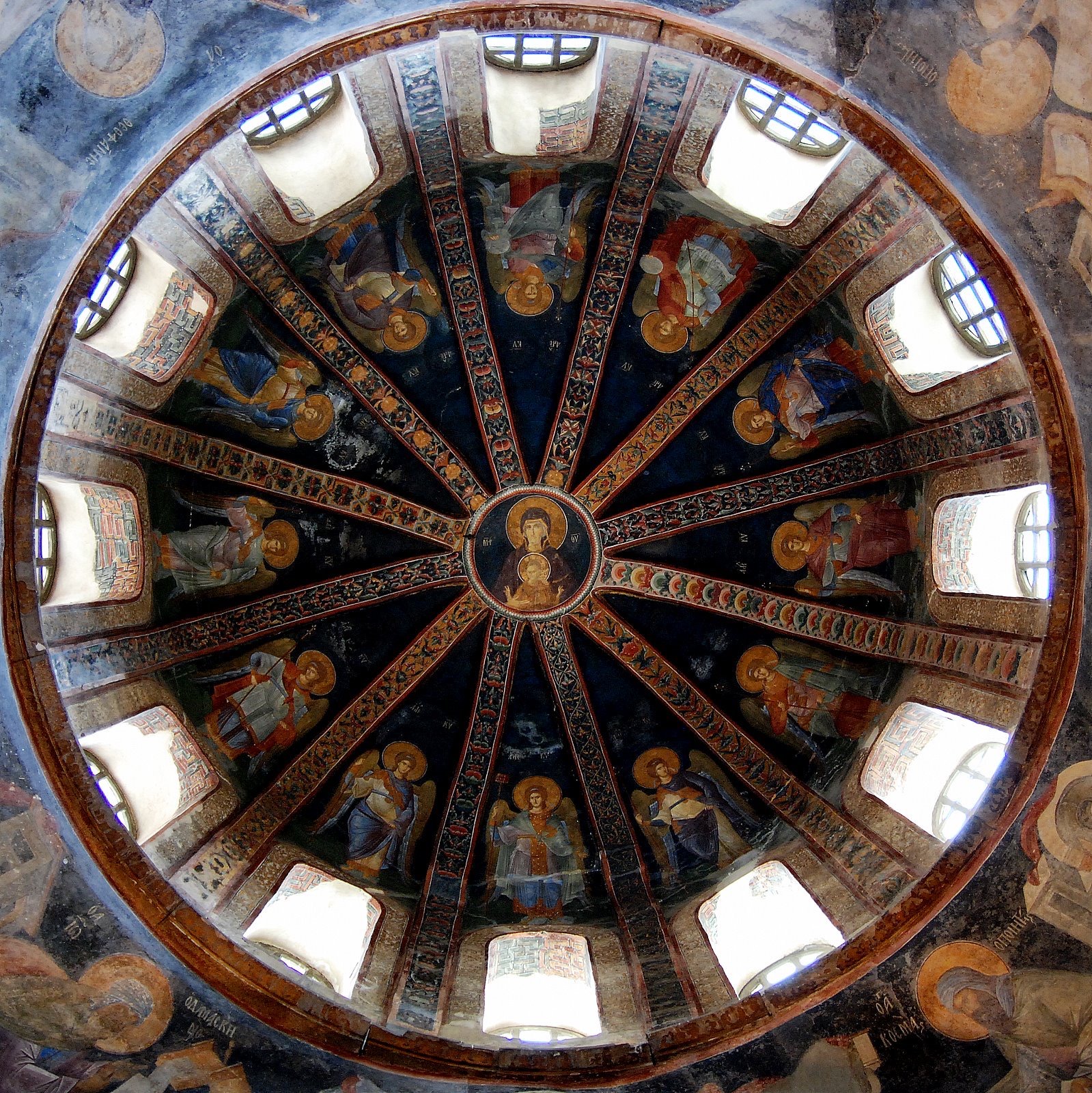
Dome over the Side Church (or parecclesion), Chora Church


We missed being able to visit this remarkable place by a day! Sadly, after staying in Istanbul for four nights, the historic Chora Church that had undergone four years of renovation would not reopen until the day after our departure.

Dating back to the time of Constantine in the early fourth-century, the Chora Church was built as part of a monastary outside the walls that were constructed when Constantinople became the new capitol of the Roman Empire in 330 A.D. Its rural location led to its formal title, Church of the Holy Savior in the Country (or Chorai, in Greek).

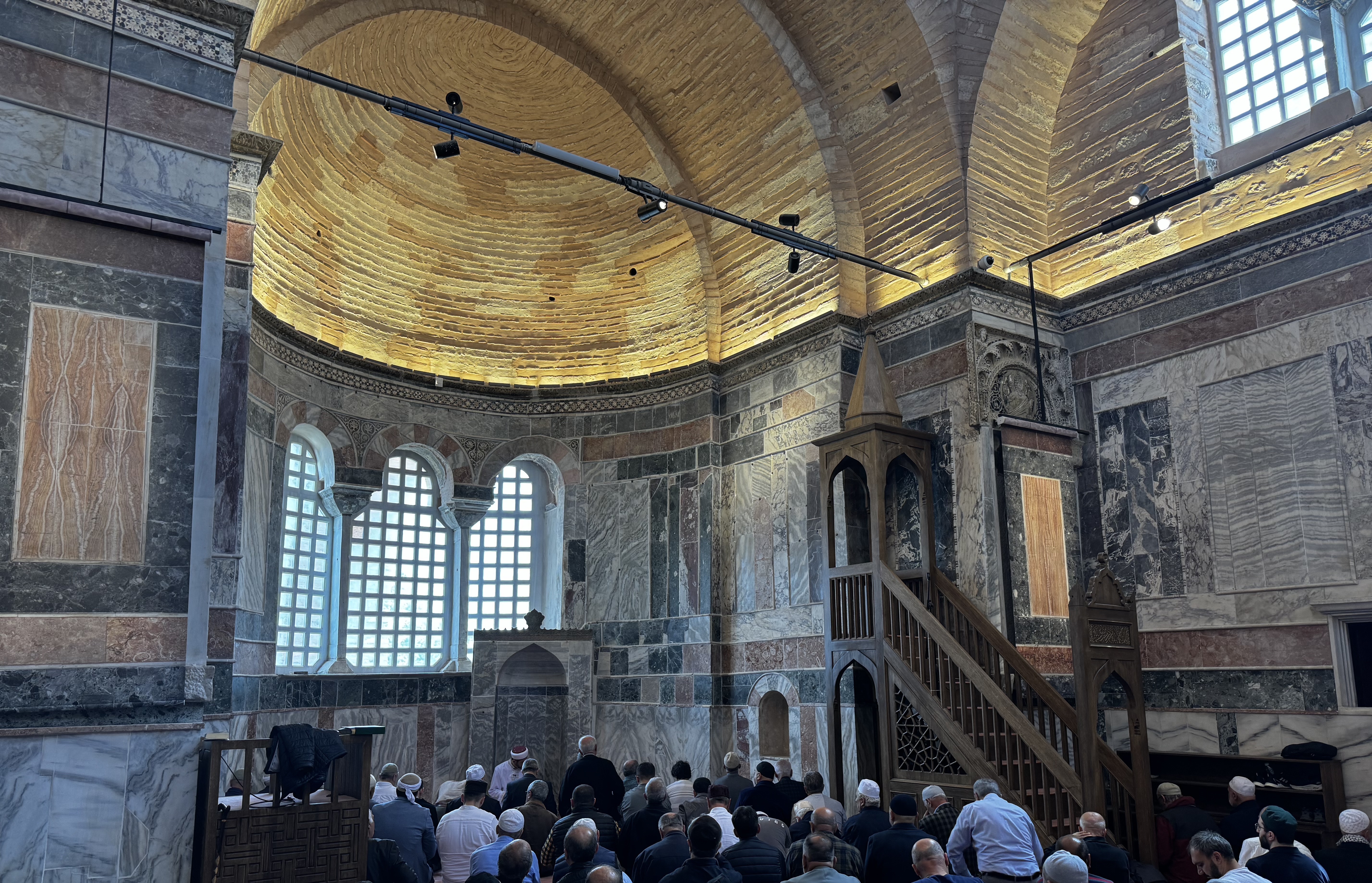
Interior of the original central nave (naos) in use as a mosque, with Christian mosaics and frescoes covered over

Chora, like the later Hagia Sophia, has over its history served as a church, a mosque, a museum, and now once again as a mosque. As I have noted in prior posts, the fact that buildings like Hagia Sophia and Chora have been able to transition from church to mosque without significant structural change helps us perceive how what became normative in mosque architecture had its origins in churches from the early Christian, pre-Islamic era. As a precursor to Hagia Sophia, the original walls of Chora may provide one of the earliest examples of what would develop into the cruciform plan for churches, a design pattern that became predominant in the Christian East. This approach to design for worship spaces is centered on a square, covered by a dome, a departure from the early rectangular basilica plan favored in the western Roman region.

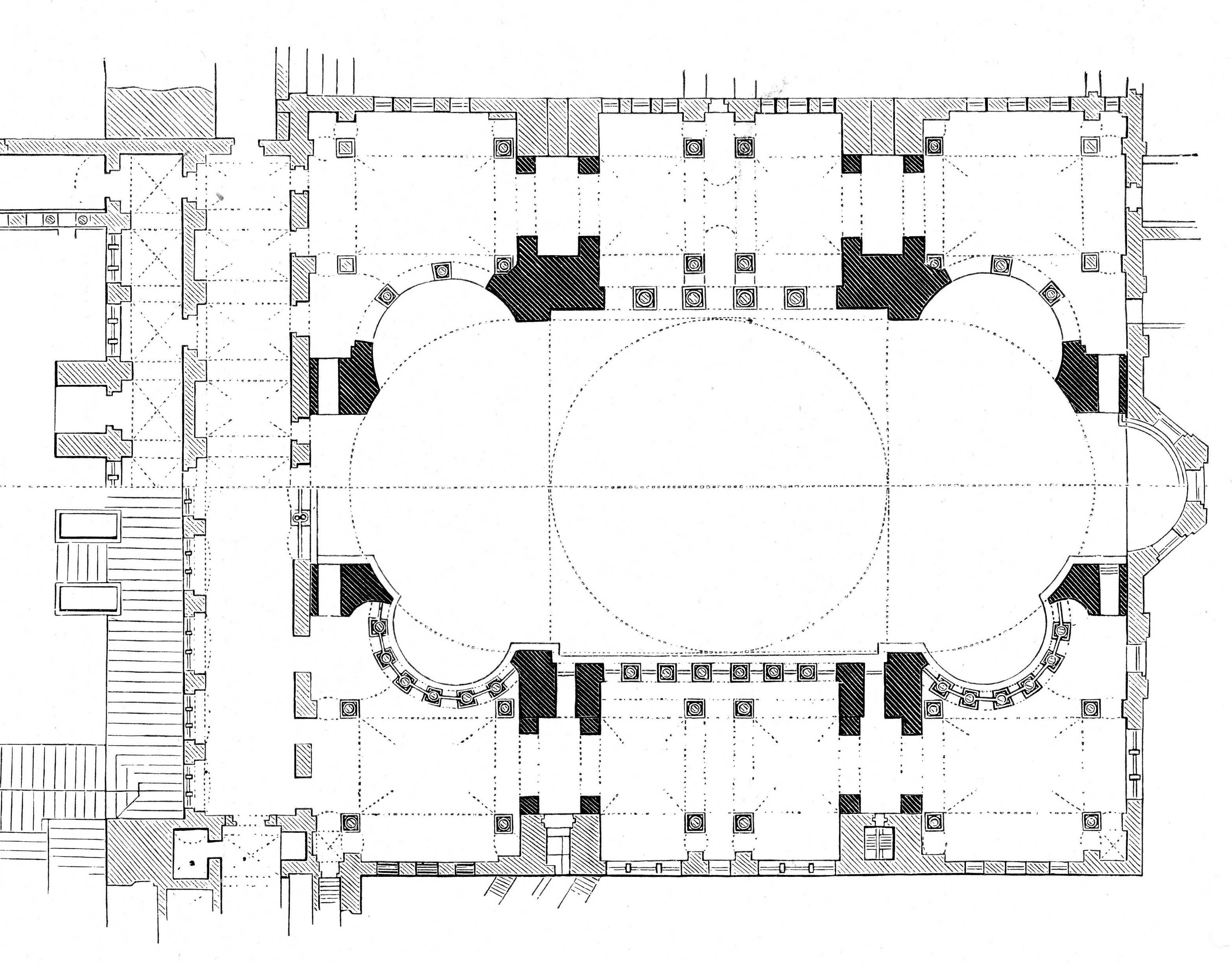
Floor plan of the Chora Church

In the floor plan above, note the subtle Greek Cross pattern of the central nave (or naos) below the large dome. As this plan indicates, the original, late Classical period Chora was significantly expanded during the Byzantine period, between the 11th century and the 14th century.

Section drawings of Chora Church showing the location of some murals and frescoes

In addition to its cruciform plan, and the church’s great antiquity, another feature that distinguishes Chora is its impressive collection of well-preserved Byzantine mosaics and frescoes, largely from the early fourteenth-century.

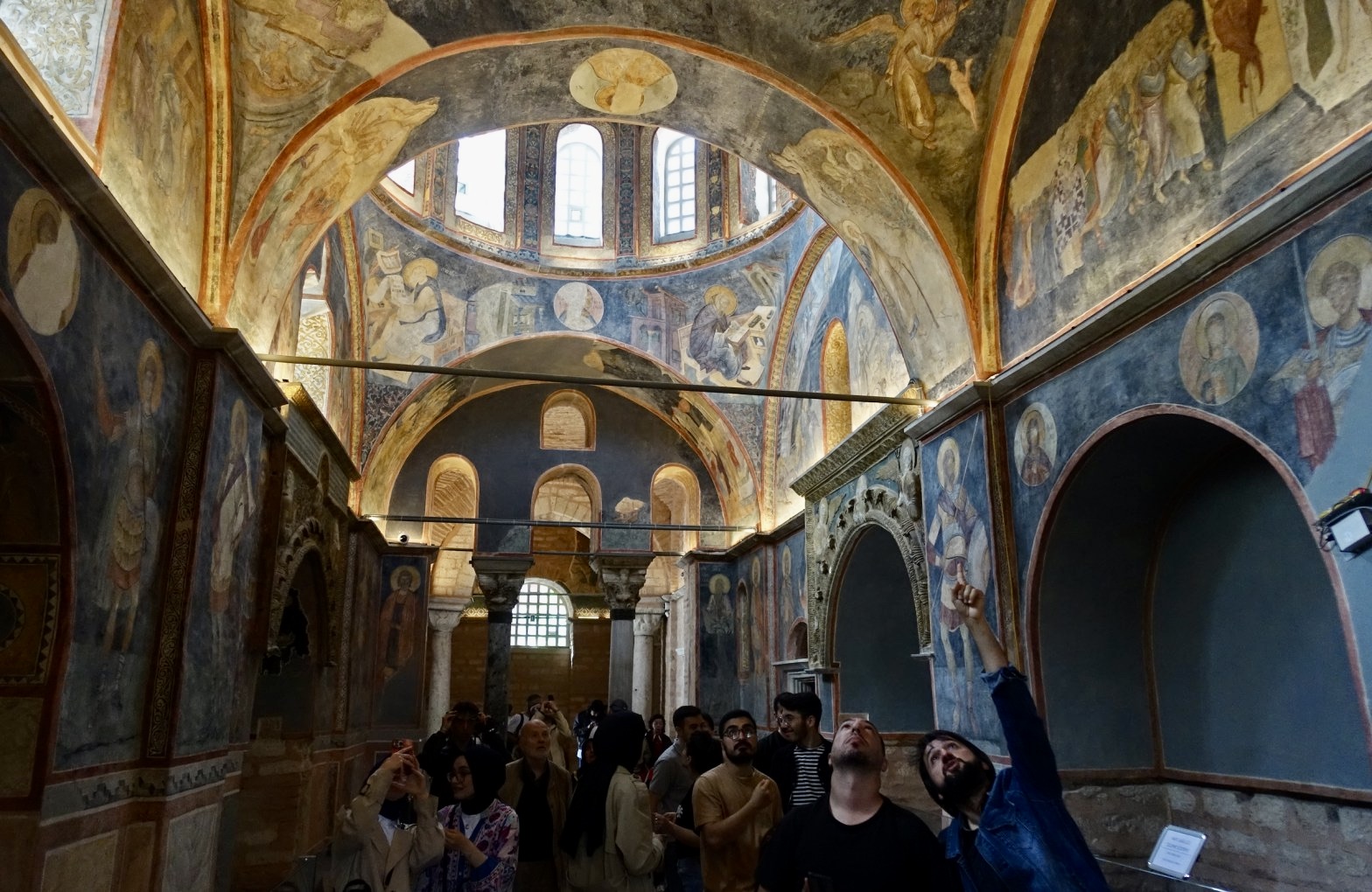
Visitors to Chora admiring the murals in the Byzantine-added “side church”

The bulk of the surviving mosaics and frescoes are located primarily in the side church (or parecclesion). This may be due to the central nave or naos having been used for Islamic worship during a significant portion of the building’s history. One of the many beautiful frescoes depicts a common theme found in works of art from the Christian East, that of the Harrowing of Hell. Images based on this theme depict the Christian belief concerning the first saving actions of the Risen Christ: pulling Adam and Eve out of their tombs and the clutches of the underworld (image below).

A fresco in the Side Church – Anastasis (or Resurrection): The Harrowing of Hell

A beautiful example of the Chora mosaics depicting Joseph and Mary’s enrollment for taxation in Bethlehem

Interior view of the side church

Like the later Hagia Sophia, Chora Church – for a time as a museum and now a mosque – still serves as an edifying spiritual place for Christians and people of other faiths to visit. For Orthodox Christians in the East, Chora’s numerous mosaics and frescoes provide multiple opportunities to (re)engage with biblical stories and with articles of faith in a way that the contemporaneous art in the much larger Arena (or Scrovegni) Chapel in Padua, Italy, provides enrichment for Western, Latin, Christians.

Exterior view of the southeast corner of Chora Church (note the later addition of a ‘flying buttress’)

A 1903 photograph of the west entrance to Chora in the late Ottoman period


Geoffrey Jellicoe: Finding and Creating Beauty in the World

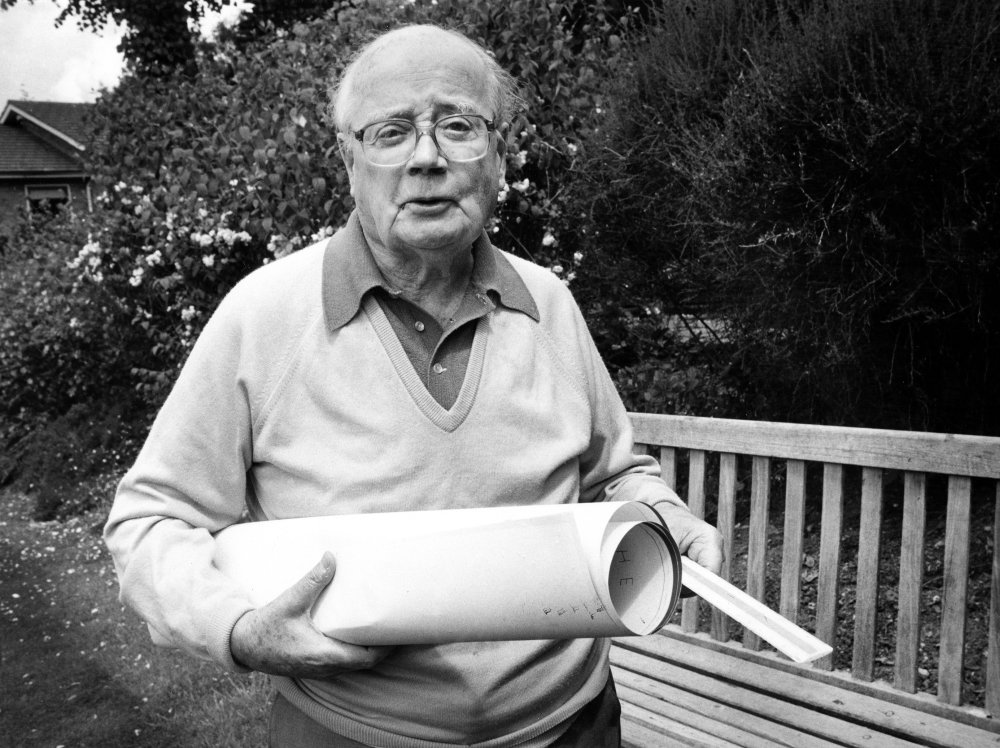
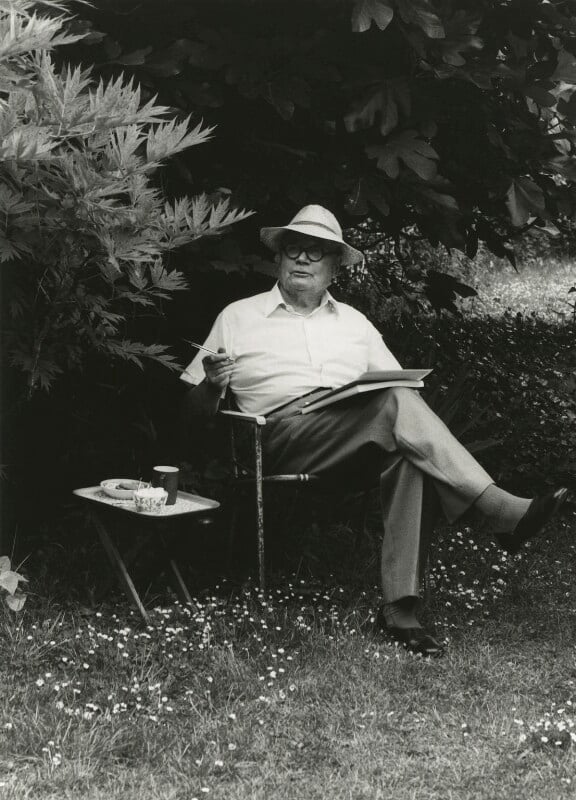
Sir Geoffrey Jellicoe at his London home shortly before his 90th birthday


Discerning beauty always presents an opportunity to experience joy. As many find, though, creating representations of beauty, as a chosen task, can be difficult.

Alive in my memory are images of areas of New York City and decaying areas of urban New England, during my high school years in the early 1970’s. I remember asking myself, as an aspiring architect and artist, how might I meet the challenge of creating examples of beauty in the world as we presently find it? Well, after some years, I discovered the life and work of Geoffrey Jellicoe, which provide an example of one way of answering questions that stay with me.

Late in his life, at a time when many seek the solace of retirement from actively pursuing such questions, Geoffrey Jellicoe took on a significant challenge. How might 150 acres of a seemingly forlorn stretch of a barrier island, adjacent to an urban area that has long surrendered to the declining effects of industrialization, be redeemed and transformed into a place for renewal by a humanistic vision of what might yet be?

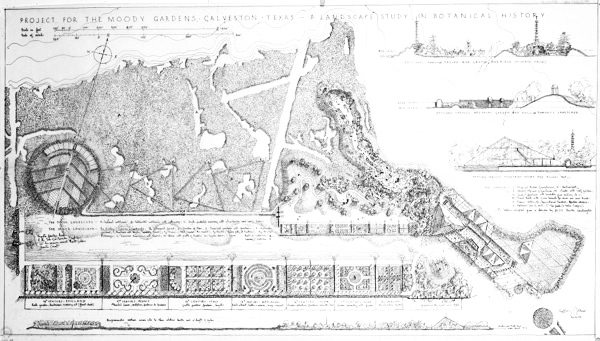
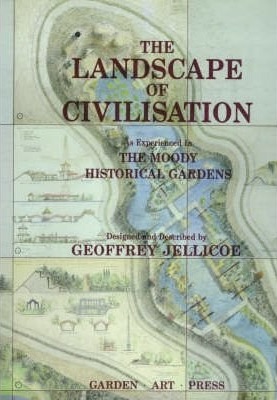
Jellicoe, at the age of 80, and to the surprise of some, accepted the opportunity to submit a proposal for what might become the Moody Gardens. In the process, he embraced the idea of working with a hundred-plus acres of neglected sea marsh and dune land on Galveston Island. This site even included a need to take into account an existing but under-used local airport. Nevertheless, the esteemed landscape architect, Jellicoe, envisioned a large facility centered on the nurture of human flourishing by designing what he hoped would become a significant botanical garden. Its plan would be dedicated to re-creating documented historic human efforts to re-shape areas of the world through the practices of horticulture and landscape architecture.

The Texas-based Moody Foundation, a philanthropic organization committed to education, health, and community development, found in Jellicoe the person they believed was best equipped to provide a master plan for what might become Moody Gardens, in the vicinity of Houston. And he brought to this challenge a lifetime of learning and accomplished work, which fitted him well to address this auspicious opportunity.

Encountering Moody Gardens as it has come to be, a vibrant, attractive, and an apparently successful facility, we may be mislead about Jellicoe’s orginal concept for the project. In presenting itself now as a tourist destination with resort-like amenities, Jellicoe’s early proposals for the Gardens seem fanciful if not also highly visionary. Yet, there may be significant things we can learn from his initial plans, and the concepts he sought to embody in his hoped-for realization of the project.

I can suggest a few of these potential learnings by posing some rhetorical questions – questions that I hope to address in future posts.

  • What is ‘our human nature,’ that we hope or believe we all share? What environments are most suited for nurturing the flourishing of our human nature?
  • What is Nature, and what humanly-created environments are most true to Nature? What things or places do we consider to be ‘natural’?
  • Why does it require human effort, financial capital, and institutional resources to facilitate, maintain, and preserve ‘natural’ environments? (Consider here the scope of the funding for the National Park Service, and the United States Forest Service.)
  • And, why is concern about the natural world- the ‘environment’ – properly a matter for serious theological reflection, and one especially related to our regard for Beauty? Why do our concerns about the natural world have theological significance?

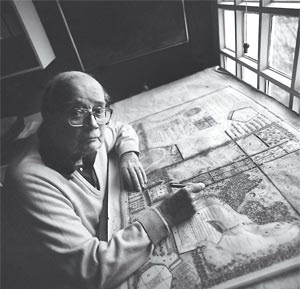
Geoffrey Jellicoe at work in his garden

Hagia Sophia’s Wondrous Dome

If reading this by email, please tap the title at the top to open your browser for the best experience. Then, clicking individual pictures will reveal higher resolution images.
Note the triangular semi-spherical panels (with angel images) on either side of the central arch


The dome over the center of Hagia Sophia has since its construction been an object of fascination, as much for its design as for its size. To stand within the space it covers is awe-inspiring. Though not unprecedented in form, the support structure for this massive dome sets the building apart. The architectural challenge the church’s designers overcame arose from a desire to set a circular dome over a square structure, especially if and when the walls of that structure would feature sizable arches.

In a traditional four-cornered room, and one in which arches (spanning the side walls) converge at the corners, a vertical line from floor to ceiling defines the juncture point of any two walls. A circular dome set on top of such a four-cornered structure would rest upon the walls, but upon the walls’ center points, above the arches. Most likely resting, therefore, upon the weakest points of those arched walls. Yet, the dome would not receive direct support at the building’s corners, usually the building’s strongest points, because the perimeter of the dome’s base would sit away from the square corners.

The genius of Hagia Sophia’s immense dome was the incorporation of what are formally termed “pendentives.” This architectural feature can be seen in the photo at the top, in the triangle-shaped, semi-spherical corner panels that allow the four corner columns to support the essential load-bearing portions of the dome’s base. It is illustrated in the diagram below (with the letter “a” representing the pendentives).

An illustration of a dome resting above pedentives

Readers of my prior post, upon the Greek Cross plan for Hagia Sophia, will observe how this mosque-cathedral has a basilica or rectangular shape at the upper level, while yet featuring a Greek Cross-shaped floor plan (see below). This is due the absence of half or semi-domes extending from the north and south sides of the building as they observably do on both the west and east ends.

Hagia Sophia floor plan, showing semi-domes (indicated by dotted lines) over the east and west ends of the Greek Cross floor plan, on either side of the central dome
Instead of the presence of half or semi-domes below the great arches on the upper level of the north and south sides of Hagia Sophia we find what are called “tympanaum.” These are wall screens that are punctuated by windows (see below).
A view of the tympanaum (or wall screen) below the dome on the south side of Hagia Sophia’s prayer space
Subsequent mosque designs, such as the breathtaking Süleymaniye Mosque in Istanbul (see below), took the same design concept forward while emphasizing the overall square shape of the Greek Cross.

These are some of the ways in which Hagia Sophia’s design set the stage for later mosque architecture. Later mosque plans tended to incorporate half or semi-domes on all four sides of the central, full-dome covered portion of the prayer space. In turn, these plans, as well as those of their predecessors, continue to influence the design of Christian churches in ways that can enhance the whole congregation’s participation in liturgy. (For more on this point, please see my prior post, “The Beauty of Hagia Sophia, and the Greek Cross”).

The Beauty of Hagia Sophia, and the Greek Cross

If reading this by email, please tap the title at the top to open your browser for the best experience. Then, clicking individual pictures will reveal higher resolution images.

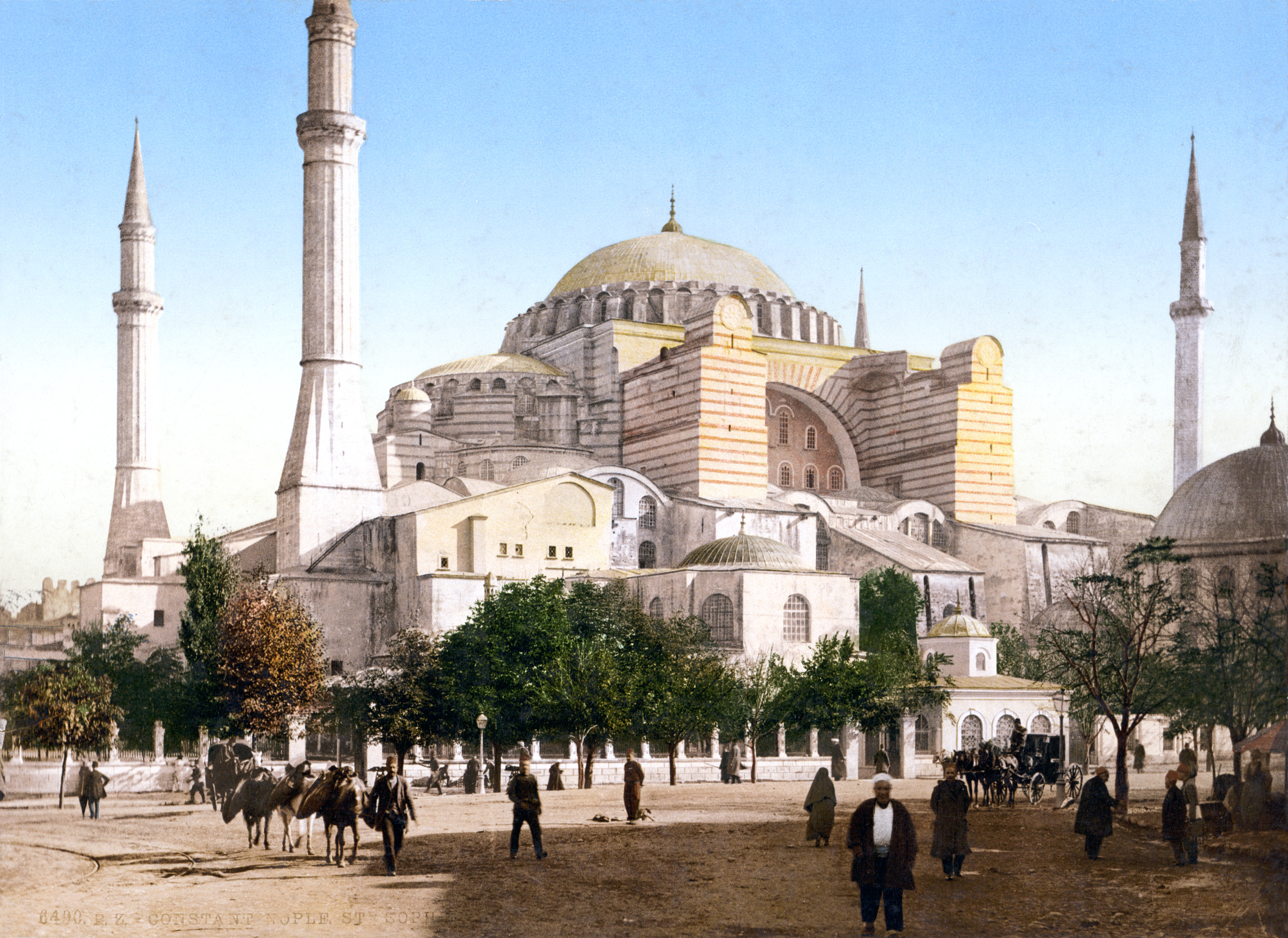
Hagia Sophia (late 19th century photo), showing a later-added (and no-longer-extant) marble paneled exterior


The first great church in Christendom, and the largest for a thousand years, was the Hagia Sophia in Istanbul. Many people think of this building as a mosque, the role in which it served from the Ottoman conquest of Constantinople in 1453 until it became a museum in 1935. The addition of minarets reinforces this historic identification of the building with Islam, and those tower-like structures once again serve (since 2020) as a means to broadcast the daily multiple summons to Muslims to attend the designated times of prayer.

This stunning building’s historical association with two of the worlds most prominent monotheistic religions has given rise to a paradox. The architectural form many of us readily associate with Islamic mosques, epitomized by present-day Hagia Sophia, is a form derived from a Christian house of worship. Most mosques, including those recently built around the world, have a structure reminiscent of this building, constructed under the reign of Justinian as the principal Christian cathedral of the late Roman or Byzantie empire, between 532 and 537 A.D.

Hagia Sophia as it sits today in modern Istanbul

The earliest Christian gathering places, before Christianity was officially recognized in the Roman Empire, were often in synagogues or in private homes as well as in safe outdoor places. Once Christians could build and maintain churches without interference, a common stylistic choice was to adopt the Roman basilica style of building, long used in Roman cities as locations for offices, courts, and for other public and business functions. They were usually designed with a rectagular floor plan, containing a central nave, accompanied by side aisles that were separated by columns supporting the central ceiling and roof.

Roof coverings over the side aisles were built at a lower height, allowing for clerestory windows in the nave above them, illuminating the central area. At one end was an apse, covered by a half or semi-dome. At the center of the apse was a dais where in Roman buildings magistrates sat, and which in later churches provided seating for the clergy.

Longitudinal plan for the Basilica of Maxentius and Constantine, Rome

Noticing how the above described spatial arrangement continues to be evident in modern churches helps us appreciate the significance of Justinian’s innovative plan for the Hagia Sophia. For the longitudinal Roman-derived spatial arrangement, evident in the basilica plan above, led in the West to the the placement of altars as well as the clergy attending them at one end of the building. Over time, these longitudinal basilica plans influenced Western medieval architects to design Gothic churches and cathedrals based loosely on the Latin cross, where the longitudinal length of the nave replicates the tall upright base of the cross, upholding the horizontal arms.

A common floor plan for Western, Latin, longitudinal church design (entrance at the west end; altar placed in the apse at the east end; nave is shaded)

By contrast, Justinian’s Hagia Sophia plan, widely influential in the Christian East, and subsequently adopted in Islamic architecture for mosques, is based on what is commonly called the Greek cross, where each of the four ‘arms’ of the cross are of equal length. Plans based upon the Greek Cross therefore lend themselves a to placement within a square and or a circle, rather than within a rectangle. They also provide scope for the placement of a large dome over the central and main part of the building.

Plan of Hagia Sophia (with an apse, but with a spatial arrangement based upon an equal-armed cross)

The effect of this Greek Cross-based development in church architecture has a symbolic significance in the liturgical use of buildings based upon it. The altar, even if placed near to one end of the building, sits more closely toward the center of the structure and within the resulting worship space. To be sure, the liturgical use of such church buildings in earlier centuries, and the theological views of those who worshipped in them, often implied hierarchical understandings of church membership, something common in the Latin West, as well. [Imagine what was subtly – if not intentionally – communicated when clergy were observed sitting in the places associated in the prior realm with public officials and the exercise of their offices.]

Yet, it is interesting to observe how a preference for Greek Cross (or circular) shaped building plans has received increased attention in modern liturgical renewal. This is because liturgical spaces based on such plans lend themselves more readily to a revived understanding of the Eucharist as an activity of the whole church, and not just of some who are designated if not also elevated to lead it, and provide its benefits.


In a subsequent post I will reflect on some further architectural features of Hagia Sophia and of designs based upon it.


The Mystic Rumi’s Burial Place

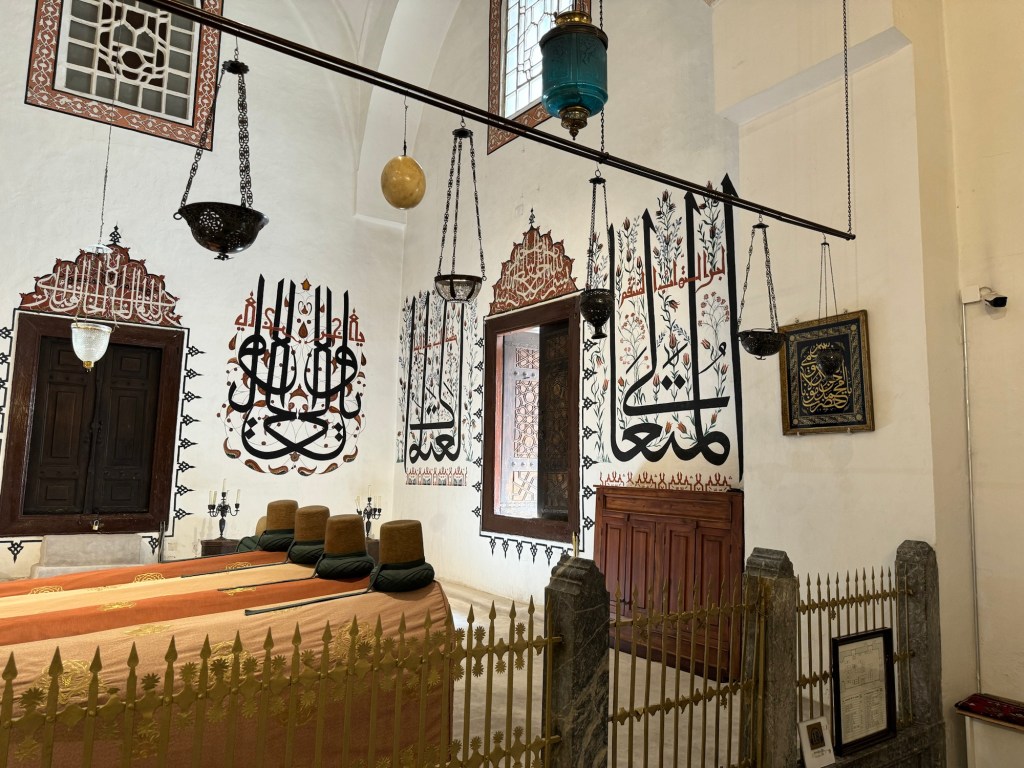
The burial place of the mystical Sufi poet, Rumi, in Konya, Turkey

Here are some photos from a recent visit to the mausoleum of the mystic Sufi poet, known in the West as Rumi. It is a very holy place for many who visit there.

The honorary coffin cover, sitting far above the entombed remains of the mystic Rumi
A Persian style multi-faceted dome in the same building
An interior view showing some of the remarkable calligraphy on the wall surfaces
A broader interior view
An original 13th century silver door
A replica small space in the courtyard adjacent to the mausoleum

Helen Nearing and Beautiful Stone Walls

If reading this by email, please tap the title at the top to open your browser for the best experience. Then, clicking individual pictures will reveal higher resolution images.


With the visionary but also impractical exuberance of youth, I graduated from high school imagining I would build my own house somewhere in New England. My design ideas were shaped by Frank Lloyd Wright while my notion of ‘responsible living’ was largely influenced by Henry David Thoreau as well as Helen and Scott Nearing. While already loving Wright’s architecture, my high school English teacher, Nick Fleck, opened a compelling new world for me through reading and learning about Thoreau and the Nearings. I identified with these mentors and the values they shared regarding building homes for themselves, and of living in harmony with the land.

Through books and articles, I then discovered an unexpected complementarity between the Nearings’ approach to home building in Vermont and Maine, and Frank Lloyd Wright’s method of construction at Taliesin West in Arizona. In what some call slipform masonary construction, builders first erect wooden forms. Between them, stones and cement are poured and allowed to set, creating walls and support pillars for the resulting structures. This method allows for considerable design flexibility while also being very economical, especially when field stone is readily available.

The Nearing’s stone house in Vermont

With the Nearings, the results reflected European and early American traditional influences in their desire to achieve an economical simplicity that was harmonious with the terrain upon which it was situated. For Wright, the plasticity of the method allowed for the creation of non-traditional walls and roof supports of varying angles and sizes. Just as concerned as the Nearings with what he called “an organic architecture” accessible to the common person, FLW – like them – sought to create a home and work environment rooted within a site while employing locally or regionally found materials when feasible. Whether or not the Nearings ever met Wright, they were clearly kindred spirits. In their most well-known book, Living the Good Life, they quote Wright in the chapter relating their stated “principles of architecture.”

Helen Nearing (facing viewer) in the gardens outside the later ‘home made of stone’ in Maine

Drawing from FLW’s writing, the Nearings articulated four general rules that should bear upon the design of domestic architecture. “Form and function should unite in the structure…; buildings should be adapted to their environments…; local materials are better adapted than any other…; {and} the style of a domestic establishment should express the {residents} and be an expression of themselves…” Clearly, the Nearings were more successful honoring that fourth principle than Wright generally was with respect to the wishes and temperament of his clients!

Helen and Scott Nearing identified several reasons for their choice to build their homes and outbuildings with stone. Stone buildings look natural in their setting; these found materials provide a variety of muted but attractive colors; sturctures made of stone are durable, practical, and economical to maintain; and buildings of this kind are less vulnerable to fire, while retaining coolness in the summer and warmth during the winter. For the Nearings, a decision to benefit from all these advantages of working with local stone was made more easy by their desire and willingness to build the structures themselves, thereby saving the financial cost of labor along with a reduction in the cost of materials.

Scott and Helen Nearing at work on a wall

Given their preference for this building material, the Nearings shared an advantage also enjoyed by Wright in Arizona – plentiful local stone with which to work. Many New England fields and forests are strewn with pieces of rock. People in Louisiana who enjoy landscaping, wish they could take for granted finding stone in such abundance. By contrast, the Vermont homesteader wishing to put up some simple but immensely practical buildings, from tool sheds to houses, can begin with a wheel barrow and a pair of gloves. Two other items are needed: cement mix in adequate quantities, and wooden forms within which the walls are to be fashioned. Happy to work without mechanized tools, the Nearings used a wheelbarrow to gather the stone, mix the cement, and transport both to where they were needed.

Two photos of Taliesin apprentices at work building slipform walls

Another point of continuity between the Nearings’ and Wright in their approach to how we might best live was the way in which they attracted large numbers of young visitors and students. With both FLW and the Nearings, those who came and stayed sought to learn about the life and work of their mentors not merely in a intellectual way, but share in it holistically. The Nearings and Wright, in their different spheres of concern, nurtured communities of fellowship and learning. This helped them influence generations of young people who, led by the example of their teachers, lived into a deepened appreciation for significant principles to which one might commit a life.

The finished result of slipform construction at Taliesin West

Helen Nearing in front of a wall she built with Scott


For more about Nick Fleck and his influence upon me and many others, please see my prior post, “The Beauty of Asking ‘Why?’” Helen and Scott Nearing’s farm in Maine is preserved as a living legacy, and is maintained as The Good Life Center (https://goodlife.org/about/).

Here is a link to my earlier post featuring some house design ideas I imagined building for myself, “The Beauty of FL Wright’s Influence” (https://towardbeauty.org/2023/02/15/the-beauty-of-fl-wrights-influence/).

Note: blog settings have been changed to provide more opportunity to offer comments, using the link below.

The Beauty of Asking “Why?”

If reading this by email, please tap the title at the top to open your browser for the best experience. Then, clicking individual pictures will reveal higher resolution images.

Back cover photo from Natural Sustenance: Selected Poems, by Nick Fleck


“Why?” It all started in a seemingly innocuous way. “What do you want from this course,” he asked. A brave one among us ventured the answer that some of us were thinking, but were not honest enough to say: “an ‘A’.” Our English teacher, Nick Fleck, responded to my classmate in a neutral way, with a further question, “Why?” Our fellow aspirant to higher grades began to offer pretty typical answers, unoriginal and unsurprising. “I want a high GPA. (Why?)… I want to get into a good college. (Why?)… I want to get into a ranked law school. (Why?)… I want a good job at a high powered law firm. (Why?)…”

Gradually the pauses before our classmate’s answers became longer. And while his responses still sounded plausible, they seemed less and less assured. That first class session set the tone for the rest of term, as over time Nick prodded all of us to articulate answers to questions like these. And nudged us toward answers that were more and more our own, and less dependent on our peers, our parents’ expectations, and our perceptions of the uncertain world outside our rural New England prep school.

Why? The question at first provides an invitation to share acquired knowledge, display settled opinions, and voice aspirations. But the question can also be unsettling, especially when we begin to run out of platitudes and ‘safe’ answers that don’t require self examination or being open to adopt a different perspective.

I can’t fully explain why, out of a class of some 350 or so fellow graduates, I was one of only 3 or 4 who did not go directly on to college. But Nick Fleck’s persistence in challenging us to think for ourselves played a big part in it. Temperamentally, I was and am a self-learner, which disposed me toward pursuing that risky path (“…in a blind career…,” as in a line from a poem Nick had us read). Naive self-confidence also bolstered my willingness to undertake a journey on what appeared to be a largely untested road. I wanted to be an architect and to make art, and those whom I most admired had embarked upon their careers in earlier times by this same route through apprenticeship and self-study.

Having been so consistently asked why, I made the question my own and began asking it in a self-referential way. Why did I want so strongly to embrace and try to create what was beautiful? Why was this important to me… and to others apparently walking the same path? Why was I then beginning to wonder whether this was good and, if so, to what end? And why then was I going on to ponder what was good for its own sake as compared to things of passing significance?

Within a year, after living in New York City seeking non-existent apprentice drafting positions during the ‘oil crisis,’ I returned hesitantly to formal schooling. My college art studies were interrupted by another sideline, driving a forklift in a warehouse freezer for six months as a Teamster. Then, surely to my parents’ relief, asking why led me on a more traditional path, from art history to classics and medieval studies, during which I experienced an unanticipated spiritual conversion. All the while I was living with the same question: why?

Nick Fleck was not a religious man in any sense that I could discern, though he was clearly attuned to the ethical principles exemplified in Thoreau’s writing, and latent in poems he would have us read. I think it greatly surprised him when, returning for our 25th reunion, I gave him credit for setting me on the path that led to my conversion, ordination, theological studies, seminary teaching, and parochial work – experiences not readily familiar to him. But he was the one who persistently asked why, and who invited us to own the question for ourselves.

This week I realize that Nick’s great question was at the heart of the Disciples’ questions when Jesus predicted his forthcoming suffering and death. Nick’s question is simple, and perfect for Lenten reflection.


I was happy to see an article in the Greenfield Recorder noting how Nick Fleck had founded the Northfield (Mass.) Bird Club and was still active in leading bird walks. I trust that he continues to write and share his poetry, and help open new worlds to young persons. He helped us to discover the power latent in the word, “why,” especially when posed as a question.

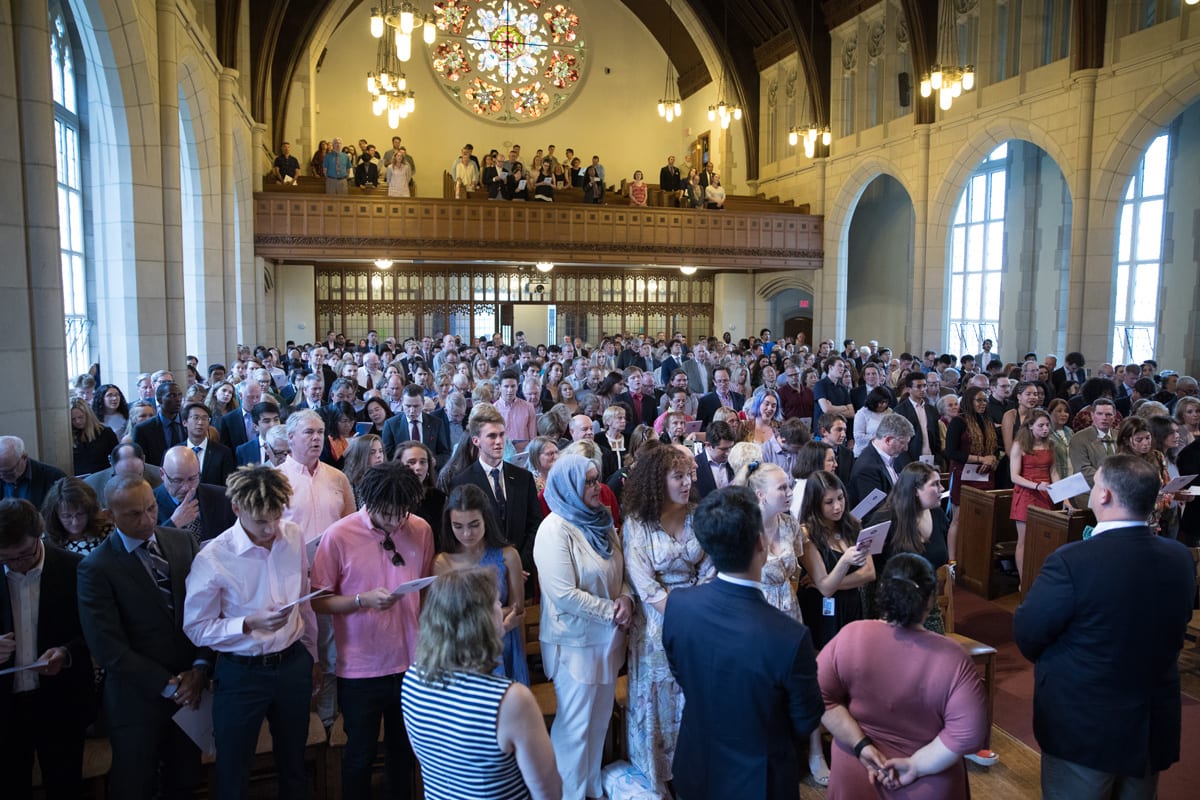
The recent movie, The Holdovers, was partly filmed at my school, Northfield Mt. Hermon, and is set in exactly the time period I was there. During those years, I was in the chapel depicted within the movie a couple of times each week for required assembly gatherings. Seeing my school again during my 50th graduation anniversary year has obviously brought back memories.

A recent gathering in Northfield Mt. Hermon’s Memorial Chapel.


Note: blog settings have been changed to provide more opportunity to offer comments, using the link below.

A Lost Treasure: Midway Gardens

If reading this by email, please tap the title at the top to open your browser for the best experience. Then, clicking individual pictures will reveal higher resolution images.


Someone as long-lived and hugely prolific as Frank Lloyd Wright might have been vulnerable to self-imitation in his work if he had run out of ideas before he ran out of clients. But like Picasso with regard to painting, Wright frequently surprised and impressed the wider public as well as many critics by his astonishing creativity, evident through several phases of self-reinvention in his work. Absorbing much from his teachers, Louis Sullivan among others, he then fundamentally transformed what he learned by creating new paradigms for architecture. FLW advanced our concept of what is beautiful and worth achieving through the design of buildings, and in helping us perceive the aesthetic potential of inspiring spaces in which to live and work, and simply be.

I have previously featured Wright’s 1923 Tokyo Imperial Hotel, located just down the avenue from the Japanese palace of the same name. Sadly, it was demolished in a 1960’s rebuilding program. An earlier structure for Chicago by Wright, with which the Imperial had considerable affinity, was his Midway Gardens, a large and elaborate project built in 1914. It was also subsequently razed despite its auspicious location on the Midway in the city’s Hyde Park neighborhood. Located across from Washington Park, and astride 60th Street, the Midway Gardens facility sat adjacent to the former location of the great Chicago Columbian Exposition of 1893, in an area graced by the landscaping of Frederick Law Olmsted.

Now less well-known than its later Tokyo counterpart, Midway Gardens succumbed to its early demolition in 1929 due, at least in part, to Prohibition and the Great Depression. It is said that the complex was built with such structural integrity that the firm contracted to apply the wrecking ball went out of business as a result of its financial loss on the project.

Midway Gardens interior (above), Imperial Hotel interior (below)

Midway Gardens was created to provide Chicago with a year-round, indoor/outdoor, concert and entertainment venue where one could enjoy dining and socializing while being able to listen to live music. Like the Imperial Hotel and a number of Wright’s California houses, it was built in what is called the Mayan Revival style, and featured Wright’s characteristic horizontal bands of yellow brick intermixed with pattern-imprinted concrete block, soaring cantilevered terraces and overhangs, and Wright-designed ornamental features such as sculpture, light fixtures, and garden urns. As with so many of his projects, FLW prepared and oversaw the implementation of plans for every detail from roof and window design to that of the dining tables and restaurant china.

Of particular interest at Midway Gardens were Wright’s designs for the sculptures and sculptural elements executed by Alfonso Iannelli, many of whose stoneworks were lost in the subsequent demolition. Wright’s timeless designs for the Sprite sculptures later reappeared in stone at Taliesin West, and reproductions of them continue to be commercially available today.


A “Sprite” executed by Alfonso Iannelli based on Wright’s plans

Courtyard architectural detail


Surviving cast concrete forms designed by Wright

Midway Gardens interior terrace

Unfortunately, no color photos of Midway Gardens appear to have survived. However, photos of the Imperial Hotel help give us a sense of the design qualities of the Gardens structures and of what it would have been like to visit there. The foreign language labeled illustration below helps us appreciate the overall scale and character of the complex, and what a loss it is to American architecture that the facility was demolished, especially when it would be so congenial to contemporary design sensibility.

The Cottage Grove Avenue entrance area

Midway Gardens in its heyday


A link to my prior post on Wright’s Imperial Hotel can be found here. I am indebted to the website, WikiArquitectura, for some of the photos included here.

Note: blog settings have been changed to provide more opportunity to offer comments, using the link below.

A Japanese Tiny House: Less Can Be More

If reading this by email, please tap the title at the top to open your browser for the best experience. Then, clicking individual pictures will reveal higher resolution images.

Tiny house on wheels, by designer Haruhiko Tagami


Imagine Frank Lloyd Wright joining forces with Marie Kondo in accepting a challenge to create a tiny house on wheels. This is what Haruhiko Tagami has designed and built for a couple in Japan. Sitting on a single axle trailer frame and weighing approximately 1,300 lbs, Tagami has produced a remarkable example of a miniature F.L. Wright Prairie house on wheels. With its horizontal bands of unfinished lapstrake cedar planking, its recessed corner windows along with those of the light-admitting clerestory above, and clever use of space, the designer of this mobile mini-residence has done ‘the Master’ proud. It even includes a small but efficient wood burning fireplace.

Interior view

A very Japanese feature of this rolling tiny house is the intended multi-use of its principle room as a place for sitting, dining, and sleeping. Backless cushions are provided for sitting, with a table that can be stowed away, especially for night time. Bedding is then brought out from a storage cabinet and spread on a flat surface just as it would be in a traditional Japanese house. The small structure has a minimalist kitchen at the far end, made larger in feel by the expansive window adjacent to the work area. The clerestory above provides standing headroom for a person over 6′ in height, as well as a 360 degree view of the unit’s surroundings.

The kitchen area

When considering all the amenities built into this tiny house, it is hard to envision how small it really is. And yet it provides adequate room for two people to use for extended trips or as a get-away place in the country. The designer kept the overall result compact and light, suitable for towing behind an average vehicle, and able to be parked (without the vehicle) in a typical parking space. A portable toilet is among the items for which stowage is provided within, though the owners specifically did not want space taken up by even a small bathroom. Public toilets are widely available in Japan, and public bathhouses are easily found in almost every neighborhood or community, in addition to the numerous hot springs facilities located throughout the country.


On a larger scale, the Oregon Cottage Company has produced in this country a tiny house they call the Tea House cottage (depicted below). It is built on an 8′ x 20′ trailer frame and includes a formal area for the tea ceremony. Though the exterior of this Japanese inspired example looks conventionally Western, the interior incorporates a number of distinctly Japanese features enhanced by the unfinished birchwood wall surfaces. The windows have opaque shoji screen coverings, and traditional tatami mats cover the floor surface, which contains an aperture for preparing the tea pot. This little ‘tea house’ even provides an enclosed Japanese style soaking tub.

Interior view of Oregon Cottage Company Tea House trailer

Clearly the spare minimalism of traditional Japanese domestic interiors is well suited to tiny house design. These structures provide very attractive places for rest and retreat wherein the beauty of being surrounded by less may contribute greatly to one’s experience of a time away. Imagine – even for a short stay – inhabiting one of these pleasing spaces.


A Building That Evokes Awe and Wonder

[If reading this by email, please tap the title at the top to open your browser for the best experience. Then, clicking individual pictures will reveal higher resolution images.


This is one of the most beautiful buildings in the world, and astonishingly it has survived twenty centuries since its construction during the great age of Rome, around 120 A.D. Replacing two earlier buildings lost to fire, this third one was built for the ages. After two thousand years, its coffered ceiling remains the largest unreinforced concrete dome in the world, and it continues to evoke awe and wonder among architects. The building is, of course, the Pantheon, whose formal Christian name is the Basilica of St. Mary and the Martyrs.

Unlike some buildings of equal stature and antiquity, the Pantheon has survived because it was consecrated as a church that has since been in continuous use. First built as a temple whose practices were anchored in pagan religious cults, its original Greek name suggests that the building was dedicated to a multitude of Roman God’s. Indeed, many modern visitors know the building only by its classical name rather than by its later Christian one, even though the transition from its original purpose for pagan worship to its current one occurred fourteen-hundred years ago!

Think about that for a moment. A pagan temple, apparently dedicated to a panoply of Roman deities, was then consecrated as a church, and renamed to commemorate Christian saints. The building’s earlier purpose and meaning was not seen as inimical to its later use for holy Christian worship.

For some of us, that is unimaginable! It seems more likely that the building would have been razed, and its materials reused to build an entirely new building for Christ-inspired liturgies. That such a removal and replacement did not happen represents courage, the courage of holy imagination turned loose to see what is good, positive, and hopeful, even amidst the remains of a decaying or already dead civilization.

The origin of the great feast of All Saints, that we celebrate on November 1 or the following Sunday, is identified by some historians with the re-dedication of the Pantheon for Christian worship, in the spring of the year 609 or 610. In its subsequent role, the building commemorates both Mary and remembered Christian witnesses to the Faith. Its new name may reinforce a misleading idea that saints like Mary, as well as the martyrs, are unique and special persons, marked out for attention because they are so different from us.

In the century after the Pantheon was consecrated as a church, the community of those honored on All Saints came to be seen as including all those who have ‘washed their robes in the blood of the lamb,’ to quote an All Saints lectionary reading from John’s Revelation. This fits well with the more expansive biblical understanding of saints. Because, in the New Testament, ‘saints’ are all the baptized; in other words, they are everyday members of the Church.

For example, at the opening of his letter to the Ephesians, Paul writes “to the saints who are in Ephesus, and are faithful in Christ Jesus.” Paul is referring not just to a select elite within that community; he is referring to all of them, who are – through Baptism – in Christ. Therefore, on All Saints, we commemorate not only saints who are remembered on particular feasts, but we celebrate all the baptized, including my granddaughter, Charlotte Mary, ‘Christened’ this past Sunday as she “put on Christ” and became a “child of God through faith (Gal 3:26-27).”

Here, among the tourists admiring beautiful ancient Roman architecture, and especially that great curved ceiling with its oculus or skylight, there are surely many saints to be found. We can hope they pause to pray in the midst of their visit and remember the ‘light of the world.’ Jesus, in John, refers to himself by these words. Perhaps to our surprise, Matthew quotes Jesus as saying that – after their call – his disciples share this remarkable identity and vocation with him.