Perception

God’s Handiwork Inspires Ours

Stones found on a northern Lake Michigan beach

Labor Day is around the corner and some of us may receive and enjoy a day off from work. What we call retirement, a stage in life I am presently enjoying, tends to represent leaving work behind. Yet these and related ideas rest upon a common assumption, that work is different from, and in some ways inimical to, enjoying fulfillment in life.

I find a biblically based theological insight helpful when thinking about work. As with many matters that can be looked at from the perspective of Christian moral theology, our view of work can be enhanced by making reference to four specific reference points. These are, first, what we have learned about God’s purposes in Creation for this or that aspect of our lives; then, what impact sin associated with our Fall has had upon what we are thinking about; third, how God’s ongoing work of Redemption has restored and or transformed the matter presently under consideration; and fourth, to ask what future – if any – does this aspect of our lives have in Christ. 

Work provides a wonderful topic for engaging in this fourfold inquiry. Based on our common way of thinking about work, it may be hard for us to consider the meaning of work from any other vantage point than of attributing its role in our lives to the Fall and to the ongoing effects of human sin. Yet, we can also learn from many who have come before us who have distinguished work from toil. This can help us see how forms of labor, and pejorative associations the word may have for us, are surely due to our proclivity to link such activity with burdensome unpleasant duties.

For what we may overlook is the biblical view of how God has shared stewardship responsibility for aspects of Creation with us, as beings created in God’s image and likeness. This was symbolized by the way that our mythic forebears (Adam and Eve) were given their ‘work’ of naming the animals as a path toward fulfillment. It was not until their expulsion from the Garden that the first human beings are described as prone to acts characteristic of sin. Thereupon, in biblical theology, our heavenly ‘work’ of praise, and of divinely-invited participation in God’s Creation stewardship, ceased to be pleasingly ready pathways toward human fulfillment, and became energy draining and spirit-diminishing activities – such as we tend to find them to be now.

A growing segment of the wider Christian community shows signs of acknowledging how God’s work of Redemption is ongoing, quite aside from its ‘once and for all time’ episodic saving events. The pattern and purpose remains the same – nothing fundamentally new is added, nothing old of lasting value taken away. Preeminent remains God’s abiding purpose for us to become and be God-like in God-intended ways. For, as Athanasius taught us, the Son of God became the Son of Man, so that the children of men and women could become the children of God. Work – not toil nor burdensome labor but creative and fulfilling work – remains a vital part of our holy path toward wholeness.

And to remind us of this abiding truth, the loving Creator has spread around us an uncountable abundance. These are the signs of outpoured and participatory grace, some of them very small, like stepped-upon seashore pebbles and tiny blossoms among hurried-by roadside weeds.

Too quickly we dismiss the significance of our our small acts of selfless giving, not to be counted by us, but adding up to so much more than we imagine in the life-growth of others. This is our holy ‘work,’ overlooked but important stepping stones on our path toward living into the godly fullness with which Christ fills us.

If on our daily course our mind

Be set, to hallow all we find,

New treasures still, of countless price,

God will provide for sacrifice.

Old friends, old scenes, will lovelier be,

As more of heaven in each we see:

Some softening gleam of love and prayer

Shall dawn on every cross and care.

[John Keble, “Morning,” from The Christian Year]

The Beauty of Gray

James_McNeill_Whistler_-_Nocturne-_Blue_and_Gold--Southampton_Water_-1280


When asked, I used to say that gray was my favorite color. Correctly, some would respond that gray is not a color, but the series of shades marking the region between black and white. Gray often represents a mixture of the two in pigment.

Examined more patiently and reflectively, and in a less technical way, gray is alive with color–but subtle color. Just look up “Payne’s grey” (note, U.K. spelling), and you will see.

Perhaps my childhood in Japan, as well as my adult experience in England, formed my appreciation for the beauty latent within the world of gray. I love James McNeil Whistler’s paintings, and especially those that employ fields of gray permeated with subtle color. Many of these were influenced by Japanese prints.

I consider these things as I reflect on the recent film, The Giver. Though people will say it starts “in black and white,” I think it can be described more properly as immersing us in a visual field of gray. The film is compelling, and not simply sentimental or youthfully romantic (which it might easily have been), because of how positive aspects of this gray world are thoughtfully presented. A thematically ‘black and white’ film would portray a more polarized contrast between the forgotten past of color, which included both conflict, hate and violence as well as their alluring opposites, and a hypothetical present world, deceptively gray, where—eerily— all seems well. A gray world might imply moral ambiguity rather than moral neutrality.

As we emerge from adolescence into adulthood, don’t we seek stability as we move away from the up-and-down emotional life of our teenage years? Don’t we assume that monastics—like us— seek something spiritually akin to a world of gray, enabled by their departure from our world of distraction, competition and self-promotion?

The Giver risks presenting a gray world as desirable, and then fearfully threatened and upset by a young man’s journey into the forgotten past. There is beauty to be found almost everywhere, in a world filled with heart-breaking contrasts of emotion and alive with color, yet even in one where affectively numb persons find everything appears in a field of gray.

I don’t question the value of the hero’s journey, nor its evocative results. Yet, I continue to muse about what made the gray world attractive to those who shaped and promoted it. Simplicity, even a morally reductionist simplicity, has abiding appeal.


Above: James McNeill Whistler’s Nocturne: Blue and Gold—Southampton Water (1872). Note the reference to color in the title of a very gray-looking painting.

Beauty in Marriage

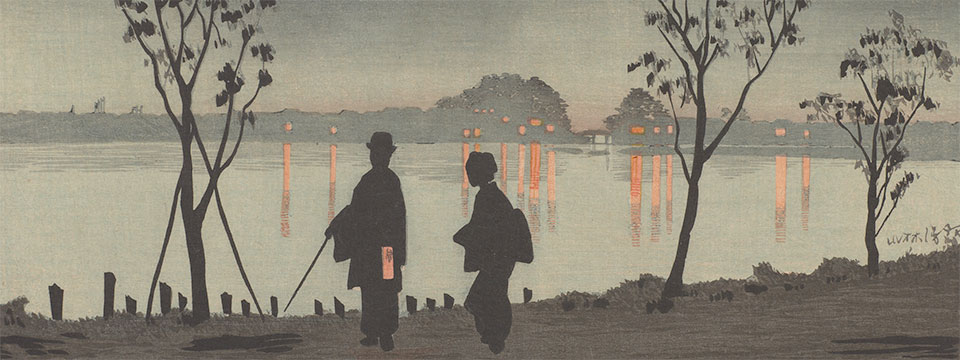
Kiyochika-Sumida River by Night-Detail-1881


Adapted from a recent wedding homily for my son.

In Sumida River by Night, Kobayashi Kiyochika depicts a man and a woman walking in Tokyo, late on a summer evening. Though from Asia, this 1881 print had a profound influence upon the American painter, James McNeill Whistler. I love how the artist grabs our interest with the glow of red paper lanterns, both near and far. This beautiful image provides a helpful metaphor.

We can see in this picture a reflection of our lives. Hans and Bridget, in your marriage together, you will have many occasions to look out onto life in the world around you and notice others. Your attention may be caught by a parallel to the glowing lights along the far side of the river in this print. Though you may have a light between yourselves, your eyes can be drawn to the multiplicity of other lights around you, and the way they reflect off events and other people. There will be times when you may think others are more happy or fortunate than you are.

Especially when we are young, we tend to think that knowledge, goodness and happiness lie elsewhere, and in others. It’s actually an important part of our journey into maturity to want to attain these things for ourselves. Our admiration for others and their achievements, prompts us to reach further and higher. But this same experience can create an illusion, the mistaken belief that we are of less value.

A similar thing can happen with love, especially romantic love. When we are single, we notice couples walking together in parks and along streets. It seems that others have found their mate, and a kind of happiness that eludes us. Even when we meet that special person, as we get to know him or her and as our relationship matures, we begin to see that not everything goes smoothly. Once again, we are prone to looking at other couples with a misleading idea ~ that they have something more than we have.

But there is another way to see this picture, which applies equally well to you at this point in your lives. I think the artist has deliberately portrayed this couple as older, with the man shown holding a cane. Notice how the paper lantern in his hand, in whose glow they both walk, rivals anything glowing on the horizon. It may be smaller than the great lanterns across the river, but it is near them and within their hands. They have all the light they need, shared between them, as they walk along the river of life.

I have suggested two ways of looking at this print, paralleling two ways of looking at our lives together in this world. In seeing this print as portraying a young couple, we might reflect on the way that things in our lives can seem scarce and limited, and how our attention can become fixed on what seems to be missing. Yet, seen the second way, as portraying an older couple, our hearts can be filled with an awareness of abundance, and how everything we really need is within our reach, if not already in hand.

You may think that I am talking about such things as our natural talents and abilities, and the resources we have been given or have attained through our work. But what I actually have in mind is that great intangible thing we call love. I have in mind not only the kind of love we have for one another, in romance and marriage and for others in our families. I mainly have in mind the kind of love we are given by our Lord, especially when we ask him for it.

The natural love the two of you have for one another is complemented by a supernatural love you will have for each other in marriage. This is a love that is given to you and through you, for your life together. Though some things in your life may become scarce, and even if many things become limited, you will always have all the love you need. Your love will be the light you carry with you as you journey along the path you share together. This kind of love, and this kind of light, are gifts, rather than something you purchase or attain. And so, tomorrow you will have just as much of this love and light to illumine your walk together, as you will have when you are old.

Jesus said, “You are the light of the world!” We are used to Jesus being spoken of as the light of the world. But he tells us that, through his gift, we share the quality of being light for the world. Love illuminates darkened hearts and darkened lives, and love becomes the source of life, true life. Jesus does not want us to hide the light he gives us. Instead, he wants us to display it through how we live, that others might give glory to our father in heaven. Even if we mistakenly think we have so little of this love, and even if sometimes there seems to be more of it in the world around us than in ourselves.

The Church is very wise to appoint this portion of Matthew’s Gospel as a reading for weddings. Not only does our Lord hope that we as individuals will bear witness to his light and love; he intends that our marriages, and our lives together as families, will display the same light.

Hans and Bridget, the love that you share with one another and with Conor and Brady is, at its heart, a gift from God. Let this light that you share as a family, be a light for your path. May it also be a beacon of light for those around you.


Sumida River by Night (1881), by Kobayashi Kiyochika. Matthew 5:13-16 is one of five Gospel readings appointed for The Celebration and Blessing of a Marriage in The Book of Common Prayer. This homily was offered near the great Mississippi River, in Baton Rouge, LA, in May.

Beauty and Grace

All-Things-Relative-Portland-Japanese-Garden-Oregon_WhereToWillie


A 4th century liturgy speaks to contemporary concerns, particularly our attention to the health of the created world around us. It helps us see that we have more than an ethical motivation for our interest in respecting the ordered patterns we find in nature. Our flourishing, and that of other living things, also depends upon how nature mediates grace, and how the Creator infuses the whole world with divine presence.

The opening paragraphs of this prayer express the mystery of God’s transcendence and immanence. First, God’s transcendence: “It is truly right to glorify you, … for you alone are God, living and true, dwelling in light inaccessible from before time and for ever.” Next, God’s immanent presence: “Fountain of life and source of all goodness, you made all things and fill them with your blessing; you created them to rejoice in the splendor of your radiance.”

Discerning the beauty of God’s presence throughout creation is part of our our calling as human beings who are made in the divine image and likeness. Naming God’s presence, and helping others see it, also number among our vocational tasks. “Joining with [the countless throngs of angels who stand before God], and giving voice to every creature under heaven,” we acclaim our Lord, and glorify his Name.

The song we sing with the angels, in every eucharistic prayer, echoes Isaiah’s words in the Temple, and the seer John, in his Revelation: “Holy, holy, holy Lord, God of power and might, heaven and earth are full of your glory…”

Because the earth is full of God’s glory, we are in a position to notice and celebrate its reality. By doing so, we give voice to every creature under heaven, and especially to creatures unable to speak or recognize how the whole world mediates the Creator’s grace. For “ever since the creation of the world, his eternal power and divine nature, invisible though they are, have been understood and seen through the things he has made.” *

As long as we remember that God is both utterly beyond and absolutely near, it is appropriate to associate the beauty of this world with God’s mediated presence. When we are moved to praise the glory of nature, we should always remember to sing praise of her Creator and sustainer.


The evocative photo of the Japanese Garden in Portland, Oregon, is by William Woodward, and is reproduced here under “Creative Commons Attribution-NonCommercial.” Visit his website at http://www.wheretowillie.com. Also, see Isaiah 6:3; Revelation 4:8; *and Romans 1:19-20. Eucharistic Prayer D, in the Book of Common Prayer, is based upon the Liturgy of St Basil.

Another Emmaus Perception

Disciples of Emmaus_11thCentury_CloisterOfSantoDomingoDeSilos_Burgos_Spain


The writer of Psalm 8 asks God, “What are human beings that you are mindful of them, mortals that you care for them?”

The Psalm answers its own question, in part by pointing back to the wisdom of Genesis. God made human beings as the crowning point of a sequential process of creation, and entrusted us with a stewardship role meant to mirror God’s own stewardship of his handiwork. But after the long history of Israel’s defection from the patterns of creation and God’s covenants, many wondered whether the Creator’s original intentions for our role in the world still remained.

We discern the most decisive answer to Psalm 8’s question, in Jesus’ resurrection. This Easter mystery has two dimensions. Clearly, the first centers on Jesus. But we don’t understand the first dimension until we perceive the significance of the second, which concerns us. Through Baptism, God raises us to a shared-life with Jesus, where we dwell in the presence of unqualified truth, pure goodness and absolute beauty.

When Jesus ‘opened the scriptures’ to the two disciples on the road to Emmaus, Luke tells us that, “he interpreted to them the things about himself in all the Scriptures.” The Psalmist’s question was surely one of the texts Jesus connected with himself, and then with them.

Jesus’ resurrection appearances to his followers nurtured a process of recognition that began prior to his death. Earlier, his teaching and his ‘signs’ prompted some to say that God was with Jesus, acting through him in a powerful way.

But after experiencing his resurrection and through having the scriptures opened to them, they perceived something further. Instead of saying that Jesus is from God, their eyes were opened to see that Jesus is God. And whereas, before, they could say that Jesus reveals the lord God, they could now identify Jesus as the lord God. To call him lord was more than to honor him as an esteemed teacher, and more than a pointed contrast with the emperor who used the same title. By beginning to confess Jesus as Lord, they identified him with the God who had revealed himself to Moses.

As the two disciples discerned on the way to Emmaus, in the risen Jesus we meet and are brought into fellowship with the One who was, and is, and is to come.


The above 11th century stone carving, Disciples of Emmaus, is found in the Cloister of Santo Domingo de Silos, in Burgos, Spain. The road to Emmaus story is found in Luke 24:13-35.