Lake Charlevoix

Earl Young’s Boulder Park Charlevoix Houses

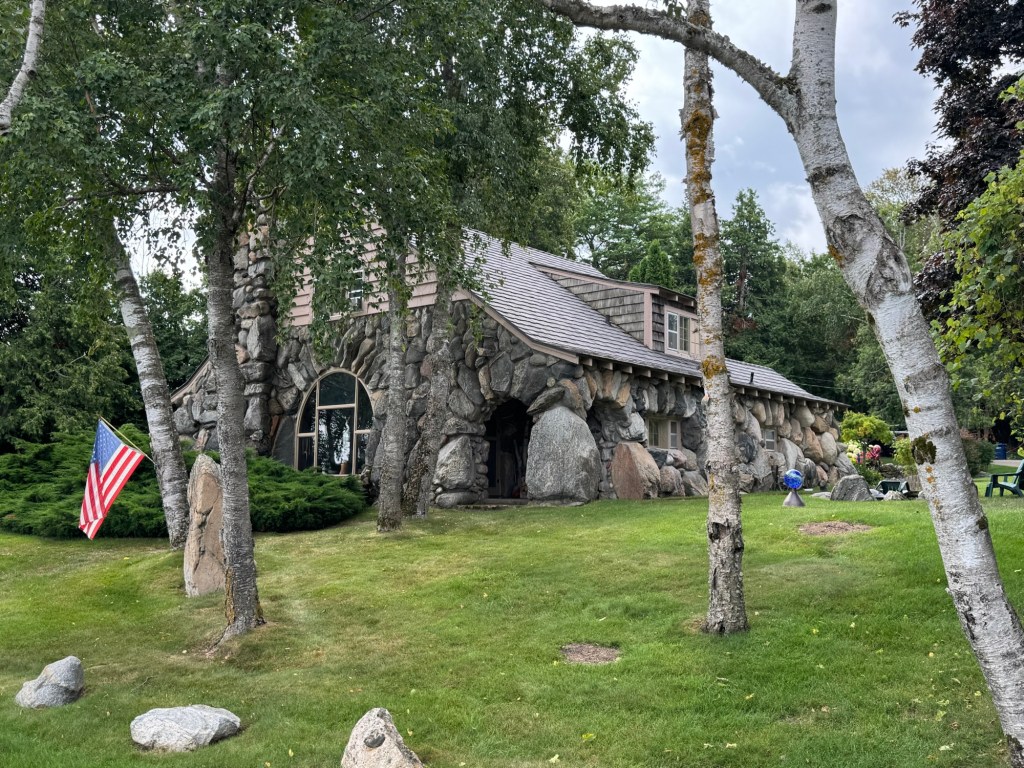
Earl Young’s Boulder Manor, built for himself, as seen on a recent day

Summer visitors to Charlevoix encounter at least two things about the area: first, that this part of Michigan is a haven for boat lovers and especially cruisers on the Great Lakes; and, second, that the city of Charlevoix is the home of Earl Young’s so-called ‘mushroom houses.’ The first observation regarding boats and the appealingly clear lake water is easily recognized. The second association with the area takes a bit of discernment, usually gained from seeing brochures or the small electric carts evident in town bearing the label, “Mushroom Houses Tours.”

A pleasant walk around Charlevoix while viewing the many houses that Earl Young designed and built in the community reveals that his approach to home design was not uniform, and that his work avoided that to which the wider community has also not succumbed – becoming a caricature of itself. For he could have approached his design work in such a way as simply to repeat and imitate prior successes, pressing forward as so many architects have done to inaugurate a particular and distinctive style in home design. Instead, Young consistently displayed his overriding commitment to his chosen materials – stone and stone-related products. Therefore, when at the age of 35 in 1924, and in buying a tract of land adjacent to the Lake Michigan shoreline, he built ten houses with enough variation among them that later homes constructed by others are frequently confused with those of his own design. Young gave the tract along with its homes the fitting label of Boulder Park.

The Owl House, named for the arched front windows

This variability in the architectural character of the Boulder Park homes helps us to begin to recognize how the common ascription to Earl Young, of being the mushroom house architect, is in some ways a misnomer for him. A few of his houses nicely justify the label, given their firm rootedness to their sites, their often low or extending rooflines with irregular surfaces, and his heavy use of large stones and boulders in a number of them. Yet, Young was equally comfortable specifying limestone cut in horizontal block slabs and even commercially available brick or block products with which to construct walls with traditional uniformly-spaced layers of mortar. We may not be enamored with the some of the results of his work, but I think most of us can identify with Young’s lifelong intention to remain true to his materials and to the sites in which he set them.
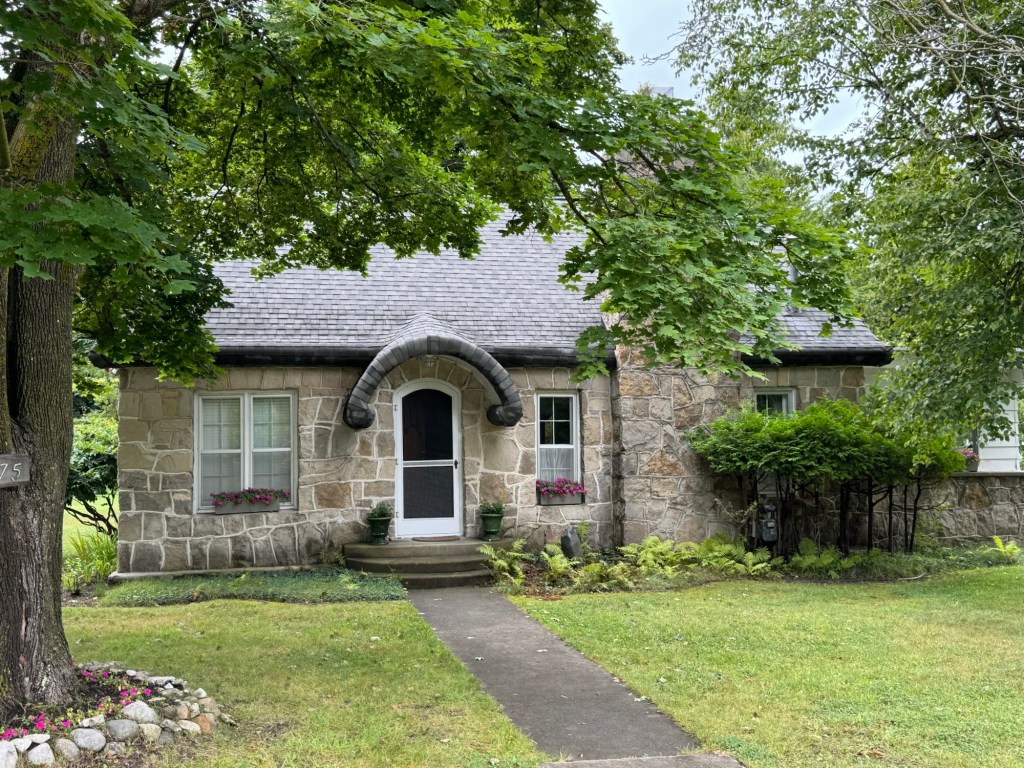
A 1929 limestone cottage in Boulder Park, known for the rolled edges of the eaves

Two neighboring homes in Boulder Park illustrate Young’s consistency of intent, and flexibility with regard to ‘style.’ Boulder Manor, built in 1928 (displayed at the top of this post), sits in close proximity to the Pagoda House, built in 1934, seen below.
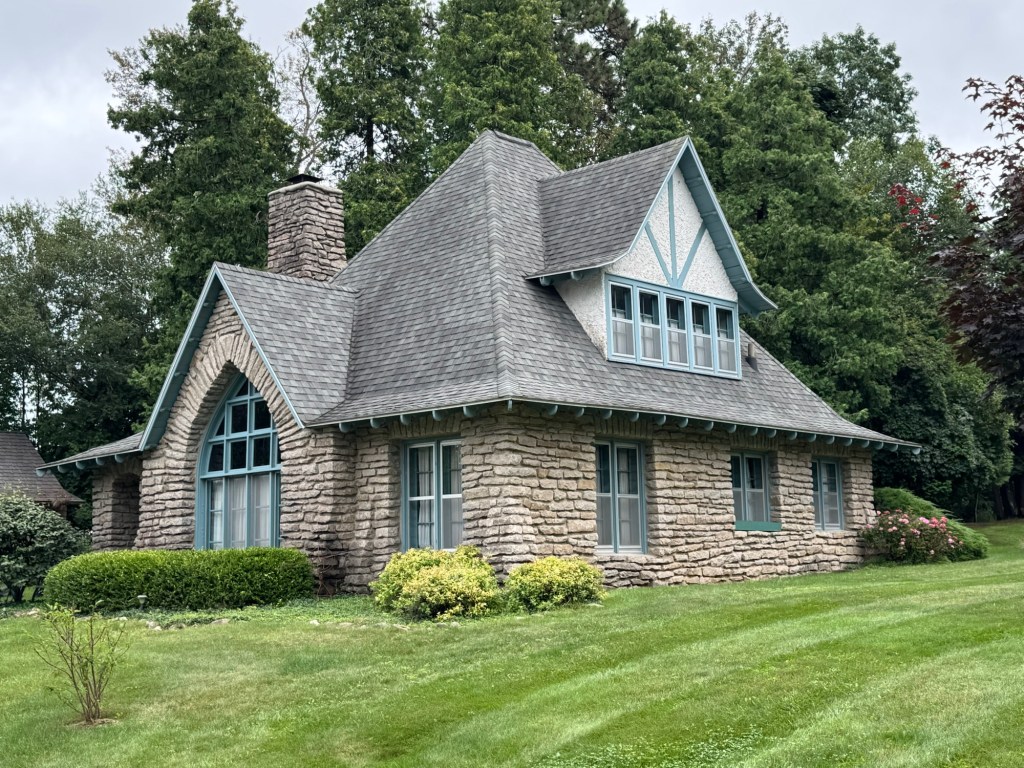
The Pagoda House

My favorite among the Boulder Park houses is the home that Young built for himself, called Boulder Manor (top photo). It is constructed with massive pieces of stone and boulders from the area, and features a matching smaller playhouse for his daughters that has a working fireplace.

Rear view of Boulder Manor along with the playhouse for the Young’s daughters

In some ways Earl Young was a bundle of contradictions, an idiosyncratic visionary who was known to tell some clients what they needed in terms of a home, and yet also one who could reside with an out of town family for a considerable period of time so as to get to know how they lived before designing a home for them. He had a consistent love of rough, ‘undressed’ stone to be used as found, and at the same time a willingness to use stone in a very conventional way. Young was famous for wanting to do virtually everything ‘his way,’ often to the consternation of others, including town leaders. And yet, one house of his in Boulder Park was the result of a client convincing him to build a home based on a design plan found in a women’s magazine, the 1933 Enchanted Cottage with its very English-looking windows (seen below).
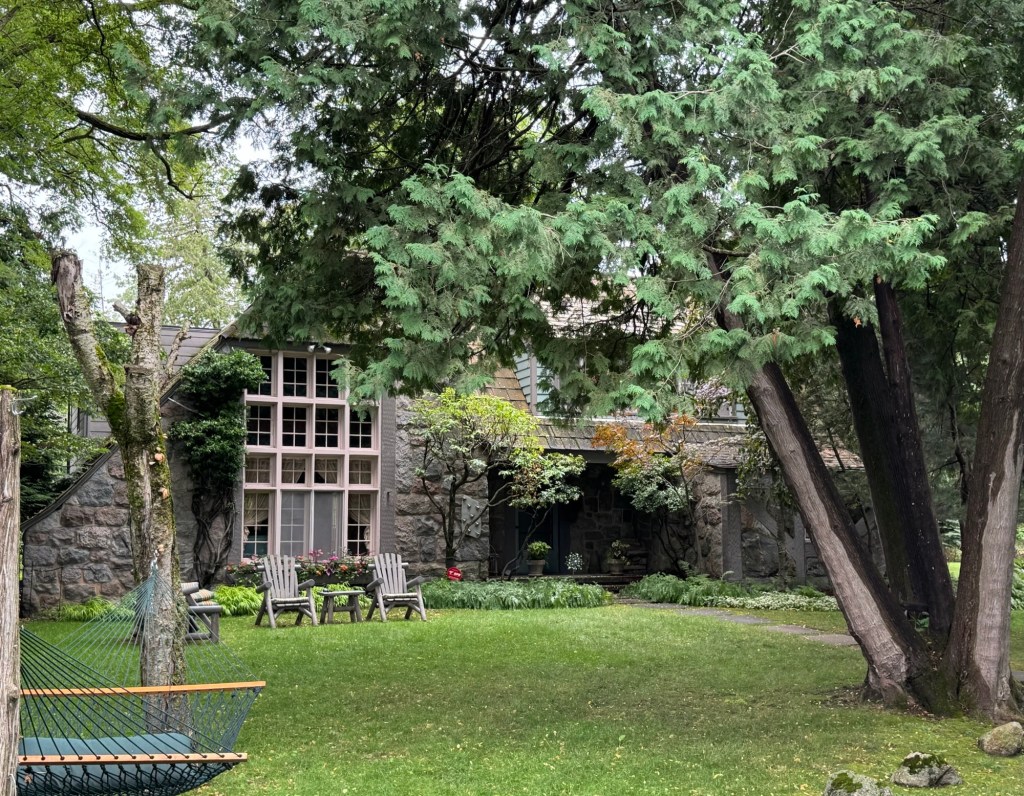
The Enchanted Cottage

The best introduction to Earl Young’s Charlevoix houses is a widely available book by the photographer, Mike Barton, titled, Mushroom Houses of Charlevoix. Filled with color photographs, and documenting every one of Young’s structures built in his home town, the book provides superb photographs, and better ones than I am able to provide.
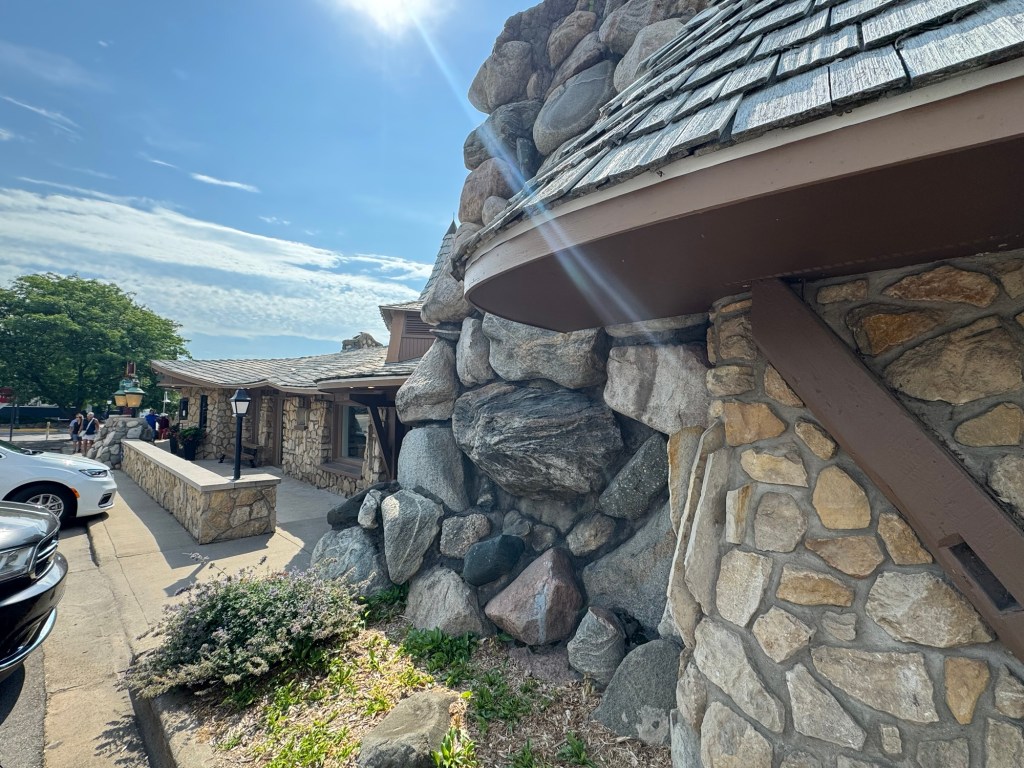
Earl Young’s Imprint on Charlevoix

Exterior view of Earl Young’s Weathervane Inn

As a young man from the rural north of Michigan, Earl Young aspired to produce ‘natural houses’ in the spirit of Frank Lloyd Wright, his inspiration and model for what became his own vocation. Young never studied with Wright, but the latter’s design spirit influenced him throughout his life. Though Young’s impact as an architect was essentially local (he designed only one house outside of Charlevoix), the present-day promotion of Charlevoix as a cultural destination is much in his debt for the way this community has come to be known as the home of the “mushroom houses.”

Earl Young

Earl Young studied architecture for one year at the University of Michigan. From the beginning he was impatient with a curriculum shaped by the kind of slavishness to European precedents that FL Wright also criticized. Young then returned to his hometown of Charlevoix to build houses, practice real estate in the family business, and sell insurance. He left the university program with his independent vision and architectural vocation intact, from which he never seemed to waver.

The Weathervane Inn adjacent to the Pine River channel and lift bridge

One recent appraisal of Young’s portfolio of buildings has suggested a neologism with which to describe his work, lithotecture, based on the Greek word for stone. For Earl Young did not simply value the utility of stone; he loved stone, and especially large boulders. He is remembered for having had a remarkable memory for the exact location, size, and texture of examples he had seen, collected, or stored away for future use. His profound appreciation for these materials, and the creative possibilities toward which they might be employed, is much in evidence throughout the older portion of Charlevoix in the many houses and other buildings he built and or designed, as well as in those influenced by them.

One of Earl Young’s Boulders Park homes (more of which are to be featured in a future post)

Earl Young’s impact upon the visual character of Charlevoix might be compared to a rather different example in architecture and in community design, the near-universal adoption of ‘the adobe style’ in Santa Fe, which has become a predominant approach to restoration, renewal, and original architectural creations. In the parallel example of Young’s case, his impact was through his way of being true to context by his use of stone, especially in highly creative ways. So pervasive has become his influence upon the development of Charlevoix that many other and more recent builders have been drawn to imitate Young’s extensive and sometimes whimsical use of locally available natural geologic materials. Given my own experience of living in south Louisiana, where hardly any naturally-occurring stone is to be found, I am struck by the abiding evidence of Young’s legacy as a community-based builder.

Two long-ago initiatives by Earl Young in particular serve to distinguish Charlevoix in the eyes of visitors, the Weathervane Inn, and the waterfront park adjacent to the city marina. Young replaced an aged mill along the edge of the Pine River channel with an attractive inn of his own design and construction, and he convinced town leaders to replace obsolete warehouses along the waterfront with what has become a four acre rolling green expanse of lawn. Both locations have become popular and much used gathering places for visitors as well as for Charlevoix residents.

The terrace overlook above the marina office – modern stonework in the Earl Young style

The marina waterfront as it has been developed in recent years demonstrates Earl Young’s lasting influence upon Charlevoix’s economic and cultural development. Realizing some of the potential latent within Young’s prescient inspiration for the land clearing that enabled the new park, several notable new structures have been built, among them a new marina office and locker rooms, and a dancing or synchronized fountain by its door.

Part of the natural-look landscaping surrounding the marina office

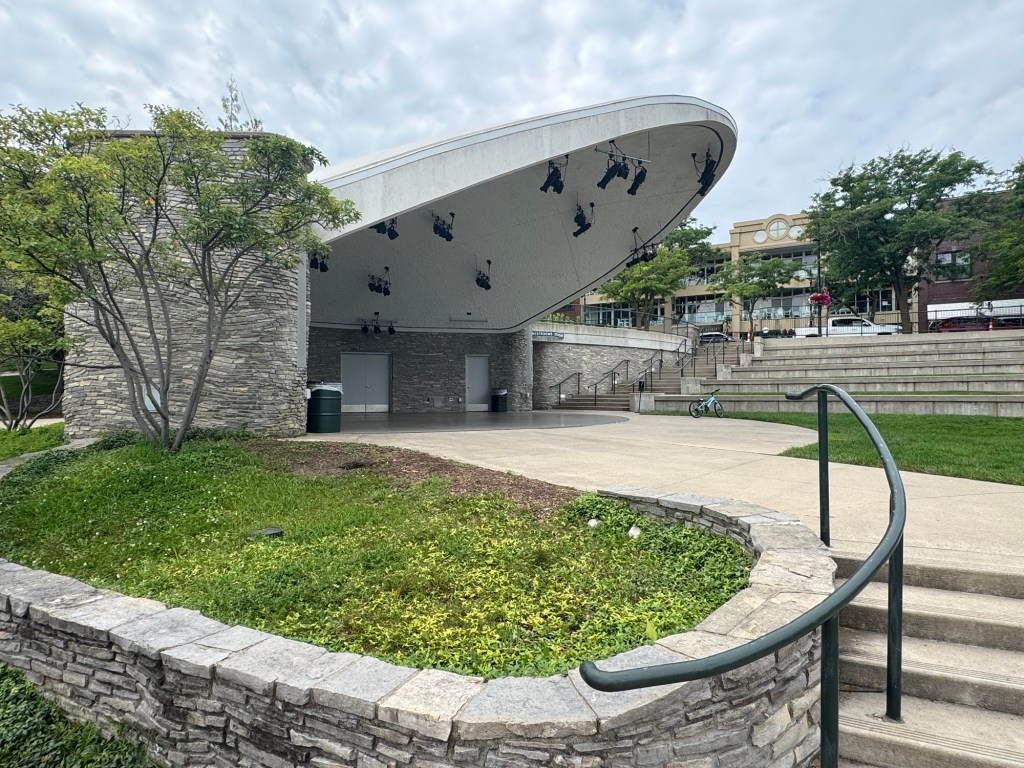
Landscaped around the marina office is a northern Michigan nature garden incorporating a human-made stream flowing between several shaded pools that contain rainbow trout. Also gracing the open green space of the park is a bandshell for weekly summer musical events, where concert-goers overlook the harbor docks and boat slips. Each of these structures, though constructed well after Young’s lifetime, reflects his vision for the beauty of stone laid up in asymmetrical curving walls.

The Earl Young influenced bandshell overlooking the marina and Round Lake harbor

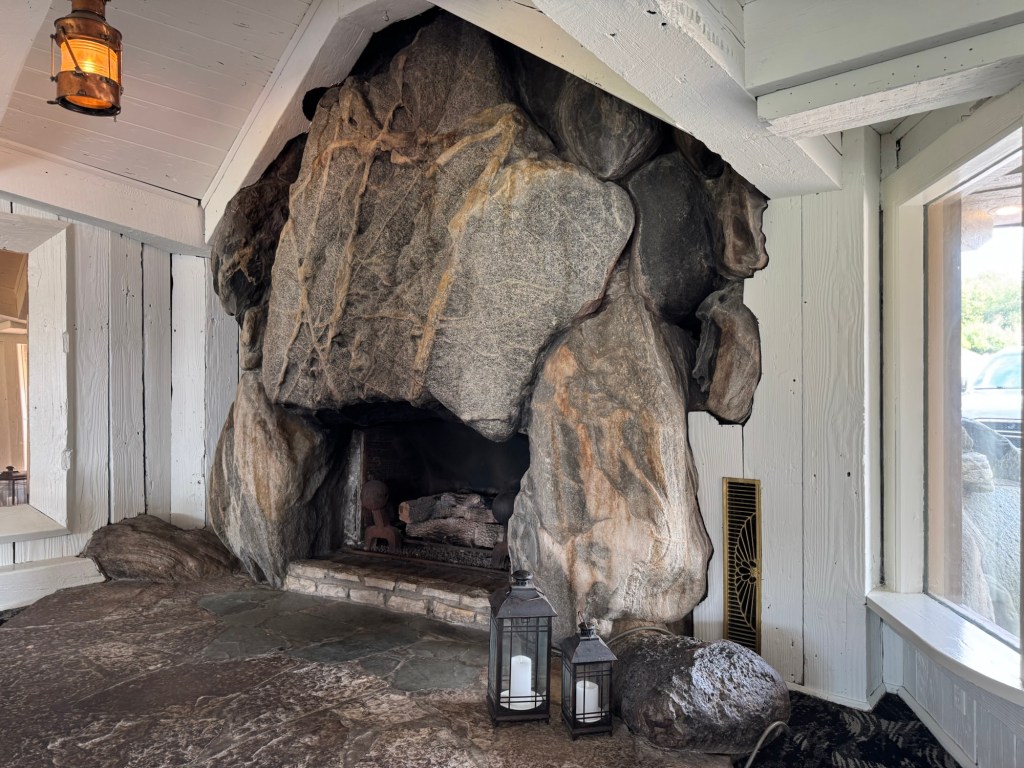
Earl Young’s profound attachment to working with local geological material evinces a lifelong devotion to what can be accomplished through building with massive boulders, each weighing multiples tons. The best place to begin to appreciate this is by a visit to the previously mentioned Weathervane Inn, the earliest of his few public buildings. The massive fireplace assembled from a seeming heap of boulders, has one large stone that weighed 9 tons, so heavy that it caused a dislocation in the foundation prepared for it.

Exterior view of Earl Young’s massive Weathervane fireplace
Interior view of the Weathervane fireplace

In a subsequent post I plan to present and offer a brief reflection upon Earl Young’s Charlevoix residential design and construction projects, most commonly known as his ‘mushroom houses.’ In all of his work, Earl Young showed himself to be something of an unforgettable local genius, whose endearing and wonder-producing legacy of unique work has transformed his community over the decades.

Beautiful Charlevoix

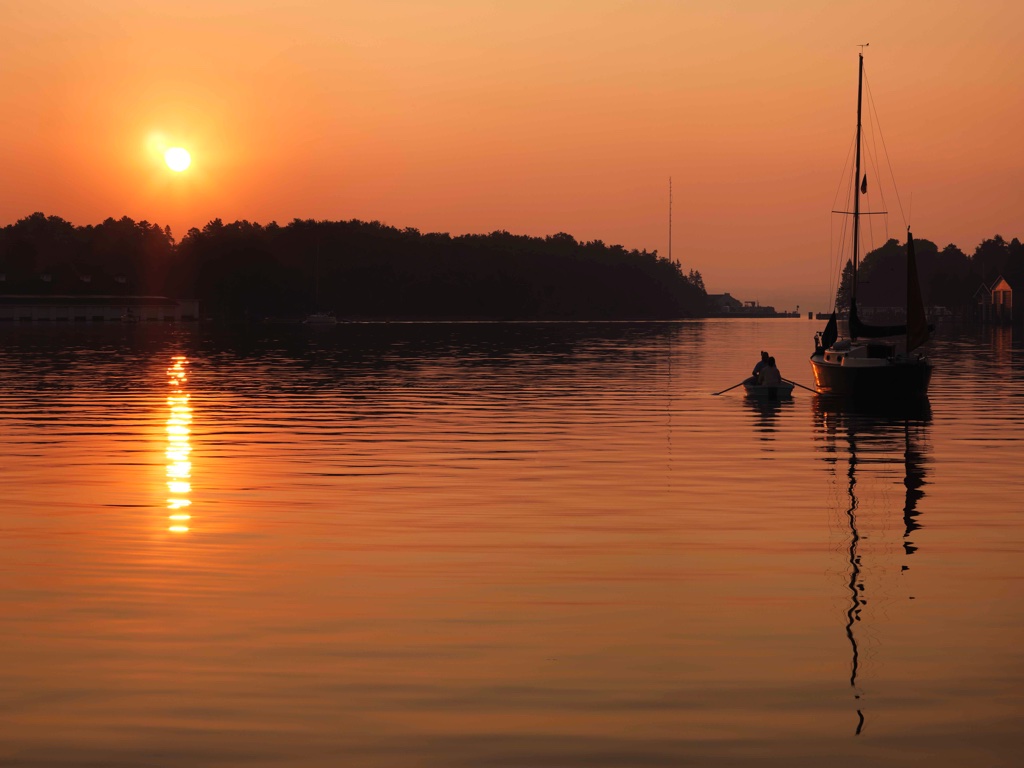
A Charlevoix sunset from the pier where the Pine River channel meets Lake Michigan

When thinking of the beauty of a person, his or her character far outshines any outward physical characteristics a person might have. And when thinking of a beautiful community, we may do more justice to those who live in that area by engaging with some aspects of their daily lives than by focusing more simply upon the sights we associate with where they live.

I have been blessed to have been able to spend a number of weeks over many summers in Charlevoix, Michigan, largely through being able to live on our old boat (featured in my last post). With this piece, I want to highlight what I have found to be so special about this community and its splendid harbor and access to nearby ‘big water.’

Thursday Farmers’ Market along the main avenue above the city marina terrace

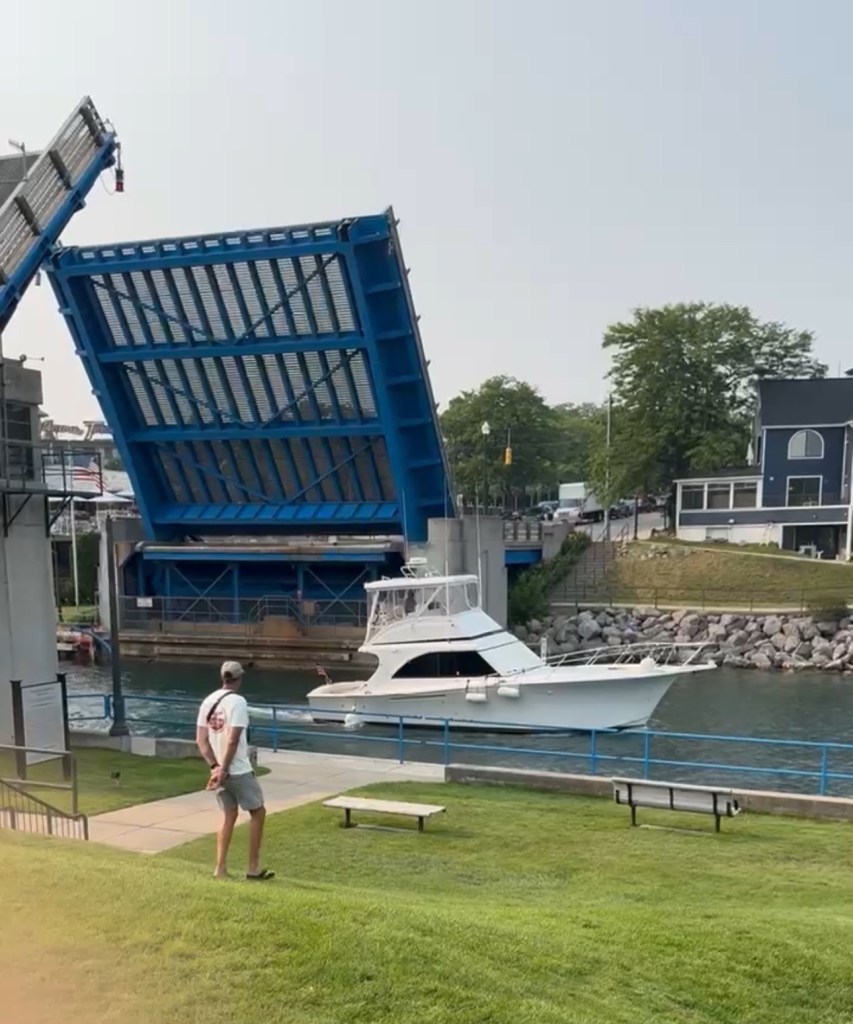
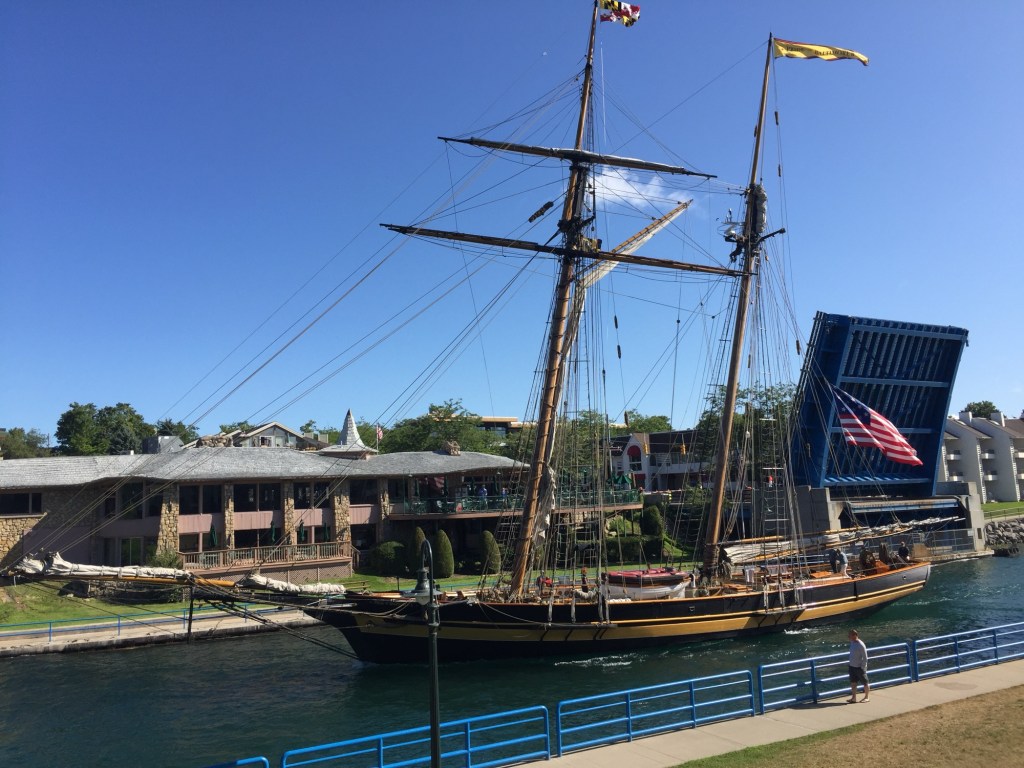
My first visit to Charlevoix may have been in around 2004. I had been to Traverse City and had seen its stunning turquoise waters, but Charlevoix was new to me. I was immediately drawn to what I saw of it during a lunch visit. Sitting on the deck of the Weathervane restaurant, I watched boats of all kinds and sizes pass through the raised arms of the drawbridge that otherwise crosses the channel between the town’s natural harbor, called Round Lake, and Lake Michigan.

The Charlevoix lift bridge over the Pine River channel

Many voyagers making passages on the American Great Loop stop in Charlevoix, as do occasional sailors from Europe on summer forays across the Atlantic, who then sail here through the Great Lakes. Even some well-known ‘tall ships’ stop here. The Pride of Baltimore was passing through the harbor on the day we arrived for our visit this year.

The Pride of Baltimore passes through the lift bridge by The Weathervane, out to Lake Michigan (in a prior year)

Visitors from larger cities find in Charlevoix a few of the amenities we associate with grander places. For over a century, Charlevoix has also been the home of two private communities of summer ‘cottages.’ Many of the boats (yachts, really) that we see on the area waters attest to the levels of discretionary income available to folks from Chicago and Detroit who make Charlevoix their summer home. Consequently, boat maintenance and winter storage facilities are substantial local businesses here.

Boats receiving maintenance at our boatyard

Yet, upon arriving in Charlevoix for my first boating visit, and docking at the city marina for a couple of weeks, I was struck by what I learned about the real, year-round community to be found here. The harbor master was a teacher at the high school, and the young people working at the marina and at main street stores were his students as well as local residents. I continue to shop for groceries with folks from town at a store they patronize throughout the year, and buy tools and replacement parts with them at the local hardware store.

A typical older and well-kept home in town

I think what many visitors find so compelling about Charlevoix is how the community has yet to succumb to a condition that has beset many places with some similar attributes. Charlevoix, in my estimation, has resisted becoming a caricature of itself. The tourist-souvenir storefronts do not outnumber shops that maintain a viable year-round business, and local history is esteemed because it remains real to those who live here, rather than offered as a commodity for visitors.

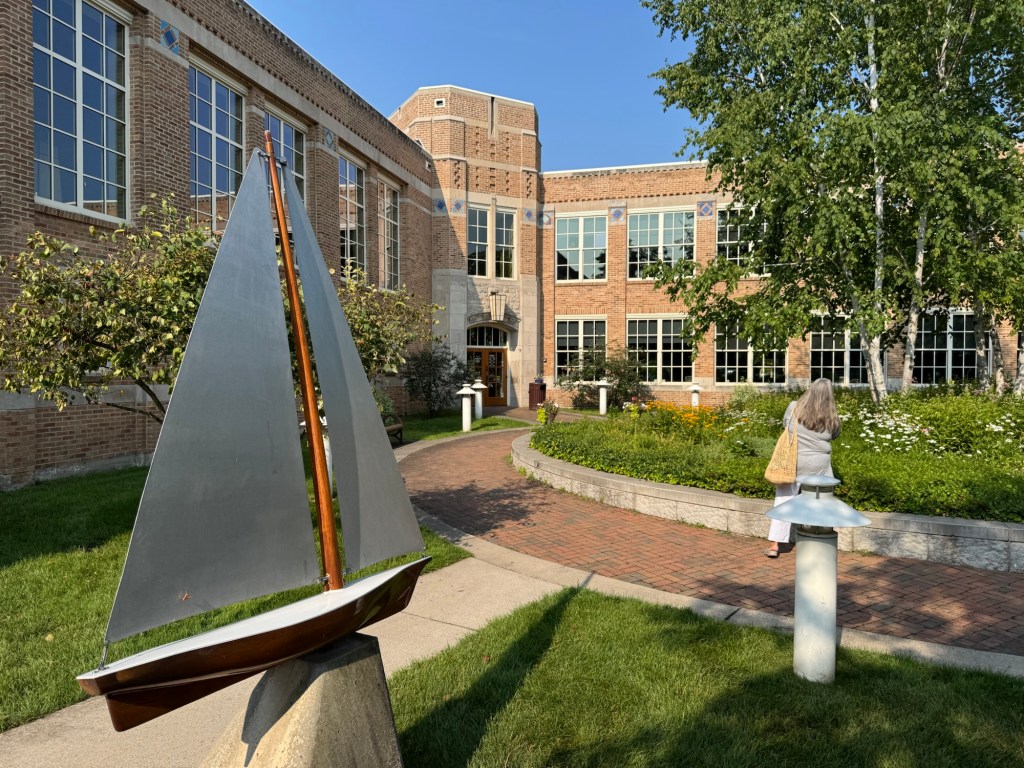
The Charlevoix Public Library, and former community K—12 school

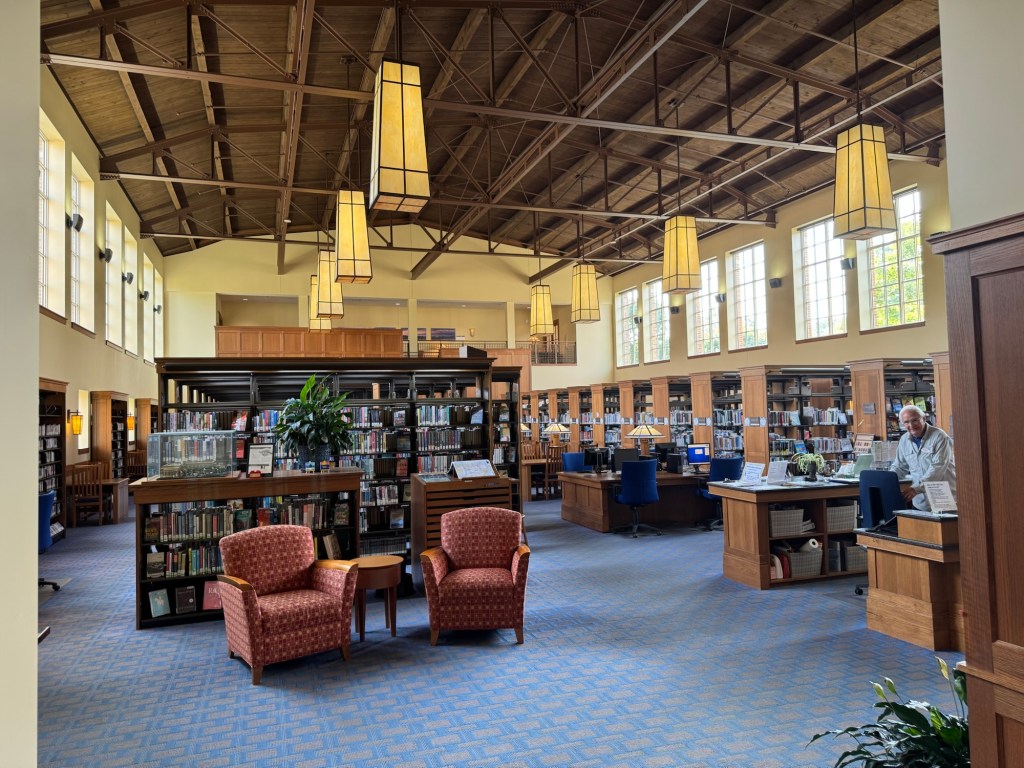
For me, the best example of this is a place we have come to love, the Charlevoix public library, which was once the town’s K—8 school, and which includes a reading room with a fireplace that earlier served as the Kindergarten room! And as long as you are not looking for lake view or waterfront property, an ordinary home in town is still affordable for many people.

The library main reading room, once a school gymn
The former Kindergarten room with its fireplace and bay window

But, of course, sitting as it does on the rocky and wooded shore of northern Lake Michigan, this town and its surrounding fields and forests, along with its tidy and well-kept streets and homes, is a truly beautiful place in the summer. Winter up here lasts a very long time, making the warm months all the more precious. I remember visiting on May 1 years ago, only to find that ice still stretched across the 18 miles of Lake Charlevoix! By that date, it is already full summer in Louisiana.

After some years of regretful absence, I am so happy to be up in beautiful Charlevoix once again.

A postcard aerial view of Charlevoix

The Allure of a Classic Old Boat: Our Nimble 24

Our Ted Brewer designed Nimble 24 sailboat, DAYSTAR

There is an affliction that is common to owners of sailboats, known as ‘one-foot-itis.’ The name refers to our ever present desire to have just that much more room inside the boat, or within her sail plan, cabin height, or in the extent of her amenities. Speaking for myself, I admire the beautiful sailing yachts my brother has been photographing on the southern coast of France. Yet, aside from the unimaginable purchase cost of a 45 or 70 foot ocean cruiser, I don’t wish to have to contend with all the maintenance work and expenses associated with such a boat. As the old saying goes: the best definition of a boat is a hole in the water into which you pour money!

Yet, for the owner of a small boat, another foot or two of length could bring with it greater stability, hull width, and such things as an enclosed working ‘head’ (I.e. toilet) and full galley (small kitchen). Standing head room inside would be a real plus. Usually, with each additional foot of length comes a proportionately larger volume of workable space and hull displacement (weight). These variables bring with them additional maintenance issues, transportation challenges, and docking fees, resulting in an overall increase in operating costs. 

DAYSTAR in her slip

My own experience with ‘one-foot-itis’ came from my enthusiastic enjoyment of our 15’ West Wight Potter, a boat whose ‘cabin’ is sometimes described as having the interior space of a pup tent, while resting on a boat with the buoyancy of a cork. I cruised solo on the boat for two weeks one summer, and was hooked on the pleasure associated with that kind of time away on the water. Then, naturally (sailors will understand this), I began looking at bigger boats, of a size that would enhance my cruising adventures.

I have always loved classic boats and ships, and the designs of a marine architect, Ted Brewer, came to my attention. I read about his Nimble 20 sailboat in Small Craft Advisor, and then discovered his Nimble 24. When one came up for sale on the north shore of Lake Pontchartrain, I had found our next boat. With bronze ports (windows), a teak and holly sole (floorboards), and tanbark sails, she is indeed a classic. Built in 1988, she is hull #3 of the N24 series. We named her DAYSTAR

DAYSTAR on Lake Charlevoix

Brewer designed the Nimble 24 with some significant criteria in mind. She would not be a ‘blue water’ or oceangoing boat, but one capable of voyaging around Puget Sound, or a crossing from Florida to the Bahamas. Some of the features Brewer designed into the Nimble include provision for safe passages in coastal waters while also being able to enter shallow inlets; cruising room for two adults with small children and or pets; space for an enclosed ‘head’ (toilet), with two distinct cabin areas as well as a cooking area. She is of a canoe-yawl design and therefore a ‘double-ender,’ with a small mizzen or second mast allowing a flexible sail plan for a variety of conditions. Her shallow draft or depth tolerance is attained by a short but heavy fin keel containing a retractable centerboard, along with a retractable rudder extension.

Removing and replacing old bottom paint: doable with jacks, patience, and some courage

For practical reasons, her outboard sits in a motor well in the aft of the cockpit, providing easy access as well as a dependable drain point should the cockpit be swamped with water. The boat is built with positive floatation within the hull, meaning that should the boat be filled with water, she will not sink. She has relatively high sides with a ‘sharpie’ (somewhat flat) hull, and her good stability enables her to handle a fair bit of wind and adverse waves.

Rowing in just after sunrise over Charlevoix harbor

All of these features result in a boat well-suited for ‘gunkholing,’ or navigating into shallow coves and inlets. DAYSTAR can be brought right up to edge of a river or beach, though her skipper must take care to keep sand or mud from getting into the outboard engine’s impeller (water-cooling intake). On the open water, she sails well, and we can regularly reach a comfortable if not a sometimes thrilling 5 knots (or 5-6 mph) with decent wind. We have sailed her on Lake Michigan, and on the adjoining 18 mile long Lake Charlevoix, as well as on Lake Pontchartrain.

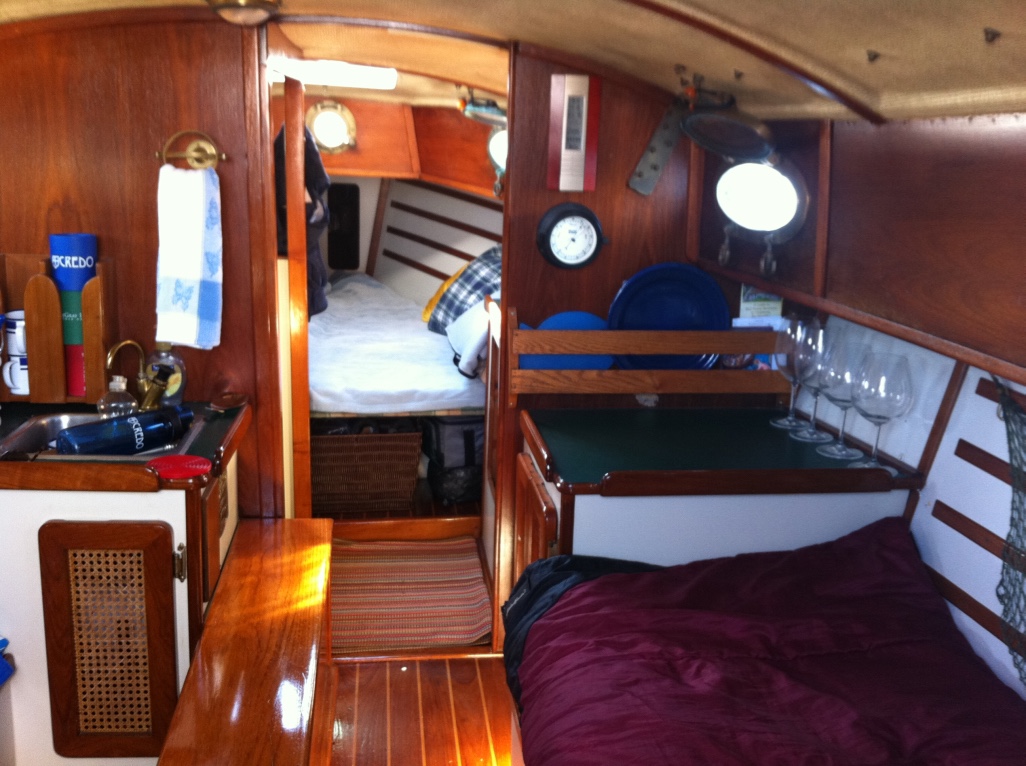
The cabin interior showing both the main and forward comparment areas

As the photos here may suggest, our stays on DAYSTAR involve camping on the boat, and she serves us as something like a little floating summer cottage. We rely on a large water jug, a good cooler with daily additions of ice, a small grill, and a portable-potty, for our basic needs. Many people love RV’s for camping holidays, something we can mimic with DAYSTAR when she is trailered. But we love sailing and the flexibility of having no roads to follow. Keeping an eye on the weather is always vital, and having good charts and GPS navigation help us discover and navigate safely unfamiliar waters. Given all these features that bring us pleasure, we are looking forward to some time away on DAYSTAR this summer.

A nice breeze fills our sails as we point toward the horizon over Lake Michigan

In honor of my friend, Norm Laskay, who was DAYSTAR’s skipper and her knowledgeable and careful steward before she came to us.

The Beauty of a Friendship

Stuart Levine, About 2010, Heading Out to Fish

For me, getting to know Stuart began with seeing a boat, an old boat. From when I first visited the northern Michigan harbor town of Charlevoix in about 2005, I noticed and was attentive to a classic fishing boat. It was a lapstrake wooden-hulled motor boat from the late 1950’s, painted in a beautiful dark forest green. Yet, I was also attentive to the easy skill and confident style of the boat’s captain, an older man whose approach to open water I admired and wished to emulate. During my increasingly frequent summer visits to Charlevoix, I took note of this boat and its persistent captain, who obviously knew what he was doing when going in and out every day to fish on Lake Michigan.

After about seven or eight years of seeing him and his boat each summer, and having taken photographs of them during many of those years, I finally met Stuart. One morning, early in the summer of 2013, I saw that venerable boat in my marina. The next afternoon I saw it again, while her captain was tying her up having come in from another fishing trip. Plucking up my courage, I walked over and haltingly introduced myself. I told him of my admiration for his boat and for what I had inferred from my limited observation about his daily practice. As it turned out, both Stuart and I loved old boats. And, serendipitously, Stuart and I hit it off. We were weekly correspondents, and fellow summer boaters, ever since.

As time has shown me, I had encountered and begun to be acquainted with a person of remarkable ability, sensitivity, and enhanced intuition. From first knowing him, Stuart seemed to look beyond the apparent limitations of the present moment, attend to what might be hoped for, and reflect on how the future could really be different. As I came to see, Stuart’s approach to life was nothing like the proverbial person who ‘sees things through rose-colored lenses.’ Stuart’s optimism was grounded in a belief that a different and more positive future results from actually choosing to live in a different way now, not just from believing or hoping differently.

A great example of this aspect of his character took place one summer. Standing with him on the Charlevoix dock while he was stowing his fishing gear after an outing, I asked about all the fishing tackle and gear he left on the boat, openly visible to anyone who might come by. Stuart told me about a valuable fishing rod that he had once left on the boat in a similar way. Upon discovering the rod’s disappearance the next day, he wrote a letter to the editor of the local newspaper, describing the theft but saying that he would not change his usual trusting practice. He wanted to spend his summers in a community where people modeled trust, rather than self-protective fear.

I am reminded of an episode in a video by the former National Geographic photographer, Dewitt Jones (Celebrate What’s Right With the World). On assignment, Jones visits a living national treasure of the UK, a woman who was an acclaimed weaver up in the northern Hebrides Islands. Jones asks her, what do you think about when you weave. She responds by saying, at first, “I wonder if I will run out of thread!” Jones admits to being surprised by this. But then, she says, “When I weave, I weave…”

Stuart lit up when I told him this story, and he then said, “When I fish, I fish.” He told me that his delight was in the process, more than in the results. His comment then struck me, as it still does, as absolutely authentic to him. Even though this was a man the Michigan DNR highly regarded for having documented every lake trout he had caught and released for decades!

At a marina cookout in 2019, Stuart and I talked about the evolving challenge of evaluating college and graduate students in this current era. With several other boaters attentive to his comments, Stuart talked about his commitment to trusting his students. As always, he spoke positively about how placing trust in others encourages them to live into our imputed and projected hope for them. He often reflected on this principle with me, hoping to commend it. After all, it is founded (among other places) in Aristotle and in the Hebrew Scriptures. For what we practice, and live into, shapes who we are becoming. Stuart exemplified this insight.

And yet, at that cookout, as a younger, less-wise and less-experienced former academic, I responded by describing my disappointing prior service on a national examination board. As he invariably would in such conversations, Stuart challenged my apparently less-than-positive view of such processes. He did this in a way that was shaped by his long life experience of having served as a reflective scholar. By his comments in conversations like this, he would disclose how he was both intellectually curious as well as spiritually sensitive. In this way, he showed how he was often a mentor not only for young intellects but also for older souls.

Stuart reminded me of some my favorite teachers. He did this by how he modeled a particular virtue. It was his disposition to value good questions over what often seem to be important answers. For me, Stuart was an excellent example of one who always encourages others to wonder, and then ask, but, what is the question? For when we come to appreciate the horizon of a beautiful question, we are then more open to discovering meaningful answers to it. Stuart displayed an abiding curiosity about finding good questions. And this led him to discerning an ever-expanding body of insightful answers.

In one other important respect I would like to offer a tribute to Stuart. From time to time he would share with me words of respectful remembrance he had shaped in his effort to honor former colleagues, friends and students. His approach to this sometimes difficult task was compelling. For Stuart embodied a desire to recognize and express appreciation for the gifts, strengths and achievements of others, as a kind of spiritual practice in itself.

May Bard College and other teaching institutions always be blessed to have persons like Stuart Levine among their faculty and in their administrative staffs. And may we all be blessed to have a friend like him.


I offer this tribute in memory of Professor Dr. Stuart Levine, who died on May 1, 2020. He was formerly a Dean and Professor of Psychology for many years at Bard College, Annandale on the Hudson, New York. Stuart’s cultural and spiritual roots were within Judaism, and Bard College’s early history was associated with The Episcopal Church, within which I was ordained as a deacon and priest.

The Beauty of a New Discovery


It happened when I was learning sea kayaking in and around the Gulf Coast. My experience on the water aroused memories of prior saltwater boating experiences from long before, back when I was 11 or 12. These experiences involved being out in a dinghy in Yokohama harbor, as well as sailing in open boats with the sailing club of the Japanese high school where my father was among the faculty. Accompanying those members, I went by train down to Enoshima to sail in Sagami Bay, southwest of Yokohama.

Then, one day as I was driving to a clergy conference in south Louisiana, I stopped at a bookstore for some extra reading material. There, I found a sailing magazine with the snappy title of Small Craft Advisor. What caught my attention on the cover was the mention of an article, “Lake Powell Potters.” After buying the issue, I was intrigued by reading about Anne Westlund’s journey from northern Michigan to Utah, towing her 15′ West Wight Potter boat, “Peapod.” She took that trip with a friend who had a similar Potter, and they sailed and camped on those quite small boats. After reading her account of the journey and voyage, and seeing photos of the boat, I was hooked.

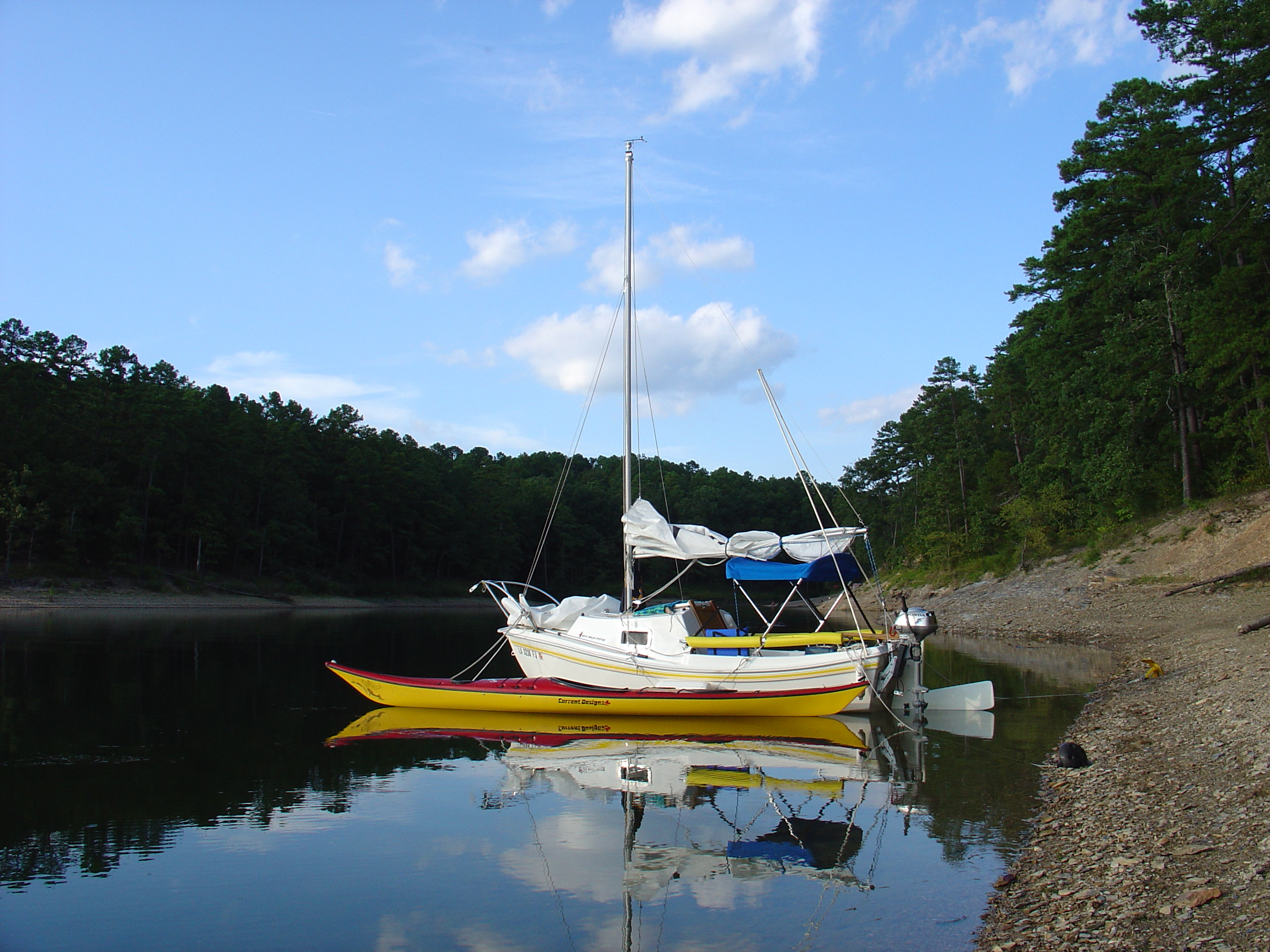
Not too long after that, I was able to get a West Wight Potter P-15 of my own, “Zoe,” hull #2634. The photo above shows her afloat on DeGray Lake in west central Arkansas in September of 2006.

Describing this boat as having a length of 15′ is perhaps generous given that Stanley Smith, the designer and builder of the original hull, listed her at 14.’ Smith built the first boats on the Isle of Wight, and sailed an early model from there to Sweden in a voyage recorded in his book, October Potter. A later model is credited with a voyage from Mexico to Hawaii. Usually, the contemplation of such voyages with a small craft like the Potter would be regarded as ridiculous and foolhardy. Yet, West Wight Potter sailors love their boats precisely because they defy common expectations, and bring such joy.

When I read about the P-15, and then saw and inspected the first nearby example I could find, I was captivated by this boat’s design and sailing capabilities. I have since acquired a larger boat, a choice which was very much influenced by the design qualities of my P-15. Yet, I still have “Zoe.” And, as I get older, and eventually will be less able to grapple with a bigger boat on my own, I will continue to love this little boat that has brought me so much pleasure and so many memories. Not least of them was a two-week long cruise on Lake Charlevoix in northern Michigan years ago, before we moved from Louisiana.

Towing a dinghy, with water-proof gear bags filled with food supplies and extra clothing on the forward deck along with a cooler, and a camping porta-potty stowed discretely aft, made such a journey and voyage possible. It also helped to have an easily rigged awning over the cockpit for an approximation of a covered ‘back-porch,’ especially under a hot sun or cool rain. Despite the physical limitations involved, I learned much and had a great time.

I have made similar but shorter such trips on both DeGray Lake and Lake Ouachita (also in Arkansas) towing my sea kayak. (below)

In this present time of the coronavirus stay-at-home orders, I try to remind myself that great adventures are still possible within the circumstances of relative confinement. I take boats seriously, and am at the same time aware that owning one can be seen as a folly, and as extravagant. I respect that view. Yet, having experienced five two-week-long voyages across the Pacific Ocean in ships, and a month-long 1969 voyage in the South China Sea, my life has been immeasurably enriched by boating and seagoing opportunities, both while alone and also with significant others. The many times I have chosen to interact with unpredictable air and sea conditions have helped me to be better prepared to deal with equally unpredictable circumstances in our current public health crisis.

Most of all, it is a time when I remind myself of one of my favorite quotes from within the tradition of Christian spiritual writing, a quote attributed to blessed Julian of Norwich: “All shall be well, and all shall be well, and all manner of things shall be well.”


Notes: If you are not yet a sailor, start ‘small.’ When it comes to boats, we all dream big at first. And my favorite first resource to recommend is Small Craft Advisor magazine. I have been consistently pleased with their fine and informative work. Sadly, I have just learned that the West Wight Potter 15 is no longer being manufactured in the US, which may limit its future availability here. For more on the West Wight Potter P-15, see Dave Bacon’s book, The Gentle Art of Pottering, which provides a great introduction to all aspects of the boat..