finding and being found by God

Resurrection Finds Us

[If reading this by email, please tap the title at the top to open your browser for the best experience.]

Stanley Spencer, Resurrection, Tidying (1945)


Stanley Spencer’s church cemetery visitors find themselves surprised by being found! They experience being found through a resurrection encounter with those who have gone before.

The resurrection of Jesus is not usually something we go looking for. The risen Jesus comes and finds us. This is the pattern we see in so many of the stories of Jesus’s first resurrection appearances to his friends and followers. The disciples and others don’t go looking for him except at first, when they go to the tomb. And even then, they are seeking Jesus’ mortal remains rather than his risen presence. He comes and finds them, just as he finds us, often in the context of fellowship. And like them, we are always surprised.

We don’t find the resurrection just as we don’t find God. Neither God nor the risen Jesus are lost, even if we may be. And so, we are found by both, and then we find ourselves as persons who have been found. This is instructive, for it corresponds with our apprehension of and encounter with beauty, which we also misleadingly credit ourselves with ‘finding.’ Really, beauty finds us. For our perception and recognition of beauty depends not on a ‘power’ that we possess to pursue and attain it, but rather on our ability to receive and recognize what is, and what is given. The same is true in our apprehension of and encounter with the grace of the resurrection.

Motivated by our sense of need, we seek to find something or someone to fill the hole at the center of our lives. Though it is a challenge for many of us, being open to being found by the Risen Lord not only meets our need, but can fill us with great joy.

Alleluia. Christ is Risen!


Stanley Spencer’s, Resurrection, Tidying, is one of a large series of paintings based on the theme of Resurrection, which span the years of his mature work.

Subject and Object

(James Tissot’s painting, Jesus Looking through a Lattice)

I continue to be fascinated by the distinction between subject and object. That is, between being the subject of the act of seeing, and being the object of someone else’s attention.

Typically, we act as if God and divine revelation are objects of our attention. Notice the way that we often speak about how people ‘seek God’ with the hope of ‘finding’ the divine presence. And yet, of course, God is not ‘lost;’ only we are! So, I think what we really seek is the experience of being ‘found,’ not only by someone who becomes a friend or a lover but most especially by God.

As Jesus’ parable of the lost sheep and his portrayal of the father in the story of the prodigal remind us, God seeks us. We can trace this idea back to the first chapters of Genesis where God seeks our primeval forebear by asking, “where art thou?”(KJV) From the beginning of Creation, we have been the object of God’s subjectivity long before we became personally conscious of it.

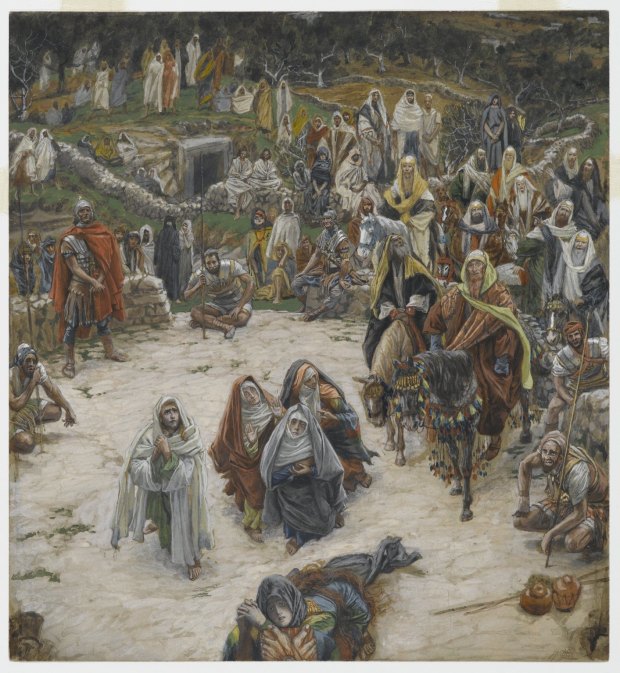
In two evocative paintings, James Tissot visually explores this inversion of perspective. These and many of his other 19th century watercolors curiously anticipate modern theatrical approaches to creating ‘scenes.’ His skill in this regard is most dramatically evident in his painting, What Our Savior Saw from the Cross (below). Portraying what we often think of as the decisive moment in salvation history, Tissot doesn’t show us Jesus as he suffers on our behalf. Instead, Tissot depicts the Lord’s loving regard for others who suffer because of their love for him. He who is so often the object of our devotional regard is represented as the subject of God’s attentive concern for us.

Much more subtle, yet equally significant I think, is his delightful painting, Jesus Looking through a Lattice (image at the top). I believe that this apparently whimsical image by Tissot actually embodies a profound spiritual and theological insight. For why does Tissot portray Jesus as looking at us, the viewers of this painting, peering at us through a lattice? Taking the image both literally and figuratively, has Jesus gone in to an inner chamber where he awaits us to join him? Or, have we gone out into the garden of our own pursuits while yet remaining within his view? Is he being coy, ‘spying’ on us (as we might say)? Or are we the ones who prefer to be somewhat hidden? Though both are possible, our usual instincts lead us to assume the former. Even though we are always the objects of divine loving regard, whether we are aware of it or not.

May we continue to experience the joy of being found by God.


The images above are by James Tissot ~ Jesus Looking through a Lattice, and What our Lord Saw from the Cross. Both water color paintings are featured in the exhibit, “James Tissot: Fashion and Faith,” at the Legion of Honor Museum in San Francisco. After February 9, 2020 the exhibit moves to Paris.