Beauty and Offering

God’s Handiwork Inspires Ours

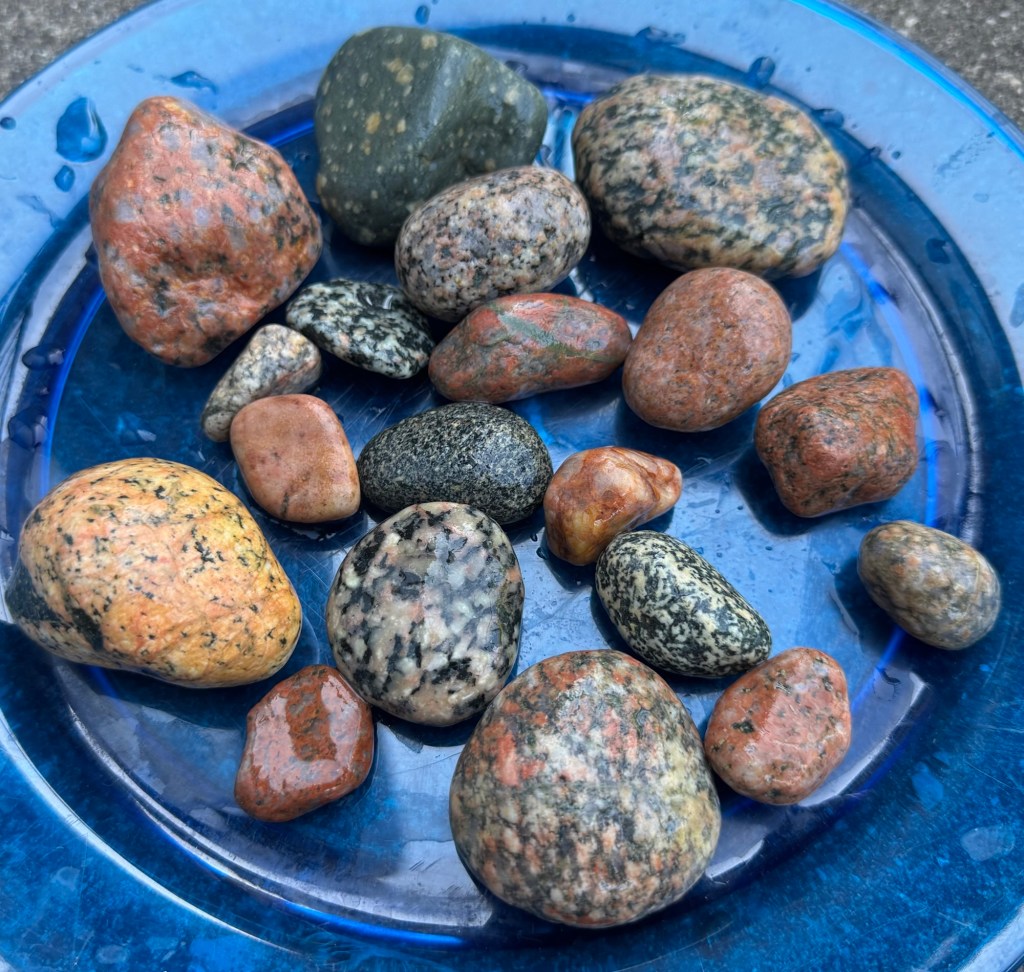
Stones found on a northern Lake Michigan beach

Labor Day is around the corner and some of us may receive and enjoy a day off from work. What we call retirement, a stage in life I am presently enjoying, tends to represent leaving work behind. Yet these and related ideas rest upon a common assumption, that work is different from, and in some ways inimical to, enjoying fulfillment in life.

I find a biblically based theological insight helpful when thinking about work. As with many matters that can be looked at from the perspective of Christian moral theology, our view of work can be enhanced by making reference to four specific reference points. These are, first, what we have learned about God’s purposes in Creation for this or that aspect of our lives; then, what impact sin associated with our Fall has had upon what we are thinking about; third, how God’s ongoing work of Redemption has restored and or transformed the matter presently under consideration; and fourth, to ask what future – if any – does this aspect of our lives have in Christ. 

Work provides a wonderful topic for engaging in this fourfold inquiry. Based on our common way of thinking about work, it may be hard for us to consider the meaning of work from any other vantage point than of attributing its role in our lives to the Fall and to the ongoing effects of human sin. Yet, we can also learn from many who have come before us who have distinguished work from toil. This can help us see how forms of labor, and pejorative associations the word may have for us, are surely due to our proclivity to link such activity with burdensome unpleasant duties.

For what we may overlook is the biblical view of how God has shared stewardship responsibility for aspects of Creation with us, as beings created in God’s image and likeness. This was symbolized by the way that our mythic forebears (Adam and Eve) were given their ‘work’ of naming the animals as a path toward fulfillment. It was not until their expulsion from the Garden that the first human beings are described as prone to acts characteristic of sin. Thereupon, in biblical theology, our heavenly ‘work’ of praise, and of divinely-invited participation in God’s Creation stewardship, ceased to be pleasingly ready pathways toward human fulfillment, and became energy draining and spirit-diminishing activities – such as we tend to find them to be now.

A growing segment of the wider Christian community shows signs of acknowledging how God’s work of Redemption is ongoing, quite aside from its ‘once and for all time’ episodic saving events. The pattern and purpose remains the same – nothing fundamentally new is added, nothing old of lasting value taken away. Preeminent remains God’s abiding purpose for us to become and be God-like in God-intended ways. For, as Athanasius taught us, the Son of God became the Son of Man, so that the children of men and women could become the children of God. Work – not toil nor burdensome labor but creative and fulfilling work – remains a vital part of our holy path toward wholeness.

And to remind us of this abiding truth, the loving Creator has spread around us an uncountable abundance. These are the signs of outpoured and participatory grace, some of them very small, like stepped-upon seashore pebbles and tiny blossoms among hurried-by roadside weeds.

Too quickly we dismiss the significance of our our small acts of selfless giving, not to be counted by us, but adding up to so much more than we imagine in the life-growth of others. This is our holy ‘work,’ overlooked but important stepping stones on our path toward living into the godly fullness with which Christ fills us.

If on our daily course our mind

Be set, to hallow all we find,

New treasures still, of countless price,

God will provide for sacrifice.

Old friends, old scenes, will lovelier be,

As more of heaven in each we see:

Some softening gleam of love and prayer

Shall dawn on every cross and care.

[John Keble, “Morning,” from The Christian Year]

The Beauty of the Epiphany


Here we see Peter Koenig’s evocative depiction of The Magi offering gifts to the holy child. The artist is a contemporary Roman Catholic painter, many of whose religious paintings are displayed within a church located in Northamptonshire, England. It’s not far from the parish where Henry Moore’s Madonna and Child is situated, the sculpture we viewed in the prior post. Though Koenig often depicts biblical figures in contemporary settings, this painting of the Magi worshipping the Christ Child is both traditional and also Byzantine in style. As in much of his work, recognizable elements of the Gospel story are intertwined with highly symbolic biblical imagery. By ‘reading’ some of the imagery Peter Koenig shares with us, his painting enriches our celebration of the Epiphany, and our appreciation for its greater meaning in our lives.

Along with obvious features in the Gospel narratives, Peter Koenig’s painting employs other biblical imagery symbolizing the broader significance of the event that is portrayed. Right away we notice the large and rough wooden cross, draped with an abundantly grape-bearing vine. The cross as an instrument of death became the fruitful tree of life, and a source of what we receive in the cup of the New Covenant. As a result, the Holy One who is worshipped is the Vine, to whom we become connected as branches.

Employing this kind of symbolism, Nativity scenes often include passion flowers and lilies, associated with our Lord’s death and resurrection. Peter Koenig’s painting has other evident suggestions of Jesus’ destined saving work. The large and open stone square represents the door of our Lord’s tomb, along with its round stone cover, rolled aside by his resurrection. In fulfillment of the Genesis promise to Eve, her counterpoint, Mary, is shown treading upon the serpent whom we associate with the cause of our suffering and death. Mary’s tunic is turquoise, that lovely mix of blue and green. Here in the clothing of the mother of new life, ‘Marian blue’ is blended with the color we associate with life in the natural world, the greenery of trees and shrubs.

Another symbol regarding the vocation of the holy child is the way in which he is clothed. Notice that he is covered by strips of cloth, wrapped around his body, just as his body is later prepared for burial. And in each of his hands, we see him grasp a nail spike. The band of cloth wrapped around his shoulders suggests the mantle or yoke of which he later speaks, and which we find represented in the stoles that deacons and priests wear in the liturgy.

The three differing cupolas of the very Russian-looking church surely represent the Trinitarian being of God, and its significance for our redemption. Another recognizable image, the wine jar in the lower right corner, stems from how this picture is part of a much larger triptych. The complete work depicts several Christmas and Epiphany themes ~ not only the Magi’s visit, but also the wedding at Cana and the Baptism of Jesus, along with the martyrdom of St. Stephen.

In addition, the shells on the foreground suggest the seaside, and may symbolize the liminal shoreline between this realm and the greater life beyond. The scallop shell is associated with St. James, who along with his fisherman brother, John, was one of our Lord’s first disciples. The shell has an ancient pre-Christian association with death and rebirth, as well as our journey into the next life for which we hope. We often use a scallop shell to scoop the water at Baptism. And in the background of this painting, we find suggestions of the harsh and inhospitable aspects of the fallen world, represented both by inanimate stone as well as glacial mountains of ice and snow. The tree of life stands out all the more against this backdrop.


Peter Koenig’s painting is reproduced here with the artist’s kind permission. This and other examples of his religious artwork can be seen by visiting the website of his parish church, where much of it is displayed (click here).  This post is based on my homily for The Epiphany, January 6, 2019, which can be accessed by clicking here.  Other homilies of mine may be accessed by clicking here. The Revised Common Lectionary, which specifies the readings for Sundays and other Holy Days, can be accessed by clicking here.

The Beauty of Offering

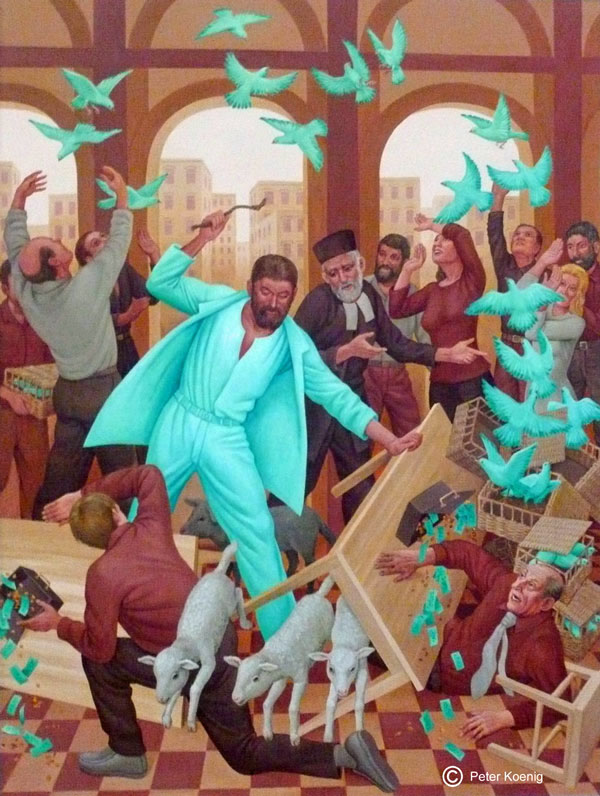
Peter Koenig_cleansingtemple1


Peter Koenig offers an evocative view of one of the most dramatic stories in the New Testament, Jesus’ so-called ‘cleansing of the Temple.’ We can’t help but notice the aquatic colored clothing worn by the Christ figure, matched by the at-first-surprising color of the doves. Fairly quickly we notice the similar but slightly differently colored paper currency falling out of the overturned cash boxes of the merchants and money-changers. Though both doves and lambs might be presented as forms of offering in the temple, the lambs are not depicted in the same hue as the doves.

Some translations render Jesus’ critical statement as, “Stop making my Father’s house a marketplace!” Another way of translating that last word is “house of trade,” which may better locate the object of his anger. Throughout the Bible, from the days of the Temple’s prototype in the wilderness, to its fulfillment in the New Jerusalem, God provides a place and a way for us to offer gifts.

The ‘exchange’ that is the object of his wrath may not be so much the trade of money for sacrificial animals, as it is the spirit of exchange that shapes and colors much of the prayer occurring within this place. By overturning the tables and driving out the animals, Jesus points to a new Temple where we meet God. He becomes the new place of offering, where pure offering replaces all the false substitutes we create by our efforts to engage God in an exchange.

Why the aquatic colored vesture for Jesus in the painting, as well as for the doves? I am not aware of any explanation by Peter Koenig. The whip in Jesus’ hand reflects a detail unique to John’s Gospel. The color of his clothing may therefore be connected with his statement on another visit to the Temple, implying that he is the source of living water. Living water and the life-giving Spirit are thematically linked in the Fourth Gospel. As a dove does at his Baptism, the similarly-colored doves may represent the Holy Spirit. Here we see the Lamb of God, who has come into the world in order to offer it up to the Father in the Spirit. Entering the Temple, he sends earthly lambs scattering, and pushes aside false ways we use to secure life and happiness through exchanges we try to make with God. Instead, Jesus invites us to join him, in his whole and complete self-offering.


The Cleansing of the Temple, (C) Peter Koenig. For this and other images by the painter, please see the website from which this painting was retrieved, http://www.stedwardskettering.org.uk. For a link to my homily on the theme of offering and exchange, in relation to John’s account of the Cleansing of the Temple, click here.