Beauty and Holy Sorrow

Art_Peter Koenig Palm Sunday


The moment is filled with paradox. Jesus enters the royal city, proclaimed as “the blessed one who comes in the name of the Lord—even the King of Israel.” Luke says his appearance signals “peace in heaven.” As he arrives, he is keenly aware that tremendous confusion lies at the heart of the recognition he is receiving. And Peter Koenig’s painting captures this nicely.

Koenig portrays Jesus dressed completely in white, suggesting his identity as ‘pure victim’ and ‘true priest.’ The painter takes a symbolic approach to the scene, envisioning it in a contemporary setting. Though we see an ample supply of date palms in the background, people in the crowd are waving flags. I count at least 18 communities or nations represented by those flags, including Israel, Lebanon and the Gaza Strip, as well as Nicaragua and Cuba. Surely , a crowd of people from many nations, united in their enthusiasm about Jesus’ arrival, is a sign of hope, is it not? Why would he be weeping?

He is weeping because he knows what is in people’s hearts. He knows how thin is our perception, and how halting is our embrace of him. We so often assume that, by virtue of our common affirmations, we can overcome our divisions. As if we could all agree upon a combination of human civil laws, and then arrive at the unity we all desire. But he knows that the healing of the divisions between the nations will not occur until the real human problem has been dealt with. The real problem is sin. It will be dealt with by his cross and resurrection, and most importantly, by the descent of the Spirit at Pentecost. Only these events will heal the divisions we have experienced since the demolition of the tower of Babel.

We see two figures in foreground unroll a band of penitentially-colored purple fabric. They discern a more appropriate way to greet him, than do those who wave symbols of the partitions between us. We so often behave as if we were less than the one people of God. Yet, the Body of Christ replaces all our competing affiliations, a fact not yet apparent to those who shout Hosanna on this day. This same heedlessness is suggested by Koenig’s portrayal of those who seek to greet him by climbing up on a cross. Soon, they will lift him up on this same form, confirming their need for him to be among them. If he weeps on this day, he weeps for us. We are among those for whom he asks forgiveness, for we know not what we do.


Peter Koenig, Entry into Jerusalem. To view more of his paintings, click here. See Mark 11:1-10, and John 12:12-19. To access my Palm Sunday homily, on which the above is based, click here.

Revealing Glory

Art_Tissot_we-would-see-jesus-tissot


James Tissot was a successful French painter and illustrator, whose beautiful paintings of boats and ships I particularly admire. His earlier work reminds me of that of other 19th century high society painters like John Singer Sargent. In 1871, Tissot moved to London where he acquired a reputation for his paintings of elegant and fashionably-dressed women. The waiting room of his studio was remembered as always having a bottle of iced champagne available to callers.

Returning to Paris in 1885, Tissot exhibited 15 large paintings under the title of The Women of Paris. Like the work of other artists of the time, his paintings reflected the influence of Japanese prints. That same year, he experienced a re-conversion to the Roman Catholic Church, which transformed his life and his art.

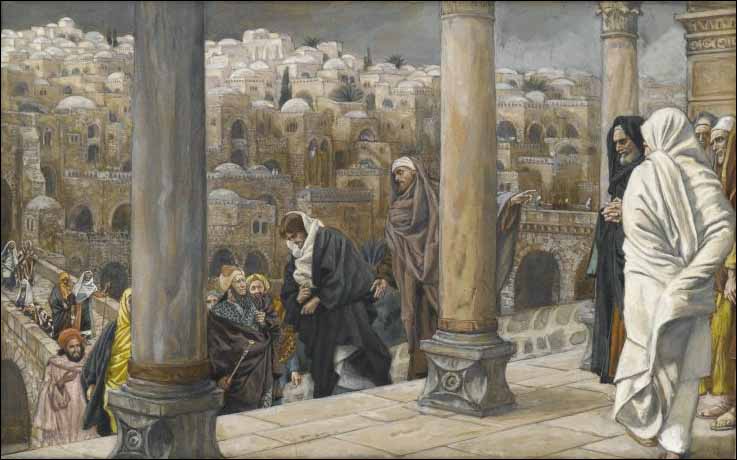
Some Greeks have come to Jerusalem for the Passover, and ask to see Jesus. Notice how Tissot portrays much more than the immediate scene of the conversation, displaying his immense interest in the history and archaeology of Jerusalem. He imagines the Greeks approaching on an arched causeway over the Tyropoeon valley, on the southwest side of the Temple Mount. They are walking up to what might have been the most dramatic entrance to the Temple. Finding a fellow visitor who speaks Greek, they tell Philip why they have come. “Sir,” they say; “we wish to see Jesus!”

Tissot portrays Jesus in his customary way, as a rabbi clothed in white, and the painting is faithful to the scene as John presents it. Tissot therefore does not show Jesus moving toward the inquiring Greeks. Instead, as John tells us, when he hears that the Greeks want to see him, Jesus responds to Philip and Andrew in a curiously indirect way. Drawing upon an image in the book of Daniel, he says, “the hour has come for the Son of Man to be glorified.” Jesus speaks of his death and his vocation, which he says is centered on God’s glorification.

Here, we begin to make sense of why Tissot portrays the Greek visitor’s arrival from Jesus’ perspective, from the vantage point on top of that southwest corner of the Temple Mount, looking out between Hellenic columns toward Mt. Zion. The occasion has deep significance, not just for Greek visitors. It has significance for all of Jerusalem, and everyone who has come for the great festival. And it has implications for the whole world, lying over and beyond the hills of this city. Here, on a dramatic high point on the Temple Mount, as Jesus stands in the place associated with God’s own glory, a voice from heaven speaks of his glorification. The Gentile foreigners whom he has drawn to himself are a sign, a sign of all those who will be drawn to him, when his glory is revealed on the cross.


James Tissot, “We Would See Jesus,” from his multi-volume, The Life of Christ. The Gospel passage to which this image refers is John 12:20-33. For a link to my Sunday homily, developing these themes, please click here.

The Beauty of the Cross

photo_mt nebo_moses_cross_from-pa.uky.edu


At the summit of Mt. Nebo, in Jordan, there is a tall sculpture that commemorates the Bronze Serpent. This is the serpent mentioned in the book of Numbers, in a story about Israel’s wilderness wanderings.

The metal sculpture, by Giovanni Fantoni, features a serpent twisted around a pole. Its head, depicted at the top, is encircled by a loop of its body. The fact that the serpent story occurred at a different place in the wilderness raises the question of why this sculpture is positioned on Mt. Nebo. That location suggests one reason. From the lookout next to the sculpture, people can see Jerusalem on a clear day. The view to the west includes Jericho and other sites in Israel.

Perhaps you have noticed African-American churches named after Mt. Nebo. From it, Moses was allowed to see the Promised Land before he died, without ever getting there. Mt. Nebo, and seeing the Promised Land, have become metaphors for the promise of deliverance and salvation. In recent history, this theme powerfully shaped Martin Luther Kings’ last sermon, on the night before he was assassinated in Memphis. See the film of it, or read his words. They are stirring.

From the biblical story we learn one reason why the serpent became metaphor for healing and deliverance. When Moses fashioned the bronze serpent, the repulsive sight of a snake in the wilderness was transformed, so that it became a symbol of his peoples’ reconciliation with God.

Here, we see how the sculptor was thinking of more than the biting serpents. Clearly, he was also mindful of Jesus’ words in John 3. In addition to depicting the serpent made by Moses, we see how the looped body of the snake around itself also suggests the head of one who has been crucified. We also notice the lyrically shaped crosspieces, evocative of outstretched arms. The sculpture reminds us of Jesus’ words to Nicodemus, “Just as Moses lifted up the serpent in the wilderness, so must the Son of Man be lifted up…” Speaking figuratively, Jesus risked likening himself and his probable death to the bronze serpent. Seeing him lifted up, repentant hearts recognize the power within this new symbol of redemption.

Think about the Cross. Over time, an object representing a dreadful death has come to symbolize a new and different meaning. Something truly frightening was transformed by God into a symbol representing reconciliation with our fear of death. The Romans used the cross as an instrument of violent subjugation, effectively employing it to suppress the will and spirit of nations under their dominion. Through the centuries, the cross has become a symbol of life, and of love. Seeing the One lifted up, opens to us the promised land of new fellowship with God.


The Bronze Serpent, by Giovanni Fantoni, on Mt. Nebo, in Jordan. See, also, Numbers 21:4-9, and John 3:14-21. For a link to my Sunday homily on this theme, and referencing both the sculpture and M.L. King’s last sermon, please click here.

The Beauty of Offering

Peter Koenig_cleansingtemple1


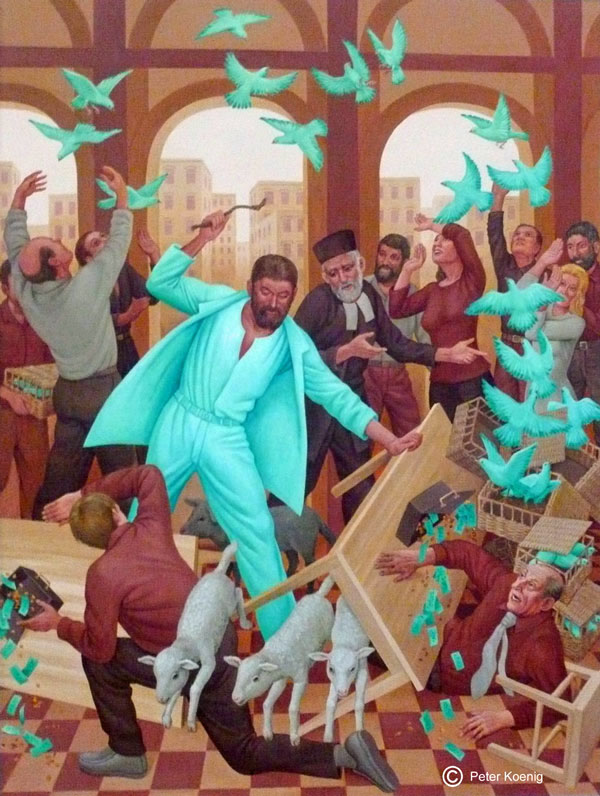
Peter Koenig offers an evocative view of one of the most dramatic stories in the New Testament, Jesus’ so-called ‘cleansing of the Temple.’ We can’t help but notice the aquatic colored clothing worn by the Christ figure, matched by the at-first-surprising color of the doves. Fairly quickly we notice the similar but slightly differently colored paper currency falling out of the overturned cash boxes of the merchants and money-changers. Though both doves and lambs might be presented as forms of offering in the temple, the lambs are not depicted in the same hue as the doves.

Some translations render Jesus’ critical statement as, “Stop making my Father’s house a marketplace!” Another way of translating that last word is “house of trade,” which may better locate the object of his anger. Throughout the Bible, from the days of the Temple’s prototype in the wilderness, to its fulfillment in the New Jerusalem, God provides a place and a way for us to offer gifts.

The ‘exchange’ that is the object of his wrath may not be so much the trade of money for sacrificial animals, as it is the spirit of exchange that shapes and colors much of the prayer occurring within this place. By overturning the tables and driving out the animals, Jesus points to a new Temple where we meet God. He becomes the new place of offering, where pure offering replaces all the false substitutes we create by our efforts to engage God in an exchange.

Why the aquatic colored vesture for Jesus in the painting, as well as for the doves? I am not aware of any explanation by Peter Koenig. The whip in Jesus’ hand reflects a detail unique to John’s Gospel. The color of his clothing may therefore be connected with his statement on another visit to the Temple, implying that he is the source of living water. Living water and the life-giving Spirit are thematically linked in the Fourth Gospel. As a dove does at his Baptism, the similarly-colored doves may represent the Holy Spirit. Here we see the Lamb of God, who has come into the world in order to offer it up to the Father in the Spirit. Entering the Temple, he sends earthly lambs scattering, and pushes aside false ways we use to secure life and happiness through exchanges we try to make with God. Instead, Jesus invites us to join him, in his whole and complete self-offering.


The Cleansing of the Temple, (C) Peter Koenig. For this and other images by the painter, please see the website from which this painting was retrieved, http://www.stedwardskettering.org.uk. For a link to my homily on the theme of offering and exchange, in relation to John’s account of the Cleansing of the Temple, click here.

Beauty and Promise

The Promise II_B


She looks out at us from the painting with a relaxed gaze. Her posture communicates calm assurance. But, look at her eyes! They suggest critical attentiveness. The painting’s composition and its egg tempura method reflect an artistic tradition going back hundreds of years. And yet, the subject matter and choice of imagery are thoroughly modern. Though relatively young, Madeline von Foerster’s portfolio displays significant scope and reflects serious engagement with the history of European painting. Equally evident is her abiding concern for the natural world and our relationship with it. You might just be able to see her careful depiction of two endangered species, the Oregon Silverspot Butterfly on the oak tree, and the American Burying Beetle crawling on its roots.

She observes that, “the first promise inherent in the image is the certainty of death,” an idea that initially may strike us as negative. However, she says, “my painting is meant to present a different concept — that of a collaboration with this part of the life cycle, since death is the opportunity for our atoms to rejoin the soil and become new life forms, as they have done countless times before becoming us.  A long held wish of mine is to be buried under a young oak tree, so that as the tree grew, it would literally acquire my atoms.  For me, this seems a sacred privilege which hints at immortality.” To the artist, then, the oak tree represents “a more significant promise” than that of death.

This painting expresses a worldview in continuity with one we discern in much of Scripture. Except for one significant point. Texts like Genesis 1 and John 1 are permeated by a conscious awareness of the Creator’s continuing presence in Creation. Though Madeline von Foerster does not explicitly claim this same awareness, something not far from it is implicit in her work. As we know, nature mediates grace. In this painting, she does not portray a covenant with death, as some might suppose. She portrays a covenant with life, in the face of death. The painter recognizes the theme of promise as implicit in the patterns of nature. Though she doesn’t credit a higher source for it, she can help us see that source even if it’s not her conscious intent.

Madeline von Foerster recognizes how purpose and meaning are intimately bound up with the waves and particles that make up the universe. She marvels at how bits of our physical embodiment have a deep connection with the stuff of Nature, and her comments echo statements made by scientists. People who identify with the Church’s faith would agree, but want to say more. Those same atoms within us have a destiny that includes but also transcends becoming part of other biological life forms. Within us, these atoms have a vocation to be bound up with the spirit of the living God. The promise at the heart of the universe is both spiritual and material, as Teilhard de Chardin spend much of his life working to show.

Promise is therefore more than something implicit in nature. Promise shapes the Creator’s activity.


Madeline von Foerster, The Promise II, 2012 / (C)Madeline von Foerster http://www.madelinevonfoerster.com (used with permission). The longer quote in the second paragraph is from an email sent by the painter, and the shorter one is quoted in an interview that appeared in MenacingHedge.com.

This reflection is adapted from my homily for Lent 2 (click here for a link).

A Covenant with the Cosmos

Edward_Hicks_-_Peaceable_Kingdom_1834_b


“He was in the wilderness forty days, tempted by Satan; and he was with the wild beasts; and the angels waited on him.” (Mark 1:13)

Unlike Israel’s forty years of temptation in the wilderness, Mark’s account of Jesus’ forty days is not colored by looming adversity, where his comfort and safety are obviously at risk. For this reason, we should be careful not to read into Mark’s spare account details we learn from Matthew and Luke. Mark doesn’t portray this time as resembling Adam and Eve’s life after Eden, or Israel’s challenges in the wilderness, where serpents and wild beasts were an active threat. Instead, Mark’s account of Jesus’ forty days in the wilderness appears to echo Adam and Eve’s experience while they were still in Eden, and to fulfill Isaiah 11’s prediction of the peaceable kingdom.

Behold! In Mark’s wilderness story, we see a portent of the New Creation, where we will be at one with God’s Creation, and live in harmony with its beauty and ordered rhythms. Angels wait upon us, and we become aware of them. Why? Because as Jesus says in the first words of his mission: “The time is fulfilled, and the Kingdom of God has come near!” The age has been inaugurated when, as 1 Peter says, angels, authorities, and powers are all made subject to him.

As God’s Kingdom breaks into this world through the mission of Jesus, we should expect to see its presence and power. And we should be moved to live in harmony with its purposes. How do we know these purposes? We learn about them in God’s words to Noah and his family when they emerge from the ark. For forty days, they journeyed through the ‘wilderness’ of the flood, living side by side with all the animals in the ark, both wild and domestic. This poetic image of the ark with its inhabitants, journeying through the flood, provides a potent metaphor for the New Creation, for the Kingdom and for the Church.

Especially fitting are God’s words to Noah once he sets foot on land. God says, “I am establishing my covenant with you… and with every living creature that is with you, the birds, the domestic animals, and every animal of the earth with you.” Genesis describes this as a covenant between God and the earth, an “everlasting covenant between God and every living creature.”

God still “so loves the world,” with all its wonder and fine beauty.


Edward Hicks, The Peaceable Kingdom (1834).  To see the homily from which the above text is excerpted, please click here. See Isaiah 11:1-9, as well as Genesis 9:8-17.

Engage with Beauty

Enclosed Mountains and Clouds_John Baggaley


Alexander Calder approached the creation of public sculpture in a unique way. His largest pieces are often set in the midst of cities, placed on plazas between modern office buildings. We have a beautiful example here in Grand Rapids, with another large one in the same bright red color, nearby in Chicago. Unlike them, Mountains and Clouds, in the Washington Hart Senate Office Building, is painted in matte black. This works well against the white marble and clear glass in the atrium where it stands. Each of these three “stabile” sculptures provides a lyrical counterpoint to the linear and grid-like facades of the office buildings. Mountains and Clouds is unique in that it also involves one of Calder’s mobiles, suspended from the atrium ceiling.

We know that monumental sculptures from earlier times often portray honored heroes, standing or on horseback. By contrast, Calder’s large works are abstract, and don’t simply draw attention to themselves. His plaza sculptures do more. They lead the observer’s eyes to notice the interplay between his work and the spaces around them, as well as their contrast with nearby buildings. One doesn’t just view these sculptures; one engages with them, and with the larger context of their placement.

Here, we must mark a paradoxical aspect of all public sculpture, which indicates something more about us than it does about the art. Many people work everyday in buildings around where these sculptures are situated. But they are just as capable of being as inattentive to these pieces of art as they are to their parking spaces or to the doors of their offices. With the stabiles’ soaring heights and reaching curves, Calder’s works are expressively shaped and tremendously uplifting. But our focus on our work and our worries, and the practical things we need to do, blinds us! And it diverts our attention from something truly beautiful, right there in front of us.

I note all this because the same thing can happen when we encounter the first verses of John’s Gospel. Often called the prologue to his Gospel, John has written a passage shaped by poetic beauty and filled with lofty theology. Yet, we have a tendency to focus on what is immediate and practical, and on what seems narrowly relevant to our everyday concerns. And so, we can go right by this Gospel ‘work of art’ just as people hurry past the great Calder downtown, absorbed with getting to their offices. In both cases, something sublime lies before us, waiting for us to engage with it. But sometimes we don’t see it because we aren’t really looking for it!


Alexander Calder, Mountains and Clouds, 1976 (installed 1986),  in the Hart Senate Office Building, Washington, D.C. The beautiful photograph is by John Baggaley, and is used by permission. For a link to the website of this talented photographer, click here.

For further reflection on Calder’s stabiles, especially his Mountains and Clouds, in relation to the Prologue of John’s Gospel, click here.

The Beauty of Gray

James_McNeill_Whistler_-_Nocturne-_Blue_and_Gold--Southampton_Water_-1280


When asked, I used to say that gray was my favorite color. Correctly, some would respond that gray is not a color, but the series of shades marking the region between black and white. Gray often represents a mixture of the two in pigment.

Examined more patiently and reflectively, and in a less technical way, gray is alive with color–but subtle color. Just look up “Payne’s grey” (note, U.K. spelling), and you will see.

Perhaps my childhood in Japan, as well as my adult experience in England, formed my appreciation for the beauty latent within the world of gray. I love James McNeil Whistler’s paintings, and especially those that employ fields of gray permeated with subtle color. Many of these were influenced by Japanese prints.

I consider these things as I reflect on the recent film, The Giver. Though people will say it starts “in black and white,” I think it can be described more properly as immersing us in a visual field of gray. The film is compelling, and not simply sentimental or youthfully romantic (which it might easily have been), because of how positive aspects of this gray world are thoughtfully presented. A thematically ‘black and white’ film would portray a more polarized contrast between the forgotten past of color, which included both conflict, hate and violence as well as their alluring opposites, and a hypothetical present world, deceptively gray, where—eerily— all seems well. A gray world might imply moral ambiguity rather than moral neutrality.

As we emerge from adolescence into adulthood, don’t we seek stability as we move away from the up-and-down emotional life of our teenage years? Don’t we assume that monastics—like us— seek something spiritually akin to a world of gray, enabled by their departure from our world of distraction, competition and self-promotion?

The Giver risks presenting a gray world as desirable, and then fearfully threatened and upset by a young man’s journey into the forgotten past. There is beauty to be found almost everywhere, in a world filled with heart-breaking contrasts of emotion and alive with color, yet even in one where affectively numb persons find everything appears in a field of gray.

I don’t question the value of the hero’s journey, nor its evocative results. Yet, I continue to muse about what made the gray world attractive to those who shaped and promoted it. Simplicity, even a morally reductionist simplicity, has abiding appeal.


Above: James McNeill Whistler’s Nocturne: Blue and Gold—Southampton Water (1872). Note the reference to color in the title of a very gray-looking painting.

Beauty in Marriage

Kiyochika-Sumida River by Night-Detail-1881


Adapted from a recent wedding homily for my son.

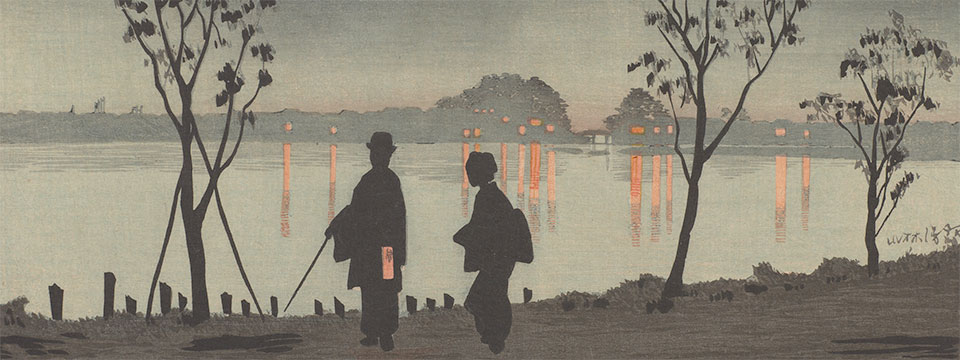
In Sumida River by Night, Kobayashi Kiyochika depicts a man and a woman walking in Tokyo, late on a summer evening. Though from Asia, this 1881 print had a profound influence upon the American painter, James McNeill Whistler. I love how the artist grabs our interest with the glow of red paper lanterns, both near and far. This beautiful image provides a helpful metaphor.

We can see in this picture a reflection of our lives. Hans and Bridget, in your marriage together, you will have many occasions to look out onto life in the world around you and notice others. Your attention may be caught by a parallel to the glowing lights along the far side of the river in this print. Though you may have a light between yourselves, your eyes can be drawn to the multiplicity of other lights around you, and the way they reflect off events and other people. There will be times when you may think others are more happy or fortunate than you are.

Especially when we are young, we tend to think that knowledge, goodness and happiness lie elsewhere, and in others. It’s actually an important part of our journey into maturity to want to attain these things for ourselves. Our admiration for others and their achievements, prompts us to reach further and higher. But this same experience can create an illusion, the mistaken belief that we are of less value.

A similar thing can happen with love, especially romantic love. When we are single, we notice couples walking together in parks and along streets. It seems that others have found their mate, and a kind of happiness that eludes us. Even when we meet that special person, as we get to know him or her and as our relationship matures, we begin to see that not everything goes smoothly. Once again, we are prone to looking at other couples with a misleading idea ~ that they have something more than we have.

But there is another way to see this picture, which applies equally well to you at this point in your lives. I think the artist has deliberately portrayed this couple as older, with the man shown holding a cane. Notice how the paper lantern in his hand, in whose glow they both walk, rivals anything glowing on the horizon. It may be smaller than the great lanterns across the river, but it is near them and within their hands. They have all the light they need, shared between them, as they walk along the river of life.

I have suggested two ways of looking at this print, paralleling two ways of looking at our lives together in this world. In seeing this print as portraying a young couple, we might reflect on the way that things in our lives can seem scarce and limited, and how our attention can become fixed on what seems to be missing. Yet, seen the second way, as portraying an older couple, our hearts can be filled with an awareness of abundance, and how everything we really need is within our reach, if not already in hand.

You may think that I am talking about such things as our natural talents and abilities, and the resources we have been given or have attained through our work. But what I actually have in mind is that great intangible thing we call love. I have in mind not only the kind of love we have for one another, in romance and marriage and for others in our families. I mainly have in mind the kind of love we are given by our Lord, especially when we ask him for it.

The natural love the two of you have for one another is complemented by a supernatural love you will have for each other in marriage. This is a love that is given to you and through you, for your life together. Though some things in your life may become scarce, and even if many things become limited, you will always have all the love you need. Your love will be the light you carry with you as you journey along the path you share together. This kind of love, and this kind of light, are gifts, rather than something you purchase or attain. And so, tomorrow you will have just as much of this love and light to illumine your walk together, as you will have when you are old.

Jesus said, “You are the light of the world!” We are used to Jesus being spoken of as the light of the world. But he tells us that, through his gift, we share the quality of being light for the world. Love illuminates darkened hearts and darkened lives, and love becomes the source of life, true life. Jesus does not want us to hide the light he gives us. Instead, he wants us to display it through how we live, that others might give glory to our father in heaven. Even if we mistakenly think we have so little of this love, and even if sometimes there seems to be more of it in the world around us than in ourselves.

The Church is very wise to appoint this portion of Matthew’s Gospel as a reading for weddings. Not only does our Lord hope that we as individuals will bear witness to his light and love; he intends that our marriages, and our lives together as families, will display the same light.

Hans and Bridget, the love that you share with one another and with Conor and Brady is, at its heart, a gift from God. Let this light that you share as a family, be a light for your path. May it also be a beacon of light for those around you.


Sumida River by Night (1881), by Kobayashi Kiyochika. Matthew 5:13-16 is one of five Gospel readings appointed for The Celebration and Blessing of a Marriage in The Book of Common Prayer. This homily was offered near the great Mississippi River, in Baton Rouge, LA, in May.

Beauty in Community

Pentecost_CELPentecost[1]_buildfaith.org


A collection of individuals fills this painting, signifying Mary and the first followers of Jesus. They are looking in different directions at the moment when the great whooshing wind and the flames of the Holy Spirit come down upon them. Caught up in the movement of the wind and flames, they are pushed forward into a celebration that is turned outward, and toward the darkness that lies beyond. The fire of the Spirit blows in and through them, not just around and over them. And they are swept forward into the future, in common mission.

We have a challenge imagining this moment. Our culture emphasizes the particularity of personal experience, and differences between us. We hear much talk about diversity and inclusion, which might reflect a positive regard for community. But it may also reflect an assumption that, apart from our efforts to bring people together, we are separate and disconnected. Perhaps, on the day of Pentecost, some of the people dramatically experienced God’s power. But we may be surprised to hear that all of them did, and together!

We don’t appreciate how community is vital to individual human flourishing. We often want individual freedom without personal accountability to others, and individual opportunity without personal responsibility. Being in community with other people may seem to be occasionally beneficial, especially when it is on our terms. But we don’t see it as essential to our lives.

In the ancient biblical vision, we are created in community, and we are redeemed in community. Whether we experience it or not, after Baptism God abidingly dwells between us and within us. There is no distance between us and God, even if we perceive a disconnection within ourselves. Whether we are conscious of it or not, God pours out grace to us in revelation and in inspiration. This is why God encourages us to open ourselves in prayer to his abundant gifts. All are blessed, for all receive a full measure of the Holy Spirit in Baptism. And all are commissioned by the fire of the Holy Spirit to engage in mission wherever we are, at home, at school, at work or at play. All are called to share in the beauty of Christ in community.


The Pentecost painting is found on the website, http://www.buildfaith.org. See Acts 2 for the Pentecost story.