Theological Reflection

The Beauty of His Continuing Presence


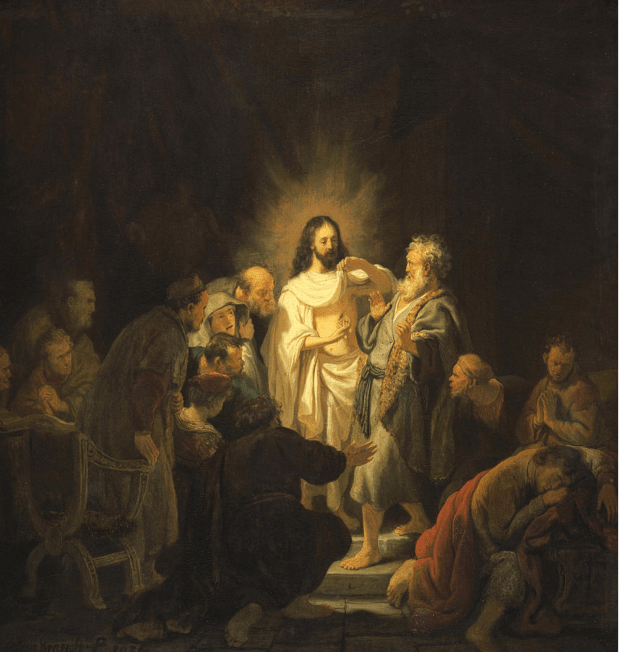
The most well-known painting of ‘Doubting’ Thomas and his encounter with the Risen Jesus may be the one by Caravaggio. And yet, paintings like his are misleading, as is referring to Thomas as ‘the doubter.’ Why? Because paintings and labels like these lead us to overlook or misperceive some very important details within John’s Gospel story. Rembrandt’s painting of the event (above) helps us notice the difference.

As John tells it, we first find ten of the disciples hiding behind locked doors out of fear. Consider how, during Jesus’ ministry with them, he had more than once told them to fear not. And at the Last Supper, he had given them ‘his peace.’ Yet, rather than remember what Jesus had shared with them, as well as his miracles, all of them have succumbed to fear. Even though Mary Magdalene that morning had already told them that she had seen the Lord. How can these details be squared with any other description than that the ten behind locked doors are doubting, as well?

Second, observe how John’s Gospel describes Jesus’ initial appearance to the ten, when he finds them fearful and doubting. At first, they do not recognize him. It is only after Jesus shows them his hands and his side that they then recognize him, and rejoice at his presence. When they see him, then they believe, and not before. So, once again, Jesus leaves them with his peace. And now, he gives them his Spirit.

Notice what the ten say to Thomas when he then arrives: “We have seen the Lord” ~ the very same witness Mary had earlier offered to them without having had much effect. Thomas naturally replies by saying something like this: ‘Look, I haven’t see him, like you guys just did— and so, just like you, I won’t be able to believe until I see him, either.” Thomas’ statement to them therefore does not need to be heard as him setting the conditions for his belief. It may simply be a practical prediction of fact.

We need to be equally perceptive about John’s description of Jesus’ later visit to that same locked room. It is a week later when Jesus returns to the eleven, among whom Thomas is present. It is vital to notice what Jesus says to Thomas. It’s even more important to observe how John describes Thomas’ response. Jesus invites Thomas to touch him and to believe. But the Gospel does not say that Thomas has any physical contact with Jesus. It does not tell us that he reaches out, or that he makes an effort to touch Jesus. Instead, and just as Jesus gives him credit for doing, he sees, and then he believes. Just like the prior experience of the other ten!

Rembrandt’s image, like the painting by Carl Bloch, is faithful both to what John tells us, and to what he does not. Observing this, we should refer to this story in John’s Gospel in a different way ~ ‘the doubting disciples, and how they all came to believe.’


The above image is of Rembrandt’s (I think mis-titled) painting, The Incredulity of Saint Thomas. This post is based on my homily for Easter 2, April 28, 2019, which can be accessed by clicking here.  Other homilies of mine may be accessed by clicking here. The Revised Common Lectionary, which specifies the readings for Sundays and other Holy Days, can be accessed by clicking here.
Beauty in Parallel

golden_gate_bridge_pillar-smaller-copy

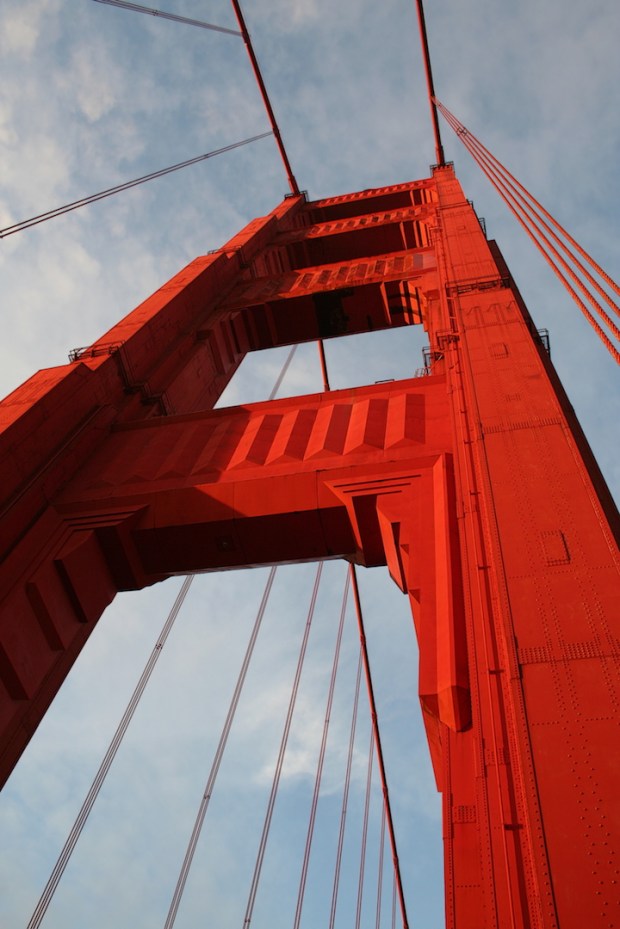
Perhaps the only thing more memorable than driving over the Golden Gate Bridge may be to pass under it on an ocean-going ship. I was lucky enough to have that experience five times before I was a teenager.

Many of us assume the name for this bridge is related to its warm color. But the name comes from the ocean straight over which it stands, though it does not derive from the Gold Rush. Rather than mimicking gold, the bridge’s official color—“International Orange”—was chosen to contrast with fog. A story is told about when that color was first applied. Painters dabbed splotches of it on the heads of curious seagulls. Pretty soon, Bay Area birdwatchers reported a new bird species, which was called the California Red-Headed seagull!

Until 1964, the Golden Gate Bridge had the longest main span in the world. Yet, its basic design isn’t unique. We know this from other suspension bridges, which are found all over the world. Bridges of this kind have two main towers, steadied in place by their suspension cables, which are anchored in the ground. From their anchor points, these substantial cables ascend to the top of the towers, and then gently descend again to the center of the bridge. From that low point, they again soar up, to the top of the opposite tower. The slightly arched roadway across is literally suspended from these main cables, by small support cables that hang from them. Here, in the beauty of this simple design, we find a helpful spiritual and liturgical metaphor.

Reflect for a moment about two significant Sundays in the church year. One is the last Sunday after Epiphany, or Transfiguration Sunday, and the other is Easter Day. Transfiguration Sunday is the last Sunday before Lent, and Easter Day is the first Sunday after Lent. Imagine these two Sundays on the Church calendar as being like the two towers of the Golden Gate Bridge. Transfiguration Sunday, coming just before Lent, is like the south tower of the Golden Gate bridge, on the urban, San Francisco, side of the straight. And, Easter Sunday is like the north tower of that bridge, on the less familiar and historically rural side of that navigational channel. The season of Lent stretches between these two Sundays like the main span of a bridge. Here is the crucial part ~ every year we need to make this liturgical crossing. And, like the great towers of a bridge, Transfiguration Sunday and Easter Sunday uphold us all the way across our Lenten journey.


This posting is based on my homily for the Last Sunday after the Epiphany, which explores the parallel between the revelation of glory that we see in the Transfiguration, and the glory we see in the Resurrection (click here for a link to it).

The Beauty of His Community

Art_James He Qi_The Doubt of St.Thomas_large


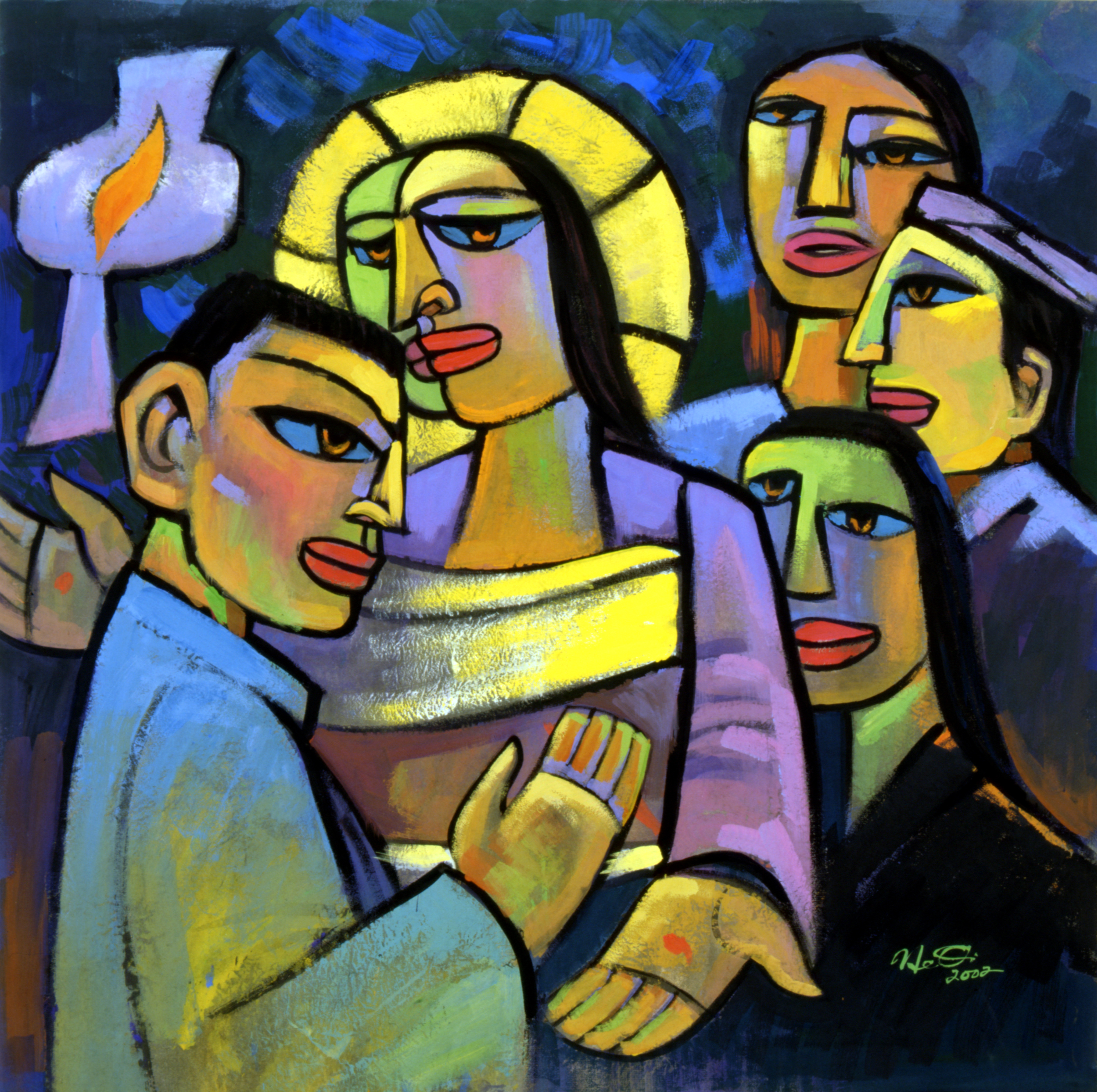
I love how artists help us read and hear Scripture in new ways. Occasionally, they help us perceive aspects of biblical texts for the first time. Paradoxically, in one case artworks have nurtured a mis-hearing of the Gospel. For all the paintings of Thomas that I know refer to him as having doubt, and portray the resolve of that doubt as coming from his touching the side or hands of the risen Jesus. But look closely at John’s Gospel. In his visit to the room where the disciples have been hiding, the risen Jesus does not directly attribute ‘doubt’ to Thomas. Instead, and perhaps with his prior visit to the other disciples in mind, he merely tells Thomas not to doubt. Nor does John describe Thomas as taking up Jesus’ invitation to touch him. Jesus credits Thomas for believing after seeing him, rather than after touching him. He then encourages the kind of belief that does not rest upon seeing.

Notice how the other ten disciples are hiding in fear, rather than joyfully confident, when Jesus comes to where they have locked themselves in. They are described as rejoicing only after Jesus shows them his hands and his side. In other words, Thomas is not unique and different from the other disciples, and benefits from exactly the same experience that transformed them from people fearfully hiding into those who are rejoicing. Their joyful confidence is reflected in their words to Thomas when he later arrives. They say, “We have seen the Lord.” Their joy is the direct result of seeing Jesus’ hands and side, the very things Thomas says will be key to his own believing. So, the ten did not believe until they saw; and Thomas will not believe until he sees. What they received, he, too, will receive. As will we, who—like Thomas—were not initially in that room. The history of art obscures this important point.

Here are two safe things we can say and accept as true. The risen Lord continues to disclose himself with signs. And, the Lord reveals himself in community, and always for the sake of his community. For his community is fellowship within the new covenant of reconciliation. As John writes in his first Epistle, “We declare to you what we have seen and heard so that you also may have fellowship with us.” Fellowship with this community, is fellowship in and with the Risen Lord.


James He Qi, The Doubt of St. Thomas (He Qi © 2014 All Rights Reserved); used with permission. I think of it as portraying the community faith of Thomas. See John 20:19-31, and 1 John 1:1-2:2. Click here for a link to my Sunday homily, which explores the impact of the resurrection upon the disciples.

A Strange Beauty

Stanley_Spencer_the_crucifixion_1958


An encounter with true beauty can be troubling, especially if we have settled for so much less. It may be our sensitivity to the juxtaposition of opposites, and their apparent lack of resolve. At times we hope for the triumph of good over evil, that beauty will overcome darkness, and serenity displace antagonism. But we cannot find it within ourselves to do more than hope. We cannot achieve the redemptive resolution for which we haltingly reach out our hands and hearts.

It is not an accident that the figure of Jesus recedes into the background of this painting, while those who oppose and crucify him grab our visual interest. Stanley Spencer, who adopted what he called a neo-primitive style, was far too gifted a colorist, and master of light and dark, to let that happen unawares. As Spencer has rendered him, Jesus’ skin tone and color match the wood of the cross, and also the clothing of the man with the hammer swung over his head, as well as much of the sky and of the ground below… including the tunic of Mary Magdalene, prostrate on the ground. This forms a compelling visual symbol of his Jesus’ total identification with us in his incarnation, and his complete joining with us, and with our world of tearing hurts and suffering.

In fact, it is precisely because —in Spencer’s composition and coloring— Jesus could blend in so well with the background of everyday life, that those who opposed him could literally gain the upper hand, with hammers and nails. But this is only the marvel of the incarnation of our God in Jesus, that the fullness of divinity could be so thoroughly joined to the incompleteness of humanity. As the Gospels attest, it was a joining so thorough that many did not notice or have regard for his divinity. When we do notice that thorough joining, when we come face to face with the truths it represents, we have either one or the other of two reactions. When we get close enough to see —to really see him— there are only two responses. We throw ourselves down in humility before him. Or, we seek to throw him down, to humble him before us.

These paradoxes are brought to their greatest prominence when, as he predicted, he is lifted up. His lifting up is his glorification, and the glorification of God within him. Yet his lifting up is on a cross, and in the agony of a humiliating public execution. Here we see a ‘strange beauty’ — the strange beauty of the Lord — a beauty for which museums better prepare us than do our malls. Let us “behold the fair beauty of the Lord, and seek him in his temple.” We will find him! We will find him in the “temple” he promised to raise in three days.


The painting above is The Crucifixion, 1958, by Stanley Spencer. This reflection is based on my homily for Good Friday, which also makes reference to Charles Wesley’s text, “Lo! He comes, with clouds descending.” Click here for a link to this homily.

Toward a “Catholic” Vision [part 2]

EucharistAtStGregoryOfNyssa_med


In part 1, I shared how Ralph McMichael offers this brief but evocative definition of the word “catholic.”

Catholic means the whole truth, about the whole God, for the whole world.

Ralph’s concise definition calls for intentional follow-through. When we hear ‘catholic’ in conversation, we should anticipate and hope for an encompassing understanding of this word. This can be a first step in helping us to aim at a holistic (and therefore holy) vision of the world.

The challenge I find in Ralph’s definition is for all of us who are baptized to be “catholic” in a genuinely biblical, apostolic and ecclesial way. This means seeking and finding wholeness and holiness within the vocation we have received together in Baptism.

Embracing a larger concept of what it means to have a catholic vision opens us to
a more expansive vision of God’s Mission throughout the world. Jesus has embraced and empowered all of us to go out as grace-enabled participants in God’s continuing mission to redeem and transform the world.

We desire ‘wholeness.’ Encouraged by the culture around us, we think of achieving wholeness as our project, as our task to fulfill, or the solution to our therapeutic needs. Approached in a more encompassing way, wholeness is reconnected with God’s Mission in the world, rather than reduced to being a feature of our personal lives. God nurtures this greater wholeness through our life in community. We express God’s Mission best when we celebrate the Eucharist together.

God’s Mission is always greater than we can ask or imagine. It is not just for us, for our families and friends. God’s Mission enables us to live into the whole truth about the whole God for the whole world. As we live forward, into this wider vision, we will find that it involves beauty and goodness, as well as our perennial concern for what is true.

On this, his feast day, we can join St. Richard of Chichester (d. 1253) in his prayer, “Day by day, dear Lord, of thee three things I pray: to see thee more clearly, love thee more dearly, [and] follow thee more nearly, day by day.”


{St. Richard’s words are quoted from Hymn 654, The Hymnal 1982 / the photo above, from a Eucharist at St. Gregory of Nyssa, San Francisco, is by Mark Pritchard, (c) Attribution-NonCommercial-ShareAlike License}

Toward a “Catholic” Vision [part 1]

OLYMPUS DIGITAL CAMERA


In an earlier age, having catholic tastes or a catholic perspective meant breadth in one’s approach to the world and to objects of interest within it. A “catholic” vision would therefore be expressed in terms of what it includes rather than what it does not.

We live in an age when words and ideas are prone to partisan and ideological interpretation. Too easily, we settle for narrow and limited meaning. When we now hear the word “catholic,” we assume the reference is to an institutional branch of Christianity. Though we find the word “catholic” in the universally accepted Apostles’ Creed, we allow lesser concerns to shape our concept of what it means for the Church to be catholic.

My friend and former teaching colleague, Ralph McMichael, offers this brief but evocative definition of the word:

Catholic means the whole truth, about the whole God, for the whole world.

His definition may help us reclaim the word, so that even ‘free church’ believers might be comfortable using it. Catholic has to do with the whole, with what is universal.

A catholic vision will include all that is beautiful and all that is good, as well as all that is true. Arguably, anything less falls short of being catholic.

I am continually challenged not to settle for less than this encompassing and holistic vision.