Rembrandt

The Beauty of Redemption-Based Identity

If reading this by email, please tap the title at the top to open your browser for the best experience. Then, clicking individual pictures will reveal higher resolution images.

Fra Angelico, The Transfiguration, prefiguring the glory of the Risen Christ and the beauty of our redeemed humanity


There is beauty to be found when we base our identity or concept of ourselves upon the Redemption that has been freely shared with us. Yet, we can experience sadness when we rest our self-perception upon our ailments and disorders. Regardless of our feelings, these alternatives represent choices we can make on a daily basis.

We all have an innate disposition to sin, and in various ways we all enact this disposition. But, for Baptized people and all others, this is not ‘the be all and end all’ of who we are made to be. Our end is in Christ, and so our wholeness is in Christ. We may be sinners; we are also among those who have been redeemed and are being transformed by the power of the Resurrection.

Appreciative Inquiry teaches us that what we we focus on grows. This empirical fact can be seen in two readily observable ways. New soccer players, especially the youngest ones, tend to swarm around the soccer ball. And, when on a fast break to try to score a goal, almost inevitably they kick the ball toward the goalie, the apparent impediment on whom their eyes are affixed instead of upon empty areas of the net. Another example lies in how Drivers Ed instruction teaches aspiring drivers to keep their eyes on the road. Why? Because we steer toward what we are looking at, often with sad results when what catches our attention are the flashing lights of an emergency vehicle on the shoulder.

I remember an observant friend remarking about another person known to both of us, regarding how that person was “someone who dotes on his infirmities.” Not a recipe for health in light of our greater awareness about the symbiotic relationship between psychology and physiology.

These insights may have what I hope are obvious spiritual implications. They may lead us to ask, toward what end are we living? Upon what image of our humanity are we most focused?

Raphael, The Transfiguration (detail)

An ironic aspect of the way that we can associate our identity with symptoms or conditions from which we suffer is how we commonly speak about our embodiment. When we say things like, “my leg is killing me,” or “my head feels terrible,” we may unintentionally reinforce a kind of dualism. All too casually, we dismiss such statements as mere figures of speech, and we may wish to consider their further significance. If I say that ‘my leg is killing me,’ then I suggest that in some way ‘my leg’ is not ‘me.’ Because my words imply that ‘it’ is acting upon ‘me.’ In a slightly more abstract way, we make statements like, “my conscience is bothering me.”

When I am inclined to think and speak in this latter way, I suggest by my words that ‘my conscience’ is something other than ‘me,’ and that it has some power of agency over or against me. What we commonly refer to as ‘my conscience’ might better be described as my experience of ‘consciencing’ (an intentional neologism). Or about how I am the kind of being who experiences and engages in acts of conscience. As the older moral tradition recognizes, conscience must not only be followed; conscience can and must be educated.

So, to say that “I am powerless over sin” does not necessarily mean that I am powerless over my disposition to engage in the bad choices and decisions that I tend to make. Like my emotional experience, I may not be able to choose to have the various physiological conditions that I experience. But I can choose how I respond, or how I act in relation to such experiences and conditions. As John Wesley is remembered as having said about the vice of lust, “a bird may land on my head, but I don’t have to make a nest for it with my hair.”

Experientially, I can associate myself with the conditions that may ‘happen to’ me, and with which I may suffer. But conceptually, I can also choose to identify with the reality of the person I have been made to be and become. By grace, we have been made to become icons of Christ, who is the beautiful Icon of God. To seek to become so is to seek to become an icon of the goodness of God as well as of the truth of God, as these have been revealed to us in the face of Christ.

Rembrandt, The Ascension, an image prefiguring our redeemed humanity to keep in mind so that we may, as the Prayer Book’s venerable words put it, “thither thereto ascend.”


Note: The wisdom of our Holy Tradition is reflected in the fact that our Lectionary appoints Gospel readings about the Transfiguration on two occasions every year: on the last Sunday after the Epiphany (or the Sunday before Ash Wednesday and Lent, March 2 this year), and also on August 6, the Feast of the Transfiguration of our Lord. / In addition, readers interested in some of the ideas presented above might consider further material relevant to them in my book, Ethics After Easter, available from libraries and booksellers.

The reflections offered here may assist choosing a theme upon which to focus in preparing for and in keeping a Holy Lent.

A Lost Rembrandt: Is Beauty Ephemeral?

If reading this by email, please tap the title at the top to open your browser for the best experience. Then, clicking individual pictures will reveal higher resolution images.

A lost painting: Rembrandt’s The Storm on the Sea of Galilee

In 1990, in one of the most notable art thefts in modern history, two men disguised as police officers entered the Isabella Stewart Gardner Museum and stole Rembrandt’s famous painting, The Storm on the Sea of Galilee, and 12 other significant works of art. When one considers the loss of this painting (for it has never been recovered), as well as the many significant works of art that have disappeared through history, two related questions may arise: Can beauty be lost? Is beauty ephemeral?

In the process of reckoning with the recent Los Angeles wildfires, people who are art-minded are beginning to wonder about a particular aspect of all that has been lost, which understandably has received less attention, works of art.

After fires and earthquakes, beautiful buildings can be rebuilt, sometimes even better than before given the learning that may have come with their destruction. But what about lost paintings, drawings, and sculptures?

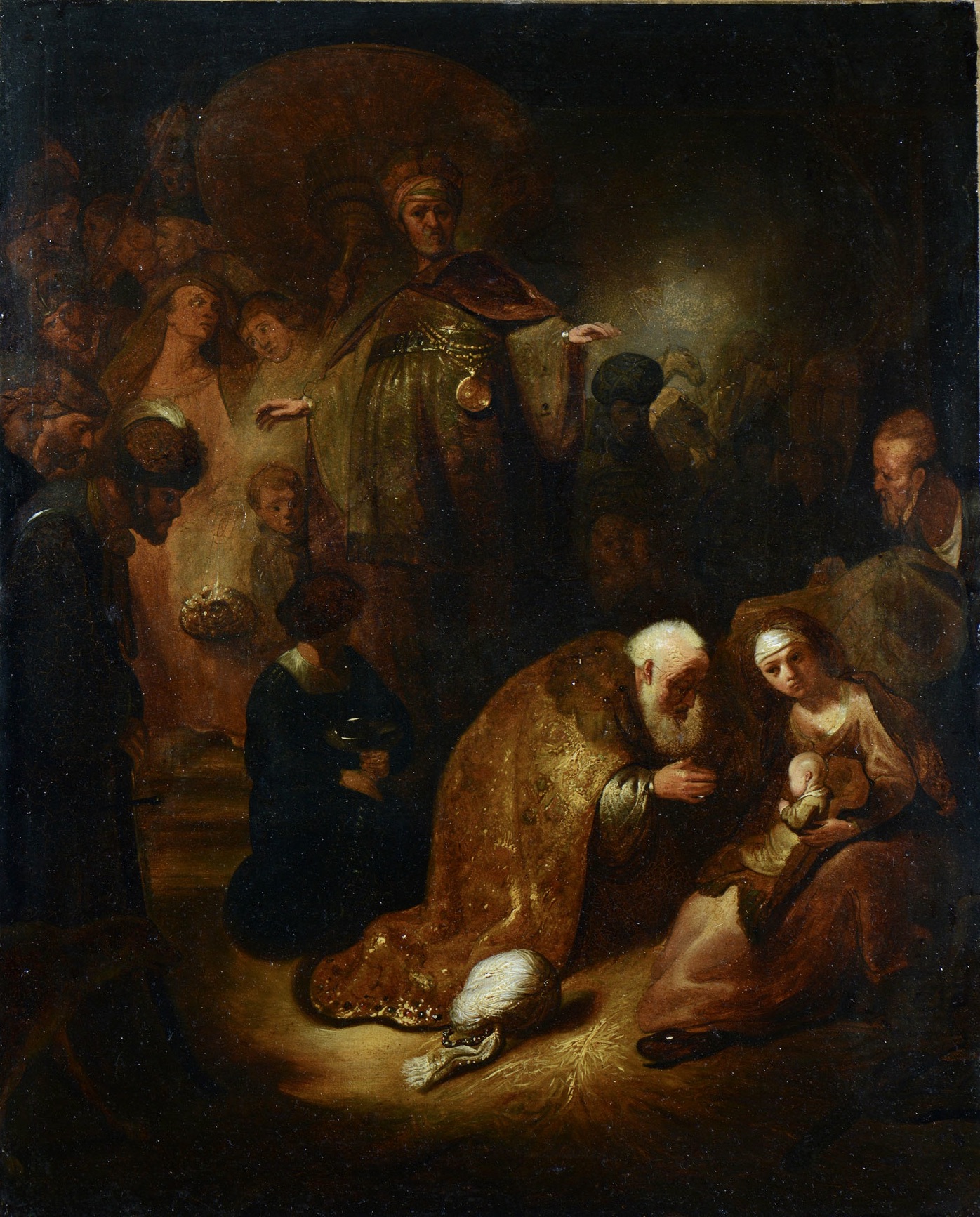
The Adoration of the Magi, attributed to Rembrandt and long thought to be lost but recently re-discovered, known otherwise through copies made by others.

Clearly, and as many of the examples featured in this space attest, works of art may now sometimes be best (or even only) appreciated through photographic reproductions obtained through the internet. It has not always been so. In earlier times collectors relied upon expert advisors and buyers through which they obtained artworks for their collections, for which they may at times only have had descriptions or comparatively poor reproductions – as did Gardner with the assistance of the famed historian, Bernard Berenson. And yet, especially when the originals had yet to be seen “in person,” or are no longer available for personal viewing, works like Rembrandts Storm painting have a beauty that is not transitory, and these artworks continue to exist as they inhabit the memory and imaginations of many others, as has been true in my own experience.

Yet, whether or not examples of Beauty in art or in nature are available for personal perusal, Beauty itself abides.

Another lost painting attributed to Rembrandt, The Unconscious Patient, also recently rediscovered.

To be consistent with their faith claims, those who are Christian believers should be among the first to agree that Beauty is not ephemeral, not here in one moment and gone in the next, nor of passing significance. Beauty, like Goodness and Truth, has since ancient times been recognized as one of the three Transcendentals. In terms of Christian faith claims, we might consider the witness of an example like the prayer for the Feast of the Transfiguration of our Lord (August 6), found in The Book of Common Prayer:

O God, who on the holy mount revealed to chosen witnesses your well-beloved Son, wonderfully transfigured, in raiment white and glistening: Mercifully grant that we, being delivered from the disquietude of this world, may by faith behold the King in his beauty; who with you, O Father, and you, O Holy Spirit, lives and reigns, one God, for ever and ever. Amen.

The Beauty of the King that is spoken of in this prayer, as with his divinity and his full participation in the Shekinah glory of the Father, is eternal rather than temporal. And so, in reference to God, to the divine nature as well as to the three persons of the Trinity who share it, we should properly speak of the source of Beauty, rather than as an example of Beauty.

Yet, as the recent Los Angeles wildfires remind us, while examples of Beauty can – at least in some respects – be ephemeral, the idea and reality of Beauty abides, continuing to inspire us even when examples of Beauty are no longer there before us to admire.

Plato, Aristotle’s teacher, continues to teach us!


Do We Give Thanks In Darkness?

[If reading this by email, please tap the title at the top to open your browser for the best experience. Then, clicking individual pictures will reveal higher resolution images.]

Rembrandt, Paul in Prison (1627)

The troubling darkness of October 7 lingers. The following is my recent homily, offering reflection on how we can respond to a time like this.


We are always prone to being unsettled or troubled by unexpected challenges, whether nearby or far away. Since we believe in an almighty and loving God, unanticipated darkness, sorrow, and anger can confuse and upset us. For the people of Israel and Gaza, and those who care for them, October 7 and the days since have been filled with the news of much evil and much suffering. But, if ‘God is love,’ and the giver of all good gifts, as Christians believe, two questions we cannot easily answer will bother us: How can God allow natural and moral evil to happen? And why does God tolerate the suffering of his creatures, and especially of people made in his image?

When facing questions like these, I like to turn to some of Paul’s words in Philippians that we have heard in our recent Sunday lectionary readings: “God… is at work in you, enabling you both to will and to work for his good pleasure” (2:13). These words may be hard to accept — and hard to live by — especially if we are discouraged or fearful about what is happening around us. Yes, we hear Paul in Scripture say that God is at work in us. But we may not feel like it’s actually true. Indeed, we may find it hard to believe that it could be true. Yet, Paul wrote these words while he was in prison.

This is what we need to remember: Our feelings are fickle! Our moods and general equilibrium are subject to the ups and downs of our circumstances. Things happen to us, which are not of our own choosing. Feelings are the same way. They also ‘happen to us.’ The difference between what happens to me, and what I choose for myself, is very significant. I can’t do much to change events in the world. And I have difficulty keeping the emotions stirred by them from affecting me. But I can reflect on how I respond to them, in terms of what I decide, and what I choose for myself.

So, instead of dwelling on feelings of discouragement, inadequacy and aloneness, I have another choice. I can choose to remember Paul’s words, and repeat them to myself: ‘God is at work within me. God is at work within me. God is at work within me, both to will and to work for his good pleasure.’

This insight helps us hear, consider, and then perhaps accept, Paul’s challenging words to us. He is saying something much more profound than “be happy,” or “be cheerful!” Instead, Paul is urging us to make a choice, a decision to rejoice and give thanks, even if we may not feel like it. “Rejoice in the Lord always,” he says (4:4), which is different from saying, “always be happy about the world.” It often seems impossible to be thankful for or about the condition of the world. But, we can still be thankful for the Lord who overcomes disorder, and who in the end makes things right. Paul says that the Lord is near, and so we should not worry about anything. Believing that the Lord is near takes precedence over anxiety and concern about what is amiss. Believing that the Lord is near is a choice we make, and not a feeling we wait for.

The imprisoned Paul teaches us how another willed-decision accompanies relying on the Lord’s nearness. In all circumstances, we can — by prayer — let our requests be made known to God with thanksgiving (4:6). This is equally a result of choice, rather than depending on how we feel. When we make this conscious choice to give thanks in all circumstances (rather than for them), Paul tells us that the peace of God, which surpasses all understanding, will guard our hearts and our minds in Christ Jesus (4:7).

Therefore, confidence, reassurance and peace are not simply feelings that may or may not happen to us. They are, instead, the result of willed-decision-making. So, Paul asks us to keep on doing these things, and that as we do them, the peace of God will be with us.

When I dwell upon what I fear, on what makes me angry or depressed, I give in to feelings that happen to me, especially in relation to circumstances I cannot change. But Paul asks us to do the opposite. Instead of dwelling on the negative, he urges us to reflect on what is positive. Think instead, Paul says, about whatever is true, honorable and just: about whatever is pure, commendable and worthy of praise (4:8). And he urges this based on choices we can make.

Notice what Paul is not saying as he urges us onward. He is not saying, ‘hope for’ good things, which might happen someday. He is saying think about the good that is already true, and happening right now.

In an accompanying lectionary Gospel reading, Jesus says that God’s kingdom ‘is like a king who gave a wedding banquet for his son.’ We have all been invited to this wedding banquet, and we are participating in it in our lives today. Again and again, the servants of the king go out and call people to respond to the king’s invitation. But like so many of those in Jesus’ story, we let other things get in the way.

Among what gets in the way are things we worry about, or we feel pressure to get done. Our attention shifts from the wedding invitation, and gets centered on our calendar, and on our ‘to do’ list. Then we get distracted by our anxiety.

Again and again God’s invitation arrives, through the King’s written Word, and through the voices of the King’s servants who call us. But other things press against and bend our priorities, and these other things shape our lives… even though we have been invited to a wedding! We are invited to a celebration and a feast! Joy is written into the invitation. But rather than let God’s joy touch our hearts, strangely, we let lesser things inhabit our imaginations. Many gifts and wedding favors are given to those who come to this wedding supper. Yet, in time, the wedding begins to feel like a ‘work-day,’ when so much seems to be asked of us. We then shrug off the invitation-bearers, as if they are a nuisance, rather than bearers of a joyful message.

So, we should remind ourselves of Paul’s words. For he says,”Rejoice in the Lord always; again, I say Rejoice… The Lord is near.” As Eugene Peterson translates the words that follow, Paul also says this: “Don’t fret or worry. Instead of worrying, pray. Let petitions and praises shape your worries into prayers, letting God know your concerns.”

Worries can be fashioned into prayers, and concerns can be shaped into praises. We can voice our concerns to the Beloved. It’s a choice! But our natural inclination lets worries and concerns drift into complaints and laments. Yet, we can choose! We can choose to rejoice, and to pray, and to praise. Of course, it may seem perverse to try and give thanks for the things that cause us worry and concern. But that is not what Paul is encouraging us to do. We can still give thanks in the midst of those things. We can give thanks that, despite troubles, we have been included in the wedding supper of the Lamb. We give thanks that we have become members of the Bride of Christ. We have been joined to the Beloved, whose wedding banquet we are part of today. Thanks be to God!

The Beauty of Now


Rembrandt’s paintings are so often moving, and speak well of the Dutch genius who created them. When many of his contemporaries sought to portray people and events with greater realism, even if with much feeling, Rembrandt often put the ‘feeling’ side of his work first.

Rembrandt shows his sensitivity to an aspect of the anticipated birth of John the Baptizer. John’s parents were old and despaired about ever having a son who might carry on their name. The artist depicts the aged priest, Zachariah, leaning on a young attendant upon hearing that Mary has arrived. He portrays Elizabeth as also showing her years as she greets her relative with warm regard. Though Mary bears within her womb the holy child of God, she appears humbled in the presence of Elizabeth, perhaps awed at how the grace of God could touch both of their lives in such an unexpected way. Light shines on the two of them, just as it should, given the way that Luke highlights this holy aspect of their shared story. Thankfulness and quiet joy suffuse the scene like the warm light at its center.

Waiting and anticipation are themes we associate with the beautiful season of Advent. In one sense, these two words suggest we already know what we are anticipating, for what we are awaiting. By contrast, Luke’s story about the Visitation suggests a variation on those themes. “Expect the un-expected,” it seems to say, to us who live a multitude of centuries later. And this is especially hard for us to do, in a culture that is so dependent upon the precise measurement of time, and upon the predictability of events in the natural order of things.

Let’s notice this about Elizabeth and Mary, and about John the Baptist who is not yet born. Luke portrays them as living in the moment, as living in God’s time rather than simply in human calendar time. When Elizabeth hears Mary’s voice, John leaps in her womb. Luke then says that Elizabeth is filled with the Holy Spirit, and she exclaims with a loud cry, “Blessed are you among women, Mary, and blessed is the fruit of your womb.” Neither John nor Jesus are yet born, and so neither mother has yet received the assurance and peace that will come from seeing them safely delivered. And yet, in this moment, both women are filled with joy ~ joy about the fulfillment of God’s promises!

Elizabeth’s son, John, and Mary’s son, Jesus, would never be closer to the two women. And, in Luke’s telling, their quiet joy reflects their awareness of this, that now, in this moment, God is truly present, imparting grace and fulfilling promises. The same is true for us.


Rembrandt van Rijn: The Visitation (1640), Detroit Institute of Arts {many images online}

See Luke 1:41-42: “When Elizabeth heard Mary’s greeting, the child leapt in her womb. And Elizabeth was filled with the Holy Spirit and exclaimed with a loud cry, ‘Blessed are you among women, and blessed is the fruit of your womb.” Context: Luke 1:39-56. This Gospel reading is appointed for the 4th Sunday in Advent, Year C, which features the Visitation of Mary to her relative, Elizabeth.

The Beauty of His Continuing Presence


The most well-known painting of ‘Doubting’ Thomas and his encounter with the Risen Jesus may be the one by Caravaggio. And yet, paintings like his are misleading, as is referring to Thomas as ‘the doubter.’ Why? Because paintings and labels like these lead us to overlook or misperceive some very important details within John’s Gospel story. Rembrandt’s painting of the event (above) helps us notice the difference.

As John tells it, we first find ten of the disciples hiding behind locked doors out of fear. Consider how, during Jesus’ ministry with them, he had more than once told them to fear not. And at the Last Supper, he had given them ‘his peace.’ Yet, rather than remember what Jesus had shared with them, as well as his miracles, all of them have succumbed to fear. Even though Mary Magdalene that morning had already told them that she had seen the Lord. How can these details be squared with any other description than that the ten behind locked doors are doubting, as well?

Second, observe how John’s Gospel describes Jesus’ initial appearance to the ten, when he finds them fearful and doubting. At first, they do not recognize him. It is only after Jesus shows them his hands and his side that they then recognize him, and rejoice at his presence. When they see him, then they believe, and not before. So, once again, Jesus leaves them with his peace. And now, he gives them his Spirit.

Notice what the ten say to Thomas when he then arrives: “We have seen the Lord” ~ the very same witness Mary had earlier offered to them without having had much effect. Thomas naturally replies by saying something like this: ‘Look, I haven’t see him, like you guys just did— and so, just like you, I won’t be able to believe until I see him, either.” Thomas’ statement to them therefore does not need to be heard as him setting the conditions for his belief. It may simply be a practical prediction of fact.

We need to be equally perceptive about John’s description of Jesus’ later visit to that same locked room. It is a week later when Jesus returns to the eleven, among whom Thomas is present. It is vital to notice what Jesus says to Thomas. It’s even more important to observe how John describes Thomas’ response. Jesus invites Thomas to touch him and to believe. But the Gospel does not say that Thomas has any physical contact with Jesus. It does not tell us that he reaches out, or that he makes an effort to touch Jesus. Instead, and just as Jesus gives him credit for doing, he sees, and then he believes. Just like the prior experience of the other ten!

Rembrandt’s image, like the painting by Carl Bloch, is faithful both to what John tells us, and to what he does not. Observing this, we should refer to this story in John’s Gospel in a different way ~ ‘the doubting disciples, and how they all came to believe.’


The above image is of Rembrandt’s (I think mis-titled) painting, The Incredulity of Saint Thomas. This post is based on my homily for Easter 2, April 28, 2019, which can be accessed by clicking here.  Other homilies of mine may be accessed by clicking here. The Revised Common Lectionary, which specifies the readings for Sundays and other Holy Days, can be accessed by clicking here.

The Beauty of Our Return


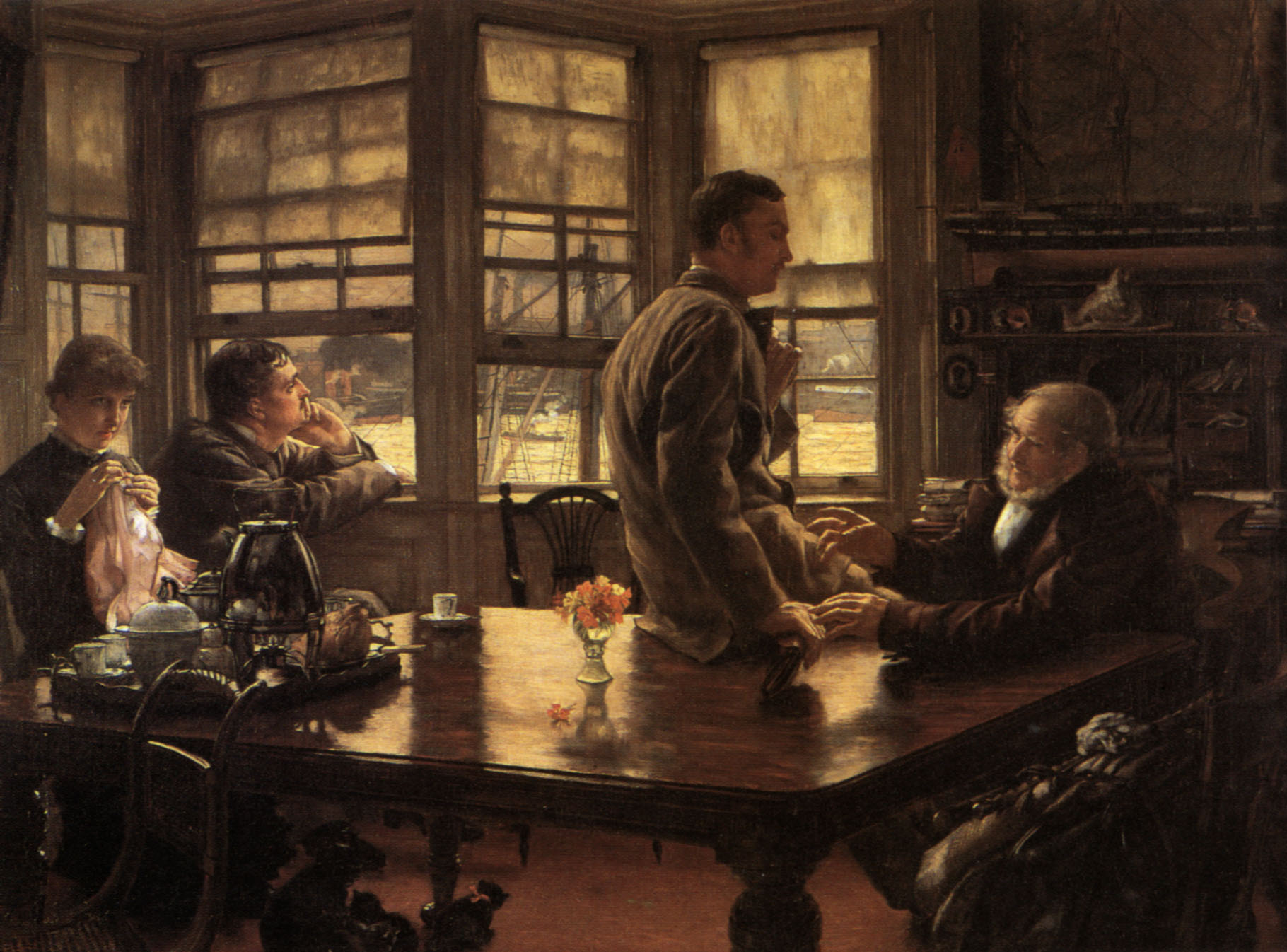
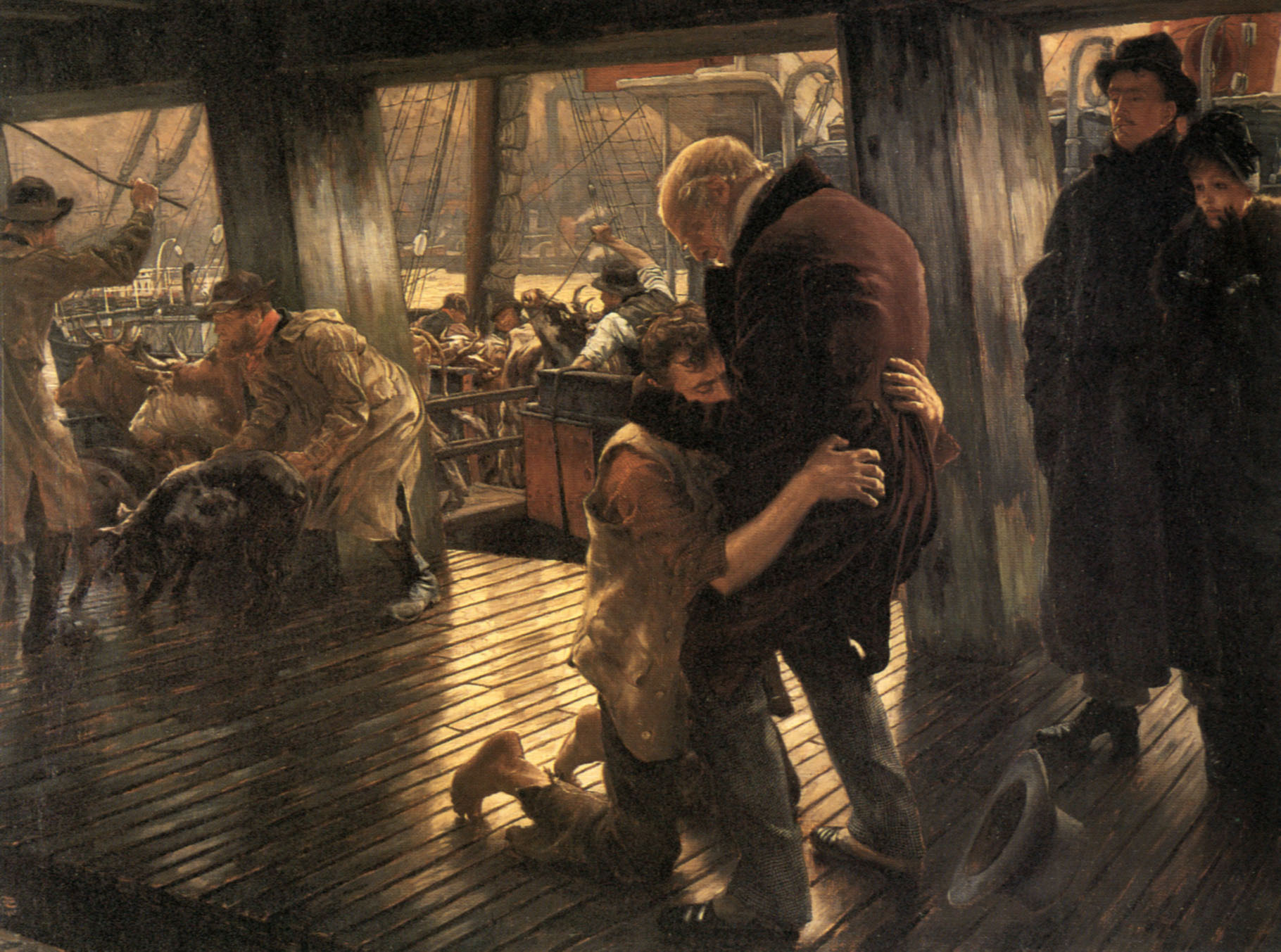
I share with you an unusual set of images from James Tissot. They represent his transition from a French and English society painter to being a visual communicator of the Gospel. They are three of his four paintings depicting The Prodigal Son in Modern Life. How beautifully he evokes the son’s presumptuous ascendancy over his father’s legacy. Then, the son’s foolhardy journey into adventures of his own making. And, third, his return home to his father’s good favor. One key to the subtlety of these three paintings is to notice the older brother in the first painting where he is sitting by his wife. He is musing about distant possibilities for himself, just as his more impetuous brother is beginning to act upon a similarly fanciful vision. In the third image, we observe the stoic and prideful older brother standing by his wife, reluctant to approach and embrace his just-returned sibling.

As Tissot show us, wise readers notice in Luke’s story that we hear about two lost sons, not just the one who went to a far-off land. The older brother couldn’t recognize how his own life was gifted, having entered into an abundant legacy that had also become his. This may be true for us, as well. So, we need to be thoughtful about how we refer to this un-named parable. To say it’s about the prodigal son overlooks how it’s also about the presumptuous older brother, as well as about the ever-loving father.

When we focus on the younger son in Jesus’ parable, we become more sensitive to how it may help check us from wandering away from God and from God’s ways. For we find in this story an account of what it’s like to come to our senses, in circumstances that could kill us spiritually and physically. It speaks about what it means to ‘return home.’ But as dramatic as experiences like this can be, they stand out because they are occasional or singular.

Seeing this parable as also about the grumbling older brother helps us notice how significant it is for other times in our lives. This is not just a Gospel about looking back to what was, and has been. This is a Gospel about living forward, toward the future God is even now preparing for us.

We are called to the feast! We gather on Sundays for the same feast about which we hear in Luke’s Gospel parable. Our Eucharist is our celebration of the return of lost ones, both ourselves and others. Henri Nouwen’s great insight about this Gospel passage, and Rembrandt’s painting of it, is this: having once been the younger brother who has experienced the grace of returning home, we are all called to become the father in the story! In other words, we are called to become people who receive others, embracing those who return some time after we do. Let us eat and celebrate! For like us, our later-returning brothers and sisters were dead and are alive again; like us, they were lost, and now are found!


The above paintings are from James Tissot’s, The Prodigal Son in Modern Life, three of his four paintings depicting Jesus’ famous parable in Luke 15. This post is based on my homily for Sunday, March 31, 2019, which can be accessed by clicking here.  Other homilies of mine may be accessed by clicking here. The Revised Common Lectionary, which specifies the readings for Sundays and other Holy Days, can be accessed by clicking here.