public architecture

A Church by Errol Barron in Gulfport

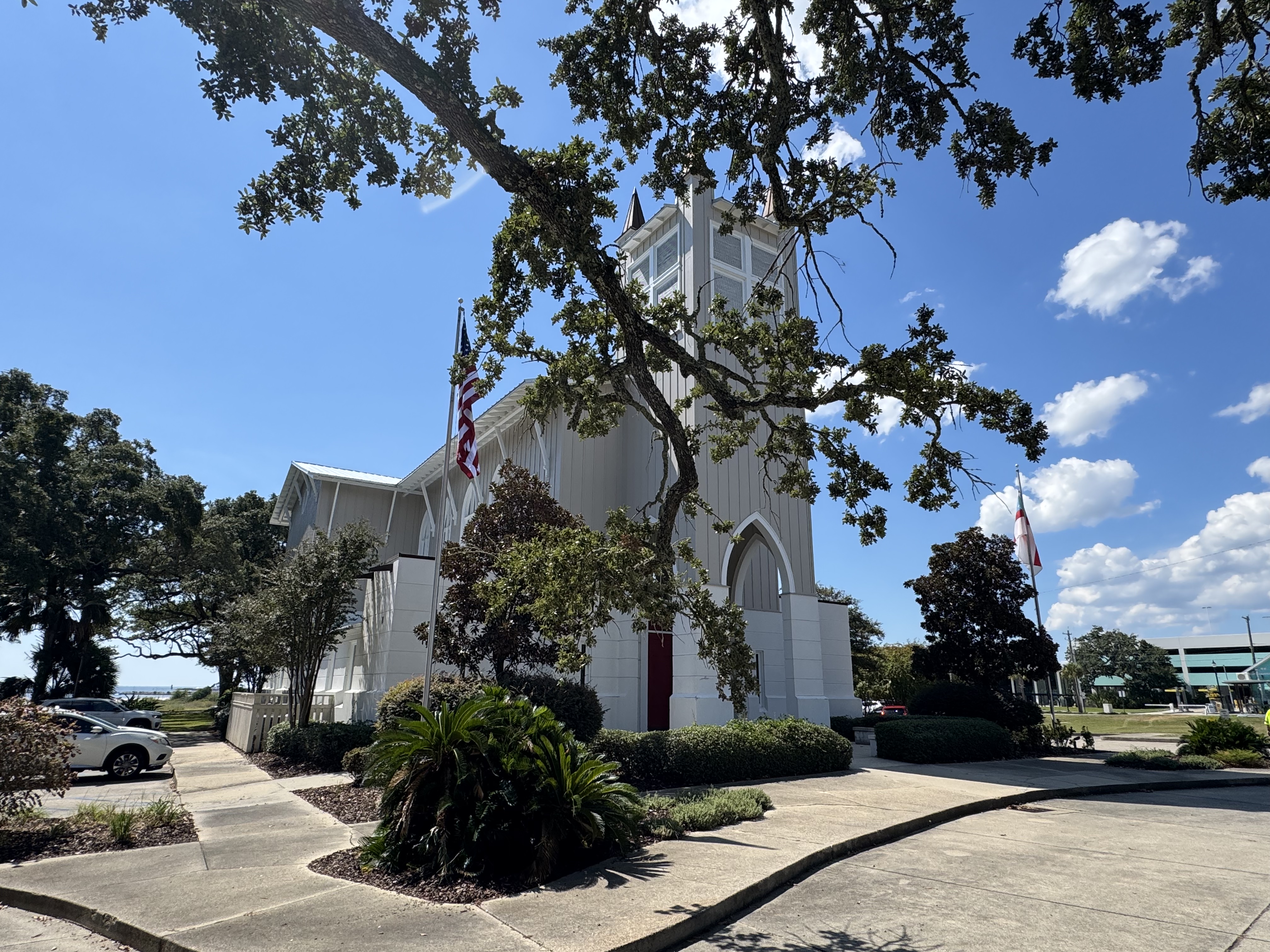
St Peter’s by the Sea, Gulfport, MS, designed by Errol Barron

Errol Barron’s work as an artist may be familiar to readers of this website based on some of his evocative New Orleans water color paintings previously featured here. His paintings of that city as well as of Tulane University, where he has taught for many years, provide strong indications that he is more than a skilled painter and draftsman, but also a trained architect. He has taught generations of architectural students at Tulane, and he has practiced his profession to great effect not only in this region but also overseas, with some houses of his located in Greece. Given Barron’s evident sensitivity to historical architecture and design features characteristic of this region, I was surprised to learn about a notable but unexpected feature of his resume. He worked for seven years with Paul Rudolph, architect of the well-known and oft-criticized Boston Government Services Center and a partial inspiration for the movie, The Brutalist.

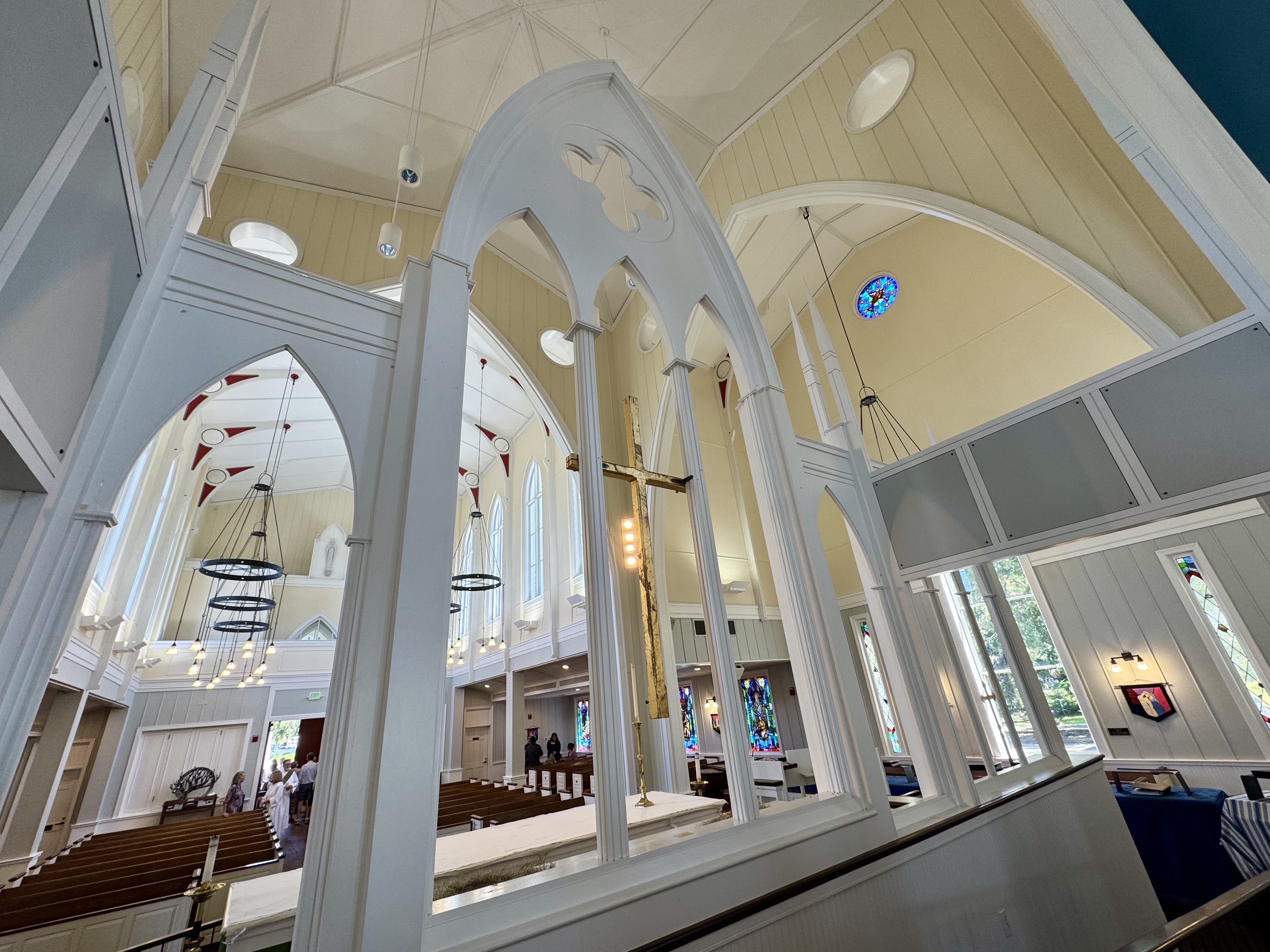
St Peter’s by the Sea, interior

I was recently delighted to discover the Episcopal church in Gulfport, Mississippi, St. Peter’s by the Sea, and that Errol Barron was its architect. It is a gem of a church, and a very successful design that incorporates traditional ecclesiastical elements associated with European Gothic churches along with features reflecting contemporary liturgical renewal. I have heard people refer to this style of church building as Carpenter Gothic, and as Southern Gothic, and the labels seem to fit well. The worship space exudes an appreciation for traditional forms while harmoniously blending them with a contemporary focus upon light, color, and the greater participation of worshippers in flowing open spaces.

The main altar with the ornamental rood screen

Visitors to the Washington National Cathedral, and similar churches of Gothic-revival style, may recognize the particular heritage that stands behind the floor plan of St Peter by the Sea. At the National Cathedral, and in its medieval forebears (such as London’s Westminster Abbey), an arched stone ‘rood screen’ separates the chancel and choir (beyond the screen) from the nave where the congregation is seated. When, in the 1960’s, the liturgical renewal movement began to influence changes in the worship arrangements of these buildings, a new main altar was often then placed in the nave, on the congregation’s side of the rood screen. Smaller gatherings for weekday services could still occur in the choir side of that screen, while Sunday gatherings for the principal Eucharist would be celebrated in the nave, with the clergy, altar, and liturgical action proximate and visible to the congregation.

A view of the ceiling and woodwork above the choir

Though St Peter’s by the Sea is a comparatively recent building, its design reflects something of the historical sequence described above. Instead of an imposing stone rood screen, shielding the chancel and choir spaces beyond, Barron has designed an ornamental arched screen of light-colored wood that suggests rather than imposes separate areas within the overall space. This allows the evocative blue canopy of the ceiling over the chancel to draw one’s eyes forward, toward the visible clear windows at the liturgical ‘east end’ of that space behind the chapel altar, facing the seashore.

Further, the notably narrow, even sharp-looking, wooden ‘spires’ protruding above where the choir chairs are placed enhance the upward sense of lift in the nave, complemented by the radiant cream and white color scheme above where the congregation sits. Light pours in through clear windows above, while delicately fashioned and dangling wrought iron fixtures provide supplemental illumination for evening services and in poor weather.

A view toward the nave from the choir, through the rood screen

On the Sunday of my recent visit, I was told that the congregation numbered about 145, and I estimate that the nave would comfortably seat about 200 people, though it could probably accommodate more. With the Gothic-inspired longitudinal floorplan, evident when one approaches the exterior of the building, a visitor might expect a rather narrow and linear worship space. Such an initial impression of the likely effect of the interior spatial arrangement is overcome by a number of subtle but effective design choices made by the architect and those who worked with him.

Accompanying the verticality of the large open area above the center of the nave are the seating areas adjoining the side aisles, taking the places of side chapels found in many medieval Gothic churches. The relatively low height of the box pews enhances the sense of horizontal width created by these adjacent seating areas, which provide relatively unobstructed views of the altar and lecterns. I also found the acoustics within the worship space to be well-suited for music as well as for public reading and speaking.

I am drawn to the ethos of historical churches; I am enthused by many examples of modern architecture; and I appreciate the fruits of the liturgical renewal movement. In my experience, a successful blend of these three things is not always found in contemporary buildings designed for worship and intended for the enhancement of congregational life. In his design for St. Peter’s by the Sea, in Gulfport, Mississippi, and in his supervision of its restoration after Hurricane Katrina, Errol Barron has achieved just such of a desirable synthesis.

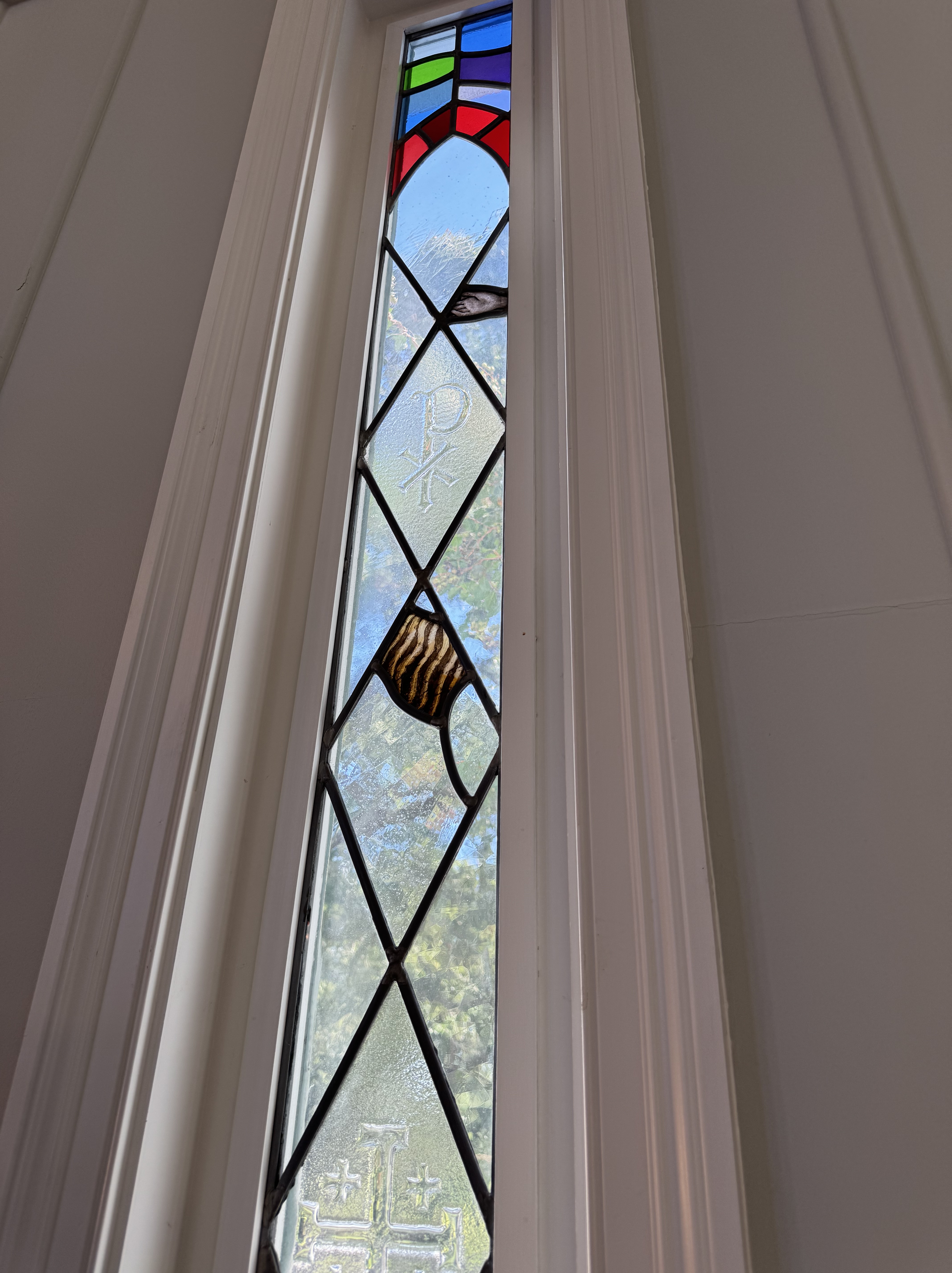
A representative side window incorporating stained glass window fragments recovered after Hurricane Katrina

Earl Young’s Imprint on Charlevoix

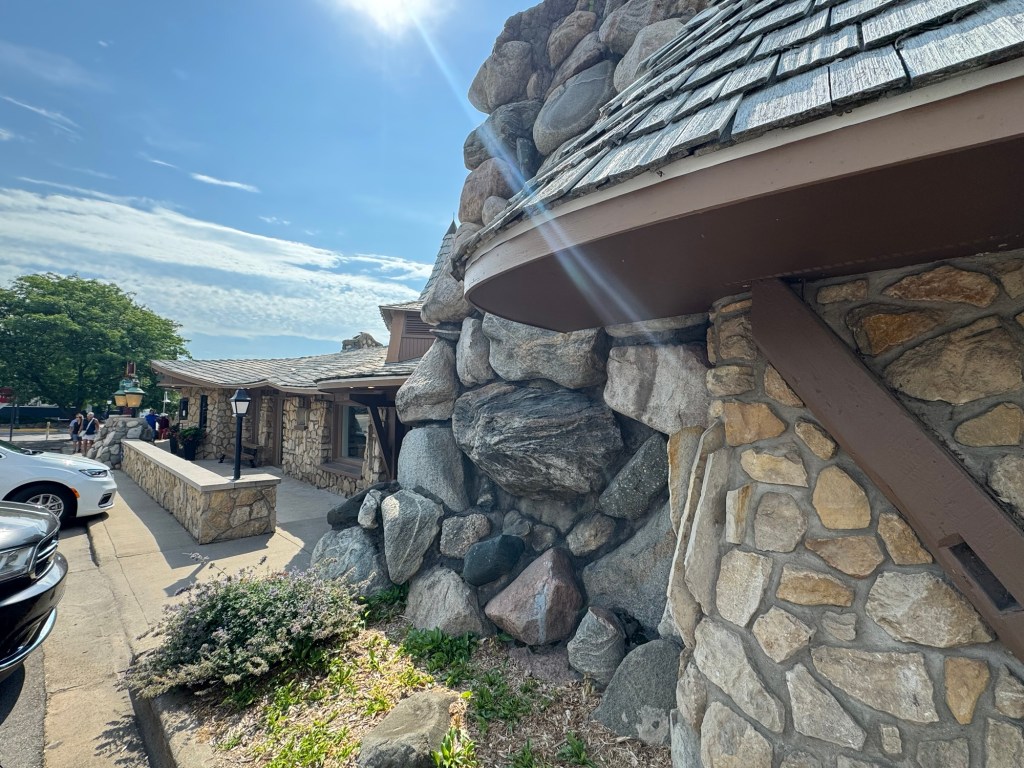
Exterior view of Earl Young’s Weathervane Inn

As a young man from the rural north of Michigan, Earl Young aspired to produce ‘natural houses’ in the spirit of Frank Lloyd Wright, his inspiration and model for what became his own vocation. Young never studied with Wright, but the latter’s design spirit influenced him throughout his life. Though Young’s impact as an architect was essentially local (he designed only one house outside of Charlevoix), the present-day promotion of Charlevoix as a cultural destination is much in his debt for the way this community has come to be known as the home of the “mushroom houses.”

Earl Young

Earl Young studied architecture for one year at the University of Michigan. From the beginning he was impatient with a curriculum shaped by the kind of slavishness to European precedents that FL Wright also criticized. Young then returned to his hometown of Charlevoix to build houses, practice real estate in the family business, and sell insurance. He left the university program with his independent vision and architectural vocation intact, from which he never seemed to waver.

The Weathervane Inn adjacent to the Pine River channel and lift bridge

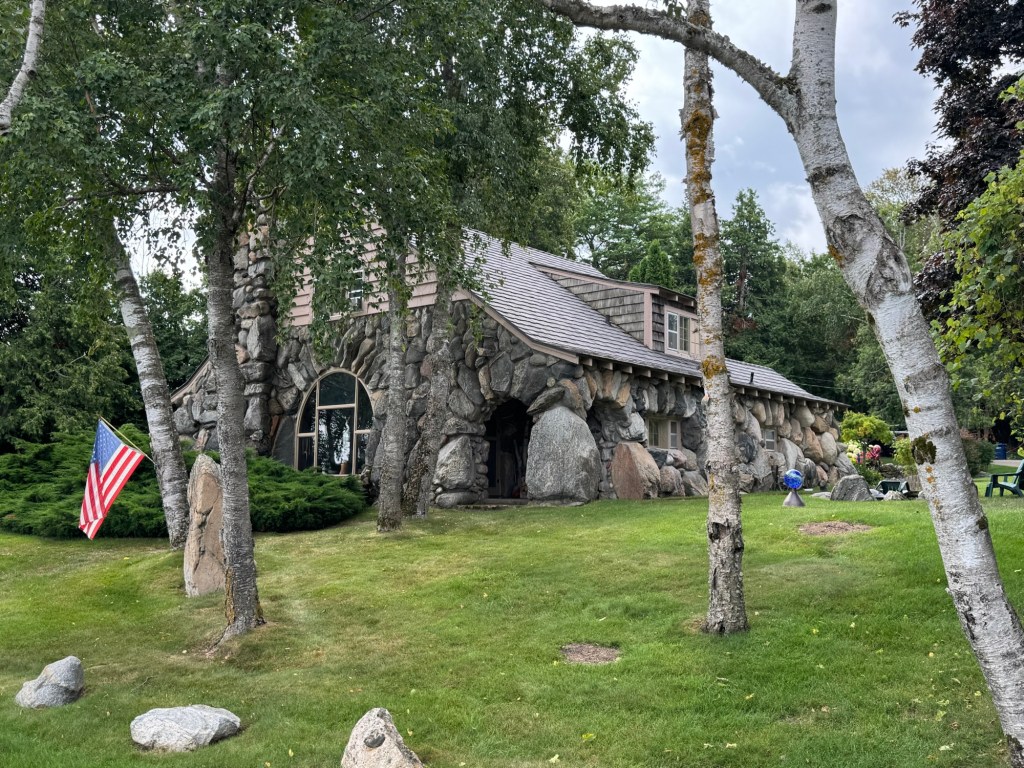
One recent appraisal of Young’s portfolio of buildings has suggested a neologism with which to describe his work, lithotecture, based on the Greek word for stone. For Earl Young did not simply value the utility of stone; he loved stone, and especially large boulders. He is remembered for having had a remarkable memory for the exact location, size, and texture of examples he had seen, collected, or stored away for future use. His profound appreciation for these materials, and the creative possibilities toward which they might be employed, is much in evidence throughout the older portion of Charlevoix in the many houses and other buildings he built and or designed, as well as in those influenced by them.

One of Earl Young’s Boulders Park homes (more of which are to be featured in a future post)

Earl Young’s impact upon the visual character of Charlevoix might be compared to a rather different example in architecture and in community design, the near-universal adoption of ‘the adobe style’ in Santa Fe, which has become a predominant approach to restoration, renewal, and original architectural creations. In the parallel example of Young’s case, his impact was through his way of being true to context by his use of stone, especially in highly creative ways. So pervasive has become his influence upon the development of Charlevoix that many other and more recent builders have been drawn to imitate Young’s extensive and sometimes whimsical use of locally available natural geologic materials. Given my own experience of living in south Louisiana, where hardly any naturally-occurring stone is to be found, I am struck by the abiding evidence of Young’s legacy as a community-based builder.

Two long-ago initiatives by Earl Young in particular serve to distinguish Charlevoix in the eyes of visitors, the Weathervane Inn, and the waterfront park adjacent to the city marina. Young replaced an aged mill along the edge of the Pine River channel with an attractive inn of his own design and construction, and he convinced town leaders to replace obsolete warehouses along the waterfront with what has become a four acre rolling green expanse of lawn. Both locations have become popular and much used gathering places for visitors as well as for Charlevoix residents.

The terrace overlook above the marina office – modern stonework in the Earl Young style

The marina waterfront as it has been developed in recent years demonstrates Earl Young’s lasting influence upon Charlevoix’s economic and cultural development. Realizing some of the potential latent within Young’s prescient inspiration for the land clearing that enabled the new park, several notable new structures have been built, among them a new marina office and locker rooms, and a dancing or synchronized fountain by its door.

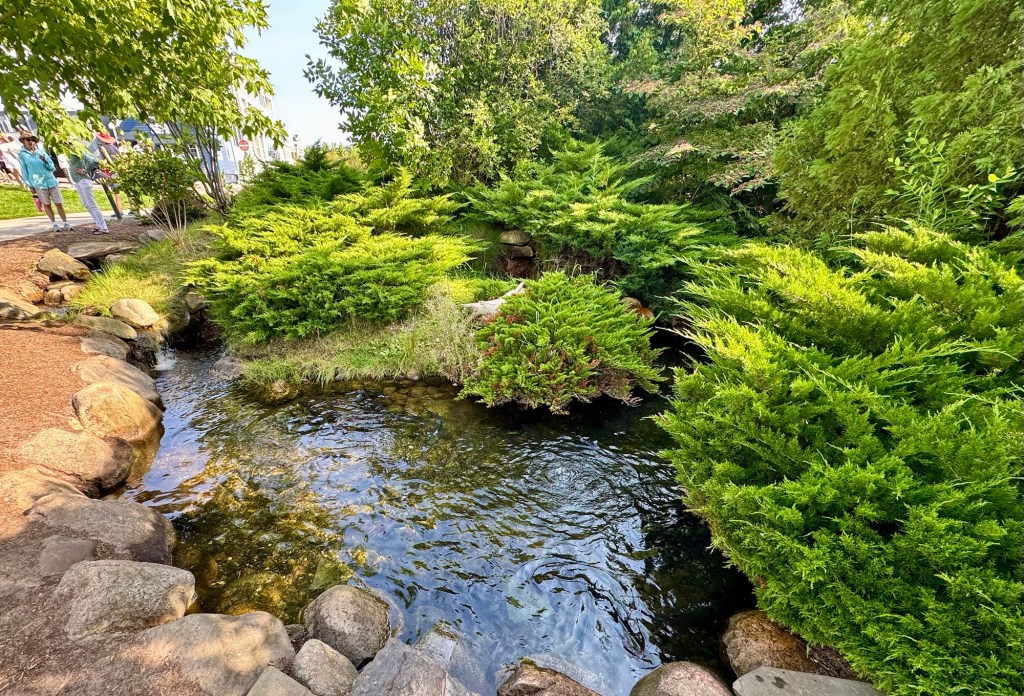
Part of the natural-look landscaping surrounding the marina office

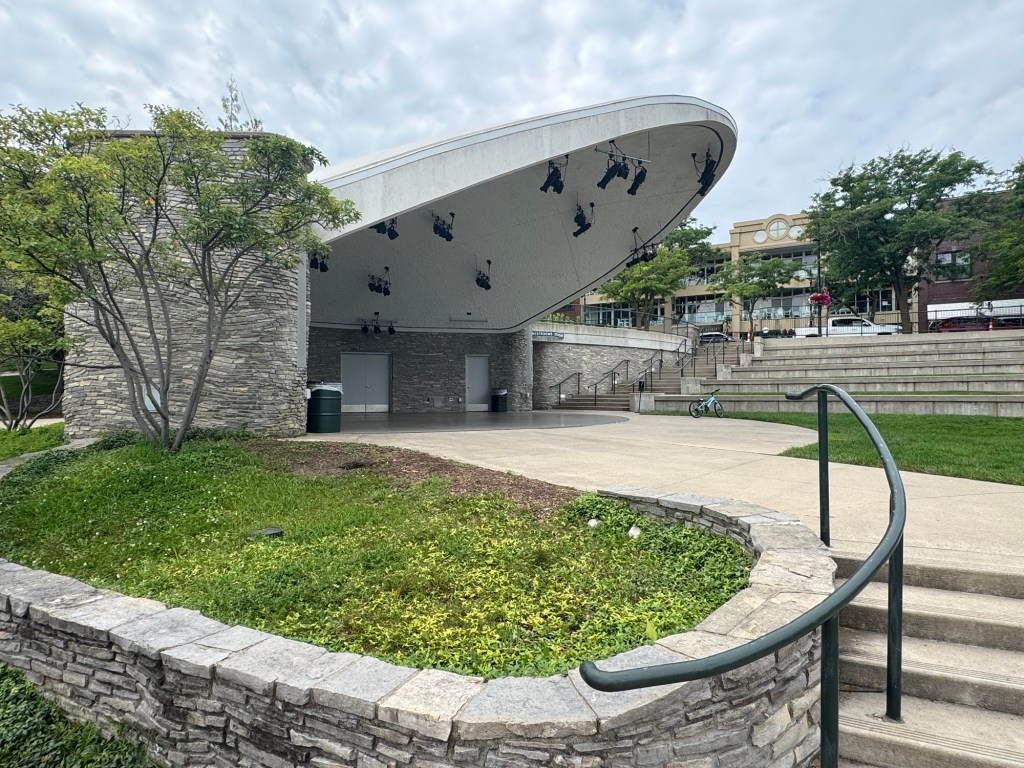
Landscaped around the marina office is a northern Michigan nature garden incorporating a human-made stream flowing between several shaded pools that contain rainbow trout. Also gracing the open green space of the park is a bandshell for weekly summer musical events, where concert-goers overlook the harbor docks and boat slips. Each of these structures, though constructed well after Young’s lifetime, reflects his vision for the beauty of stone laid up in asymmetrical curving walls.

The Earl Young influenced bandshell overlooking the marina and Round Lake harbor

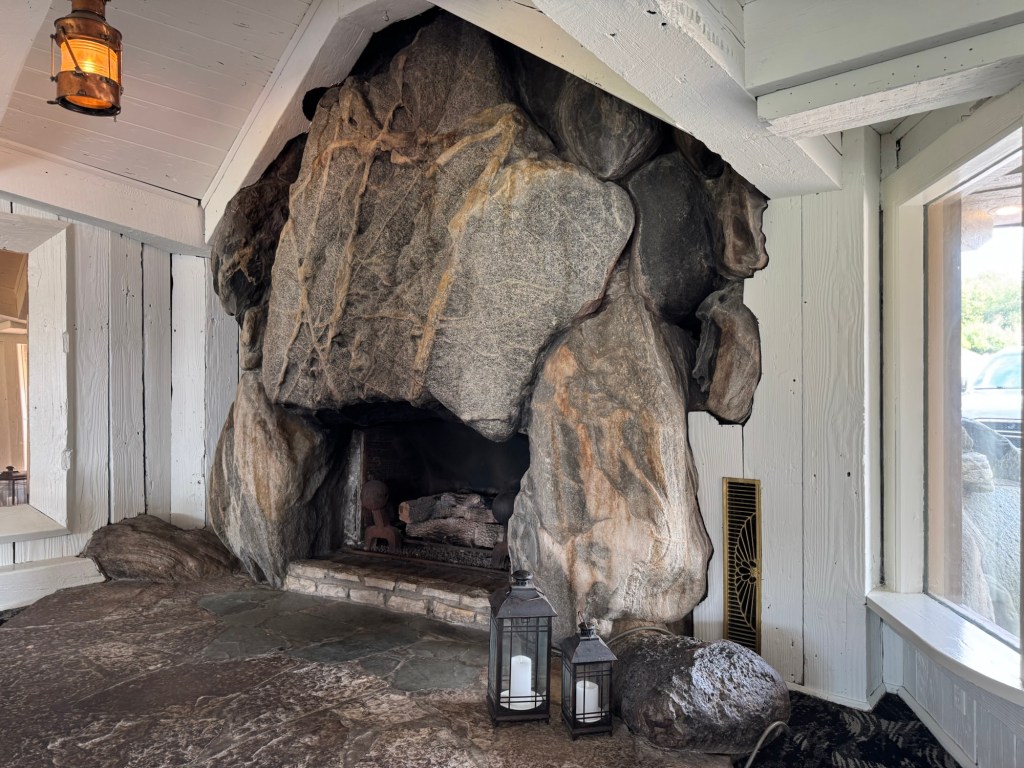
Earl Young’s profound attachment to working with local geological material evinces a lifelong devotion to what can be accomplished through building with massive boulders, each weighing multiples tons. The best place to begin to appreciate this is by a visit to the previously mentioned Weathervane Inn, the earliest of his few public buildings. The massive fireplace assembled from a seeming heap of boulders, has one large stone that weighed 9 tons, so heavy that it caused a dislocation in the foundation prepared for it.

Exterior view of Earl Young’s massive Weathervane fireplace
Interior view of the Weathervane fireplace

In a subsequent post I plan to present and offer a brief reflection upon Earl Young’s Charlevoix residential design and construction projects, most commonly known as his ‘mushroom houses.’ In all of his work, Earl Young showed himself to be something of an unforgettable local genius, whose endearing and wonder-producing legacy of unique work has transformed his community over the decades.

Denver’s New Train Platforms

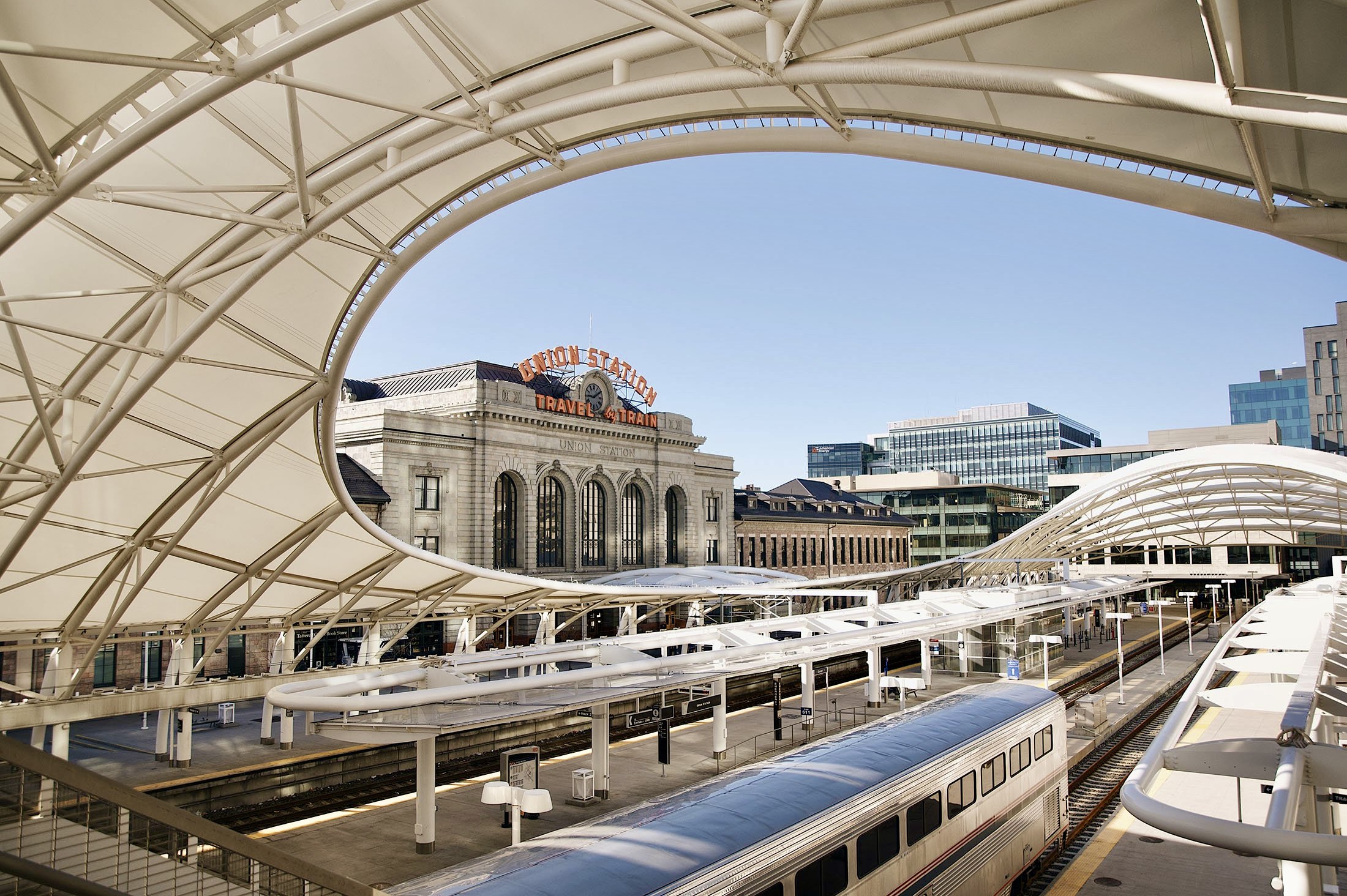
The 2012 Denver Train Station train shed, adjacent to the historic Denver Union Station

I have had a lifelong love of trains and of the stations where we board them. My love for them is partly inherited. My grandfather worked his whole career on the Soo Line RR, having retired as a Conductor on the overnight “Winnepeger,” running from his home in the Twin Cities to the city of the train’s namesake. And my father worked on the same railroad while in college. Of course, having spent my younger years in Japan, riding trains was an everyday occurrence.

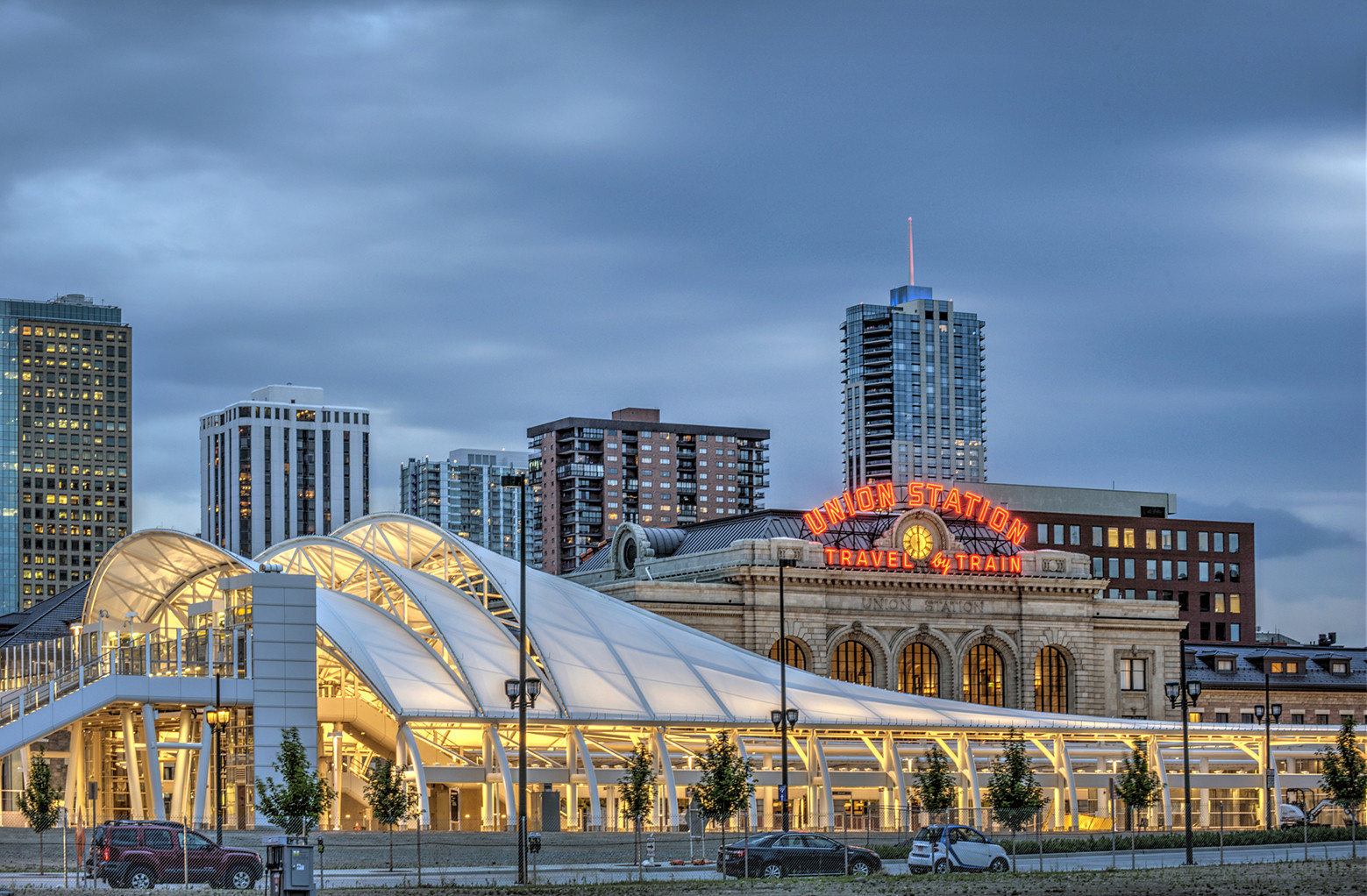
And so I am delighted this week to feature the ‘new’ (2012) open-air train shed built adjacent to Denver’s historic Union Station (now beautifully repurposed as the Crawford Hotel). What especially pleases me about the new station’s addition to the opportunities available to rail travelers in the U.S. is the apparent intention for this project to reflect a harmony with Denver’s tensile-structure airport terminal (featured in my prior post).

SOM Architects Transportation Hub site plan
The new station awning structure with the historic Union Station in the background

These train station platforms and their exuberant rooflines at the heart of the city, designed as part of a new transportation hub, were the creation of the long-successful and ‘big name’ architectural firm, Skidmore, Owings, and Merrill (now generally known as SOM). The awning-like structures over the platforms recall the translucent glass and steel train platform awnings familiar to rail travelers in the U.K. A difference here from the also-white structures at Denver Airport is the predominant use of steel beams as principal supports for the awnings, rather than a primary reliance upon tensile cables and poles. A greater resemblance to bridge structures results from this design choice, while also retaining the stretched fabric layers of weather protection, which like those of the airport are translucent. A lyrical building for public use once again has been provided for travelers to and within Denver.

Interior view showing the translucent fabric awning panels and support beams

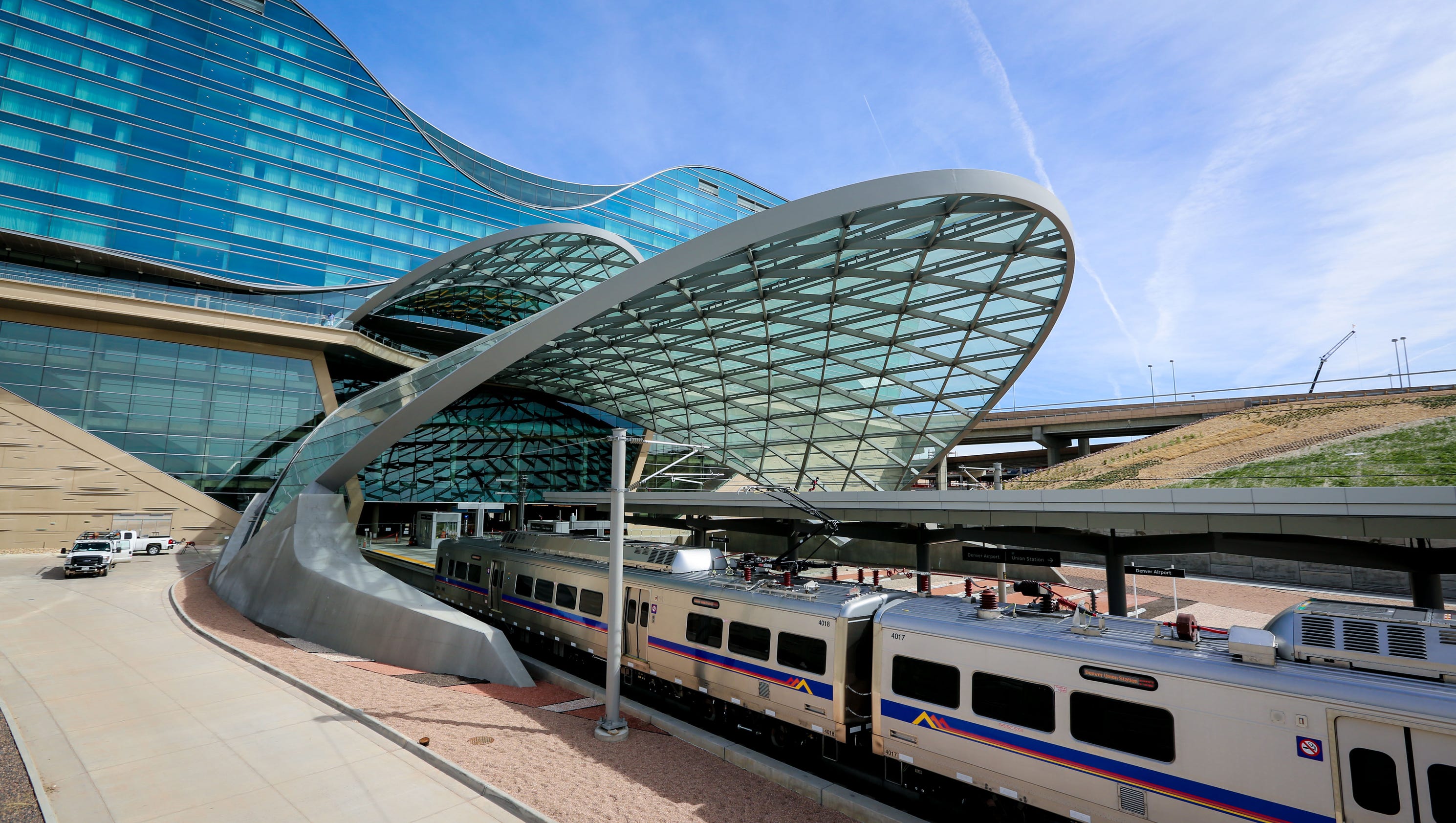
One other significant connection between Denver Airport and the city’s new transportation hub has been established by the construction of a rail line directly linking the two. Adjacent to the tracks employed by Amtrak’s cross-country trains, Denver now has a rail line dedicated to the needs of those who wish to get to the airport, saving time as well as parking and or shuttle costs.

Station interior showing the Regional Transportation District (RTD) airport train platforms (foreground)
An RTD airport train arriving at its destination

Denver’s new transportation hub serves as an attractive inner city renewal project, and provides a similar sense of uplift and visual ‘joy’ as does the airport. Along with the nearby 1995 Coors Field baseball park, the hub further enhances the visitor-appeal of the city’s downtown area, and serves as a central point for the region’s light rail network (RTD / Regional Transportation District).

The Station Complex with the Union Station Crawford Hotel and Denver downtown skyline

Increasingly we are recognizing the continuing implications of America’s significant distances between cities, the relatively low population density of areas between them, and how our reliance upon our cars and our expansive interstate highway system has reduced the financial viability of railroads as a primary resource for our passenger transportation needs. Nevertheless, it is pleasing to see that where new or revitalized rail stations and terminals are contemplated, there has been a demonstrated growth in awareness of their significance as public spaces not only through which we meet our travel needs, but as places where we meet and share meaningful time with others.

Evening at the station

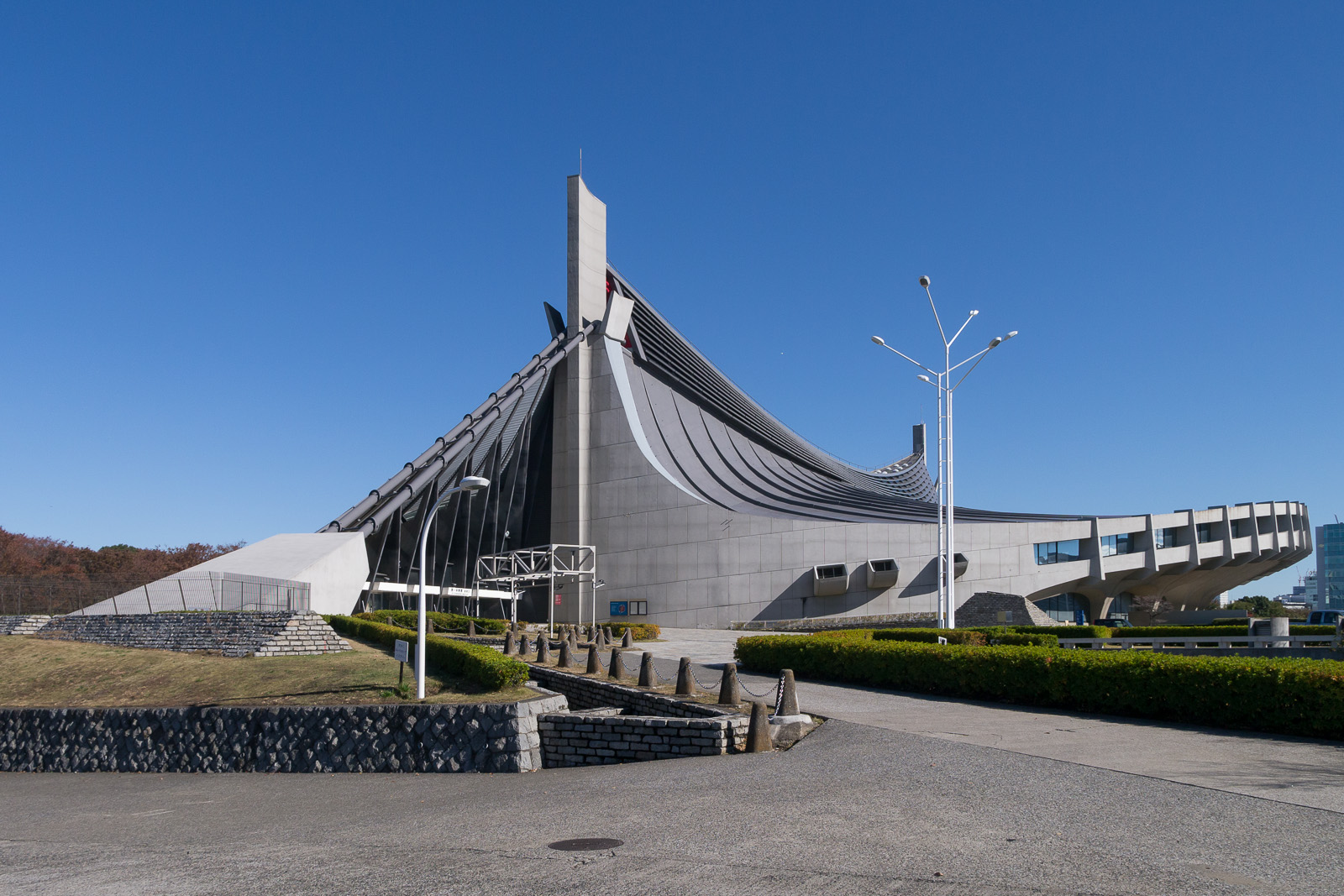
SOM’s Denver Station and the design of its open-air train awnings reminds me of another building, one I have loved since childhood, Kenzo Tange’s 1964 Tokyo Olympics aquatics building, which my family passed by on many family Sunday train trips to church. Tange’s employment of catenary cables for the suspension of the sweeping curved rooflines serves in a similar way as Denver Station to lift our awareness above ourselves. Design achievements like these move us to contemplate beauty as a noble goal of architecture and in engineering, a goal just as important to us as utility and efficiency.

Kenzo Tange’s catenary cable supported roofline for his 1964 Olympics aquatic center
What the new Denver Train Station replaced

Note: My prior post featuring Tange’s Olympics aquatic center can be viewed by clicking here.

Beauty in Architecture for Public Places


By 1964, as Tokyo prepared for that summer’s Olympic Games, I had been in Japan for five years. Our family lived not far from the stunning Olympic Pool building designed and being built by the Japanese architect, Kenzo Tange. I remember seeing it on our Sunday train journeys to church. Some 60 years after construction on it began, the lyrical design of this timelessly modern building continues to awe visitors. No longer housing swimming and diving pools, the building has been designated for use as a gymnasium during the (now postponed) 2020 Tokyo Olympic Games.

Tange’s Olympic Pool has long been one of my favorite works of architecture. Walking or driving around its perimeter provides an experience akin to walking around a large Alexander Calder stabile or one of Henry Moore’s more abstract sculptures. I think it is due to the building’s long arcing lines, made possible by structural cables employing catenary curves. These elements continue to give the 1964 Olympic Pool building a very contemporary appearance. More subtle are the distinctively Japanese features of the building, which are less obvious to western observers. The protruding portion of the two principal vertical columns, the horizontal panels between them mimicking a formal roof cap, as well as the upward curve of the outward edge of the roofline, bear an affinity with aspects of the nearby Meiji Shrine. Note the small but significant wing-like flares adjacent to the twin upward columns in Tange’s design.

I reflect on this building when I think of what might best be called public architecture. By this, I mean public buildings such as airport concourses, courthouses and even hospitals. The debate on federal architecture generated by the recently-leaked draft executive order has had at least one benefit. The evolving discussion has raised the profile of our consideration of beauty in relation to buildings intended to serve, and perhaps also to enhance, our common life as fellow citizens. Whatever one may think of that draft executive order’s commendation of classicism as a design criteria for high costing federal buildings (those over $50 million), we can surely agree that striving for beauty is of significant value within our communities, however that quality may be defined.

Think of the last time that you felt your soul uplifted and your view of the world enlarged by your engagement with a building’s facade, and your movement through its interior space. By this, I am referring to an experience that transcends one of marveling at the scale and complexity of some architectural achievement, and the intellectual pleasure such an encounter might provide. Instead, I am pointing to the way that works of architecture can enhance our sense of community, as well as our regard for the pursuit of beauty, goodness, truth, and other recognized virtues. We might expect these qualities to be evident in buildings designed for public worship. But do we also expect them to be features of our encounter with a government or publicly-funded new courthouse, airport terminal or sports arena? I think it is right that we should.


The photos featured here are creative commons licensed photos of Kenzo Tange’s beautiful building designed and built for the swimming and diving pool events at the 1964 Tokyo Olympic Games.