Objective and Subjective

A Tao of Seeing: Reflections Inspired by Feng Shui

Michael Pollan’s writer’s hut, intentionally situated by a boulder on the brow of a hill

Recently, I observed my middle son moving a black plastic pond module around in a small space in his New Orleans courtyard. As he moved the container that would soon have fish in it, he tried situating the vessel in various ways, in relation to a tree, a fence, some potted plants, and an existing low stone wall. He is not a student or practitioner of feng shui, but I believe I was seeing some of those principles at work in his decision-making.

Western readers may have heard of feng shui, the Asian philosophical approach to discerning the unseen forces that affect objects and their balance in nature. It gives attention to the metaphysical or non-material energies thought to be at work upon or within the world around us. We might say that this approach provides a Tao of seeing, or a natural way of perceiving within and around surface phenomena to the underlying dynamisms that are believed to affect what happens in nature.

This notion that there are unseen forces at work in the world is an idea that is receiving something of a revival in Western Christian spirituality. This is noticeable when people refer to a concept attributable to the Celtic tradition, in which it has become common to refer to “thin places. “ These are places where the veil between the material and the ethereal or the heavenly seems temporarily dissolved. Another parallel here between East and West may lie in the quest within Christian spirituality for the goal of harmony and balance between people and the created world.

However, my reflections here constitute an aesthetic rather than a philosophical or historical inquiry. I am interested in the dynamics of movement we perceive in the circumstances that we encounter, and less in the metaphysical forces or energies that may be present within them. At the outset, however, I want acknowledge how a nuanced Asian approach can be an authentic route toward a culturally-informed appreciation of the phenomena we encounter, especially from a historically Asian perspective.

As we look at paintings in the context of Western culture, one factor we discern assesses composition and attends to the way our seeing is drawn from one part of a larger image to another. This dynamic is often an artist-intended aspect of an overall composition. Sight lines in garden design and arrangement provide another example, as does the architectural arrangement of space in buildings.

Attention given by Western designers to feng shui is sometimes criticized as being a superficial application of historically and philosophically nuanced ideas. But I want to give credit to ways in which our sensitivity toward perceiving movement and direction is a genuine factor that is available for analysis and articulation. We notice this when we encounter both two dimensional compositions as well as three dimensional spaces and the objects we find in them. We can always come to know more about what we see.  Because what we see is something that is there, not simply what we believe, or are disposed or inclined to see.

An Asian garden said to be designed according to feng shui principles

Motion, balance between forces, spatial arrangement of objects, and the dynamic relationships that are visible because they exist between and among these variables, continue to grab my interest. Contrasts between colors and textures, as well as between sizes and shapes, play a significant role.  Additionally, the perceived difference between what is natural and things that are humanly fashioned is equally significant, as is our perception of the criteria for what constitutes that which we consider to be natural. These are among the factors that help account for our sensitivity towards and interest in these many observable variables, and our common quest for purpose and meaning in the contexts where we find ourselves.

Motions and balance as we find these factors in Wassily Kandinsky’s painting, Several Circles

Painters, sculptors, and architects, seriously consider these factors within visual and spatial compositions. The painter, Wassily Kandinsky, and the architect, Frank Lloyd Wright, provide two examples of those who also perceived a spiritual dimension within their creative work.

If so, we –  as caring lay observers of the world and of the things and places among which we find ourselves – should give deference to this evident fact. For we can all be thoughtful, as people often are inclined to be, about what we see, touch, and experience when we interact with visual phenomena.

I find myself increasingly sensitive to these aspects of our appreciation for Beauty, and endeavor to be more mindful about them. I am intrigued by possible parallels that may exist between Eastern metaphysical interpretations of visual phenomena and more familiar approaches to what we see that are shaped by Western aesthetics. Especially as these familiar approaches are described and developed within our artistic and architectural best practices.

The Beauty of Objectivity

If reading this by email, please tap the title at the top to open your browser for the best experience. Then, clicking individual pictures will reveal higher resolution images.

William Blake, The Ancient of Days (one of numerous hand-colored prints)


I like to use a couple of throw-away lines: First, the world was here before we were here to notice it (or try to describe and evaluate its various facets). And, second, God was here before we were ever able to think the thought, much less give value to or try to describe this fundamental insight. And so, the world had God-given beauty and value before we were here to notice such things. To put this matter in the formal terms I propose that we recover, we were objects of God’s subjectivity before God ever became an object of ours. These insights ought to be primary in our outlook upon the world, and upon our lives within it.

The stark alternative to what these throw-away lines represent is the view that the world, its meaning and any purposes within it, and or God, came to have significance if not also actuality, when we chose to notice or imagine such things.

I have written before urging recognition of how beauty exists apart from the ‘eyes of the beholder.’ This is to say that the reality of beauty transcends the perception and apprehension processes of the one who beholds it. Another way to say this is to contend that beauty has objective reality. But what do we mean when we say something is objective?

Here, I would like to commend an insight regarding this word, ‘objective,’ and its pair, ‘subjective,’ terms we may use too casually. For we tend to employ these words most often to characterize two different aspects of how we perceive matters that come before us. One we regard as being oriented toward what is factual; we use the second to refer to that which is subject to the variability of emotions and sentiments that are particular to ourselves.

We need to recover a prior sense of what these two words, objective and subjective, can mean. We can return to using the word objective, not first to refer to the fact-oriented aspect of our consciousness of the world, but as referring primarily to the world itself and to the things within it. In this recovered use of these terms, the objective can best designate the objects of perception. And the second term, the subjective, can best represent the subject of our perceptions (us).

We can, of course, have ‘subjective’ notions about the objects of our perception, while we can also seek to be more accurate in our sense of those things that we perceive. Accurate description and evaluation of the objects of our perception are aided by comparative reference to the perceptions of those same things by others, and thus are aided by an effort to step beyond notions that are particular to ourselves and to our private experience of them.

In this respect, the practice of good science shares a basic property with the practice of good religion. Both seek to describe what is true, and what is in accord with reality.

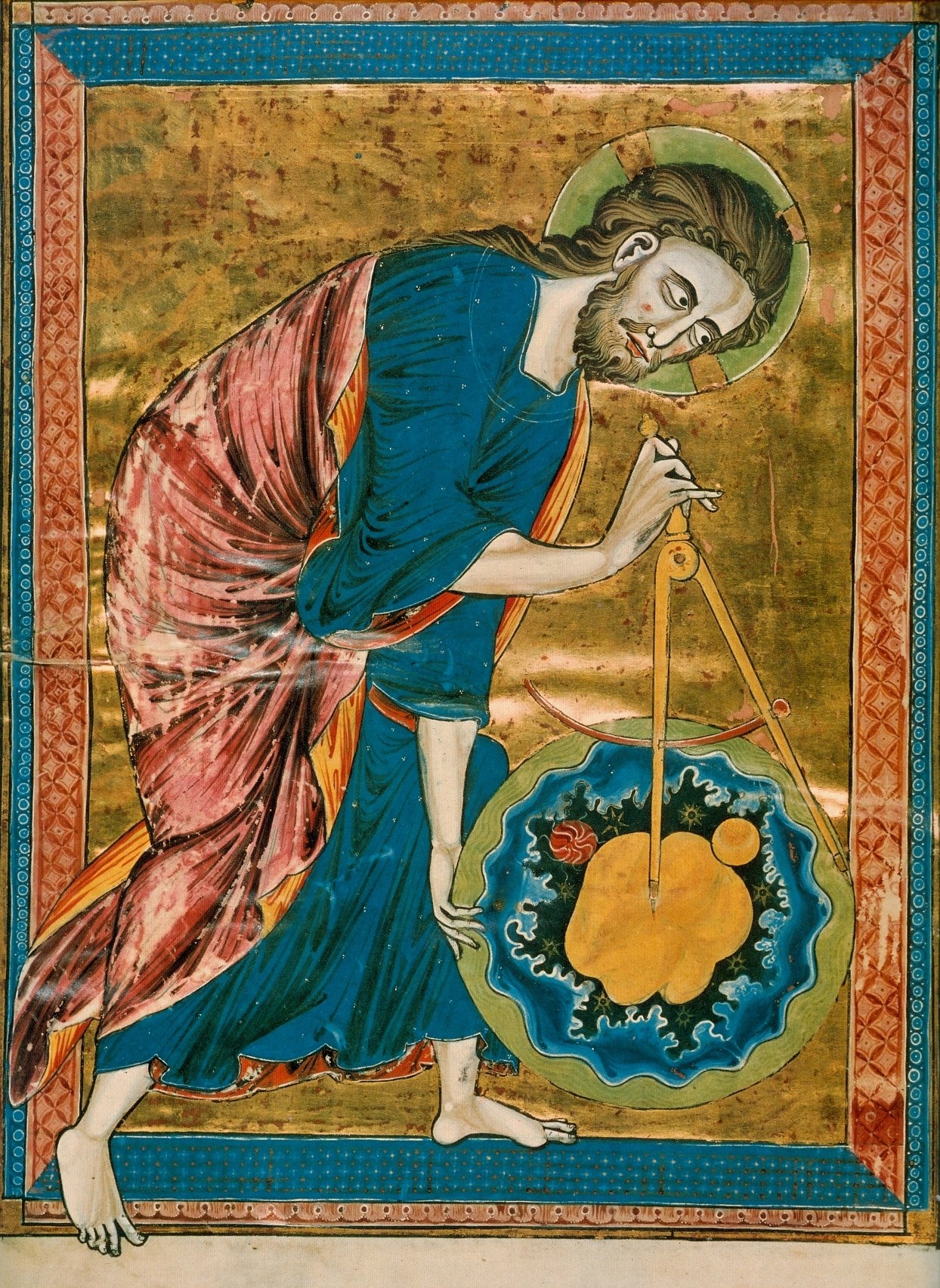
God the Geometer (from a medieval manuscript)

In perhaps an overly simplistic summary, the choice between these two outlooks upon ‘what is,’ emerged with what we now call the Enlightenment, and the development of what we now call ‘natural science.’ And yet, the emergence of modern science, and the world view which it has come to nurture, lies in pre-modern theism, in the ancient and primal belief that before all things, was and is God. And that God was and is the author of what the medievals called the Book of Nature, who was also the author of the Book of Scripture. Two books with overlapping significance, by one Author, about all that was, and is, and ever shall be.

Among the works of this author, and behind or within them, are ideas, ideas latent in the mind of the Author. And preeminent among these ideas are Beauty, Goodness, and Truth. These ideas represent the highest things we cannot not know, especially if we seek to have our minds shaped by the mind of the Author of all things. Beauty, Goodness, and Truth, are therefore – as we like to say and think – objective. That is, they are among the highest, most valuable and excellent, objects of our perception. And whether we grasp their significance, and how we grasp their significance, as fellow-subjects of their perception, can of course be – as we like to say and think – subjective.

William Blake, Newton as A Divine Geometer

Nevertheless, the objects of our perception ought to govern and discipline our shared and comparative perception – as fellow-subjects – of Beauty, Goodness, and Truth. This is the beauty of human objectivity and of subjectivity.