Environmental Concern

Roger Tory Peterson’s Art, Helping Us See

If reading this by email, please tap the title at the top to open your browser for the best experience. Then, clicking individual pictures will reveal higher resolution images.


If you wanted to buy a guide to help you identify birds, what would you choose? A book with glossy photographs showing birds as found in nature? Or would you choose an artist’s rendition of those same birds abstracted from their natural setting? Without considering the question closely, I suspect that I am not alone in being one who would choose the former for what seems an obvious reason, that photographs purport to capture reality in what we call an objective way. And when seeking to identify birds, correct apprehension of reality is what we are after. Paradoxically, Roger Tory Peterson’s, Field Guide to the Birds, first published in 1934, has long been valued precisely because his paintings and notes may aid accurate identification of birds to a greater degree than can be obtained by studying photographs.

As we also find in the presumed intent of more recent, photo-based, bird books, Peterson’s aim was to help us see, and then upon seeing, correctly identify the birds we have apprehended in our sights. Yet, Peterson, a much-regarded pioneer in the environmental movement, sought to aid our perception by prioritizing the various unique properties of individual species, and then to highlight those features that distinguish them from other birds. With the aid of his editors and book designers, he helped to achieve these goals by adding small black lines or dashes pointing to various parts of each bird on the color illustration pages displaying his paintings.

These small lines correspond to observation notes in the text, signaling to the reader the principal identification marks and points of difference between various similar-looking species of birds (see below). His creation of this method for the identification of observed field marks in birds has come to be called the Peterson Identification System.
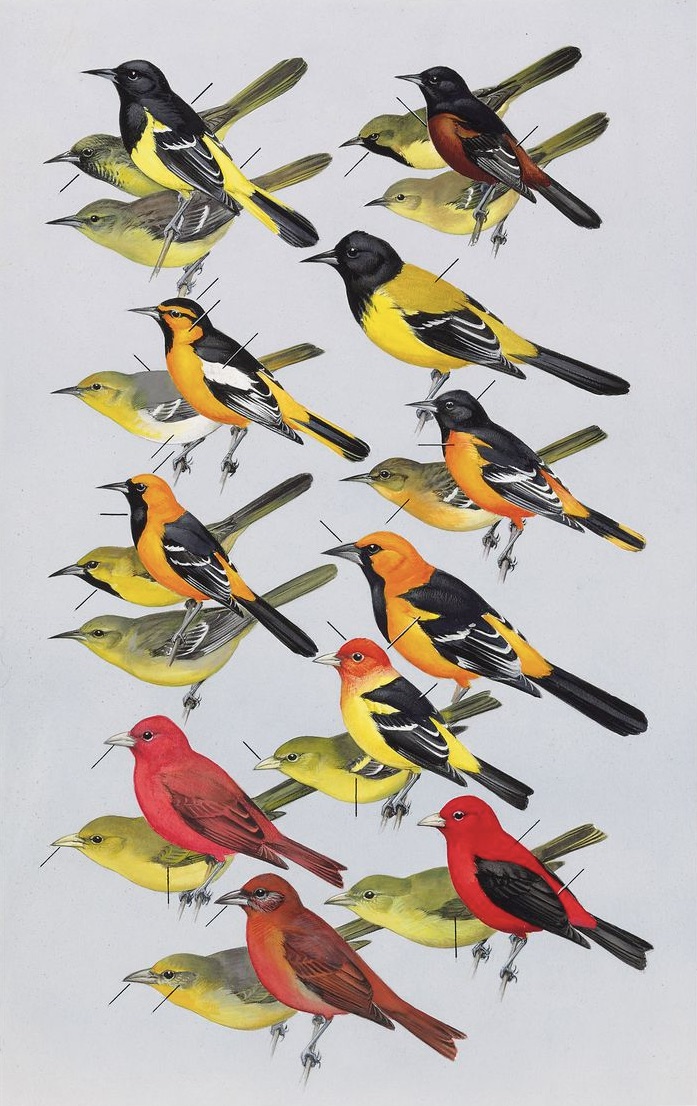
A pre-publication page from Peterson’s Field Guide. Note the small black lines or dashes, explained above.

The paradoxical limitation that may accompany a photographic guide to birds is that a photograph captures an object in only one posture in one moment of time. Photographs are also dependent upon existing light conditions, and where the object of attention may also visually be obscured or overwhelmed by its larger context.

With paintings, Peterson may have been better able to help us see three dimensional aspects of the birds he portrayed while yet employing a two dimensional medium, in part because those birds are presented against a non-distracting neutral background. By painting rather than photographing, he was able to emphasize and enhance certain features of birds, such as subtle areas of color and the impact of light upon them, to a greater extent than would have been possible with the photographic means available to him at the time. In the process, Peterson demonstrated a consistently high degree of proficiency in his work of illustration, while also achieving what are arguably finished works of art that help us perceive beauty in the natural world around us.

The Finches page from my grandfather’s 1959 edition of Peterson’s Field Guide


Note: Having featured Peterson’s work, there are many newer bird identification books being published, and they are worth exploring when someone seeks a reliable birding guide. For many people of my generation, Peterson’s work will always be on the shelf, given its art rather than his having employed photo-based images, especially since his books are so widely available. I am proud to have and use my grandfather’s annotated copy (above), with his sightings noted on numerous pages going back to the 1960’s.

I am conscious of the fact that I featured multiple color photos of the Common Nighthawk in my prior post, as well as having offered a substantial amount of information about this particular species. If bird guides were to offer an equivalent kind and amount of coverage of every species commonly observed, they would be immense, and very expensive!

Roger Tory Peterson (1908-1996). It is one thing to be serious about one’s life work, and another to be able to laugh about it!


Encountered Beauty: Nighthawks in a Dark Sky

If reading this by email, please tap the title at the top to open your browser for the best experience. Then, clicking individual pictures will reveal higher resolution images.


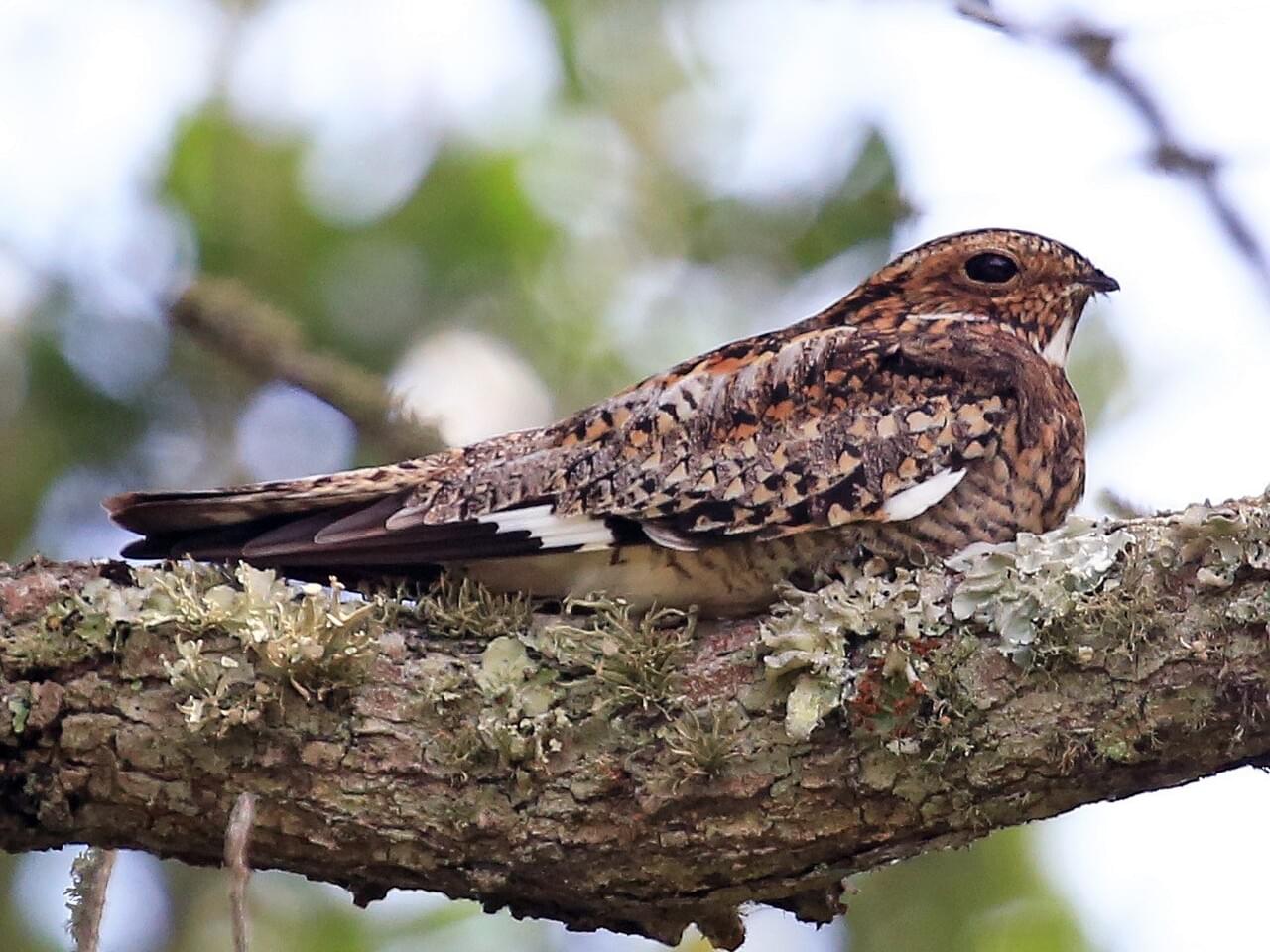
I have clear memories of a particular time of day in a town where I lived for two short periods of time, Northfield, Minnesota. In middle school, and then during college, I would frequently walk over the Water Street bridge spanning the Cannon River, by the old dam and historic Malt-O-Meal mill. On summer evenings and nights, I remember almost always hearing the distinctive nasal or buzzing be-zeet, be-zeet sound of birds calling to one another in the sky above. When I first observed them, I wondered what kind of birds these were, and about their surprising nocturnal behavior as compared with other birds more familiar to me. Based on the white patches on the underside of their wings, visible from the reflected glow of the lights in the town center below, I was able to identify them as Common Nighthawks, based on Roger Tory Peterson’s well-known book, Field Guide to the Birds.

Seeming to fly far above me, I was curious about their size, imagining them to be rather large. I then learned that their size and weight puts them somewhere between a common robin and a crow, suggesting that they do not fly as high as I had first imagined. Nighthawks are insect-eaters, which accounts for why they are so evident on summer nights, amidst the target rich environment of flying bugs swarming over city lights.

With their long wings, these birds engage in bat-like flapping as well as in gliding, and I remember them flying closely together as they went about their nocturnal feeding. The American Bird Conservancy website describes them in this way: “the Common Nighthawk’s erratic, acrobatic flight style gives the bird its folk name, ‘bullbat’.” Memorable in this regard is the way that they make occasional dives toward the ground. Some observers report that these dives cause the wind under their wings to make a booming or a whooshing sound, though I don’t remember hearing it.

I was intrigued to learn that, given their relative size, these birds will roost and nest on such apparently vulnerable locations as the ground, elevated tree limbs, ledges, and even gravel rooftops. Among things I appreciate about Nighthawks is how their mottled coloring, with blends of light and dark feathers, has adapted them well to survive in a variety of environments, and helps to protect them from predators like hawks and falcons. Of course, there are those incongruous white wing patches, which may be an evolutionary bow to some needs parallel to survival, both the attraction of a mate and the procreation of offspring.

The shape and size of Nighthawks’ comparatively long wings aid not only their feeding activity while flying, but also the extraordinarily long annual migration they make between their breeding grounds in North America to their winter habitats in South America. In fact, they are believed to have one of the longest migration patterns of all North American birds.

To me, Nighthawks are an unexpected kind of bird to find in a town center or in a city, given their dimensions and surprising willingness to live and reproduce in proximity to the commercial activity we associate with such areas. I am always delighted when I recognize their sounds above me on a summer evening, as I look up to see them wheeling about in the darkness, with their white wing patches flashing here and there.

In the natural world around us, with all its dynamic interrelationships, these amazing birds are our fellow creatures. In relation to them, as well as to other examples of what traditionally have been termed flora and fauna, we are called to engage in God-like stewardship. We all seem to have our favorite species in nature that we want to protect and care for. Needless to say, Nighthawks are high on my list.


The Nighthawk page from my grandfather’s copy of Peterson’s Field Guide to the Birds


Geoffrey Jellicoe: Finding and Creating Beauty in the World

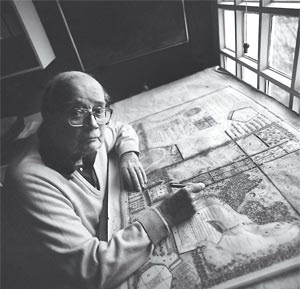
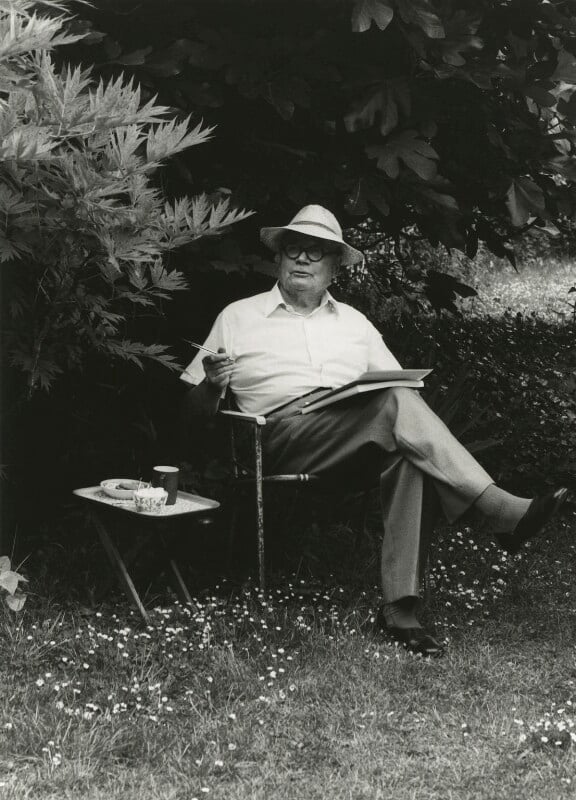
Sir Geoffrey Jellicoe at his London home shortly before his 90th birthday


Discerning beauty always presents an opportunity to experience joy. As many find, though, creating representations of beauty, as a chosen task, can be difficult.

Alive in my memory are images of areas of New York City and decaying areas of urban New England, during my high school years in the early 1970’s. I remember asking myself, as an aspiring architect and artist, how might I meet the challenge of creating examples of beauty in the world as we presently find it? Well, after some years, I discovered the life and work of Geoffrey Jellicoe, which provide an example of one way of answering questions that stay with me.

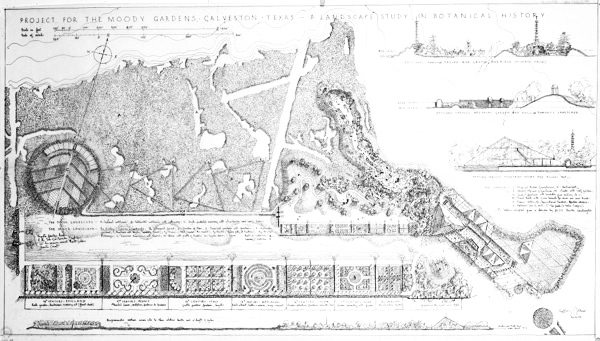
Late in his life, at a time when many seek the solace of retirement from actively pursuing such questions, Geoffrey Jellicoe took on a significant challenge. How might 150 acres of a seemingly forlorn stretch of a barrier island, adjacent to an urban area that has long surrendered to the declining effects of industrialization, be redeemed and transformed into a place for renewal by a humanistic vision of what might yet be?

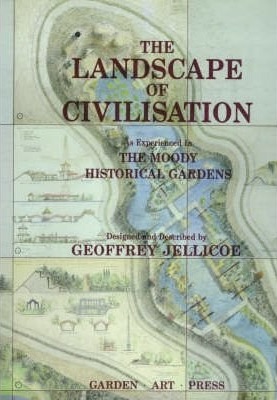
Jellicoe, at the age of 80, and to the surprise of some, accepted the opportunity to submit a proposal for what might become the Moody Gardens. In the process, he embraced the idea of working with a hundred-plus acres of neglected sea marsh and dune land on Galveston Island. This site even included a need to take into account an existing but under-used local airport. Nevertheless, the esteemed landscape architect, Jellicoe, envisioned a large facility centered on the nurture of human flourishing by designing what he hoped would become a significant botanical garden. Its plan would be dedicated to re-creating documented historic human efforts to re-shape areas of the world through the practices of horticulture and landscape architecture.

The Texas-based Moody Foundation, a philanthropic organization committed to education, health, and community development, found in Jellicoe the person they believed was best equipped to provide a master plan for what might become Moody Gardens, in the vicinity of Houston. And he brought to this challenge a lifetime of learning and accomplished work, which fitted him well to address this auspicious opportunity.

Encountering Moody Gardens as it has come to be, a vibrant, attractive, and an apparently successful facility, we may be mislead about Jellicoe’s orginal concept for the project. In presenting itself now as a tourist destination with resort-like amenities, Jellicoe’s early proposals for the Gardens seem fanciful if not also highly visionary. Yet, there may be significant things we can learn from his initial plans, and the concepts he sought to embody in his hoped-for realization of the project.

I can suggest a few of these potential learnings by posing some rhetorical questions – questions that I hope to address in future posts.

  • What is ‘our human nature,’ that we hope or believe we all share? What environments are most suited for nurturing the flourishing of our human nature?
  • What is Nature, and what humanly-created environments are most true to Nature? What things or places do we consider to be ‘natural’?
  • Why does it require human effort, financial capital, and institutional resources to facilitate, maintain, and preserve ‘natural’ environments? (Consider here the scope of the funding for the National Park Service, and the United States Forest Service.)
  • And, why is concern about the natural world- the ‘environment’ – properly a matter for serious theological reflection, and one especially related to our regard for Beauty? Why do our concerns about the natural world have theological significance?

Geoffrey Jellicoe at work in his garden

A Beautiful Place Where I Went to School

A view from the campus farm across the Connecticut River valley


In the fall of 1971, I was truly fortunate to be able to head off to Northfield Mt. Hermon School for my sophomore year of high school. After growing up mostly in Japan, and returning to the States for a couple of years, I was ready for a new challenge. I was yearning for an educational opportunity that would build upon my earlier experience at the Yokohama International School. When I arrived at Northfield Mt. Hermon (NMH) as a scholarship student, this inviting place opened the world for me, and changed my life.

Rooflines of a dorm, faculty house, and the student center in early evening light

Recently, I attended the 50th reunion of my NMH high school graduation class, which numbered about 365 in May of 1974. After graduating from this wonderful place for learning and formation, many of us at our reunion had not seen one another in fifty years! Anticipating being with school friends after such a length of time was a bit unsettling for me, given my awareness that – like others, as I came to see – I was not the same person I was when we last saw each other. I soon felt more at ease when greeted graciously by fellow members of my class and by our school hosts.

Two of the remodeled “Cottages” that serve as dorms

A theme periodically voiced during our weekend together was how troubling were the years in which we were students at NMH. The Vietnam War was still a concern; our President was in political if not legal trouble; the society around us was deeply divided and appeared to be coming apart; and large numbers of our fellow citizens seemed either unaware of or uncaring about the precarious state of the air, water, and food supply in the world around us. [In some ways, the world has not changed!]

Being the largest class in NMH’s history, at such a time, provided another challenge. Could we – from our multiple and differing backgrounds – find or make a community built of more than passing relationships upon arriving at a place that was – for some of us – far from home? To my astonishment, my first roommate was a former Yokohama classmate with whom I had last attended 7th grade, halfway around the world. And yet, I also remember my surprise at how I felt when observing the sudden absence of everyone from campus on graduation afternoon, many of whom I would not see again until our recent weekend together.

A wonderfully large green space at the center of campus

Here are a few things that distinguished my (and our) experience at NMH during those years, which are strong features of our school. The legacy of our founder, the 19th century evangelist, D.L. Moody, continues to be manifest in a strong emphasis upon spiritual and ethical values that have the power to transform both individuals and the world in which we live. Moody’s own commitment, to address not only the spiritual needs but also the social and educational needs of marginalized youth, remains central to our school’s mission. For we as alumni are rightly proud that among the first NMH students after our 1879 founding were 16 Indigenous Americans and a freed African-American from a formerly enslaved family.

The new science building

These themes are evident in our school’s mission statement, in words regarding an education that seeks to form the head, the heart, and the hands, of all those who share life together in the beautiful surroundings of the Connecticut River Valley. Fundamental to this commitment is the requirement for every student to have a work job, 3 – 5 hours per week, participating in dish crew, cleaning dorms or classrooms, or working on the school farm. These work jobs save the school a considerable amount of money that is directed toward the substantial scholarship funds that enable many students from a modest financial background to be at NMH.

Again and again during our reunion weekend I found myself saying to Martha, “I was so lucky to go here!”

Our Head of School, Brian Hargrove, speaking to us at the Alumni Convocation, in the chapel also featured in the recent film, The Holdovers

A welcome sign in the nearby historic town of Northfield, Massachusetts


Note: NMH provided a fitting setting for the movie, The Holdovers, and for many of its memorable scenes. The film was set in the time period when my fellow classmates and I were in attendance at NMH. One fellow alumnus at the Reunion was celebrating the 75th anniversary of his graduation!

Helen Nearing and Beautiful Stone Walls

If reading this by email, please tap the title at the top to open your browser for the best experience. Then, clicking individual pictures will reveal higher resolution images.


With the visionary but also impractical exuberance of youth, I graduated from high school imagining I would build my own house somewhere in New England. My design ideas were shaped by Frank Lloyd Wright while my notion of ‘responsible living’ was largely influenced by Henry David Thoreau as well as Helen and Scott Nearing. While already loving Wright’s architecture, my high school English teacher, Nick Fleck, opened a compelling new world for me through reading and learning about Thoreau and the Nearings. I identified with these mentors and the values they shared regarding building homes for themselves, and of living in harmony with the land.

Through books and articles, I then discovered an unexpected complementarity between the Nearings’ approach to home building in Vermont and Maine, and Frank Lloyd Wright’s method of construction at Taliesin West in Arizona. In what some call slipform masonary construction, builders first erect wooden forms. Between them, stones and cement are poured and allowed to set, creating walls and support pillars for the resulting structures. This method allows for considerable design flexibility while also being very economical, especially when field stone is readily available.

The Nearing’s stone house in Vermont

With the Nearings, the results reflected European and early American traditional influences in their desire to achieve an economical simplicity that was harmonious with the terrain upon which it was situated. For Wright, the plasticity of the method allowed for the creation of non-traditional walls and roof supports of varying angles and sizes. Just as concerned as the Nearings with what he called “an organic architecture” accessible to the common person, FLW – like them – sought to create a home and work environment rooted within a site while employing locally or regionally found materials when feasible. Whether or not the Nearings ever met Wright, they were clearly kindred spirits. In their most well-known book, Living the Good Life, they quote Wright in the chapter relating their stated “principles of architecture.”

Helen Nearing (facing viewer) in the gardens outside the later ‘home made of stone’ in Maine

Drawing from FLW’s writing, the Nearings articulated four general rules that should bear upon the design of domestic architecture. “Form and function should unite in the structure…; buildings should be adapted to their environments…; local materials are better adapted than any other…; {and} the style of a domestic establishment should express the {residents} and be an expression of themselves…” Clearly, the Nearings were more successful honoring that fourth principle than Wright generally was with respect to the wishes and temperament of his clients!

Helen and Scott Nearing identified several reasons for their choice to build their homes and outbuildings with stone. Stone buildings look natural in their setting; these found materials provide a variety of muted but attractive colors; sturctures made of stone are durable, practical, and economical to maintain; and buildings of this kind are less vulnerable to fire, while retaining coolness in the summer and warmth during the winter. For the Nearings, a decision to benefit from all these advantages of working with local stone was made more easy by their desire and willingness to build the structures themselves, thereby saving the financial cost of labor along with a reduction in the cost of materials.

Scott and Helen Nearing at work on a wall

Given their preference for this building material, the Nearings shared an advantage also enjoyed by Wright in Arizona – plentiful local stone with which to work. Many New England fields and forests are strewn with pieces of rock. People in Louisiana who enjoy landscaping, wish they could take for granted finding stone in such abundance. By contrast, the Vermont homesteader wishing to put up some simple but immensely practical buildings, from tool sheds to houses, can begin with a wheel barrow and a pair of gloves. Two other items are needed: cement mix in adequate quantities, and wooden forms within which the walls are to be fashioned. Happy to work without mechanized tools, the Nearings used a wheelbarrow to gather the stone, mix the cement, and transport both to where they were needed.

Two photos of Taliesin apprentices at work building slipform walls

Another point of continuity between the Nearings’ and Wright in their approach to how we might best live was the way in which they attracted large numbers of young visitors and students. With both FLW and the Nearings, those who came and stayed sought to learn about the life and work of their mentors not merely in a intellectual way, but share in it holistically. The Nearings and Wright, in their different spheres of concern, nurtured communities of fellowship and learning. This helped them influence generations of young people who, led by the example of their teachers, lived into a deepened appreciation for significant principles to which one might commit a life.

The finished result of slipform construction at Taliesin West

Helen Nearing in front of a wall she built with Scott


For more about Nick Fleck and his influence upon me and many others, please see my prior post, “The Beauty of Asking ‘Why?’” Helen and Scott Nearing’s farm in Maine is preserved as a living legacy, and is maintained as The Good Life Center (https://goodlife.org/about/).

Here is a link to my earlier post featuring some house design ideas I imagined building for myself, “The Beauty of FL Wright’s Influence” (https://towardbeauty.org/2023/02/15/the-beauty-of-fl-wrights-influence/).

Note: blog settings have been changed to provide more opportunity to offer comments, using the link below.

A Desecrated Beauty

[If reading this by email, please tap the title at the top to open your browser for the best experience. Then, clicking individual pictures will reveal higher resolution images.]

An encounter with beauty may provide a gateway to what is holy. For beauty often embodies and expresses something sacred. When this is so, a violation or desecration of beauty can strike us as having the character of evil.

When apparent destruction befell Notre Dame cathedral in Paris, or earlier upon the Golden Spruce tree in the Queen Charlotte Islands, British Columbia, people learning about these events were shocked and in mourning. In the case of Notre Dame, a devastating fire accidentally accompanied repair work on the building. But with the Golden Spruce, a  willful human act destroyed a spiritually significant tree.

The several hundred year old Golden Spruce became widely known based on news reports of its loss, and through a subsequent book by John Vaillant. An extremely rare genetic mutation occurred in one of a very large species of trees common to the Pacific Northwest, the Sitka spruce. Vaillant tells the story of this beautiful tree, which was known as Kiidk’yaas to the First Nation Haida people. The Golden Spruce was revered through a mythical spiritual story retold over countless generations in Haida oral tradition.

The author draws us in to the significance of this particular tree for the Haida and for many others, including the person who figures principally in his narrative, Grant Hadwin. He was a forester and logger who developed a reputation for having extraordinary skills as a woodsman who possessed seemingly superhuman physical strength and endurance. Paradoxically for someone whose livelihood depended upon employment by forest product companies, Hadwin over time developed an increasing antipathy toward the detrimental effects of commercial logging and the forest clear-cutting with which he and the industry were associated. Over time he became known as a radical environmental activist, whose views may have been inspired by some remarkable spiritual experiences.

Vaillant lays the groundwork for his story about the Golden Spruce by offering a compelling introduction to the ecosystem of the Pacific Northwest coast and its islands. The reader comes to appreciate the unique habitat within which early European explorers and traders found the huge trees of the old growth forests. These trees include Douglass Fir, Western Red Cedar, and the Sitka Spruce, which in diminishing numbers are still seen today. The reader also learns about the history and culture of the Haida, and the detrimental impact caused first by Sea Otter pelt traders, and then by foresters, upon what became British Columbia, its islands, lands and first peoples. Given this background, one might expect that Grant Hadwin would somehow be the hero of the story, given his abilities, integrity, and emerging commitments.

The central irony of the narrative centers on Hadwin’s concern about the rapacious devastation of the old growth forests by commercial interests and their professional employees, who generally approach the land’s natural endowments as resources to be exploited, quickly and extensively. Yet, Hadwin himself targeted the Golden Spruce, seeing it as a corporate ‘pet,’ falsely preserved by a company in a park-like artificial island of nature, surrounded by lands violated by those who had no care for them. In the process, Hadwin – through an apparent combination of correctable ignorance and oversight – seemed surprised and defensive when he learned about the Golden Spruce’s significance for the Haida, on whose lands it had long stood.

In this book, the author accomplishes several things that taken together may seem incongruous. We gain a regard for the immense scale of the old growth forests of the Pacific Northwest, the towering size of their tall trees, and the hundreds or even thousand years over which some of them have grown undisturbed. We become aware of the astonishing danger and rate of mortality associated with tree felling, while coming to admire something of loggers’ courage and tenacity. And our righteous anger is stirred by the corporate appropriation of natural resources for commercial benefit at the expense of the cultural and spiritual significance of forests. For forests number among special places that have long reminded people of our higher values, and are a context where we can rediscover deeper purpose and meaning for our lives.

Vaillant  leaves us with another unresolved sense of paradox. It is prompted by the knowledge we gain of how the Haida, long feared as brutal victimizers and enslavers of other First Nation peoples, themselves became victims of hostile social, economic and geographical forces. Against this backdrop, we learn how a well-liked man, who was regarded as having extraordinary skills and integrity, and who might once have been defended by the Haida, perpetrated a bewildering act of environmental desecration and came to be seen by them as an enemy of their spiritual history and culture.

Kiidk’yaas, the Golden Spruce may be gone. The transcending beauty it had, and which it still represents, will last.

A sapling from Kiidk’yaas