Architecture

A Tao of Seeing: Reflections Inspired by Feng Shui

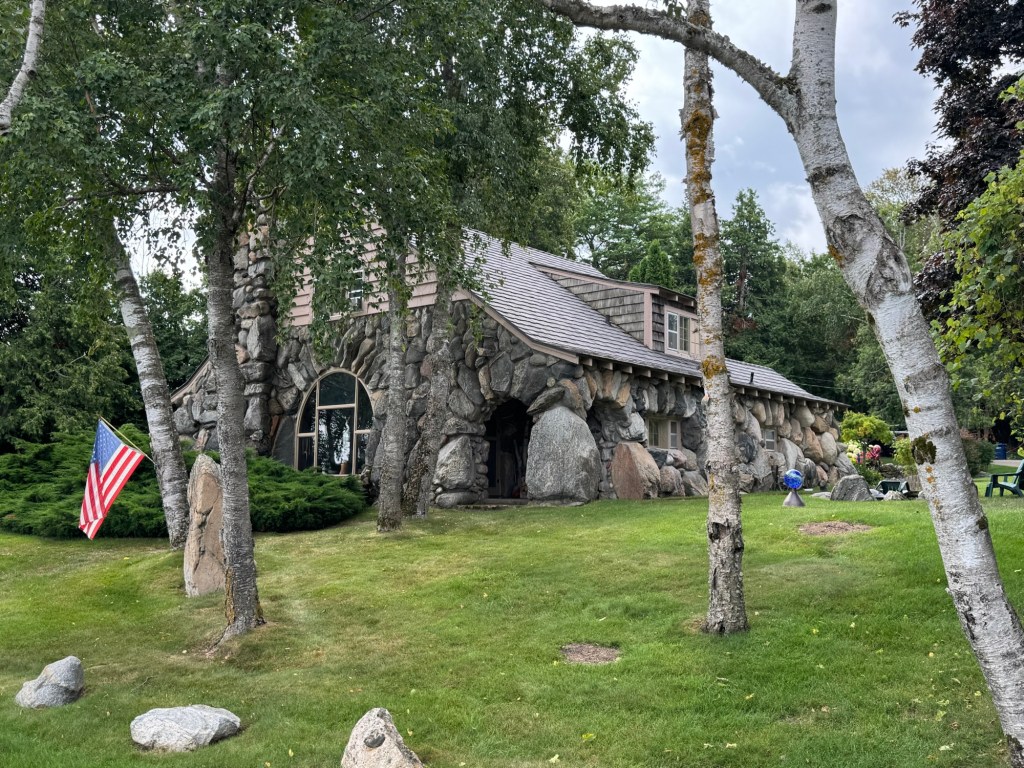
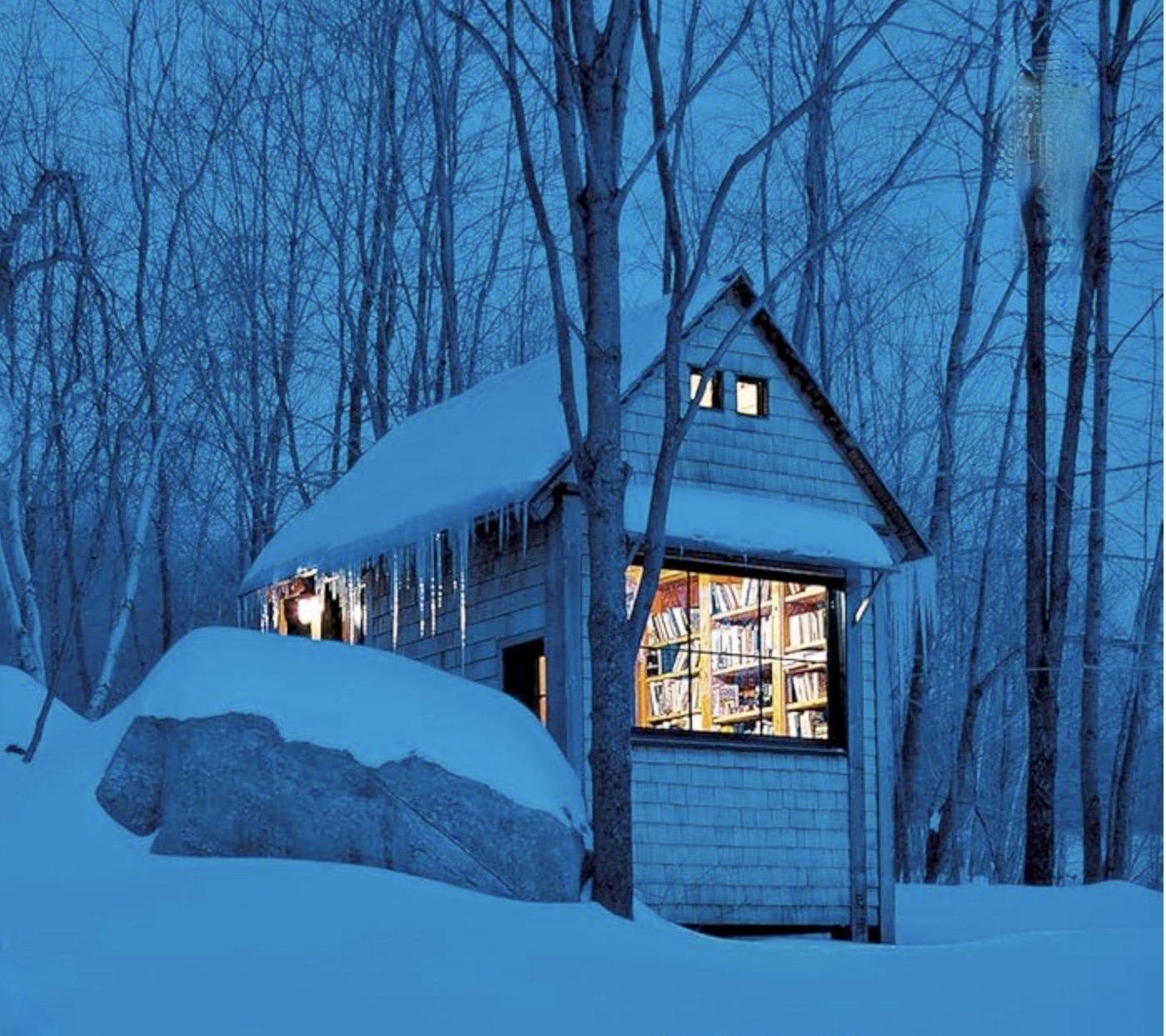
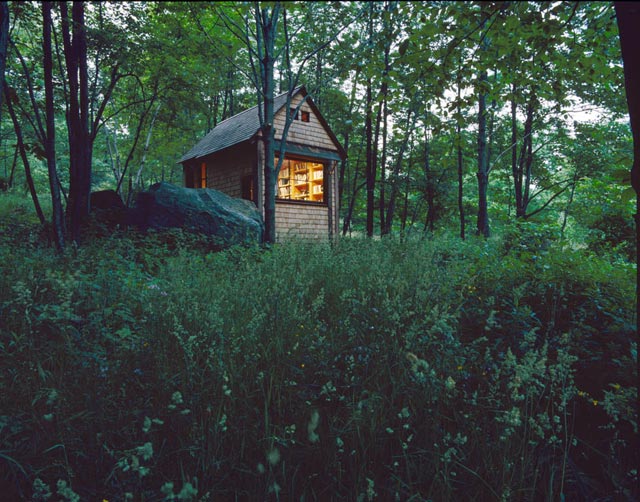
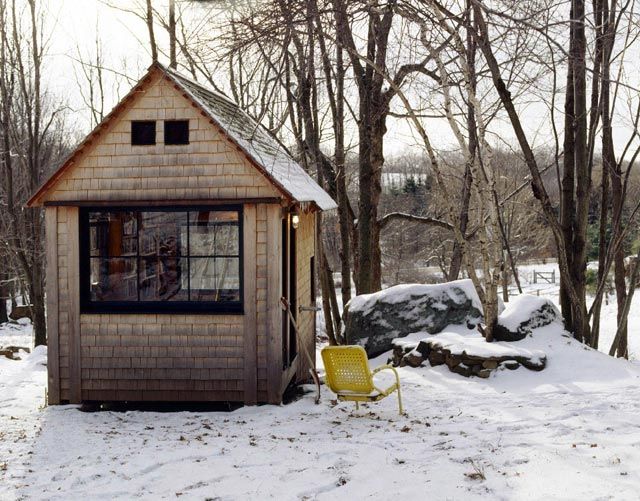
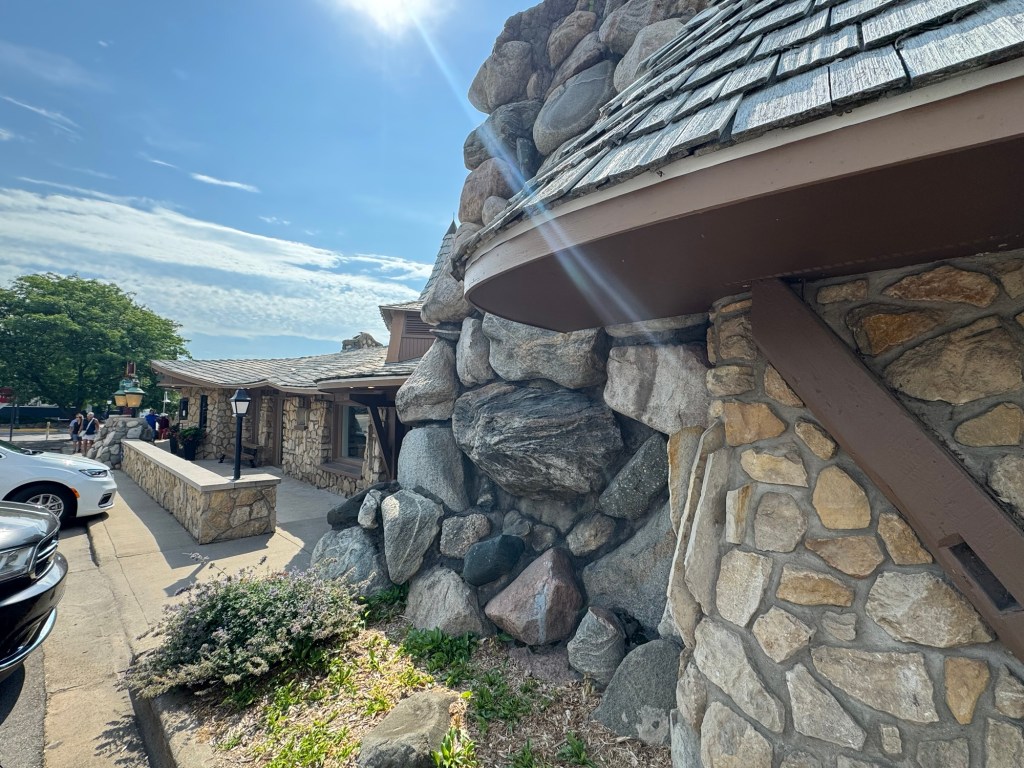
Michael Pollan’s writer’s hut, intentionally situated by a boulder on the brow of a hill

Recently, I observed my middle son moving a black plastic pond module around in a small space in his New Orleans courtyard. As he moved the container that would soon have fish in it, he tried situating the vessel in various ways, in relation to a tree, a fence, some potted plants, and an existing low stone wall. He is not a student or practitioner of feng shui, but I believe I was seeing some of those principles at work in his decision-making.

Western readers may have heard of feng shui, the Asian philosophical approach to discerning the unseen forces that affect objects and their balance in nature. It gives attention to the metaphysical or non-material energies thought to be at work upon or within the world around us. We might say that this approach provides a Tao of seeing, or a natural way of perceiving within and around surface phenomena to the underlying dynamisms that are believed to affect what happens in nature.

This notion that there are unseen forces at work in the world is an idea that is receiving something of a revival in Western Christian spirituality. This is noticeable when people refer to a concept attributable to the Celtic tradition, in which it has become common to refer to “thin places. “ These are places where the veil between the material and the ethereal or the heavenly seems temporarily dissolved. Another parallel here between East and West may lie in the quest within Christian spirituality for the goal of harmony and balance between people and the created world.

However, my reflections here constitute an aesthetic rather than a philosophical or historical inquiry. I am interested in the dynamics of movement we perceive in the circumstances that we encounter, and less in the metaphysical forces or energies that may be present within them. At the outset, however, I want acknowledge how a nuanced Asian approach can be an authentic route toward a culturally-informed appreciation of the phenomena we encounter, especially from a historically Asian perspective.

As we look at paintings in the context of Western culture, one factor we discern assesses composition and attends to the way our seeing is drawn from one part of a larger image to another. This dynamic is often an artist-intended aspect of an overall composition. Sight lines in garden design and arrangement provide another example, as does the architectural arrangement of space in buildings.

Attention given by Western designers to feng shui is sometimes criticized as being a superficial application of historically and philosophically nuanced ideas. But I want to give credit to ways in which our sensitivity toward perceiving movement and direction is a genuine factor that is available for analysis and articulation. We notice this when we encounter both two dimensional compositions as well as three dimensional spaces and the objects we find in them. We can always come to know more about what we see.  Because what we see is something that is there, not simply what we believe, or are disposed or inclined to see.

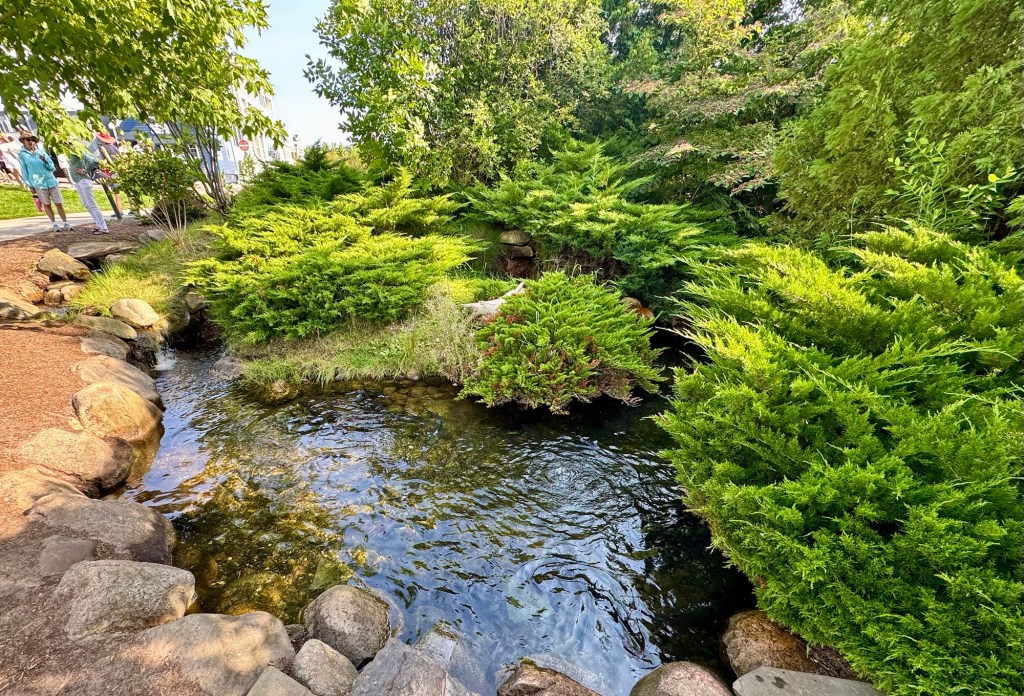
An Asian garden said to be designed according to feng shui principles

Motion, balance between forces, spatial arrangement of objects, and the dynamic relationships that are visible because they exist between and among these variables, continue to grab my interest. Contrasts between colors and textures, as well as between sizes and shapes, play a significant role.  Additionally, the perceived difference between what is natural and things that are humanly fashioned is equally significant, as is our perception of the criteria for what constitutes that which we consider to be natural. These are among the factors that help account for our sensitivity towards and interest in these many observable variables, and our common quest for purpose and meaning in the contexts where we find ourselves.

Motions and balance as we find these factors in Wassily Kandinsky’s painting, Several Circles

Painters, sculptors, and architects, seriously consider these factors within visual and spatial compositions. The painter, Wassily Kandinsky, and the architect, Frank Lloyd Wright, provide two examples of those who also perceived a spiritual dimension within their creative work.

If so, we –  as caring lay observers of the world and of the things and places among which we find ourselves – should give deference to this evident fact. For we can all be thoughtful, as people often are inclined to be, about what we see, touch, and experience when we interact with visual phenomena.

I find myself increasingly sensitive to these aspects of our appreciation for Beauty, and endeavor to be more mindful about them. I am intrigued by possible parallels that may exist between Eastern metaphysical interpretations of visual phenomena and more familiar approaches to what we see that are shaped by Western aesthetics. Especially as these familiar approaches are described and developed within our artistic and architectural best practices.

The Kelpies: Canal-Side Art and Engineering

If reading this by email, please tap the title at the top to open your browser for the best experience. Then, clicking individual pictures will reveal higher resolution images.

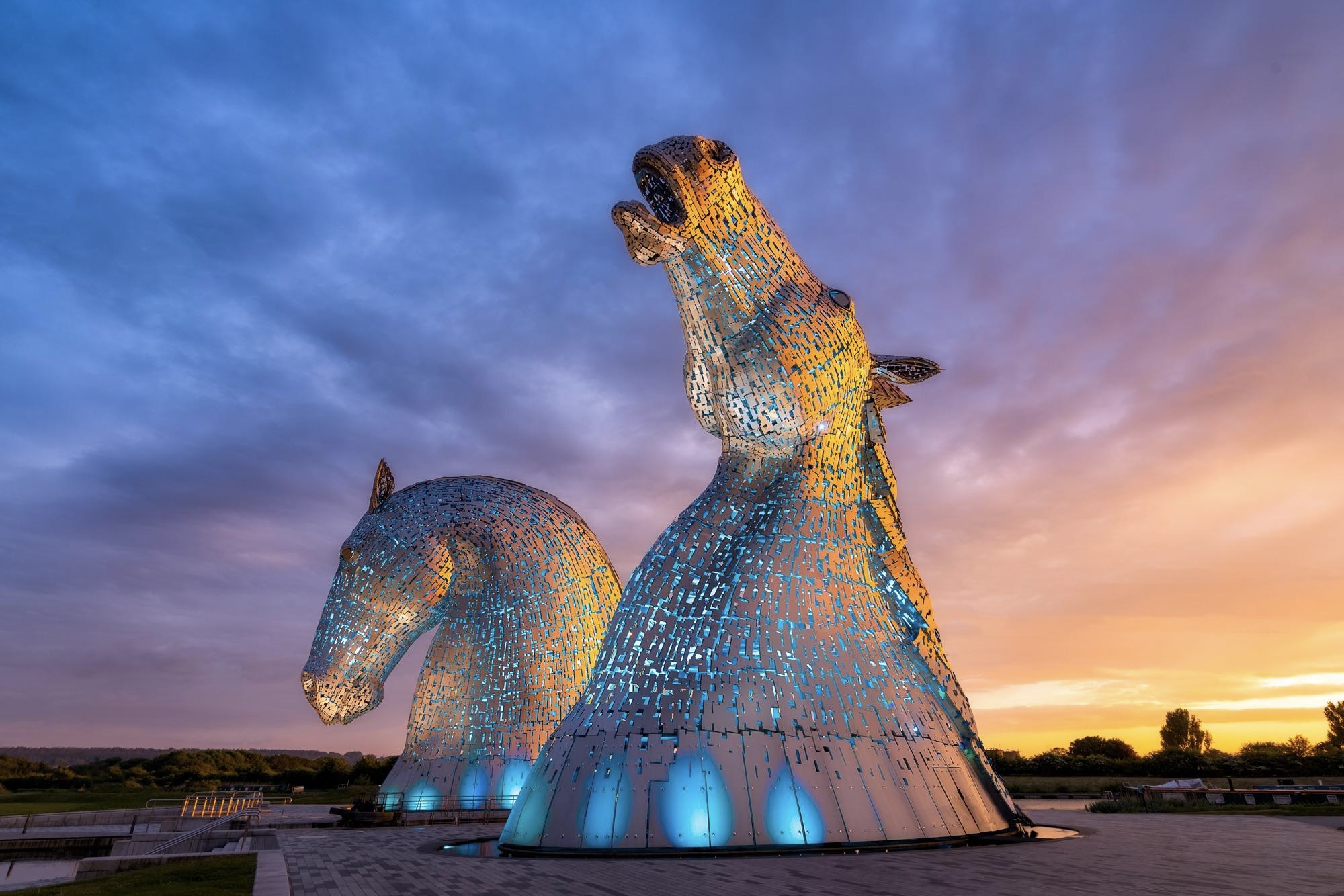
The Kelpies sculptures by Andy Scott

The Kelpies in evening light


If ever there was a reason to take a narrow boat journey, especially in Scotland, an engineering marvel will reward those who travel in that region by such means. Two magnificent large scale sculptures called the Kelpies commemorate the horses that once pulled cargo canal boats along what are still called towpaths. This monument straddling the Firth and Clyde Canal, northwest of Edinburgh, is comprised of twin large scale structures that are said to be the largest equine sculptures in the world. Just under 100’ tall, and each weighing over 300 tons, the structures were built of steel, partly in deference to the historic steel industry in Scotland.

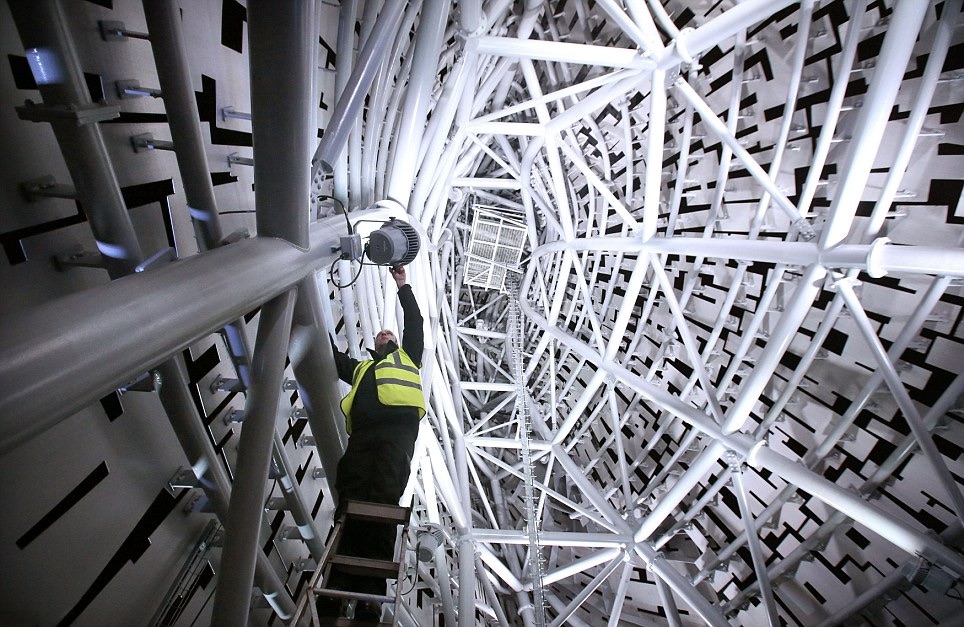
With an interior armature made of construction-steel beams prefabricated elsewhere, the sculptures were assembled on site with the assistance of large cranes and then clad with stainless steel plates. Aside from their resulting durability and their efficient use of materials, the Kelpies’ engineering design permits dramatic interior lighting, especially effective in the evening and early morning hours.

The Kelpies sit adjacent to a newly created canal lock and basin in the Helix Park, and serve as symbolic sentinels in a newly created juncture between the Union Canal and the River Carron.

Boats can be seen on the River Carron in the background

A lighting engineer adjusts an interior light in one of the Kelpies

Stainless steel plates being added to the structural armature

Some people have suggested that the two sculptures are based upon a pair of draft horses of the type that may once have been used on the Firth and Clyde Canal. In my observation, Clydesdale and other draft horses tend to be gentle and of a mild temperament. They are rather stocky in appearance, not only in their bodies but also in their necks and heads. Draft horses are certainly capable of running, and I am sure that some have been known to kick, especially if they have been mistreated. But draft horses can also look as if they embody a spirit of docile resignation to their tasks.

The artist’s design for these Kelpies reminds me not of those lovable working companions, the Clydesdales, but instead look like Arabians or the Mustangs and other wild horses one sees in the American West, spirited, lean, and untamed. I am glad the Kelpies appear this way, as I think they are inspirational, rising up hugely as they do at Helix Park. These horses, especially the one on the right, look as if they have not only been ‘given their head,’ they seem never to have surrendered themselves to our governance. This is only fitting, given the mythological source of the Kelpie name. Kelpies were said to be the spirits of streams that when ridden, might carry their riders down to a tempestuous demise in the depths. As such, we can not only admire their beauty, but these Kelpies can remind us of the canals and those who died building them, the canals’ unromantic industrial past, and those who toiled at canal-side factories in what William Blake – in his poem commonly known as “Jerusalem” – memorably termed Britain’s “dark Satanic Mills.”

Nina Akamu, The American Horse

Another large scale equine sculpture may come to mind when viewing the Scottish Kelpies, inspired by Leonardo da Vinci’s drawing of a large horse monument, designed for the Duke of Milan. A modern day sculpture, based on Leonardo’s drawings, can be found at the Meijer Gardens, in Grand Rapids, Michigan, as well as one cast for the city of Milan. Nina Akamu’s, The American Horse, expresses a similar kind of energetic vitality such as we find in Andy Scott’s great figures along the Firth and Clyde Canal. 24 feet high, Akamu’s strong and vigorous impression of a horse has something of the bone structure and mass of a Clydesdale, and every bit of the spirit that we find in Scott’s two stirring examples.


Le Corbusier’s Villa Savoye: A House as Sculpture?

If reading this by email, please tap the title at the top to open your browser for the best experience. Then, clicking individual pictures will reveal higher resolution images.


Le Corbusier, a pioneering contemporary of Frank Lloyd Wright, articulated part of his architectural philosophy with these words, “the house is a machine for living in.” Wright, by contrast, designed domestic buildings more easily described as desirable homes.

Despite Le Corbusier’s modernist statement regarding his approach to design, his Villa Savoye, completed in 1931, was and is once again a beautiful work of what I would call architectural sculpture. This stunning and now restored project has the distinction of having been France’s first modernist building officially designated as an historical monument.

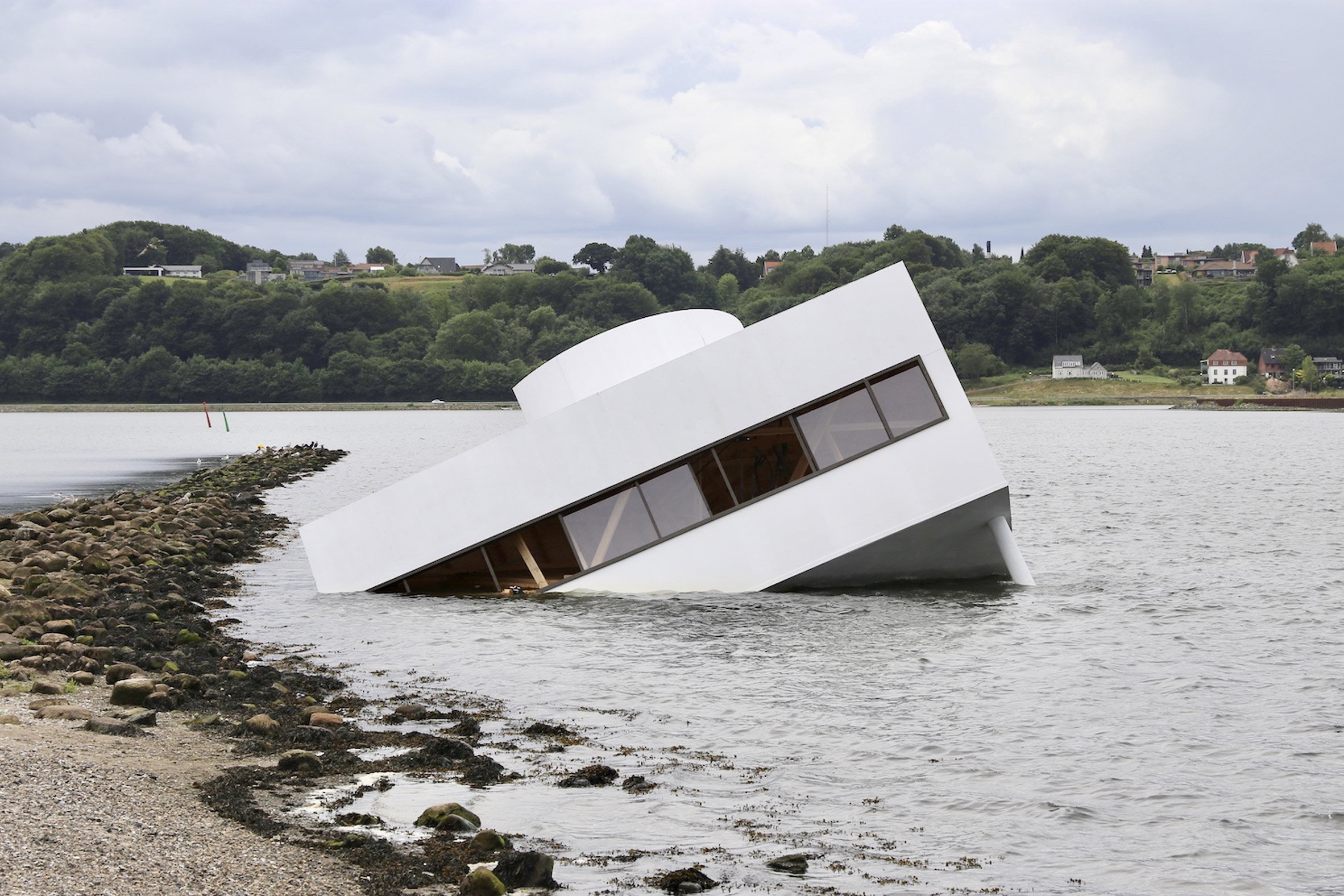
The adjective “iconic” may be overused in contemporary social culture, but the label fits Villa Savoye. So memorable are its lines, curves, and stunning white exterior, that the building has inspired both architectural model kits, as well as two notable tribute structures. The better known of the latter two was an installation by the Danish artist, Asmund Havsteen-Mikkelsen, in a fjord (below).

Another work inspired by Villa Savoye is an almost exact reproduction, but an ‘antipodean shadow’ of the original with its dramatically contrasting black facade (see below). Set in the Southern Hemisphere, it was created as an academic building, a purpose for which Corbu’s design might have been more suitable:

Ashton Ragatt McDougal’s building for the Australian Institute of Aboriginal and Torres Straight Islander Studies, Canberra, Australia

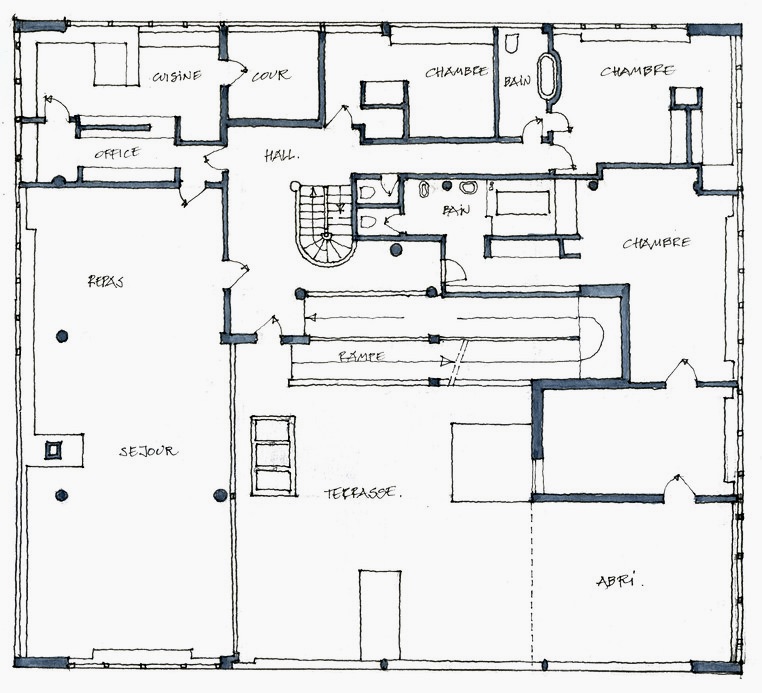
A recent rendering of the plan for the main floor of Villa Savoye

Comparison with Wright’s houses is apt in another sense, for both Le Corbusier and Wright gained well-deserved reputations for prioritizing innovative design features before relying upon time-tested construction methods. One result was that Villa Savoye, like Wright’s famous Wingspread in Wisconsin, suffered from leaks. Leaks throughout the house bedeviled the Villa’s first occupants. While I join others in admiring the formal and visual beauty of Villa Savoye, its practical suitability for a home is questionable.

For me, Villa Savoye’s kitchen focuses the ‘livability’ concern (see photo below). Imagine using this room to prepare aesthetically pleasing meals. This kitchen is not likely to inspire cooking a festive Christmas dinner, looking as it does like an industrial food preparation area. Instead, with the kitchen’s inadequate lighting, I think the expansive windows looking out and away from this part of the building are more likely to attract a cook’s interest.

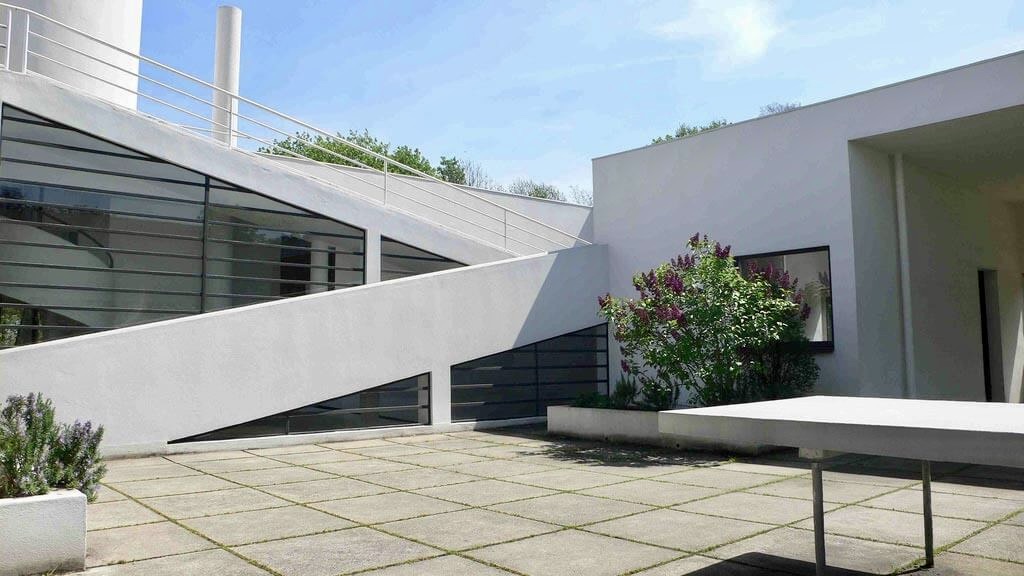
Yet, Villa Savoye has long been an object of fascination for many architects and members of the public, especially with its marvelous facade where the structure appears to float above the site. In sharp contrast to F.L. Wright’s consistent effort to situate his houses within their locations, employing local materials and integrating the structures with their settings, Le Corbusier set Villa Savoye on the site, just as a classical statue might be set up on a pedestal in the context of a formal garden. All natural landscaping has been cleared well back from the structure, which stands upon the billiard table-like surface of a trimmed lawn.

This deliberate juxtaposition of the building and its setting, where the structure’s design elements contrast so deliberately with the surrounding environment, visually marks the Villa as functioning more like a sculpture rather than as a practical dwelling place. The most successful parts of this house, and perhaps the most beautiful aspects of its design, may actually be those least suited to enhancing actual domesticity. These include the curving walled stairwells and ramped walkways, attractive transition zones through which the residents simply pass.

The main floor’s atrium-like terrace, as well as the curving wall elements on the ground and roof levels are immensely appealing to look at. They draw attention to themselves as objects of visual interest as much as they function as places in which to spend time. Yet, it may be ironic that these are primarily exterior parts of the building.

What I have characterized as the sculptural quality of this building is also evident from the vantage point of the principal living area (see below). This living room strikes me as austere rather than as compelling. Despite its modest fireplace, the room might be better imagined as a gallery space – especially for small scale sculptures – than as a room in which to relax with family or friends. As designed, it and the rest of the house may have been theoretically suitable for its location in north central France, but it is hard to imagine the large room, with its original pre-modern windows, being comfortable on a hot day or during the winter without a modern and adequate HVAC system installed (steam radiators are still evident).

Le Corbusier clearly loved and felt at home on the southern rim of France, in the Cote D’azure, and may have seriously misjudged the suitability of this building for the north central region of his country. But there it sits, no longer a home, and now once again an object for all to admire.

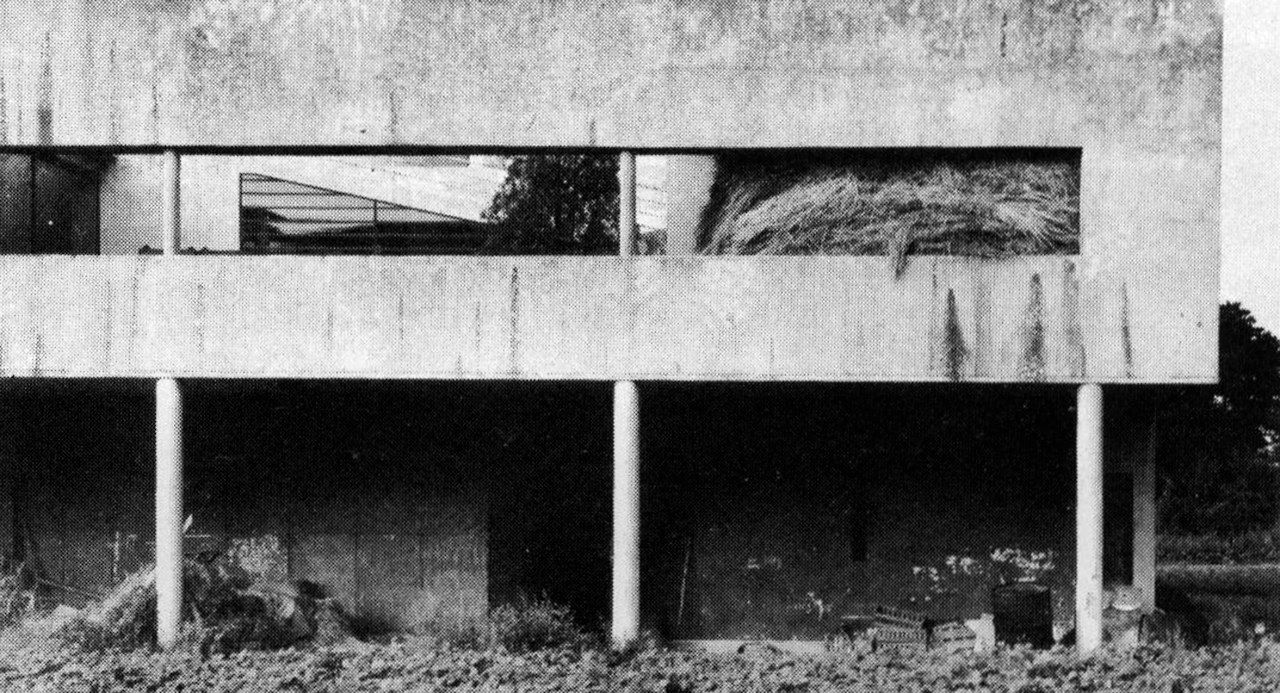
Though I have indicated the likely reasons why I would not want to live in Villa Savoye, I am delighted that the building has been preserved as a focal point for our appreciation of modernist architecture and the International Style. The photos below indicate how near this beautiful place came to demolition after abandonment by its frustrated owners, and its subsequent abuse during the Second World War.


Additional note: Readers who are intrigued by this stunning building may wish to become familiar with some of Le Corbusier’s other notable projects, including his chapel at Ronchamp (featured in a prior blog post), his Marseilles block building, and his theoretical Modular system intended to facilitate human-scale architectural design. The latter may have been inspired by Da Vinci’s Vitruvian Man, reimagined in a metric system of measurement. The following image demonstrates the way in which Le Corbusier’s modernism was in part based on mathematical theory, and how it played a role in his design for Villa Savoye.


Special thanks to my daughter in law, Laure Le Coq Holmgren, for helping me with the French terms for aspects of Villa Savoye’s plan, and for the correct pronunciation of the building’s name.

The Beauty of Philip Simmons’ Charleston Ironwork

If reading this by email, please tap the title at the top to open your browser for the best experience. Then, clicking individual pictures will reveal higher resolution images.

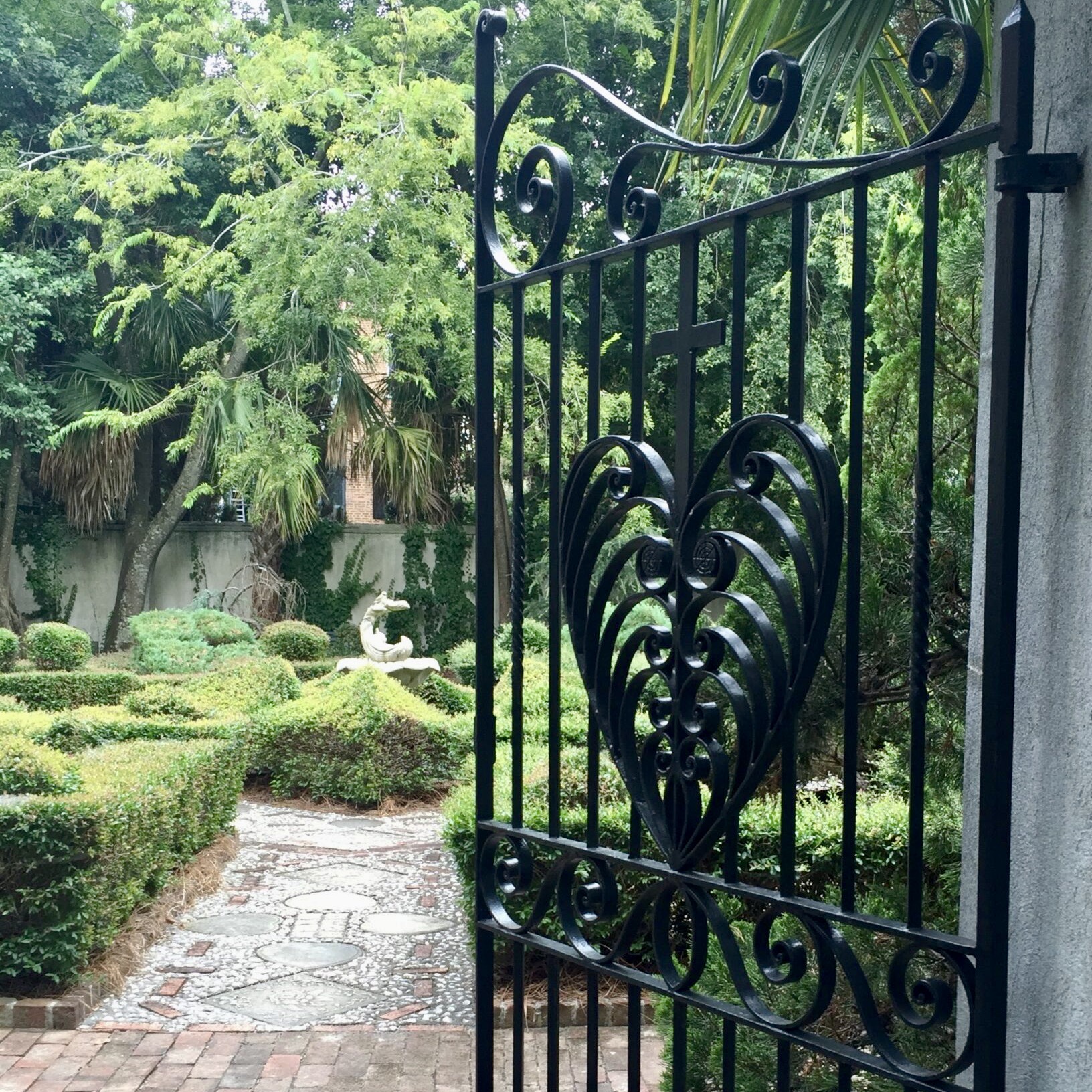
Gate to the Philip Simmons Memorial Garden, Anson Street, Charleston (featuring a Simmons design)


Philip Simmons, was a blacksmith who spent his life and working career in Charleston, SC, where much of his work is preserved by homeowners, collectors, and a foundation dedicated to honoring his legacy. Along with his lifelong body of ironwork, he has been described as a national treasure. Born in 1912 in the Old South, he received a very limited education and apprenticed himself at an early age to blacksmiths he saw in his Charleston neighborhood. Eight decades of work in a blacksmith’s shop followed as he pursued what some might call a trade craft, and which in his hands was truly an art.

Mary E. Lyons has written a book about Simmons for young persons, which includes some compelling photos of his work. She offers this introduction to the artist: “Philip Simmons began his career as an untrained boy. Now he is called the Dean of Blacksmiths by professional smiths across the country. His memories show that skill and patience take years of work. They also prove that everyone can achieve both. An honored artist, teacher, and businessman, Philip Simmons is the working person’s hero.”

Though the circumstances in which he lived and worked were modest, he is warmly remembered by his home city, and he has been commemorated by a marker at the Fort Sumter and Fort Moultrie National Historical Park (shown above), by the preservation of his home and studio, as well as by a high school named in his honor. Numerous examples of Simmons’ ironwork can be seen on walking tours in Charleston, in the course of which one can enter, through a gate fashioned by Simmons, a memorial garden for named for him maintained by the Garden Club of Charleston.

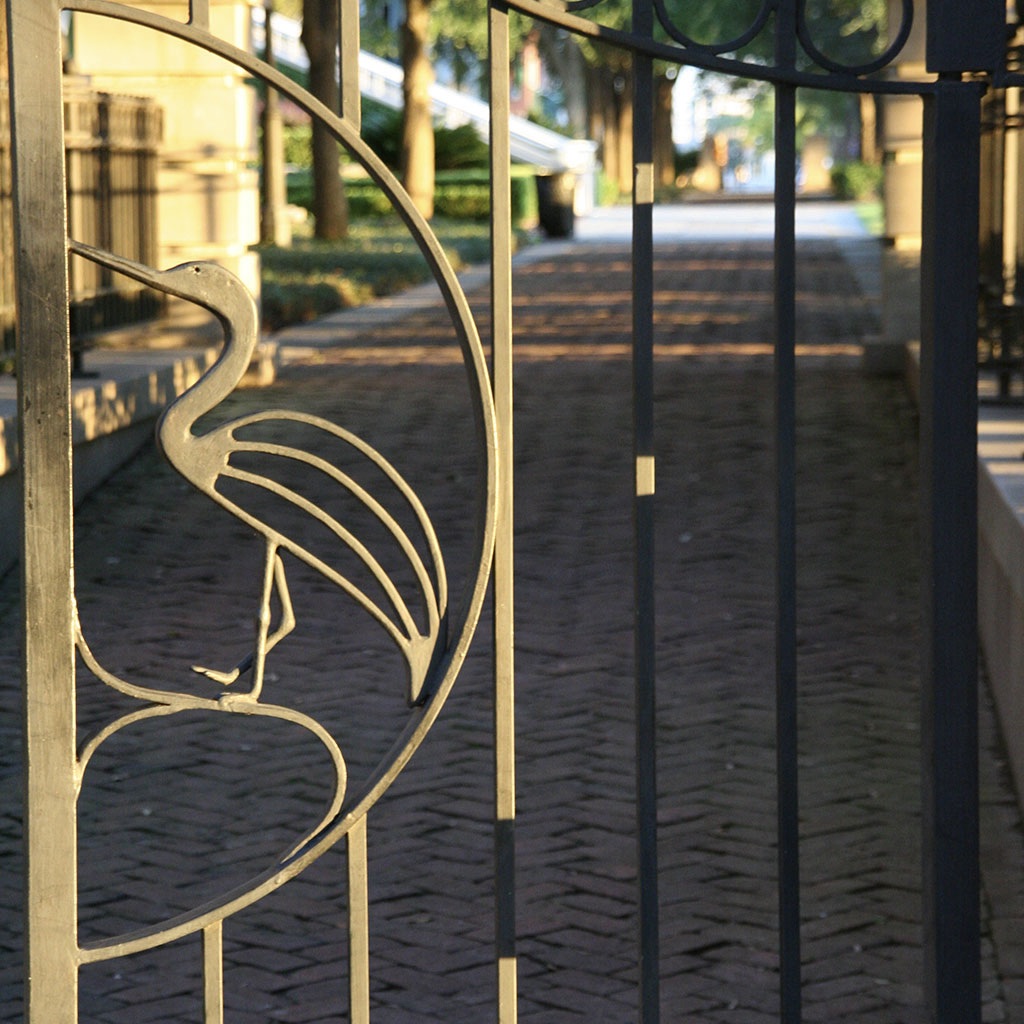
An egret, one of Simmons’ favorite motifs in his ironwork

In addition to representations of egrets, other images such as palmetto fronds, hearts, fish and serpents, number among those images often featured in Simmons’ ironwork. The artist’s choice of these images reflected his sensitivity to the locale in which he was raised, both Daniel Island where he was born, and then Charleston and its low country and aquatic surroundings.

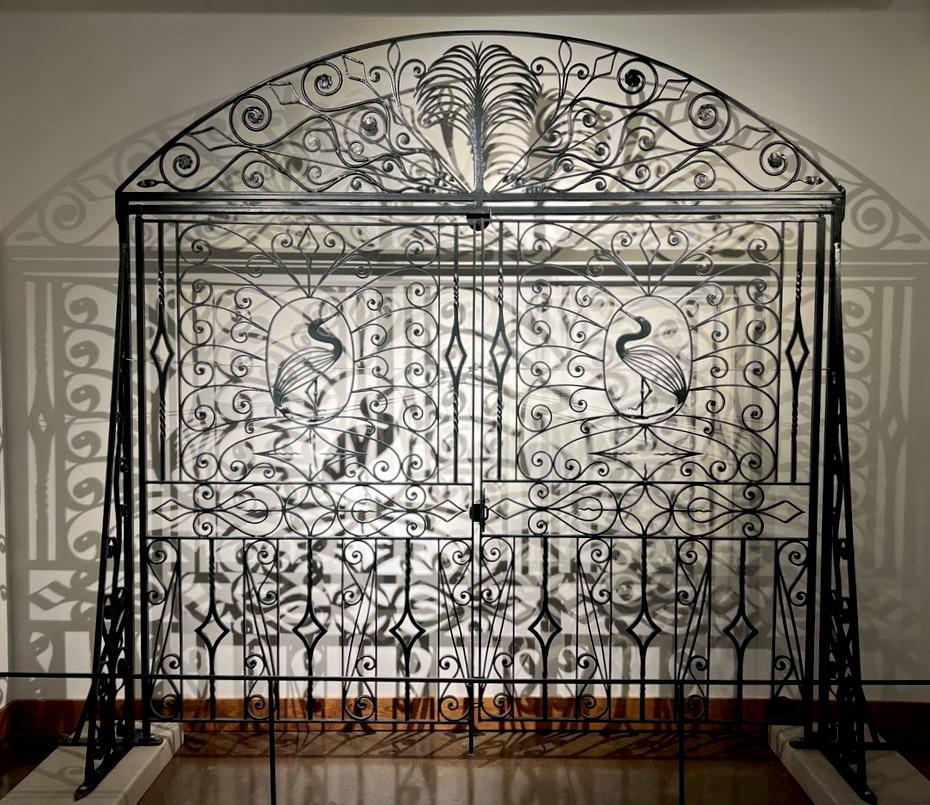
A major turning point in Simmon’s life’s work came with an unexpected opportunity brought to him when he was 64, an age when many contemplate retirement. He was invited to participate in the 1976 Bicentennial commemorative Festival of American Folklife to take place on the Mall by the Lincoln Memorial in Washington, D.C. Asked to craft a gate onsite during the event, Simmons wondered about the imagery that he might select for the project. Thinking about images that would reflect where he was from, he settled on the moon, stars in the sky, the rolling surface of water, and fish. This combination of images reflected, in his mind, the night sky sparkling upon the waters of the two rivers that form Charleston Harbor. The resulting gate, which has come to be known as the Star and Fish Gate, was purchased by the Smithsonian Institution (image below).

Philip Simmons’ crafting of the Star and Fish Gate in a temporary workshop set up on the Washington Mall, complete with a portable foundry and anvil, attracted a great deal of attention during the festival, and resulted in the artist gaining national attention. Among those taking an interest in Simmons’ work, and then helping bring it to a wider audience, was John Michael Vlach, a professor at George Washington University. Vlach published a biography of Simmons in 1981, which may have helped those at the National Endowment for the Arts to take note of Simmons’ lifetime of achievement in the field of blacksmithing. In 1982, the NEA awarded Simmons with a National Heritage Fellowship, the United States government’s highest honor in the folk and traditional arts. Other honors followed, including the Order of the Palmetto, his home state’s highest honor, as well as induction into the South Carolina Hall of Fame. During his lifetime, he was referred to as “a living national treasure.”

Simmons’ iron work incorporating the medical symbol of a caduceus, and a fish representing an aspect of his home region as well as the Christian faith

In spite of all of the accolades and honors he received later in life, Philip Simmons continued with humility to devote himself to his art, and to teaching younger aspirants and apprentices who wished to become proficient themselves in creating beautiful yet also functional ironwork. Despite the very significant cultural differences between his approach and those of Japanese craftspeople, I find Simmons’ approach to his life’s work characteristic of the best of what is often described as folk art, work that is appreciated for its beauty without necessarily calling attention to the artisan who made it.

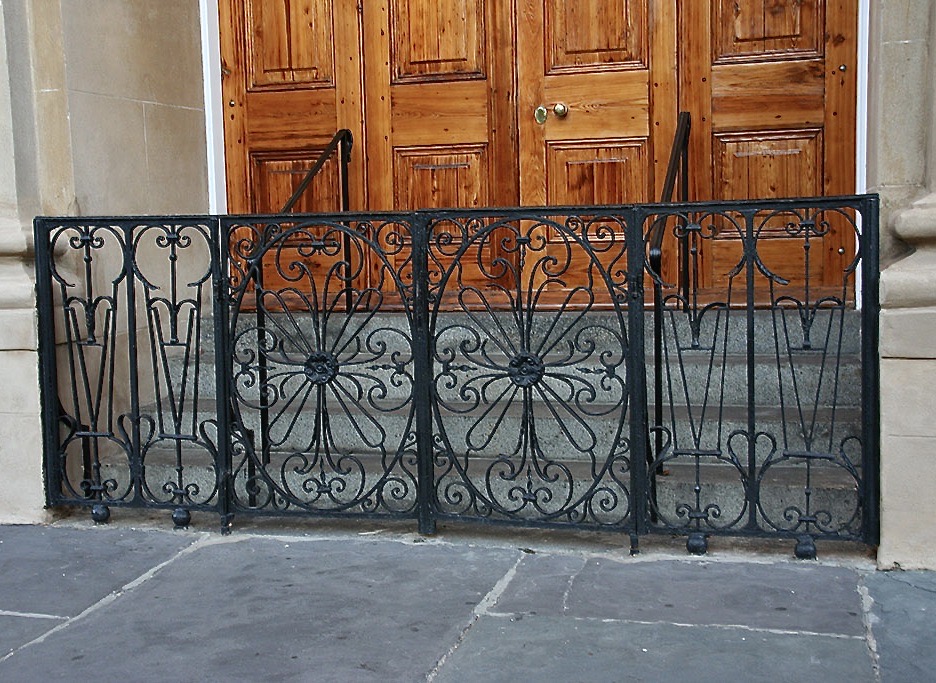
Displayed below are images of a number of Simmons’ creations as a blacksmith.

A Simmons gate for St. Philip Episcopal Church, Charleston

The cover of Mary Lyons’ book for young persons, featuring Philip Simmons at work on a piece of scrolled iron


The full title of John Michael Vlach’s book, mentioned above, is: Charleston Blacksmith: The Work of Philip Simmons. The book includes a map of Charleston showing the location of Simmons’ works, as well as brief descriptions of them.

Japanese Thatched Roof Farm and Country Houses

If reading this by email, please tap the title at the top to open your browser for the best experience. Then, clicking individual pictures will reveal higher resolution images.


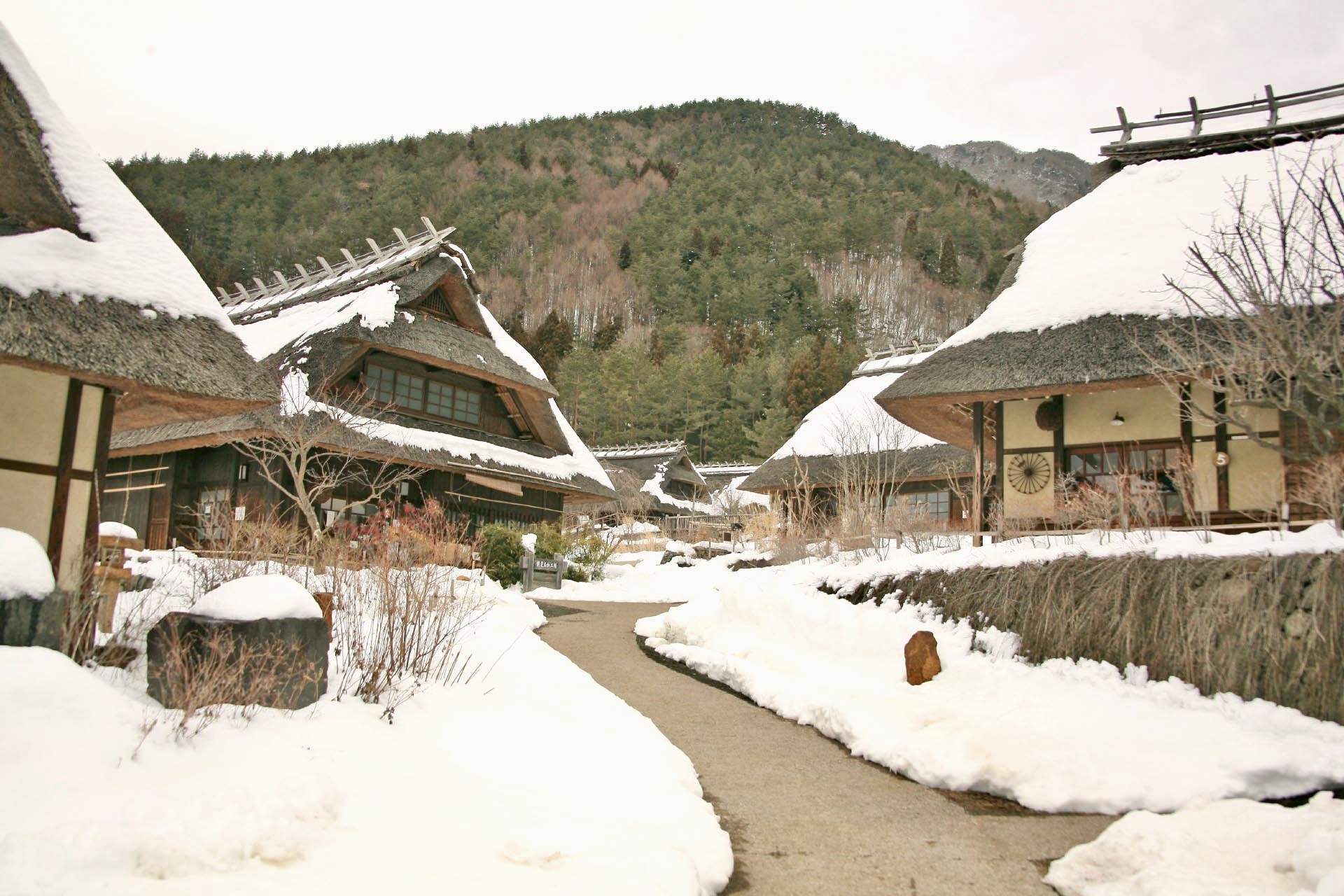
Those who watched the Winter Olympics broadcast from Nagano, Japan, may have gained some familiarity with a region sometimes referred to as the Japanese Alps. While living in Japan, my parents developed a deep interest in Japanese folk art (Mingei). Through this, they became acquainted with Sanshiro Ikeda, a recognized authority on Mingei, who built craft furniture. Through our trips to Nagano-ken (or prefecture), we visited Ikeda’s small furniture factory and the country farm house he had restored, and in which he lived. Through these visits, we became familiar with Matsumoto, its beautiful many hundred year old castle, and the surrounding Nagano countryside. My strongest memory, though, is of Ikeda’s restored traditional farmhouse, and those like it in the area.

The choice of Nagano prefecture as a location for the Winter Olympics was based on the fact that that region regularly receives a good deal of snow. As a consequence, the historic pattern for the design of farm and country houses involves very steep roofs which are quite often thatched. The combination of these two characteristics in the resulting roofs renders them amenable to heavy snow loads, which also help provide additional insulation against the seasonal cold weather.

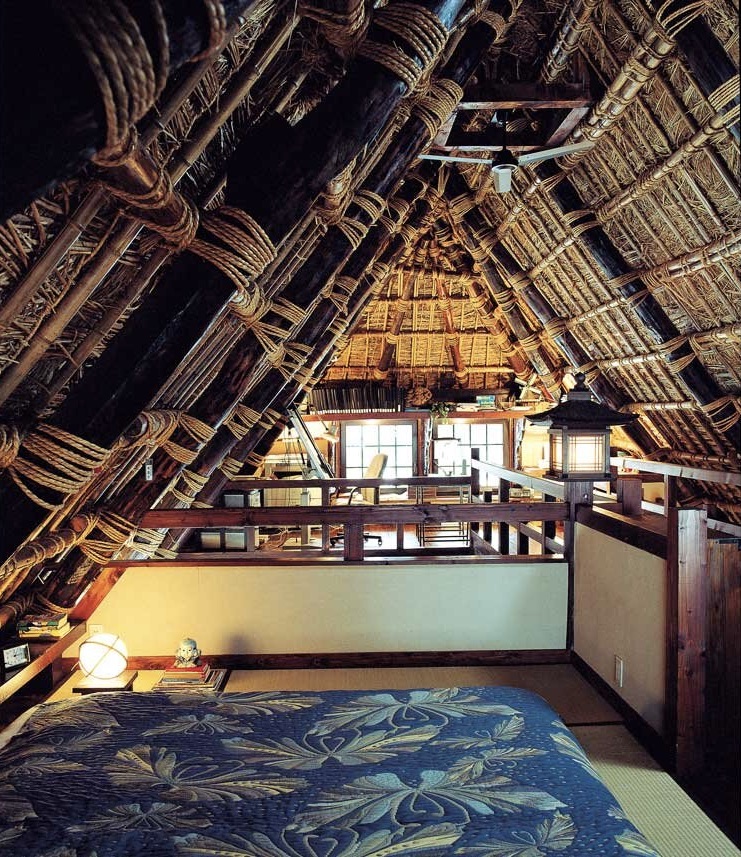
These farm and country houses are typically built from wooden posts and beams, with plaster or stucco walls, and wooden plank floors if not otherwise covered with tatami mats made of straw and rice husks. The equivalent of what we refer to as rafters, and the lath cross pieces or straps supporting the thatched roof material, are typically beams made from tree branches or thick and thin pieces of bamboo, lashed together with rope, something that surely would not pass building codes for contemporary construction.

Traditional house with beams lashed together (above) and stucco walls above sliding shoji (lattice door and window panels), seen in the lower photo.

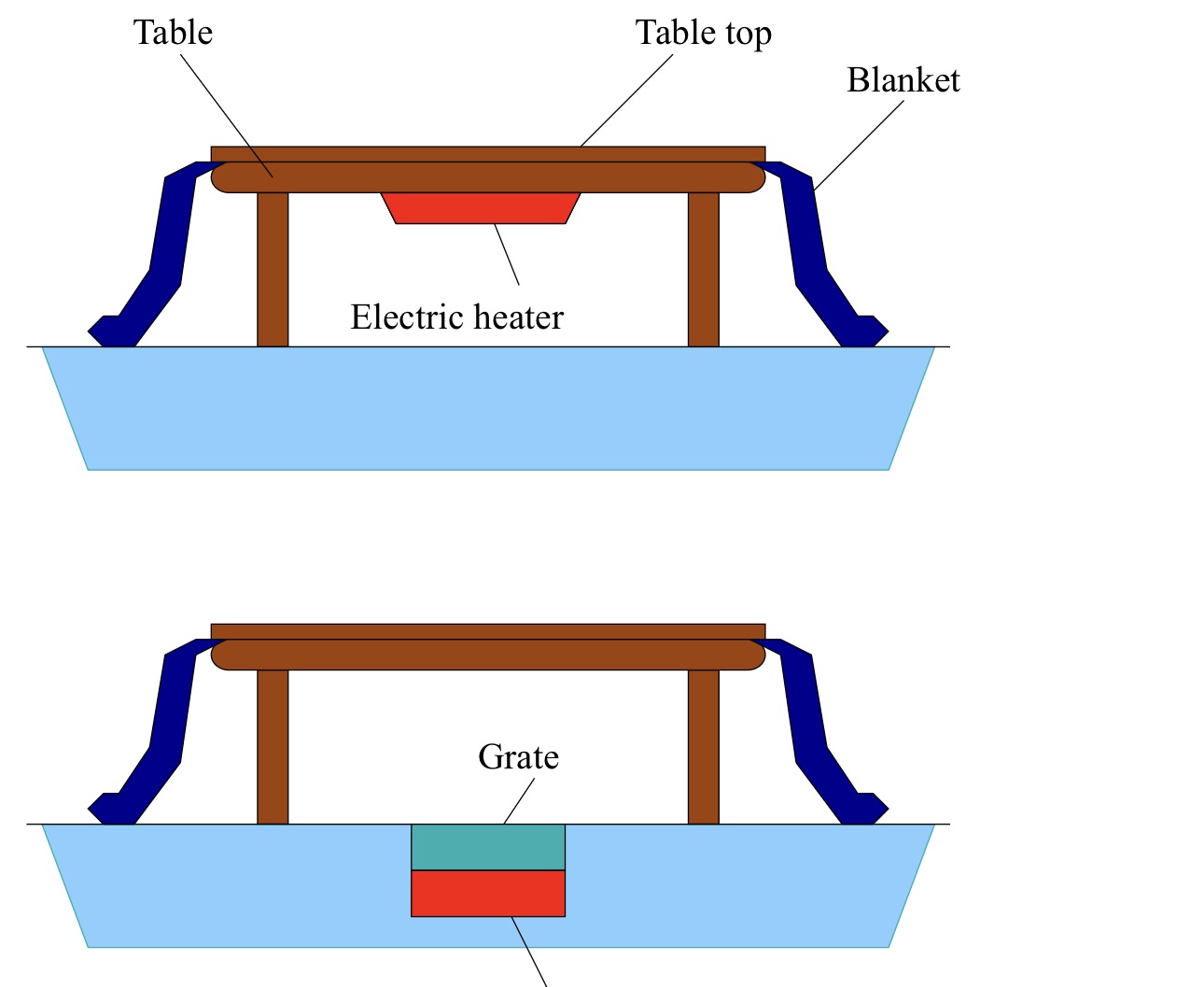
Instead of any form of central heating, generally unknown in Japan until modern times, many of the rooms on the ground floor would have a footwell in the floor, at the base of which traditionally there would have been a small charcoal brazier (charcoal kotatsu). Those in the room sitting on the floor, with their legs dangling in the footwell, managed to stay warm with the benefit of a small table over their thighs and knees, above the footwell, along with a lap blanket suspended from the low table.

A kotatsu blanket (with table top removed)

Kotatsu design (traditional charcoal and contemporary electronic patterns)

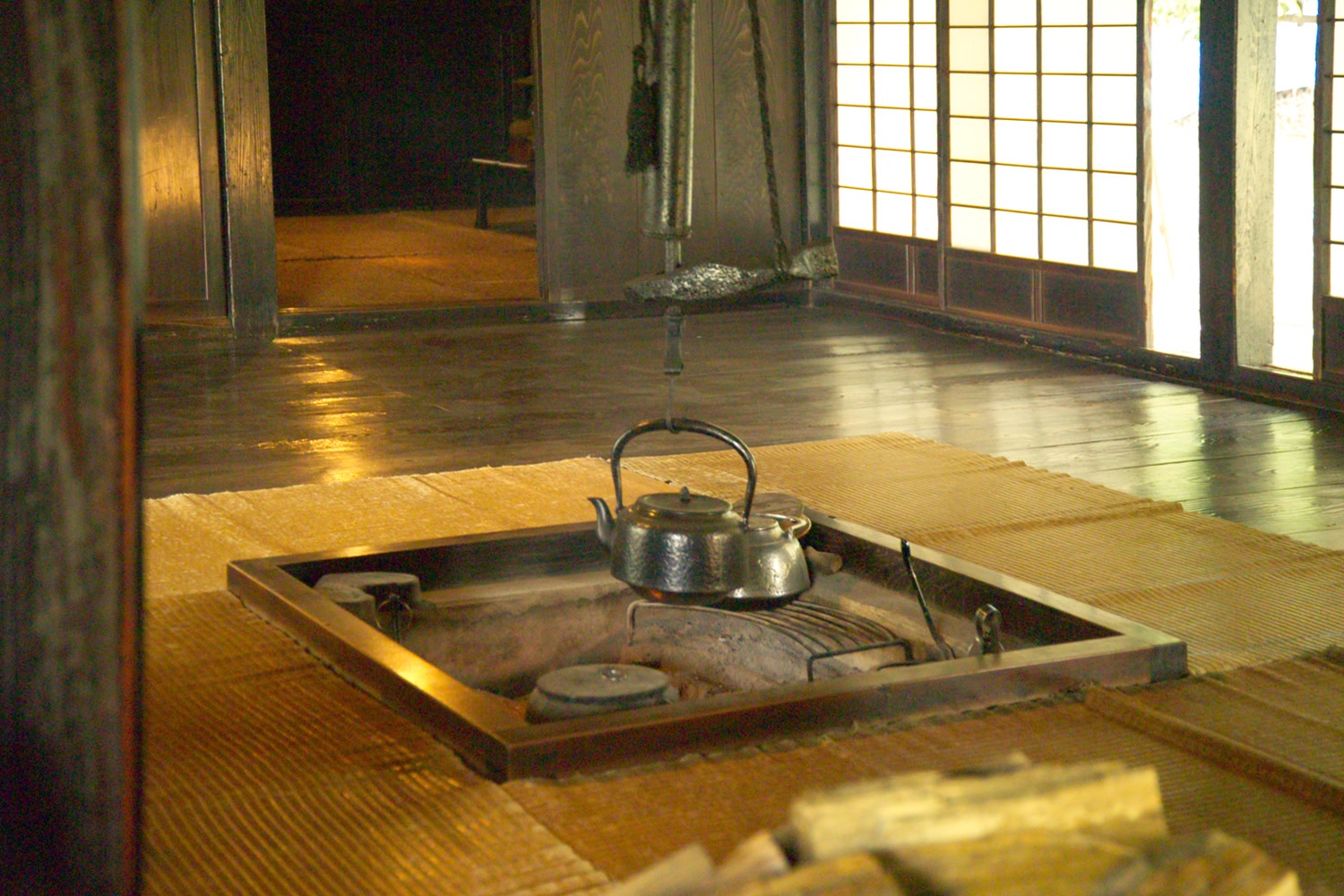
A similar but very shallow well-like indentation in the floor provided a place for cooking at the floor level.

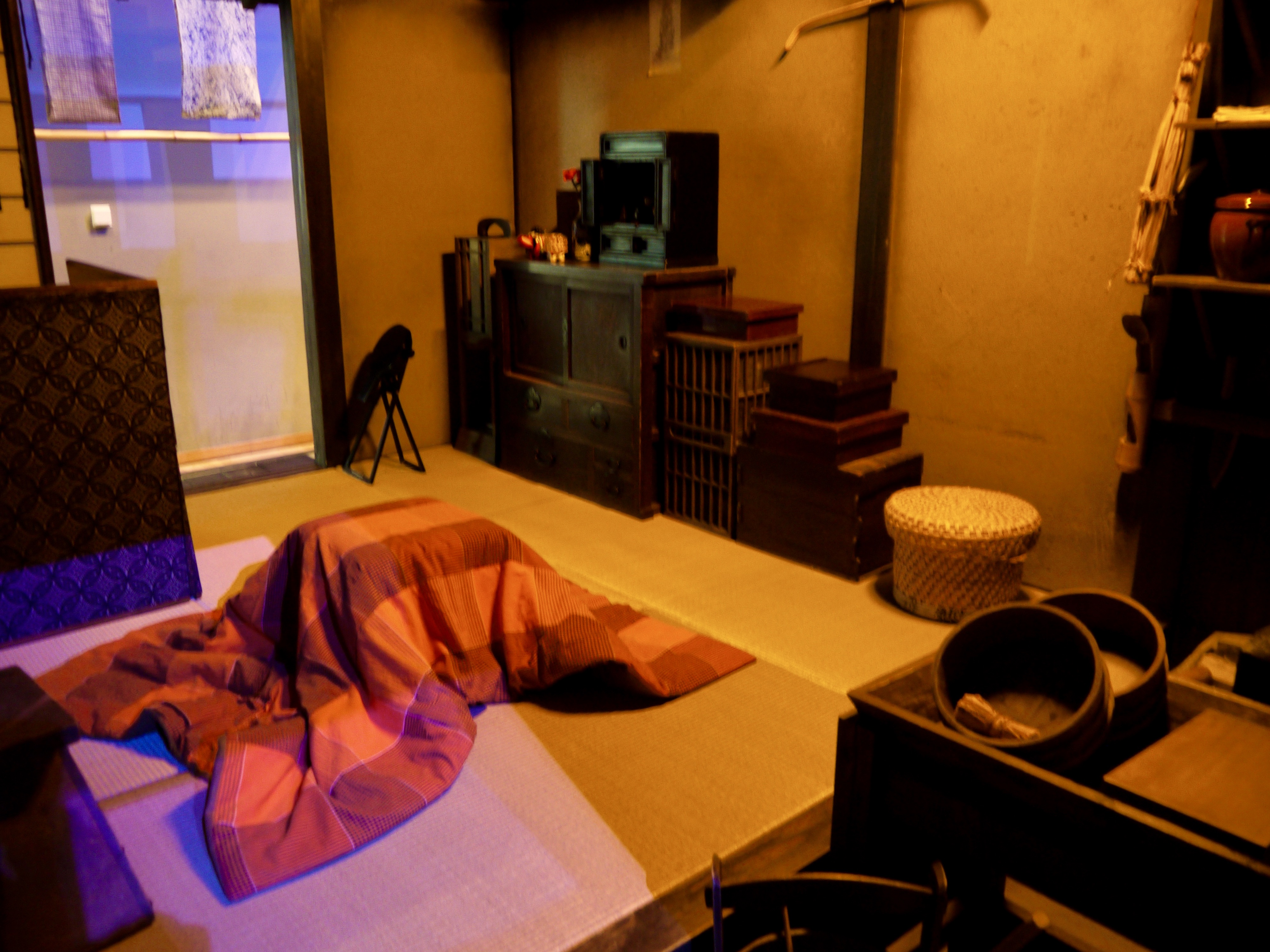
Quite often these houses would feature one or two successively smaller floors above the ground floor in a way that will recall Western A-frame ski lodge houses. Typically, the sleeping areas would be on the upper floors with futon beds laid out on the tatami mats, thick quilts provided, and pillows stuffed with uncooked rice grains.

Interior of a traditional farmhouse showing a futon (or Japanese mattress), and a quilt covering, set above tatami mats.

Below, I am including a selection of photos of various examples of traditional Japanese country houses and related buildings, which demonstrate the consistency with which this approach to domestic architecture was adopted and practiced through the centuries. The first three photos show what appear to be contemporary structures built in the historic farmhouse style (followed by photos of historic structures).

The following photos feature historic structures.

The same village area (as in the photo above it) on a winter’s evening

The well-preserved historic examples of Japanese farm and country houses in the photos above, as well as the contemporary reproductions employing this historically-informed approach to domestic architecture, attest to the heightened appreciation that Japanese people have for their ancient culture. It may be that, as in some other parts of the world, the highly advanced technological developments characterizing the urban areas where most of their people now live, has nurtured a deep and latent regard for aspects of their nation’s social, artistic, and spiritual heritage.


From Dream to Reality: Michael Pollan and His Writing House

If reading this by email, please tap the title at the top to open your browser for the best experience. Then, clicking individual pictures will reveal higher resolution images.


In an updated preface to his book, A Place of My Own: the Architecture of Daydreams, Michael Pollan laments how some readers approach his book expecting something like a “how to” guide to building their own writer’s hut or shack. Though he does provide a wealth of detail concerning the construction methods he used, the book’s richness lies in its thoughtful engagement with the idea of human shelter and its function in architecture. Of particular note is the attention he gives to the French writer, Gaston Bachelard, whose book, The Poetics of Space, prompts a good deal of reflection by Pollan. The author quotes Bachelard with words that obviously inspired the subtitle of A Place of My Own: “I should say: the house shelters daydreaming, the house protects the dreamer, the house allows one to dream in peace.”

Michael Pollan dreams of building and inhabiting what we might call his own writer’s studio in the woods behind his Connecticut home. As he muses about its possibilities, he considers potential designs in dialogue with his chosen site for the small building. From a book by the English geographer, Jay Appleton, he gleans the insight that ideal human shelters provide two dialectically interconnected values, ‘prospect’ and ‘refuge.’ A shelter conducive for human flourishing provides both the opportunity to view and appreciate one’s surroundings while at the same time providing a secure resting place. Achieving these twin goals becomes one of Pollan’s priorities for his little writing hut.

At the same time, while embarking upon this project to build his place for writing, he acknowledges that the endeavor also provides the occasion for him to examine the idea of architecture, and its contemporary role in Western society. He discovers – through a gift subscription to Progressive Architecture magazine – that the field has increasingly become focused on the exploration and expression of ideas, leaving behind a principal focus upon providing beautiful yet practically useful spaces and structures for human habitation and work.

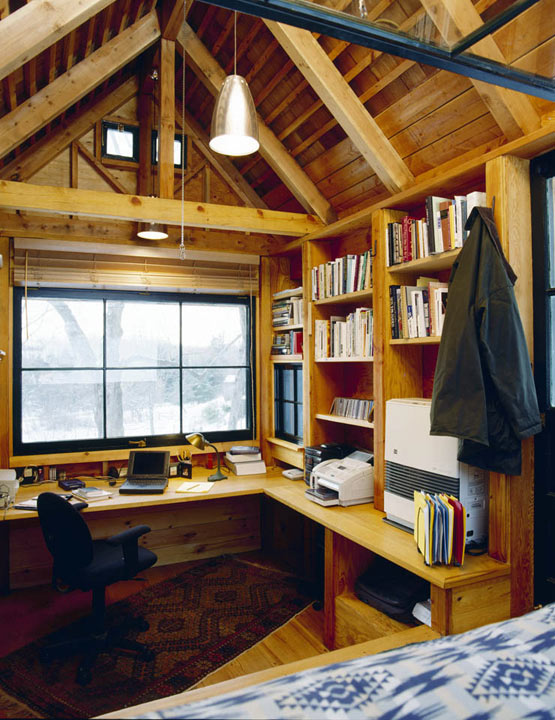
The interior of Michael Pollan’s writing house (note the daybed in the foreground)

Pollan realizes that what he wants to build is not something that points to something else, or to a set of ideas and concepts (as is the case with some contemporary practitioners in the field of design). Instead, he wants a structure that he can use for everyday work, for reading, and as a place where occasionally he can have a nap. With his aversion to the little building becoming an artistic statement rather than something truly useful, Pollan’s book reminds me of a principal theme in Tom Wolfe’s splendid little book, From Bauhaus to Our House.

Especially in the first two chapters, Michael Pollan offers a set of thought provoking and historically informed reflections on the nature and purpose of architecture, which are shaped in a writerly way. As much as I was drawn to the concrete aspects of his project – as in his account of his search for the ideal design of the window through which he would look while writing – I found his engagement with the theoretical aspects of the project to be very compelling. A good example of the latter is his reflection on our conscious experience of form and pattern in buildings, and our unconscious experience of the spaces we encounter and through which we move. Other examples include the role of feng shui in his selection of a site for his project, as well his explanation of the function of the Golden Section (or Divine Proportion, 1/1.618) in deciding the parameters of the rectangle for his floor plan.

Most of all, I appreciate Pollan’s delineation of the difference between the 20th century modernist or International Style approach to architecture, which abstractly stressed universality of form and consistent design elements regardless of a building’s context, with the architecture of someone like Frank Lloyd Wright, who focused on the connection between his buildings and their location within their chosen sites and his intentional employment of local materials. Pollan offers an insightful two-columned table to illustrate the difference between the two, with the first (stressing universality) labeled, “There,” and the second (stressing locality) labeled, “Here.”

All in all, he has given us a finely written book.


David Macaulay and Mosque Architecture

If reading this by email, please tap the title at the top to open your browser for the best experience. Then, clicking individual pictures will reveal higher resolution images.


Recently I became reacquainted with a book I discovered some years ago, by an author whose work I greatly admire – David Macaulay. It is his book on Islamic mosque architecture, based on a historically informed but fictional mosque erected in Istanbul in the 16th century. Macaulay’s great skill lies in his ability to provide the reader with insights gained from his use of drawing with pen and ink, frequently with color overlaid, in such a way as to unfold the often complex inner structure of the buildings he wishes to explore and explain. For a primer on traditional mosque design and construction, complete with a glossary of terms, the book is invaluable.

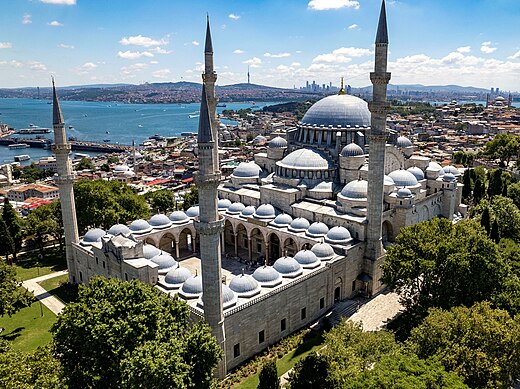
The project featured in this book is a mosque commissioned by Suha Mehmet Pasa, a fictitious high official in the early Ottoman period who engages in a charitable act inspired by his Islamic faith and the five pillars of Islam (faith, prayer, charity, fasting, and pilgrimage). He funds the design and construction of a complex of buildings that includes both a grand mosque and its accompanying courtyard and related structures, as well as a mausoleum for himself upon his death. The influence of the historical architect, Mirmar Sinan, as well as Sinan’s breathtaking Süleymaniye Mosque in Istanbul (depicted below), are plainly evident in Macaulay’s composition of the book.

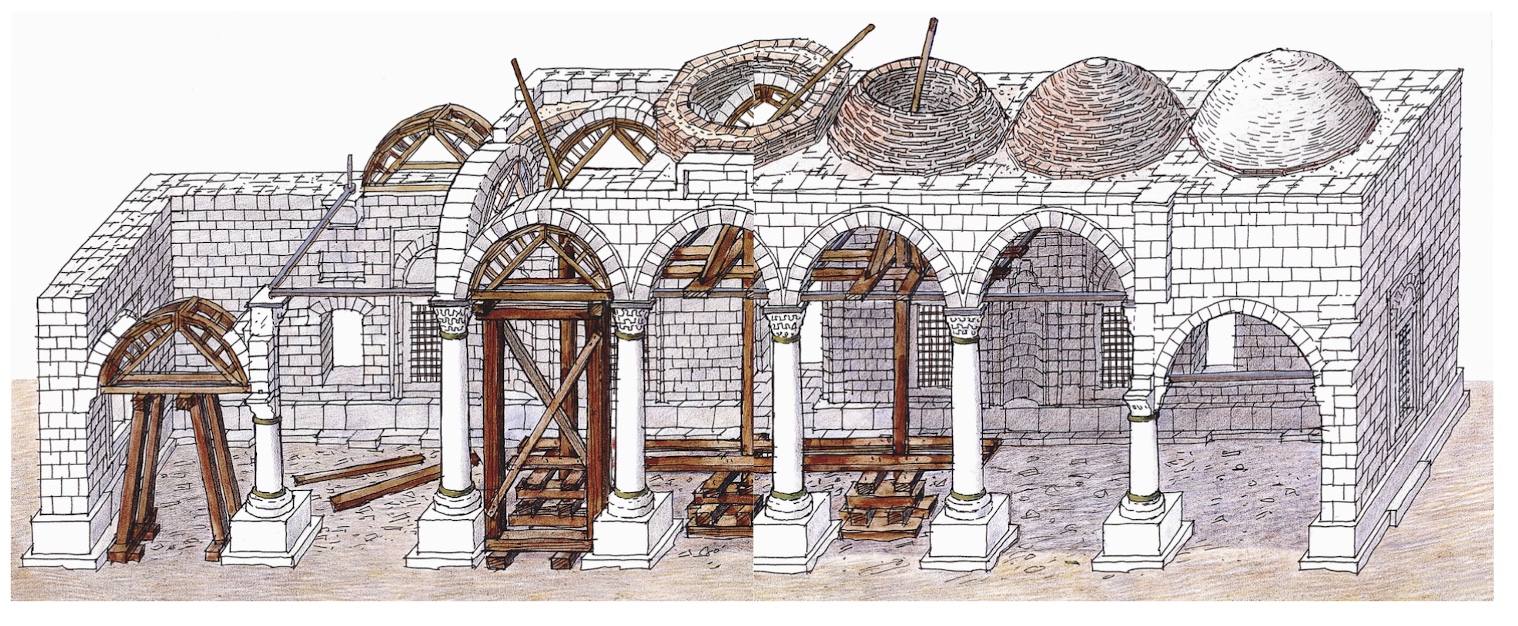
Because of my own fascination with domes incorporated within mosque architecture, I will focus here on that aspect of Macaulay’s book, though he provides a comprehensive account of the construction of almost every feature of a traditional mosque from the early Ottoman period. I find most helpful the following diagrammatic illustration of the basic building components which together support the dome on such a mosque as the Süleymaniye Mosque, featured in a prior post.

The above illustration corresponds to the following floor plan for the same hypothetical structure.

Now, how did that imaginary 16th century architect, his masons and carpenters, manage to build the magnificent dome featured in this project, and as we find in the actual Süleymaniye Mosque? Macaulay unfolds the mystery with a series of instructive drawings that give us insight into the process. Once the proper height of the walls and support piers was attained, a semi-circular structure of wood was constructed to provide the proper curvature of the intended dome (as seen below).

This structure was then lifted up and placed upon a kind of spindle, so that it could revolve horizontally around the perimeter of what would become the brick structure of the dome.

With the rotation of this semi-circular wooden form, the builders could stack up the bricks according to the intended proper curvature of the inside of the dome, while allowing the exterior of the dome to be wider at its base, for greater strength and stability.

A final step in the construction of the main and other domes was the preparation of sheets of lead, cut in precise patterns so that they would sheath the dome with a series of overlapping panels, to avoid water intrusion:

The smaller domes covering areas of the courtyard and entrance portico were constructed in a similar fashion, but on a smaller scale, as seen in the following illustrations. A simple swinging pendulum-like wooden arm was employed rather than the more elaborate semi-circular structure used for the large main dome.

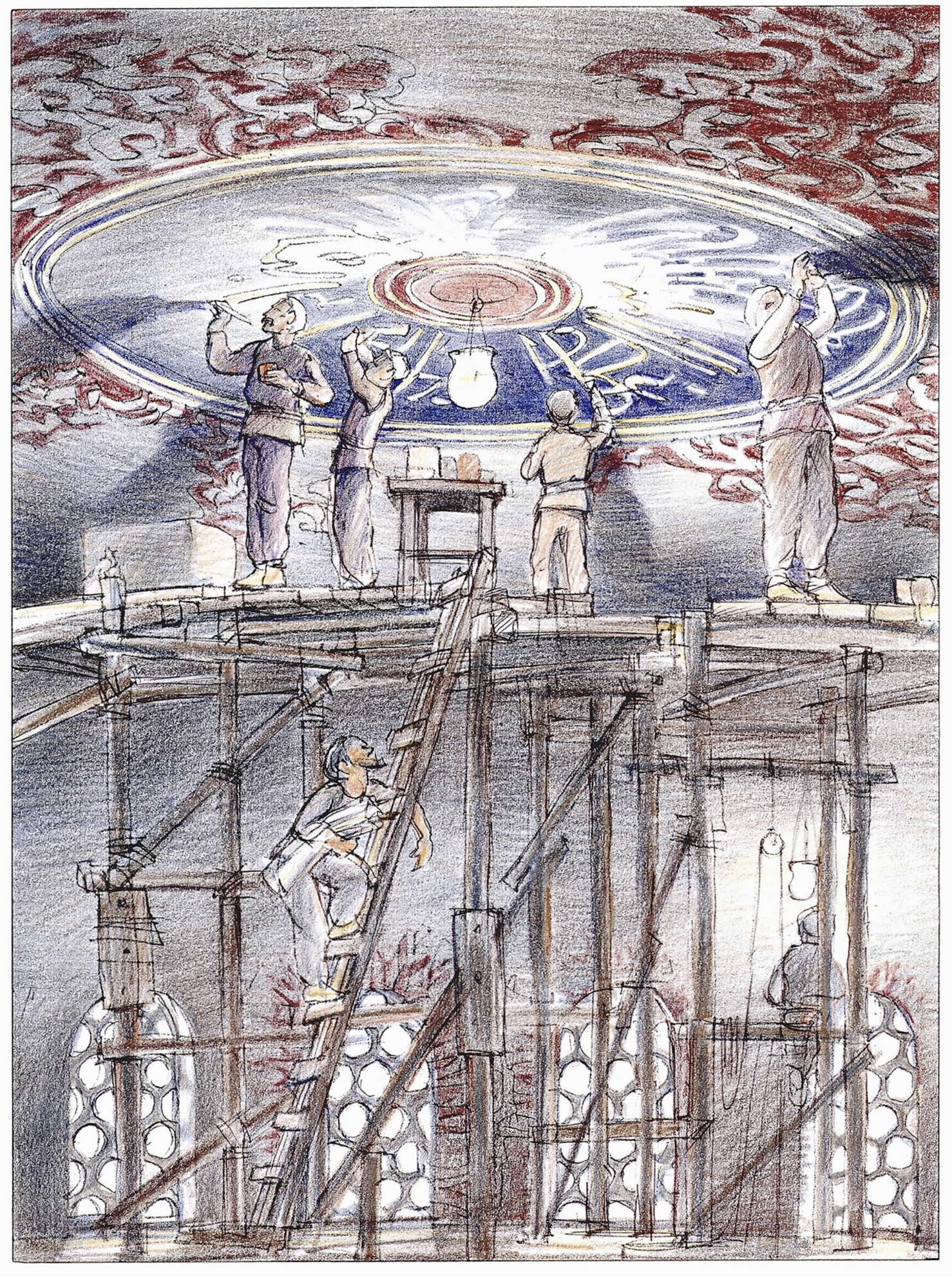
Completion of the construction of the main dome was followed by the finishing of the interior surfaces with plaster, and then with elaborate paint work, which of course involved the need for scaffolding and platforms.

Macaulay then provides two evocative interior views of the finished interior of the mosque, and from two unique perspectives.

These drawings and my primary focus upon the dome aspect of this hypothetical mosque project provide just a hint of the richness to be found in this evocative book. Though it may appear to be a ‘picture book’ intended for middle school students, it is actually a rich source of information for adults who wish to become familiar with the basic elements of historical mosque architecture, and the construction methods used to produce such buildings in the early Ottoman period. In addition to the highly instructive drawings, the glossary at the back of the book is also of significant value.

As readers might guess, I highly commend this book.


St John the Divine – A Building and a Gospel


In the summer of 1974, I left my Massachusetts prep school as one of the few graduates not intending to go on to college. I moved to Manhattan in a youthfully naive venture to try and replicate an aspect of the life of my hero, Frank Lloyd Wright. I wanted to follow his career path of eventually obtaining architectural licensing through practicing in the field, something that was and may still be possible.

Unfortunately, as a career move this was at an improvident time, largely due to what was then called “the oil crisis,” and its effect upon the economy. No architectural office was hiring beginning draftsmen, and some were taking on licensed architects to do the kind of basic drafting work for which I wanted to be hired. The former Frank Lloyd Wright associate, Edgar Tafel, was most gracious in allowing me to come to his New York City office for an interview and then by how he tolerantly responded to my youthful exuberance and evident lack of preparedness for the work. Philip Johnson was less patient with me. When I managed somehow to reach him by phone, he said, “Look – I don’t do the hiring around here. Talk to my associate!”

I had found a room a block and a half from the Cathedral of St. John the Divine, which was a prominent local landmark and soon became a welcome place to visit. Only years later did I discover that the house in which I had been able to rent my room, the former Alpha Delta Phi fraternity house, on 114th St, opposite the Columbia University Library, was where Thomas Merton had lived when he was a student there.

I would walk over to St. John’s, an alluring place to stop and rest. Now, at this point in my life, I would say it was ‘to pray.’ But I would not have said that then. Yet, as one beautiful phrase in The Book of Common Prayer Catechism puts it, “Prayer is responding to God.” Those are profound words. If taken seriously, we can recognize how many, many people in this world ‘respond to God,’ quite spontaneously and quite naturally – and aside from doctrine or ritual.

The magnificent space and architectural achievement of the unfinished cathedral of St. John the Divine was a profoundly converting space for me, in ways I did not realize then, and in ways that would not really make sense to me until much later.

Drawn to this place, absorbed with my intuitions about its architecture, and visiting frequently with inquiries, I volunteered to become a docent, a kind of tour guide for visitors before places like this cathedral became commercially oriented, leading to the charging of fees and the like. In the process of my time as a guide, I learned many arcane and obscure things, among them the size and height of the granite columns surrounding the main altar (54’ tall, 6’ in diameter); the number and architecturally significant variations among the chapels adjacent to the ambulatory surrounding the apse that encloses the high altar; as well as significant features of other side chapels in addition to the crypt.

If you had asked me then about the nature of my interest in that building, I would have said it was purely of architectural significance. Ask me now and I will tell you that I was seeking a closer experience of what St John the Divine shares with us in his Gospel. I was – as we say in a paradoxical way – unconsciously looking for God. But what I was really looking for, as we all do, is the experience of being found… and of feeling found, by God.

I think it is also providential that my year in New York, and the brief time I served as an occasional volunteer guide at the Cathedral, was when Canon Edward West was Sub-Dean, and Madeleine L’Engle was officially the cathedral librarian. I may have had only passing contact with either of them, but both were exemplars of how the arts may draw people into a more direct experience of what our Christian faith is all about. The Cathedral of St. John the Divine has represented this vision and value for decades.

Where St. John the Divine as a building nurtured my nascent spiritual awareness, the Gospel given to us through St. John the Divine, and the hymn-poems in his Revelation, have been for me a key, a doorway, and a beckoning gateway into a greater fullness of life.


The Architecture of Sacre Coeur in Paris

If reading this by email, please tap the title at the top to open your browser for the best experience. Then, clicking individual pictures will reveal higher resolution images.


This past weekend, we had the opportunity to watch the men’s and women’s Olympic long distance cycling events, involving 80-90 riders. After multiple hours, these races took them from outside of Paris back into the city. The telecasts of the races highlighted the latter segments, which included the challenging ascents to Montmartre, as the participants sped their way through and past the large crowds gathered on the hillside surrounding the church of Sacre Coeur. As they did, race commentators noted that the church is said to be Paris’s second-most visited tourist site after the Eiffel Tower.
With its soaring lines and its location on one of the tallest elevations in Paris, along with its stone surfaces, Sacre Coeur may remind us of some medieval European cathedrals. Despite its historic appearance it is a relatively modern building. Construction began in 1875, and concluded in 1914. What first strikes many viewers is the building’s structural emphasis upon height, reminiscent of Gothic predecessors, which is accentuated by its notably elongated or stretched rather than hemispherical domes (as is evident in the drawing above).

What is unique about this building is its homage to the Greek Cross plan, including its Romanesque arches. These features recall the general design of Constantinople’s great church, Hagia Sophia, and the common pattern for Islamic mosque architecture subsequently derived from it. Sacre Coeur’s Greek Cross plan is also reminiscent of Venice’s medieval basilica of San Marco. Roughly contemporary with Sacre Coeur, is H.H. Richardson’s evocative Trinity Church in Boston (1872). Like Trinity Church, Sacre Coeur’s design has been described as neo-Byzantine (as well as Romanesque), and the label fits specifically in connection with the historical precedents of Christian and Islamic origin just mentioned. Sacre Coeur’s design-dependence upon this history is most evident by studying the drawing provided below.

The above rendering of the floor plan of Sacre Coeur is vital for appreciating how this church building is as characteristic of the Christian East as it is of the West. The key point to observe involves the inner four columns that support the large central dome, and the four smaller domes on the peripheral corners that encompass the central square. These smaller domes as well as the huge principal one are suggested in the floor plan by the patterns of concentric circles adjacent to the four columns.

Between the domed spaces we find four rectangular areas of space that parallel one another in size, forming the arms of the Greek Cross. Like mosques geographically oriented along an axis directed toward Mecca, Christian churches traditionally are oriented with the altar on the eastern or sunrise side of the building, in honor of the Resurrection. Yet, due to the chosen site for a new church, the structure might have its chancel and altar on the north side of the building, as is the case with Sacre Coeur.

The apse, or altar area of Sacre Coeur is indicated in the above drawing by the Latin cross-shaped floor pattern. It is mirrored in length by the entrance portico, shown in the lower portion of the drawing. The semi-circular chapels surrounding the apse and its altar reflect an homage to Western and Latin medieval Gothic precedents. In Western, Gothic-inspired church architecture, the placement of these chapels is thought to represent the thorn of crowns placed on Christ’s head.

The choir or chancel at the liturgical ‘east’ side of the church

The remarkable ceiling mosaic over the choir

Another distinctively ‘Eastern’ feature of this building is its adornment with mosaics, and principally by the vast mosaic covering the ceiling over the chancel and choir, above the main altar. Designed by the noted painter, Luc-Olivier Merson, whose Annunciation painting I have previously featured, the mosaic is composed of some 25,000 ceramic tiles, many of which are gilded. With this church dedicated to the Sacred Heart of Jesus, it is not surprising to see the Lord depicted with outstretched arms and the golden namesake of the building emblazoned on his chest. Yet, even with this distinctively Western motif, the mosaic recalls the frequent choice in the East to portray Christ the Pantocrator, or the Almighty, in a mosaic or painting on the surface of a principal dome or semi-dome in a church.

I admit to this. Sacre Coeur in Paris has in the past looked to me like a Disney park caricature of a grand, historically classic, stone church. Having studied the plan and its design with more attention, as well as learning more about the original architect and about many of its details, I have a heightened appreciation for this remarkable and liturgically conducive building.


Finding Beauty in the Most Unexpected Places

If reading this by email, please tap the title at the top to open your browser for the best experience. Then, clicking individual pictures will reveal higher resolution images.

Actor Koji Yakusho portraying Hirayama looking upwards, in the film Perfect Days


An improbable premise underlies the remarkable film, Perfect Days, and it is displayed in two principal ways. A Tokyo public toilet cleaner has a positive attitude, even a cheerful spirit, as he approaches his daily routine of attending to places where other people leave their waste. And yet, the primary places where this man is lucky to work are the architecturally significant public toilets commissioned and built for the 2020 Tokyo Olympics. The film portrays these places well. Some have suggested that the architectural features of these structures may have inspired the movie’s production. Nevertheless, the film is centered upon one man’s approach to how he lives every day.

He is a man about whom we know only his surname, and we learn more about his daily routine than we do about his inner life. The latter, his interests and perhaps aspirations, are suggested by the books he reads and the music to which he listens while driving. Many scenes depict him at his work. But the film does this in ways that do not romanticize his occupation, while he is shown cleaning and polishing toilet bowls and seats, as well as sinks and other aspects of plumbing. The film skillfully negotiates the ambiguous terrain lying between a heroic portrayal of an apparently righteous man, and a sentimental celebration of an unreal figure.

A montage of some of the public toilets featured in Perfect Days

The approach to life epitomized by Hirayama in the film is one of contentment. He models someone who accepts the limitations presented by the contexts in which many of us live, and he displays an openness to unexpected moments of discovered and quiet beauty. The film is not overtly spiritual. Yet, these qualities may represent – to some Western viewers like me – compelling reflections of Japanese culture as it has been shaped by Buddhism.

Hirayama at work on a hobby, Bonsai

In addition to the overt paradoxes at the heart of the film – a happy toilet cleaner and beautiful public toilets – the film subtly presents other aspects of Japanese society that Western visitors might notice. In what may surprise many who are not of Japanese heritage, regarding a very private culture where people typically meet one another in commercial establishments rather than in personal dwelling places, public baths with full nudity are common. I experienced occasional visits to public baths in my youth, growing up in Japan.

Hirayama in the neighborhood bath house

And within the context of this very private culture, some Tokyo public restrooms were created with transparent glass walls, appearing to risk users to full disclosure (the glass walls magically become opaque when the doors are locked).

Three motifs or tropes in the film are memorable. Hirayama is portrayed as always looking up to the sky when emerging from his home in the morning on his way to work, and is also seen gazing upwards (as in the photo at the top of this post). This suggests that he unconsciously senses a connection with something bigger than himself, and this may be the source of his frequently displayed habit of smiling at others.

Another motif, surely related to the first, is the employment of black and white sequences that portray flickering images, usually of dappled sunlight glimpsed through tree limbs, which Hirayama captures with his old-fashioned film camera. Most often, he seems to take these photos during his lunch breaks in a local park. In relation to these images, the movie highlights the Japanese word, and concept, of komorebi, which in a single word expresses the idea of sunshine filtering through the leaves of trees overhead.

The third is the employment by the movie makers of the Sumida River in Tokyo, long celebrated in Japanese art, over which we see Hirayama cross while walking, driving, or biking. The river appears to symbolize a form of divide between the part of the city where his small apartment is located, and the more elegant commercial district where he usually works.

My favorite image of Tokyo’s Sumida River in art, a woodblock print by Kobayashi, Kiyochika ({1847-1915} name in traditional Japanese order)

These juxtapositions in Perfect Days of contrasting details, color versus black and white, and interior privacy and public life, along with the harmony in which they are presented, distinguish this film. To me, it is remarkable that this movie was made by a Western filmmaker, regardless of the assistance provided by Japanese colleagues. A studied sensitivity to what I know about Japanese culture is evident in the film’s portrayal of this fictional character in improbable circumstances, as it invites us to discover – along with Hirayama – beauty in the most unexpected places.

Hirayama, gazing upwards, holding his old-fashioned film camera