Author: Stephen Holmgren

I have been an Episcopal priest for thirty eight years, having served in parishes and in academia. My interests include art and theology, liturgy and spirituality, and I love to go sailing whenever I can.

Japanese Thatched Roof Farm and Country Houses

If reading this by email, please tap the title at the top to open your browser for the best experience. Then, clicking individual pictures will reveal higher resolution images.

 

Those who watched the Winter Olympics broadcast from Nagano, Japan, may have gained some familiarity with a region sometimes referred to as the Japanese Alps. While living in Japan, my parents developed a deep interest in Japanese folk art (Mingei). Through this, they became acquainted with Sanshiro Ikeda, a recognized authority on Mingei, who built craft furniture. Through our trips to Nagano-ken (or prefecture), we visited Ikeda’s small furniture factory and the country farm house he had restored, and in which he lived. Through these visits, we became familiar with Matsumoto, its beautiful many hundred year old castle, and the surrounding Nagano countryside. My strongest memory, though, is of Ikeda’s restored traditional farmhouse, and those like it in the area.

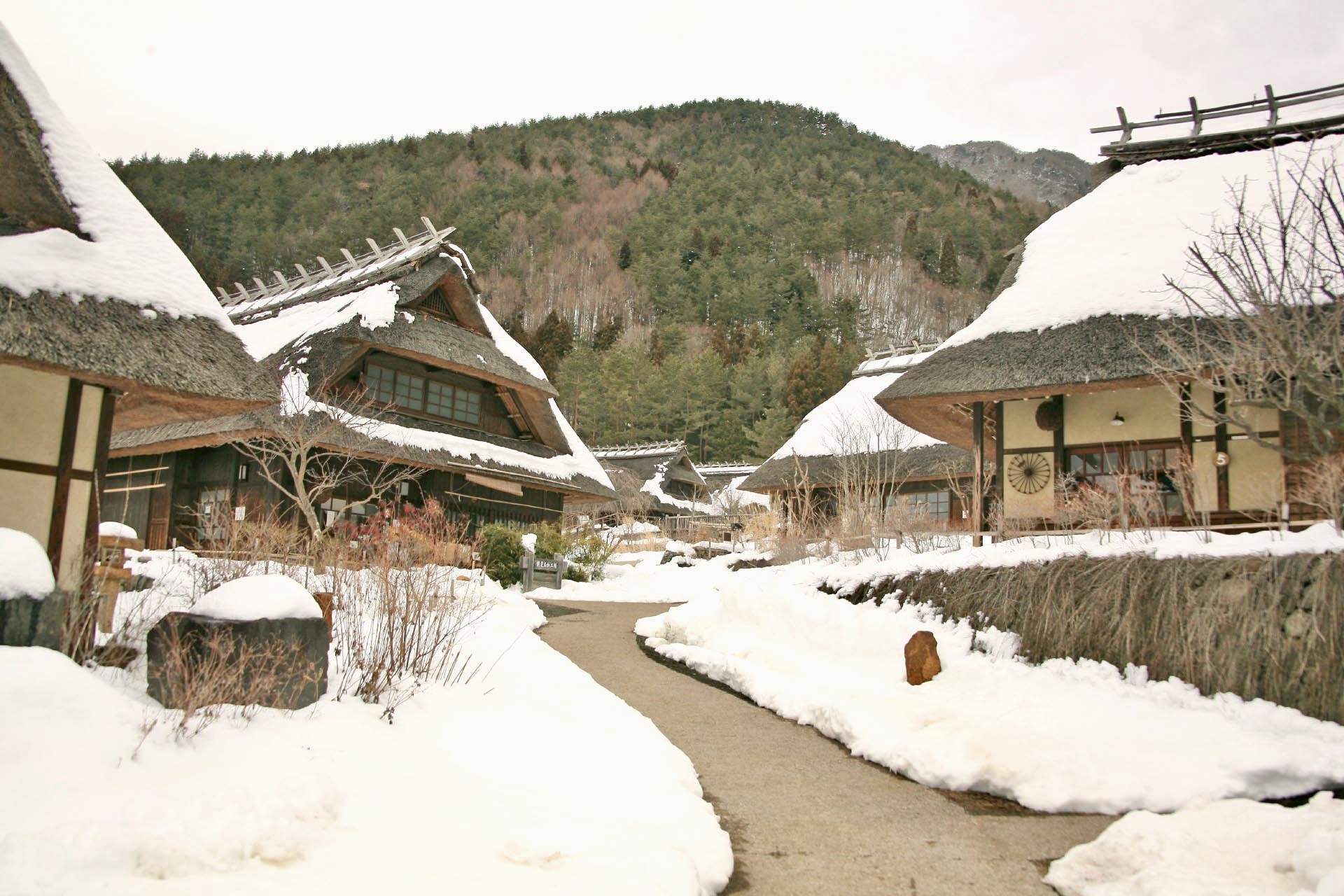
The choice of Nagano prefecture as a location for the Winter Olympics was based on the fact that that region regularly receives a good deal of snow. As a consequence, the historic pattern for the design of farm and country houses involves very steep roofs which are quite often thatched. The combination of these two characteristics in the resulting roofs renders them amenable to heavy snow loads, which also help provide additional insulation against the seasonal cold weather.

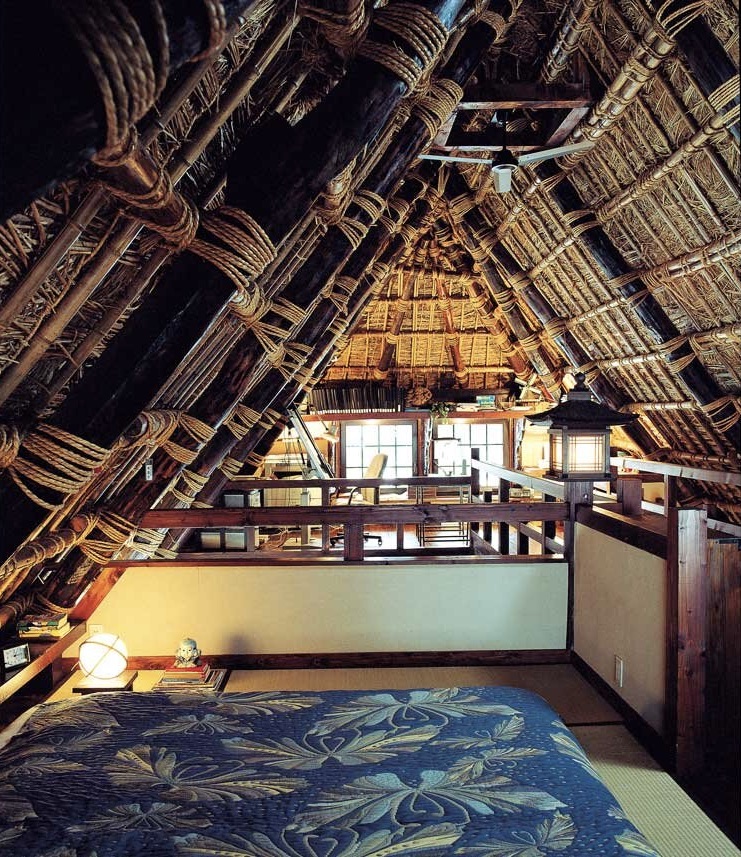
These farm and country houses are typically built from wooden posts and beams, with plaster or stucco walls, and wooden plank floors if not otherwise covered with tatami mats made of straw and rice husks. The equivalent of what we refer to as rafters, and the lath cross pieces or straps supporting the thatched roof material, are typically beams made from tree branches or thick and thin pieces of bamboo, lashed together with rope, something that surely would not pass building codes for contemporary construction.

Traditional house with beams lashed together (above) and stucco walls above sliding shoji (lattice door and window panels), seen in the lower photo.

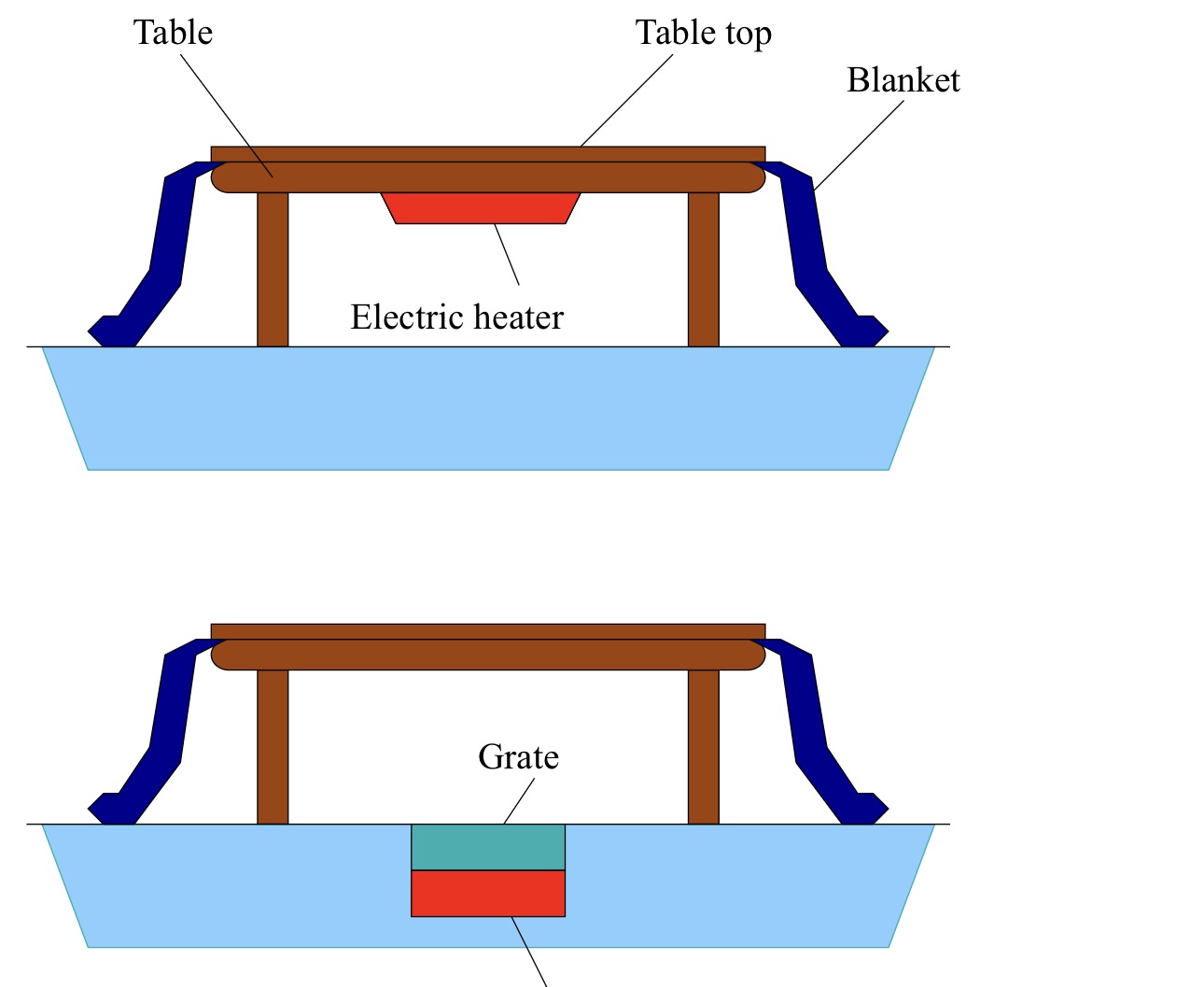
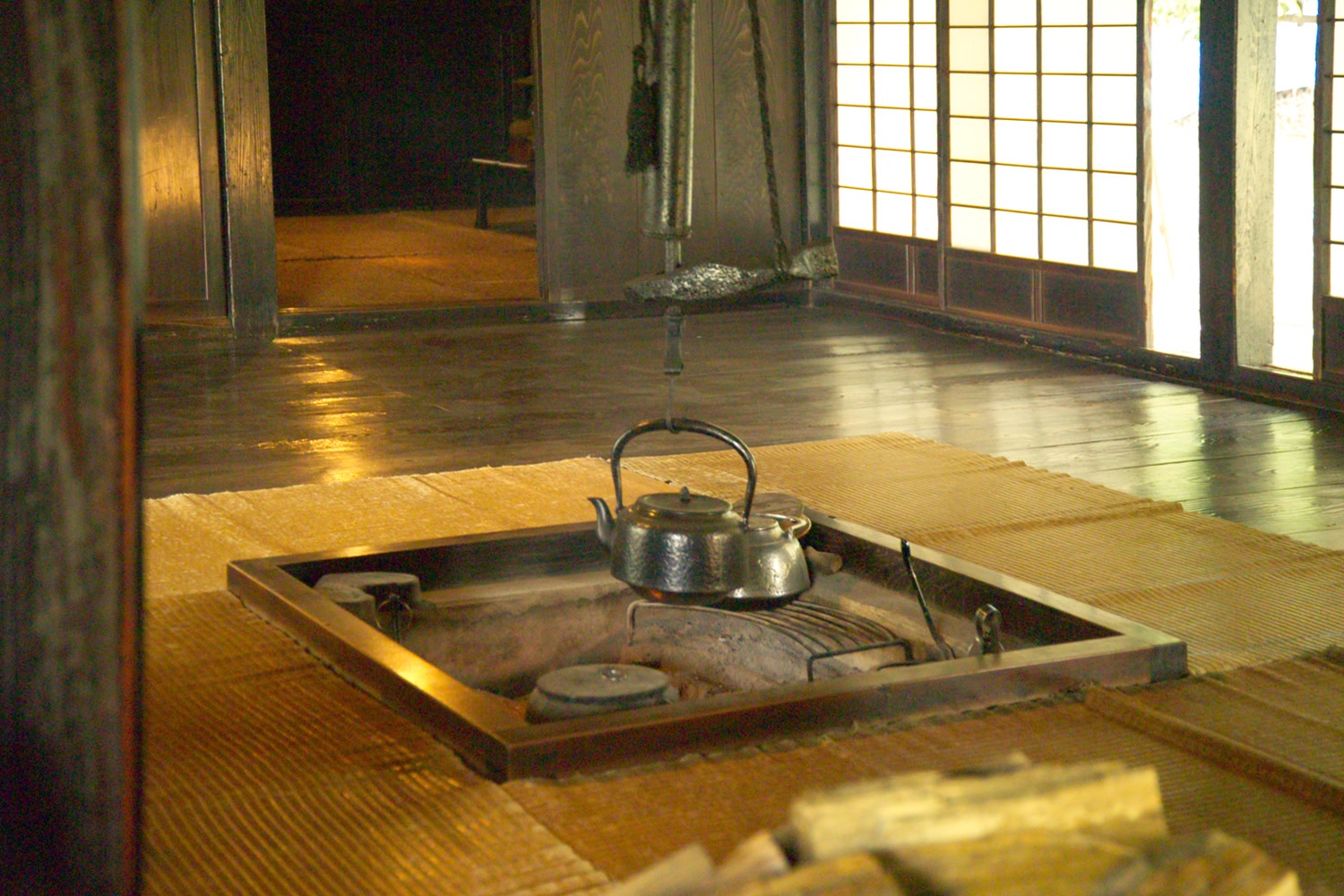
Instead of any form of central heating, generally unknown in Japan until modern times, many of the rooms on the ground floor would have a footwell in the floor, at the base of which traditionally there would have been a small charcoal brazier (charcoal kotatsu). Those in the room sitting on the floor, with their legs dangling in the footwell, managed to stay warm with the benefit of a small table over their thighs and knees, above the footwell, along with a lap blanket suspended from the low table.

A kotatsu blanket (with table top removed)

Kotatsu design (traditional charcoal and contemporary electronic patterns)

A similar but very shallow well-like indentation in the floor provided a place for cooking at the floor level.

Quite often these houses would feature one or two successively smaller floors above the ground floor in a way that will recall Western A-frame ski lodge houses. Typically, the sleeping areas would be on the upper floors with futon beds laid out on the tatami mats, thick quilts provided, and pillows stuffed with uncooked rice grains.

Interior of a traditional farmhouse showing a futon (or Japanese mattress), and a quilt covering, set above tatami mats.

Below, I am including a selection of photos of various examples of traditional Japanese country houses and related buildings, which demonstrate the consistency with which this approach to domestic architecture was adopted and practiced through the centuries. The first three photos show what appear to be contemporary structures built in the historic farmhouse style (followed by photos of historic structures).

The following photos feature historic structures.

The same village area (as in the photo above it) on a winter’s evening

The well-preserved historic examples of Japanese farm and country houses in the photos above, as well as the contemporary reproductions employing this historically-informed approach to domestic architecture, attest to the heightened appreciation that Japanese people have for their ancient culture. It may be that, as in some other parts of the world, the highly advanced technological developments characterizing the urban areas where most of their people now live, has nurtured a deep and latent regard for aspects of their nation’s social, artistic, and spiritual heritage.


Appreciating Chrysanthemums in Japan

If reading this by email, please tap the title at the top to open your browser for the best experience. Then, clicking individual pictures will reveal higher resolution images.

Ichimonji Kiku variety chrysanthemum – the basis for the Japanese Imperial Crest

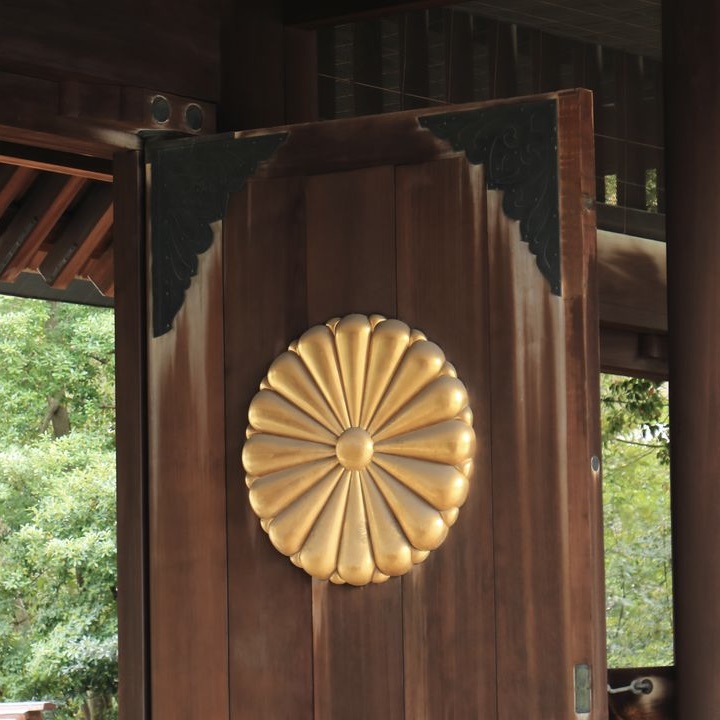
The chrysanthemum-based Japanese Imperial Crest, Yasukini Shrine, Tokyo, and on Japanese passports


Every year, in November, the residents of Tokyo are treated to the Kiku MatSuri flower show, the annual chrysanthemum exhibition featuring a most stunning display of flowering plants propagated by some of Japan’s most skilled gardeners and horticulturalists. Kiku is the Japanese common name for chrysanthemum (originally native to China), and matsuri is the Japanese word for festival. Geographically about 30 degrees north of the equator, Japan’s climate has some affinity with that of Louisiana, with hot humid summers, and occasional frosts and even a rare snow shower in Tokyo. Chrysanthemums appear to grow well in both regions.

A photo of the 1914 Kiku Matsuri (note how the gentleman wears a western hat with Japanese clothing and wooden sandals {geta})

In our country at this relatively same time of the year, we are used to seeing large containers of chrysanthemums, covered with abundant blossoms, offered for sale in displays outside large box stores and nurseries. Yet, they tend to be small blossomed plants, differing from one another usually only in terms of color. At the Kiku Matsuri festivals, many varieties of mums, some of them exotic-looking, are beautifully arranged for viewing in a very formal and traditional setting. Yushima Shrine in Tokyo often serves as a location for these displays.

Kiku Matsuri displays of mums outside Yushima Shrine, Tokyo (above and below)

I have strong and clear memories of walking around these remarkable chrysanthemum arrangements with my parents and brothers, and being astonished at the multi-blossomed plants with a wide spread of blooms, extending upwards from a single or a few stems.  One version of this practice is known as Sanbon-Jitate, which features three large blossoms grown from a single stem. Each of the blossoms is symbolic, and represent the heavens, the earth, and humankind (as in the image below). Yet, clearly, all of the chrysanthemums on display at these annual festivals are in one way or another carefully and labor-intensively grown.

Atsumoto Kiku variety of mums (above), grown and featured in Sanbon-Jitate arrangements

The above bonsai, featuring miniature blossoms, provides another example of labor-intensively grown chrysanthemums

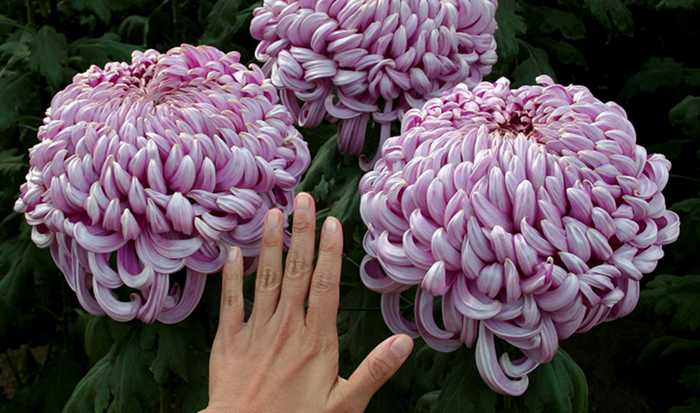
The Atsumoto Kiku variety of chrysanthemum (featured further above, and in the photos below) is a classic Japanese form of the plant, with its dense and thick blooms. This variety is propagated in many colors, among which the most beautiful may be the two colored Tomoenishiki variety.

Other examples of the Astumoto Kiku variety are shown below.

Another very attractive variety of Japanese kiku (or mums) is the Kudamono Kiku, known in English by the common name, spider mum, shown in the images seen below.

The propagation and cultivation of chrysanthemums in Japan by skilled gardeners reflects the highly refined aesthetic vision possessed and valued by many of the nations artisans, and by the wider society in which they live and practice their craft. The delicacy and exquisite beauty of many of these flowers, and yet the transitory nature of their flowering, speak to a cultural appreciation for what can be apprehended and enjoyed in the present moment, much like the way in which Japanese people (and foreign visitors) will in great numbers visit shrines, temples, and castle parks in the springtime to view the cherry blossoms.

Seeing these photos reminds me of the diligent care with which many Japanese gardeners, artists, and craftsmen engage in a lifelong pursuit of aesthetic perfection in a single area of practice, whether it is in propagating new forms and elaborate displays of chrysanthemums, throwing clay pots, writing in caligraphy, or seeking to make the most beautiful and durable sword. Though in each case individuals pursue the practice, it always seems to be in the context of a guild or society of fellow practitioners, and always with a significant degree of community awareness of the importance of this or that art for the wider society in which the practice of it is engaged.

Small and edible chrysanthemum blossoms added as a garnish to sashimi (traditional Japanese raw fish)


From Dream to Reality: Michael Pollan and His Writing House

If reading this by email, please tap the title at the top to open your browser for the best experience. Then, clicking individual pictures will reveal higher resolution images.


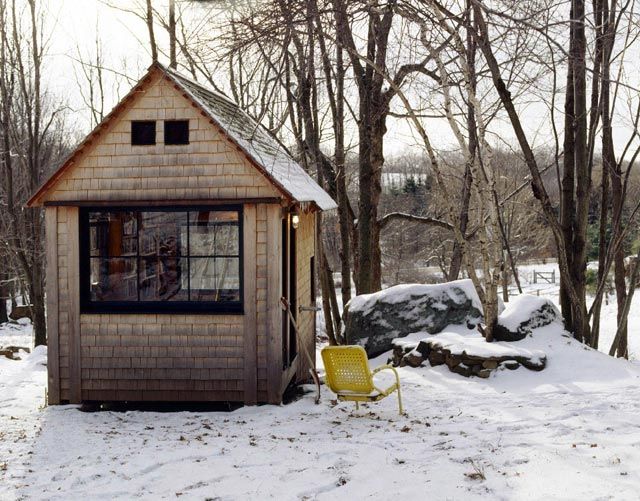
In an updated preface to his book, A Place of My Own: the Architecture of Daydreams, Michael Pollan laments how some readers approach his book expecting something like a “how to” guide to building their own writer’s hut or shack. Though he does provide a wealth of detail concerning the construction methods he used, the book’s richness lies in its thoughtful engagement with the idea of human shelter and its function in architecture. Of particular note is the attention he gives to the French writer, Gaston Bachelard, whose book, The Poetics of Space, prompts a good deal of reflection by Pollan. The author quotes Bachelard with words that obviously inspired the subtitle of A Place of My Own: “I should say: the house shelters daydreaming, the house protects the dreamer, the house allows one to dream in peace.”

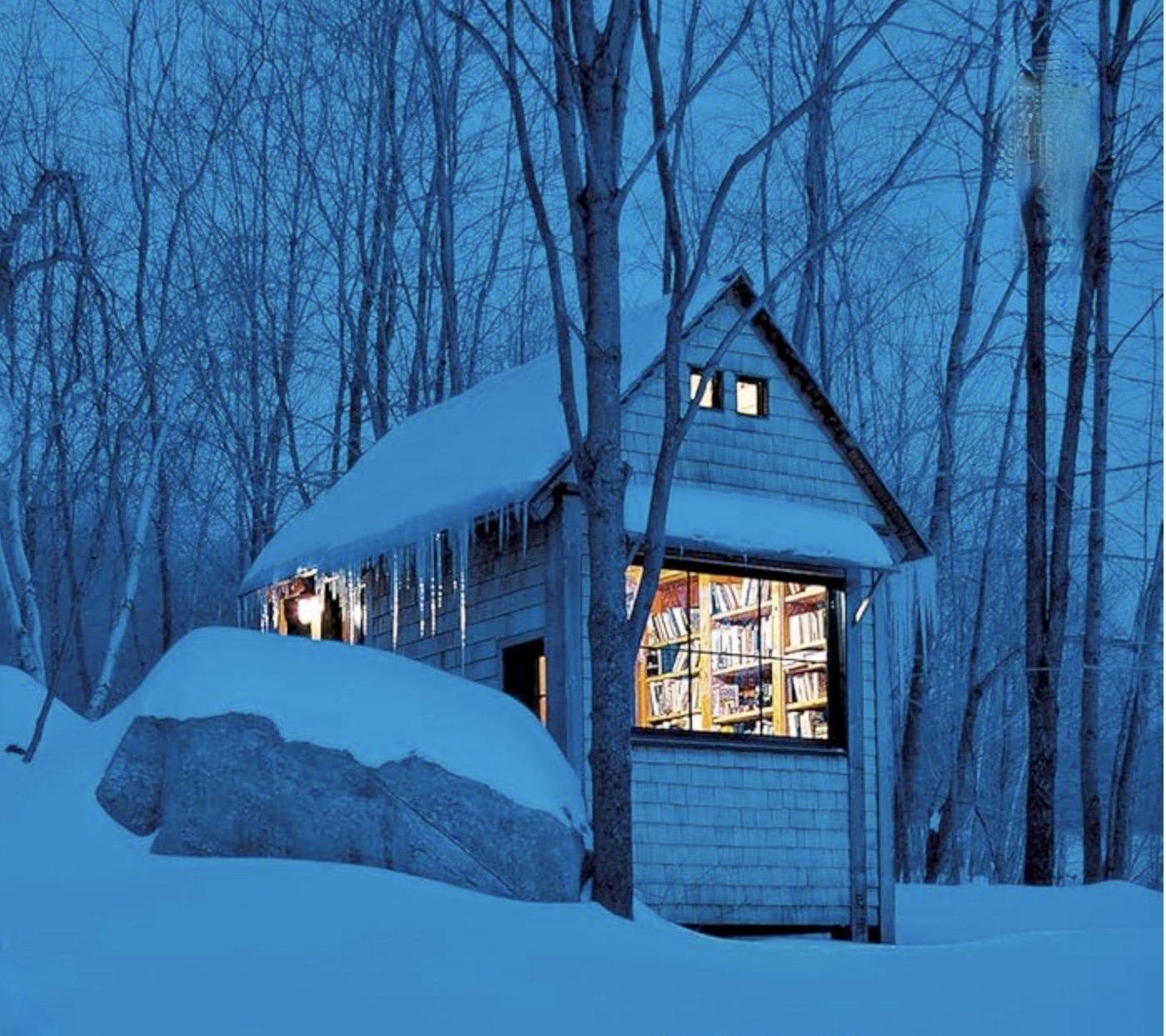
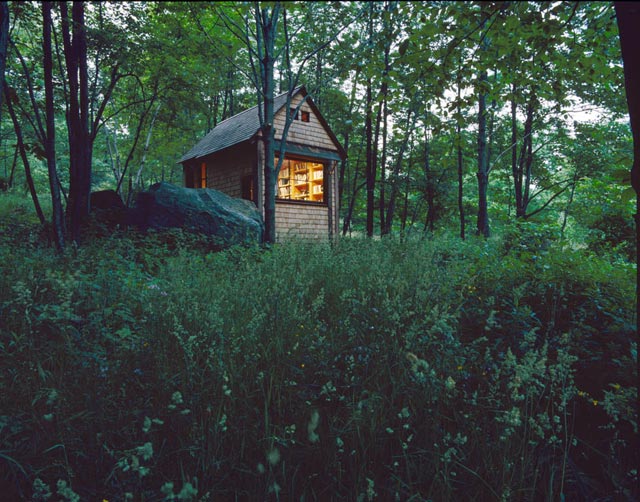
Michael Pollan dreams of building and inhabiting what we might call his own writer’s studio in the woods behind his Connecticut home. As he muses about its possibilities, he considers potential designs in dialogue with his chosen site for the small building. From a book by the English geographer, Jay Appleton, he gleans the insight that ideal human shelters provide two dialectically interconnected values, ‘prospect’ and ‘refuge.’ A shelter conducive for human flourishing provides both the opportunity to view and appreciate one’s surroundings while at the same time providing a secure resting place. Achieving these twin goals becomes one of Pollan’s priorities for his little writing hut.

At the same time, while embarking upon this project to build his place for writing, he acknowledges that the endeavor also provides the occasion for him to examine the idea of architecture, and its contemporary role in Western society. He discovers – through a gift subscription to Progressive Architecture magazine – that the field has increasingly become focused on the exploration and expression of ideas, leaving behind a principal focus upon providing beautiful yet practically useful spaces and structures for human habitation and work.

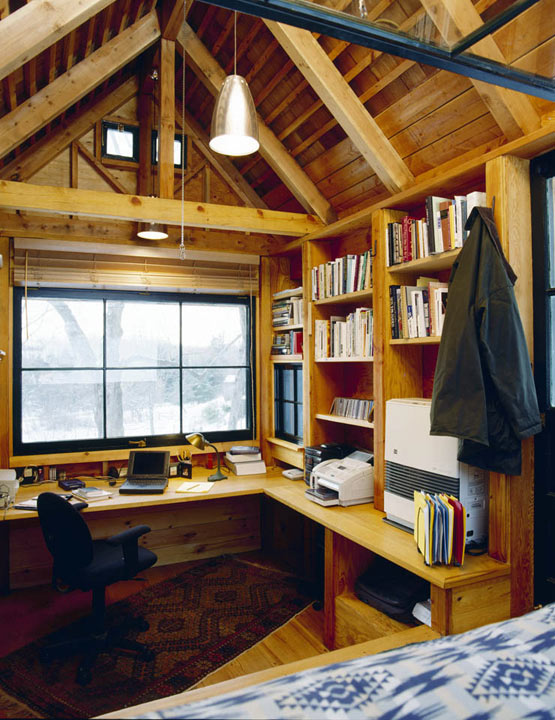
The interior of Michael Pollan’s writing house (note the daybed in the foreground)

Pollan realizes that what he wants to build is not something that points to something else, or to a set of ideas and concepts (as is the case with some contemporary practitioners in the field of design). Instead, he wants a structure that he can use for everyday work, for reading, and as a place where occasionally he can have a nap. With his aversion to the little building becoming an artistic statement rather than something truly useful, Pollan’s book reminds me of a principal theme in Tom Wolfe’s splendid little book, From Bauhaus to Our House.

Especially in the first two chapters, Michael Pollan offers a set of thought provoking and historically informed reflections on the nature and purpose of architecture, which are shaped in a writerly way. As much as I was drawn to the concrete aspects of his project – as in his account of his search for the ideal design of the window through which he would look while writing – I found his engagement with the theoretical aspects of the project to be very compelling. A good example of the latter is his reflection on our conscious experience of form and pattern in buildings, and our unconscious experience of the spaces we encounter and through which we move. Other examples include the role of feng shui in his selection of a site for his project, as well his explanation of the function of the Golden Section (or Divine Proportion, 1/1.618) in deciding the parameters of the rectangle for his floor plan.

Most of all, I appreciate Pollan’s delineation of the difference between the 20th century modernist or International Style approach to architecture, which abstractly stressed universality of form and consistent design elements regardless of a building’s context, with the architecture of someone like Frank Lloyd Wright, who focused on the connection between his buildings and their location within their chosen sites and his intentional employment of local materials. Pollan offers an insightful two-columned table to illustrate the difference between the two, with the first (stressing universality) labeled, “There,” and the second (stressing locality) labeled, “Here.”

All in all, he has given us a finely written book.


David Macaulay and Mosque Architecture

If reading this by email, please tap the title at the top to open your browser for the best experience. Then, clicking individual pictures will reveal higher resolution images.


Recently I became reacquainted with a book I discovered some years ago, by an author whose work I greatly admire – David Macaulay. It is his book on Islamic mosque architecture, based on a historically informed but fictional mosque erected in Istanbul in the 16th century. Macaulay’s great skill lies in his ability to provide the reader with insights gained from his use of drawing with pen and ink, frequently with color overlaid, in such a way as to unfold the often complex inner structure of the buildings he wishes to explore and explain. For a primer on traditional mosque design and construction, complete with a glossary of terms, the book is invaluable.

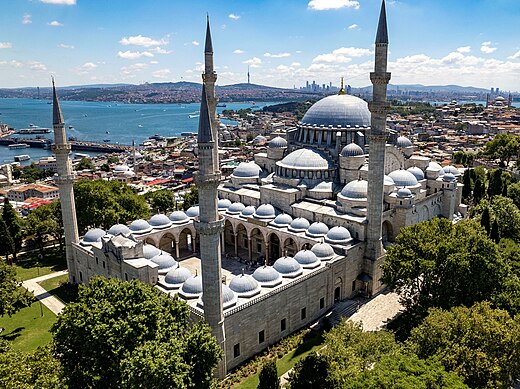
The project featured in this book is a mosque commissioned by Suha Mehmet Pasa, a fictitious high official in the early Ottoman period who engages in a charitable act inspired by his Islamic faith and the five pillars of Islam (faith, prayer, charity, fasting, and pilgrimage). He funds the design and construction of a complex of buildings that includes both a grand mosque and its accompanying courtyard and related structures, as well as a mausoleum for himself upon his death. The influence of the historical architect, Mirmar Sinan, as well as Sinan’s breathtaking Süleymaniye Mosque in Istanbul (depicted below), are plainly evident in Macaulay’s composition of the book.

Because of my own fascination with domes incorporated within mosque architecture, I will focus here on that aspect of Macaulay’s book, though he provides a comprehensive account of the construction of almost every feature of a traditional mosque from the early Ottoman period. I find most helpful the following diagrammatic illustration of the basic building components which together support the dome on such a mosque as the Süleymaniye Mosque, featured in a prior post.

The above illustration corresponds to the following floor plan for the same hypothetical structure.

Now, how did that imaginary 16th century architect, his masons and carpenters, manage to build the magnificent dome featured in this project, and as we find in the actual Süleymaniye Mosque? Macaulay unfolds the mystery with a series of instructive drawings that give us insight into the process. Once the proper height of the walls and support piers was attained, a semi-circular structure of wood was constructed to provide the proper curvature of the intended dome (as seen below).

This structure was then lifted up and placed upon a kind of spindle, so that it could revolve horizontally around the perimeter of what would become the brick structure of the dome.

With the rotation of this semi-circular wooden form, the builders could stack up the bricks according to the intended proper curvature of the inside of the dome, while allowing the exterior of the dome to be wider at its base, for greater strength and stability.

A final step in the construction of the main and other domes was the preparation of sheets of lead, cut in precise patterns so that they would sheath the dome with a series of overlapping panels, to avoid water intrusion:

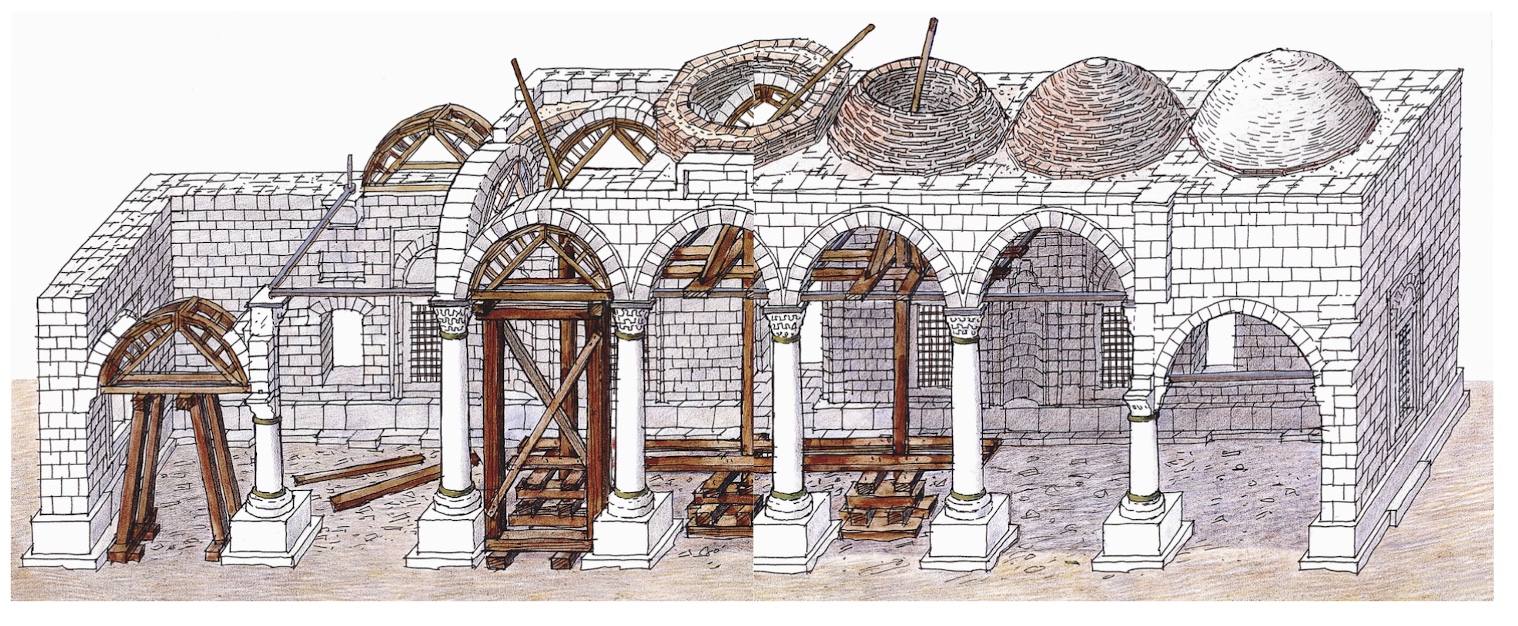
The smaller domes covering areas of the courtyard and entrance portico were constructed in a similar fashion, but on a smaller scale, as seen in the following illustrations. A simple swinging pendulum-like wooden arm was employed rather than the more elaborate semi-circular structure used for the large main dome.

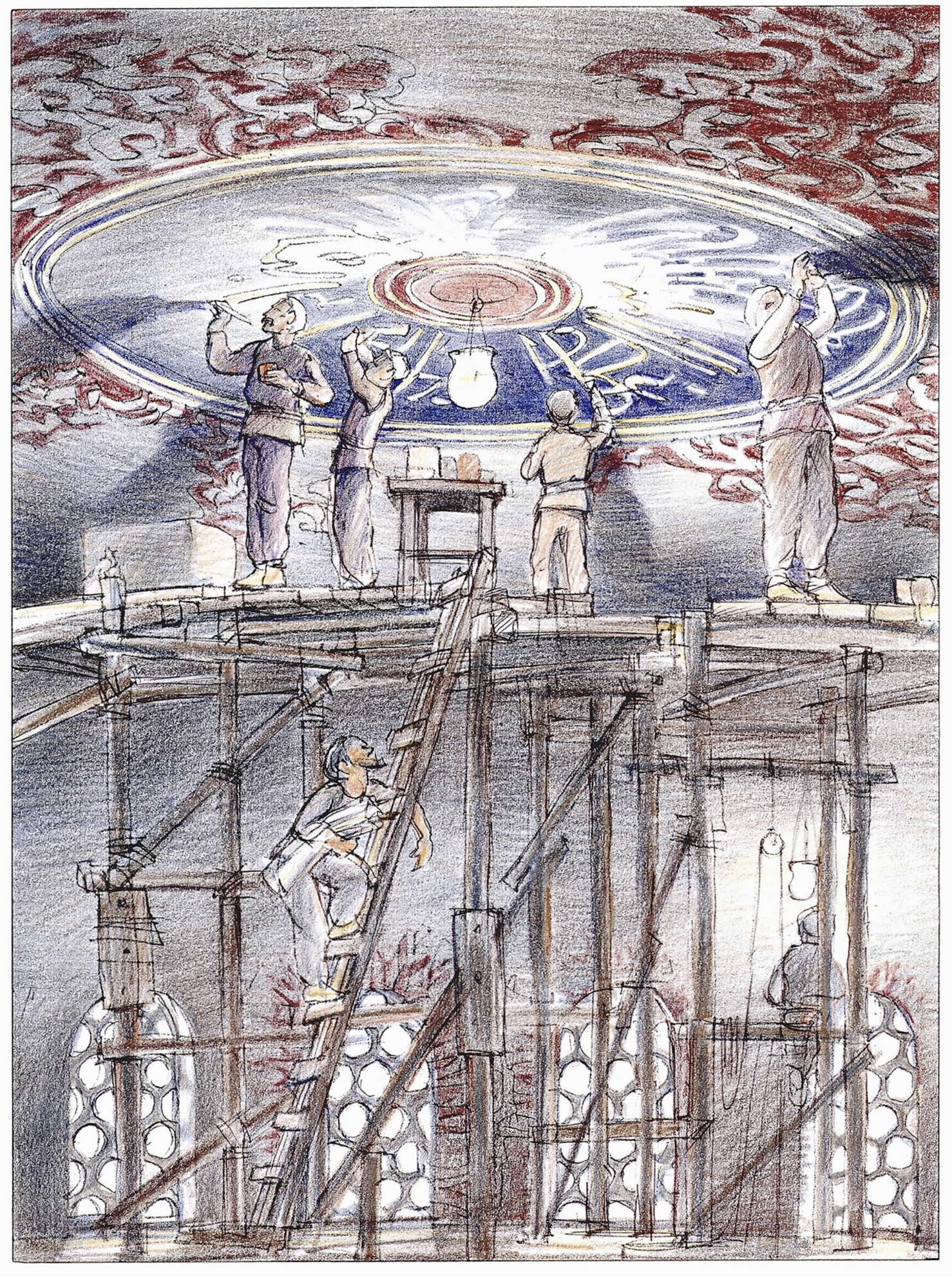
Completion of the construction of the main dome was followed by the finishing of the interior surfaces with plaster, and then with elaborate paint work, which of course involved the need for scaffolding and platforms.

Macaulay then provides two evocative interior views of the finished interior of the mosque, and from two unique perspectives.

These drawings and my primary focus upon the dome aspect of this hypothetical mosque project provide just a hint of the richness to be found in this evocative book. Though it may appear to be a ‘picture book’ intended for middle school students, it is actually a rich source of information for adults who wish to become familiar with the basic elements of historical mosque architecture, and the construction methods used to produce such buildings in the early Ottoman period. In addition to the highly instructive drawings, the glossary at the back of the book is also of significant value.

As readers might guess, I highly commend this book.


Jesus and The Beauty of Emotional Intelligence


As a hurricane is bearing down upon us, potentially upending some patio furniture, I think back to some words I first published in 2018. The Gospel reading this past Sunday at church reminded me of what first prompted these thoughts. Here is part of that reading:

Jesus set out and went away to the region of Tyre. He entered a house and did not want anyone to know he was there. Yet he could not escape notice, but a woman whose little daughter had an unclean spirit immediately heard about him, and she came and bowed down at his feet. Now the woman was a Gentile, of Syrophoenician origin. She begged him to cast the demon out of her daughter. He said to her, “Let the children be fed first, for it is not fair to take the children’s food and throw it to the dogs.” But she answered him, “Sir, even the dogs under the table eat the children’s crumbs.” Then he said to her, “For saying that, you may go—the demon has left your daughter.” So she went home, found the child lying on the bed, and the demon gone.

In this part of Mark’s Gospel, we hear a story about Jesus’ encounter with a Canaanite woman. It is easy to overlook a critical aspect of this story ~ the fact that Jesus chooses to travel to an area populated by Gentiles. There, he is confronted by a woman who for two reasons is ‘an outsider’: she is not an Israelite, and her daughter has a demon.

By overlooking Jesus’ choice to travel to Gentile territory, it then becomes easy to mishear a vital aspect of this Gospel reading. It’s Jesus’ willingness to be playful —even dangerously playful — as he enlarges our concept of God’s Kingdom. Some contemporary commentators don’t recognize this about Jesus’ journey into the region of Tyre. For they view it as a story about how a Gentile woman enlarges Jesus’ concept of the Kingdom. This follows from the way modern theologians stress the humanity of Jesus over his divinity. In other words, ‘how he was like us’ comes to overshadow ‘how he was different from us.’

This is especially true with our understanding of intellect. We associate ‘intelligence’ with skills like computing numbers and remembering information. Yet, the key to this Gospel story may lie in something different, in what is called “emotional intelligence.” Emotional intelligence is relational, and involves feelings, character, and temperament. It depends on maturity, and relies on insight about what enhances or hinders well-functioning community. When we overlook these fuller dimensions of ourselves, we limit our concept of what it means to be human.

Think, for example, about humor. We assume humor depends on being witty, and making fun of people and situations. We forget that we also deal with serious things through humor. Humor approaches life indirectly, from the side, instead of straight-on. In medieval times, Christians actually debated whether Jesus ever laughed! We know he wept, but Scripture never records Jesus as laughing. Surely, we can see beyond this narrow assumption that Jesus never laughed or spoke with irony and humor.

Appreciating how Jesus uses playful humor helps us understand his interaction with the Canaanite woman, and how he is compassionate rather than rude in speaking with her. The story displays the beauty of his emotional intelligence instead of a limitation in his perception of his vocation.


This post is based on a homily I offered on Sunday, September 9, 2018. The Egyptian Arabic manuscript illustration above is credited to Ilyas Basim Khuri Bazzi Rabib (1684).

St John the Divine – A Building and a Gospel


In the summer of 1974, I left my Massachusetts prep school as one of the few graduates not intending to go on to college. I moved to Manhattan in a youthfully naive venture to try and replicate an aspect of the life of my hero, Frank Lloyd Wright. I wanted to follow his career path of eventually obtaining architectural licensing through practicing in the field, something that was and may still be possible.

Unfortunately, as a career move this was at an improvident time, largely due to what was then called “the oil crisis,” and its effect upon the economy. No architectural office was hiring beginning draftsmen, and some were taking on licensed architects to do the kind of basic drafting work for which I wanted to be hired. The former Frank Lloyd Wright associate, Edgar Tafel, was most gracious in allowing me to come to his New York City office for an interview and then by how he tolerantly responded to my youthful exuberance and evident lack of preparedness for the work. Philip Johnson was less patient with me. When I managed somehow to reach him by phone, he said, “Look – I don’t do the hiring around here. Talk to my associate!”

I had found a room a block and a half from the Cathedral of St. John the Divine, which was a prominent local landmark and soon became a welcome place to visit. Only years later did I discover that the house in which I had been able to rent my room, the former Alpha Delta Phi fraternity house, on 114th St, opposite the Columbia University Library, was where Thomas Merton had lived when he was a student there.

I would walk over to St. John’s, an alluring place to stop and rest. Now, at this point in my life, I would say it was ‘to pray.’ But I would not have said that then. Yet, as one beautiful phrase in The Book of Common Prayer Catechism puts it, “Prayer is responding to God.” Those are profound words. If taken seriously, we can recognize how many, many people in this world ‘respond to God,’ quite spontaneously and quite naturally – and aside from doctrine or ritual.

The magnificent space and architectural achievement of the unfinished cathedral of St. John the Divine was a profoundly converting space for me, in ways I did not realize then, and in ways that would not really make sense to me until much later.

Drawn to this place, absorbed with my intuitions about its architecture, and visiting frequently with inquiries, I volunteered to become a docent, a kind of tour guide for visitors before places like this cathedral became commercially oriented, leading to the charging of fees and the like. In the process of my time as a guide, I learned many arcane and obscure things, among them the size and height of the granite columns surrounding the main altar (54’ tall, 6’ in diameter); the number and architecturally significant variations among the chapels adjacent to the ambulatory surrounding the apse that encloses the high altar; as well as significant features of other side chapels in addition to the crypt.

If you had asked me then about the nature of my interest in that building, I would have said it was purely of architectural significance. Ask me now and I will tell you that I was seeking a closer experience of what St John the Divine shares with us in his Gospel. I was – as we say in a paradoxical way – unconsciously looking for God. But what I was really looking for, as we all do, is the experience of being found… and of feeling found, by God.

I think it is also providential that my year in New York, and the brief time I served as an occasional volunteer guide at the Cathedral, was when Canon Edward West was Sub-Dean, and Madeleine L’Engle was officially the cathedral librarian. I may have had only passing contact with either of them, but both were exemplars of how the arts may draw people into a more direct experience of what our Christian faith is all about. The Cathedral of St. John the Divine has represented this vision and value for decades.

Where St. John the Divine as a building nurtured my nascent spiritual awareness, the Gospel given to us through St. John the Divine, and the hymn-poems in his Revelation, have been for me a key, a doorway, and a beckoning gateway into a greater fullness of life.


A Beautiful Holy Place: San Marco, Venice

If reading this by email, please tap the title at the top to open your browser for the best experience. Then, clicking individual pictures will reveal higher resolution images.


A city and its cathedral, San Marco, are built upon low-lying islands and saltwater marshes. From its earliest history, Venice has contended with the sea. But in recent times, the municipality and its basilica have continued to suffer from sinking land and high waters, much to the grief of those who love this historic place. This emerging geographical tragedy is of world-wide significance, and begs for sensitive and imaginative responses. I can only offer a personal spiritual witness.

For it is one of the most beautiful places I have visited, and one that has played a significant role in my spiritual journey. Formally, the building is the Patriarchal Cathedral of San Marco, in Venice, and is named for the Gospel writer, Mark, whose remains are believed to be entombed in the structure.

In the autumn of the year when I experienced adult conversion to the Christian faith, as a college exchange student in Europe in 1976, I found myself pulled. Pulled forward, toward an unappreciated and an intellectually misunderstood faith, and pulled away from having been a largely agnostic art major. By God’s grace, two buildings played a significant role in my spiritual journey.

The first was the basilica or shrine commemorating St Francis, in Assisi, with its incredible Giotto frescoes. The second, and for me the more enduringly influential, was St. Mark’s in Venice. It was an unexpected but important precursor to what I experienced recently at Hagia Sophia in Istanbul. For what strikes many visitors is how much San Marco owes to the architectural heritage of the Christian East, even though we also see how aspects of it are congruent with earlier buildings found in the West.

While growing up in Japan, with my family I visited Buddhist temples and Shinto shrines, many of which seemed to be genuinely holy places. I believe these experiences helped to prepare me for what happened when I walked into San Marco on a Sunday morning for the Eucharist. I found it breathtaking. For it was and is a place that draws people in, not only to marvel at its beauty, but a place that seems historically and organically to be imbued with a reverent sense of devotion to what is transcendent, to what is other. On my first visit there, I could see that I was not alone in this perception, especially as I experienced being present for worship in that transformational interior. As T.S. Eliot said about another church, San Marco is a place “where prayer has been valid.”

Notice, above, the elongated or stretched domes as we find in the much later Sacre Coeur, Paris (recently featured here)

There are reasonable grounds for supposing that the actual remains/relics of St. Mark were brought to Venice around 830 A.D., and that the earliest form of the basilica was then built to house them, completed by about 836 A.D. This was at a time when the Republic of Venice began to emerge as a regional power in the Byzantine continuation of the Roman Empire. One observable reflection of Western influence upon this very Eastern-looking building can be seen in the foreshortened dimensions of the chancel or sanctuary space. This space contains the altar, surrounded by a semi-circular apse, in the liturgically eastern arm of the Greek Cross plan (at the top of the diagram shown below).

Floor plan of San Marco, showing the Greek Cross pattern with five domes

In the Christian West, we have – at least since the Englightenment – been inclined to see the heart of Christianity as expressed in doctrinal terms, and doctrine as conceived primarily in a propositional way. In my acquaintance with Eastern Christianity, I have found a predominant disposition towards mystical theology and the spiritual life. A personal fact connected with what I have shared above, is this: after camping and fasting for about 5 weeks on Crete between Oxford terms during that same exchange-study year, I was baptized at the Easter Vigil, in St. Paul’s Anglican Church, in Athens, Greece. It was on March 25 (a significant Marian date), 1977, in a place that is a gateway to the Christian East.

I have long had a devotion to St. Mark, stemming from my experience in this beautiful cathedral building dedicated to him in Venice. I was ordained on St Mark’s day forty years ago, and was later called to serve as Assistant Chaplain of Keble College, Oxford, while pursuing my doctoral studies. These experiences gave me a heightened sense of God’s mysterious Providence in bringing together unexpectedly connected threads in my personal history. For blessed John Keble, in whose memory my Oxford college was founded, was himself devoted to St. Mark, having been born on St. Mark’s day, a day which was then chosen for the foundation and eventual dedication of the college.

San Marco and its public square, as – sadly – it more frequently appears. When I returned to Venice and San Marco in the early 2000’s, I was dismayed by how much the tiled floor of the basilica evidenced significant warps in its surface, principally from water intrusion.

 

Roger Tory Peterson’s Art, Helping Us See

If reading this by email, please tap the title at the top to open your browser for the best experience. Then, clicking individual pictures will reveal higher resolution images.


If you wanted to buy a guide to help you identify birds, what would you choose? A book with glossy photographs showing birds as found in nature? Or would you choose an artist’s rendition of those same birds abstracted from their natural setting? Without considering the question closely, I suspect that I am not alone in being one who would choose the former for what seems an obvious reason, that photographs purport to capture reality in what we call an objective way. And when seeking to identify birds, correct apprehension of reality is what we are after. Paradoxically, Roger Tory Peterson’s, Field Guide to the Birds, first published in 1934, has long been valued precisely because his paintings and notes may aid accurate identification of birds to a greater degree than can be obtained by studying photographs.

As we also find in the presumed intent of more recent, photo-based, bird books, Peterson’s aim was to help us see, and then upon seeing, correctly identify the birds we have apprehended in our sights. Yet, Peterson, a much-regarded pioneer in the environmental movement, sought to aid our perception by prioritizing the various unique properties of individual species, and then to highlight those features that distinguish them from other birds. With the aid of his editors and book designers, he helped to achieve these goals by adding small black lines or dashes pointing to various parts of each bird on the color illustration pages displaying his paintings.

These small lines correspond to observation notes in the text, signaling to the reader the principal identification marks and points of difference between various similar-looking species of birds (see below). His creation of this method for the identification of observed field marks in birds has come to be called the Peterson Identification System.

A pre-publication page from Peterson’s Field Guide. Note the small black lines or dashes, explained above.

The paradoxical limitation that may accompany a photographic guide to birds is that a photograph captures an object in only one posture in one moment of time. Photographs are also dependent upon existing light conditions, and where the object of attention may also visually be obscured or overwhelmed by its larger context.

With paintings, Peterson may have been better able to help us see three dimensional aspects of the birds he portrayed while yet employing a two dimensional medium, in part because those birds are presented against a non-distracting neutral background. By painting rather than photographing, he was able to emphasize and enhance certain features of birds, such as subtle areas of color and the impact of light upon them, to a greater extent than would have been possible with the photographic means available to him at the time. In the process, Peterson demonstrated a consistently high degree of proficiency in his work of illustration, while also achieving what are arguably finished works of art that help us perceive beauty in the natural world around us.

The Finches page from my grandfather’s 1959 edition of Peterson’s Field Guide


Note: Having featured Peterson’s work, there are many newer bird identification books being published, and they are worth exploring when someone seeks a reliable birding guide. For many people of my generation, Peterson’s work will always be on the shelf, given its art rather than his having employed photo-based images, especially since his books are so widely available. I am proud to have and use my grandfather’s annotated copy (above), with his sightings noted on numerous pages going back to the 1960’s.

I am conscious of the fact that I featured multiple color photos of the Common Nighthawk in my prior post, as well as having offered a substantial amount of information about this particular species. If bird guides were to offer an equivalent kind and amount of coverage of every species commonly observed, they would be immense, and very expensive!

Roger Tory Peterson (1908-1996). It is one thing to be serious about one’s life work, and another to be able to laugh about it!


Encountered Beauty: Nighthawks in a Dark Sky

If reading this by email, please tap the title at the top to open your browser for the best experience. Then, clicking individual pictures will reveal higher resolution images.


I have clear memories of a particular time of day in a town where I lived for two short periods of time, Northfield, Minnesota. In middle school, and then during college, I would frequently walk over the Water Street bridge spanning the Cannon River, by the old dam and historic Malt-O-Meal mill. On summer evenings and nights, I remember almost always hearing the distinctive nasal or buzzing be-zeet, be-zeet sound of birds calling to one another in the sky above. When I first observed them, I wondered what kind of birds these were, and about their surprising nocturnal behavior as compared with other birds more familiar to me. Based on the white patches on the underside of their wings, visible from the reflected glow of the lights in the town center below, I was able to identify them as Common Nighthawks, based on Roger Tory Peterson’s well-known book, Field Guide to the Birds.

Seeming to fly far above me, I was curious about their size, imagining them to be rather large. I then learned that their size and weight puts them somewhere between a common robin and a crow, suggesting that they do not fly as high as I had first imagined. Nighthawks are insect-eaters, which accounts for why they are so evident on summer nights, amidst the target rich environment of flying bugs swarming over city lights.

With their long wings, these birds engage in bat-like flapping as well as in gliding, and I remember them flying closely together as they went about their nocturnal feeding. The American Bird Conservancy website describes them in this way: “the Common Nighthawk’s erratic, acrobatic flight style gives the bird its folk name, ‘bullbat’.” Memorable in this regard is the way that they make occasional dives toward the ground. Some observers report that these dives cause the wind under their wings to make a booming or a whooshing sound, though I don’t remember hearing it.

I was intrigued to learn that, given their relative size, these birds will roost and nest on such apparently vulnerable locations as the ground, elevated tree limbs, ledges, and even gravel rooftops. Among things I appreciate about Nighthawks is how their mottled coloring, with blends of light and dark feathers, has adapted them well to survive in a variety of environments, and helps to protect them from predators like hawks and falcons. Of course, there are those incongruous white wing patches, which may be an evolutionary bow to some needs parallel to survival, both the attraction of a mate and the procreation of offspring.

The shape and size of Nighthawks’ comparatively long wings aid not only their feeding activity while flying, but also the extraordinarily long annual migration they make between their breeding grounds in North America to their winter habitats in South America. In fact, they are believed to have one of the longest migration patterns of all North American birds.

To me, Nighthawks are an unexpected kind of bird to find in a town center or in a city, given their dimensions and surprising willingness to live and reproduce in proximity to the commercial activity we associate with such areas. I am always delighted when I recognize their sounds above me on a summer evening, as I look up to see them wheeling about in the darkness, with their white wing patches flashing here and there.

In the natural world around us, with all its dynamic interrelationships, these amazing birds are our fellow creatures. In relation to them, as well as to other examples of what traditionally have been termed flora and fauna, we are called to engage in God-like stewardship. We all seem to have our favorite species in nature that we want to protect and care for. Needless to say, Nighthawks are high on my list.


The Nighthawk page from my grandfather’s copy of Peterson’s Field Guide to the Birds


The Architecture of Sacre Coeur in Paris

If reading this by email, please tap the title at the top to open your browser for the best experience. Then, clicking individual pictures will reveal higher resolution images.


This past weekend, we had the opportunity to watch the men’s and women’s Olympic long distance cycling events, involving 80-90 riders. After multiple hours, these races took them from outside of Paris back into the city. The telecasts of the races highlighted the latter segments, which included the challenging ascents to Montmartre, as the participants sped their way through and past the large crowds gathered on the hillside surrounding the church of Sacre Coeur. As they did, race commentators noted that the church is said to be Paris’s second-most visited tourist site after the Eiffel Tower.

With its soaring lines and its location on one of the tallest elevations in Paris, along with its stone surfaces, Sacre Coeur may remind us of some medieval European cathedrals. Despite its historic appearance it is a relatively modern building. Construction began in 1875, and concluded in 1914. What first strikes many viewers is the building’s structural emphasis upon height, reminiscent of Gothic predecessors, which is accentuated by its notably elongated or stretched rather than hemispherical domes (as is evident in the drawing above).

What is unique about this building is its homage to the Greek Cross plan, including its Romanesque arches. These features recall the general design of Constantinople’s great church, Hagia Sophia, and the common pattern for Islamic mosque architecture subsequently derived from it. Sacre Coeur’s Greek Cross plan is also reminiscent of Venice’s medieval basilica of San Marco. Roughly contemporary with Sacre Coeur, is H.H. Richardson’s evocative Trinity Church in Boston (1872). Like Trinity Church, Sacre Coeur’s design has been described as neo-Byzantine (as well as Romanesque), and the label fits specifically in connection with the historical precedents of Christian and Islamic origin just mentioned. Sacre Coeur’s design-dependence upon this history is most evident by studying the drawing provided below.

The above rendering of the floor plan of Sacre Coeur is vital for appreciating how this church building is as characteristic of the Christian East as it is of the West. The key point to observe involves the inner four columns that support the large central dome, and the four smaller domes on the peripheral corners that encompass the central square. These smaller domes as well as the huge principal one are suggested in the floor plan by the patterns of concentric circles adjacent to the four columns.

Between the domed spaces we find four rectangular areas of space that parallel one another in size, forming the arms of the Greek Cross. Like mosques geographically oriented along an axis directed toward Mecca, Christian churches traditionally are oriented with the altar on the eastern or sunrise side of the building, in honor of the Resurrection. Yet, due to the chosen site for a new church, the structure might have its chancel and altar on the north side of the building, as is the case with Sacre Coeur.
The apse, or altar area of Sacre Coeur is indicated in the above drawing by the Latin cross-shaped floor pattern. It is mirrored in length by the entrance portico, shown in the lower portion of the drawing. The semi-circular chapels surrounding the apse and its altar reflect an homage to Western and Latin medieval Gothic precedents. In Western, Gothic-inspired church architecture, the placement of these chapels is thought to represent the thorn of crowns placed on Christ’s head.
The choir or chancel at the liturgical ‘east’ side of the church

The remarkable ceiling mosaic over the choir

Another distinctively ‘Eastern’ feature of this building is its adornment with mosaics, and principally by the vast mosaic covering the ceiling over the chancel and choir, above the main altar. Designed by the noted painter, Luc-Olivier Merson, whose Annunciation painting I have previously featured, the mosaic is composed of some 25,000 ceramic tiles, many of which are gilded. With this church dedicated to the Sacred Heart of Jesus, it is not surprising to see the Lord depicted with outstretched arms and the golden namesake of the building emblazoned on his chest. Yet, even with this distinctively Western motif, the mosaic recalls the frequent choice in the East to portray Christ the Pantocrator, or the Almighty, in a mosaic or painting on the surface of a principal dome or semi-dome in a church.

I admit to this. Sacre Coeur in Paris has in the past looked to me like a Disney park caricature of a grand, historically classic, stone church. Having studied the plan and its design with more attention, as well as learning more about the original architect and about many of its details, I have a heightened appreciation for this remarkable and liturgically conducive building.