Seeing and Believing

The Believing Eleven

If reading this by email, please tap the title at the top to open your browser for the best experience. Then, clicking individual pictures will reveal higher resolution images.

Peter Paul Rubens, The Rockox Altarpiece, 1613-1615 (center panel)


It is evening on the day of Resurrection-discovery. John tells us that ten of the disciples are hiding behind a secured door out of fear. Judas is deceased, and Thomas is away.

Jesus suddenly appears to the unprepared disciples, and shares with them his peace. He shows them his hands and his side, and then – as a direct consequence of seeing the places on his body associated with his death – the ten disciples rejoice when they see their Lord. In other words, their recognition of him, and that he was somehow alive again, brings them joy by restoring their belief in him.

When hearing this story from John’s Gospel on the second Sunday of Easter, we may be prone to considering it apart from what happens just before it. The disciples, who are hiding out of fear, have already received an eye-witness to the resurrection of Jesus. Mary Magdalene, to whom Jesus revealed himself at the tomb that morning, had come and told the ten the Lord was alive, and that he had appeared to her. Clearly, and prior to Jesus’ unexpected appearance, the ten disciples are still doubting her personal witness. Even after receiving what should have been trusted testimony from Mary Magdalene, a fellow follower of Jesus.

So why – in popular imagination – isn’t this well-known Gospel reading from John 20 commonly referred to as the “doubting disciples” reading? Why should Thomas be singled out, when his joyful recognition of the risen Jesus depended on nothing more or less than what the 10 had needed, and received, before him?

And why have so many painters in the Western tradition privileged Thomas’ purported unbelief in the Risen Lord, rather than depict the earlier reluctance of the ten others to arrive at joyful confidence about the Lord’s astonishing return? Apparently, in many painters’ eyes (especially Caravaggio), more visual drama was to be found in images of a doubter’s hand placed within an open wound.
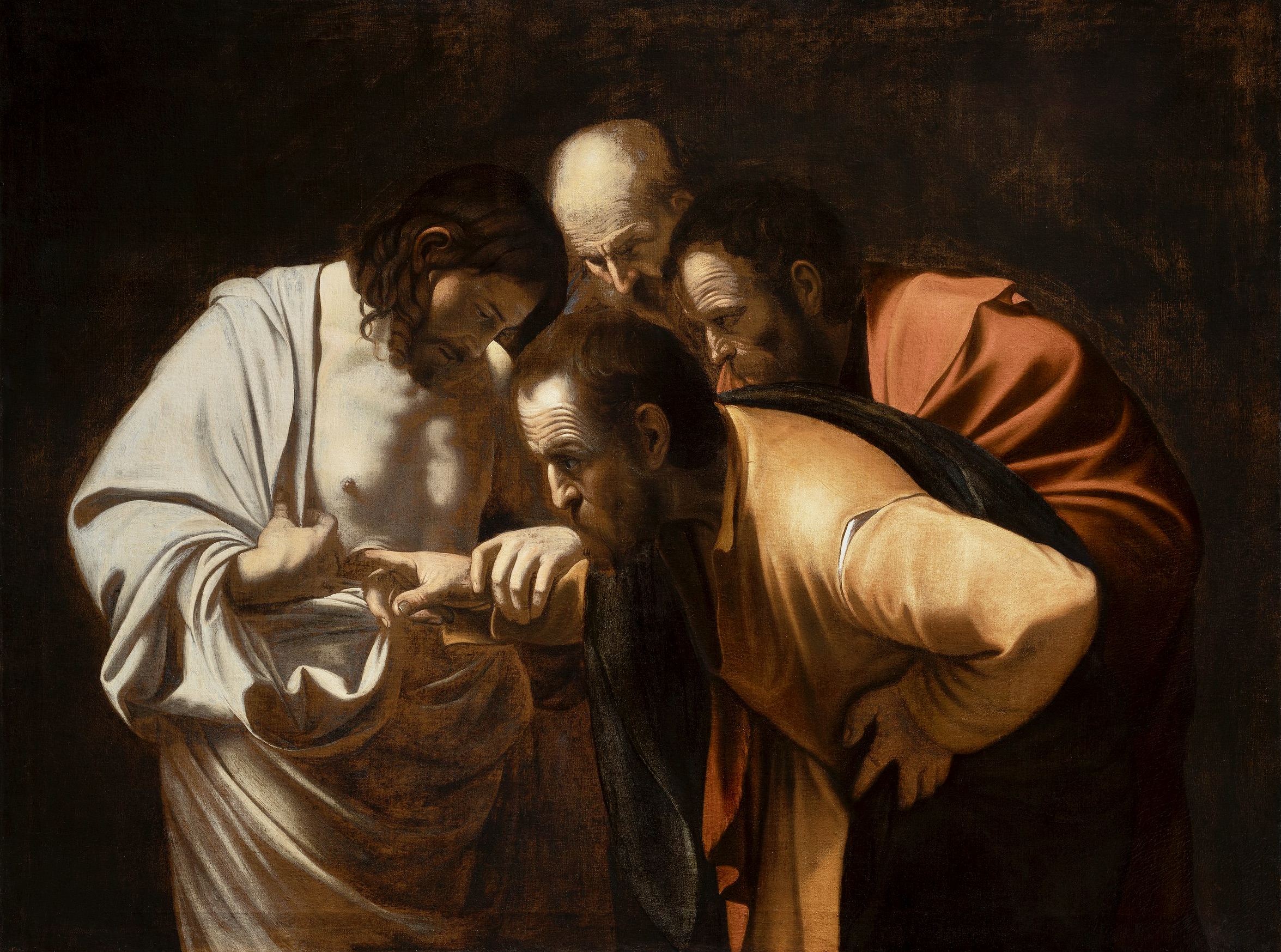
Caravaggio, Doubting Thomas, 1601 (a famous traditional presentation of the event in John 20)

A further detail to notice, which our familiarity with so many paintings helps to obscure, has to do with how Thomas responds to Jesus. According to John, Jesus appears to the not-yet-believing ten, and – unbidden – shows them his hands and his side. Seeing the traces of his wounds on his risen body brings them joy. Jesus then appears unexpectedly a week later, this time showing himself to the one not present on the prior occasion. And just as he had done previously, Jesus offers Thomas the same opportunity he had provided to the others.

We should therefore not be misled by Thomas’ oft-quoted comment to the other disciples, prior to his own epiphany, about what he needed in order to believe. According to the text, Jesus – upon appearing in the same house a second time – bids Thomas to touch him. Yet, Thomas immediately responds to Jesus’ words without any mention in the Gospel of him having physical contact with the risen Lord’s wounds. Jesus then asks Thomas a rhetorical question, “Have you believed because you have seen me?” Naturally, Thomas’ implied answer is ‘yes.’

For all these reasons, we will do better to find a different and more positive descriptive phrase by which to refer to this well-known passage from John 20. “Jesus meets the disciples according to their needs,” though wordy, would do better.
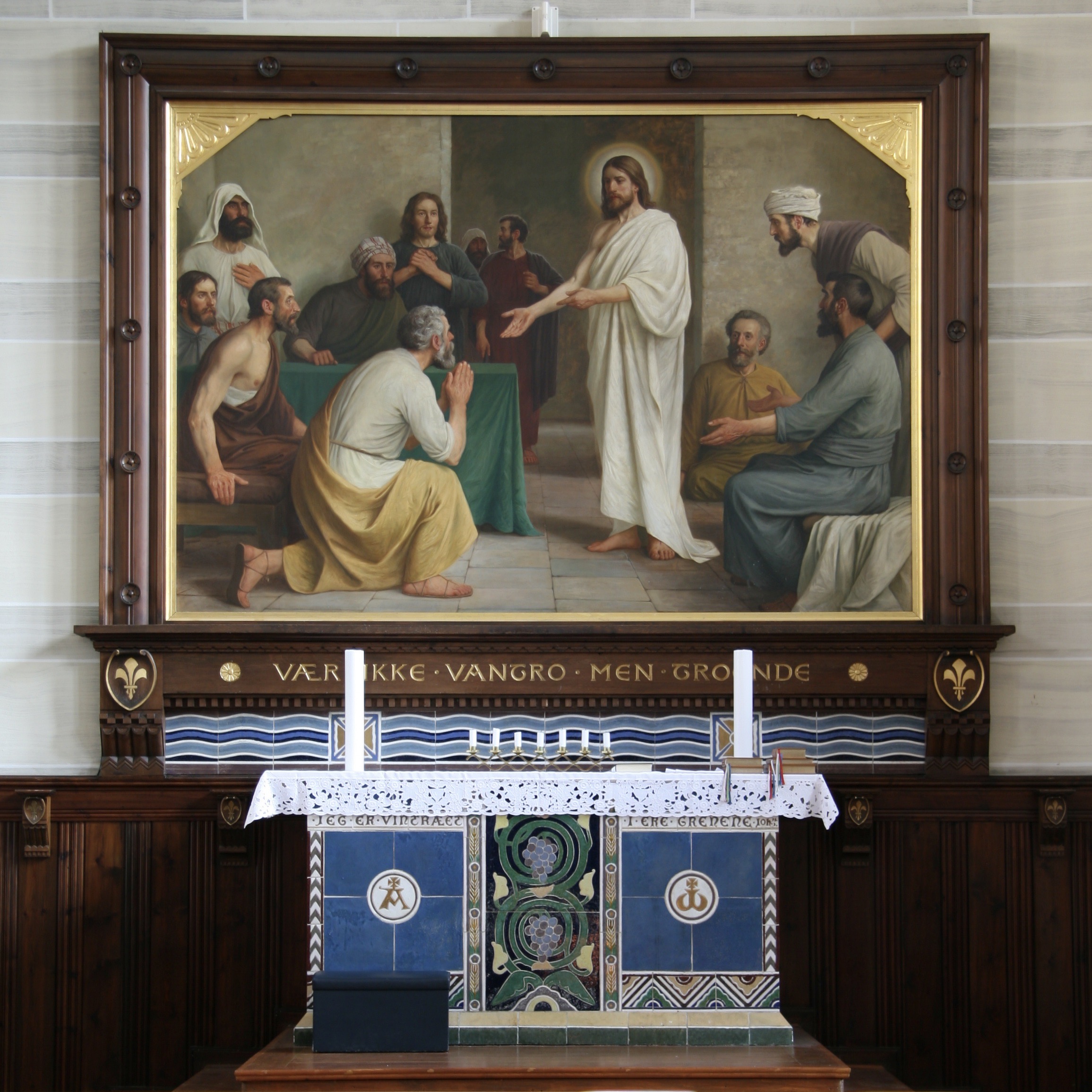
P. Steffensen’s altarpiece painting behind the altar of Zion Lutheran Church, Copenhagen


This post is based on the traditional Gospel reading for the second Sunday of Easter (April 7 in 2024), John 20:19-31. The story within it concludes with these words: “Jesus said to Thomas, ‘Have you believed because you have seen me? Blessed are those who have not seen and yet have believed’.”

Note: The altarpiece paintings by P. Steffensen and Rubens provide an interesting counterpoint to the prevailing tendency of painters to focus on Thomas placing his hand in the side of the Risen Jesus.
 

The Beauty of His Continuing Presence


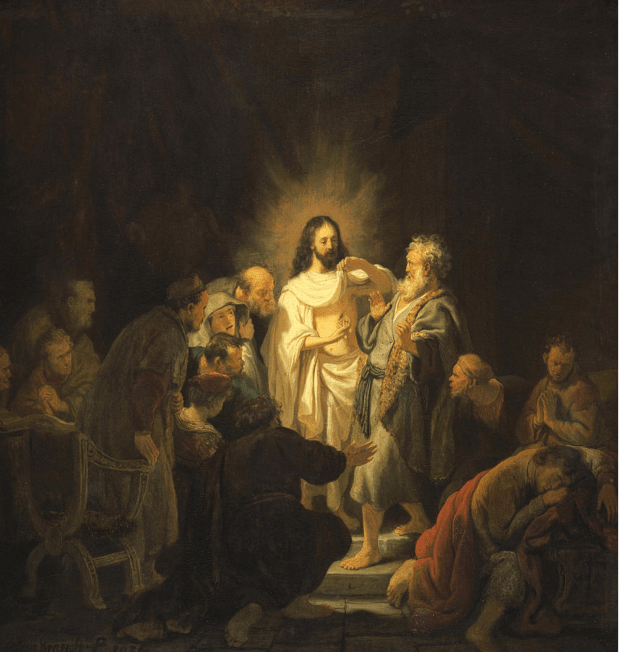
The most well-known painting of ‘Doubting’ Thomas and his encounter with the Risen Jesus may be the one by Caravaggio. And yet, paintings like his are misleading, as is referring to Thomas as ‘the doubter.’ Why? Because paintings and labels like these lead us to overlook or misperceive some very important details within John’s Gospel story. Rembrandt’s painting of the event (above) helps us notice the difference.

As John tells it, we first find ten of the disciples hiding behind locked doors out of fear. Consider how, during Jesus’ ministry with them, he had more than once told them to fear not. And at the Last Supper, he had given them ‘his peace.’ Yet, rather than remember what Jesus had shared with them, as well as his miracles, all of them have succumbed to fear. Even though Mary Magdalene that morning had already told them that she had seen the Lord. How can these details be squared with any other description than that the ten behind locked doors are doubting, as well?

Second, observe how John’s Gospel describes Jesus’ initial appearance to the ten, when he finds them fearful and doubting. At first, they do not recognize him. It is only after Jesus shows them his hands and his side that they then recognize him, and rejoice at his presence. When they see him, then they believe, and not before. So, once again, Jesus leaves them with his peace. And now, he gives them his Spirit.

Notice what the ten say to Thomas when he then arrives: “We have seen the Lord” ~ the very same witness Mary had earlier offered to them without having had much effect. Thomas naturally replies by saying something like this: ‘Look, I haven’t see him, like you guys just did— and so, just like you, I won’t be able to believe until I see him, either.” Thomas’ statement to them therefore does not need to be heard as him setting the conditions for his belief. It may simply be a practical prediction of fact.

We need to be equally perceptive about John’s description of Jesus’ later visit to that same locked room. It is a week later when Jesus returns to the eleven, among whom Thomas is present. It is vital to notice what Jesus says to Thomas. It’s even more important to observe how John describes Thomas’ response. Jesus invites Thomas to touch him and to believe. But the Gospel does not say that Thomas has any physical contact with Jesus. It does not tell us that he reaches out, or that he makes an effort to touch Jesus. Instead, and just as Jesus gives him credit for doing, he sees, and then he believes. Just like the prior experience of the other ten!

Rembrandt’s image, like the painting by Carl Bloch, is faithful both to what John tells us, and to what he does not. Observing this, we should refer to this story in John’s Gospel in a different way ~ ‘the doubting disciples, and how they all came to believe.’


The above image is of Rembrandt’s (I think mis-titled) painting, The Incredulity of Saint Thomas. This post is based on my homily for Easter 2, April 28, 2019, which can be accessed by clicking here.  Other homilies of mine may be accessed by clicking here. The Revised Common Lectionary, which specifies the readings for Sundays and other Holy Days, can be accessed by clicking here.

The Beauty of His Community

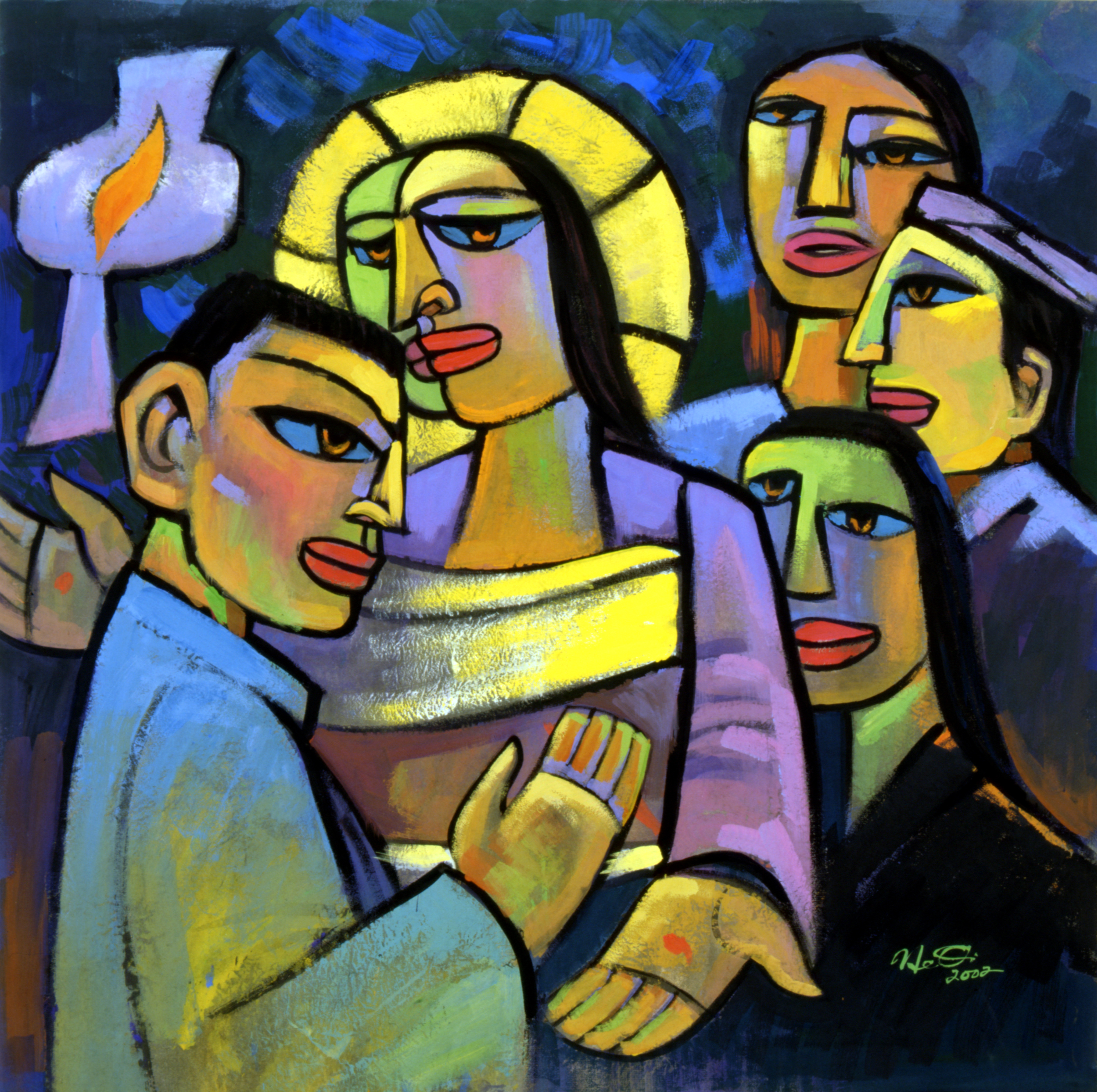
Art_James He Qi_The Doubt of St.Thomas_large


I love how artists help us read and hear Scripture in new ways. Occasionally, they help us perceive aspects of biblical texts for the first time. Paradoxically, in one case artworks have nurtured a mis-hearing of the Gospel. For all the paintings of Thomas that I know refer to him as having doubt, and portray the resolve of that doubt as coming from his touching the side or hands of the risen Jesus. But look closely at John’s Gospel. In his visit to the room where the disciples have been hiding, the risen Jesus does not directly attribute ‘doubt’ to Thomas. Instead, and perhaps with his prior visit to the other disciples in mind, he merely tells Thomas not to doubt. Nor does John describe Thomas as taking up Jesus’ invitation to touch him. Jesus credits Thomas for believing after seeing him, rather than after touching him. He then encourages the kind of belief that does not rest upon seeing.

Notice how the other ten disciples are hiding in fear, rather than joyfully confident, when Jesus comes to where they have locked themselves in. They are described as rejoicing only after Jesus shows them his hands and his side. In other words, Thomas is not unique and different from the other disciples, and benefits from exactly the same experience that transformed them from people fearfully hiding into those who are rejoicing. Their joyful confidence is reflected in their words to Thomas when he later arrives. They say, “We have seen the Lord.” Their joy is the direct result of seeing Jesus’ hands and side, the very things Thomas says will be key to his own believing. So, the ten did not believe until they saw; and Thomas will not believe until he sees. What they received, he, too, will receive. As will we, who—like Thomas—were not initially in that room. The history of art obscures this important point.

Here are two safe things we can say and accept as true. The risen Lord continues to disclose himself with signs. And, the Lord reveals himself in community, and always for the sake of his community. For his community is fellowship within the new covenant of reconciliation. As John writes in his first Epistle, “We declare to you what we have seen and heard so that you also may have fellowship with us.” Fellowship with this community, is fellowship in and with the Risen Lord.


James He Qi, The Doubt of St. Thomas (He Qi © 2014 All Rights Reserved); used with permission. I think of it as portraying the community faith of Thomas. See John 20:19-31, and 1 John 1:1-2:2. Click here for a link to my Sunday homily, which explores the impact of the resurrection upon the disciples.