Easter and Resurrection

Beauty Over the Reality of Chaos

[If reading this by email, please tap the title at the top to open your browser for the best experience.]

Peter Koenig, Good Shepherd Resurrection


The Resurrection of Jesus is all about grounded hope, and the strength to persevere in the face of adversity. Peter Koenig’s Good Shepherd Resurrection provides a compelling image of its power. The painting builds upon ancient biblical imagery of chaos manifest as a sea monster, and acknowledges how death and resistance to the will of God in the order of Creation pervade the world. The painting is brilliant in its conception, precisely because it is so counter to our culture-bound world of Easter bunnies, daffodils, and pastel-colored candy.

The Resurrection of Jesus is not mainly about hopeful feelings, a positive attitude and self-improvement, even though it can enable these things. His Resurrection is really about the defeat of evil and death, and triumph over pain and suffering. We may not immediately experience that defeat and triumph in our every moment of need. But, we live by Easter faith, and not by Easter feelings.

Peter Koenig risks showing us the Risen Lord stepping out of the mouth of a sea monster. The fresh water from his side recalls the water he made into wine, his crucifixion, and also -much earlier- the water from the rock in the wilderness. All these give us fresh water that fulfills genuine human need, as compared with the inhospitable salt water in which the dragon finds its abode. Every one of us is the lamb, held safely upon his shoulders, as he carries us out of the jaws of death into the new life where he is preeminent.

To me, this is real hope. Precisely because it is hope that deals with where we are now, rather than hope for something that might be, some day, somewhere. Both you and I want the kind of hope that squarely addresses all the things we’ve been worried about this last month. We all want hope that squarely confronts all the things we fear might go wrong in the coming month. And that is the kind of real hope that God brings to us in Jesus’ resurrection.


It pleases me once again to feature Peter Koenig’s painting, Good Shepherd Resurrection. This painting continues to give me confidence and courage. Click here to visit the website where this and other paintings by him may be viewed, or search his name on the internet. To see my Easter homily from which this is adapted, please click here. For background, see Revelation 12 and or do an internet search for biblical texts related to the words dragon, Rahab (i.e., Job 26:12-13 & Isaiah 51:9-10), Leviathan (i.e., Job 3:8, Psalm 74:13-14 & Isaiah 27:1), the deep, etc.
Easter, Eggs, and Mary Magdalene


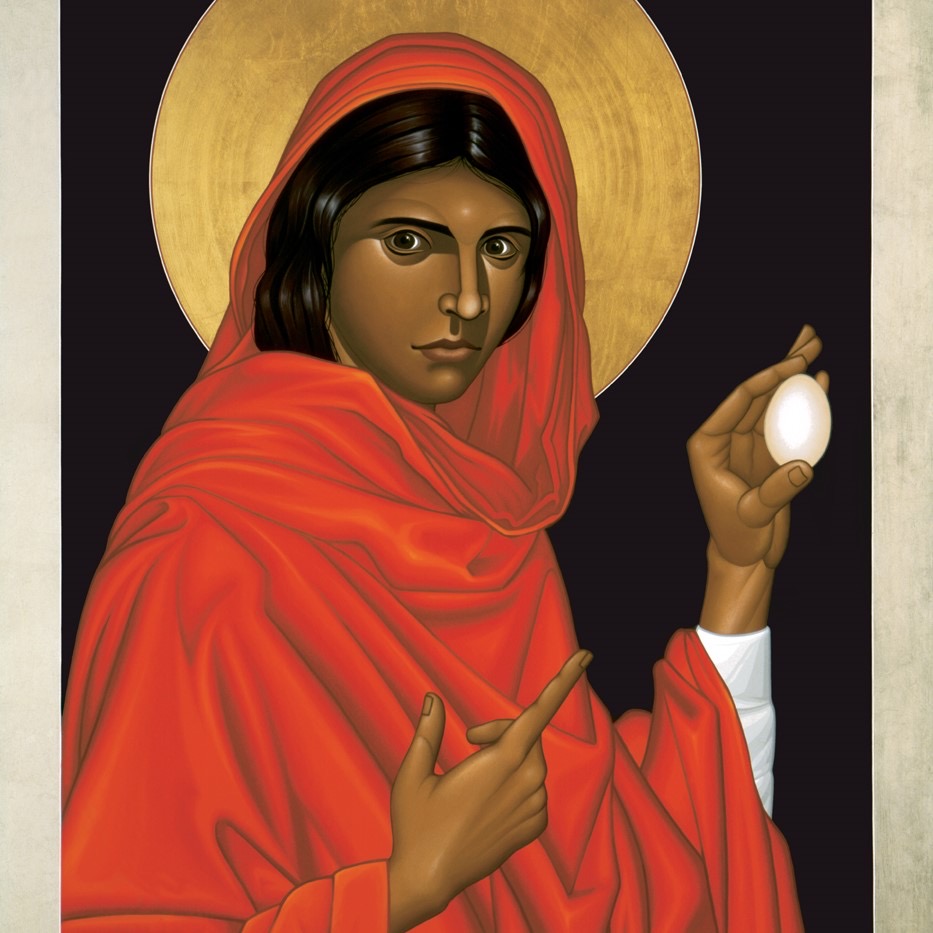
Mary Magdalene, an icon by Robert Lentz


Artists help us see, intuit, and understand in not always rational ways. In my view, this does not uniquely qualify or disqualify their work. Instead, it challenges us to try to see more perceptively what we apprehend, what moves us, and what prompts us to make assertions regarding the truth-value of what we have visually and conceptually encountered.

Over the years, I have purchased a number of wood-mounted reproductions of icons by Brother Robert Lentz, OFM. I continue to value his ability, spiritual perception, and sensibility in sharing with us insights about the holiness and character of many of those whom he has portrayed. Many of his portrayals are stylistically highly refined (see his two images of Julian of Norwich, or his James Lloyd Breck) while he takes a more playful approach with certain other historical figures (e.g., Simone Weil or Damian of Molokai). Examples of the latter have led some to criticize Lentz for not strictly adhering to traditional Eastern Orthodox practice when creating his icons.

Lentz’s vocation has been as a friar and follower of St. Francis, whose life and subsequent Franciscan Order bequeathed to us the tradition of Christmas creches in churches. Lentz’s humanistic regard for so many facets of our experience, as illustrated in the lives of those he has chosen as subjects for his work, has fit well with his Franciscan tradition. His icons have much to teach us, for he has sought through sacred art to communicate what he perceives to be biblical and spiritual truth.

One icon so fitting for this Easter week is Lentz’s portrayal of Mary Magdalene. It has been noted that,

according to the ancient tradition of the East, Mary Magdalene was a wealthy woman from whom Christ expelled seven “demons.”  During the three years of Jesus’ ministry, she helped support Him and His other disciples with her money.  When almost everyone else fled, she stayed with Him at the cross.  On Easter morning she was the first to bear witness to His resurrection.  She is called “Equal to the Apostles.”

After the Ascension, she journeyed to Rome where she was admitted to Tiberias Caesar’s court because of her high social standing.  After describing how poorly Pilate had administered justice at Jesus’ trial, she told Caesar that Jesus had risen from the dead.  To help explain the resurrection, she picked up an egg from the dinner table.  Caesar responded that a human being could no more rise from the dead than the egg in her hand turn red.  The egg turned red immediately, which is why red eggs have been exchanged at Easter for centuries in the Byzantine East.

Mary did not end her days as a penitent hermit in a French cave.  She traveled the Mediterranean preaching the resurrection.  Like Peter and Paul, she died a martyr and she bears witness to the important roles women play in the Church.

The inscription at the bottom of the icon reads: “Saint Mary Magdalene” in Syriac, a dialect of the language spoken by Jesus.  The Gospel comes to us, not from Rome or Greece, but from the deserts of the Middle East.  We owe our faith to Semitic Christians like Mary Magdalene.  Her feast day is July 22.


As has been observed, there is a similarity between Lentz’s icon and the well-known National Geographic cover photo {June 1985} of ‘the green-eyed young woman’ from Afghanistan. Her possible inspiration for Lentz’s portrayal of Mary Magdalene is noted here: { http://art-for-a-change.com/blog/2006/02 }. The text quoted above is borrowed from the Trinity Stores website (I have no commercial connection with them), through whom copies of Lentz’s icons may still be available.