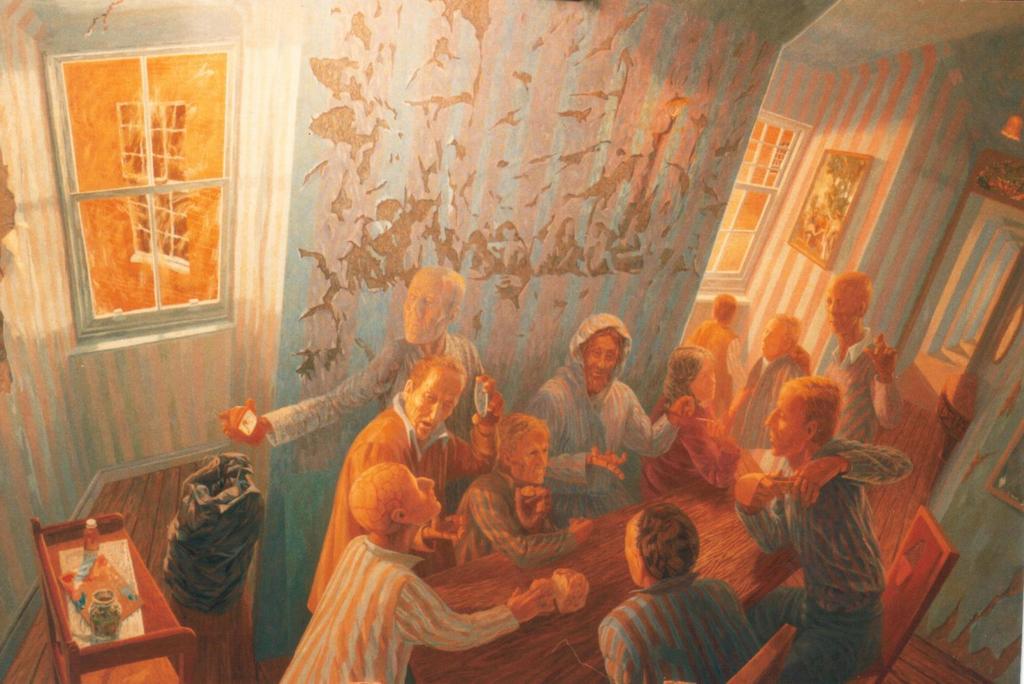
Peter Warden, Pentecost (1985)
Paul’s stirring words to the Ephesians assert an abiding truth: “There is one Body and one Spirit; there is one hope in God’s call to us; One Lord, One Faith, One Baptism, One God and Father of all.” Paul was focused on the God-given and true things that unite us, that hold us together, and which give us life. Yet, in contemporary American culture, everything now seems to center on how we differ from one another. How might we hold both insights together?
Some years ago, I discovered Peter Warden’s wonderful contemporary painting about the post-Resurrection Pentecost event, which reflects the presence of such differences among us as people. Warden’s painting is based on the well-know story from Acts, chapter 2. The painter portrays the disciples together in their upper room retreat. But, in this case, the first Christian community is gathered in a 20th Century Scottish attic! The painting seems to capture the disciples just at the moment when the mighty Spirit-wind and tongues of fire appear. In other words, the disciples – as Warden depicts them – are not yet bound together, and not yet ready for mission.
Though they are in the same room, these disciples show few signs of unity. They react against one another, as much as they may talk together. Notice how this is suggested by the alternating warm/cool color palette that Warden has used. We also want to notice the suggestively peeling wallpaper behind the group. Can you see the pattern that the artist has created with the lower part of the rendering of the wallpaper?
If you look closely, you can see how Warden has used his depiction of that scrappy wallpaper to suggest Leonardo Da Vinci’s famous painting of the last supper. Da Vinci’s painting has also suffered the fate of being on a peeling wall. Peter Warden portrays a group of people with a shared history, who were brought together by Jesus at their earlier supper with him. But now, after his death, they find themselves regressing, regressing to their before-knowing-Jesus identities, and falling back upon their differences from one another.
Yet, as the painting’s title suggests, in just this moment God’s Holy Spirit finds them. Just as, through the Church, God’s Spirit finds us. When God’s Spirit finds us, we are grafted into the Body of Christ. In the process, we come to perceive who we really are. For we receive a new baptismal identity in Christ.
Our new identity builds upon and transforms the uniqueness of our natural, biological-identity. Our baptismal-identity emphasizes a new way of seeing ourselves in relation to others. Now, we also celebrate what we share and have in common, rather than simply emphasize our practical awareness regarding how we are unique and different from others.
Through hearing and reading Scripture, and in our fellowship with others in Jesus’ beloved community, we learn something very important. It has to do with this matter of our identity. We learn that the “Who am I?” question cannot rightly be answered apart from the “Who are we?” question. And, in turn, the “Who are we?” question cannot rightly be answered apart from another question: “Who are we made to be?” Once we ask, “Who are we made to be?”, we are on the threshold of discovering, perhaps for the first time in our lives, who we are meant to be and become, both as individuals, and in community.
Here is the truth of the great feast of Pentecost: God’s Spirit has come down! God’s Spirit has come down upon, and within, people who are sometimes alienated, and who often fall short of God’s mission. Preoccupied with ourselves and our own pursuits, we are gifted with the experience of transformation. We are drawn into relationship. As we are, we find meaning and we find purpose. We discover who we are, as we discern what we are called to be and do together. The mission of God brings both mercy and meaning. In it, we discover a shared life in God’s Spirit-shaped Kingdom.

John Nava, Pentecost, 2012
The quote from Ephesians is from the Book of Common Prayer Baptismal Rite adaptation of Ephesians 4:4-6. I have featured Peter Warden’s Pentecost painting once before, though without reflective comment, in a post offering Family Devotions during Covid, on May 30, 2020.
Further note: last week I was fortunate to walk down the same central street in ancient Ephesus upon which Paul surely often walked, while – according to Acts – he was there for two years. In writing the words quoted above, Paul was likely responding to the Ephesians’ devotion to the fertility mother goddess, Artemis, and the great temple they had built in dedication to her.
![Pentecost_CELPentecost[1]_buildfaith.org](https://towardbeauty.org/wp-content/uploads/2014/06/pentecost_celpentecost1_buildfaith-org.jpg)
 Toward Beauty