Beauty and Intimacy

The Believing Eleven

If reading this by email, please tap the title at the top to open your browser for the best experience. Then, clicking individual pictures will reveal higher resolution images.

Peter Paul Rubens, The Rockox Altarpiece, 1613-1615 (center panel)


It is evening on the day of Resurrection-discovery. John tells us that ten of the disciples are hiding behind a secured door out of fear. Judas is deceased, and Thomas is away.

Jesus suddenly appears to the unprepared disciples, and shares with them his peace. He shows them his hands and his side, and then – as a direct consequence of seeing the places on his body associated with his death – the ten disciples rejoice when they see their Lord. In other words, their recognition of him, and that he was somehow alive again, brings them joy by restoring their belief in him.

When hearing this story from John’s Gospel on the second Sunday of Easter, we may be prone to considering it apart from what happens just before it. The disciples, who are hiding out of fear, have already received an eye-witness to the resurrection of Jesus. Mary Magdalene, to whom Jesus revealed himself at the tomb that morning, had come and told the ten the Lord was alive, and that he had appeared to her. Clearly, and prior to Jesus’ unexpected appearance, the ten disciples are still doubting her personal witness. Even after receiving what should have been trusted testimony from Mary Magdalene, a fellow follower of Jesus.

So why – in popular imagination – isn’t this well-known Gospel reading from John 20 commonly referred to as the “doubting disciples” reading? Why should Thomas be singled out, when his joyful recognition of the risen Jesus depended on nothing more or less than what the 10 had needed, and received, before him?

And why have so many painters in the Western tradition privileged Thomas’ purported unbelief in the Risen Lord, rather than depict the earlier reluctance of the ten others to arrive at joyful confidence about the Lord’s astonishing return? Apparently, in many painters’ eyes (especially Caravaggio), more visual drama was to be found in images of a doubter’s hand placed within an open wound.
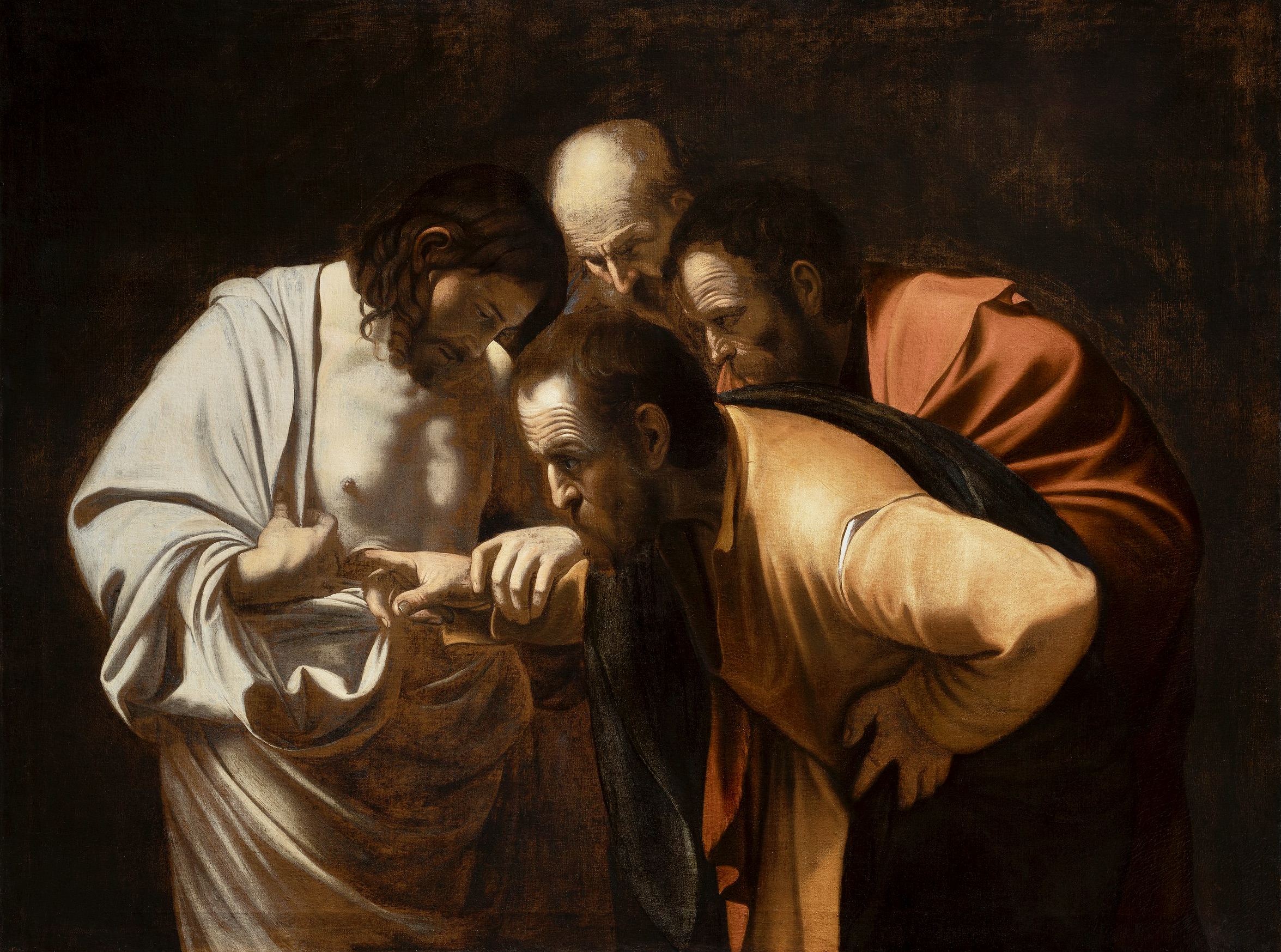
Caravaggio, Doubting Thomas, 1601 (a famous traditional presentation of the event in John 20)

A further detail to notice, which our familiarity with so many paintings helps to obscure, has to do with how Thomas responds to Jesus. According to John, Jesus appears to the not-yet-believing ten, and – unbidden – shows them his hands and his side. Seeing the traces of his wounds on his risen body brings them joy. Jesus then appears unexpectedly a week later, this time showing himself to the one not present on the prior occasion. And just as he had done previously, Jesus offers Thomas the same opportunity he had provided to the others.

We should therefore not be misled by Thomas’ oft-quoted comment to the other disciples, prior to his own epiphany, about what he needed in order to believe. According to the text, Jesus – upon appearing in the same house a second time – bids Thomas to touch him. Yet, Thomas immediately responds to Jesus’ words without any mention in the Gospel of him having physical contact with the risen Lord’s wounds. Jesus then asks Thomas a rhetorical question, “Have you believed because you have seen me?” Naturally, Thomas’ implied answer is ‘yes.’

For all these reasons, we will do better to find a different and more positive descriptive phrase by which to refer to this well-known passage from John 20. “Jesus meets the disciples according to their needs,” though wordy, would do better.
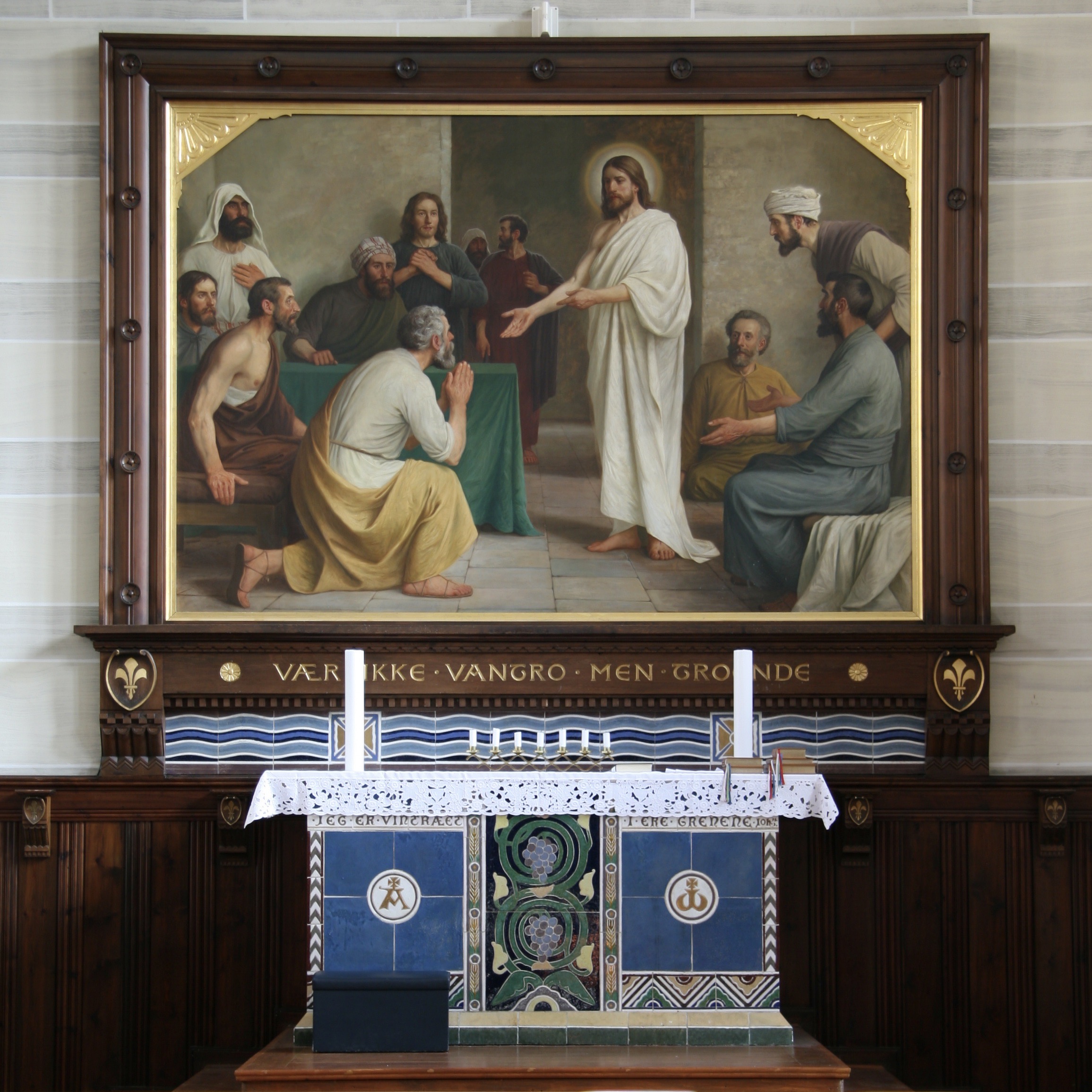
P. Steffensen’s altarpiece painting behind the altar of Zion Lutheran Church, Copenhagen


This post is based on the traditional Gospel reading for the second Sunday of Easter (April 7 in 2024), John 20:19-31. The story within it concludes with these words: “Jesus said to Thomas, ‘Have you believed because you have seen me? Blessed are those who have not seen and yet have believed’.”

Note: The altarpiece paintings by P. Steffensen and Rubens provide an interesting counterpoint to the prevailing tendency of painters to focus on Thomas placing his hand in the side of the Risen Jesus.


The Beauty of Mystical Union

Art_the-wedding-at-cana-niels-larsen-stevns_(1864-1941)


This painting by Niels Larsen Stevns, a relatively unknown Danish painter, strikes me as profound. I think he portrays the occasion in a way John the Evangelist would have liked. First, notice the huge stone basins, which by their placement in the painting occupy the center of our attention. These vessels exceed what we might imagine when we hear the English word “jars.” Yet John, who is consistently focused on mystical and symbolic themes, takes care to tell us how these ‘jars’ hold twenty to thirty gallons each. To put that in perspective, 24” of water in a standard bathtub equals roughly 24 gallons. And Jesus transformed six times that amount, for just one party!

After the large vessels, we notice next Jesus and his mother, the two main figures in this painting and in John’s story. In addition to their placement, we can tell who they are by their halo’s. While Mary stands fully graced by the glow of the late afternoon sun, the upper torso of Jesus is in shadow. I think this is for both pictorial and theological reasons, allowing the glow of his halo to be all the more radiant. At the same time, he is the only figure in the painting portrayed as praying. Very subtly, and faithful to John’s Gospel, Stevns depicts how the light shines in the darkness, and that the darkness has not ‘comprehended’ it. This moment is all about Epiphany, about the revealing of light in new and profound ways, for the benefit of all who long to see it. Water, set aside for the purification of the body, becomes wine that warms and gladdens the heart and soul.

The chief steward is just behind, being given an opportunity to apprehend and perceive the light. It comes in the form of a cup of wine, reckoned to be among “the best.” Also subtle is Stevn’s depiction of the two persons on the left side, who are in conversation. They appear to be discussing something whose meaning eludes them, reminding us of the two disciples later walking on the road to Emmaus. Like them, and like the chief steward, these two at Cana do not yet perceive what this is all about. Only in the background, under and through the low arches, do we see the wedding party, feasting together at the tables. Among many paintings of this scene, this may be among the most faithful to what John wants us to see, and to believe. This story, like the whole of John’s Gospel, is about the wedding of the human and the divine, in Jesus.

Many guests at this wedding probably noticed the sudden arrival of a batch of fine wine—but not where it came from, nor what it represented. Those at the table were likely focused on the bridal couple, while enjoying all the splendid things on offer. But those who stood nearby, at the edges of the scene, were in a position to notice something else. Of greatest significance at this event was not the hospitality provided by the wedding hosts, whose wine in fact ran out! Most significant was the abundant and mystical hospitality, revealed and provided by a higher source. In this gathering, God’s hospitality is extended not so much as it is in other Gospel stories, to people who are unique and different, and on the margins. Here, God’s hospitality embraces what is common and the same, our needy human nature. God shows us how the deficiency we all share is blessed, and then filled. The empty vessels of our souls are ‘filled to the brim’ with the living water of the Holy Spirit.


The Wedding at Cana by Niels Larsen Stevns (correct spelling! / 1864-1941), based on John 2:1-11. To see my homily, which explores this Gospel reading in relation to historical representations of it in art, click here.

Beauty and Intimacy

Sadao Watanabe_Last Supper_1995


Because the humanity we inhabit involves the intertwined concepts of person and body, our notion of personal intimacy is interwoven with bodily intimacy. Intimacy provides a great challenge for western culture. Though we are barraged by displays of physical intimacy, we are naive about personal intimacy.

Many forms of our social interaction rest upon two assumptions: that personal intimacy is always physical and sexual; and, that sexual intimacy is merely physical. These widely held assumptions create spiritual challenges for us: we have a hard time imagining personal intimacy that is not sexual; and we have an equally hard time accepting that sexual intimacy is always personal, with relational implications. These assumptions hinder our ability to imagine personal intimacy that is not physical, and therefore our ability to follow Jesus into intimacy with God.

Think of John, the beloved disciple, at the Last Supper. Jesus loved him for who he was and not merely for his physical embodiment. Reclining against Jesus at the Last Supper table meant something very different in his culture than it would today. It expressed genuine friendship and love for Jesus, and prefigured the personal and intimate relationship we all have with Jesus, through Baptism. Our culture does not prepare us to perceive this truth. And when we don’t experience its beauty, we don’t believe it is real.

Intimacy with God always has some affinity with, but also clear differences from, our intimacy with other persons in this fallen world. Sometimes, our words, facial expressions and bodily gestures are not sincere, and we fall short of encouraging each other’s wholeness. We find ourselves merely creating the impression of a personal relationship and intimacy. But our intimacy with God never involves using one another. God cherishes us for who we are in his embrace, and not merely for who we are in our own eyes.

With God, we are always the end and goal of divine self-giving love. Jesus revealed and embodied God’s personal love and intimacy. His loving intimacy is nurturing and healing, and enables a wholeness that can only be called the beauty of holiness.


The above print, The Last Supper (1995), is by the Japanese Christian printmaker, Sadao Watanabe (1913-1996). For further reflection on these ideas, click here to see my homily exploring the theme of how Jesus is the Way into intimacy with God.