Photography

Jason Sparks’ Artistic Adaptation of Tenkara Flies

If reading this by email, please tap the title at the top to open your browser for the best experience. Then, clicking individual pictures will reveal higher resolution images.
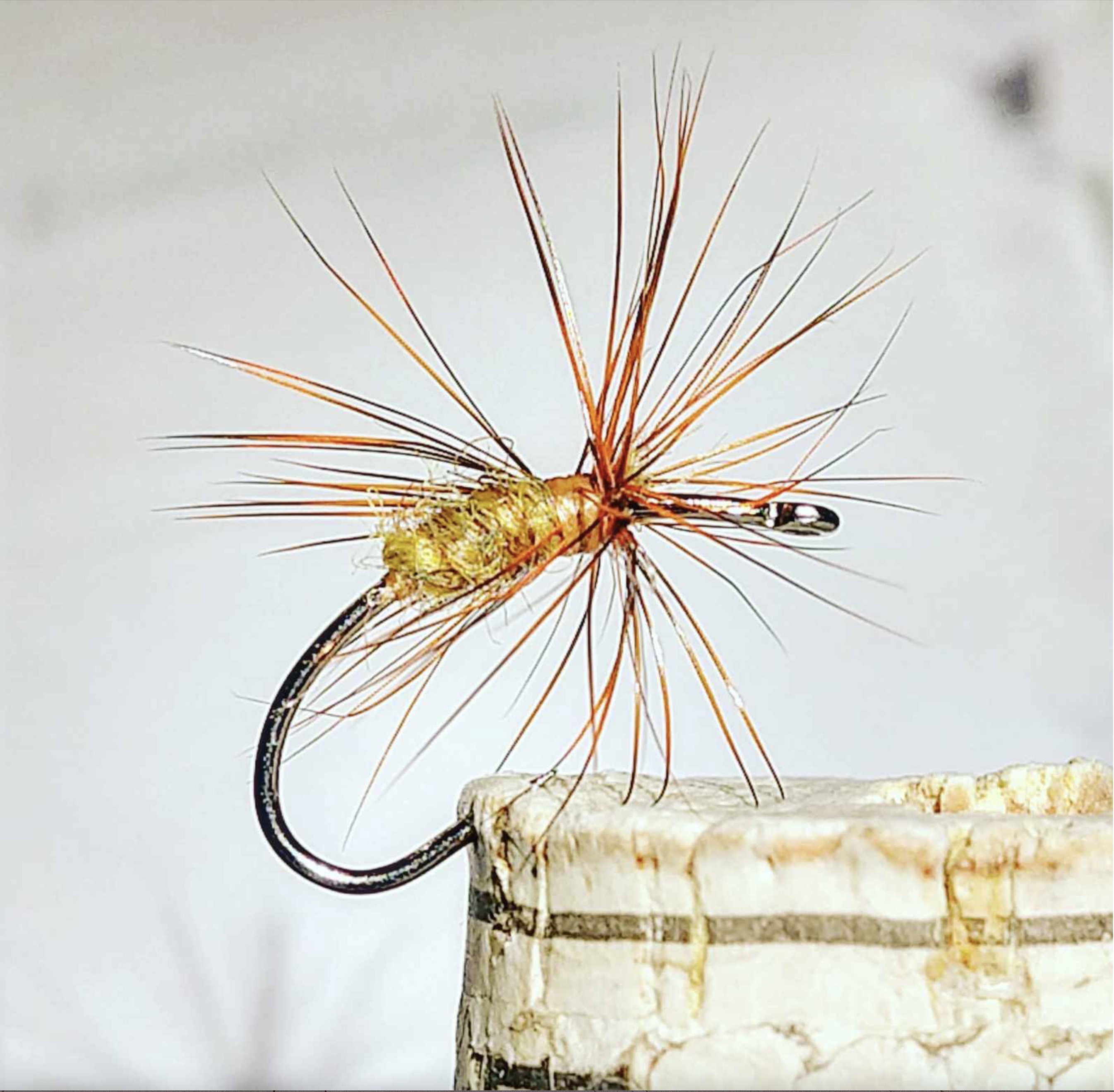
 

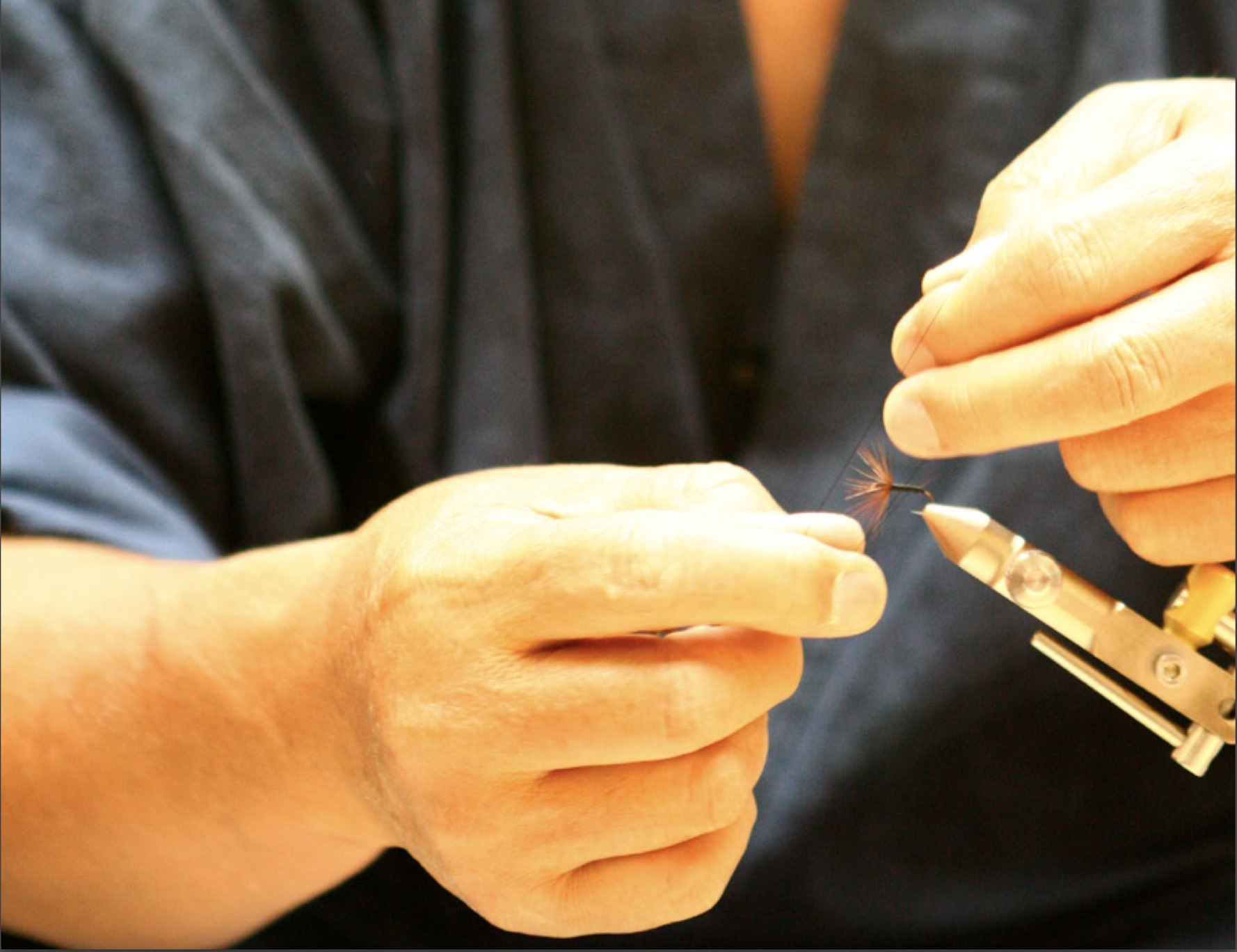
I discovered the handiwork of Jason Sparks through the writing of Jason Klass, a Colorado fisherman who has come to fish exclusively using the Japanese approach to fly fishing called Tenkara. Tenkara fishing has at least two distinguishing features, the first having to do with a difference from typical American fly fishing rods. Compared to familiar Western examples, Tenkara rods are very long poles, historically made of bamboo, along with a fixed-length line of roughly the length of the pole, and no fishing reel for the line. The flies used in Tenkara fishing are the second distinguishing feature. Tenkara flies, as in Jason Sparks’ beautiful example (above), generally feature hackle feathers (rooster and or hen) tied to the hook in a way that projects the feather’s barbs forward, toward the eye of the hook. This creates a pulsing motion when the fly is pulled against the current in a stream.

The anatomy of a fish hook. (Sparks prefers barbless hooks to facilitate ‘catch and release’ fishing)

The artistic design work of Jason Sparks, and his adaptation of traditional Tenkara flies, stress an intentional use of natural materials. In order to appreciate the originality of his flies, it’s worth considering examples of traditional Tenkara flies.
A traditional Tenkara fly tied by Dr. Hisao Ishigaki, a recognized authority on Tenkara fishing and fly tying

Traditional Tenkara flies are composed of three basic materials, a hook, thread, and part of a feather. The thread is wrapped around the neck of the hook, creating a base; thread-wraps then secure part of a feather to the hook; the feather is then spun around the shaft of the hook while perpendicular to it, thereby spreading the feather’s barbs. More thread is then wrapped around the shank of the hook, and tied off with a knot.

Almost all fly tyers make use of a vice, as depicted in the photo above, which holds the hook in place while the fly is created. One Japanese authority, Katsutoshi Amano, is famous for tying Tenkara flies without a vice:

Observing these aspects of traditional Tenkara fly design helps us appreciate Jason Sparks’ creativity and aesthetic sensibility, as he creates works of art that actually catch fish. His willingness to work beyond the usual parameters of Tenkara flies can be seen in his choice of hooks. Those employed by the two Japanese masters in the photos above feature straight shanks in the upper part of the hook.

Sparks frequently uses what are commonly called scud or nymph hooks, which have a long and curving shank, where the eye of the hook tilts slightly downward. A similar tilt can be seen in another type of hook he often uses, which has a traditional straight shaft of moderate length, but which also has a wide gap above the hook’s point and a somewhat squared bend between it and the shank. These various features can be seen in photos of Sparks’ flies included below.

In both the photo directly above, as well as the one at the top, we see Sparks’ use of a scud hook, yet with minimal added material on the hook’s shank. While many tyers match fly body materials with the size of the hook, Sparks finds that a hook’s size matters less than the presentation of the material attached to it. Further, by locating that material closer to the middle of the shank, it is easier to attach or replace the fly line (and leader) to the hook’s eye.

With his preference for using natural materials, Sparks likes to tie with silk thread, and he prefers naturally dyed woolen yarn from the Shetland Islands, given its variations of color and textured finish. With a yarn ‘body,’ and the spiky feather barbs wrapped around the hook, Sparks achieves very ‘buggy-looking’ flies:

Two points are worth noting about Jason Sparks’ flies. Though the examples here look large, they are actually not very big, being photographed closely to help us appreciate their detail and composition. His typical hook sizes range from an 8  to a 12 or 14 (in most cases less than an inch, and many considerably smaller). And, second, Sparks often directs the feather barbs both forward and rearward, in contrast to the usual forward tilt of many traditional Tenkara flies. These features can also be seen in the following examples:

Sparks also ties flies that are commonly called nymphs, suggesting the appearance of bugs in their larva stage of development. With these flies, we notice the absence of feathers, and a spare use of other materials such as Sparks’ preferred Scottish yarn:

Despite how much of the hook is exposed in these examples, Sparks contends that they are effective for fishing.

Jason Sparks is obviously a gifted fly tier and has made a significant artistic contribution to this avocation, which for some is also a form of employment. In contrast to the neatness and precision of his finished flies, Sparks’ fly tying desk resembles the workspace of many others who tie flies:


Readers interested in fly tying may wish to look at my prior post, The Beauty of Fly Tying, which may be accessed by clicking here.

Roger Tory Peterson’s Art, Helping Us See

If reading this by email, please tap the title at the top to open your browser for the best experience. Then, clicking individual pictures will reveal higher resolution images.


If you wanted to buy a guide to help you identify birds, what would you choose? A book with glossy photographs showing birds as found in nature? Or would you choose an artist’s rendition of those same birds abstracted from their natural setting? Without considering the question closely, I suspect that I am not alone in being one who would choose the former for what seems an obvious reason, that photographs purport to capture reality in what we call an objective way. And when seeking to identify birds, correct apprehension of reality is what we are after. Paradoxically, Roger Tory Peterson’s, Field Guide to the Birds, first published in 1934, has long been valued precisely because his paintings and notes may aid accurate identification of birds to a greater degree than can be obtained by studying photographs.

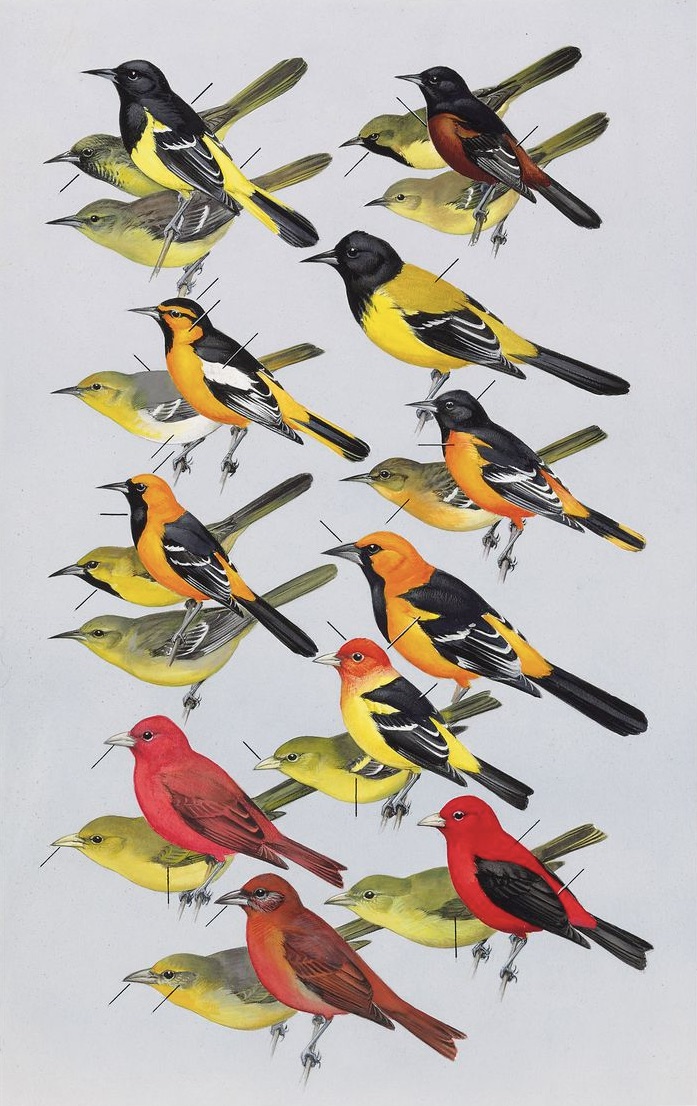
As we also find in the presumed intent of more recent, photo-based, bird books, Peterson’s aim was to help us see, and then upon seeing, correctly identify the birds we have apprehended in our sights. Yet, Peterson, a much-regarded pioneer in the environmental movement, sought to aid our perception by prioritizing the various unique properties of individual species, and then to highlight those features that distinguish them from other birds. With the aid of his editors and book designers, he helped to achieve these goals by adding small black lines or dashes pointing to various parts of each bird on the color illustration pages displaying his paintings.

These small lines correspond to observation notes in the text, signaling to the reader the principal identification marks and points of difference between various similar-looking species of birds (see below). His creation of this method for the identification of observed field marks in birds has come to be called the Peterson Identification System.

A pre-publication page from Peterson’s Field Guide. Note the small black lines or dashes, explained above.

The paradoxical limitation that may accompany a photographic guide to birds is that a photograph captures an object in only one posture in one moment of time. Photographs are also dependent upon existing light conditions, and where the object of attention may also visually be obscured or overwhelmed by its larger context.

With paintings, Peterson may have been better able to help us see three dimensional aspects of the birds he portrayed while yet employing a two dimensional medium, in part because those birds are presented against a non-distracting neutral background. By painting rather than photographing, he was able to emphasize and enhance certain features of birds, such as subtle areas of color and the impact of light upon them, to a greater extent than would have been possible with the photographic means available to him at the time. In the process, Peterson demonstrated a consistently high degree of proficiency in his work of illustration, while also achieving what are arguably finished works of art that help us perceive beauty in the natural world around us.

The Finches page from my grandfather’s 1959 edition of Peterson’s Field Guide


Note: Having featured Peterson’s work, there are many newer bird identification books being published, and they are worth exploring when someone seeks a reliable birding guide. For many people of my generation, Peterson’s work will always be on the shelf, given its art rather than his having employed photo-based images, especially since his books are so widely available. I am proud to have and use my grandfather’s annotated copy (above), with his sightings noted on numerous pages going back to the 1960’s.

I am conscious of the fact that I featured multiple color photos of the Common Nighthawk in my prior post, as well as having offered a substantial amount of information about this particular species. If bird guides were to offer an equivalent kind and amount of coverage of every species commonly observed, they would be immense, and very expensive!

Roger Tory Peterson (1908-1996). It is one thing to be serious about one’s life work, and another to be able to laugh about it!


Encountered Beauty: Nighthawks in a Dark Sky

If reading this by email, please tap the title at the top to open your browser for the best experience. Then, clicking individual pictures will reveal higher resolution images.


I have clear memories of a particular time of day in a town where I lived for two short periods of time, Northfield, Minnesota. In middle school, and then during college, I would frequently walk over the Water Street bridge spanning the Cannon River, by the old dam and historic Malt-O-Meal mill. On summer evenings and nights, I remember almost always hearing the distinctive nasal or buzzing be-zeet, be-zeet sound of birds calling to one another in the sky above. When I first observed them, I wondered what kind of birds these were, and about their surprising nocturnal behavior as compared with other birds more familiar to me. Based on the white patches on the underside of their wings, visible from the reflected glow of the lights in the town center below, I was able to identify them as Common Nighthawks, based on Roger Tory Peterson’s well-known book, Field Guide to the Birds.

Seeming to fly far above me, I was curious about their size, imagining them to be rather large. I then learned that their size and weight puts them somewhere between a common robin and a crow, suggesting that they do not fly as high as I had first imagined. Nighthawks are insect-eaters, which accounts for why they are so evident on summer nights, amidst the target rich environment of flying bugs swarming over city lights.

With their long wings, these birds engage in bat-like flapping as well as in gliding, and I remember them flying closely together as they went about their nocturnal feeding. The American Bird Conservancy website describes them in this way: “the Common Nighthawk’s erratic, acrobatic flight style gives the bird its folk name, ‘bullbat’.” Memorable in this regard is the way that they make occasional dives toward the ground. Some observers report that these dives cause the wind under their wings to make a booming or a whooshing sound, though I don’t remember hearing it.

I was intrigued to learn that, given their relative size, these birds will roost and nest on such apparently vulnerable locations as the ground, elevated tree limbs, ledges, and even gravel rooftops. Among things I appreciate about Nighthawks is how their mottled coloring, with blends of light and dark feathers, has adapted them well to survive in a variety of environments, and helps to protect them from predators like hawks and falcons. Of course, there are those incongruous white wing patches, which may be an evolutionary bow to some needs parallel to survival, both the attraction of a mate and the procreation of offspring.

The shape and size of Nighthawks’ comparatively long wings aid not only their feeding activity while flying, but also the extraordinarily long annual migration they make between their breeding grounds in North America to their winter habitats in South America. In fact, they are believed to have one of the longest migration patterns of all North American birds.

To me, Nighthawks are an unexpected kind of bird to find in a town center or in a city, given their dimensions and surprising willingness to live and reproduce in proximity to the commercial activity we associate with such areas. I am always delighted when I recognize their sounds above me on a summer evening, as I look up to see them wheeling about in the darkness, with their white wing patches flashing here and there.

In the natural world around us, with all its dynamic interrelationships, these amazing birds are our fellow creatures. In relation to them, as well as to other examples of what traditionally have been termed flora and fauna, we are called to engage in God-like stewardship. We all seem to have our favorite species in nature that we want to protect and care for. Needless to say, Nighthawks are high on my list.


The Nighthawk page from my grandfather’s copy of Peterson’s Field Guide to the Birds


Vivian Maier, Who Saw Beauty in People on the Street

If reading this by email, please tap the title at the top to open your browser for the best experience. Then, clicking individual pictures will reveal higher resolution images.

A classic self-portrait by Vivian Maier


Vivian Maier (1926-2009), whose artistic works were until recently largely unknown, is now credited with being among the most significant street photographers of the 20th-century. Her main way of supporting herself was as a nanny in New York City. But clearly, her vocation was to see the people around her in a sensitive and insightful way, and document her encounters with them through the art of photography. As a perceptive observer, she captured them ‘as they were.’

My hunch is that her much-appreciated work as a caregiver for children, in the context of their families, positively reflected an inborn gift for discernment about other people as she apprehended the beauty she found within them. This may have provided her with a greater sense of tolerance and comfort with how others could appear, some of whom she photographed in states of disarray, plagued by the challenges of poverty and or illness, as well as those who seemed to be among the elite and socially inaccessible.

Vivian Maijer took thousands of photographs in the years before our new era of digital photography, and she never had a sizable proportion of her images developed into stored negatives. Traditional cameras in her era allowed light to pass through their lenses so as to impact chemically-coated light-reactive rolls of plastic film. These rolls of film then required either commercial processing, or the equivalent in private ‘dark rooms,’ where the light-sensitive film could be transformed into a stable medium. It is worth noting that, in its earlier days, photography was dismissed as being a lesser (or not even an) art. Yet, photography, as Maier’s work exemplifies, has the power to communicate great beauty, inspire goodness, and convey significant truths.

She was nevertheless unassertive with regard to what may have been seen as her ‘hobby’. She seems to have had confidence in her talent, and in the reasonable validity of her expenditures on cameras and film (a lot of film!), as well as the costs of developing the film she chose to have processed. And yet, we can only wonder why she did not seek out public recognition of her talents and work in a more encompassing way.

A compelling example of Maijer’s work

Three variables mark Vivian Maier’s accomplishments in photographic proficiency:

First, she was adept at capturing compelling and memorable images of people whose face and expression, and or posture, caught her interest.

Second, she became very proficient in producing images in black and white that have a significant light value contrast between those two reference points (light and dark). She also appears to have become adroit in manipulating the technical features of cameras such as shutter speed and aperture. For example, and taking into account the speed at which various film types absorb light, a quick shutter speed is often required when capturing people and objects in motion, to avoid a resulting blurred image. At the same time, when the shutter speed is fast, the aperture or degree to which the shutter is set to open in terms of size, not only affects how much light is let in but, interestingly, also affects how far objects in the distance remain in focus. Her attainment of these skills allowed her to be in greater control of depth of field, something important when taking photographs of people in public settings.

These first two variables involve skills that can be learned through practice. The third significant variable is picture composition, an inherited gift as much as it may be something that can be taught. Whether or not it can be learned through study, I believe that she had it naturally.

The following are some of the most significant images I have found in the available online archive of Vivian Maier’s oeuvre or life’s work.

There are, to be sure, photos of men (as below), but her most compelling images, I believe, are those involving women from a complex variety of what are now called ‘social locations,’ in New York City.

I find the following artistic self-portrait both visually compelling as well as insightful about herself.

What a remarkable ‘amateur’ photographer was Vivian Maijer!


Beauty, Transcendence, and Personal Transparency


In preparing to offer an autumn class through an LSU seniors learning forum, I have been reflecting on the general themes that animate this blog website — art, beauty, and transcendence. The link between art and transcendence is intriguing, and for many of us, it is something we experience. Yet, the alluring and knowable significance of beauty – linked here with art and transcendence – is harder for us to get at. Relying upon a famous historical quote that some will recognize, I will paraphrase the matter this way: I can’t define Beauty; but I know it when I see it!

Readers of this blog will have noticed my prior exploration of what may be a common sequence or pattern in life experience. Through it, we move from encounters with Beauty, on to reflection about what may be Good. This then can lead to a search for, and reflection upon, what is True. These three facets of this transitional sequence, Beauty, Goodness, and Truth, are also referred to as the “Three Transcendentals.” They have  been portrayed in art history as the Three Graces, in the form of three young women appearing together as in a dance.

We may infer something from this common association between Beauty, Goodness, and Truth, in relation to the further category of that which is transcendent. The three so-called ‘Transcendentals’ at least verbally have something to do with our human interest in the compelling category of transcendence. [Note: transcendental and transcendence obviously come from the same root word.] For our experiential encounter with some objects and or events can lead us to describe them as having been memorably beautiful, very good, and or compellingly true. Why? Because when remembering these encounters as occasions in which we glimpsed, sensed, and or apprehended something real and beyond sense experience, we have had an engagement with what we may best describe as having a ‘transcendental’ quality.

One way to help account for the above is to recognize that we are ‘spiritual’ beings, and not merely animate beings whose significance can be explained solely in terms of bio-physical data and analysis. To help get at the questions we are exploring, we can refer to the long-recognized brain-mind question. Does human conscious experience terminate with brain function? That is the blunt way to put a matter that can be so much more suggestive and evocative. Our human experience – here and now, in our conscious awareness – clearly depends upon brain function. But what if it also transcends brain function?

Here, we can fall back upon a basic principle of received Christian doctrine: we are embodied. In life beyond, if it is granted to us, the New Testament tells us that we will remain ‘embodied,’ though not in the same form as we are now. So, if brain function demonstrably ceases upon physical death, and if consciousness may transcend the cessation of brain function, what might we make of this?

My reflections on these ideas have led me to a further perception, which may call for additional consideration. When we have encounters with objects, experiences, and or events, that we describe as highly beautiful, movingly good, and or compellingly true, we have experiences of not only what is here and now, but also of what may be transcendent. In having such experiences, we often feel more true to our selves, to who we are, and to whom we hope to become. And the world feels more real and true in an expanded way. In the process, we may become more transparent to ourselves.

Stemming from such experiences, I find that I am also more open to being transparent with others. How? Sensing I have encountered something truly beautiful, genuinely good, and or fundamentally true, I feel more alive, and more in touch with the way the world really is. These experiences leave me more sure about my perceptions of what I have sensed. I then find I am more confident about these experiences, and more willing to share them – and myself – with others.

Experiencing Beauty, apprehending Goodness, and discerning Truth, may therefore open the doors of communication we yearn to have with others.


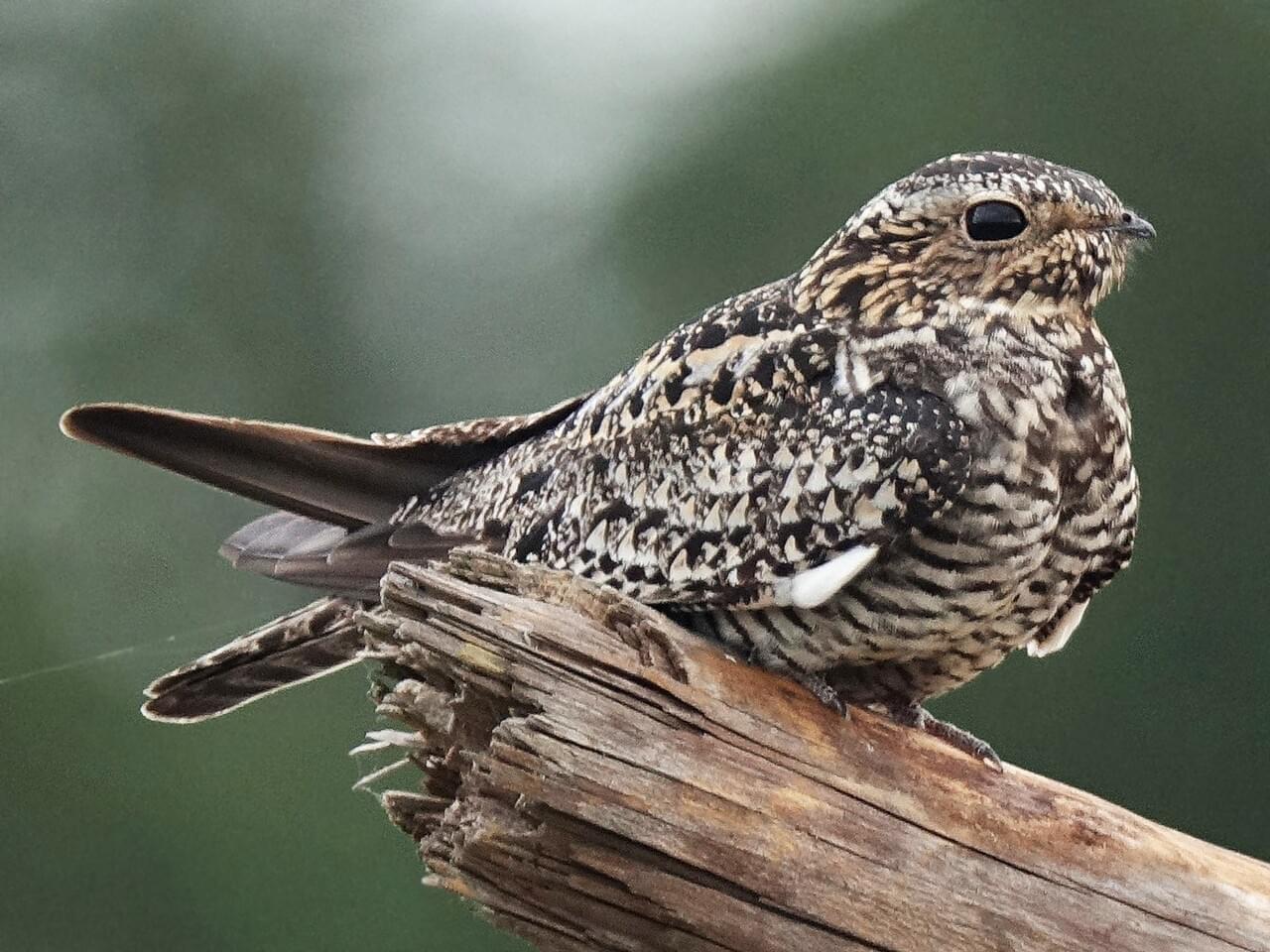
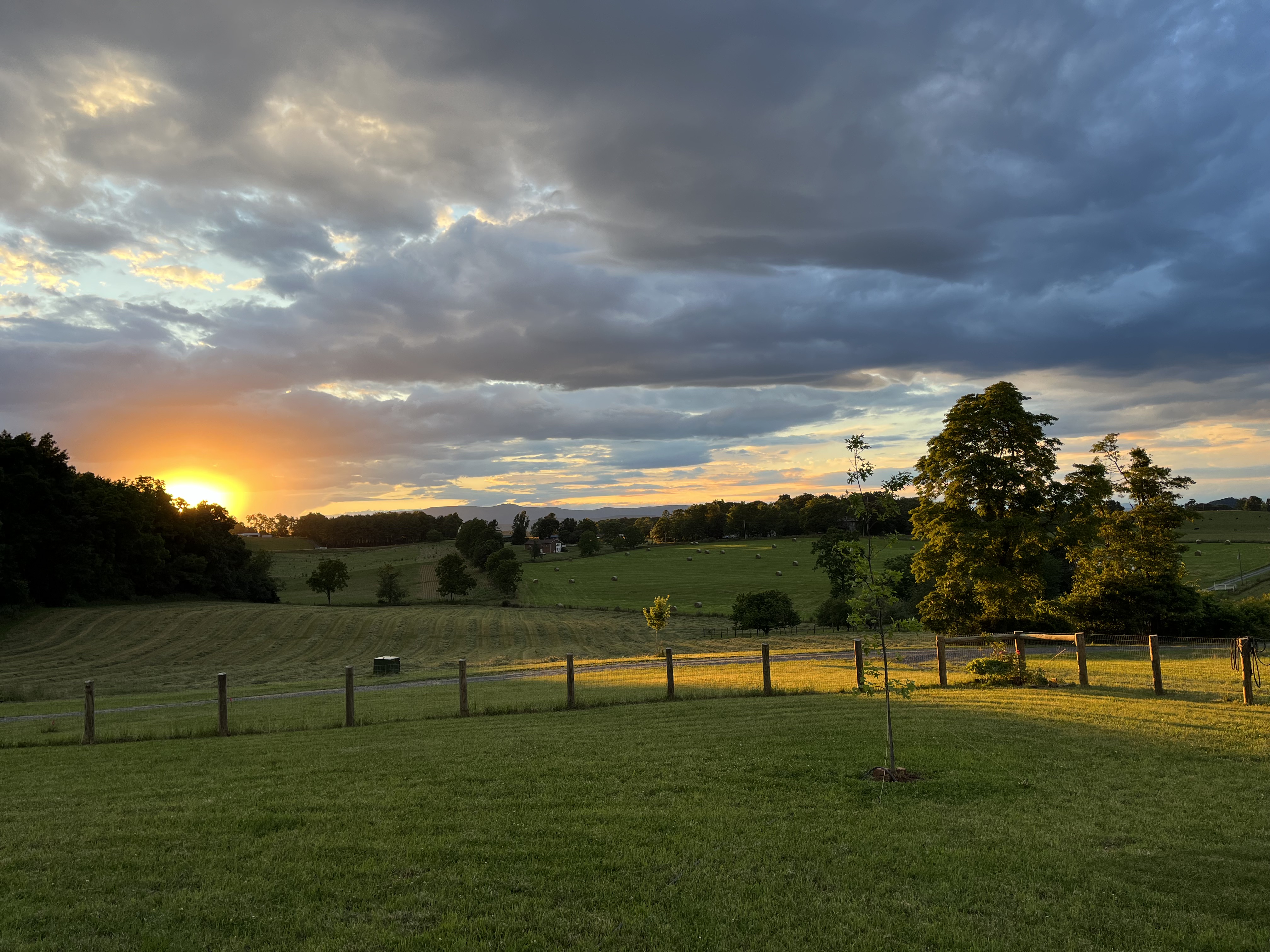
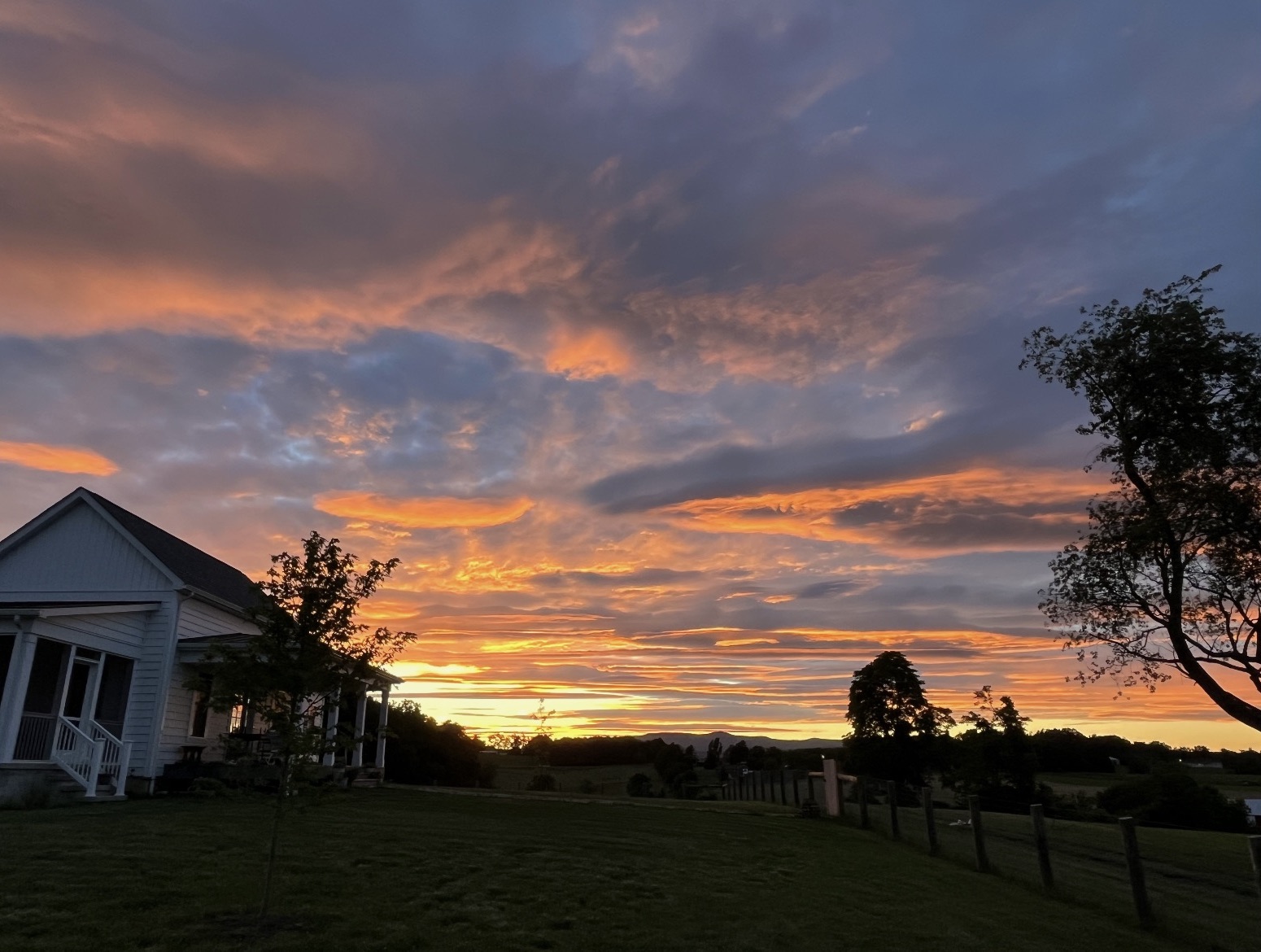
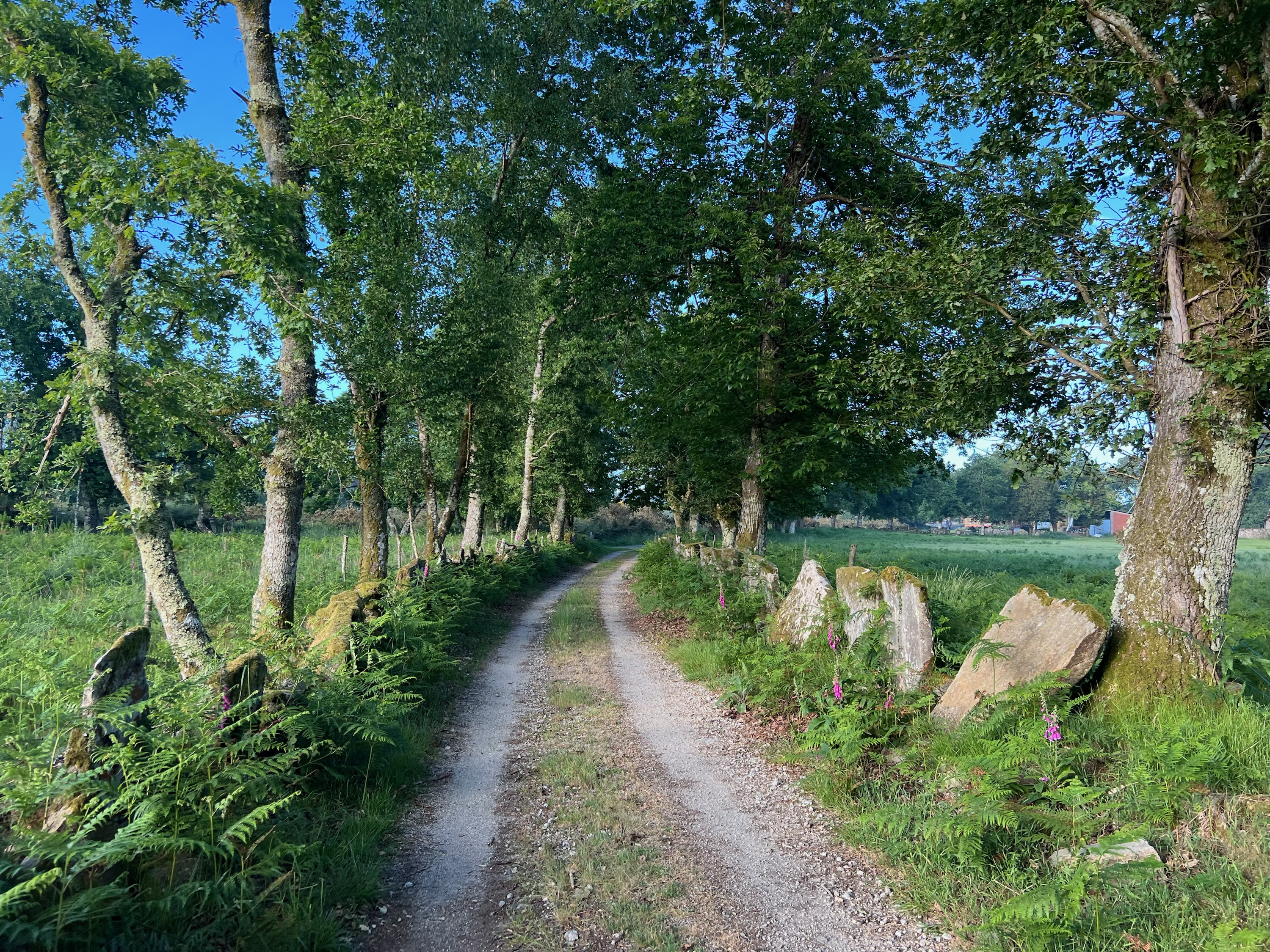
My thanks to a longtime friend, Chip Prehn, and to my brother, Greg, for the above photos. The first three come from Sassafras Farm, during haying season in Virginia, and the latter photo was taken while my brother was recently completing his fourth Camino de Santiago.

Andres Amador: Earthscape Artist

[If reading this by email, please tap the title at the top to open your browser for the best experience.]


Above we see a drone-based digital image of a pattern that a contemporary artist has inscribed upon the sand of a beach. He is also an academically trained scientist, who has employed his gifts in a particularly sensitive way.

Now, why are some or all of those details important? Because we see here the abilities of Andres Amador, someone whose public art work may lead us to wonder about how this artist could have accomplished all this. Not only in the image above, those presented below, as well as those widely available now on the internet.

Well, what would it take for you or me physically to be able to produce such an image upon the sand on a seaside beach? To my surprise, it is only geological timing (the tides); an appropriate location in relation to that matter of the tides; and then only a couple of simple tools. These would include some common and small garden rakes, and perhaps also – in relation to the circular-based patterns – a metal or wooden spike, a long rope, and some kind of carving or scraping tool at the end of that rope. The invention of the small drone with a camera has also been of help.

But, clearly, it takes more than physical circumstances, geography, and available tools. It also takes a scientifically trained sensibility as well as a developed intuitive creativity. What Andres Amador has accomplished and still produces is not in any way simple. And yet, he provides frequent teaching sessions, open to all, inviting others to do what he does. Insight about this is provided by a short but compelling video produced some years ago by KQED San Francisco (see link below). I think that one way to summarize a principal theme in his work is that he seeks to see things “whole,” which for some folks is related to seeing what is “holy.”

In that video, Amador describes two reference points, or two sorts of impulses within him, as sources for his earthscape art. “The two main directions that I go with, in the art, are {first} the geometric, which is very precise… So, it’s all about perfection.” Pattern can be imposed upon the ‘blank canvas’ of nature.

“The other {or second} side of it,” he says, “is the organic art, the art the feels like it is emerging from the location… the art that is telling me what to do next.” Pattern may therefore be in some sense received.

I find these two insights to be spiritually and theologically significant. We are able to impose pattern upon our lives, and often attempt to do this within the social world around us. At the same time, we may discern and receive pattern for our lives from within, whether from a divine or from a natural source, or through the gifts of others. Impose, and receive; both are important for our search to become whole.

God bless your continuing work, Andres, and especially for helping us perceive beauty in a fuller way.


Here is a link to the compelling KQED Andres Amador short video : https://www.kqed.org/arts/10134941/andres-amadors-earthscapes-art-that-goes-out-with-the-tide


The Beauty of the Night Sky

The milky way over an arch in Joshua Tree National Monument. © by CC Lockwood/ used with permission


Recently, a photographer friend, CC Lockwood, offered a welcome suggestion. Had I thought about doing a blog post on the beauty of the night sky? Not only did his idea inspire this new post, he was willing to let me include here two of his copyrighted photographs. They display well his masterful skill with a camera, especially in challenging circumstances. Following his lead, I will focus on the night sky theme here, and anticipate a proper focus on CC’s photography and books in a future posting.

Milky Way rising over the Davis Mountains. © by CC Lockwood/ used with permission

The allure of the night sky was recently and surprisingly brought home to me in, of all places, downtown New Orleans. For there, because of bright city lights, on a clear night you will see few or no stars at all from just about any location in the Central Business District or the French Quarter. Yet, sitting in New Orleans’ historic Saenger Theater for a concert, I was delighted and distracted by the ceiling overhead, mimicking the enchanting night sky, with subtle bulb-lights effectively representing sparkling stars and recognizable constellations. If you have been there, you will know what I mean.

One of my earliest memories of having a sense of wonder in response to the night sky goes back to our first house in a suburban area of Yokohama, Japan. My room had a built-in bunkbed. At the top of the ladder, at the foot-end of the bed, was a framed clear window. I remember moving my pillow near it, looking out on a dark and clear night, and marveling at the view of the stars above.

from Nepali Times

I also remember a late summer night in south central Minnesota, about ten years later. Some friends and I had decided to sleep out at a place at the edge of town. We not only had the benefit of a clear sky on a dark night, we saw a partial eclipse of the moon as well as some aurora borealis. It was an astonishing and memorable experience.

That we are still touched by such sights, especially when we get away from urban areas, tells us something. We are not so different from people who lived 2,000+ years ago in the Near East, whose words record a similar sense of marvel. “The heavens declare the glory of God, and the firmament shows forth his handiwork” (Psalm 19) These words spoke especially to me when I was camping on a then-somewhat-remote part of the south coast of Crete, preparing for Baptism, between terms at Oxford.

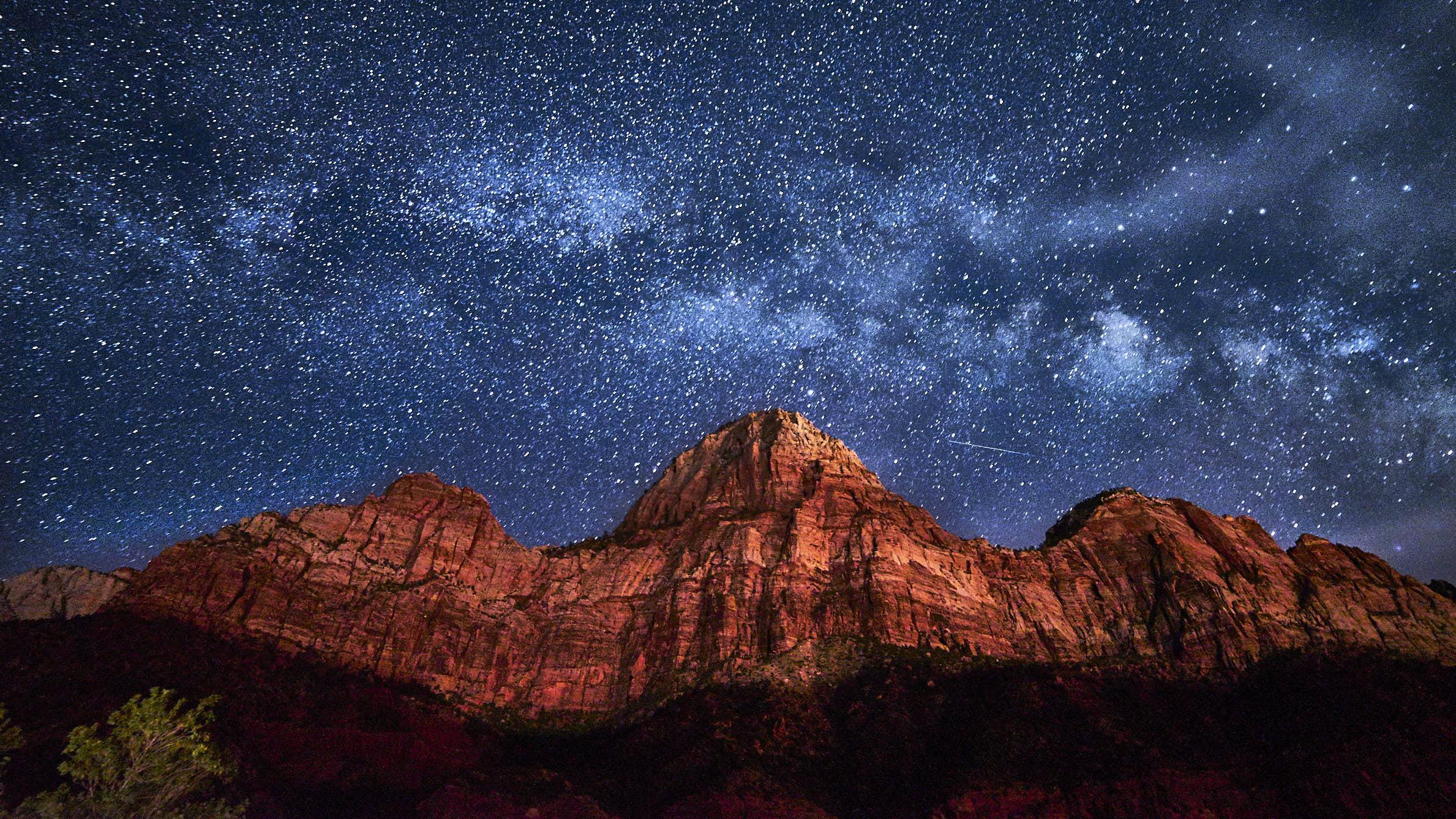
The image below, of the night sky over Zion National Park, reminds me of a more recent experience while camping on the south rim of the Grand Canyon. It not only brought home to me those words from Psalm 19, but also the story about God summoning Abram out of his tent to view the abundant stars in the night sky as a sign of God’s promises (Genesis 15; in an image much repeated in the following chapters and books of the Hebrew Bible). I cannot think of a more evocative place than the Canyon rim to say one’s morning prayers at sunrise, and especially one’s night prayers under the canopy of light above.

It is encouraging to learn how in recent years managers of a number of geographical locations have sought to establish no-light zones, precisely so that we might appreciate the glory of the night sky. The website, https://idahodarksky.org, has some very beautiful images of what may be seen at such a location.


To see more of CC Lockwood’s evocative photography, as well as to learn about his numerous books, you can visit his website here: https://cclockwood.com/

On Donkeys and Horses


I would like to return to a quote from Psalm 147:10, the wider significance of which may not be apparent. In my most recent post, I reflected on the contrast between the Psalmist’s assertion concerning God’s lack of delight in the strength of a horse, and God’s probable appreciation for the beauty of the same.

But what lies behind that stark observation by the Psalmist? The answer may be found in many images from within the Bible, and can most readily be seen in the dramatic story of Jesus’ entry into Jerusalem.

As James Tissot vividly portrays the moment, Jesus enters Jerusalem to acclaim and praise, riding on a donkey rather than a horse. At that time, many armed and horse-mounted Roman soldiers entered and left this city as they did to and from many others across the Empire. But not the Prince of Peace, who arrived without earthly weapons upon a humble beast of burden.

This is in keeping with a significant body of biblical imagery where horses are associated with military and / or government power. A most dramatic example is found in the story of the Israelites escaping from Egypt, pursued by “the chariots of Pharaoh and his army.” Exodus, in a passage often termed ‘The Song of Moses,’ gives voice to Israel’s joyful recollection about the event: “I will sing to the Lord, for he is lofty and uplifted; the horse and its rider has he hurled into the sea.”

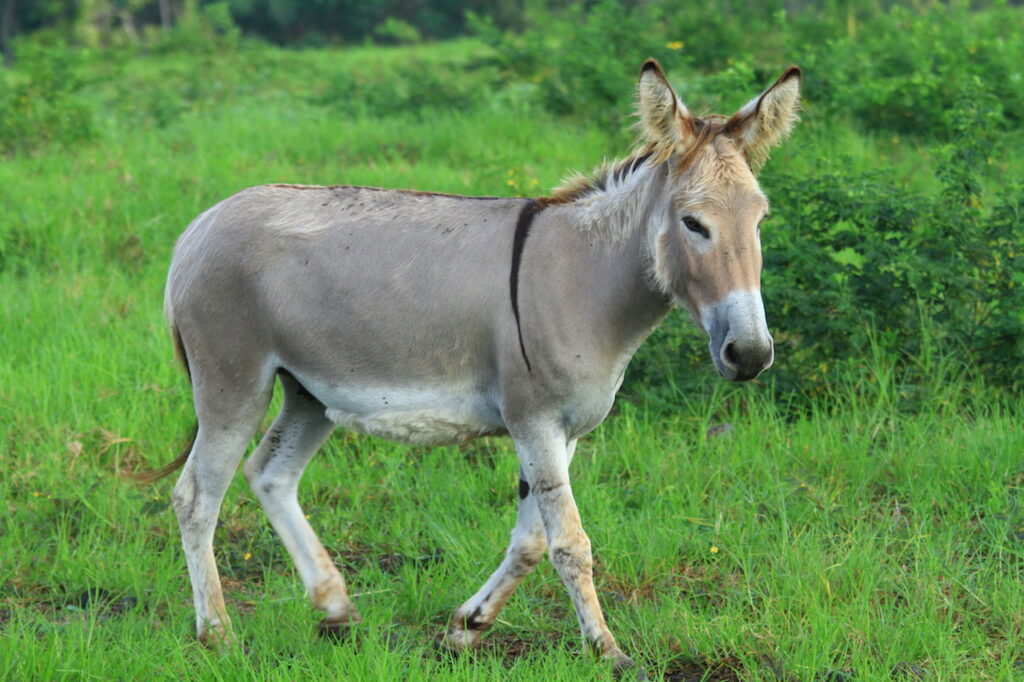
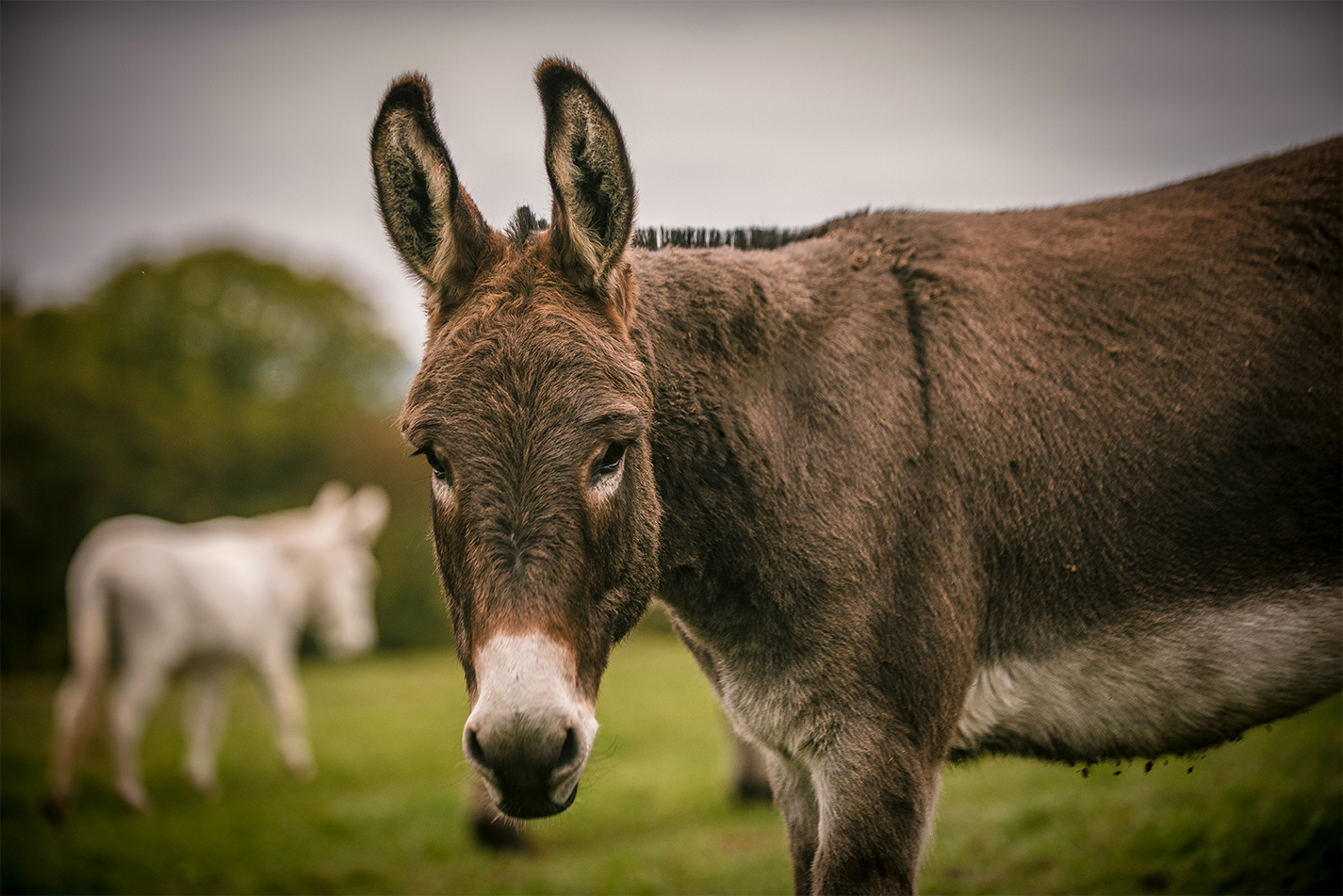
Jesus’ entry into Jerusalem on a donkey is not only a historical recollection; it also provides a legendary association with the unique physical markings of that animal. Donkeys have two perpendicular stripes on their backs, one running from the neck to the tail, and the other forming a cross as it runs down over the shoulders.

Hence, the poetic observation that the one who entered Jerusalem riding on a cross was lifted above it on a cross. The one who refused to enter the city posing as a challenge to military authority, was himself subject to its power and in its most brutal form. So, the one who arrived possessing spiritual authority chose not to act with worldly power. He was then subject to a military power whose authority was compromised.

As I have previously suggested, horses have provided an image of beauty through a long history of their portrayal in various art forms. Yet, those magnificent animals have an even longer history of association with military might and conquest, and the subjugation of peoples less prepared to defend themselves. Consider how the historically recent introduction of the horse transformed the lives of native American peoples and their community relations with others. Yet, the humble donkey (or burro or ass), more diminutive in stature, and which so readily bears our burdens, has a beauty of its own. Though sometimes less deferential to human guidance than many horses, a donkey’s physical presence is less likely to be intimidating despite its demonstrable strength and endurance.

The Beauty of an Appaloosa Horse

While composing a prior post on the beauty of a horse, I was reminded of a portion of the Pslams – “{The Lord’s} delight is not in the strength of the horse (PS 147:10).” Yet, God must surely delight in the beauty of a horse, a possibility that may have occurred to some of us during the recent Triple Crown racing season and / or through admiring Dega’s renditions of race horses. Perhaps the Lord especially delights in the breed of horses known as Appaloosa’s.

Traveling back and forth between Japan and my parents’ birth home area of Minneapolis, we met a family on one of the voyages across the Pacific who had a ranch in Montana. Among the many wonderful discoveries during multiple visits there was the beauty of the Appaloosa. A ‘spotted backside’ might not at all be desirable among humans and some other living beings, but in my view this common Appaloosa trait provides one of the most compelling amalgams of both solid color and random patterning that I know of in the animal world.

Most closely associated with the Nez Perce nation among indigenous American peoples, the breed initially suffered along with the decline of the community propagating its existence in the latter 19th century. Yet, despite that sad history, and perhaps because of its compelling beauty, the Appaloosa breed of horses has since thrived.

Our friends’ ranch had numerous Appaloosas, but three that I remember fondly, and for differing reasons. One, named Lonesome, a striking looking horse, had Thoroughbred blood lineage and was tall and slim, with a reputation for being occasionally arbitrary as was another more dramatically colored one named Blue. Leo, like Lonesome, was mostly spotted all over but, when first seen with his more compact and robust physique, could be identified as having an American Quarter Horse lineage.

My favorite, the one with whom I became most familiar, was Marble, a mare of not-readily-evident Appaloosa lineage, among which some are almost white and others appear almost black. Marble looked like a common brown Morgan horse, except for one distinctive detail – she had one blue eye, like one sees in some Australian shepherd dogs. Unlike the sometimes mercurial Lonesome, and the sometimes stubborn Leo, Marble would let me bridle her in the pasture, lead her into the stable next to the tack room, and saddle her without much difficulty.

An Appaloosa gelding, with a Morgan-coloring like “Marble” (note the slight brindle pattern)

The patterned coat commonly associated with Appaloosa horses may be an acquired taste, much like variegated plants among gardeners. I find horses of this background stunning to look at, and I especially appreciate how they have often been portrayed in Western art, such as in the paintings of Charles M. Russel (whose expressive Western-themed paintings I hope to feature in a future blog). It tells us something about the aesthetic sensibility of the Nez Perce that they they would have pursued breeding and cultivating the bloodline of these horses, not only for their utilitarian value but also for their sheer beauty.

The Beauty of Ansel Adams’ Vision


Here is one image of Ansel Adams’ encounter with the evocative forms, textures, and light-sensitive surfaces of the historic church in Taos, New Mexico.

Here is another of his images of the same church, from the east end:

Adams’ attentiveness to the features of the natural world, and with his particular eye to the dynamic interrelationship between light and dark, helped him to create a legacy of compelling photographs that continue to be a source of allure for those who love photography. Many of us find especially compelling his winter images, as well as those of Yosemite and northern New Mexico, where he spent so much time in the field.

Adams’ photographs often prompt me to think of John’s Gospel. This is because of Adams’ and John’s mutual interest in the juxtaposition of light and dark, and the dynamic relation between the two in our perception and experience. Given our present physical as well as spiritual existence in this world, and considering the terms of successful photography, the presence of the dark helps us appreciate the beauty of light.

A technical inquiry into Ansel Adams methods, about how he photographed scenes with film-based cameras, helps us appreciate the significance of his technique. He used lens filters to highlight visual contrast, and was equally attentive to the composition of the chemical baths used for developing the negatives and the subsequent prints made from them. Noticing and considering these aspects of his creative work helps us appreciate how the ‘given-ness’ of what he saw was also shaped by how he came to render and present it. If he had been a religious man, he might have attributed some of this ‘rendering process’ to the shaping power of the grace of the Holy Spirit.

The Gospel writer, John, in receiving, interpreting, and then presenting Jesus and his ministry, as well as Jesus’ life and death, had a similar challenge. There was the ‘given-ness’ of Jesus’ teachings, signs or mighty acts, and his powerful presence in the eyes of many. Yet, John, led by the Holy Spirit, has given us a marvelous Gospel shaped by the spiritual dialectic between light and dark. And this is what brings to mind the ostensibly secular parallel provided by Ansel Adams’ portfolio. Among several passages in John, consider the marvelous account of Nicodemus’ visit to Jesus by night in chapter 2. And John, alone among the Gospels, records Jesus as saying, “I am the light of the world; whoever follows me will not walk in darkness, but will have the light of life.”

Perhaps, when we are brought to the hoped-for ‘other side,’ we won’t experience a contrast between light and dark, but rather something more like a contrast among various captivating colors. Yet, while in this world, and while our lives remain colored by sin, we see, and we see better, when we are blessed by the perception of contrast between light and dark.

A ‘both-and’ approach to what we encounter in life may be congenial and even comforting when we deal with paradox and contradiction. But, an either/or challenge to our preferred ways of seeing things can be bracing and helpful for our perception. This is one reason why, even though most of us see the world in color, black and white photographs can be so evocative. As John recognizes in his Gospel, the darkness that has not overcome the light helps us recognize the Light of the world.


In memory of Robert (Bob) Bolton of Albuquerque, NM (1948-2022).