Painting

Holy Fear

[If reading this by email, please tap the title at the top to open your browser for the best experience.]

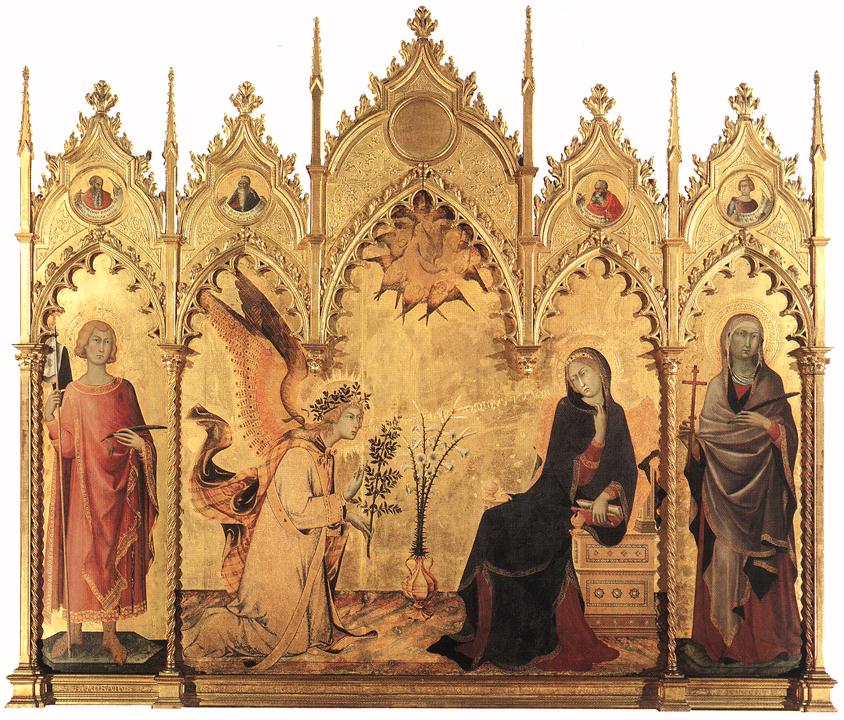
Simone Martini, Annunciation {detail} (1333)


It is easy at this time of the year to think of our observance of Christmas as being all about good news, the celebration of love, and “tidings of comfort and joy.” We find a caution with regard to this assumption within so many biblical texts, but especially within Matthew’s and Luke’s infancy narratives.

Consider for a moment how often the phrase, “fear not,” appears in Scripture. Encounters with the divine presence, whether directly as in Moses’ and Elijah’s experiences, or through the medium of an angelic messenger for Mary and Joseph, typically inspire fear about the prospect of coming into contact with the source of all goodness and holiness.

For me, one of the most compelling quotations from the Authorized or King James Version is that which we hear every year in the broadcast of the service of Nine Lessons and Carols from King’s College, Cambridge.

And in the sixth month the angel Gabriel was sent from God unto a city of Galilee, named Nazareth, to a virgin espoused to a man whose name was Joseph, of the house of David; and the virgin’s name was Mary. And the angel came in unto her, and said, Hail, thou that art highly favoured, the Lord is with thee: blessed art thou among women. And when she saw him, she was troubled at his saying, and cast in her mind what manner of salutation this should be. And the angel said unto her, Fear not, Mary: for thou hast found favour with God. (from Luke 1:26-35)

It is no surprise that, when she saw the angel, Mary was troubled, and wondered what form of greeting this may have been.

Simone Martini’s Annunciation altarpiece has long been one of my favorites in this genre, especially with its glorious gold-leafed background and stunningly carved woodwork. But most compelling for me is the way that God’s angel, depicted kneeling, greets Mary with the words of salutation literally cut into the surface of the painting’s wooden panel. Mary’s recoil at the encounter involves – I think – several dimensions: an innate humility along with a pious regard for the presence of divinity; an accompanying holy fear; and a natural human reticence about such an intimate encounter. Notice how she is shown pulling the collar of her cloak about her neck.

Note also how the angel bears what appears to be an olive branch of peace, and how a vase of lilies stands between them, a symbol as we have seen of both Mary’s purity and of the resurrection that will be gifted to God’s people through the Incarnation of her promised yet improbable offspring.

In considering all of the above, I encourage you to look up Exodus 24, especially verses 9-11. You may well be surprised by what you read there, an unexpected anticipation of what we celebrate at this time of year!

Martini’s complete altarpiece


If you wish to have greater access to biblical texts, and with multiple translations freely available, I recommend http://www.biblegateway.com, with which I have no professional or financial connection.

The Holy Name

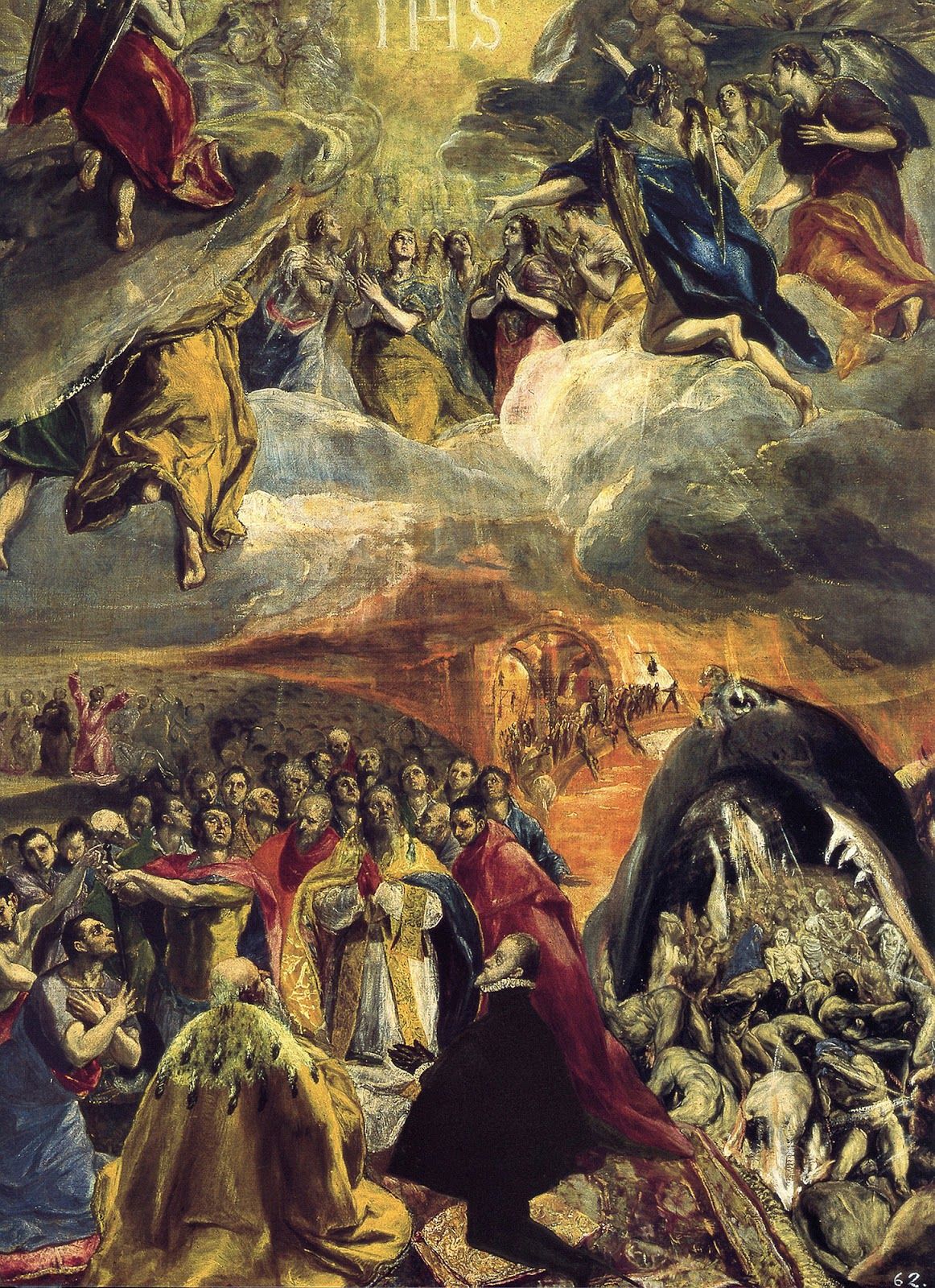
El Greco, Adoration of the Holy Name of Jesus (1579)


Today is the Feast of the Holy Name, otherwise commonly known as New Year’s Day. The traditional name for this day on the Church’s calendar refers to the event of Jesus’ circumcision and his naming on the 8th day. Most of us are well familiar with his name, but not necessarily with its origin.

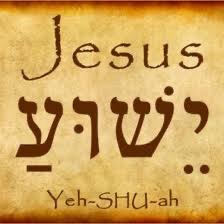
As we recently noted with regard to Alexander Ivanov’s painting of the Annunciation to Joseph, when the angel appeared to the latter in a dream, Joseph was instructed to anticipate the birth of this holy child, and to name him Jesus. The following image helps us appreciate why:

Jesus is an anglicized form of the name we know from the Old Testament as “Joshua,” or from the Hebrew as “Yehshuah.” And why would this divinely promised child be named in this way? Because Joshua was God’s faithful servant who led God’s people across the Jordan River into the Promised Land.

El Greco’s painting depicted above may not be immediately clear in its connection with this feast day. The letters, IHS, at the very top of the painting represent a Latin transliteration of the first letters of Jesus’ name in Greek. Figures in heaven, joined by the angels, are shown in adoration of the divinely revealed name, and its salvific significance. Human figures, including Philip II of Spain, a Pope, and other notables, are depicted in the foreground, who gather in prayerful regard for the same. Paradoxically, to the side of this pious gathering we find the yawing jaws of hell, in an image that may owe something to Hieronymus Bosch, portraying the suffering and demise of those who refuse to acknowledge that same name, and the saving reality it represents.


I think of and pray for my nephew, Joshua (‘Yeshuah’), and his family on this day.

Annunciation to Mary

Luc-Olivier Merson, Annunciation (1908)


Having begun this series with a painting of the Annunciation to Joseph by Alexander Ivanov, and having featured Luc-Olivier Merson’s painting of the Flight into Egypt, I would like to offer Merson’s less-well known but equally memorable depiction of the Annunciation to Mary.

Unlike many Annunciation paintings, Merson does not focus on the encounter between two personal beings. His Annunciation is not colored by the dynamics of male-female interaction, a theme that so absorbs our present culture, and implicit in some historical treatments of the moment. Here we have a feminine or an androgynous angel, who instead of being face-to-face with Mary, hovers above another building.

I think Merson depicts the moment just after the angel shares the news with Mary, and before she sings her magnificat. Mary is wrapped in white, suggesting her purity, but also prefiguring the burial shrouds with which her son will be wrapped. Her gaze is focused on the unlikely stem of lilies she finds on the ground, outside a dark open doorway through which she emerges. Both symbolize resurrection. Doves grace the air in the foreground, a traditional way to suggest the presence and activity of the Holy Spirit.

Rather than gesturing toward Mary, the angel points to the heavens! Here we find a spiritual sign in accord with the Gospel. It depicts a call. The scene symbolizes what God is doing, and what God wants to accomplish.

May our Lord, who was and is, and is to come, bless us and our loved ones during this holy time.


For a more extended reflection on Merson’s Annunciation painting, some comparison with the rather different Annunciation image on the Santana Abraxas album cover, and in relation to the Gospel for the 4th Sunday of Advent, click this link: Advent 4 B 14 copy_for 2022 blog_PDF

[If reading this by email, please tap the title at the top to open your browser for the best experience.]

Flight to Egypt

Luc-Olivier Merson, Rest on the Flight to Egypt, 1880


“Now when [the wise men] had departed, behold, an angel of the Lord appeared to Joseph in a dream and said, “Rise, take the child and his mother, and flee to Egypt, and remain there until I tell you, for Herod is about to search for the child, to destroy him.” And he rose and took the child and his mother by night and departed to Egypt and remained there until the death of Herod. This was to fulfill what the Lord had spoken by the prophet, ‘Out of Egypt I called my son.’” (Matthew 2:13-15)

With the threat of the impending massacre of the Holy Innocents, the feast day for whom we commemorated yesterday, the Holy Family of Mary, Joseph, and Jesus, fled to Egypt. Matthew’s Gospel briefly refers to this event. Their journey to Egypt, and eventual return, recapitulated Israel’s historic sojourn to and escape from that land and the tyranny of Pharaoh.

Luc-Olivier Merson’s painting, above, depicts in a romantic 19th century way a moment on the family’s journey.


Here is a link to a prior blog posting with a more extended reflection upon Merson’s painting: https://towardbeauty.org/2020/01/13/light-in-the-darkness/


The Holy Innocents


Peter Bruegel the Younger, The Massacre of the Innocents, late 1500’s


During these twelve days commemorating biblical events that we associate with Christmas, we return to another winter image from Peter Bruegel, in this case probably by Peter the Younger. Like the Bruegel painting of the Census at Bethlehem, shared with you previously, this is another favorite of mine.

Today, December 28, is the day on which the western Church remembers the event recorded by Matthew in his Gospel (2:13-18), wherein the wicked King Herod turned his fearful wrath upon the children of Bethlehem in Judea.

Herod was rightfully insecure about his throne and reign, having been propped up in the role by the Romans and others, and apprehensive about potential rivals. Imagine his anxiety when apparently wealthy astrologers arrived from a foreign land bearing reports regarding one who would be born “King of the Jews,” especially when these visitors expressed a desire to worship this anticipated newborn.

Once again we marvel that in our calendar for the 12 Days of Christmas the Church should commemorate those, like St. Stephen and the Holy Innocents, whose death gave tribute to the Lord of Life and the King of kings.

From the Book of Common Prayer:

“We remember today, O God, the slaughter of the holy innocents of Bethlehem by King Herod. Receive, we pray, into the arms of your mercy all innocent victims; and by your great might frustrate the designs of evil tyrants and establish your rule of justice, love, and peace; through Jesus Christ our Lord, who lives and reigns with you, in the unity of the Holy Spirit, one God, for ever and ever. Amen.”


[If reading this by email, please tap the title at the top to open your browser for the best experience.]

Glory to God in the Highest

James B. Janknegt, Glory to God in the Highest


Luke’s Gospel portrays the birth of Jesus in the context of literal good news for the poor and those who are outcast. In Luke’s telling, angels announce the arrival of the Messiah to shepherds sleeping out in the fields or in caves with their flocks. As we shall note soon, Matthew casts these events in a more worldly and political context, with visiting Magi from the East, and Herod’s anxiety about a challenge to his propped-up throne.

Jim Janknegt is a painter whose thoughtful and creative engagement with the Scriptures I have admired for years. He paints in a style that some might describe as ‘primitive.’ Yet, in my view, he is an artist whose work often displays a highly sophisticated engagement with multiple dimensions of the biblical texts that shape our worship in both this and in other liturgical seasons. As the above image suggests, he also demonstrates a sensitive and wide-ranging color palette.

On this third day of Christmas, which is also the feast of St. John, the Apostle and Evangelist, I am grateful for Janknegt’s portrayal of the shepherds receiving and rejoicing over the witness of the holy angels.

As we sing in a favorite hymn:

Angels we have heard on high,
singing sweetly through the night,
and the mountains in reply
echoing their brave delight.

Gloria in excelsis Deo.

Shepherds why this jubilee?
Why these songs of happy cheer?
What great brightness did you see?
What glad tidings did you hear?

[repeat chorus]

Come to Bethlehem and see
him whose birth the angels sing;
come, adore on bended knee
Christ the Lord, the newborn King.

The Hymnal 1982, #96

To learn more about the artist, James B. Janknegt, and his work, click this link: http://bcartfarm.com/index.html

[If reading this by email, please tap the title at the top to open your browser for the best experience.]

… On the Feast of Stephen

Music and Illustration related to the Christmas Carol, Good King Wenceslas, from 1913


For our brothers and sisters ‘across the pond’ in the U.K., today is Boxing Day. The name comes from the tradition of giving boxes or baskets of Christmas gifts to family, friends, and employees, on December 26. Today is also the feast of St. Stephen, my patron saint. We have a familiar Christmas carol associated with this day.

From Wikipedia:

“Good King Wenceslas” is a Christmas carol that tells a story of a Bohemian king who goes on a journey, braving harsh winter weather, to give alms to a poor peasant on the Feast of St Stephen. During the journey, his page (or helper) is about to give up the struggle against the cold weather, but is enabled to continue by following the king’s footprints, step for step, through the deep snow. The legend is based on the life of the historical Saint Wenceslaus I, Duke of Bohemia (907–935).

The fact that the Church, in its historical liturgical calendar, would remember the first of the martyrs on the second of the 12 Days of Christmas bears some reflection. Here, below, is a panel of a compelling contemporary triptych painting by the gifted British painter, Peter Koenig, depicting the martyrdom by stoning of Stephen (see Acts, Chapters 6 – 7). Against the backdrop of the spires and walls of an image of the new Jerusalem come down from heaven (in the upper left), we find Stephen holding a chalice of the ‘the blood of the new covenant’ outside the walls of the ‘old city,’ the world in which we presently live.


Arrival at Bethlehem

Pieter Bruegel the Elder, Census at Bethlehem, 1566


In one of my favorite paintings for this time of year, we find the Holy Family arriving at Bethlehem just at sunset on what might have been Christmas Eve. Mary on a donkey, in the center foreground, is led by Joseph toward what appears to be a crowded inn, a likely location for where the census was taking place. (See Luke 2:1-7.)

We approach this holy feast time like Mary and Joseph, with anticipation, yet not fully aware of the glory that is to be revealed to us.

May our Lord, who was and is, and is to come, bless us and our loved ones during this holy time.
Annunciation to Joseph

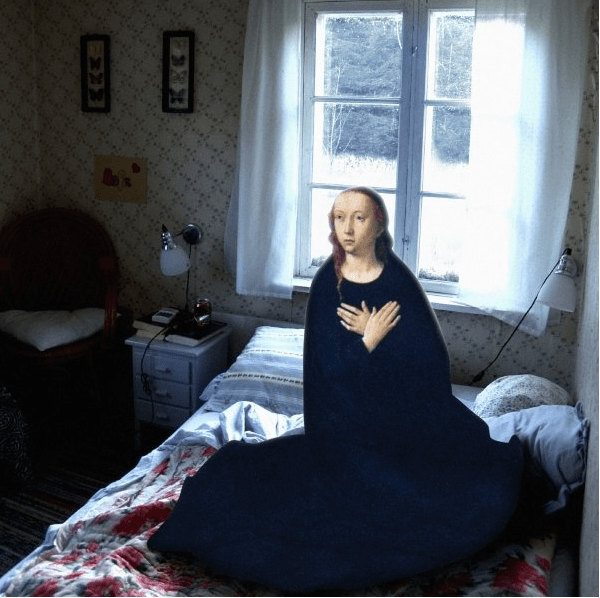
Alexander Ivanov, Joseph’s Dream


Here I begin sharing a series of images for the 12 days of Christmas, including two prior events as well as some that follow the Nativity. Christmas Day, Dec. 25, is officially the first of the 12 days. Yet, as we anticipate the holy season ahead, it is appropriate to remember and consider what prepared the way for the miracle we are soon to celebrate.

In this new Revised Common Lectionary year, which focuses on Matthew’s Gospel we hear of an Annunciation to Joseph (Matthew 1:18-25), less familiar to most of us than the Annunciation to Mary as recorded by Luke. Joseph was as attentive to his Annunciation as Mary was to hers. And like her, he was equally trusting and obedient.

May our Lord, who was and is, and is to come, bless us and our loved ones during this holy time.
Lo! He Comes with Clouds Descending (The Beauty of His Return)

Jim Janknegt: I will make all things new (2005)


The title of this post comes from Charles Wesley’s hymn-text adaptation of words from Revelation that refer to the Second Coming of Christ in glory: “Behold, he is coming with the clouds, and every eye will see him, even those who pierced him, and all tribes of the earth will wail on account of him” (Rev 1:7). In this first week of Advent, and perhaps having sung Wesley’s hymn on Sunday, we need to explore what this ‘wailing’ may involve.

Many people today regard the Second Coming as something prompting fear about a Final Judgment. This may be one cause for the wailing that Wesley anticipates. Though texts in Revelation, as well as in the Gospels, certainly involve this theme, Revelation’s author is also very clear in expressing a faith that Christ’s return will involve restoration, the fulfillment of promises, and the beauty of shared glory. Hence, the wailing may also reflect holy sorrow stemming from a deepened awareness of personal sin, accompanied by ‘tears of joy’ over being forgiven.

Wesley’s verse 2 of his hymn predicts the first dimension of wailing: “Every eye shall now behold him, robed in dreadful majesty; those who set at nought and sold him, pierced, and nailed him to the tree, deeply wailing, … shall the true Messiah see.” Verse 3 describes the second dimension: “Those dear tokens of his passion still his dazzling body bears, cause of endless exultation to his ransomed worshipers; with what rapture, … gaze we on those glorious scars!”

Words in Revelation, preceding and following its prediction about how “all tribes of the earth will wail,” provide a foundation for hope. The author says at the beginning of this last book of the Bible (1:4-5), “Grace to you and peace from him who is and who was and who is to come, and from … Jesus Christ the faithful witness, the firstborn of the dead…” And then (in 1:8) we find, “‘I am the Alpha and the Omega,’ says the Lord God, ‘who is and who was and who is to come…’”

These words are echoed near the end of Revelation, where we find a description of the New Jerusalem and a renewed Creation. Among them are these: “And he who was seated on the throne said, ‘Behold, I am making all things new'” (21:5).

Jim Jaknegt’s painting, I will make all things new, expressively captures the positive dimension of these themes and the ground for hope that lies in the beauty of the Lord’s return. All things! That is a phrase worth exploring in terms of quite a number of biblical texts, especially Paul’s letter to the Colossians.

In the first chapter, Paul writes, “For by him all things were created, in heaven and on earth, visible and invisible, whether thrones or dominions or rulers or authorities—all things were created through him and for him. And he is before all things, and in him all things hold together” (1:16-17). Paul then indicates (1:19-20) the ground for hope regarding “all things,” which Janknect suggestively depicts: “For in him all the fullness of God was pleased to dwell, and through him to reconcile to himself all things, whether on earth or in heaven…”  God’s ultimate goal in all this is reconciliation rather than condemnation, even though people who dismiss God’s ongoing work of reconciliation may find themselves brought to sadness.

Notice the pronounced swirling motion in Janknegt’s painting, as all things are caught up into the returned Lord’s orbit. But all people? For unlike flora and fauna, as well as inanimate objects, human beings made in God’s image and likeness possess the freedom of will either to accept or to refuse God’s initiatives to reconcile us into divine intimacy. This is why there may be at least two dimensions to the wailing that the Lord’s return is likely to initiate. For grief over sin may bear fruit in repentance.

We should therefore note the words of invitation at the end of Revelation: “‘Surely I am coming soon.’ Amen. Come, Lord Jesus!” (Rev 22:20)


Jim Janknegt is a painter who is based in the Austin, Texas, area, who has produced a remarkably large body of work based on biblical themes and imagery. The website featuring his work can be found at http://bcartfarm.com/ I have admired, and with his permission have featured, his images for many years. Lo! He comes with clouds descending appears as Hymn 57 in The Episcopal Church’s The Hymnal 1982.