Marc Chagall

Wrestling With God

Marc Chagall, Jacob Wrestles with the Angel (and receives a blessing)

Recently, the Lectionary included a familiar reading from Genesis (chapter 32). It describes Jacob’s dilemma concerning his brother, Essau, from whom he is alienated. Alone at night in the wilderness, Jacob lays down on the ground and places his head upon a stone to sleep. In the darkness, Jacob then contends with an angel in what becomes a wrestling match that lasts through much of the night.

In parsing the elements of this deeply symbolic story, we must remember that in much of the Old Testament, angels appear and act as divine representatives. They also function as a literary device where the angelic figure is a stand-in for God. This is why it is appropriate to read this passage as a story about Jacob wrestling with God, as well as the more literal reading of it as an account of his wrestling with an angelic being. In either case, we are right to understand that the story portrays Jacob’s struggle to discern, and then accept, God’s will for him and for his future.

We are told that Jacob is fearful about meeting Esau, who is traveling with a large band of men. For, as we may remember, Jacob has wronged his brother by ‘stealing’ Esau’s birthright blessing, which Esau was to have received from their father, Isaac. As recorded in a well-known earlier story, Jacob had deceived their aged father by masquerading as his twin brother, who was only-minutes-older than him, thus receiving the blessing that Isaac had intended for Esau.

Now, with our modern understanding of psychology, contemporary readers of the nighttime angelic wrestling story may prefer to understand it as simply a symbolic portrayal of Jacob’s wrestling with his conscience. Though partly true, accepting such a univocal reading of the story comes at the expense of a profound dimension of the narrative. For this episode is what students of the Bible call a ‘theophany,’ a story about divine self-revelation, as Jacob himself (as well as the narrator) understood it to be.

So how might we appreciate this story of a nighttime struggle, involving unresolved aspects of a particular person’s history having to do with family relationships, as well as recording a pivotal moment within his long term quest for divine guidance?

I find it helpful to read the story within the following interpretive framework. When we refer to ‘struggling with God,’ I believe that what we often mean is our struggle to accept what we perceive to be (or suspect is) God’s will for us. As such, it has much to do with our understanding of prayer.

Jacob Wrestling With the Angel (attribution uncertain)

As I noted in a recent post, our Prayer Book teaches us that prayer is first of all a matter of responding to God. Responding to God, and responding to our perception of God’s will for us, are not often automatic or straightforward activities. Our natural disposition may be to fall back into thinking of prayer as enacting our desire to bring God’s will into accord with our own wants and hopes. For our prayers may often take this form. Yet, prayer is most holy when prayer is pursued in a way where we give ourselves up to an acceptance of our real need, not our wants. This is to accept our basic need for our wills to be brought into accord with the divine will. When this comes to be our more usual pattern of response to God, we are less likely to find ourselves having the feeling that we are struggling with God, and more likely to experience the peace of living harmoniously with God’s hopes and plans for us.
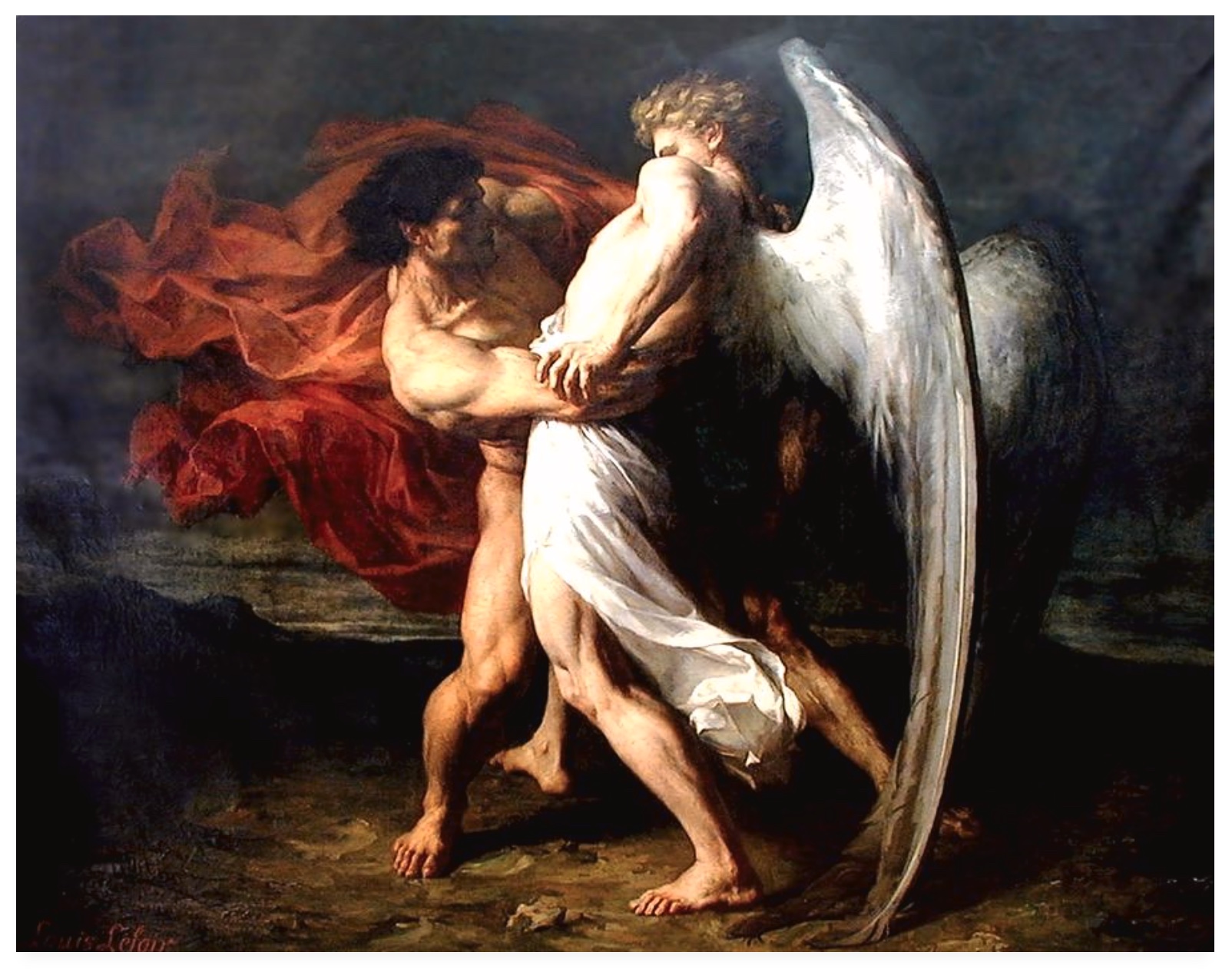
Alexander Louis Leloir, Jacob Wrestling with the Angel

When the Genesis story refers to Jacob’s having prevailed we will do better than to settle for the conclusion that he has ‘won’ or achieved a goal. Jacob hung on to the angel; he did not let go. And in the process he came to have a limp, the struggle having dislocated aspects of his prior way of being. The limp was therefore less a sign of an injury and more a sign of a deep change within him, and within his mode of engaging the world that lay before him. Jacob could then utter his famous words: “For I have seen God face to face, and yet my life has been delivered.” Encountering God’s awesome and holy presence did not consume him as fire would dry tinder. Instead, Jacob was transformed, and received a new name, Israel.

Responding to God – and God’s will for us – with acceptance, will likely disrupt aspects of our present ways of living. And we may feel that some important parts of our lives, even of ourselves, have been dislocated in the process. But if we cling to God, even through the feeling of struggle, with the aim of coming to be more fully in accord with God, and God’s ways, we will be blessed, just as Jacob was.


Note: among the many symbolic elements in Chagall’s painting, shown at the top, you might see if you can discern elements of the larger context of Jacob’s story, including those related to Joseph, in Genesis.
Comfort Ye My People

[If reading this by email, please tap the title at the top to open your browser for the best experience. Then, clicking individual pictures will reveal higher resolution images.

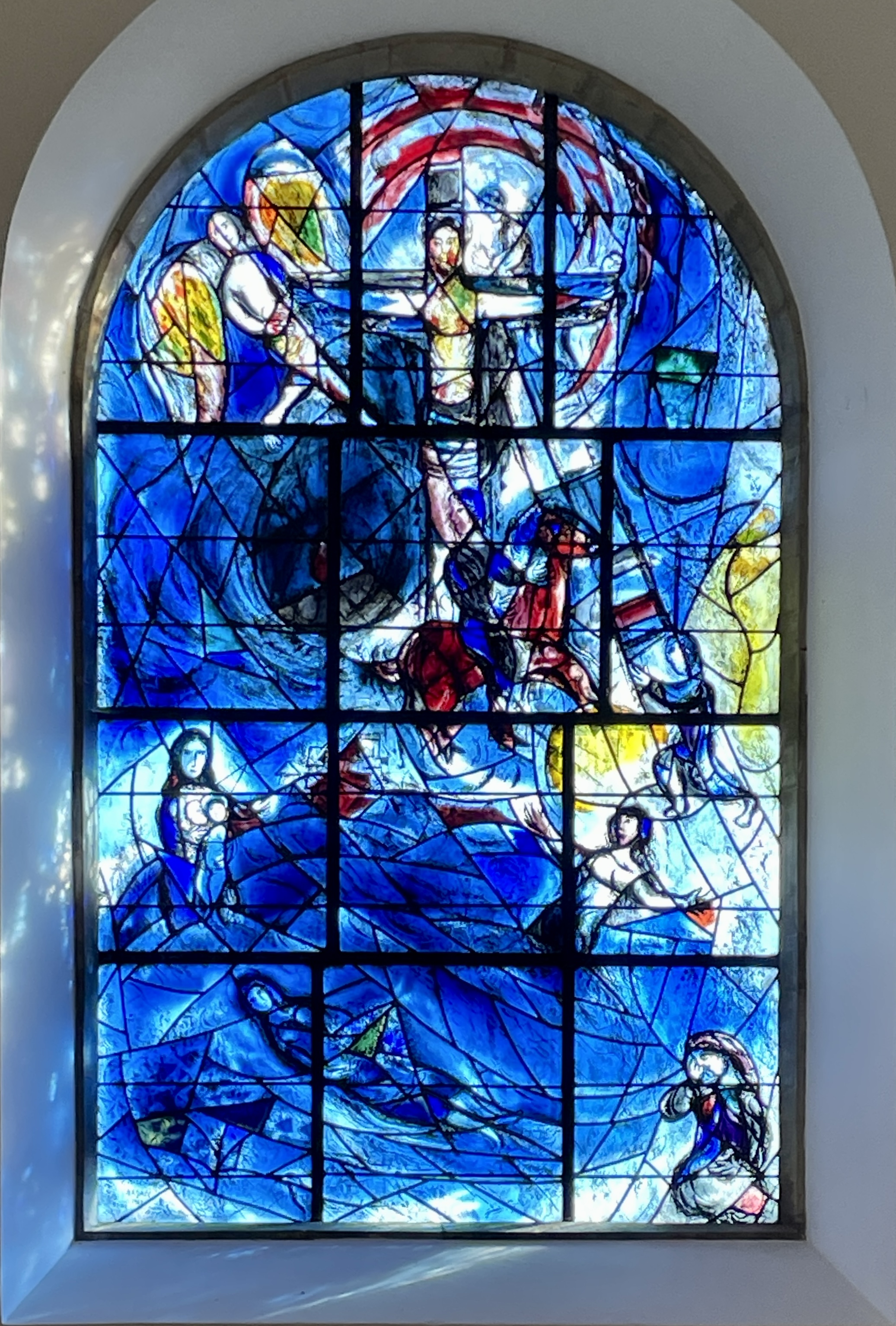
Marc Chagall, Memorial Window, All Saints Church, Tudeley, Tonbridge, UK


As a priest and from recent personal experience, I know how these weeks are a tender time for many of us. Especially for those who have lost loved ones at this time of year. Finding consolation and hope after losing the tangible nearness of a beloved family member or friend is hard at any time. Faced with such a loss or its memory around Christmas, how do we find comfort and reassurance in this season? Are “the hopes and fears of all the years” really met in Him, even now?

I find help with questions like these in what may seem an unlikely place: a beautiful window by an artist whose upbringing was shaped by Hasidic Judaism, placed over the altar of an Anglican church (shown above). It was designed by Marc Chagall for All Saints Church, Tudeley, in England.

Chagall was commissioned by a grieving couple to design this window as a memorial for their adult daughter who drowned in the sea. She is portrayed below the waves in the lower portion of the window, with what appears to be her grieving mother near her feet. We find here an unexpected coupling of images that frequently appear in Chagall’s work. Seeing his depiction of a crucified man juxtaposed with that of a mother and child surprises many Christians when they learn of Chagall’s Judaism.

The imagery in Chagall’s window may seem like an unusual choice for this holiday time. Yet, it fits. Though he often painted crucifixion images in his work, the artist had in mind the suffering of Jews through the centuries, and especially in his own time. In a similar way, he thought the portrayal of a mother and child, so familiar in Christian iconography, was a universal image within human experience. Chagall believed that the Christian conscience could be touched by familiar images from the Gospels, but which were also deeply resonant for Jews based on Hebrew Bible antecedents.

This is why I think that Chagall’s art might speak to us in this season. After all, the one whose birth we celebrate at this troubled time in the world awakens hope in us, hope for new life through the renewal of our shared humanity. Our Christmas hymns touch upon this theme. And, of course, the child born to Mary and Joseph was destined – as was prophesied – for the fall and rise of many (Luke 2:33-35).

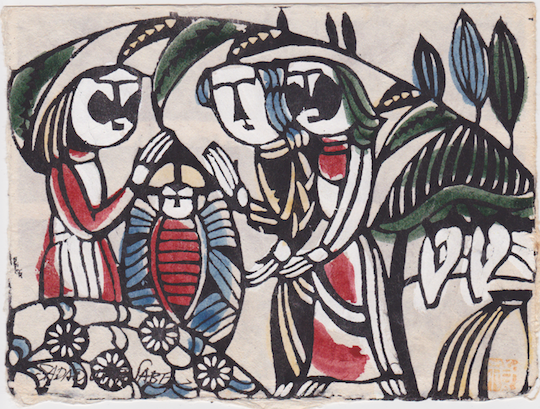
Christian artists through the centuries have been captivated by many aspects of our Lord’s Nativity. Countless examples of their work have sought to express our impression of the circumstances of Jesus’ birth, and its significance for the world, not just for his immediate family. It is noteworthy how often depictions of the Annunciation, and of the Nativity contain noticeable hints of his later saving death, and resurrection. The inclusion of discernible palm fronds, passion flowers and of lilies in these works provide common examples of these visual hints of a veiled significance yet to be revealed.

Sadao Watanabe, Nativity Christmas card, with palms, lilies, and passion flowers

Both literally and conceptually, what we celebrate at Christmas is easier to ‘grasp’ than what we celebrate at Easter. We are more prepared for the presence of the Word made flesh in a manger than we are for the absence of the Word, said to be risen and ascended from an empty tomb. The comforting appeal of the Virgin Mary holding her newborn son in a stable contrasts with the mystery of another Mary later reaching out to try and hold the risen Jesus in a garden.

This Holy Child brought us the possibility of new life by overcoming the power of death. We celebrate his birth precisely because his death and resurrection provide the pathway to our own new birth. He was born and died as one of us. And so, in him, we die and rise again to the new life he shares with the world.

Mild he lays his glory by,
born that we no more may die,
born to raise us from the earth,
born to give us second birth.
Risen with healing in his wings,
Light and life to all he brings,
hail, the Sun of Righteousness!
hail, the heaven-born Prince of Peace!

Hark! the herald angels sing,
glory to the newborn King!


The hymn text is by Charles Wesley (Hark! the herald angels sing, verse 3).

Advent Annunciations: Elijah

[If reading this by email, please tap the title at the top to open your browser for the best experience. Then, clicking individual pictures will reveal higher resolution images.

Marc Chagall, Elijah Touched by an Angel


Surely God’s annunciation to Elijah would have come early in his ministry, or before he embarked upon his calling. To our surprise, God’s personal self-revealing to Elijah happens after – rather than before – a series of dramatic events at which Elijah acted powerfully in the Lord’s name.

The presence of the Lord within the prophet’s words and action had already made a powerful impression upon others. After meeting a personal representative sent out by the wicked Ahab to find him, Elijah confronted the king himself. Then followed Elijah’s contest with the prophets of Baal on Mt Carmel, when God mightily came down in fire upon the sacrifice Elijah had prepared.

Marc Chagall, Elijah on Mt. Carmel

It is only after these things, and after Ahab’s wife, Jezebel, threatened to kill Elijah within 24 hours, that he reacts with notable fear and doubt! He flees into the wilderness where he asks the Lord that he might die. Elijah is twice visited by an angel, who bids him to eat and drink what has been provided. Strengthened, Elijah proceeds – apparently on his own initiative – to “Horeb, the mount of God” (called Sinai in Exodus). He travels 40 days and nights to encounter God personally.

Retreating to the safety of a cave, Elijah is confronted by God in a way that prompts him to face his own fears. God says to him, “What are you doing here, Elijah?” The question contains an ambiguity regarding the words doing and here. For why is Elijah not doing what God has already commissioned him to do, which is prophetically to tell the truth in God’s name? And why is Elijah here, in this remote place after a flight of forty days?

James Tissot, Elijah in the Wilderness at Mt Horeb

Elijah answers God, saying, “I have been very jealous for the Lord… For the people of Israel have forsaken your covenant, thrown down your altars, and killed your prophets with the sword, and I, even I only, am left, and they seek my life…” All to which he has devoted himself, all for which he had worked, appears to have been for nought. What would be the point of going any further on his vocational path, or of continuing to live?

God answers his forlorn prophet in a remarkable way. God says to him ,“Go out and stand on the mount before the Lord.”

And behold, the Lord passed by, and a great and strong wind tore the mountains and broke in pieces the rocks before the Lord, but the Lord was not in the wind. And after the wind an earthquake, but the Lord was not in the earthquake. And after the earthquake a fire, but the Lord was not in the fire. And after the fire the sound of a low whisper. And when Elijah heard it, he wrapped his face in his cloak and went out and stood at the entrance of the cave.

Marc Chagall, Elijah’s Vision

God has spoken in a low whisper. Not in the hurricane with which God has just terrified the prophet. Nor in the calamity of a seismic disturbance. And not in a raging wildfire. God has revealed himself to Elijah in stillness and silence. Only then does God send him on to his mission.

To a people whose lives are troubled by extraordinary events and personal crises – us – God often chooses to reveal self in a similar fashion. Unlike Elijah, we have been given assurance that God is not only abidingly with us. As baptized people, God is in us, always. With so much drama around us, why should we expect God to reveal self, and God’s hopes for us, in some dramatic way? But to hear God as God often prefers to speak to us, we may need to find moments and places of quiet amidst all the noise in our lives. Advent helps us prepare to hear the gentle and quiet whisper of God’s voice.

How silently, how silently,
the wondrous gift is giv’n!
So God imparts to human hearts
the blessings of His heav’n.
No ear may hear His coming,
but in this world of sin,
where meek souls will receive Him still,
the dear Christ enters in.


Elijah (later seen as forerunner of the Messiah) and his cycle of stories can be found in 1 Kings 17:1 — 2 Kings 2:12. The episode on Mt. Horeb is found in 1 Kings 19. The hymn, O little town of Bethlehem (verse 3), is by Phillips Brooks.

Note: blog settings have been changed to provide more opportunity to offer comments, using the link below.