James Tissot

Transfigured By Beauty

[If reading this by email, please tap the title at the top to open your browser for the best experience. Then, clicking individual pictures will reveal higher resolution images.]

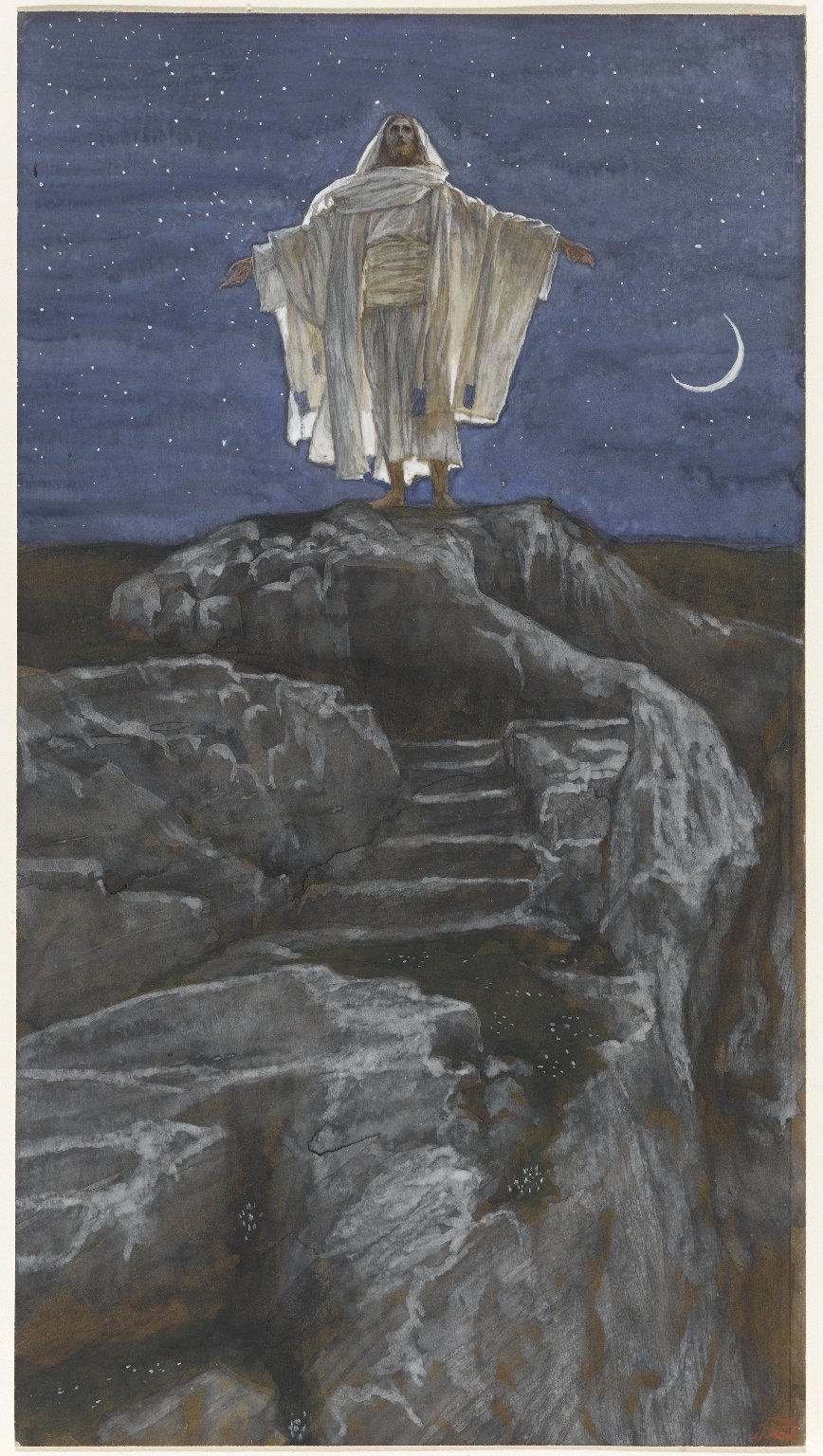
James Tissot, Jesus Goes Up Alone Onto A Mountain To Pray


In a painting whose title refers to one of Jesus’ common practices, James Tissot portrays him as caught up in prayer, an involvement he widely encouraged his followers to pursue. Regarding prayer, the Catechism in The Book of Common Prayer may surprise us. To the question, what is prayer, we find an answer which begins with these words: “Prayer is responding to God…” Jesus modeled a life wholly centered on responding to God, in heart and mind, in soul and body. On one occasion, he appeared transformed while at prayer. Over time, his followers discerned how God was fully present within him.

The story of his Transfiguration on a high mountain, reported in the first three Gospels and commemorated this past Sunday, provides a narrative demonstration of this truth. What Tissot depicts regarding Jesus when alone at prayer was later revealed semi-publicly on that mountain in the company of Peter, James, and John, as well as with the heavenly apparitions of Moses and Elijah. It was then fully revealed in Jesus’ Resurrection appearances.

Exodus 24 provides the background for this, and tells us something astonishing: “Moses and Aaron, Nadab and Abihu, and seventy of the elders of Israel went up {Mt. Sinai}, and they saw the God of Israel.” In Exodus 34, we learn that when Moses came down from the summit, “the skin of his face shone because he had been talking with God. When Aaron and all the Israelites saw Moses… they were afraid to come near him.” The text suggests that Moses then started putting a veil over his face for the sake of those who were unused to, or unprepared for, the glory and power of God’s immediate presence.

Paul, in 2 Corinthians, extends and also alters this idea of the veil. Instead of it being a means to protect people from a direct encounter with divine glory, the veil has become in Paul’s letter a kind of impediment. When our hearts and minds are not open to God, nor sensitive to God’s power, we become hardened. We become hardened in such a way that our hearts and minds are veiled, preventing us from perceiving God’s glory.

But Christ has set aside this veil. As a result, “all of us, with unveiled faces, {see} the glory of the Lord as though reflected in a mirror (2 Cor. 3:18).” And weare being transformed into the same image from one degree of glory to another, for this comes from the Lord, the Spirit.” Through prayer, we also are transformed.

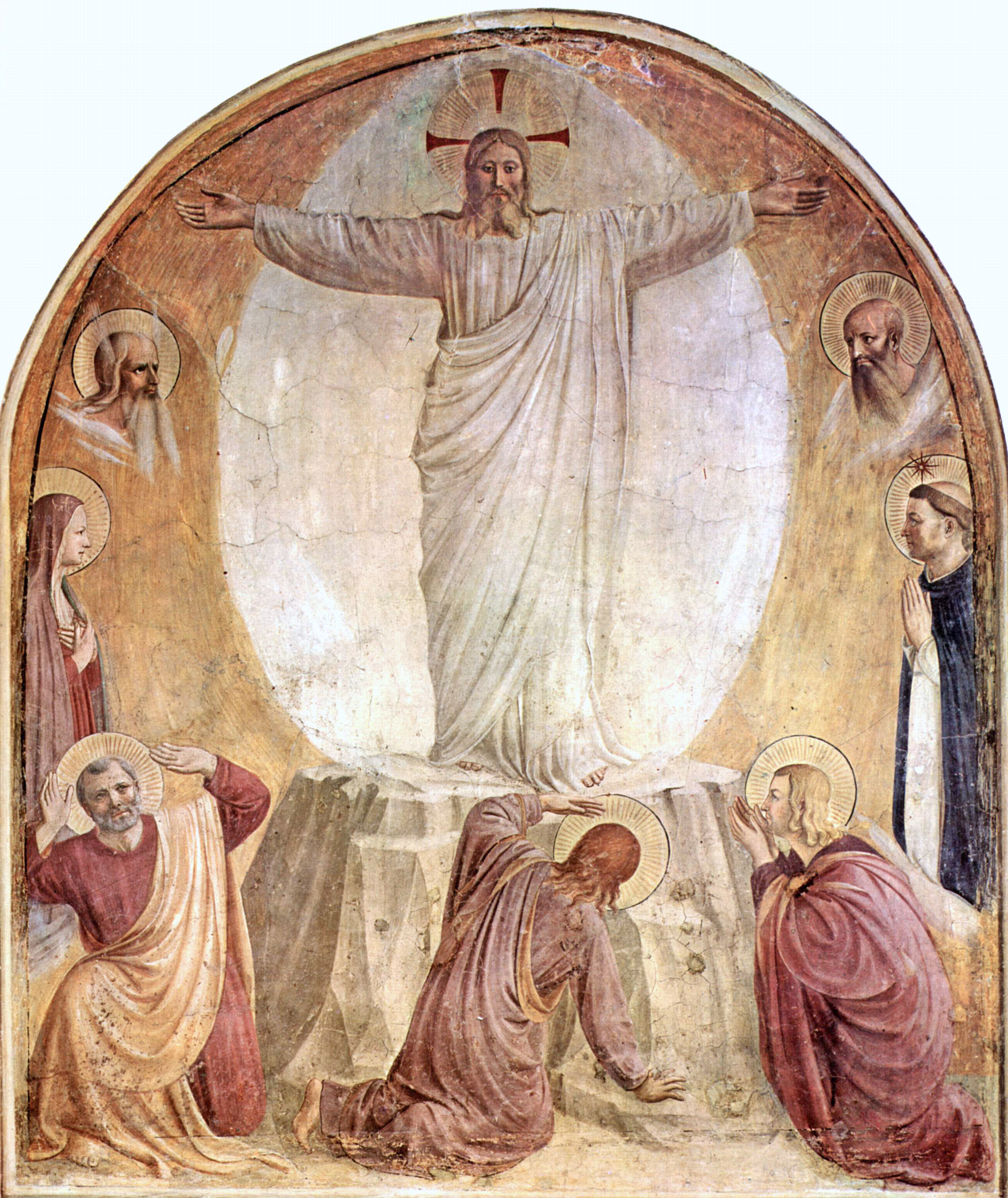
Fra Angelico, The Transfiguration (San Marco, Florence)

The Transfiguration of Jesus is all about the unveiling of God’s glory. Jesus takes Peter, John and James up with him on a mountain to pray. While he is praying, the appearance of his face changes, as does his clothing. In contrast with the Exodus and Pauline images of light shining on a surface, Luke presents God’s glory as coming from within Jesus. In other words, he radiates God’s glory rather than reflecting it. Luke tells us that Moses and Elijah, who appear with him, appear in his glory. This may mean that Jesus has shared his glory with them in a way that prefigures what he will share with all of his followers after his Resurrection.

This should lead us to ask a good question: If we feel like there is a veil between us and the divine presence, where does this veil lie? Does God ‘hide’ behind a veil, either to protect us, or challenge us? Or is the veil within ourselves, formed by our spiritual blindness and our lack of openness to how the Holy Spirit imparts glory? Paul suggests that our experience may be like that of the earlier Israelites, for whom hard-heartedness caused them to be blind to the bright light of God’s glorious presence, whether in Moses’ face or when reading and hearing the Law. Hard-heartedness can be equally blinding for us, veiling the glory that is all around us.

And where, according to Paul, do we find this glory? We find it in the faces of everyone who has been open to God’s transforming Spirit. In other words, we can find it in each other, as well as in ourselves. For this reason it can be like looking into a mirror, as the glory that we will perceive in others is the same glory that they can perceive within us.

And He Sent Out the Twelve

[If reading this by email, please tap the title at the top to open your browser for the best experience.]

James Tissot, The Ordaining of the Twelve Disciples


As Matthew tells the story, those who are called to follow Jesus are then sent out. Before they go, they are not only commissioned to represent him and his message; he shares with them portion of his remarkable power. According to Matthew, “… Jesus summoned his twelve disciples and gave them authority over unclean spirits, to cast them out, and to cure every disease and every sickness.” They have witnessed his teaching in what we know of as the Sermon on the Mount, which in the first Gospel runs over several chapters. Yet this moment is relatively early in the Gospel narrative, and it should surprise us that Jesus is so willing to let them go out on his behalf, and apart from him.

It is sometimes observed that with certain vocations one never really ‘retires” even if one ceases to be engaged in remunerated employment. This bears witness to the fact that through the calling that underlies all other callings, our baptismal vocation never has a terminus though it may come to greater fulfillment in life. Yet as we go through successive stages in our lives, we may be more open to being ‘sent out’ when we are younger even if we continue to be open to being ‘called’ – and, indeed, called anew – through our later years. My parents were relatively young when they were sent out as missionaries to Japan, living into a pattern that we can recognize in many spheres of our human communities such as in the Peace Corps and in Teach for America. Having myself been more recently retired, I find that I am now less inclined toward the opportunity of being sent out in and for the mission of the Kingdom though I still experience being called.

For reasons like these I tend to think that the twelve whom Jesus first called to be his disciples were  more likely to have been young rather than middle-aged. In that they may have had a greater openness to discipleship formation; they may have had a greater degree of idealism and more energy for a new kind of work; and they may simply have had the prospect of more years ahead with which to share with others what they would perceive and learn about God’s mission in and to his Creation.

It is a subtle point, but this may be why Tissot – following Matthew – portrays what is titled The Ordaining of the Twelve Disciples separately from a depiction of their initial experiences of being called. For this moment in their lives and in their time with him became the occasion of their formal participation in Jesus’ mission, even when they were not in proximity to him and his work. Jesus, as Matthew tells us,  had already gone “about all the cities and villages, teaching in their synagogues and proclaiming the good news of the kingdom, and curing every disease and every sickness.” And having commissioned the twelve, and given them his own authority, Jesus sent them “out with the following instructions: ‘… go to the lost sheep of the house of Israel. As you go, proclaim the good news, The Kingdom of heaven has come near. Cure the sick, raise the dead, cleanse the lepers, cast out demons’.”

When doing this, Jesus not only equips them for the mission upon which they are sent. He also forewarns them of the adversity they are likely to face, adversity which might involve betrayal, trials and flogging, being hated, and even being put to death. This is yet another reason why I tend to think of the disciples, at this point in their lives, as generally younger than older, just as we saw with Caravaggio’s likely portray of Matthew’s calling, last week.

As we get older, some but not all of us may be less open to being sent out, and less inclined to seek such an opportunity. But we should never cease to be open to ‘the call,’ and the varying ways it may be ever-renewed in our lives.


This posting is offered in relation to the readings appointed for Proper 6, Year A, in the Revised Common Lectionary for Sunday, June 18, 2023.

Entry Into Jerusalem

[If reading this by email, please tap the title at the top to open your browser for the best experience.]

James Tissot, The Procession in the Streets of Jerusalem


This coming Sunday will be Palm Sunday in the Church’s western calendar, when we commemorate Jesus’ triumphal entry into Jerusalem. The day will also mark the beginning of our observance of Holy Week and the Passion of our Lord.

In James Tissot’s painting (above), look at the crowd of excited people he portrays, who await and greet Jesus’ entry into the Holy City. Two things are obvious about the arrival of this rabbi from the north in Jerusalem. We notice the huge and enthusiastic crowd. And, we notice the object of their attention, Jesus, who is riding on a donkey. At first, we naturally assume an affinity between the crowd and Jesus. The crowd is joyful about Jesus precisely because he is the answer to their questions, and the apparent solution to their concerns. Who he is seems to fit neatly with who they are, and with where they want to go. After all, who wouldn’t be happy when long-nurtured hopes and expectations are about to be fulfilled.

As Matthew describes the scene, the crowd responds to Jesus’ arrival in two ways, both of which evoke historic precedent. We learn from 2 Kings about the followers of Jehu. When they learn he has been anointed king, they spread their cloaks for him to walk on. And in 2 Maccabees, we learn how Judas Maccabaeus was greeted upon arriving in Jerusalem, after defeating Israel’s enemies. The people honored him by waving palm branches in the air. To clinch the point, Matthew want us to know that when Jesus arrived in Jerusalem, the crowd’s dramatic response was a fulfillment of God’s word through the prophets: “”Tell the daughter of Zion, look, your king is coming to you, humble, and mounted on a donkey, and on a colt, the foal of a donkey.”

In other words, as Matthew describes Jesus’ arrival in the city, the crowd’s greeting of him suggested a similar hope, that he might vanquish the repressive powers causing God’s people to suffer. This Nazarene might be the one to make God’s Kingdom present in their time. These observations can help us appreciate how Jesus was greeted when he entered Jerusalem, and how he was viewed soon after. For, like so many leaders in history, he was the object of an immense amount of hopeful projection. And yet, he did not arrive as a warrior on a horse.

Look again at this crowd in Tissot’s wonderful painting of Jesus’ arrival. How many in this crowd are looking directly at him? And of those, how many actually see him, and for who he is rather than for what he represents among their pre-existing desires? Look at how many in the crowd are carried away by the moment. They are excited by imagined possibilities, rather than by the Kingdom concretely at hand. This situation is not merely of historical interest, nor is it primarily about other people, living at another time. Jesus’ arrival in Jerusalem is also about us. His arrival invites us to consider our own hopes and expectations as we greet Him with palms and walk along beside him this Holy Week.


This image is from James Tissot’s painting, The Entry Into the City. I am indebted to N.T. Wright for the specific references to earlier biblical precedents regarding the way Jesus was greeted upon his arrival in Jerusalem.

The Beauty of Our Return


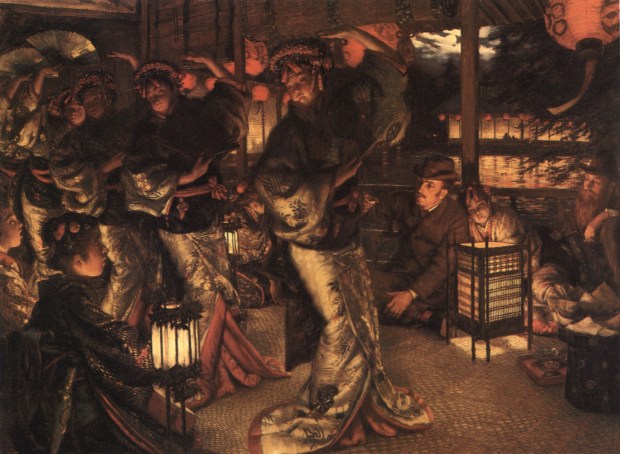
I share with you an unusual set of images from James Tissot. They represent his transition from a French and English society painter to being a visual communicator of the Gospel. They are three of his four paintings depicting The Prodigal Son in Modern Life. How beautifully he evokes the son’s presumptuous ascendancy over his father’s legacy. Then, the son’s foolhardy journey into adventures of his own making. And, third, his return home to his father’s good favor. One key to the subtlety of these three paintings is to notice the older brother in the first painting where he is sitting by his wife. He is musing about distant possibilities for himself, just as his more impetuous brother is beginning to act upon a similarly fanciful vision. In the third image, we observe the stoic and prideful older brother standing by his wife, reluctant to approach and embrace his just-returned sibling.

As Tissot show us, wise readers notice in Luke’s story that we hear about two lost sons, not just the one who went to a far-off land. The older brother couldn’t recognize how his own life was gifted, having entered into an abundant legacy that had also become his. This may be true for us, as well. So, we need to be thoughtful about how we refer to this un-named parable. To say it’s about the prodigal son overlooks how it’s also about the presumptuous older brother, as well as about the ever-loving father.

When we focus on the younger son in Jesus’ parable, we become more sensitive to how it may help check us from wandering away from God and from God’s ways. For we find in this story an account of what it’s like to come to our senses, in circumstances that could kill us spiritually and physically. It speaks about what it means to ‘return home.’ But as dramatic as experiences like this can be, they stand out because they are occasional or singular.

Seeing this parable as also about the grumbling older brother helps us notice how significant it is for other times in our lives. This is not just a Gospel about looking back to what was, and has been. This is a Gospel about living forward, toward the future God is even now preparing for us.

We are called to the feast! We gather on Sundays for the same feast about which we hear in Luke’s Gospel parable. Our Eucharist is our celebration of the return of lost ones, both ourselves and others. Henri Nouwen’s great insight about this Gospel passage, and Rembrandt’s painting of it, is this: having once been the younger brother who has experienced the grace of returning home, we are all called to become the father in the story! In other words, we are called to become people who receive others, embracing those who return some time after we do. Let us eat and celebrate! For like us, our later-returning brothers and sisters were dead and are alive again; like us, they were lost, and now are found!


The above paintings are from James Tissot’s, The Prodigal Son in Modern Life, three of his four paintings depicting Jesus’ famous parable in Luke 15. This post is based on my homily for Sunday, March 31, 2019, which can be accessed by clicking here.  Other homilies of mine may be accessed by clicking here. The Revised Common Lectionary, which specifies the readings for Sundays and other Holy Days, can be accessed by clicking here.