Author: Stephen Holmgren

I have been an Episcopal priest for thirty eight years, having served in parishes and in academia. My interests include art and theology, liturgy and spirituality, and I love to go sailing whenever I can.

The Beauty of Now


Rembrandt’s paintings are so often moving, and speak well of the Dutch genius who created them. When many of his contemporaries sought to portray people and events with greater realism, even if with much feeling, Rembrandt often put the ‘feeling’ side of his work first.

Rembrandt shows his sensitivity to an aspect of the anticipated birth of John the Baptizer. John’s parents were old and despaired about ever having a son who might carry on their name. The artist depicts the aged priest, Zachariah, leaning on a young attendant upon hearing that Mary has arrived. He portrays Elizabeth as also showing her years as she greets her relative with warm regard. Though Mary bears within her womb the holy child of God, she appears humbled in the presence of Elizabeth, perhaps awed at how the grace of God could touch both of their lives in such an unexpected way. Light shines on the two of them, just as it should, given the way that Luke highlights this holy aspect of their shared story. Thankfulness and quiet joy suffuse the scene like the warm light at its center.

Waiting and anticipation are themes we associate with the beautiful season of Advent. In one sense, these two words suggest we already know what we are anticipating, for what we are awaiting. By contrast, Luke’s story about the Visitation suggests a variation on those themes. “Expect the un-expected,” it seems to say, to us who live a multitude of centuries later. And this is especially hard for us to do, in a culture that is so dependent upon the precise measurement of time, and upon the predictability of events in the natural order of things.

Let’s notice this about Elizabeth and Mary, and about John the Baptist who is not yet born. Luke portrays them as living in the moment, as living in God’s time rather than simply in human calendar time. When Elizabeth hears Mary’s voice, John leaps in her womb. Luke then says that Elizabeth is filled with the Holy Spirit, and she exclaims with a loud cry, “Blessed are you among women, Mary, and blessed is the fruit of your womb.” Neither John nor Jesus are yet born, and so neither mother has yet received the assurance and peace that will come from seeing them safely delivered. And yet, in this moment, both women are filled with joy ~ joy about the fulfillment of God’s promises!

Elizabeth’s son, John, and Mary’s son, Jesus, would never be closer to the two women. And, in Luke’s telling, their quiet joy reflects their awareness of this, that now, in this moment, God is truly present, imparting grace and fulfilling promises. The same is true for us.


Rembrandt van Rijn: The Visitation (1640), Detroit Institute of Arts {many images online}

See Luke 1:41-42: “When Elizabeth heard Mary’s greeting, the child leapt in her womb. And Elizabeth was filled with the Holy Spirit and exclaimed with a loud cry, ‘Blessed are you among women, and blessed is the fruit of your womb.” Context: Luke 1:39-56. This Gospel reading is appointed for the 4th Sunday in Advent, Year C, which features the Visitation of Mary to her relative, Elizabeth.

Personal and Family Devotions for Trinity Sunday June 7


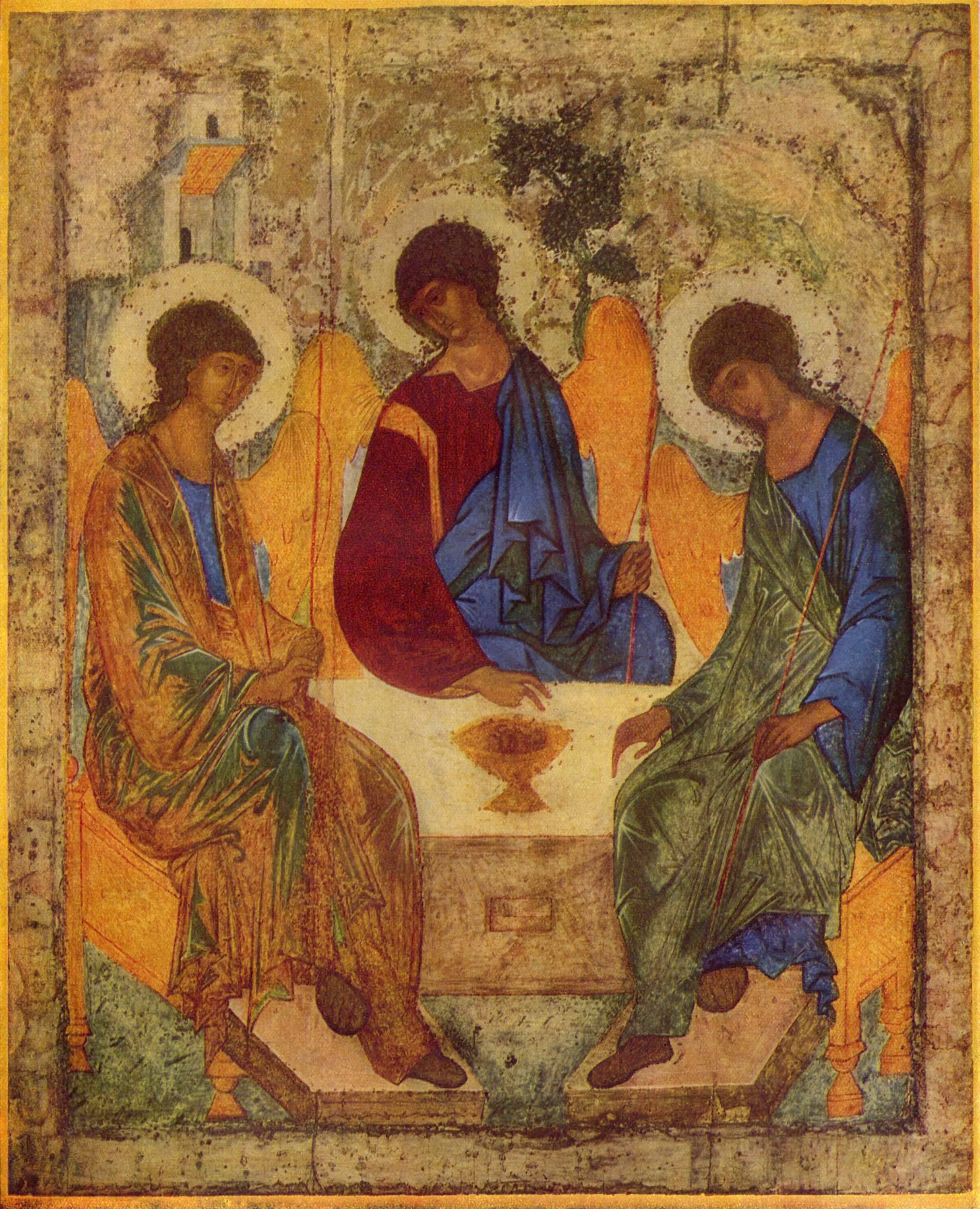
Andrei Rublev, The Hospitality of Abraham (or The Holy Trinity), 1410


For this Trinity Sunday I am happy once again to share with you a format for personal and family devotions.

I invite you to read these readings, and pray these prayers tomorrow (on Sunday). The format is especially suitable for sharing with others. I am sure that many of you are already staying in touch with family, friends and loved ones, with the help of an app like Zoom for web-based internet group meetings. Feel free to share the link to the devotions with others

The icon above and in the devotions document is by Andre Rublev, and depicts the story of the three angelic visitors to Abraham recorded in Genesis 18, which is often perceived as a disclosure of the Holy Trinity.

You can access the Personal and Family Devotions document that I have prepared for tomorrow, Trinity Sunday, June 7, 2020, by clicking here.

Personal and Family Devotions for Pentecost, Sunday May 31

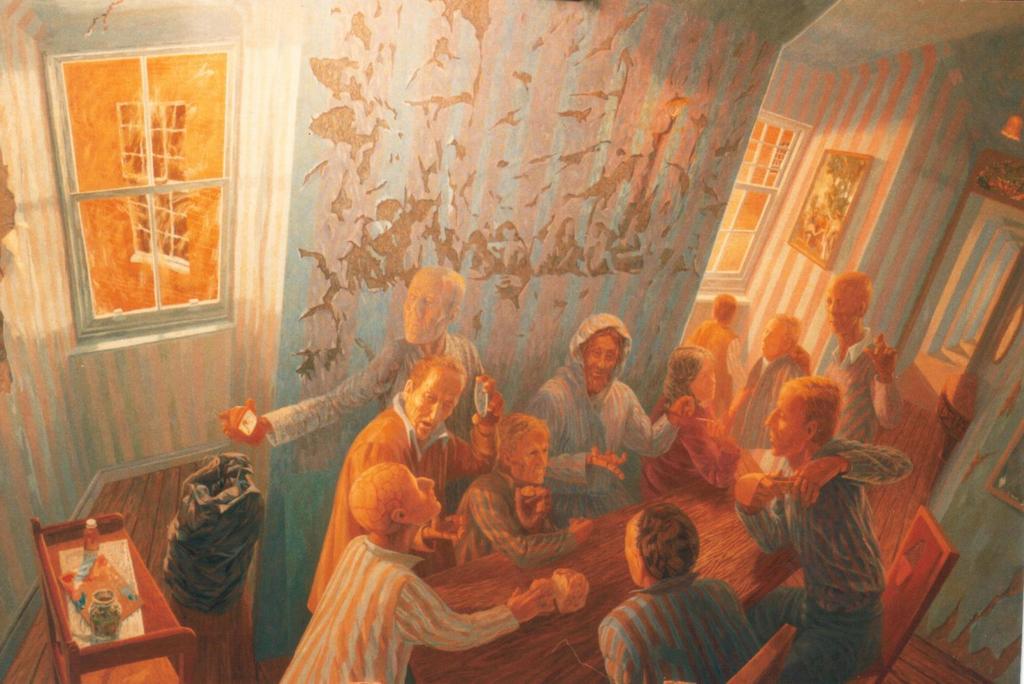
Peter Warden, Pentecost (1985)


For this Pentecost Sunday, concluding the Great 50 Days of Easter, I am happy once again to share with you a format for personal and family devotions.

I invite you to read these readings, and pray these prayers tomorrow. The format is especially suitable for sharing with others. I am sure that many of you are already staying in touch with family, friends and loved ones, with the help of an app like Zoom for web-based internet group meetings. Feel free to share the link to the devotions with others

The painting above and in the devotions document is a painting by Peter Warden.

You can access the Personal and Family Devotions document that I have prepared for tomorrow, Pentecost Sunday, May 31, 2020, by clicking here.

Personal and Family Devotions for Easter 7, Sunday May 24


Giotto, The Last Supper (Detail)


For this Seventh Sunday (during the Great 50 Days) of Easter, I am happy once again to share with you a format for personal and family devotions.

I invite you to read these readings, and pray these prayers tomorrow. The format is especially suitable for sharing with others. I am sure that many of you are already staying in touch with family, friends and loved ones, with the help of an app like Zoom for web-based internet group meetings. Feel free to share the link to the devotions with others

The painting above and in the Devotions document is a portion of a fresco painting by Giotto.

You can access the Personal and Family Devotions document that I have prepared for tomorrow, Sunday, May 24, 2020, by clicking here.

Personal and Family Devotions for Easter 6, Sunday May 17

Sadao Watanabe, Jesus and the Twelve Disciples


For this Sixth Sunday (during the Great 50 Days) of Easter, I am happy once again to share with you a format for personal and family devotions.

I invite you to read these readings, and pray these prayers tomorrow. The format is especially suitable for sharing with others. I am sure that many of you are already staying in touch with family, friends and loved ones, with the help of an app like Zoom for web-based internet group meetings. Feel free to share the link to the devotions with others

The wood block print above and in the Devotions document is by the Japanese artist, Sadao Watanabe. The image corresponds to the context of the reading from John’s Gospel for this day.

You can access the Personal and Family Devotions document that I have prepared for tomorrow, Sunday, May 17, 2020, by clicking here.

The Beauty of a Friendship

Stuart Levine, About 2010, Heading Out to Fish

For me, getting to know Stuart began with seeing a boat, an old boat. From when I first visited the northern Michigan harbor town of Charlevoix in about 2005, I noticed and was attentive to a classic fishing boat. It was a lapstrake wooden-hulled motor boat from the late 1950’s, painted in a beautiful dark forest green. Yet, I was also attentive to the easy skill and confident style of the boat’s captain, an older man whose approach to open water I admired and wished to emulate. During my increasingly frequent summer visits to Charlevoix, I took note of this boat and its persistent captain, who obviously knew what he was doing when going in and out every day to fish on Lake Michigan.

After about seven or eight years of seeing him and his boat each summer, and having taken photographs of them during many of those years, I finally met Stuart. One morning, early in the summer of 2013, I saw that venerable boat in my marina. The next afternoon I saw it again, while her captain was tying her up having come in from another fishing trip. Plucking up my courage, I walked over and haltingly introduced myself. I told him of my admiration for his boat and for what I had inferred from my limited observation about his daily practice. As it turned out, both Stuart and I loved old boats. And, serendipitously, Stuart and I hit it off. We were weekly correspondents, and fellow summer boaters, ever since.

As time has shown me, I had encountered and begun to be acquainted with a person of remarkable ability, sensitivity, and enhanced intuition. From first knowing him, Stuart seemed to look beyond the apparent limitations of the present moment, attend to what might be hoped for, and reflect on how the future could really be different. As I came to see, Stuart’s approach to life was nothing like the proverbial person who ‘sees things through rose-colored lenses.’ Stuart’s optimism was grounded in a belief that a different and more positive future results from actually choosing to live in a different way now, not just from believing or hoping differently.

A great example of this aspect of his character took place one summer. Standing with him on the Charlevoix dock while he was stowing his fishing gear after an outing, I asked about all the fishing tackle and gear he left on the boat, openly visible to anyone who might come by. Stuart told me about a valuable fishing rod that he had once left on the boat in a similar way. Upon discovering the rod’s disappearance the next day, he wrote a letter to the editor of the local newspaper, describing the theft but saying that he would not change his usual trusting practice. He wanted to spend his summers in a community where people modeled trust, rather than self-protective fear.

I am reminded of an episode in a video by the former National Geographic photographer, Dewitt Jones (Celebrate What’s Right With the World). On assignment, Jones visits a living national treasure of the UK, a woman who was an acclaimed weaver up in the northern Hebrides Islands. Jones asks her, what do you think about when you weave. She responds by saying, at first, “I wonder if I will run out of thread!” Jones admits to being surprised by this. But then, she says, “When I weave, I weave…”

Stuart lit up when I told him this story, and he then said, “When I fish, I fish.” He told me that his delight was in the process, more than in the results. His comment then struck me, as it still does, as absolutely authentic to him. Even though this was a man the Michigan DNR highly regarded for having documented every lake trout he had caught and released for decades!

At a marina cookout in 2019, Stuart and I talked about the evolving challenge of evaluating college and graduate students in this current era. With several other boaters attentive to his comments, Stuart talked about his commitment to trusting his students. As always, he spoke positively about how placing trust in others encourages them to live into our imputed and projected hope for them. He often reflected on this principle with me, hoping to commend it. After all, it is founded (among other places) in Aristotle and in the Hebrew Scriptures. For what we practice, and live into, shapes who we are becoming. Stuart exemplified this insight.

And yet, at that cookout, as a younger, less-wise and less-experienced former academic, I responded by describing my disappointing prior service on a national examination board. As he invariably would in such conversations, Stuart challenged my apparently less-than-positive view of such processes. He did this in a way that was shaped by his long life experience of having served as a reflective scholar. By his comments in conversations like this, he would disclose how he was both intellectually curious as well as spiritually sensitive. In this way, he showed how he was often a mentor not only for young intellects but also for older souls.

Stuart reminded me of some my favorite teachers. He did this by how he modeled a particular virtue. It was his disposition to value good questions over what often seem to be important answers. For me, Stuart was an excellent example of one who always encourages others to wonder, and then ask, but, what is the question? For when we come to appreciate the horizon of a beautiful question, we are then more open to discovering meaningful answers to it. Stuart displayed an abiding curiosity about finding good questions. And this led him to discerning an ever-expanding body of insightful answers.

In one other important respect I would like to offer a tribute to Stuart. From time to time he would share with me words of respectful remembrance he had shaped in his effort to honor former colleagues, friends and students. His approach to this sometimes difficult task was compelling. For Stuart embodied a desire to recognize and express appreciation for the gifts, strengths and achievements of others, as a kind of spiritual practice in itself.

May Bard College and other teaching institutions always be blessed to have persons like Stuart Levine among their faculty and in their administrative staffs. And may we all be blessed to have a friend like him.


I offer this tribute in memory of Professor Dr. Stuart Levine, who died on May 1, 2020. He was formerly a Dean and Professor of Psychology for many years at Bard College, Annandale on the Hudson, New York. Stuart’s cultural and spiritual roots were within Judaism, and Bard College’s early history was associated with The Episcopal Church, within which I was ordained as a deacon and priest.

Personal and Family Devotions for Easter 5, Sunday May 10

James Tissot, The Last Supper

For this Fifth Sunday (during the Great 50 Days) of Easter, I am happy once again to share with you a format for personal and family devotions.

I invite you to read these readings, and pray these prayers tomorrow. The format is especially suitable for sharing with others. I am sure that many of you are already staying in touch with family, friends and loved ones, with the help of an app like Zoom for web-based internet group meetings. Feel free to share the link to the devotions with others

The painting above and in the Devotions document is by James Tissot. The image corresponds to the context of the reading from John’s Gospel for this day.

You can access the Personal and Family Devotions document that I have prepared for tomorrow, Sunday, May 10, 2020, by clicking here.

Personal and Family Devotions for Easter 4, Sunday May 3


Sadao Watanabe, The Good Shepherd


For this Fourth Sunday (during the Great 50 Days) of Easter, I am happy once again to share with you a format for personal and family devotions.

I invite you to read these readings, and pray these prayers tomorrow. The format is especially suitable for sharing with others. I am sure that many of you are already staying in touch with family, friends and loved ones, with the help of an app like Zoom for web-based internet group meetings. Feel free to share the link to the devotions with others

The wood block print above and in the Devotions document is by Sadao Watanabe, a Japanese Christ artist.

You can access the Personal and Family Devotions document that I have prepared for tomorrow, Sunday, May 3, 2020, by clicking here.

The Beauty of a Holy Place


I recently received a touching photo of one of my granddaughters, sent to me by her mother. My granddaughter Anna lost her twin sister a day after their birth. In a lower part of the photo above (which I have cropped), my granddaughter appears to have a look of sadness on her face as she walks through the cemetery. Still, photos can capture momentary facial expressions that do not necessarily reflect our inward disposition.

Anna’s sister’s remains lie under a nearby stone in the cemetery depicted above. The photo shows the very old but still used burial ground of Grace Church, St. Francisville, Louisiana, where I served until 2007. When called away from there, the blessed folks of that parish provided a burial plot for Martha and me in the rector’s portion of the cemetery. It is one of the most touching gifts we have ever received.

In viewing the cemetery scene above, some may have a hard time imagining how a place like this that is associated with death could be replete with signs of life. And yet, it is. These evident signs of life transcend the presence of the church building and its related Christian symbols, like the crosses and inscriptions found on the monuments. Look closely at the live oaks with their long draping limbs, and how they stay green year-long, often supporting gangly strands of gray-green Spanish moss. More subtle are the plant-like growths on the upper surfaces of those limbs, which appear to be a blend of moss and ivy. Their name is resurrection fern, which in dry spells has an ochre color, but which then miraculously transforms into a deep green after an overnight rain.

My former rector’s office looked out upon the ground in which are buried the remains of dear Lucy, a deacon I helped sponsor for ordination. Every time I walk through the paths between alternating old and newer stones, I go to visit her resting place, and also see reminders of other friends and acquaintances. And now, I also go there to visit ‘one of my own,’ in that most personal sense of the phrase. Some day, under one of these magnificent oaks, my remains, as well as Martha’s, will lie next to those of our granddaughter, Avery.

To write these things and muse upon them in this way during the coronavirus pandemic may strike some as morbid. Yet, I share my thoughts here in the spirit of the life-giving texts we encounter liturgically every year in our Eastertide lectionary readings. For, in one way or another, we are all called to visit that rocky ‘garden’ tomb and find it empty, and ponder its significance. There is undeniable beauty in this story about what then becomes a holy place.

The beauty of the good news concerning that empty tomb is so much more than a wonder-story about a lucky man whose experience might inspire us. A man who, despite the worst that this world can do to ‘good’ people, somehow managed to escape into something better. The Gospel story is also the ground for our hope, our hope for ourselves and our loved ones. Can that empty tomb then help us recognize how, in similar places reminiscent of death, we can find signs of new life? Yes. For our cemeteries are places where we seek to remember and honor our loved ones, with whom we are still connected. Here, in these places of burial, we are reminded that through God’s love we are destined for more than we can now see or imagine.


The photo above depicts the cemetery of Grace Episcopal Church in St. Francisville, Louisiana. The church was founded in 1827, and the present building was completed by 1860. Three years later it was damaged by canon fire from Union gunboats on the nearby Mississippi River who were targeting the Courthouse across the street.

Personal and Family Devotions for Easter 3, Sunday April 25

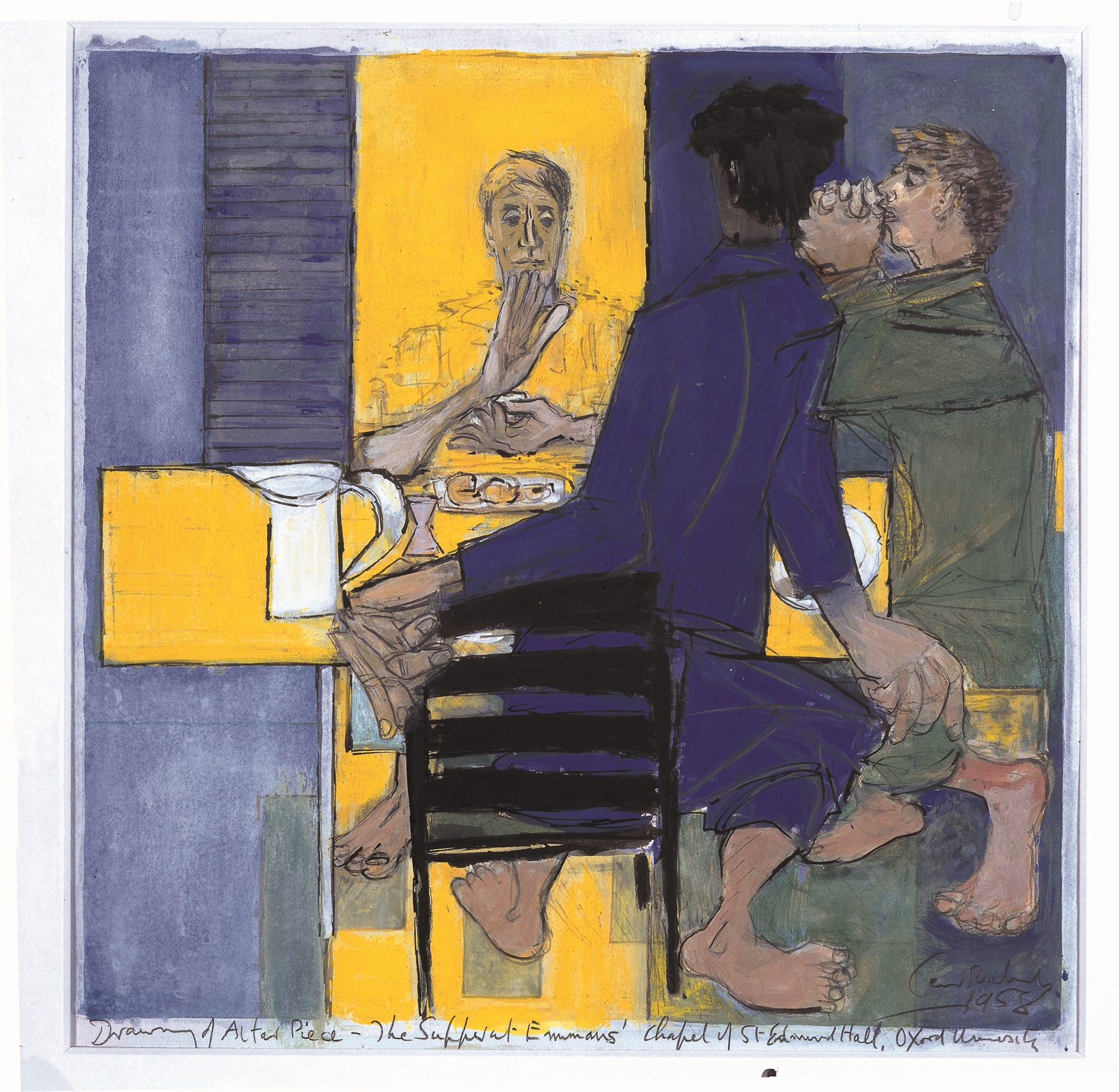
Ceri Richards, The Supper at Emmaus 


For this Third Sunday (during the Great 50 Days) of Easter, I am happy once again to share with you a format for personal and family devotions.

I invite you to read these readings, and pray these prayers tomorrow. The format is especially suitable for sharing with others. I am sure that many of you are already staying in touch with family, friends and loved ones, with the help of an app like Zoom for web-based internet group meetings. Feel free to share the link to the devotions with others

The painting above and in the devotions is by Ceri Richards, a Methodist painter from England.

You can access the Family Devotions document that I have prepared for tomorrow, Sunday, April 26, 2020, by clicking here.