Author: Stephen Holmgren

I have been an Episcopal priest for thirty eight years, having served in parishes and in academia. My interests include art and theology, liturgy and spirituality, and I love to go sailing whenever I can.

Annunciation to Mary

Luc-Olivier Merson, Annunciation (1908)


Having begun this series with a painting of the Annunciation to Joseph by Alexander Ivanov, and having featured Luc-Olivier Merson’s painting of the Flight into Egypt, I would like to offer Merson’s less-well known but equally memorable depiction of the Annunciation to Mary.

Unlike many Annunciation paintings, Merson does not focus on the encounter between two personal beings. His Annunciation is not colored by the dynamics of male-female interaction, a theme that so absorbs our present culture, and implicit in some historical treatments of the moment. Here we have a feminine or an androgynous angel, who instead of being face-to-face with Mary, hovers above another building.

I think Merson depicts the moment just after the angel shares the news with Mary, and before she sings her magnificat. Mary is wrapped in white, suggesting her purity, but also prefiguring the burial shrouds with which her son will be wrapped. Her gaze is focused on the unlikely stem of lilies she finds on the ground, outside a dark open doorway through which she emerges. Both symbolize resurrection. Doves grace the air in the foreground, a traditional way to suggest the presence and activity of the Holy Spirit.

Rather than gesturing toward Mary, the angel points to the heavens! Here we find a spiritual sign in accord with the Gospel. It depicts a call. The scene symbolizes what God is doing, and what God wants to accomplish.

May our Lord, who was and is, and is to come, bless us and our loved ones during this holy time.


For a more extended reflection on Merson’s Annunciation painting, some comparison with the rather different Annunciation image on the Santana Abraxas album cover, and in relation to the Gospel for the 4th Sunday of Advent, click this link: Advent 4 B 14 copy_for 2022 blog_PDF

[If reading this by email, please tap the title at the top to open your browser for the best experience.]
Celebrating the 12 Days

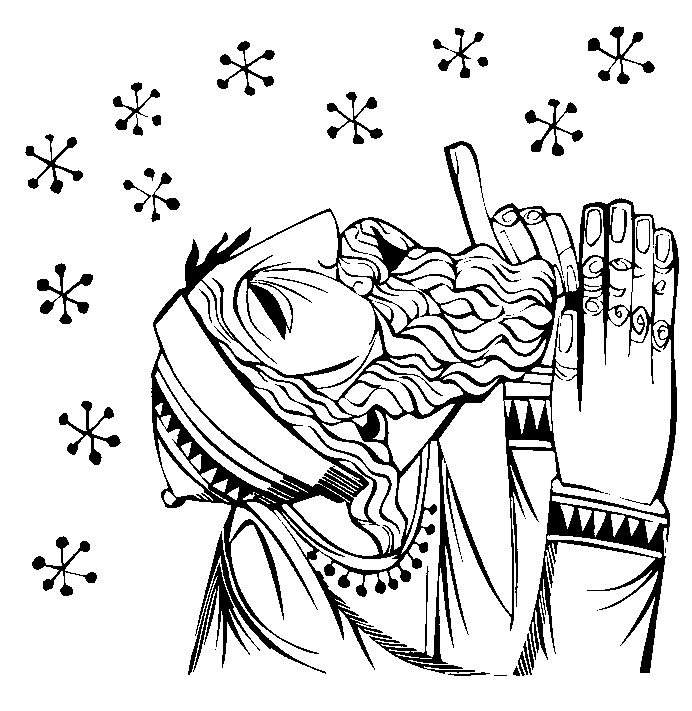
Brother Martin Erspamer, OSB


Having driven through my neighborhood yesterday and seeing two Christmas trees already put out onto the road edge, I am once again mindful of how the traditional Church calendar observes the Feast of the Incarnation of our Lord, or Christmas, for a full 12 days. I am therefore especially appreciative of the above image by Brother Martin Erspamer.

Martin Erspamer is a member of the Benedictine community at St. Meinrad’s Abbey in Indiana. His evocative black and white prints, sometimes referred to as ‘clip art,’ have been widely used on worship bulletins and in Sunday school materials.

The popularity of his images, and their widespread use in media such as Sunday bulletins, should not lead us to devalue the beauty of his handiwork, which evidences a studied sensitivity to medieval imagery as much as it does to the possession of a modern graphic artist’s temperament.

I especially like his image of Abram counting the stars, based on Genesis 15 (below). The image and its theme arises from God’s challenge to Abram to go out into the dark of the night and count the stars in the heavens – if he can. For one of God’s promises is that, while Abram is despairing of being without an heir, he will eventually have as many descendants as he can count the stars in the night sky.

Genesis presents three covenants between God and Abram, in chapters 12, 15, and 17, each of which is relevant to our celebration of these 12 Days of Christmas. In various ways, God promises Abram many descendants, a new land for him and those that would follow, and that through him a blessing would come to all the people of the world. This third promise, fulfilled for us in the child born in Bethlehem, is the most relevant to our observance of this holy time of the year.

From Psalm 147:

1 Hallelujah! How good it is to sing praises to our God! * how pleasant it is to honor him with praise!

2 The LORD rebuilds Jerusalem; * he gathers the exiles of Israel.

3 He heals the brokenhearted * and binds up their wounds.

4 He counts the number of the stars * and calls them all by their names.

5 Great is our LORD and mighty in power; * there is no limit to his wisdom.

6 The LORD lifts up the lowly, * but casts the wicked to the ground.


For those able to visit the Abbey, St. Meinrad’s has an exhibit of art by Brother Erspamer in the Archabbey Library Gallery until January 15:

Flight to Egypt

Luc-Olivier Merson, Rest on the Flight to Egypt, 1880


“Now when [the wise men] had departed, behold, an angel of the Lord appeared to Joseph in a dream and said, “Rise, take the child and his mother, and flee to Egypt, and remain there until I tell you, for Herod is about to search for the child, to destroy him.” And he rose and took the child and his mother by night and departed to Egypt and remained there until the death of Herod. This was to fulfill what the Lord had spoken by the prophet, ‘Out of Egypt I called my son.’” (Matthew 2:13-15)

With the threat of the impending massacre of the Holy Innocents, the feast day for whom we commemorated yesterday, the Holy Family of Mary, Joseph, and Jesus, fled to Egypt. Matthew’s Gospel briefly refers to this event. Their journey to Egypt, and eventual return, recapitulated Israel’s historic sojourn to and escape from that land and the tyranny of Pharaoh.

Luc-Olivier Merson’s painting, above, depicts in a romantic 19th century way a moment on the family’s journey.


Here is a link to a prior blog posting with a more extended reflection upon Merson’s painting: https://towardbeauty.org/2020/01/13/light-in-the-darkness/


The Holy Innocents


Peter Bruegel the Younger, The Massacre of the Innocents, late 1500’s


During these twelve days commemorating biblical events that we associate with Christmas, we return to another winter image from Peter Bruegel, in this case probably by Peter the Younger. Like the Bruegel painting of the Census at Bethlehem, shared with you previously, this is another favorite of mine.

Today, December 28, is the day on which the western Church remembers the event recorded by Matthew in his Gospel (2:13-18), wherein the wicked King Herod turned his fearful wrath upon the children of Bethlehem in Judea.

Herod was rightfully insecure about his throne and reign, having been propped up in the role by the Romans and others, and apprehensive about potential rivals. Imagine his anxiety when apparently wealthy astrologers arrived from a foreign land bearing reports regarding one who would be born “King of the Jews,” especially when these visitors expressed a desire to worship this anticipated newborn.

Once again we marvel that in our calendar for the 12 Days of Christmas the Church should commemorate those, like St. Stephen and the Holy Innocents, whose death gave tribute to the Lord of Life and the King of kings.

From the Book of Common Prayer:

“We remember today, O God, the slaughter of the holy innocents of Bethlehem by King Herod. Receive, we pray, into the arms of your mercy all innocent victims; and by your great might frustrate the designs of evil tyrants and establish your rule of justice, love, and peace; through Jesus Christ our Lord, who lives and reigns with you, in the unity of the Holy Spirit, one God, for ever and ever. Amen.”


[If reading this by email, please tap the title at the top to open your browser for the best experience.]

Glory to God in the Highest

James B. Janknegt, Glory to God in the Highest


Luke’s Gospel portrays the birth of Jesus in the context of literal good news for the poor and those who are outcast. In Luke’s telling, angels announce the arrival of the Messiah to shepherds sleeping out in the fields or in caves with their flocks. As we shall note soon, Matthew casts these events in a more worldly and political context, with visiting Magi from the East, and Herod’s anxiety about a challenge to his propped-up throne.

Jim Janknegt is a painter whose thoughtful and creative engagement with the Scriptures I have admired for years. He paints in a style that some might describe as ‘primitive.’ Yet, in my view, he is an artist whose work often displays a highly sophisticated engagement with multiple dimensions of the biblical texts that shape our worship in both this and in other liturgical seasons. As the above image suggests, he also demonstrates a sensitive and wide-ranging color palette.

On this third day of Christmas, which is also the feast of St. John, the Apostle and Evangelist, I am grateful for Janknegt’s portrayal of the shepherds receiving and rejoicing over the witness of the holy angels.

As we sing in a favorite hymn:

Angels we have heard on high,
singing sweetly through the night,
and the mountains in reply
echoing their brave delight.

Gloria in excelsis Deo.

Shepherds why this jubilee?
Why these songs of happy cheer?
What great brightness did you see?
What glad tidings did you hear?

[repeat chorus]

Come to Bethlehem and see
him whose birth the angels sing;
come, adore on bended knee
Christ the Lord, the newborn King.

The Hymnal 1982, #96

To learn more about the artist, James B. Janknegt, and his work, click this link: http://bcartfarm.com/index.html

[If reading this by email, please tap the title at the top to open your browser for the best experience.]

… On the Feast of Stephen

Music and Illustration related to the Christmas Carol, Good King Wenceslas, from 1913


For our brothers and sisters ‘across the pond’ in the U.K., today is Boxing Day. The name comes from the tradition of giving boxes or baskets of Christmas gifts to family, friends, and employees, on December 26. Today is also the feast of St. Stephen, my patron saint. We have a familiar Christmas carol associated with this day.

From Wikipedia:

“Good King Wenceslas” is a Christmas carol that tells a story of a Bohemian king who goes on a journey, braving harsh winter weather, to give alms to a poor peasant on the Feast of St Stephen. During the journey, his page (or helper) is about to give up the struggle against the cold weather, but is enabled to continue by following the king’s footprints, step for step, through the deep snow. The legend is based on the life of the historical Saint Wenceslaus I, Duke of Bohemia (907–935).

The fact that the Church, in its historical liturgical calendar, would remember the first of the martyrs on the second of the 12 Days of Christmas bears some reflection. Here, below, is a panel of a compelling contemporary triptych painting by the gifted British painter, Peter Koenig, depicting the martyrdom by stoning of Stephen (see Acts, Chapters 6 – 7). Against the backdrop of the spires and walls of an image of the new Jerusalem come down from heaven (in the upper left), we find Stephen holding a chalice of the ‘the blood of the new covenant’ outside the walls of the ‘old city,’ the world in which we presently live.


And the Word Became Flesh

Giotto, The Nativity


“Unto you is born this day in the city of David a Saviour, which is Christ the Lord. And this shall be a sign unto you; Ye shall find the babe wrapped in swaddling clothes and lying in a manger.”

The master pre-Renaissance painter, Giotto (1267-1337), produced a remarkable series of paintings in Padua’s Scrovegni Chapel. One of the most memorable is this image of the Nativity of our Lord. Giotto’s paintings are noted for his sensitive portrayal of distinguishable human figures, moving away from the Byzantine style of icon-like painting characteristic of the era in which he began his work.

Some verses from Phillips Brooks’ beloved hymn (O Little Town of Bethlehem) provide a fitting prayer for this day:

How silently, how silently, The wondrous gift is given!

So God imparts to human hearts The blessings of his heaven…

O holy Child of Bethlehem, Descend to us, we pray;

Cast out our sin, and enter in, Be born in us today.

We hear the Christmas angels The great glad tidings tell:

O come to us, abide with us, Our Lord Emmanuel!

May our Lord, who was and is, and is to come, bless us and our loved ones during this holy time.

Arrival at Bethlehem

Pieter Bruegel the Elder, Census at Bethlehem, 1566


In one of my favorite paintings for this time of year, we find the Holy Family arriving at Bethlehem just at sunset on what might have been Christmas Eve. Mary on a donkey, in the center foreground, is led by Joseph toward what appears to be a crowded inn, a likely location for where the census was taking place. (See Luke 2:1-7.)

We approach this holy feast time like Mary and Joseph, with anticipation, yet not fully aware of the glory that is to be revealed to us.

May our Lord, who was and is, and is to come, bless us and our loved ones during this holy time.

Annunciation to Joseph

Alexander Ivanov, Joseph’s Dream


Here I begin sharing a series of images for the 12 days of Christmas, including two prior events as well as some that follow the Nativity. Christmas Day, Dec. 25, is officially the first of the 12 days. Yet, as we anticipate the holy season ahead, it is appropriate to remember and consider what prepared the way for the miracle we are soon to celebrate.

In this new Revised Common Lectionary year, which focuses on Matthew’s Gospel we hear of an Annunciation to Joseph (Matthew 1:18-25), less familiar to most of us than the Annunciation to Mary as recorded by Luke. Joseph was as attentive to his Annunciation as Mary was to hers. And like her, he was equally trusting and obedient.

May our Lord, who was and is, and is to come, bless us and our loved ones during this holy time.

The Beauty of a Promise

Charles Blakeman’s portrayal of Isaiah and King Ahaz


In one of the oldest churches in London, St. Etheldreda’s, we find a series of evocative stained glass windows by Charles Blakeman, modern but medieval in style. The window shown above depicts the prophet Isaiah’s encounter with King Ahaz (Isaiah, Chapter 7), which contains a quote from Isaiah’s prediction of a promised child, a prediction fulfilled in Matthew’s Gospel (Chapter 1.)

This window portrays persons from very different times and places, side by side in the same scene. The prophet Isaiah, in gold, stands alongside King Ahaz, robed in royal purple. Both look ahead – literally and figuratively – to a later realization of Isaiah’s promise. That moment of realization occurred about seven hundred years later when an angel appeared to Joseph in a dream. And standing with, but behind, Isaiah and Ahaz, we see the boy David, who lived three hundred years before Ahaz. For David was a common ancestor both to the wicked King Ahaz, and to the later righteous King Jesus.

Freed from the constraints of geographical space and linear time, Charles Blakeman has portrayed the content of a vision. It is a spiritual perception not bound by our usual orientation toward objective data and factual information. The prophet and the king, if they are open to it, can apprehend the vision pictured in black and white, a revealed sign of something real, but not yet seen by human eyes.

There are fewer visionaries and seers in our world today, and this is no accident. We are overwhelmed by competing and high-quality visual images on electronic screens everywhere around us. And I value some of them like many others do. But they can lead us to be blind, blind to the important connection between what we see and what is yet unseen. By not appreciating the power of signs and dreams, we are not likely to look beyond what is literally ‘at hand.’

The Collect or focussing prayer for this past 4th Sunday of Advent mentions “God’s daily visitation.” This refers to a pattern we can see in Scripture. Through love, God is always revealing signs ~ signs of truth, signs of goodness, and signs of beauty. But, whether by reading Scripture and or through prayer, we can open ourselves to perceiving these signs. So that (as the same prayer says), at his coming, Jesus “may find in us a mansion prepared for himself.” In the final week of this season of anticipation and hope, this can be our Advent prayer.

The above window by Charles Blakeman, portraying the prophecy of Jeremiah (Chapter 23) regarding a promised righteous king. Below, Blakeman’s depiction of the visionary prophecy of Ezekiel (Chapter 47.)