Walker Percy

What Distinguishing Religion, Science, Magic, and Technology, Might Teach Us About Beauty

A book of essays by Peter Kreeft

Peter Kreeft has written an illuminating essay on the use of indirect communication by CS Lewis and Walker Percy. In it, and in a humorous recording of its content, he explores how both Lewis and Percy present the predicament of the modern person. We live as upside-down persons. And we are not among the first people in history to suspect this. (See St. Augustine, d. 430 AD)

As a way into the heart of his theme, Kreeft invites us to consider a hypothetical challenge posed to a child: take four common objects and sort them into two boxes. The four items are a baseball, a basketball, a baseball bat, and a basketball net. The two most obvious solutions to this challenge, based on the categories of being and doing, nicely set up a thought experiment that Kreeft intends for his audience to engage. He invites us to sort the following four things into two (undefined) categories: Religion, Science, Magic, and Technology. Try it. 

In taking up this simple quiz question, we discover one way that our contemporary thinking habits depart from those of our ancient forebears. Our common assumption that science and technology are sister fields, reliably distinguished by their empirical methodology from both religion and magic, reflects a misunderstanding. For what we may overlook in this supposition of an affinity between science and technology, as well as between the second pair of terms, is how our categorization of these four terms demonstates our understanding of what we consider to be real. And the key variable governing our typical way of sorting these four conceptual categories centers less on what is ‘real,’ and more on the significance of how we conceptualize our encounter with ‘reality.’

A theme that has surfaced from time time in this space, and which plays a large role in structuring my understanding of Beauty, rests upon my appreciation for the distinction between the meaning of the words ‘objective’ and ‘subjective.’ I credit my graduate research in ethics and moral theology for raising my awareness of what these terms can and do mean. With regard to Beauty, and more broadly about what is real versus what is presently actual in our awareness of things, ‘objective’ best refers to the objects of perception, and ‘subjective’ in a corollary way best refers to the subject of perception (I.e., to me, the observer, the knower).

CS Lewis in his Oxford study

Kreeft makes the case that both CS Lewis and Walker Percy shared a conceptual understanding with many philosophers and writers from the pre-modern era. In making the point, Kreeft quotes what he says are the three most illuminating sentences he has ever read about our civilization:

“There is something which unites magic and applied science [i.e., technology] while separating both from the “wisdom” of earlier ages. For the wise men of old, the cardinal problem had been how to conform the soul to reality, and the solution had been knowledge, self-discipline, and virtue. For magic and applied science alike, the problem is how to subdue reality to the wishes of men: the solution is a technique.”

And if we have not guessed where Kreeft is headed with all this, he puts the matter succinctly: “Technology is more like magic than like science.” It follows that he commends thinking of religion as being like science by also involving a search for what is real and true, even if differing in its methodology and content.  
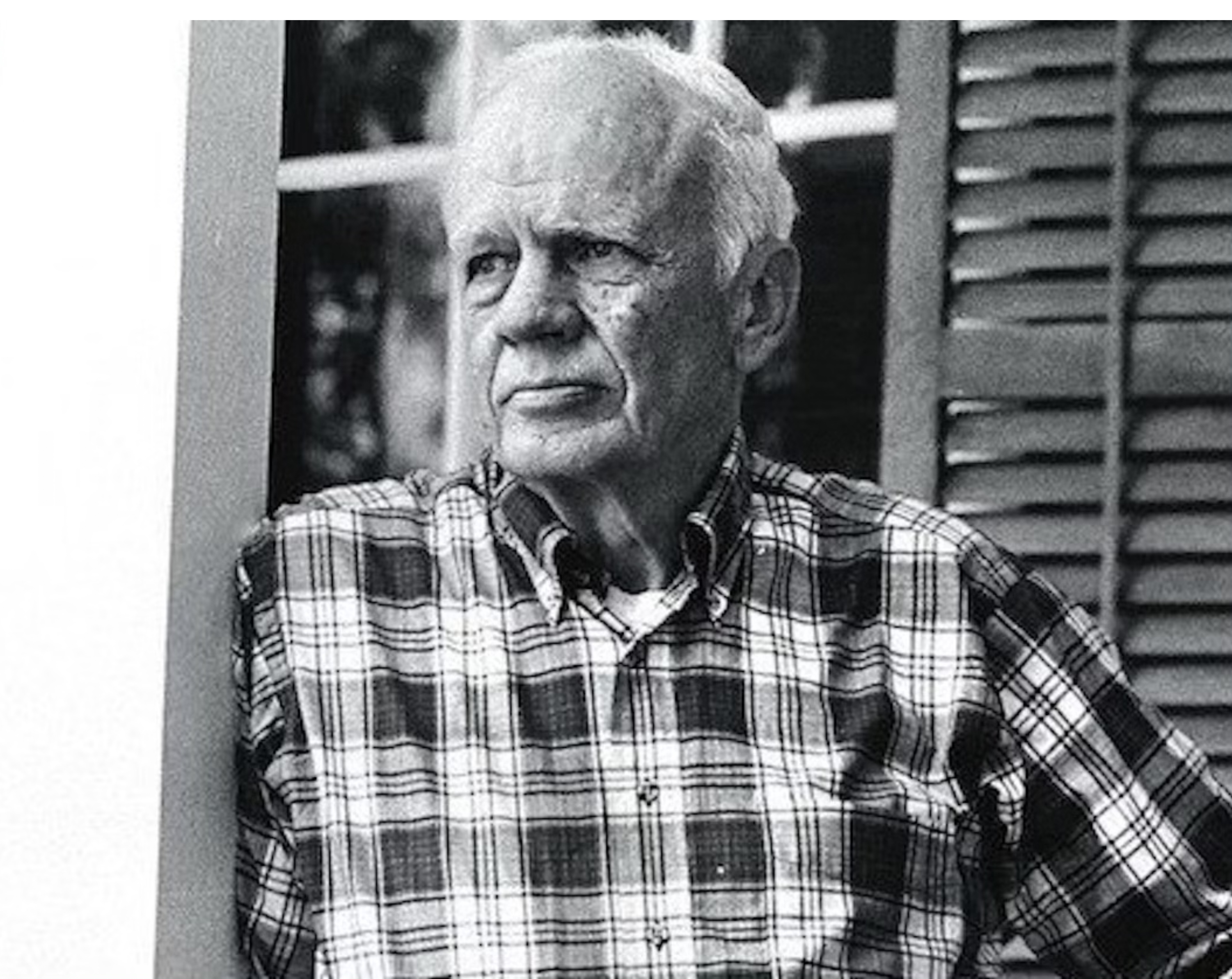
Walker Percy at home in Covington, LA

A challenge related to Kreeft’s theme, regarding how we approach beauty, faces us as modern people. It stems from how – through the influence of our culture – we are inclined to think of art and architecture as being more akin to magic and technology, than to science and religion. For we tend to assume that artists and architects manipulate materials and space to stimulate certain responses from those who interact with their work. And, of course, they do. But is this all that these crafters of beautiful things accomplish? Are they not also among those who seek and make available to others instantiations of what is real, and more particularly of the beauty that is there for us also to perceive and come to know? I believe that they are. 

Artists and architects approach the world in a way that has an affinity with those who work in religion and science, while what they do may seem to be like the work of those who ‘practice’ technology or magic. For like all genuine seekers of Truth, Goodness, and Beauty, scientists (especially theoretical physicists) as well as religionists include dedicated persons who want to know these real aspects of the world that may be apprehended by those who look for them.

I continue to learn by reflecting on these themes.

Note: Kreeft develops at greater length than I have scope here to address the significance of these and related distinctions. He does this in his essay, “Walker Percy’s Lost in the Cosmos: The Abolition of Man in Late Night Comedy Format.” I commend an entertaining recording of Kreeft’s presentation of the essay’s content, which can be found on his website (by clicking this link).
The Beauty of Coming to Ourselves


In his novel, The Last Gentleman, Walker Percy offers an interesting observation, prompted by the experience of hurricanes. It recurs as a theme in his later writing. Here is how one observer captures it:

At one point, Will (the main character) recalls a date with a girl… The date is a disaster until the two are caught in a hurricane. “Though science taught that good environments were better than bad environments, it appeared to him that the opposite was the case. Take hurricanes, for example, certainly a bad environment if ever there was one. It was his impression that not just he but other people felt better in hurricanes,” Percy writes. The hurricane, it turns out, saved the day: “The hurricane blew away the sad, noxious particles which befoul the sorrowful old Eastern sky and Midge no longer felt obliged to keep her face stiff. They were able to talk. It was best of all when the hurricane’s eye came with its so-called ominous stillness. It was not ominous. Everything was yellow and still and charged up with value…”

In [another book, Percy] asks, “Why do people often feel so bad in good environments, that they prefer bad environments? . . . Why is a man apt to feel bad in a good environment, say suburban Short Hills, New Jersey, on an ordinary Wednesday afternoon? Why is the same man apt to feel good in a very bad environment, say an old hotel on Key Largo during a hurricane?”

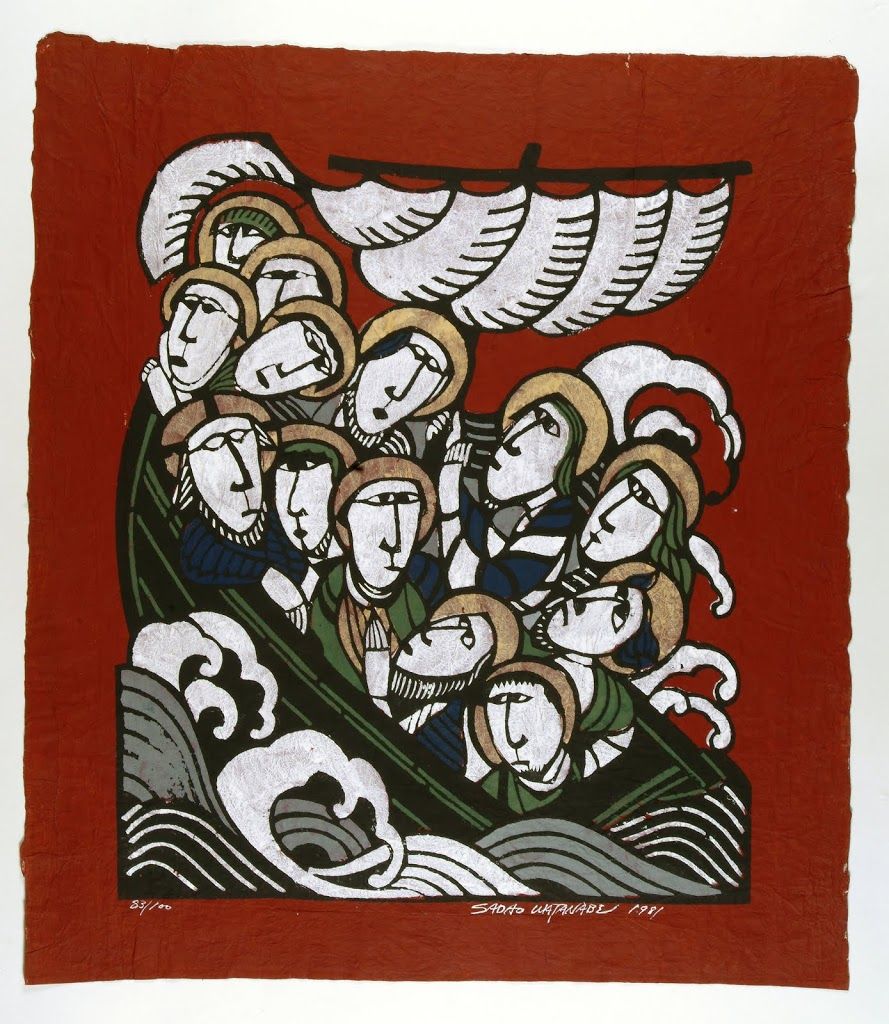
This has come to be called Walker Percy’s ‘hurricane theory.’ In a moment of crisis, ‘we come to ourselves,’ and discover our connection with others. Percy’s theory helps me address a lingering question, prompted by Mark’s story about a storm on the Sea of Galilee: why did Jesus go to sleep in the boat? I love the way that Sadao Watanabe so beautifully portrays the scene. Notice how he depicts Jesus’ arm, casually resting upon the edge of the boat, with his eyes peacefully closed, while the disciples look about in alarm.

Jesus —in this image— seems to know what they have not discovered: that he rests in the Father’s hands, as do they. And so, when he says, “Peace! Be still,” he may also be speaking to them, as he clearly is to the storm. In this storm, for at least a moment, they come to themselves.


This post is adapted from my homily for Sunday, June 24, 2018, which can be accessed by clicking here. The image of Jesus and the Disciples in the Boat is by Sadao Watanabe (1981). The observation about Percy’s ‘Hurricane Theory,’ is by Brett Yates, as quoted by Michael Potemra.

The Beauty of Knowing Who We Are


Walker Percy’s second novel, The Last Gentleman, begins with this apparently unpromising start: a nameless young man is lying on the grass in New York’s Central Park. He is referred to anonymously, as “the engineer,” and as a man who is lost in thought. How odd that the author does not identify him in any concrete way. We also might notice a curious fact; that this man is resting his head upon his jacket, which is folded inside-out. Given this small detail, that his jacket is wrongside-in, we may infer that the young man himself is in some way ‘outside-in.’ Unknown to us— he may also be unknown to himself. The mystery of his exterior personhood reflects the probable mystery of his interior identity.

Having bought a very expensive telescope, our young man oddly finds himself looking at other people in the park. Through the eyepiece, the engineer becomes an observer of others by means of a scientific instrument. Nevertheless, this approach to learning about other people, and therefore about himself, will never bear much fruit. For the self that he seeks is not accessible through scientific inquiry.

Walker Percy presents the young man as a cypher ~ that is, at first, he is a secret to us, as much as he is to himself. His life is like the proverbial blank canvas with its endless possibilities. But he has no freedom. Freedom only comes from knowing what you have to do, and then choosing to do it. And he does not yet know what to do. Instead, he has become a master at conforming to what other people think and do. A wise grandmother or mother will tell us, ‘remember who you are!’ Yet, struggling with bouts of amnesia, the engineer at times cannot remember who he is. And so he does not know what he has to do. For when we do not remember who we are, we cannot remind ourselves of what we are called to do.

Like all of us, in one way or another, this young man is on a journey ~ he is a kind of wayfarer through life. He is seeking to ‘get home.’ Getting home will require coming to know who he is.


This posting is based on my homily for Sunday, June 10, 2018, which can be accessed by clicking here. My focus on this book by Percy was inspired by my recent attendance at the Annual Walker Percy Weekend in my former community of St. Francisville, LA.

The Beauty of Being on Pilgrimage

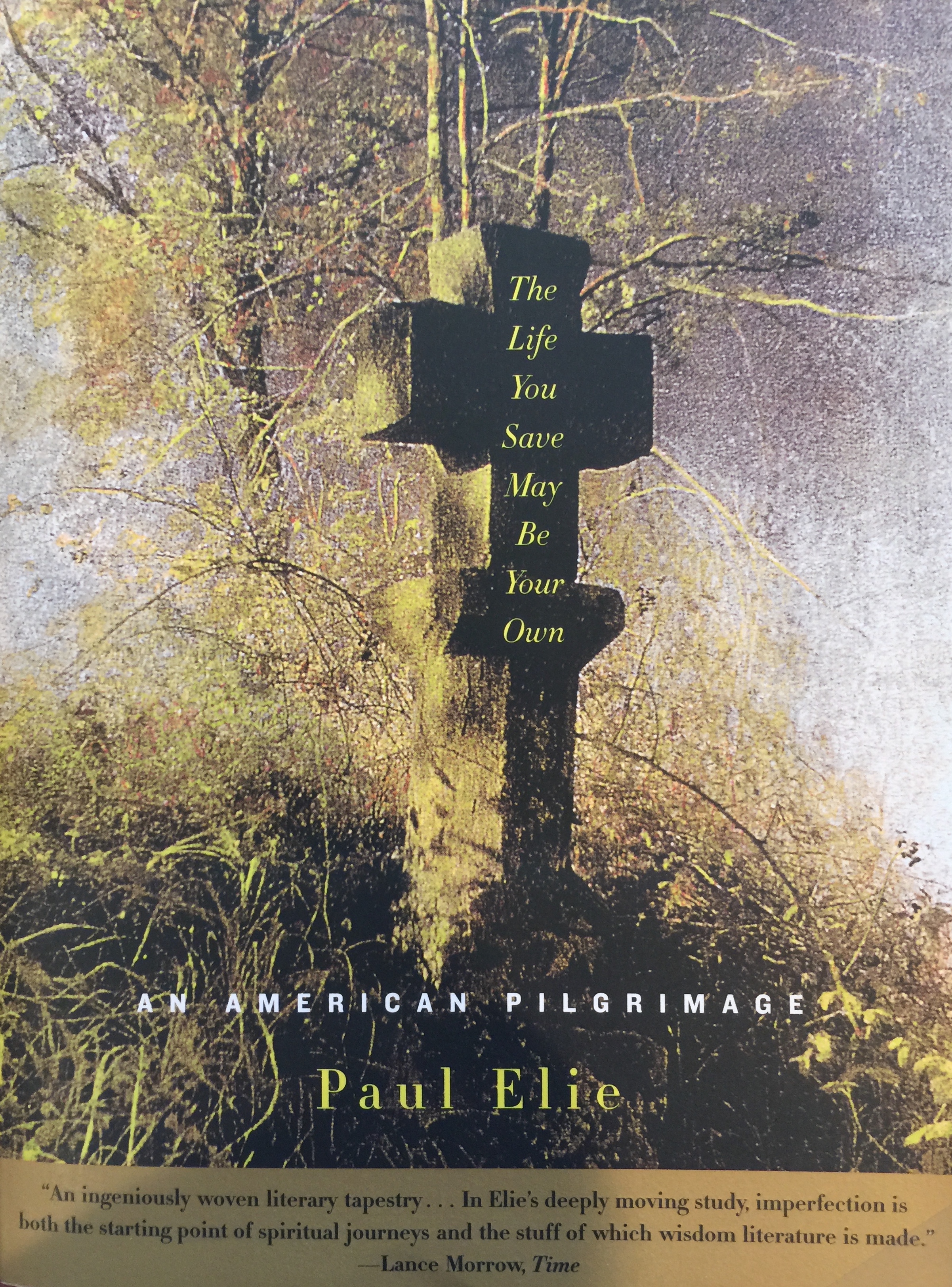
Paul Elie Cover photo


I have been reading and learning from a wonderfully perceptive book. It’s about the converging lives and work of four modern Roman Catholic authors. In it, Paul Elie explores the writing of Dorothy Day, Thomas Merton, Walker Percy and Flannery O’Conor. The book’s subtitle is, An American Pilgrimage. This theme of pilgrimage provides a meaningful metaphor. For, as we grow up, we gradually discern that we are on pilgrimage ~ both to find ourselves, and, to find the God who has already found us. And all the while, we seek to find our place in the world.

In one fashion or another, we are all on the road to Emmaus. We are like the earliest Christian pilgrims, not knowing that we have been found, and joined, by the One who is at first not seen nor recognized. With those first two on the way to Emmaus, we ponder the meaning of the mysterious Passover events in Jerusalem, and our apparent place within them. Regardless of whether we’re physically traveling or not, we are on Camino-like journeys. Our pilgrimage takes us from the partial to the whole, from brokenness to healing, and from darkness into light. We are therefore always on the way. We are on the way towards something whose meaning may not yet be clear. Yet, it still draws us onward.

Have you seen Martin Sheen’s evocative movie about the Camino de Santiago? It is called The Way (which refers to the Way of St. James). The title has layers of meaning. To be on the way to some place, is to journey toward it. Journeying is something that we do. This is the first meaning.

Yet, a “way” can also be a thing in itself, and not just the means for getting somewhere. A way is something we can be part of. In Acts, we find several references to what Luke calls “the Way,” spelled with a capital “W.” For example, we learn about the pre-conversion Paul, who was “breathing threats and murder against the disciples of the Lord,” and asking for letters from the hight priest. This was “so that, if he found any who belonged to the Way,” he might arrest them. Then, we read of a man named Apollos, who “had been instructed in the Way of the Lord; and [who] spoke with burning enthusiasm and taught accurately the things concerning Jesus.” And later, when Paul is under arrest and brought before the governor Felix, we are told that even Felix was “well informed about the Way”!

The Way was and is what Presiding Bishop Michael Curry calls ‘The Jesus Movement.” It’s more than a set of beliefs and a body of teaching, for it is something to which we can belong. The Way is a community of pilgrims, united by a common vision and a shared spirit. We travel through this world together on a path shaped by grace.


This is based on my sermon for Sunday, May 14, 2017. I make reference here to Paul Elie’s book, The Life You Save May Be Your Own. You can access my sermon (“Our House of Pilgrimage”) by clicking here.