Vision

Common Beauty

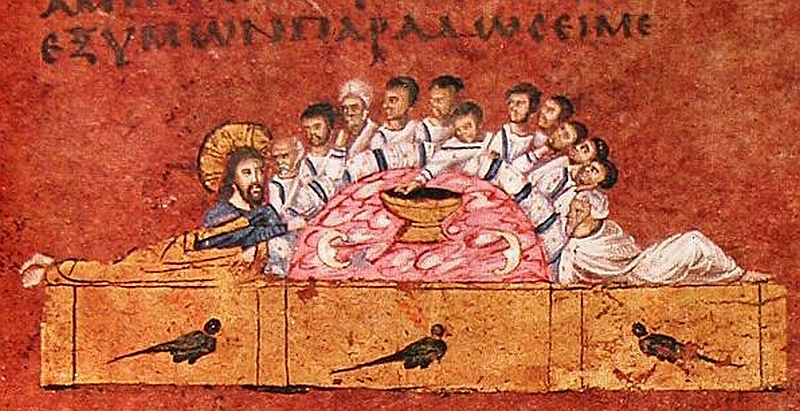
Rossano_Gospels_Last_Supper


We have many ties with others through birth and our families. We find we are connected with one another by bonds that are not of our own making.

Like the links we have with our families into which we are born or adopted, our relationships with other members of the Body of Christ are also given to us. These relationships are a reality we find rather than one we construct, for they are not products of our acts of willing.

Though we discern the reality of these given birth and baptismal connections between us, we easily fall into patterns of thought that suggest otherwise. When asked who we are, we often answer in ways that ignore these received relationships. We forget that, especially after Baptism, who we are can never rightly be described without also referring to whom we are for.

Acts 2 describes the post-resurrection community as having four shared attributes : common worship, common practices, common goods, and common witness.* Members of this community could share “all things” because they already shared the most important thing, the beauty of new life in the risen Jesus.

The Rossano Gospels depict Jesus with the disciples at the last supper, reclining in ancient mediterranean style. The image of circular fellowship applies equally to their life together after the resurrection and ascension. They shared their lives at the table of Eucharist and at tables of fellowship, which became visible symbols of everything else they shared.

Judas is shown leaning out from the pattern of this circle, fulfilling Jesus’ prediction about the one who would dip in the bowl after him. Judas’ stance mirrors his refusal to share the common purse with which he has been entrusted, and his disinclination to share common worship and common witness to Jesus’ power among them.

Common beauty is within us and around us. Seeing each other as joined in the risen Lord is directly correlated with seeing the risen Lord in each other. By sharing union with him, and through discerning his beauty in one another, we are more likely to share everything else.


The image above is from the Rossano Gospels, 6th century A.D. *Robert W. Wall offers this insight.

The Beauty of Connections

image


We live in a world filled with “data.” Disconnected bits of information, especially in great quantity, overwhelm our ability to see and to think. Accumulating additional data or more information does not produce knowledge. Knowledge has to do with seeing the connections between bits of information. When we see the connections, we begin to see a picture, we begin to hear a story, and we gain understanding as well as wisdom.

The unrecognized fellow traveler on the road to Emmaus asks, ‘what are all these things you are talking about?’ The answer he receives from the other two on the road amounts to giving him information. But his question was pointed toward understanding, especially in relation to ‘the big picture.’ What do ‘all these things’ have to do with what God has been up to, all along?

Here is a basic Christian truth that we find in the Emmaus Road story: Things take on meaning in relation to the risen Jesus. It happens when we see events in our lives in relation to him. It happens also with things like bread and wine as we gather at table. And it happens with people like you and me as we gather in community.

Jesus helps our perception on the road to Emmaus, and reveals something even more profound at the inn. This ‘inn,’ unlike the one where he was born, has many rooms, many mansions. When we see things like past events and the bread in relation to him, we discern more about what they are, and what they can become. When we see ourselves in relation to him, we better discern who we really are, and who we are called to be.

Prayerfully, we can look around, between things, and within. We can look for the connections. When we do, we see and discern. We see more because we see more wholly. Then we see the holy.


The above painting, Supper at Emmaus (1958), is by Ceri Richards, and is used by permission from the Trustees of the Methodist Modern Art Collection (UK). The penciled notation at the base of this guache painting on paper suggests that it was intended as a study for an altarpiece painting for the chapel of St. Edmund Hall (or College, at Oxford, England). The Emmaus story can be found in Luke 24:13-35.

Unexpected Beauty

He Qi The-Road-to-Emmaus

In the mid 1970’s, I had a short stint as an art student in Wisconsin. Through those studies I met the remarkable professor, Reinhold Marxhausen, who was skillful at teaching others to see. Like the more recent work of Dewitt Jones, Marxhausen embodied a calling to help others discern unexpected beauty in everyday places and people.

The vocation of the artist is to see and help make apparent the beauty that surrounds us. Theologians have the same vocation. For artists and theologians share an interest in beauty, goodness and truth, and their common divine source. A saying from the early Egyptian Christian monk, Evagrius, may help us here. He said that a theologian is someone who prays. Someone who prays acquires logos about theos. He or she gains wisdom from God and, in the process, receives a fuller vision of beauty, goodness and truth.

On Sunday, we will hear one of my favorite Gospel stories ~ the road to Emmaus. This story prompts an Eastertide question, of interest to both the artist and the theologian: Where do we find the resurrection? In what unexpected places or people do we find the risen Jesus? The inverse question is more perceptive: Where does the resurrection find us? In what quite unexpected place or part of our lives are we found by the risen Jesus?

The Gospels help us see the answer, in darkened tombs and in our darkened hearts. Resurrection finds us on our life journeys as we are joined by our often unrecognized Companion on the Way, and at table when we break bread together. He helps us see the big picture, and how “every story whispers his name.” *

Encountering and then seeing true beauty, we find our hearts burning within us.

 
The painting, The Road to Emmaus (1997), by He Qi (He Qi,© 2013), is used by licensed permission. The Emmaus story can be found in Luke 24:13-35.  * This is the evocative subtitle of the commendable book, The Jesus Storybook Bible (Zondervan).

Beauty and Resurrection

Stanley Spencer_the-resurrection-reunion-of-families-1945

Stanley Spencer’s church cemetery visitors find themselves surprised by being found! They experience being found through a resurrection encounter with those who have gone before.

The resurrection of Jesus is not usually something we go looking for. The risen Jesus comes and finds us. This is the pattern we see in so many of the stories of Jesus’s first resurrection appearances to his friends and followers. The disciples and others don’t go looking for him except at first, when they go to the tomb. And even then, they are seeking Jesus’ mortal remains rather than his risen presence. He comes and finds them, just as he finds us, often in the context of fellowship. And like them, we are always surprised.

We don’t find the resurrection just as we don’t find God. Neither God nor the risen Jesus are lost, even if we may be. And so, we are found by both, and then we find ourselves as persons who have been found. This is instructive, for it corresponds with our apprehension of, and encounter with, beauty —which we also misleadingly credit ourselves with ‘finding.’ Really, beauty finds us. For our perception and recognition of beauty depends not on a ‘power’ that we possess to pursue and attain it, but rather on our ability to receive and recognize what is, and what is given. The same is true in our apprehension of, and encounter with, the grace of the resurrection.


Stanley Spencer, The Resurrection – Reunion of Families, 1945.

Fully Alive

Byzantine Imago Dei


An early Christian bishop, St. Irenaeus, left a saying dear to many: the glory of God is the human person fully alive.

We are called to be fully alive, and to realize God’s glory in our own being. To be fully alive is a gift rather than an attainment, and means experiencing an integration of body and mind, as well as heart and spirit. Such a synthesis is uniquely human. Angels lack bodies, and animals lack God’s breath or spirit within them.

When fully alive, we reflect how we were created in God’s image and likeness. We have lost likeness with God, yet God’s image remains within us. God seeks to restore us to likeness with him through his redemptive mission, to transform us and all Creation toward our End in him.

We explore varying interests and concerns on our journeys toward wholeness, and holiness. We recognize we are drawn to beauty. We sense what is right and good in our interaction with others. We become aware of our spiritual growth when we discern how truth involves more than analytical knowledge, and requires divine wisdom.

Some people conceive of beauty, goodness and truth as involving a hierarchical journey, where we ascend from beauty through the good toward truth. Thinking in this ‘layered’ way can have a negative consequence ~ leaving beauty behind.

Why? If pursuing the good takes us beyond beauty, and our desire for truth takes us beyond exploring the good, we may wrongly think that wholeness involves forgetting beauty. Mistakenly, we will conclude that growth toward inward beauty is not essential to our wholeness in God. We are then less able to accept genuinely godly art, music or literature.

The events we commemorate liturgically during Holy Week are not an optional overlay on what God has done for us in Creation. The redemptive mission of God, manifest on the Cross and in the Resurrection, makes possible being fully alive. We are restored and transformed through a beautiful self-offering, made by the One through whom all things were made. True human beauty cannot be grasped without a vision of divine glory, revealed fully in the face of Jesus.


[In relation to the above, see Gen. 1:26-8, for how we were created in God’s own image and likeness, and Gen. 2:7, for how, among all creatures, we are uniquely “in-breathed” with God’s breath/spirit (same word in Hebrew). In Christian doctrine, angels are spiritual persons without bodies; we are spiritual persons with bodies; animals are embodied but –however intelligent– are without a “spiritual” nature.]

Beauty and Authority

Transfiguration300dpi

A noticeable antipathy toward “authority” pervades our culture. We think of authority as external to us, and as having the capacity to constrain our free choices and self-expression. Modern and ancient examples support this impression. Think of recent stories about the Port Authority of NY & NJ and the closure of traffic lanes leading to a major bridge. Or the Gospel centurion who referred to himself as “a man under authority,” who also had soldiers under him.

Given this, it may seem incongruous to mention the words “beauty” and “authority” in the same breath. But then, compare these sentences: “I was arrested by the authorities;” and, “I was arrested by her beauty.” Beauty has authority!

Years after studying with Oliver O’Donovan, I remain curious about an insight he offers concerning authority. Put in my own words, an authority is something that makes our responses or actions intelligible. When we defer to an older person, we are responding in part to the authority of age. If we set aside a long-held idea when presented with a compelling reason to see the matter differently, we respond to the authority of truth. The natural authority of beauty functions in a similar way. By selecting a stunning handmade cross for our church rather than one from a religious supply catalogue, we are responding to the authority of beauty.

These examples help us recognize how authority functions internally within us as we respond to the world. Authority is not simply a feature of our encounter with various officials and institutions, and it does more than compel. Authority invites responses by summoning our attention and prompting our discernment. This concept of authority imbues a prayer for the feast of The Transfiguration:

“O God, who on the holy mount revealed… your well-beloved Son, wonderfully transfigured, in raiment white and glistening: Mercifully grant that we, being delivered from the disquietude of this world, may by faith behold the King in his beauty…”

The beauty of the King arouses our deference by his appearance. As we look at him more and more, we disregard competing objects of attention. Beholding the fair beauty of the Lord, we will seek him in his temple  (Ps 27).

The above painting, Transfiguration (2003), by Armando Alemdar Ara, is reproduced with permission from the artist. The prayer is a collect in the Book of Common Prayer, p. 243.

Toward a “Catholic” Vision [part 2]

EucharistAtStGregoryOfNyssa_med


In part 1, I shared how Ralph McMichael offers this brief but evocative definition of the word “catholic.”

Catholic means the whole truth, about the whole God, for the whole world.

Ralph’s concise definition calls for intentional follow-through. When we hear ‘catholic’ in conversation, we should anticipate and hope for an encompassing understanding of this word. This can be a first step in helping us to aim at a holistic (and therefore holy) vision of the world.

The challenge I find in Ralph’s definition is for all of us who are baptized to be “catholic” in a genuinely biblical, apostolic and ecclesial way. This means seeking and finding wholeness and holiness within the vocation we have received together in Baptism.

Embracing a larger concept of what it means to have a catholic vision opens us to
a more expansive vision of God’s Mission throughout the world. Jesus has embraced and empowered all of us to go out as grace-enabled participants in God’s continuing mission to redeem and transform the world.

We desire ‘wholeness.’ Encouraged by the culture around us, we think of achieving wholeness as our project, as our task to fulfill, or the solution to our therapeutic needs. Approached in a more encompassing way, wholeness is reconnected with God’s Mission in the world, rather than reduced to being a feature of our personal lives. God nurtures this greater wholeness through our life in community. We express God’s Mission best when we celebrate the Eucharist together.

God’s Mission is always greater than we can ask or imagine. It is not just for us, for our families and friends. God’s Mission enables us to live into the whole truth about the whole God for the whole world. As we live forward, into this wider vision, we will find that it involves beauty and goodness, as well as our perennial concern for what is true.

On this, his feast day, we can join St. Richard of Chichester (d. 1253) in his prayer, “Day by day, dear Lord, of thee three things I pray: to see thee more clearly, love thee more dearly, [and] follow thee more nearly, day by day.”


{St. Richard’s words are quoted from Hymn 654, The Hymnal 1982 / the photo above, from a Eucharist at St. Gregory of Nyssa, San Francisco, is by Mark Pritchard, (c) Attribution-NonCommercial-ShareAlike License}

Toward a “Catholic” Vision [part 1]

OLYMPUS DIGITAL CAMERA


In an earlier age, having catholic tastes or a catholic perspective meant breadth in one’s approach to the world and to objects of interest within it. A “catholic” vision would therefore be expressed in terms of what it includes rather than what it does not.

We live in an age when words and ideas are prone to partisan and ideological interpretation. Too easily, we settle for narrow and limited meaning. When we now hear the word “catholic,” we assume the reference is to an institutional branch of Christianity. Though we find the word “catholic” in the universally accepted Apostles’ Creed, we allow lesser concerns to shape our concept of what it means for the Church to be catholic.

My friend and former teaching colleague, Ralph McMichael, offers this brief but evocative definition of the word:

Catholic means the whole truth, about the whole God, for the whole world.

His definition may help us reclaim the word, so that even ‘free church’ believers might be comfortable using it. Catholic has to do with the whole, with what is universal.

A catholic vision will include all that is beautiful and all that is good, as well as all that is true. Arguably, anything less falls short of being catholic.

I am continually challenged not to settle for less than this encompassing and holistic vision.