Peter Koenig

Beauty and Holy Sorrow

Art_Peter Koenig Palm Sunday


The moment is filled with paradox. Jesus enters the royal city, proclaimed as “the blessed one who comes in the name of the Lord—even the King of Israel.” Luke says his appearance signals “peace in heaven.” As he arrives, he is keenly aware that tremendous confusion lies at the heart of the recognition he is receiving. And Peter Koenig’s painting captures this nicely.

Koenig portrays Jesus dressed completely in white, suggesting his identity as ‘pure victim’ and ‘true priest.’ The painter takes a symbolic approach to the scene, envisioning it in a contemporary setting. Though we see an ample supply of date palms in the background, people in the crowd are waving flags. I count at least 18 communities or nations represented by those flags, including Israel, Lebanon and the Gaza Strip, as well as Nicaragua and Cuba. Surely , a crowd of people from many nations, united in their enthusiasm about Jesus’ arrival, is a sign of hope, is it not? Why would he be weeping?

He is weeping because he knows what is in people’s hearts. He knows how thin is our perception, and how halting is our embrace of him. We so often assume that, by virtue of our common affirmations, we can overcome our divisions. As if we could all agree upon a combination of human civil laws, and then arrive at the unity we all desire. But he knows that the healing of the divisions between the nations will not occur until the real human problem has been dealt with. The real problem is sin. It will be dealt with by his cross and resurrection, and most importantly, by the descent of the Spirit at Pentecost. Only these events will heal the divisions we have experienced since the demolition of the tower of Babel.

We see two figures in foreground unroll a band of penitentially-colored purple fabric. They discern a more appropriate way to greet him, than do those who wave symbols of the partitions between us. We so often behave as if we were less than the one people of God. Yet, the Body of Christ replaces all our competing affiliations, a fact not yet apparent to those who shout Hosanna on this day. This same heedlessness is suggested by Koenig’s portrayal of those who seek to greet him by climbing up on a cross. Soon, they will lift him up on this same form, confirming their need for him to be among them. If he weeps on this day, he weeps for us. We are among those for whom he asks forgiveness, for we know not what we do.


Peter Koenig, Entry into Jerusalem. To view more of his paintings, click here. See Mark 11:1-10, and John 12:12-19. To access my Palm Sunday homily, on which the above is based, click here.
The Beauty of Offering

Peter Koenig_cleansingtemple1


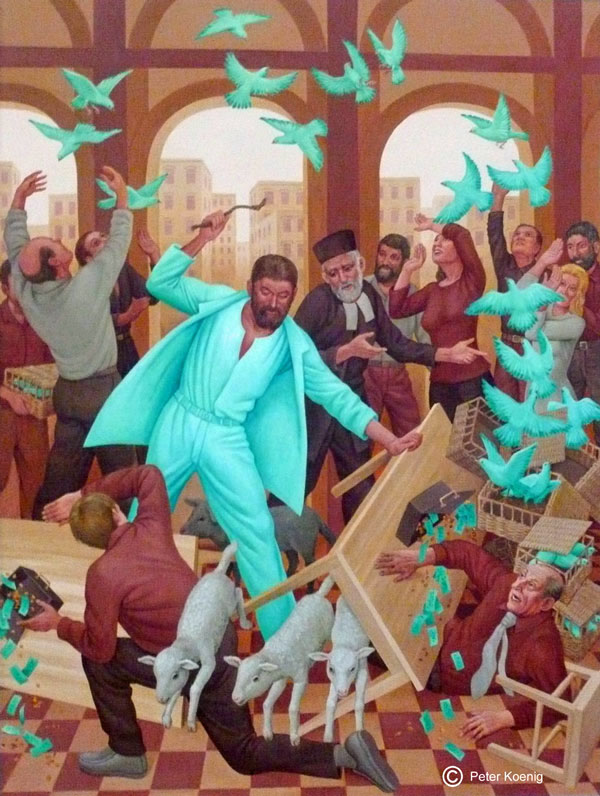
Peter Koenig offers an evocative view of one of the most dramatic stories in the New Testament, Jesus’ so-called ‘cleansing of the Temple.’ We can’t help but notice the aquatic colored clothing worn by the Christ figure, matched by the at-first-surprising color of the doves. Fairly quickly we notice the similar but slightly differently colored paper currency falling out of the overturned cash boxes of the merchants and money-changers. Though both doves and lambs might be presented as forms of offering in the temple, the lambs are not depicted in the same hue as the doves.

Some translations render Jesus’ critical statement as, “Stop making my Father’s house a marketplace!” Another way of translating that last word is “house of trade,” which may better locate the object of his anger. Throughout the Bible, from the days of the Temple’s prototype in the wilderness, to its fulfillment in the New Jerusalem, God provides a place and a way for us to offer gifts.

The ‘exchange’ that is the object of his wrath may not be so much the trade of money for sacrificial animals, as it is the spirit of exchange that shapes and colors much of the prayer occurring within this place. By overturning the tables and driving out the animals, Jesus points to a new Temple where we meet God. He becomes the new place of offering, where pure offering replaces all the false substitutes we create by our efforts to engage God in an exchange.

Why the aquatic colored vesture for Jesus in the painting, as well as for the doves? I am not aware of any explanation by Peter Koenig. The whip in Jesus’ hand reflects a detail unique to John’s Gospel. The color of his clothing may therefore be connected with his statement on another visit to the Temple, implying that he is the source of living water. Living water and the life-giving Spirit are thematically linked in the Fourth Gospel. As a dove does at his Baptism, the similarly-colored doves may represent the Holy Spirit. Here we see the Lamb of God, who has come into the world in order to offer it up to the Father in the Spirit. Entering the Temple, he sends earthly lambs scattering, and pushes aside false ways we use to secure life and happiness through exchanges we try to make with God. Instead, Jesus invites us to join him, in his whole and complete self-offering.


The Cleansing of the Temple, (C) Peter Koenig. For this and other images by the painter, please see the website from which this painting was retrieved, http://www.stedwardskettering.org.uk. For a link to my homily on the theme of offering and exchange, in relation to John’s account of the Cleansing of the Temple, click here.