[If reading this by email, please tap the title at the top to open your browser for the best experience. Then, clicking individual pictures will reveal higher resolution images.
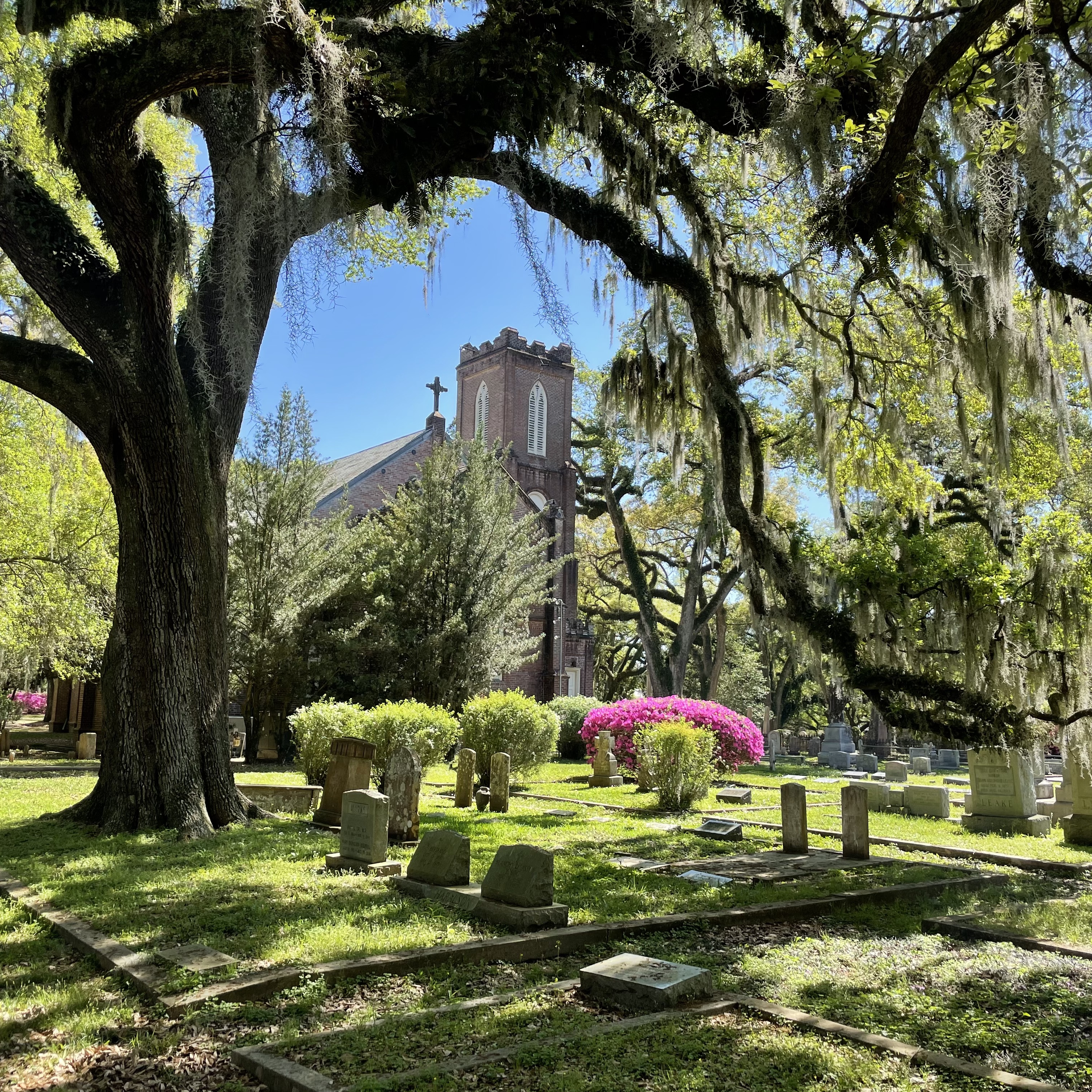
One of my joys in retirement is once again to live near and be able to serve occasionally at Grace Church in St. Francisville, Louisiana. For many years it has been a ‘home away from home,’ not least because our three sons and their families live not far from it, and because many dear friends are members of the congregation and in the community.
Like so many, we are gathering this week with family as we celebrate Thanksgiving. High on our list of things for which we give thanks is having five of our granddaughters living within about a ten minute walk from our house, and our sixth granddaughter and her brother just a couple of hours away in New Orleans.
Among our grandchildren is one whose remains lie under one of the stones in our beautiful and historic cemetery. It is an especially meaningful place for us to stop and linger in the quiet, especially at holiday times like this. When in late 2007 I was called away to serve elsewhere, the blessed folks of Grace provided us with a burial plot in the rector’s portion of the cemetery. We give thanks for it as one of the most touching gifts we have ever received.
Some may have a hard time imagining how a cemetery, a place associated with death, could be replete with signs of life. And yet, it is. These evident signs of life transcend the presence of the church building and its related Christian symbols, like the crosses and inscriptions found on the monuments. I marvel at the live oaks with their long draping limbs, and how they stay green year-long, often supporting gangly strands of gray-green Spanish moss. More subtle are the fuzzy growths on the upper surfaces of those limbs, which appear to be a blend of moss and ivy. Their common name is resurrection fern, which in dry spells has an ochre color, but which then miraculously transforms into a deep green after an overnight rain.
My former church office looks out upon the cemetery ground in which are buried the remains of dear Lucy, a deacon our parish sponsored for ordination. Every time I walk the paths between alternating old and newer stones, I am mindful of her resting place and those of other friends and acquaintances, with whom we share in the communion of saints. Now, we also go there to visit ‘one of our own,’ in that most personal sense of the phrase. Some day, under one of these magnificent oaks, my remains, as well as Martha’s, will lie next to those of our granddaughter.
To muse upon these things during Thanksgiving week may strike some as dark and sad. Yet, a walk among the remembrance stones of this holy place reminds me of the life-giving texts we encounter every year on All Saints, and in our Eastertide lectionary readings. For, in one way or another, we are all called to visit that rocky ‘garden’ tomb, to find it empty and ponder its significance. There is undeniable beauty in the stories about what then became a holy place.
The beauty of the good news concerning that empty tomb is so much more than a wonder-story about a lucky man whose experience might inspire us. A man who, despite the worst that this world can do to a ‘good’ person, somehow managed to escape into something better. The Gospel story is also the ground for our hope, our hope for ourselves and our loved ones. Can that empty tomb then help us recognize how, in similar places reminiscent of death, we can find signs of new life? Yes. For our cemeteries are places where we seek to remember and honor our loved ones, with whom – in Christ – we are still connected. Here, in these places of burial, we can give thanks that through God’s love we are destined for more than we can now see or imagine.
The photo above depicts the cemetery of Grace Episcopal Church in St. Francisville, Louisiana. The church was founded in 1827, and the present building was completed by 1860. Three years later it was damaged by cannon fire from Union gunboats on the nearby Mississippi River, whose sailors were using our church tower to target the Courthouse across the street. (photo by Stephen Holmgren)

 Toward Beauty