Good News

The Believing Eleven

If reading this by email, please tap the title at the top to open your browser for the best experience. Then, clicking individual pictures will reveal higher resolution images.

Peter Paul Rubens, The Rockox Altarpiece, 1613-1615 (center panel)


It is evening on the day of Resurrection-discovery. John tells us that ten of the disciples are hiding behind a secured door out of fear. Judas is deceased, and Thomas is away.

Jesus suddenly appears to the unprepared disciples, and shares with them his peace. He shows them his hands and his side, and then – as a direct consequence of seeing the places on his body associated with his death – the ten disciples rejoice when they see their Lord. In other words, their recognition of him, and that he was somehow alive again, brings them joy by restoring their belief in him.

When hearing this story from John’s Gospel on the second Sunday of Easter, we may be prone to considering it apart from what happens just before it. The disciples, who are hiding out of fear, have already received an eye-witness to the resurrection of Jesus. Mary Magdalene, to whom Jesus revealed himself at the tomb that morning, had come and told the ten the Lord was alive, and that he had appeared to her. Clearly, and prior to Jesus’ unexpected appearance, the ten disciples are still doubting her personal witness. Even after receiving what should have been trusted testimony from Mary Magdalene, a fellow follower of Jesus.

So why – in popular imagination – isn’t this well-known Gospel reading from John 20 commonly referred to as the “doubting disciples” reading? Why should Thomas be singled out, when his joyful recognition of the risen Jesus depended on nothing more or less than what the 10 had needed, and received, before him?

And why have so many painters in the Western tradition privileged Thomas’ purported unbelief in the Risen Lord, rather than depict the earlier reluctance of the ten others to arrive at joyful confidence about the Lord’s astonishing return? Apparently, in many painters’ eyes (especially Caravaggio), more visual drama was to be found in images of a doubter’s hand placed within an open wound.
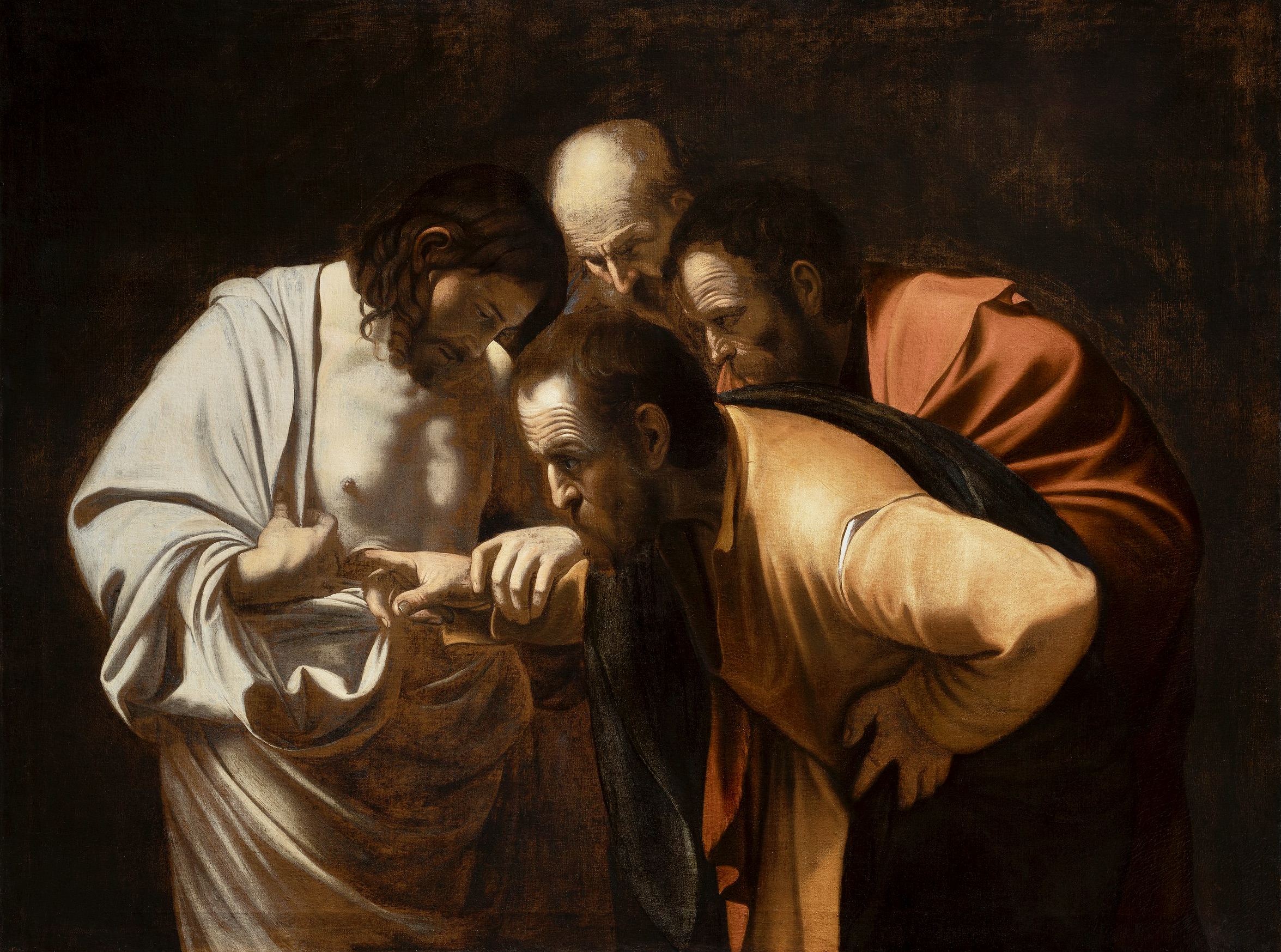
Caravaggio, Doubting Thomas, 1601 (a famous traditional presentation of the event in John 20)

A further detail to notice, which our familiarity with so many paintings helps to obscure, has to do with how Thomas responds to Jesus. According to John, Jesus appears to the not-yet-believing ten, and – unbidden – shows them his hands and his side. Seeing the traces of his wounds on his risen body brings them joy. Jesus then appears unexpectedly a week later, this time showing himself to the one not present on the prior occasion. And just as he had done previously, Jesus offers Thomas the same opportunity he had provided to the others.

We should therefore not be misled by Thomas’ oft-quoted comment to the other disciples, prior to his own epiphany, about what he needed in order to believe. According to the text, Jesus – upon appearing in the same house a second time – bids Thomas to touch him. Yet, Thomas immediately responds to Jesus’ words without any mention in the Gospel of him having physical contact with the risen Lord’s wounds. Jesus then asks Thomas a rhetorical question, “Have you believed because you have seen me?” Naturally, Thomas’ implied answer is ‘yes.’

For all these reasons, we will do better to find a different and more positive descriptive phrase by which to refer to this well-known passage from John 20. “Jesus meets the disciples according to their needs,” though wordy, would do better.
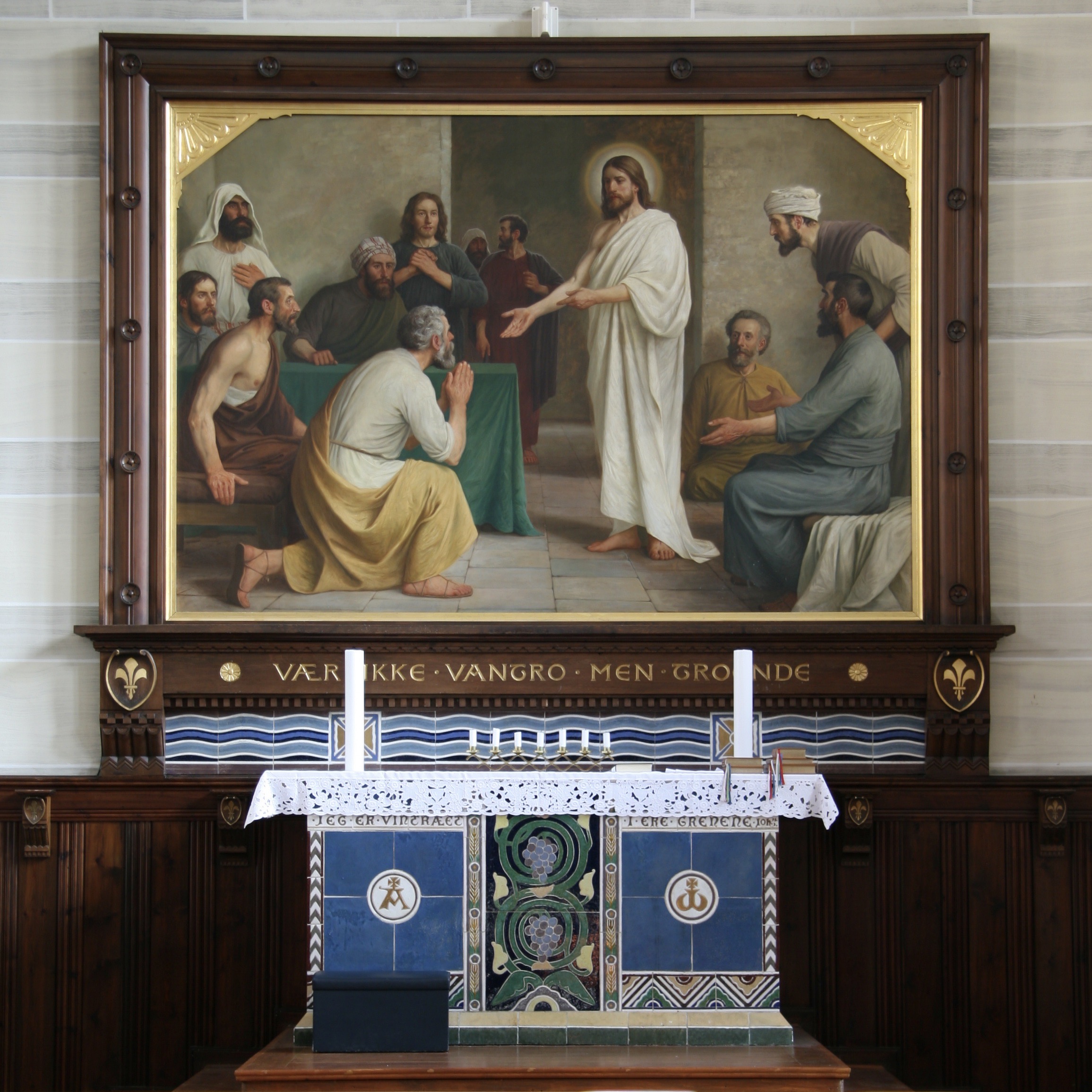
P. Steffensen’s altarpiece painting behind the altar of Zion Lutheran Church, Copenhagen


This post is based on the traditional Gospel reading for the second Sunday of Easter (April 7 in 2024), John 20:19-31. The story within it concludes with these words: “Jesus said to Thomas, ‘Have you believed because you have seen me? Blessed are those who have not seen and yet have believed’.”

Note: The altarpiece paintings by P. Steffensen and Rubens provide an interesting counterpoint to the prevailing tendency of painters to focus on Thomas placing his hand in the side of the Risen Jesus.
 

The Paradoxical Beauty of Hope


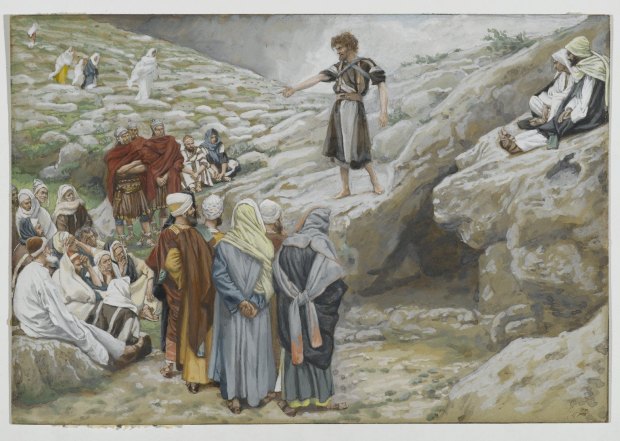
As all four Gospels attest, John the Baptizer’s ministry occurs in the wilderness around the Jordan River. This requires people to go out to him. James Tissot’s painting of the scene nicely captures the drama of their interaction. For as the artist depicts, people do not casually encounter John in the public square or marketplace, but out in a barren region to which they deliberately have to travel. Therefore, in addition to those who have come out with malice, many journey to John with a genuine curiosity and a sincere spirit of inquiry.

Luke reports how John greets these people in an apparently hostile way: “You brood of vipers! Who warned you to flee the wrath to come?” As we see in the painting, among them are various officials and soldiers. Surprisingly, they don’t turn and leave when they perceive the prophet’s scorn. Instead, they respond with a question: “What then should we do?” To which John responds with concise, practical —but also unexpected— advice. He does not tell the tax collectors to stop serving the infidel foreign regime occupying their historic lands. Nor does John tell the soldiers to abandon their compromised relationship with the Roman-supported local authorities. Instead, he counsels them on how to behave ethically, while they remain in their present roles! Astonishing!

And John says all this in the context of predicting the Coming One, the one who will baptize with the Holy Spirit and with fire. This will be the true Messiah, who will manifest his vocation by wielding a “winnowing fork in his hand.” He will “clear the threshing floor and… gather the wheat into his granary; [while] the chaff he will burn with unquenchable fire.” Paradoxically, Luke refers to these dramatic and threatening predictions as the proclamation of good news.

The appointed Lectionary readings from Paul and Luke, for the third Sunday of Advent, complement a reading from Zephaniah. For the prophet speaks of “the king of Israel, the Lord” who is in our midst ~ “a warrior who gives victory,” and who renews us in his love. Zephaniah urges us to rejoice, and not to fear, while he points to the implications of God’s mission for the world. Prefiguring Paul’s later words in Philippians 4, which encourage us to rejoice and not fear anything, Zephaniah challenges us to practice the virtue of hope. Like faith and charitable love, hope is a gift of the Holy Spirit. Though it is a gift, we need to put it into practice. Hope, faith and charitable love are therefore more than feelings, more than passing sentiments. And we should expect to see these beautiful signs of the Spirit’s movement in our churches. We notice them as we are lifted up by a rising tide ~ the rising tide of the Holy Spirit’s presence in our midst.


This post is based on my homily for Advent 3, December 16, 2018, which can be accessed by clicking here.  Other homilies of mine may be accessed by clicking here. The Revised Common Lectionary, which specifies the readings for Sundays and other Holy Days, can be accessed by clicking here.

The Beauty of True News


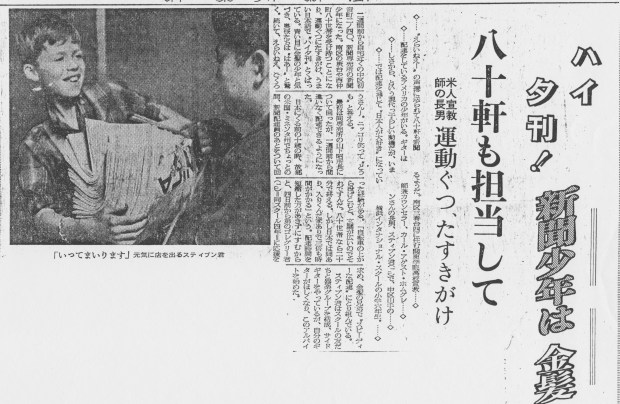
It may be that I was the first American ‘paperboy’ in Japan, when I worked for the Japanese newspaper, the Yomiuri Shimbun. At least that’s what they told me when writing their story. Like many kids in the States, then and now, with whom I had few things in common, I still shared what may be a universal desire. I hoped to earn money to supplement my small allowance. And I wanted extra money so I could buy a guitar.

We lived in a Japanese neighborhood, and our local contacts were almost entirely Japanese. Having grown up in Japan, and being fairly fluent in Japanese, this led me to a job in our local economy. That’s how I became a ‘paper boy,’ delivering—as I remember it—about 40 or 50 newspapers, every afternoon. Before delivery, I had to insert advertisement fliers in each copy. This could make the whole bundle rather heavy. I slung them under my left arm, using something like a Judo-belt.

Well ~ my plan worked. I was able to buy my dream, my first electric guitar. It was a brilliant red Japanese Gibson knock-off, which I wish I still had.

We all receive ‘news,’ and we count on it. Even when we are frustrated or angry about what we learn. The source of our ‘news’ may be helpful and encouraging. But often, it’s not. Rarely are our news-providers neutral about what they communicate. Various considerations, like politics and commercial interests, affect the results. Yet, in my case, as a 12 year old foreigner, I was delivering a Japanese language newspaper to neighborhood homes that were very different from mine. In the process, I was largely indifferent to what I delivered. And the recipients seemed largely indifferent to me, as compared with how they probably approached their newspaper.

Now, I share all this because what I have observed here may provide a significant clue. It might signal a small but important part of Mark’s Gospel account of when a certain King Herod hears news. And, he hears news that alarms him. Yet, those who communicated it may not have known the significance of what they had told him. And when we, in similar ways, neglect reflectively to consider what we hear, it doesn’t always work out well for us. Especially if we are not attending to nuance, or ideas, or subtle distinctions and other sensitive things that have a real bearing upon our life together.

What makes some types of ‘news’ significant, as compared with some others? Does it make a difference, to consider the source of the ‘news’ we receive? The current rhetorical dismissal of some forms of the media, as ‘fake’ news, tells us something ~ that, just because something is reported, may not mean that it is true or reliable. Also, just because ‘news’ may be true, doesn’t mean it will be reported. And even if true news is reported, this doesn’t mean that we will attend to it, or properly value what it tells us. After all, the Gospel is literally good news, and meant for the whole world and all its people. And yet, consider the extent of our own engagement with it. Also consider how many, who are only somewhat familiar with it, remain indifferent to its meaning, and to its power and purpose.

And so we need to receive, and also attend to, news that is true.


This post is based on my homily for Sunday, July 15, 2018, which can be accessed by clicking here. The news story with photo above is from some time in the spring of 1968.