Creation as Revelation

1024px-NautilusCutawayLogarithmicSpiral-cc license


“Ever since the creation of the world God’s eternal power and divine nature, invisible though they are, have been understood and seen through the things he has made.” Writing to the Romans, Paul suggests that all people have an opportunity to learn about God through our experience of the world. Visible beauty speaks of invisible mystery. Some call this common grace, and others refer to general revelation.

We learn about God in other ways that complement the ‘special’ revelation given to Israel and in Christ. This ‘general’ revelation from God through nature provides true knowledge even if it is not saving knowledge. Saving knowledge comes to us solely through special revelation. Therefore, to say that all can learn from God through his Creation does not imply that all will be saved. Only that all may experience delight and wonder from him.

“The heavens declare the glory of God, and the firmament shows his handiwork.” Psalm 19 celebrates how the beautiful ordering of the world reflects our Creator and speaks of his purposes. We find this ancient insight at the heart of a modern prayer:

“Almighty and everlasting God, you made the universe with all its marvelous order, its atoms, worlds, and galaxies, and the infinite complexity of living creatures: Grant that, as we probe the mysteries of your creation, we may come to know you more truly, and more surely fulfill our role in your eternal purpose…”

When Paul visited Athens and spoke to civic leaders at the Areopagus, he built his message on a similar assumption. Having found an altar dedicated “to an unknown God,” Paul revealed to his listeners the identity of the deity whose existence they had implicitly acknowledged. According to Paul, the Creator had fashioned the world in such a way that all people “would search for God and perhaps grope for him and find him.” Though the Athenians did not yet know the God of Creation by name, they had already encountered him.

Regardless of their inclination or efforts to discern deity, Paul tells the Athenians that God “is not far from each one of us. For ‘In him we live and move and have our being’.” Remarkably, within this statement, Paul quotes one of their poets to make a theological observation, and in the process identifies himself with his listeners.

The God in whom we all live reveals his divinity in the beauty and patterns of creation.


See Romans 1:19-20, Psalm 19, and Acts 17:16-34, which is the first reading appointed for the 6th Sunday of Easter, Year A. The Prayer is found in The Book of Common Prayer, page 827. (Note: Beginning the week of May 25, I may post less frequently during the summer.)

The nautilus photograph is from Wikimedia Commons. For more on the logarithmic spiral discerned in the nautilus shell, and reflection on how the spiral may be diagramed in relation to the golden ratio proportion, see the web page <http://www.goldennumber.net/nautilus-spiral-golden-ratio/&gt; by Gary Meisner.

Beauty and Grace

All-Things-Relative-Portland-Japanese-Garden-Oregon_WhereToWillie


A 4th century liturgy speaks to contemporary concerns, particularly our attention to the health of the created world around us. It helps us see that we have more than an ethical motivation for our interest in respecting the ordered patterns we find in nature. Our flourishing, and that of other living things, also depends upon how nature mediates grace, and how the Creator infuses the whole world with divine presence.

The opening paragraphs of this prayer express the mystery of God’s transcendence and immanence. First, God’s transcendence: “It is truly right to glorify you, … for you alone are God, living and true, dwelling in light inaccessible from before time and for ever.” Next, God’s immanent presence: “Fountain of life and source of all goodness, you made all things and fill them with your blessing; you created them to rejoice in the splendor of your radiance.”

Discerning the beauty of God’s presence throughout creation is part of our our calling as human beings who are made in the divine image and likeness. Naming God’s presence, and helping others see it, also number among our vocational tasks. “Joining with [the countless throngs of angels who stand before God], and giving voice to every creature under heaven,” we acclaim our Lord, and glorify his Name.

The song we sing with the angels, in every eucharistic prayer, echoes Isaiah’s words in the Temple, and the seer John, in his Revelation: “Holy, holy, holy Lord, God of power and might, heaven and earth are full of your glory…”

Because the earth is full of God’s glory, we are in a position to notice and celebrate its reality. By doing so, we give voice to every creature under heaven, and especially to creatures unable to speak or recognize how the whole world mediates the Creator’s grace. For “ever since the creation of the world, his eternal power and divine nature, invisible though they are, have been understood and seen through the things he has made.” *

As long as we remember that God is both utterly beyond and absolutely near, it is appropriate to associate the beauty of this world with God’s mediated presence. When we are moved to praise the glory of nature, we should always remember to sing praise of her Creator and sustainer.


The evocative photo of the Japanese Garden in Portland, Oregon, is by William Woodward, and is reproduced here under “Creative Commons Attribution-NonCommercial.” Visit his website at http://www.wheretowillie.com. Also, see Isaiah 6:3; Revelation 4:8; *and Romans 1:19-20. Eucharistic Prayer D, in the Book of Common Prayer, is based upon the Liturgy of St Basil.

Beauty and Intimacy

Sadao Watanabe_Last Supper_1995


Because the humanity we inhabit involves the intertwined concepts of person and body, our notion of personal intimacy is interwoven with bodily intimacy. Intimacy provides a great challenge for western culture. Though we are barraged by displays of physical intimacy, we are naive about personal intimacy.

Many forms of our social interaction rest upon two assumptions: that personal intimacy is always physical and sexual; and, that sexual intimacy is merely physical. These widely held assumptions create spiritual challenges for us: we have a hard time imagining personal intimacy that is not sexual; and we have an equally hard time accepting that sexual intimacy is always personal, with relational implications. These assumptions hinder our ability to imagine personal intimacy that is not physical, and therefore our ability to follow Jesus into intimacy with God.

Think of John, the beloved disciple, at the Last Supper. Jesus loved him for who he was and not merely for his physical embodiment. Reclining against Jesus at the Last Supper table meant something very different in his culture than it would today. It expressed genuine friendship and love for Jesus, and prefigured the personal and intimate relationship we all have with Jesus, through Baptism. Our culture does not prepare us to perceive this truth. And when we don’t experience its beauty, we don’t believe it is real.

Intimacy with God always has some affinity with, but also clear differences from, our intimacy with other persons in this fallen world. Sometimes, our words, facial expressions and bodily gestures are not sincere, and we fall short of encouraging each other’s wholeness. We find ourselves merely creating the impression of a personal relationship and intimacy. But our intimacy with God never involves using one another. God cherishes us for who we are in his embrace, and not merely for who we are in our own eyes.

With God, we are always the end and goal of divine self-giving love. Jesus revealed and embodied God’s personal love and intimacy. His loving intimacy is nurturing and healing, and enables a wholeness that can only be called the beauty of holiness.


The above print, The Last Supper (1995), is by the Japanese Christian printmaker, Sadao Watanabe (1913-1996). For further reflection on these ideas, click here to see my homily exploring the theme of how Jesus is the Way into intimacy with God.

Another Emmaus Perception

Disciples of Emmaus_11thCentury_CloisterOfSantoDomingoDeSilos_Burgos_Spain


The writer of Psalm 8 asks God, “What are human beings that you are mindful of them, mortals that you care for them?”

The Psalm answers its own question, in part by pointing back to the wisdom of Genesis. God made human beings as the crowning point of a sequential process of creation, and entrusted us with a stewardship role meant to mirror God’s own stewardship of his handiwork. But after the long history of Israel’s defection from the patterns of creation and God’s covenants, many wondered whether the Creator’s original intentions for our role in the world still remained.

We discern the most decisive answer to Psalm 8’s question, in Jesus’ resurrection. This Easter mystery has two dimensions. Clearly, the first centers on Jesus. But we don’t understand the first dimension until we perceive the significance of the second, which concerns us. Through Baptism, God raises us to a shared-life with Jesus, where we dwell in the presence of unqualified truth, pure goodness and absolute beauty.

When Jesus ‘opened the scriptures’ to the two disciples on the road to Emmaus, Luke tells us that, “he interpreted to them the things about himself in all the Scriptures.” The Psalmist’s question was surely one of the texts Jesus connected with himself, and then with them.

Jesus’ resurrection appearances to his followers nurtured a process of recognition that began prior to his death. Earlier, his teaching and his ‘signs’ prompted some to say that God was with Jesus, acting through him in a powerful way.

But after experiencing his resurrection and through having the scriptures opened to them, they perceived something further. Instead of saying that Jesus is from God, their eyes were opened to see that Jesus is God. And whereas, before, they could say that Jesus reveals the lord God, they could now identify Jesus as the lord God. To call him lord was more than to honor him as an esteemed teacher, and more than a pointed contrast with the emperor who used the same title. By beginning to confess Jesus as Lord, they identified him with the God who had revealed himself to Moses.

As the two disciples discerned on the way to Emmaus, in the risen Jesus we meet and are brought into fellowship with the One who was, and is, and is to come.


The above 11th century stone carving, Disciples of Emmaus, is found in the Cloister of Santo Domingo de Silos, in Burgos, Spain. The road to Emmaus story is found in Luke 24:13-35.

Sharing Beauty

Prayer in Taize Church


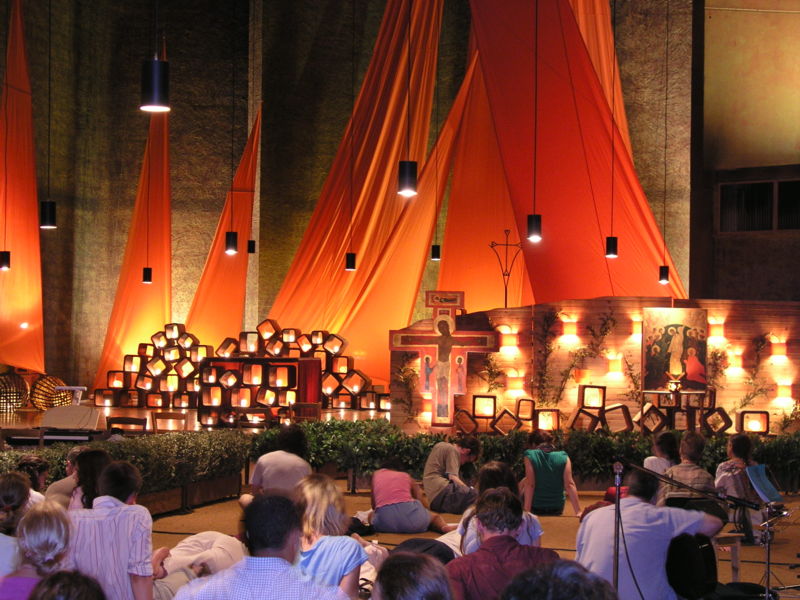
“Intentional community” has become a familiar phrase used to describe a group of people who choose to live together in a patterned way. In making this decision, they order their common life through shared commitments rather than by default. Sometimes these fellowships model their way of life after religious communities known as monasteries, convents and friaries. But not all who live in ‘intentional community’ take vows, or describe themselves as “catholic.” In recent years, believers from protestant and evangelical backgrounds have chosen to live together in religious communities so they can share prayer and meals, as well as assets and expenses.

The ecumenical monastic order of Taize, and the L’Arche communities for people with developmental disabilities, provide compelling examples. They inspire young people to live together for a period of time, so as deliberately to evoke the apostolic community described in Acts.

At the heart of these initiatives is an observation: through Baptism, we already share membership with one another through our incorporation in the One Body. In every Eucharist, we offer all that we are and all that we have. We may not actually give our energies and our goods in ways that literally manifest these resurrection-enabled realities. But they discipline our awareness and vision, if we open ourselves to their power to transform our lives.

The beauty of the risen Lord and his Spirit permeate the community that bears his name, wherever it may be found — in an apartment in a blighted urban area or in a house on a rural farm; in a convent or friary of life-vowed missionaries, and in the ordinary households of believers everywhere.

If we already share the most valuable thing we have, our Spirit-led life in the Risen Jesus, why is it so hard to share ourselves and our things with generosity and joy? Old habits and attitudes die hard, even if they have lost their original power. This may be why Paul urges us not to set our minds on the things of this world but on things above. It is surely why we find Jesus so often telling us not to be afraid.

The beauty of the Lord, whether in the face of an icon, or in the face of a fellow believer, frees us and transforms our natural inclinations and limitations. His grace and love are abundant, and his beauty is found everywhere — even in you, even in me.


The photo above shows people gathered for prayer in the Church of Reconciliation at Taize (Creative Commons Attribution-Share Alike licence). The theme of this posting directly follows the theme of the prior one, “Common Beauty.” See Acts 2:42-47.

Common Beauty

Rossano_Gospels_Last_Supper


We have many ties with others through birth and our families. We find we are connected with one another by bonds that are not of our own making.

Like the links we have with our families into which we are born or adopted, our relationships with other members of the Body of Christ are also given to us. These relationships are a reality we find rather than one we construct, for they are not products of our acts of willing.

Though we discern the reality of these given birth and baptismal connections between us, we easily fall into patterns of thought that suggest otherwise. When asked who we are, we often answer in ways that ignore these received relationships. We forget that, especially after Baptism, who we are can never rightly be described without also referring to whom we are for.

Acts 2 describes the post-resurrection community as having four shared attributes : common worship, common practices, common goods, and common witness.* Members of this community could share “all things” because they already shared the most important thing, the beauty of new life in the risen Jesus.

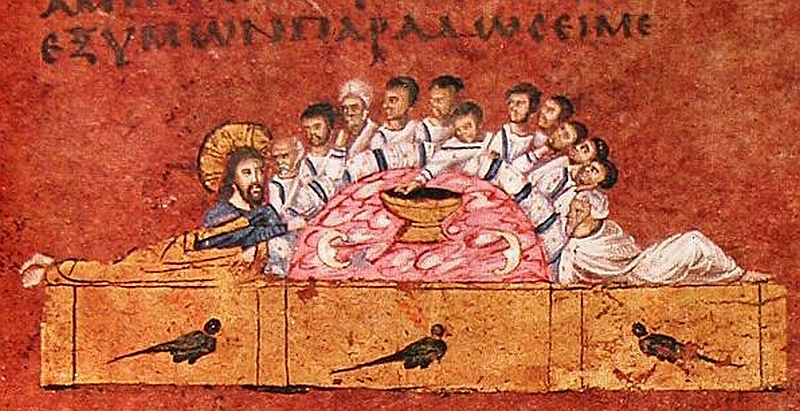
The Rossano Gospels depict Jesus with the disciples at the last supper, reclining in ancient mediterranean style. The image of circular fellowship applies equally to their life together after the resurrection and ascension. They shared their lives at the table of Eucharist and at tables of fellowship, which became visible symbols of everything else they shared.

Judas is shown leaning out from the pattern of this circle, fulfilling Jesus’ prediction about the one who would dip in the bowl after him. Judas’ stance mirrors his refusal to share the common purse with which he has been entrusted, and his disinclination to share common worship and common witness to Jesus’ power among them.

Common beauty is within us and around us. Seeing each other as joined in the risen Lord is directly correlated with seeing the risen Lord in each other. By sharing union with him, and through discerning his beauty in one another, we are more likely to share everything else.


The image above is from the Rossano Gospels, 6th century A.D. *Robert W. Wall offers this insight.

The Beauty of Connections

image


We live in a world filled with “data.” Disconnected bits of information, especially in great quantity, overwhelm our ability to see and to think. Accumulating additional data or more information does not produce knowledge. Knowledge has to do with seeing the connections between bits of information. When we see the connections, we begin to see a picture, we begin to hear a story, and we gain understanding as well as wisdom.

The unrecognized fellow traveler on the road to Emmaus asks, ‘what are all these things you are talking about?’ The answer he receives from the other two on the road amounts to giving him information. But his question was pointed toward understanding, especially in relation to ‘the big picture.’ What do ‘all these things’ have to do with what God has been up to, all along?

Here is a basic Christian truth that we find in the Emmaus Road story: Things take on meaning in relation to the risen Jesus. It happens when we see events in our lives in relation to him. It happens also with things like bread and wine as we gather at table. And it happens with people like you and me as we gather in community.

Jesus helps our perception on the road to Emmaus, and reveals something even more profound at the inn. This ‘inn,’ unlike the one where he was born, has many rooms, many mansions. When we see things like past events and the bread in relation to him, we discern more about what they are, and what they can become. When we see ourselves in relation to him, we better discern who we really are, and who we are called to be.

Prayerfully, we can look around, between things, and within. We can look for the connections. When we do, we see and discern. We see more because we see more wholly. Then we see the holy.


The above painting, Supper at Emmaus (1958), is by Ceri Richards, and is used by permission from the Trustees of the Methodist Modern Art Collection (UK). The penciled notation at the base of this guache painting on paper suggests that it was intended as a study for an altarpiece painting for the chapel of St. Edmund Hall (or College, at Oxford, England). The Emmaus story can be found in Luke 24:13-35.

Unexpected Beauty

He Qi The-Road-to-Emmaus

In the mid 1970’s, I had a short stint as an art student in Wisconsin. Through those studies I met the remarkable professor, Reinhold Marxhausen, who was skillful at teaching others to see. Like the more recent work of Dewitt Jones, Marxhausen embodied a calling to help others discern unexpected beauty in everyday places and people.

The vocation of the artist is to see and help make apparent the beauty that surrounds us. Theologians have the same vocation. For artists and theologians share an interest in beauty, goodness and truth, and their common divine source. A saying from the early Egyptian Christian monk, Evagrius, may help us here. He said that a theologian is someone who prays. Someone who prays acquires logos about theos. He or she gains wisdom from God and, in the process, receives a fuller vision of beauty, goodness and truth.

On Sunday, we will hear one of my favorite Gospel stories ~ the road to Emmaus. This story prompts an Eastertide question, of interest to both the artist and the theologian: Where do we find the resurrection? In what unexpected places or people do we find the risen Jesus? The inverse question is more perceptive: Where does the resurrection find us? In what quite unexpected place or part of our lives are we found by the risen Jesus?

The Gospels help us see the answer, in darkened tombs and in our darkened hearts. Resurrection finds us on our life journeys as we are joined by our often unrecognized Companion on the Way, and at table when we break bread together. He helps us see the big picture, and how “every story whispers his name.” *

Encountering and then seeing true beauty, we find our hearts burning within us.

 
The painting, The Road to Emmaus (1997), by He Qi (He Qi,© 2013), is used by licensed permission. The Emmaus story can be found in Luke 24:13-35.  * This is the evocative subtitle of the commendable book, The Jesus Storybook Bible (Zondervan).

Beauty and Resurrection

Stanley Spencer_the-resurrection-reunion-of-families-1945

Stanley Spencer’s church cemetery visitors find themselves surprised by being found! They experience being found through a resurrection encounter with those who have gone before.

The resurrection of Jesus is not usually something we go looking for. The risen Jesus comes and finds us. This is the pattern we see in so many of the stories of Jesus’s first resurrection appearances to his friends and followers. The disciples and others don’t go looking for him except at first, when they go to the tomb. And even then, they are seeking Jesus’ mortal remains rather than his risen presence. He comes and finds them, just as he finds us, often in the context of fellowship. And like them, we are always surprised.

We don’t find the resurrection just as we don’t find God. Neither God nor the risen Jesus are lost, even if we may be. And so, we are found by both, and then we find ourselves as persons who have been found. This is instructive, for it corresponds with our apprehension of, and encounter with, beauty —which we also misleadingly credit ourselves with ‘finding.’ Really, beauty finds us. For our perception and recognition of beauty depends not on a ‘power’ that we possess to pursue and attain it, but rather on our ability to receive and recognize what is, and what is given. The same is true in our apprehension of, and encounter with, the grace of the resurrection.


Stanley Spencer, The Resurrection – Reunion of Families, 1945.

Community Permeated By Beauty

Stanley Spencer_the-resurrection

Stanley Spencer painted several Resurrections. They portray his vision of the new community, of which we have been made a part. He does not imagine resurrection as a one-by-one event, paralleling our human experience of how people are individually and serially born, receive Baptism and die. Instead, Spencer sees resurrection as a community event, which may be more true to Scripture than what most of us anticipate.

Here we see several people in a churchyard busily tending the graves of departed loved ones. Suddenly, they are surprised by a reunion with those who have gone before. Departed fellow-members of the Body of Christ, their arms joyfully upraised in a dance, gather with the eucharistic community here on earth. Resurrection is an interactive celebration, involving not just those we have known and remember, but also those we have never met.

Spencer’s resurrection paintings reverse what we imagine. At death, we think of individual persons lifted-up, out of this world, into his presence with those on the other side. But Spencer depicts our reunion with them as taking place on this side! And he is profoundly right. For when we are baptized into Christ’s death and resurrection, we are baptized into the communion of saints, with whom we are now in active fellowship. Some of them first lived centuries ago. Others live with us today. Yet, in every eucharistic moment, we are all one and together, in the community of Jesus’ resurrection. His resurrection community is permeated by beauty, by the beauty of his holiness.

But who has seen or touched the resurrection of Jesus? Spencer helps us see the answer: All of us! All who now live in the fellowship of his resurrection. John speaks for us in his first letter, when he refers to “what we have heard, what we have seen with our eyes, … and touched with our own hands, concerning the word of life.” We think of the resurrection as something that happened to Jesus. Yet, we would not be celebrating his resurrection unless it also happened to the disciples.

His resurrection transforms every one of us. Not just one-by-one, and away, to dwell with the departed. Resurrection brings the company of the departed here, into our midst. Through Baptism, we can expect transformation within us, as individuals. We should also expect transformation between us in community! For in our fellowship with one another, we see and touch the beauty Jesus’ resurrection.


Resurrection: Rejoicing (1947), by Stanely Spencer (1891-1959). For the quote from John, see 1 John 1:1. Click here for a link to my Easter Sunday homily, on which this is based.