Landscape Architecture

A Beautiful Garden: Nitobe Memorial (Part II)

[If reading this by email, please tap the title at the top to open your browser for the best experience. Then, clicking individual pictures will reveal higher resolution images.]
 

In Part I, I closed with this observation: one does not visit a Japanese garden in the way one might go to a park, as a context to pursue some activity like an exercise walk, but as a place to experience simply being.

Here we encounter a paradox, perhaps one of many associated with traditional Japanese gardens. At first, for many Western visitors, the elements within such a garden, and their arrangement, catch the eye and draw one in further to an encounter with what is seen there. Yet, what is seen within a Japanese garden exists less to provide an object of attention, and more to facilitate and enhance how one sees. A journey around the garden therefore encourages a journey within. The “spirit that informs [the] spaces” found in “a garden created and maintained in the Japanese tradition,” to which the UBC website alludes, is a spirit or quality of experience to be nurtured within the viewer who encounters this intangible element of the garden.

A carefully arranged sense of space therefore forms a prominent feature of traditional Japanese gardens, where plantings and structural objects both near and further away are placed deliberately. Except for the surrounding walls, there are no straight lines in a Japanese garden, and formal symmetry is strenuously avoided. Plantings and objects are more often placed singly or in three’s, given how two points often suggest a line and three suggest a circle. The spatial interrelationship between such things as large stones, trees, and water features is not accidental, and for the Japanese has a spiritual as well as visual significance.

In Japanese garden design, each particular feature, whether alive and growing or humanly made, has a distinct significance and is purposely chosen for its location. Perception of this is enhanced when a visitor becomes aware of how the elements of a garden’s composition are selected with an appreciation for seasonal viewing, such as at the annual cherry blossom time. Throughout the year plantings in the garden draw attention to themselves through an occasional heightened display of color, or by contributing to a muted harmony of differing tones and textures. On successive visits, a familiar place somehow can seem different.

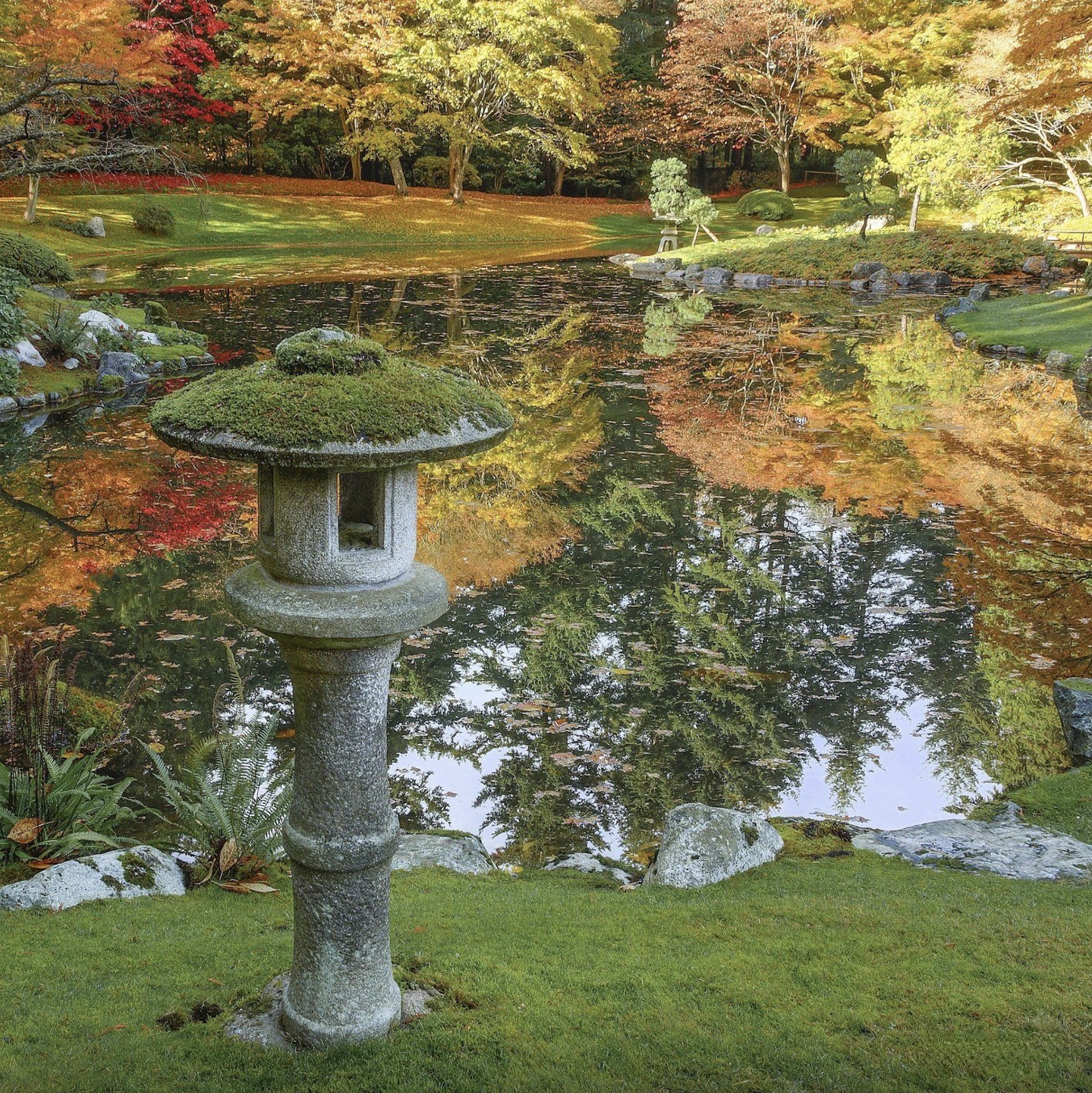
Plants, shrubs, and trees in Japanese gardens are cut and trimmed so as to appear manicured  just as European topiary is studiously tended, albeit with very different results. Whereas gardeners in the Southern U.S. might allow azaleas to grow unevenly to avoid looking like a hedge, ornamental shrubs such as holly and cedar, and the branches of evergreens, are painstakingly shaped by the Japanese-trained gardener, often into softly rounded forms. These provide contrast to the smooth sculptural shapes of tree trunks, while also standing out against the flat reflective surface of ponds.

Traditional Japanese gardens usually contains a pathway, a design element not unique to such gardens, though its treatment in this context draws attention to itself. For the pathway through the garden can be just as important as what is viewed from it, so that the experience of the journey becomes in some sense its destination. Even in a relatively compact space, a consideration important in Japan, a pathway in a garden can make a small area seem much larger than it is, as the visitor is prompted to slow down and live into the present moment.
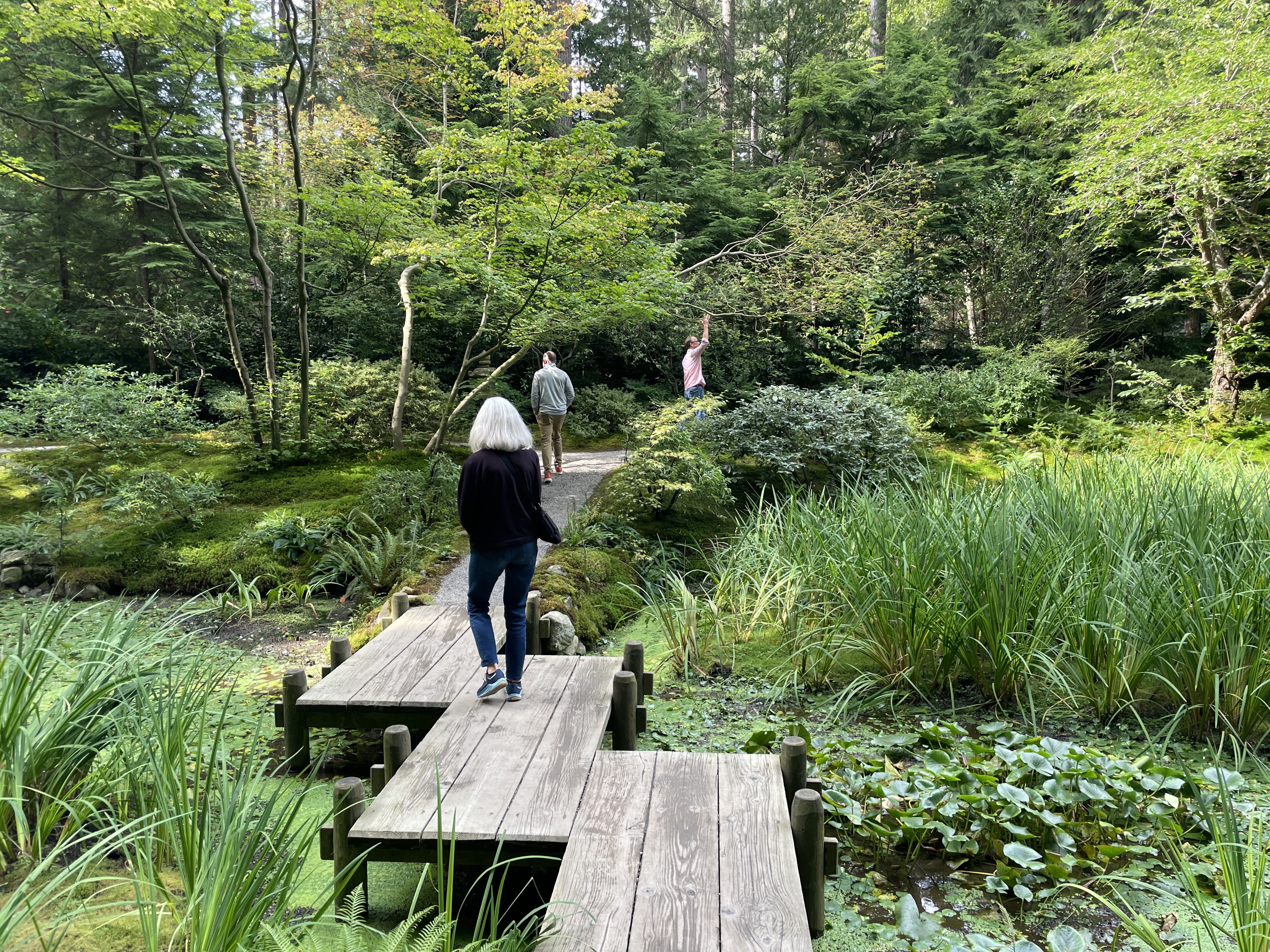
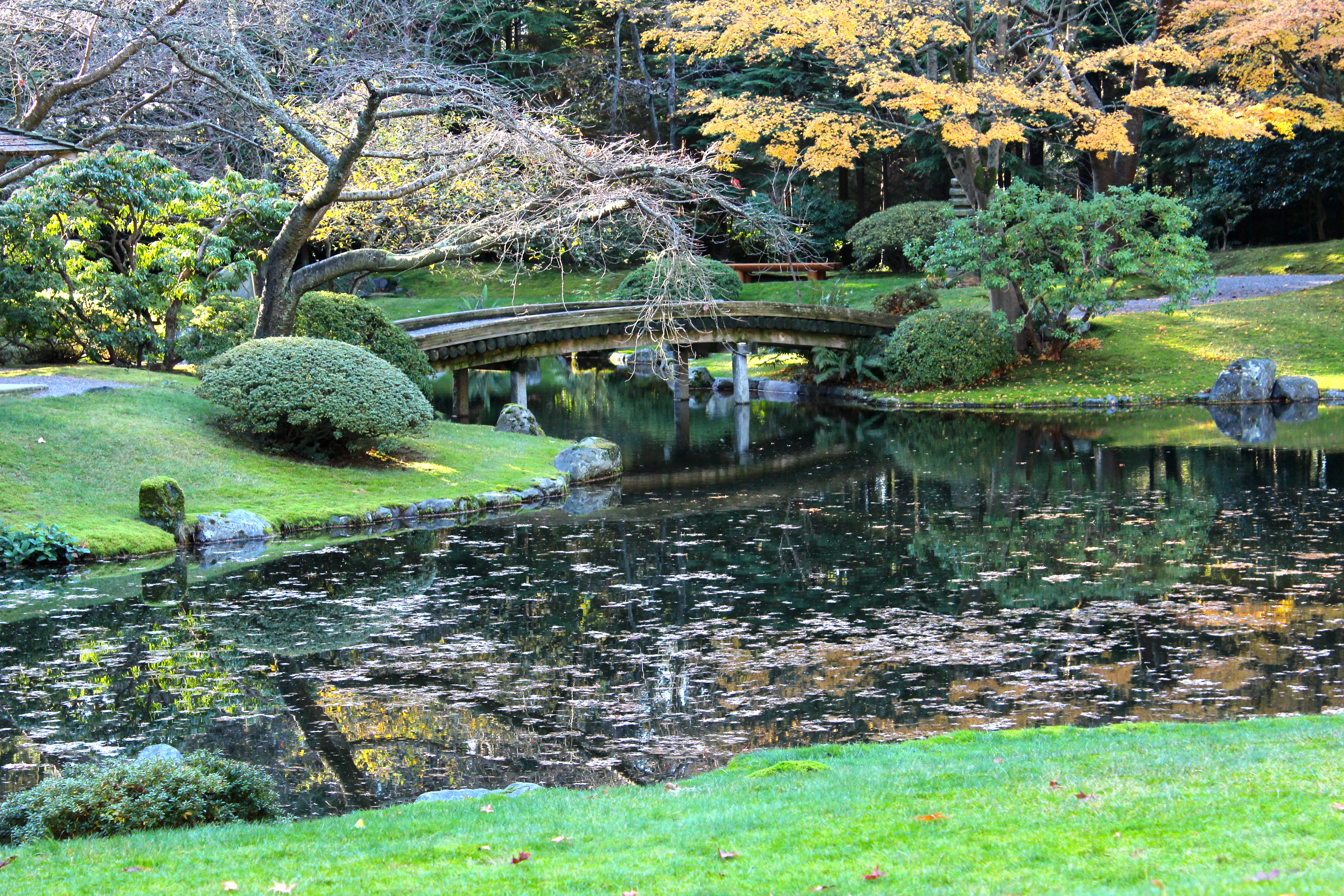
Padding along the soft pea gravel between areas of green covered by multiple textures from soft moss to tall bladed plant spikes, one gains glimpses and then temporarily loses sight of what lies ahead. Views include garden features such as a teahouse awaiting encounter, or a low-arching bridge from which Koi might be observed below the still water’s surface.

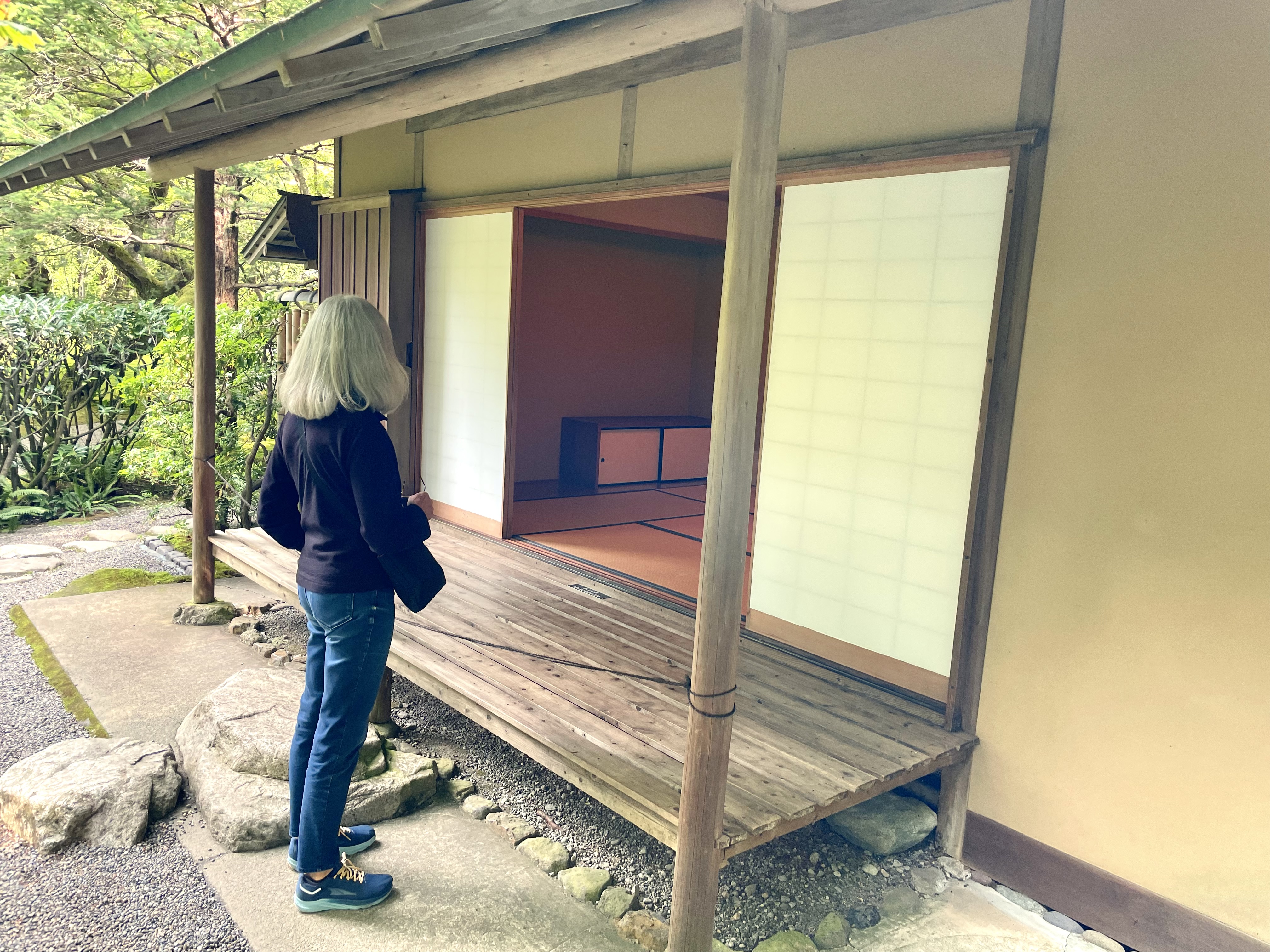
The UBC website says that “Nitobe Memorial Garden is considered one of the most authentic Japanese gardens outside of Japan.” A testament to this perception was provided by Emperor Akihito during a visit there. He said that, while in this garden, “I am in Japan.” Enhancing this sense of being in Japan is the presence of a traditional Japanese house in which opportunities to experience the ‘tea ceremony’ are seasonally available.
 

A Beautiful Garden: Nitobe Memorial (Part I)

[If reading this by email, please tap the title at the top to open your browser for the best experience. Then, clicking individual pictures will reveal higher resolution images.]


The Nitobe Memorial Garden on the grounds of the University of British Columbia (UBC) is readily recognizable as a traditional Japanese garden. Like other gardens of this type, it provides an experience of tranquility. Even in an urban area such as Vancouver, Nitobe Garden offers a quiet refuge from daily life concerns and tensions that visitors might carry with them.

An interpretive guide to “understanding Japanese Gardens,” found on the UBC Botanical Garden website, asserts the following:

… it is almost impossible to clearly state what defines a Japanese garden. Many Japanese resist classifying and categorizing the various features of Japanese gardens.

The website attributes this reluctance to the idea that beauty “not explained allows the viewer to remain in a state of wonder.” This worthy observation applies as much to modern abstract painting as it does to historic patterns of landscape arrangement. Yet, in this and in the next post, I will articulate characteristics that enable us to distinguish a traditional Japanese garden from, for example, a casual English cottage garden or a formal French garden.

The UBC website acknowledges how “most visitors can tell when they have entered a garden created and maintained in the Japanese tradition,” crediting this perception to people who “are sensing the Japanese spirit that informs these spaces.” This may be due to how various strands within Japan’s cultural history have coalesced to form a recognizable ‘style’ manifest in its gardens. Among the results of such a melding process, we can identify and describe several features in the Nitobe Garden that are common to other well-known Japanese gardens.

We can begin by observing how gardens and parks found in the East and in the West have a number of shared attributes. Among them, most gardens and parks around the world feature a scheme for the arrangement of their various parts even if it is not readily evident to visitors. Many such places appear to promote and preserve a ‘natural’ quality among the things growing in them, even in formal gardens. Some gardens and parks accentuate this natural element, perhaps in deliberate contrast to surrounding urban areas. This fosters an impression that the plants, shrubs, and trees have grown where they are of their own accord, and in their own way, regardless of any horticultural tending they have received. Especially in the West, ‘nature’ and that which is ‘natural’ are seen as what does not readily bear the imprint of human interaction, and as emerging more from its roots than from our planning.

Western gardens and parks may have gates, but often their entrance designs accentuate pubic access, providing a continuity of experience for visitors who may have potted plants or flowers where they live and work. In this sense, these garden and park entranceways draw people in from what is less into what is more. In the process, visitors are likely to encounter familiar though markedly larger and more extensively planted shrubs and trees, many of which do not appear to have been shaped or altered by human hands.

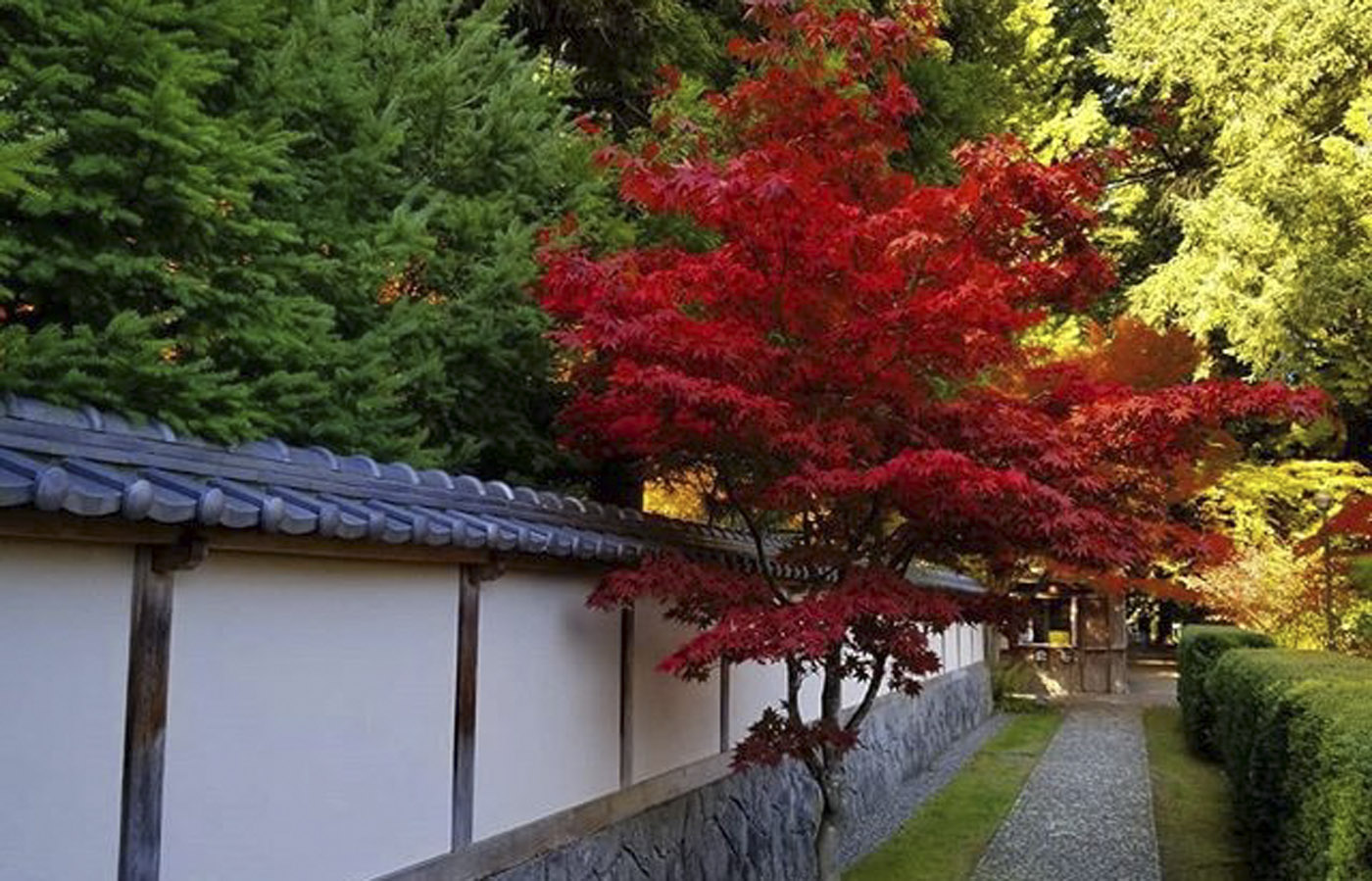
Formal gardens both East and West usually have marked boundaries and even barriers between what is within and that which is outside. Traditional Japanese gardens are typically surrounded by view-blocking walls topped by a ceramic tile parapet. These indicate a formal boundary between the transient outside world of energy-charged daily activity and the stillness available within, where visitors are subtly bidden to release their grasp upon time and their surroundings.

Imposing entrance gates mark a portal to a different realm lying beyond, as much as they appear to provide a barrier protecting what is within. Though these gates and the walls around a Japanese garden may serve to keep out intruders and foraging animals, they exist primarily for the sake of those who enter and take time there. For one does not visit a Japanese garden in the way one might go to a park, as a context to pursue some activity like an exercise walk, but as a place to experience simply being.

In the next post we will continue to explore what is identifiably distinctive about traditional Japanese gardens like the Nitobe Memorial.


Christo and Jeanne-Claude: Landscape Artists with Vision

Surrounded Islands in Biscayne Bay, ‘wrapped,’ 1983


Having in prior posts featured an introduction to three landscape artists beginning with Andres Amador, today I would like to focus on the earlier work by a couple who gained recognition through the unexpected character of their joint projects.

“Christo and Jeanne-Claude described the myriad elements that brought the projects to fruition as integral to the artwork itself, and said their projects contained no deeper meaning than their immediate aesthetic impact; their purpose being simply for joy, beauty, and new ways of seeing the familiar.” [Wikipedia]

I am grateful for Wikipedia’s succinct summary of Christo and Jeanne-Claude’s shared-aim for their joint work, and especially for that phrase, “their projects contained no deeper meaning than their immediate aesthetic impact…” Modern art in its many forms has been subject to much misunderstanding, as viewers have often looked within it for ‘meaning’ and ‘a higher purpose’ where none has been intended. I have previously featured the work of Alexander Calder and look forward to presenting the work of other 20th century (and later) artists, who have offered us the sheer beauty of non-representative paintings and sculptures.

Christo and Jeanne-Claude’s collaborative work has long struck me as epitomizing this approach to the exploration of beauty. They risked appearing to have trivialized their engagement with the natural world as well as with well-known works of architecture. But they also helped us see familiar and unfamiliar things in different ways, and with new appreciation.

Most significant was their consistent effort to make their projects not only self-funded, but as ecologically sensitive as possible, with their subsequent donation or recycled use of art installation materials. In my view, they did not seek to alter the landscapes or structures with which they worked in more than a very temporary way. And certainly not in any way that would compromise those beautiful places, but instead to enhance our regard for them.

I offer the photos below with appreciation for the simple joy that these prior installations may have brought to those who were able to be present at them, and for the beauty of the preserved digital images we still have of them. I wish I could have seen one myself, in context!

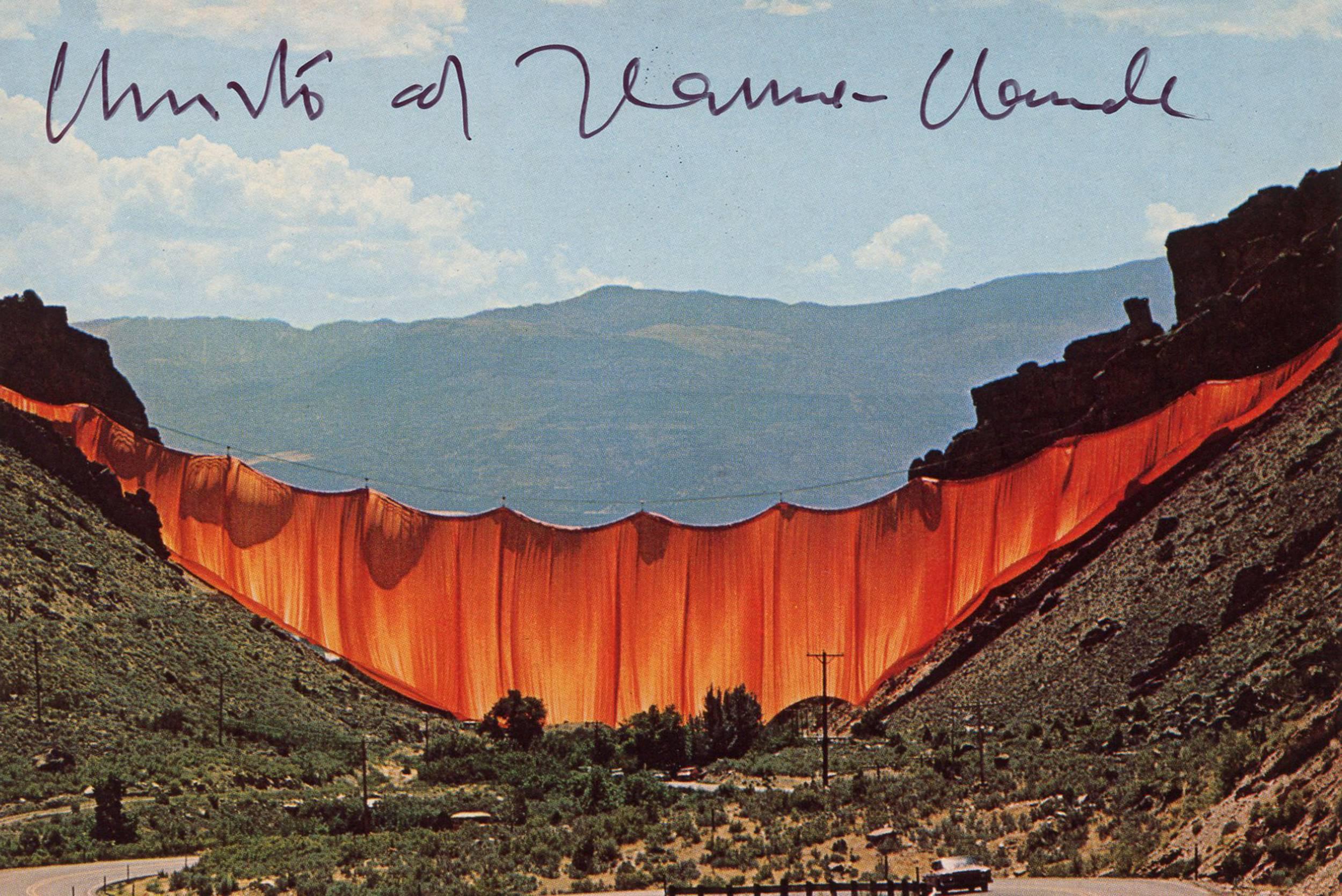
Valley Curtain, Colorado, 1972

Running Fence, Sonoma and Marin Counties, CA, reported as 24 miles long, 1976

Christo on Floating Piers, Lake Iseo, Italy, 2016, after Jeanne-Claude’s death in 2009

Hundreds if not thousands walked on the floating causeway to the island

Pont-Neuf bridge in Paris, ‘wrapped,’ 1985

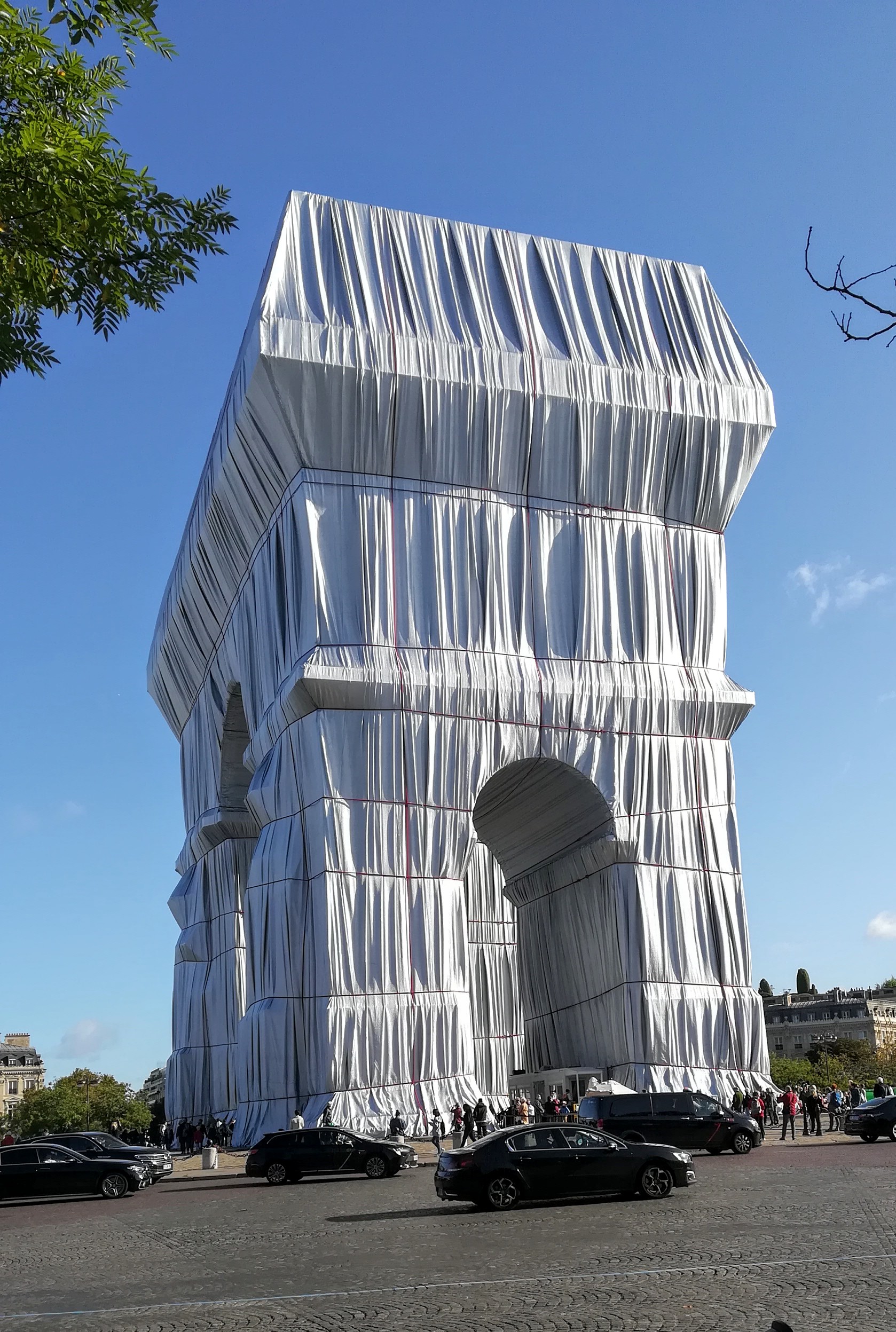
The Arc-de-Triomphe in Paris, ‘wrapped,’ 2021

Andres Amador: Earthscape Artist

[If reading this by email, please tap the title at the top to open your browser for the best experience.]


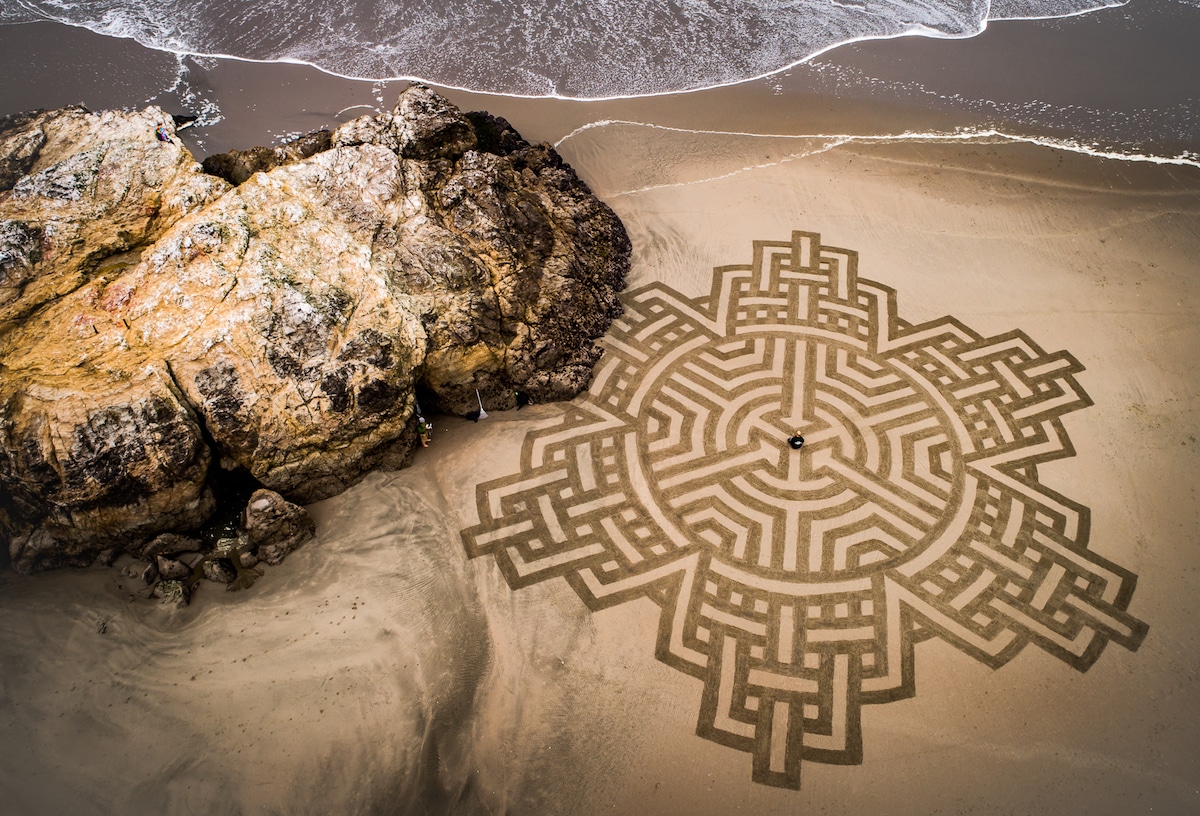
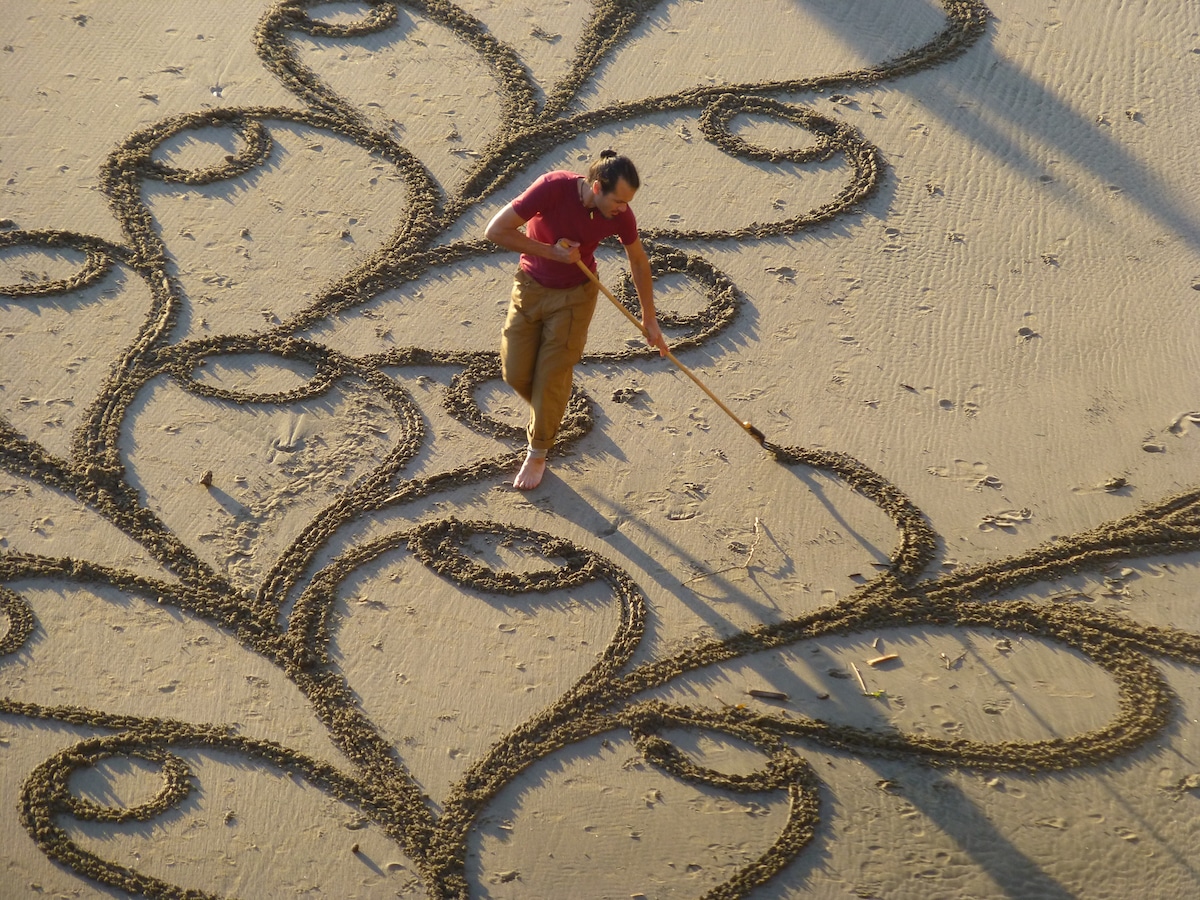
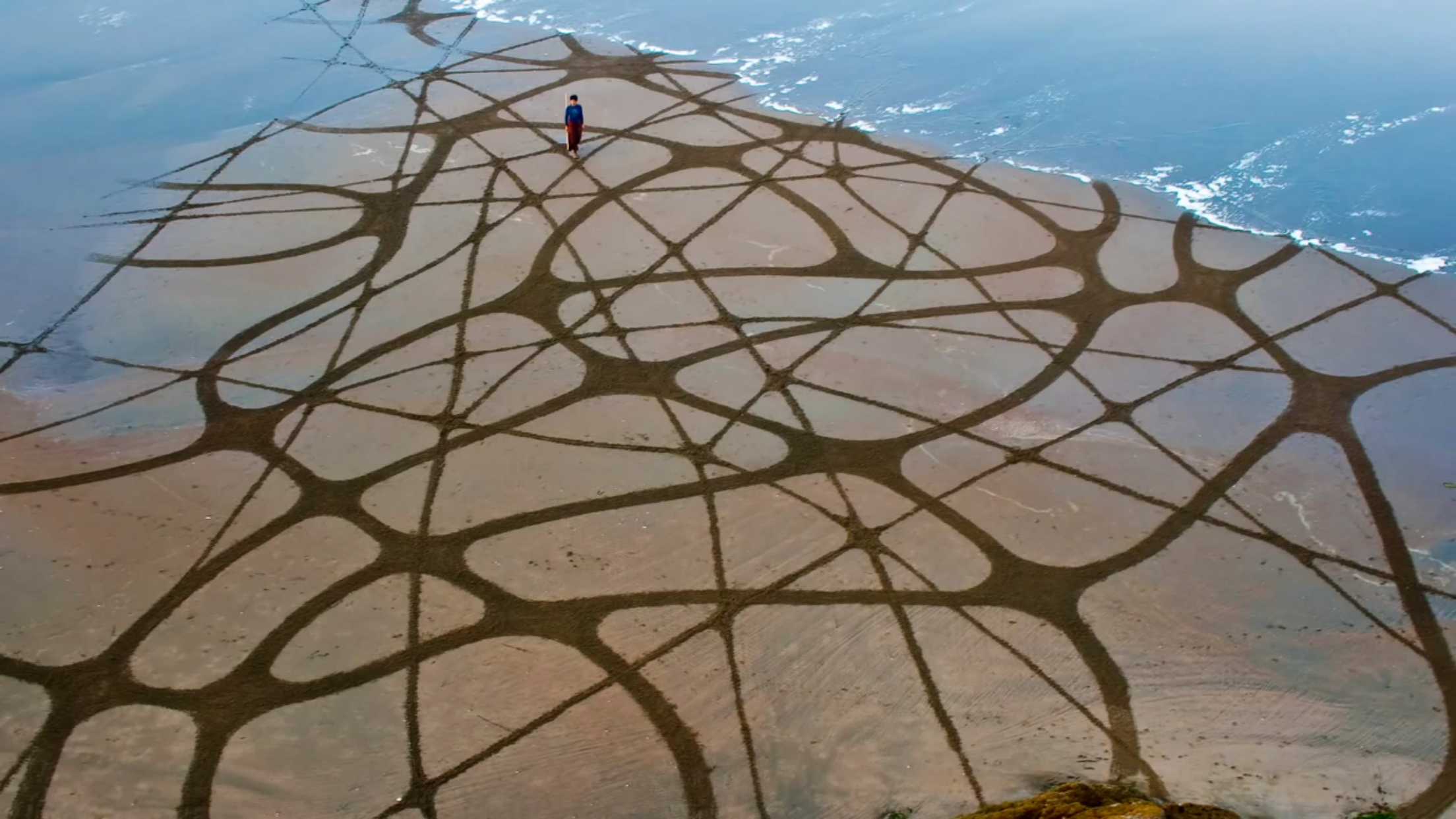
Above we see a drone-based digital image of a pattern that a contemporary artist has inscribed upon the sand of a beach. He is also an academically trained scientist, who has employed his gifts in a particularly sensitive way.

Now, why are some or all of those details important? Because we see here the abilities of Andres Amador, someone whose public art work may lead us to wonder about how this artist could have accomplished all this. Not only in the image above, those presented below, as well as those widely available now on the internet.

Well, what would it take for you or me physically to be able to produce such an image upon the sand on a seaside beach? To my surprise, it is only geological timing (the tides); an appropriate location in relation to that matter of the tides; and then only a couple of simple tools. These would include some common and small garden rakes, and perhaps also – in relation to the circular-based patterns – a metal or wooden spike, a long rope, and some kind of carving or scraping tool at the end of that rope. The invention of the small drone with a camera has also been of help.

But, clearly, it takes more than physical circumstances, geography, and available tools. It also takes a scientifically trained sensibility as well as a developed intuitive creativity. What Andres Amador has accomplished and still produces is not in any way simple. And yet, he provides frequent teaching sessions, open to all, inviting others to do what he does. Insight about this is provided by a short but compelling video produced some years ago by KQED San Francisco (see link below). I think that one way to summarize a principal theme in his work is that he seeks to see things “whole,” which for some folks is related to seeing what is “holy.”

In that video, Amador describes two reference points, or two sorts of impulses within him, as sources for his earthscape art. “The two main directions that I go with, in the art, are {first} the geometric, which is very precise… So, it’s all about perfection.” Pattern can be imposed upon the ‘blank canvas’ of nature.

“The other {or second} side of it,” he says, “is the organic art, the art the feels like it is emerging from the location… the art that is telling me what to do next.” Pattern may therefore be in some sense received.

I find these two insights to be spiritually and theologically significant. We are able to impose pattern upon our lives, and often attempt to do this within the social world around us. At the same time, we may discern and receive pattern for our lives from within, whether from a divine or from a natural source, or through the gifts of others. Impose, and receive; both are important for our search to become whole.

God bless your continuing work, Andres, and especially for helping us perceive beauty in a fuller way.


Here is a link to the compelling KQED Andres Amador short video : https://www.kqed.org/arts/10134941/andres-amadors-earthscapes-art-that-goes-out-with-the-tide


Beauty in Architecture for Public Places


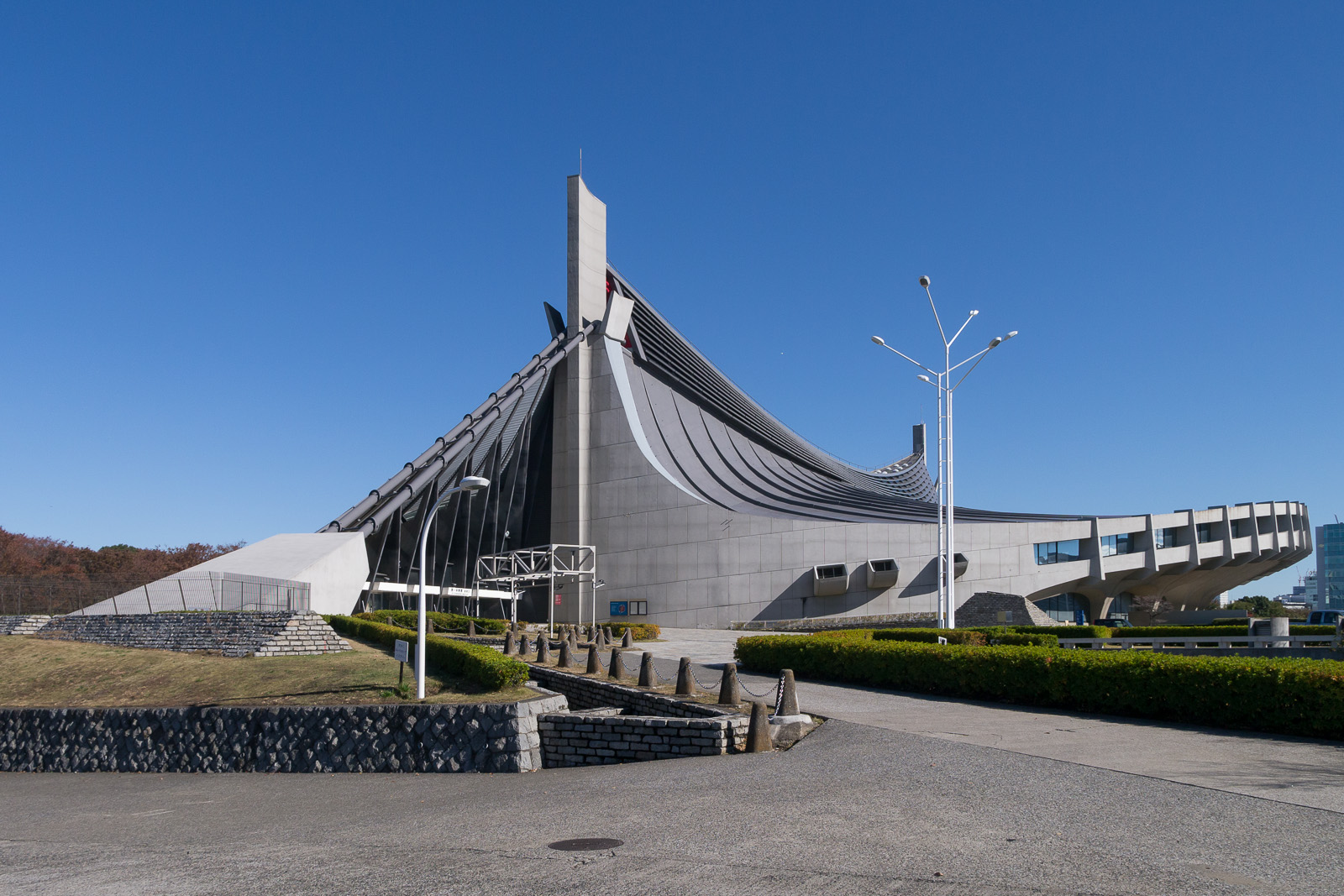
By 1964, as Tokyo prepared for that summer’s Olympic Games, I had been in Japan for five years. Our family lived not far from the stunning Olympic Pool building designed and being built by the Japanese architect, Kenzo Tange. I remember seeing it on our Sunday train journeys to church. Some 60 years after construction on it began, the lyrical design of this timelessly modern building continues to awe visitors. No longer housing swimming and diving pools, the building has been designated for use as a gymnasium during the (now postponed) 2020 Tokyo Olympic Games.

Tange’s Olympic Pool has long been one of my favorite works of architecture. Walking or driving around its perimeter provides an experience akin to walking around a large Alexander Calder stabile or one of Henry Moore’s more abstract sculptures. I think it is due to the building’s long arcing lines, made possible by structural cables employing catenary curves. These elements continue to give the 1964 Olympic Pool building a very contemporary appearance. More subtle are the distinctively Japanese features of the building, which are less obvious to western observers. The protruding portion of the two principal vertical columns, the horizontal panels between them mimicking a formal roof cap, as well as the upward curve of the outward edge of the roofline, bear an affinity with aspects of the nearby Meiji Shrine. Note the small but significant wing-like flares adjacent to the twin upward columns in Tange’s design.

I reflect on this building when I think of what might best be called public architecture. By this, I mean public buildings such as airport concourses, courthouses and even hospitals. The debate on federal architecture generated by the recently-leaked draft executive order has had at least one benefit. The evolving discussion has raised the profile of our consideration of beauty in relation to buildings intended to serve, and perhaps also to enhance, our common life as fellow citizens. Whatever one may think of that draft executive order’s commendation of classicism as a design criteria for high costing federal buildings (those over $50 million), we can surely agree that striving for beauty is of significant value within our communities, however that quality may be defined.

Think of the last time that you felt your soul uplifted and your view of the world enlarged by your engagement with a building’s facade, and your movement through its interior space. By this, I am referring to an experience that transcends one of marveling at the scale and complexity of some architectural achievement, and the intellectual pleasure such an encounter might provide. Instead, I am pointing to the way that works of architecture can enhance our sense of community, as well as our regard for the pursuit of beauty, goodness, truth, and other recognized virtues. We might expect these qualities to be evident in buildings designed for public worship. But do we also expect them to be features of our encounter with a government or publicly-funded new courthouse, airport terminal or sports arena? I think it is right that we should.


The photos featured here are creative commons licensed photos of Kenzo Tange’s beautiful building designed and built for the swimming and diving pool events at the 1964 Tokyo Olympic Games.