If reading this by email, please tap the title at the top to open your browser for the best experience. Then, clicking individual pictures will reveal higher resolution images.

The Kelpies sculptures by Andy Scott
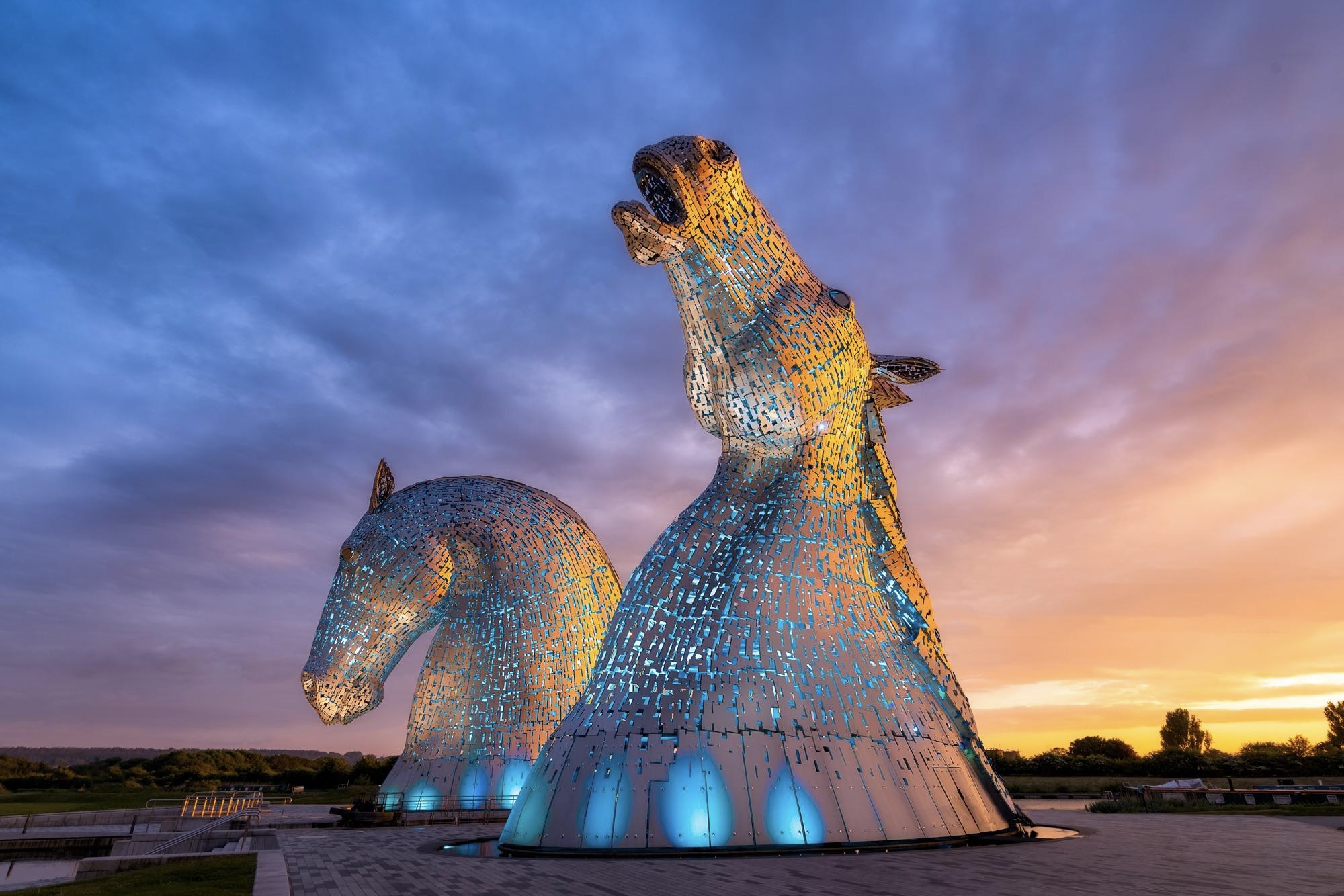
The Kelpies in evening light
If ever there was a reason to take a narrow boat journey, especially in Scotland, an engineering marvel will reward those who travel in that region by such means. Two magnificent large scale sculptures called the Kelpies commemorate the horses that once pulled cargo canal boats along what are still called towpaths. This monument straddling the Firth and Clyde Canal, northwest of Edinburgh, is comprised of twin large scale structures that are said to be the largest equine sculptures in the world. Just under 100’ tall, and each weighing over 300 tons, the structures were built of steel, partly in deference to the historic steel industry in Scotland.
With an interior armature made of construction-steel beams prefabricated elsewhere, the sculptures were assembled on site with the assistance of large cranes and then clad with stainless steel plates. Aside from their resulting durability and their efficient use of materials, the Kelpies’ engineering design permits dramatic interior lighting, especially effective in the evening and early morning hours.
The Kelpies sit adjacent to a newly created canal lock and basin in the Helix Park, and serve as symbolic sentinels in a newly created juncture between the Union Canal and the River Carron.

Boats can be seen on the River Carron in the background
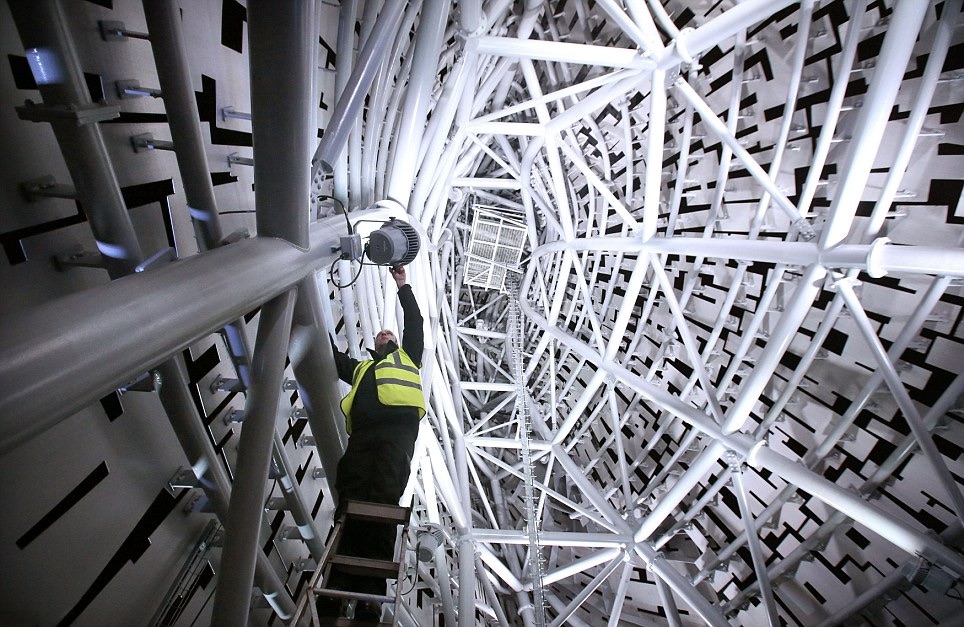
A lighting engineer adjusts an interior light in one of the Kelpies

Stainless steel plates being added to the structural armature
Some people have suggested that the two sculptures are based upon a pair of draft horses of the type that may once have been used on the Firth and Clyde Canal. In my observation, Clydesdale and other draft horses tend to be gentle and of a mild temperament. They are rather stocky in appearance, not only in their bodies but also in their necks and heads. Draft horses are certainly capable of running, and I am sure that some have been known to kick, especially if they have been mistreated. But draft horses can also look as if they embody a spirit of docile resignation to their tasks.

The artist’s design for these Kelpies reminds me not of those lovable working companions, the Clydesdales, but instead look like Arabians or the Mustangs and other wild horses one sees in the American West, spirited, lean, and untamed. I am glad the Kelpies appear this way, as I think they are inspirational, rising up hugely as they do at Helix Park. These horses, especially the one on the right, look as if they have not only been ‘given their head,’ they seem never to have surrendered themselves to our governance. This is only fitting, given the mythological source of the Kelpie name. Kelpies were said to be the spirits of streams that when ridden, might carry their riders down to a tempestuous demise in the depths. As such, we can not only admire their beauty, but these Kelpies can remind us of the canals and those who died building them, the canals’ unromantic industrial past, and those who toiled at canal-side factories in what William Blake – in his poem commonly known as “Jerusalem” – memorably termed Britain’s “dark Satanic Mills.”

Nina Akamu, The American Horse
Another large scale equine sculpture may come to mind when viewing the Scottish Kelpies, inspired by Leonardo da Vinci’s drawing of a large horse monument, designed for the Duke of Milan. A modern day sculpture, based on Leonardo’s drawings, can be found at the Meijer Gardens, in Grand Rapids, Michigan, as well as one cast for the city of Milan. Nina Akamu’s, The American Horse, expresses a similar kind of energetic vitality such as we find in Andy Scott’s great figures along the Firth and Clyde Canal. 24 feet high, Akamu’s strong and vigorous impression of a horse has something of the bone structure and mass of a Clydesdale, and every bit of the spirit that we find in Scott’s two stirring examples.





 Toward Beauty