Biblical Interpretation

The Beauty of Our Return


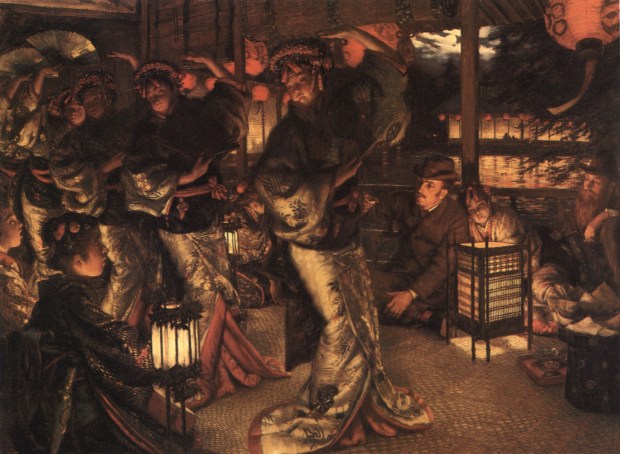
I share with you an unusual set of images from James Tissot. They represent his transition from a French and English society painter to being a visual communicator of the Gospel. They are three of his four paintings depicting The Prodigal Son in Modern Life. How beautifully he evokes the son’s presumptuous ascendancy over his father’s legacy. Then, the son’s foolhardy journey into adventures of his own making. And, third, his return home to his father’s good favor. One key to the subtlety of these three paintings is to notice the older brother in the first painting where he is sitting by his wife. He is musing about distant possibilities for himself, just as his more impetuous brother is beginning to act upon a similarly fanciful vision. In the third image, we observe the stoic and prideful older brother standing by his wife, reluctant to approach and embrace his just-returned sibling.

As Tissot show us, wise readers notice in Luke’s story that we hear about two lost sons, not just the one who went to a far-off land. The older brother couldn’t recognize how his own life was gifted, having entered into an abundant legacy that had also become his. This may be true for us, as well. So, we need to be thoughtful about how we refer to this un-named parable. To say it’s about the prodigal son overlooks how it’s also about the presumptuous older brother, as well as about the ever-loving father.

When we focus on the younger son in Jesus’ parable, we become more sensitive to how it may help check us from wandering away from God and from God’s ways. For we find in this story an account of what it’s like to come to our senses, in circumstances that could kill us spiritually and physically. It speaks about what it means to ‘return home.’ But as dramatic as experiences like this can be, they stand out because they are occasional or singular.

Seeing this parable as also about the grumbling older brother helps us notice how significant it is for other times in our lives. This is not just a Gospel about looking back to what was, and has been. This is a Gospel about living forward, toward the future God is even now preparing for us.

We are called to the feast! We gather on Sundays for the same feast about which we hear in Luke’s Gospel parable. Our Eucharist is our celebration of the return of lost ones, both ourselves and others. Henri Nouwen’s great insight about this Gospel passage, and Rembrandt’s painting of it, is this: having once been the younger brother who has experienced the grace of returning home, we are all called to become the father in the story! In other words, we are called to become people who receive others, embracing those who return some time after we do. Let us eat and celebrate! For like us, our later-returning brothers and sisters were dead and are alive again; like us, they were lost, and now are found!


The above paintings are from James Tissot’s, The Prodigal Son in Modern Life, three of his four paintings depicting Jesus’ famous parable in Luke 15. This post is based on my homily for Sunday, March 31, 2019, which can be accessed by clicking here.  Other homilies of mine may be accessed by clicking here. The Revised Common Lectionary, which specifies the readings for Sundays and other Holy Days, can be accessed by clicking here.
Beauty in Parallel

golden_gate_bridge_pillar-smaller-copy

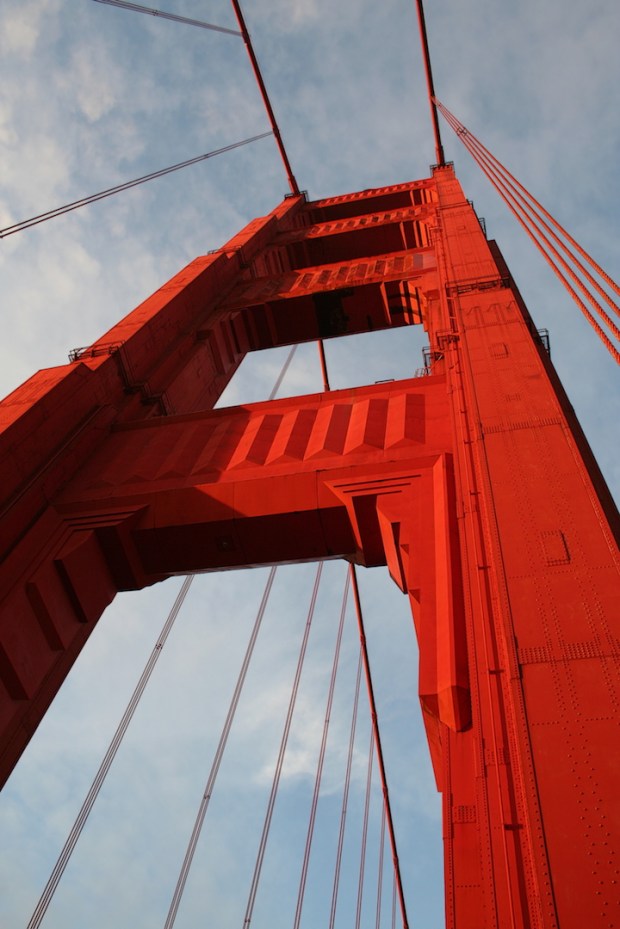
Perhaps the only thing more memorable than driving over the Golden Gate Bridge may be to pass under it on an ocean-going ship. I was lucky enough to have that experience five times before I was a teenager.

Many of us assume the name for this bridge is related to its warm color. But the name comes from the ocean straight over which it stands, though it does not derive from the Gold Rush. Rather than mimicking gold, the bridge’s official color—“International Orange”—was chosen to contrast with fog. A story is told about when that color was first applied. Painters dabbed splotches of it on the heads of curious seagulls. Pretty soon, Bay Area birdwatchers reported a new bird species, which was called the California Red-Headed seagull!

Until 1964, the Golden Gate Bridge had the longest main span in the world. Yet, its basic design isn’t unique. We know this from other suspension bridges, which are found all over the world. Bridges of this kind have two main towers, steadied in place by their suspension cables, which are anchored in the ground. From their anchor points, these substantial cables ascend to the top of the towers, and then gently descend again to the center of the bridge. From that low point, they again soar up, to the top of the opposite tower. The slightly arched roadway across is literally suspended from these main cables, by small support cables that hang from them. Here, in the beauty of this simple design, we find a helpful spiritual and liturgical metaphor.

Reflect for a moment about two significant Sundays in the church year. One is the last Sunday after Epiphany, or Transfiguration Sunday, and the other is Easter Day. Transfiguration Sunday is the last Sunday before Lent, and Easter Day is the first Sunday after Lent. Imagine these two Sundays on the Church calendar as being like the two towers of the Golden Gate Bridge. Transfiguration Sunday, coming just before Lent, is like the south tower of the Golden Gate bridge, on the urban, San Francisco, side of the straight. And, Easter Sunday is like the north tower of that bridge, on the less familiar and historically rural side of that navigational channel. The season of Lent stretches between these two Sundays like the main span of a bridge. Here is the crucial part ~ every year we need to make this liturgical crossing. And, like the great towers of a bridge, Transfiguration Sunday and Easter Sunday uphold us all the way across our Lenten journey.


This posting is based on my homily for the Last Sunday after the Epiphany, which explores the parallel between the revelation of glory that we see in the Transfiguration, and the glory we see in the Resurrection (click here for a link to it).

Annunciation

Simone_Martini_Annunciation_Detail

Today we celebrate the feast of the Annunciation to Mary. The angel of God brought her “good news” ~ but news she could hardly have understood at the time. She would bear a child, who would be called Son of the Most High. I have always loved Annunciation paintings, and this one by Simone Martini (from 1333), in particular.

When the angel appeared to Mary, she encountered God’s holiness and righteousness. Like so many times in history, God’s presence pushes everything else into clarity. The bright light of Glory throws into relief all the dark places in the world – all the hidden corners of our lives. We usually react to this with disquiet and concern. We hear that God’s word comes as Good News. And yet we experience God’s call to become a new person, or do a new thing, as a fearful invitation!

For me, it has been a call to move from one beloved congregation to what I could only hope would be another. For both you and me, it will be a call to speak to someone with whom we have a misunderstanding, or forgive someone whom we have failed to forgive. When God calls us to new life, we are often afraid. We think of what we fear might happen: like losing a familiar home and community; or setting aside our pride, and opening ourselves to being hurt again.

Look at how Martini portrays Mary’s response to the angel! Gabriel visits her with holy news about the child she will bear, who will bring salvation to the world. Mary draws back from his message, fearful about what it might mean. We know it turns out for good. But at first, God’s call can frighten us. A change to something new, always means a change from where we started.

The scene reminds me of spiritual advice I received years ago – advice that helped me be willing to leave a tenured seminary position and return to parish ministry. I had a sense of call, but the prospect of this change was frightening. A wise friend said to me, “when you go toward the heart of your fear in faith, God will always meet you there with power.”