Art Installations

The Beauty of Witness

Memorial sculpture commemorating the Martyrs of Memphis

This week, on September 9, we observed a significant date on our personal calendar by celebrating the birthday of one of our sons. September 9 was already a notable date for us beginning some years before his birth, after our move to Memphis in the summer of 1983. During those years, the date became associated with an addition to the Episcopal Church Calendar that has readings appointed for it in our Lectionary. September 9 is designated as the feast of The Martyrs of Memphis: Constance, Thecla, Ruth, Frances, Charles Parsons, and Louis Schuyler.

To those unfamiliar with its history, the official title for this feast day may suggest dramatic images of early Christian saints contending with ferocious animals and or human adversaries in the name of the Faith. Which then raises questions about whether, perhaps, the Memphis in question was the one in ancient Egypt. Yet, the name designation for this day can be instructive for all of us because it may remind us of something we once learned – that the etymological root of the word martyr lies in the ancient Greek word meaning ‘witness.’ Hence, those persons we commemorate on the Church’s Calendar because of their examples of Faith are remembered for being especially compelling witnesses to God’s redemptive mission in Christ, regardless of whether they faced circumstances that might have led to a heroic death.

The Martyrs of Memphis provides an occasion for us to remember the men and women who remained in Memphis to minister to those with whom they faced together the ravages of a severe Yellow Fever epidemic, from which they could have fled to safer places elsewhere. Unknown to them was the fact that this horrible plague was a mosquito-borne infectious virus, and not something arising from ‘swamp vapors’ or bad city air. Among the faithful persons who succumbed to the fever, and who are remembered on the feast day of September 9, are the four women named in the feast’s title who were community members of the Sisters of St. Mary, Father Charles Parsons, the last remaining Episcopal priest in the city, and Father Louis Schuyler, who came as a volunteer from New Jersey to take Parsons’ place and join the Sisters in ministry.
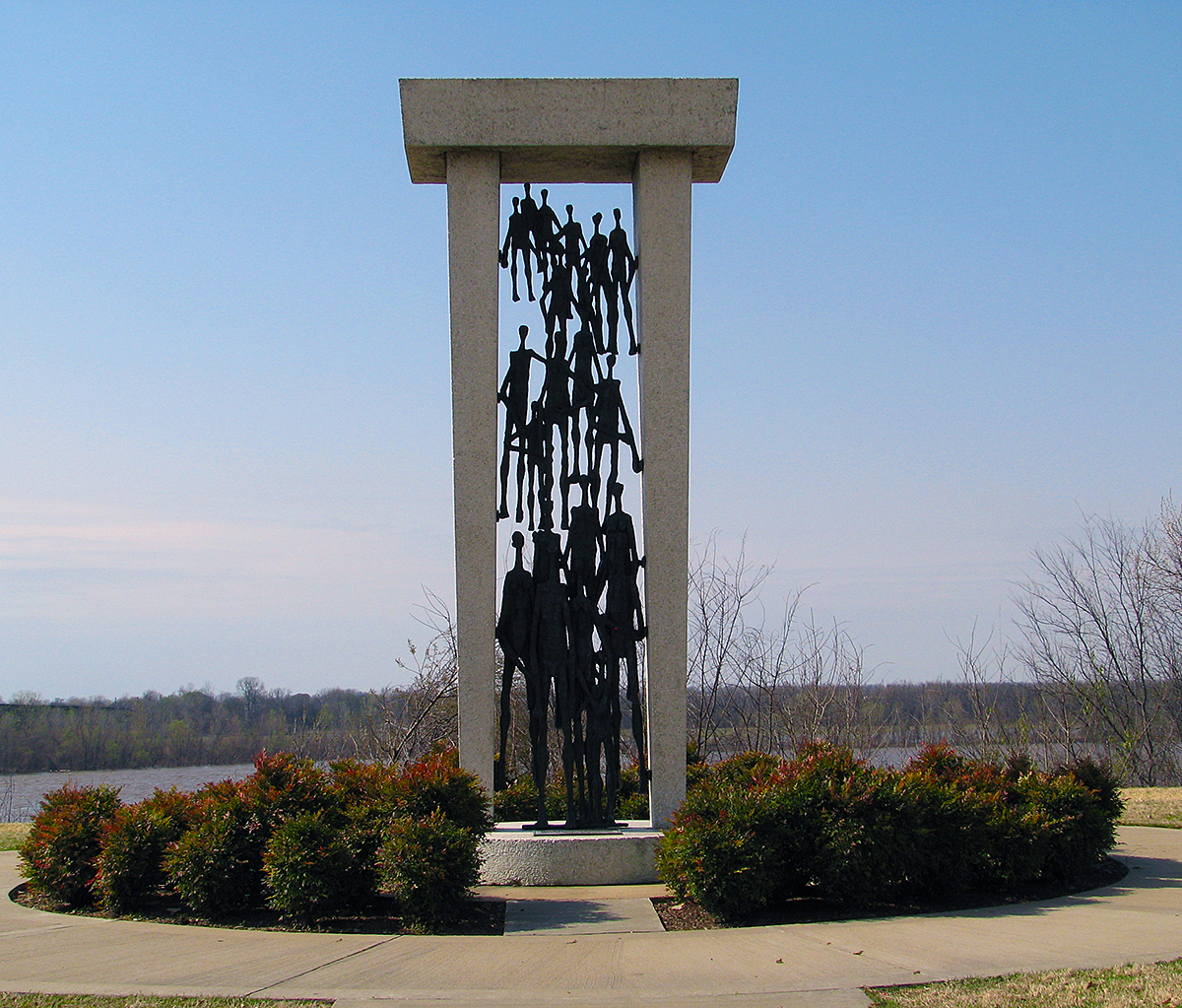
Monument by Harris Sorrelle, in the Memphis Martyrs Park, overlooking the Mississippi River

Words from the collect (or principal prayer) for the feast day of the Martyrs of Memphis capture well why these particular individuals are named among so many others – known and unknown – who shared their faith as well as fate: “We give you thanks and praise, O God of compassion, for the heroic witness of the Martyrs of Memphis, who, in a time of plague and pestilence, were steadfast in their care for the sick and dying, and loved not their own lives, even unto death…”

The generic character of the title for this significant feast day was chosen to help us also remember that the number of those who died in the epidemic, not only in Memphis, but up and down the Mississippi River and beyond, numbered in the thousands. Memphis’s historic Elmwood Cemetery, its oldest, has a particularly moving monument that complements the contemporary riverside sculptural composition by Harris Sorrelle (displayed above). At Elmwood, instead of having an impact upon the use of anonymous and aptly dark-colored figurative silhouettes, as Sorrelle’s sculpture does, the cemetery monument provides just paragraphs of words, stating in plain but moving terms the reality that lies below where cemetery visitors walk (as the following image attests). As the Elmwood monument notes, at least 1,400 Yellow Fever victims are buried in nearby unmarked mass graves.

Martyrs monument in Elmwood Cemetery (clicking the photo will provide an expanded view of it)

The faithful witness of those who died ministering to and with others among the Yellow Fever victims in Memphis in the 1870’s can have the effect of prompting us to reflect on the very different circumstances in which we live, with our advances in medicine, healthcare, and social services. Nevertheless, the COVID crisis of 2020, and its lingering legacy, can also remind us of our mortality, our higher calling to seek godly life in its fulness, and to be faithful companions with and to those less fortunate than ourselves.
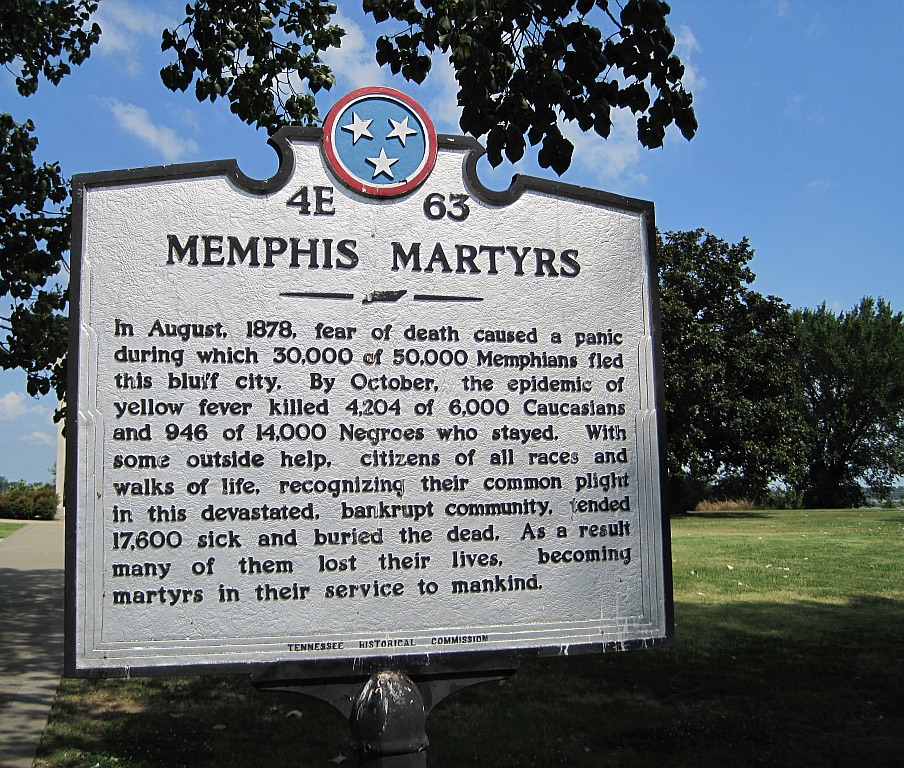
A state-provided historical marker that includes use of the word ‘martyr’

Additional note: a tragic-comic aspect of the Yellow Fever’s impact upon Memphis was another pre-scientific belief (in addition to the ‘swamp vapors’ theory regarding its origin) amongst those who remained in the city. It is said that those who seemed to have the lowest mortality rate were corpulent men who smoked cigars, the smoke from which may have warded off the mosquitos responsible for the plague’s transmission.
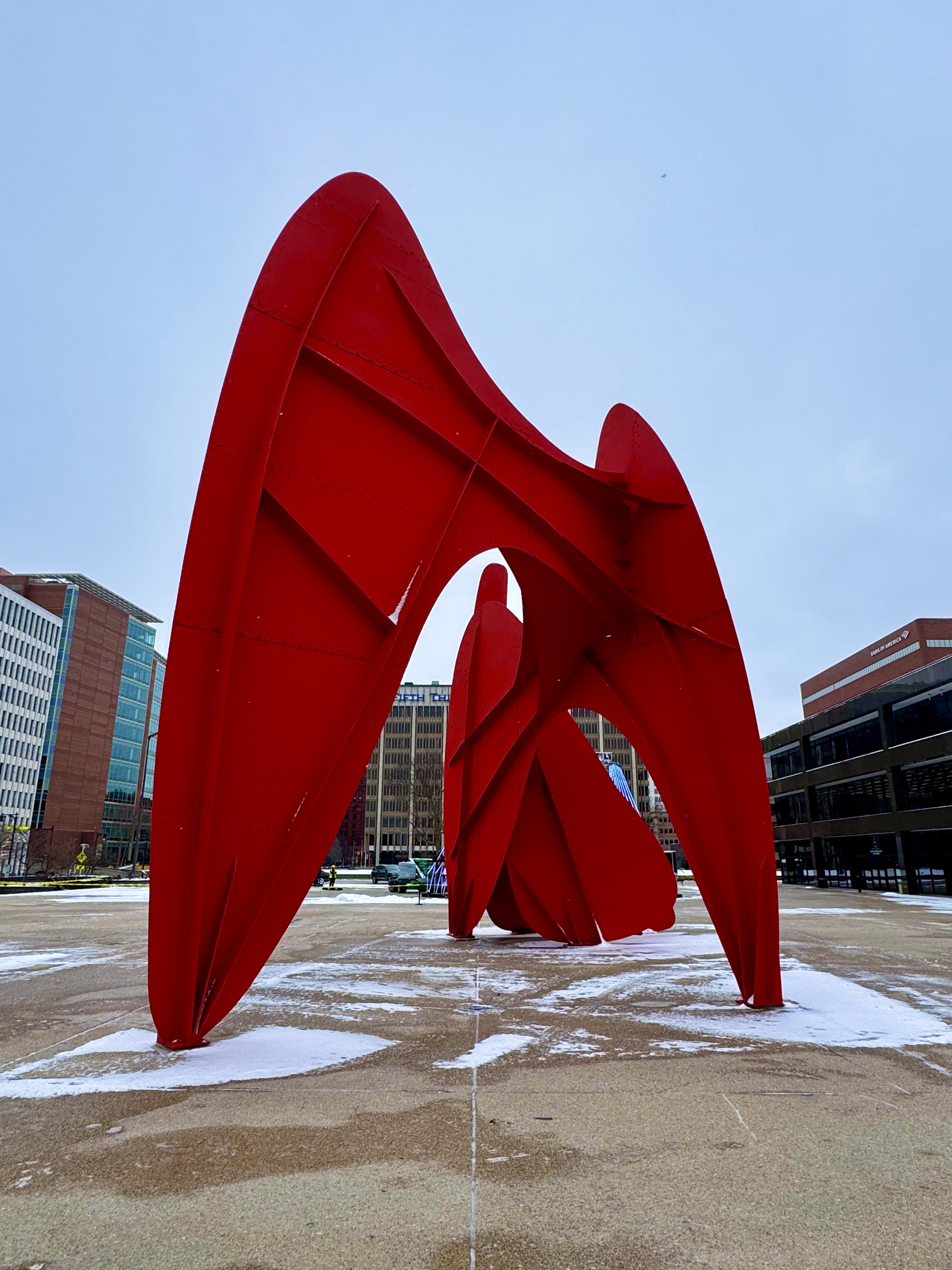
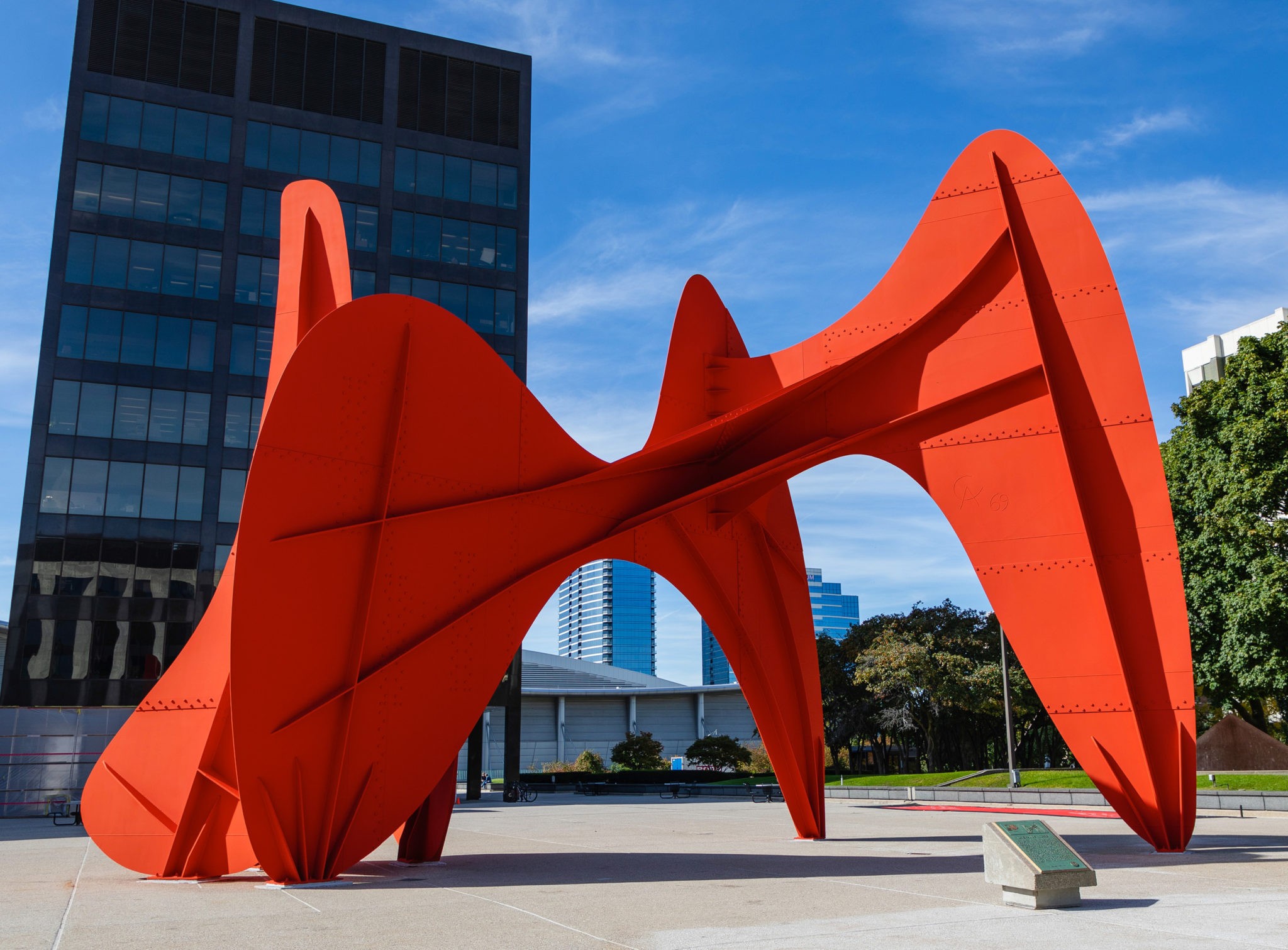
Calder’s La Grande Vitesse

If reading this by email, please tap the title at the top to open your browser for the best experience. Then, clicking individual pictures will reveal higher resolution images.


This past weekend, with the temperature in the lower twenties and lake-effect snow in the air, I had a chance to revisit a favorite sculpture, Calder’s La Grande Vitesse. Sitting on a plaza in downtown Grand Rapids, MI, the sculpture is notable for being the product of the first award granted by the National Endowment for the Arts for a work of public art, with the project dedicated in 1969. It is a stirring example of Calder’s large scale ‘stabiles,’ as distinguished from his better-known mobiles. La Grande Vitesse may be his most successful work in the stabile category, a grouping which comprises several monumental compositions of welded and bolted sections of steel, often painted in Calder’s favorite vibrant and warm bright red.

Because it is lyrical and engaging, La Grande Vitesse has the pronounced effect of drawing the viewer in to engage with the artist’s vision for the work, both visually, spatially, and even in a tactile way. Sculpture is by definition three-dimensional, in that works of sculpture comprise shapes and forms, whereas painting and drawing typically involve two-dimensional images, whether representational or abstract.

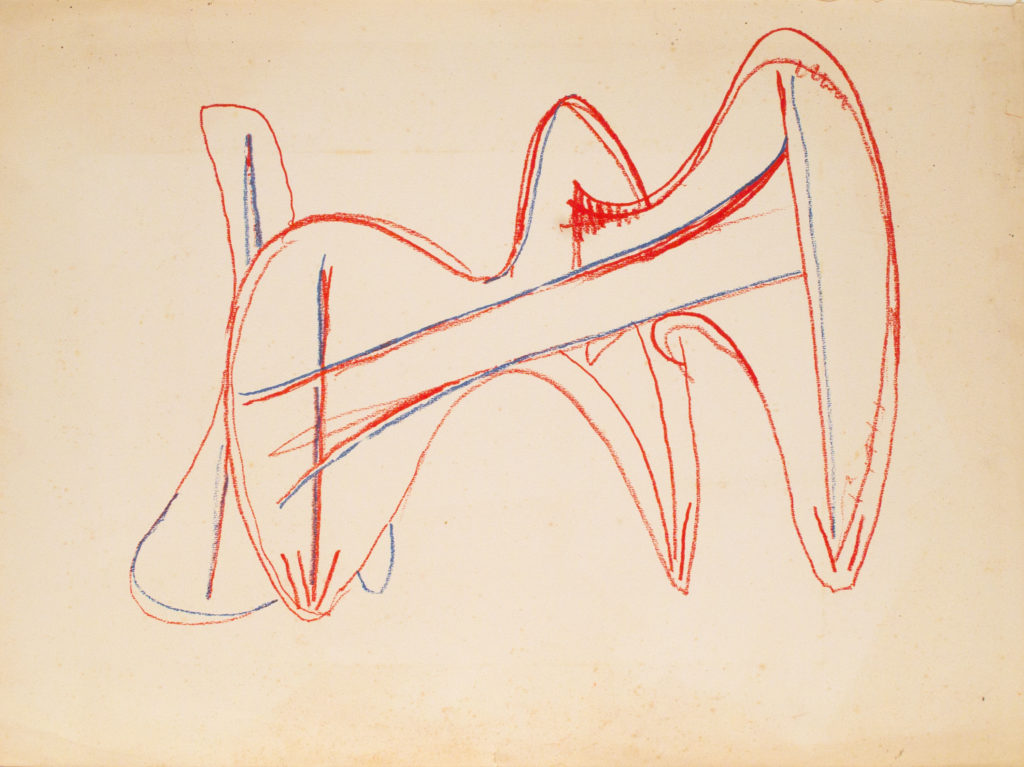
Two concept drawings of what became La Grande Vitesse

Although some painters in the modern era have pushed against the distinction I have just offered (regarding multiple dimensions) by their manipulation of the surfaces of paintings, sculpture remains distinctively in a sphere of its own. You can look at the back of a painting, but you move around (and sometimes through) a work of sculpture – something manifestly true with Calder’s stabiles. Whereas a viewer can encounter a painting through visual apprehension and imagination while standing before it in even a small room, a visitor encountering a sculpture – especially a large one – engages with it as an embodied being, interacting with another object occupying a shared space within a common area.

This helps us notice how the location of a sculpture can make a difference in our appreciation of it. With its stunning color and soaring curved surfaces, Calder’s La Grand Vitesse commands the plaza upon which it rests and would be much diminished if placed in a dark and cramped alley just wide enough to accommodate its size. Therefore, when sculptures are beautiful to behold, stirring in their effect, and well-placed, encountering works of this kind can provide a profound, whole body experience. In this respect, sculpture has an affinity with architecture.

What sets La Grande Vitesse apart from some of Calder’s other large stabiles is the extent of the quality of mystery he created by increasing the number of vantage points required in order to get a sense for the shape of the whole. This, then, extends the time it takes to gain an appreciation for the dynamic interrelation among the sculpture’s parts. Not all examples of sculpture merit the observation that when progressing to each new vantage point, the work appears to be different from one’s prior impression of it.

A second distinguishing aspect of La Grande Vitesse connects its formal title with the name of the city in which it has found a home. Grand Rapids is named for a historic feature of the river it straddles, and the sculpture’s French title can be translated with roughly the same two words. Guides also explain that La Grande Vitesse may properly be rendered as “the great swiftness.” These related names for the art work and its alluvial location fit well with its fluid lines, curves, and protruding fin-shaped panels, which would be at home in a marine environment. For me, the masterful conjunction of the scupture’s multiple curved surfaces accentuates the allure of the work, a sculpture that I find simultaneously uplifting, joyous, and very pleasing to behold.

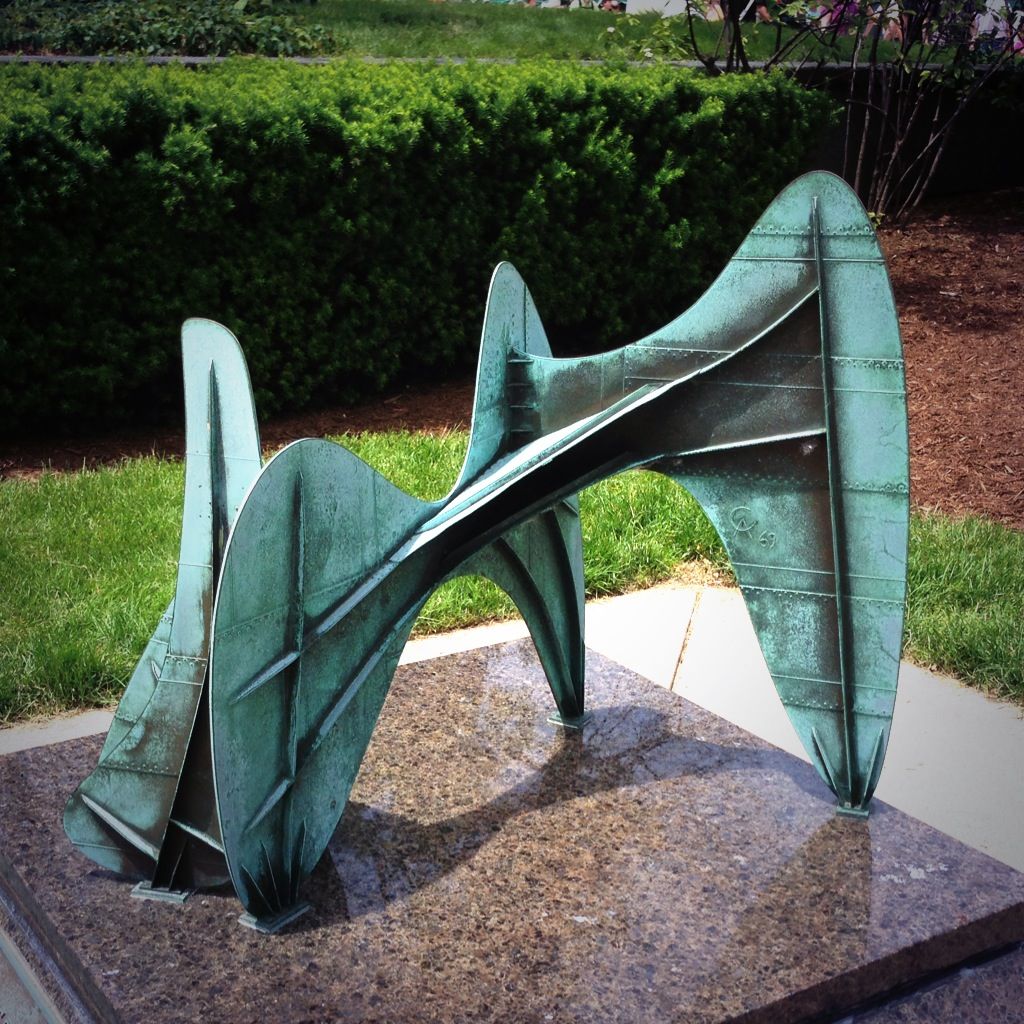
A 1:5 intermediate maquette of La Grande Vitesse bearing Calder’s signature and date

A 1:23 interpretive model for the sight-impaired (placed on the plaza near the sculpture in Grand Rapids)


Additional note: Placed next to civic buildings designed by Skidmore, Owings and Merrill, the Calder commission to produce La Grande Vitesse for the City of Grand Rapids was part of a larger project – as in so many cities during the 1960’s – to transform the heart of an urban area with what was then sometimes euphemistically called a process of ‘renewal.’ The photograph below of the 1969 dedication ceremony is revealing in that much of the area surrounding the sculpture plaza has since been covered by useful but not always beautiful government and commercial buildings, as well as a new medical center connected with Michigan State University, adjacent to extensions of an interstate highway.

Chihuly’s Glass Installations

[If reading this by email, please tap the title at the top to open your browser for the best experience. Then, clicking individual pictures will reveal higher resolution images.]

Marine Blue and Citron Tower, by Dale Chihuly, installed in 2021 at Taliesin West, Arizona


The making of art glass, especially when glassblowing, begins with glass melted in a furnace heated to over 2,000 degrees f. by gas-powered flames. As the artist works with the material, additional quantities of glass shards are typically added to the furnace. The added glass may be clear or colored, especially when recycled glass is employed, and other ingredients can be added to achieve a desired hue or tint.

Once, when my glassblowing instructor was scooping shards of recycled material into the flames, he accidentally lost grip of the metal scoop, which fell into the molten glass. To his delight, this produced a most beautiful and unexpected yellow color in the subsequently formed glass objects. Of particular note in Chihuly’s work is the conjunction of multiple colors, and the agate-like striations involving both colored and clear portions of glass.


At the most basic level, glassblowing involves attaching a glob of molten glass to the end of a tube-like metal pipe, which is then spun while air is introduced into it. At first this creates a globe-shaped object. Spinning the material fixed to the pipe can have an effect like that of a spinning pottery wheel upon wet clay. In both cases, the material can be formed into a symmetrical mass. But it can also be spun out of shape into a mess.

Whereas hands are used in ceramics to do the primary shaping, with molten glass a number of tools are employed to achieve various effects. These include assorted molds which Chihuly and his assistants may use to produce the rippled edges in some of his finished pieces like those depicted below. Wooden paddles, tweezers, cutting shears, and a variety of other tools are used in the process of shaping the very hot glassware while it is being formed, sometimes pulling and stretching it, at other times changing its orientation by causing parts of a piece to turn in on themselves. All the while the glassware artist must periodically reintroduce the work in progress into the open end of the furnace, or apply a torch to its surface, so as to keep the material hot and malleable.

Lower image: A portion of Chihuly’s Persian Ceiling, lit from above

In recent years, Chihuly has become known for his sometimes massive installations of glass. These often involve a seemingly uncountable number of objects linked together by an upright frame, suspended from a rack, or cradled from below. Viewers might encounter these installations indoors where they are displayed as a chandelier might be hung, or placed in an outdoor setting.


With his artistic exploration of the possibilities inherent in the manipulation of molten glass, and by pushing the parameters of what conceivably may be accomplished through working with this medium, Chihuly has created a huge portfolio of truly remarkable work. Of note is the way that so many of his pieces simultaneously have a sophistication that appeals to specialists and collectors, while at the same time being works of art that bring delight and wonder to children as well as to those who may not credit themselves with being aesthetically aware or sensitive. Dale Chihuly has effectively devoted his career to helping others encounter and perceive beauty in new and unexpected ways.

Another Chihuly installation, Fire Amber Herons, at Frank Lloyd Wrights’ Taliesin West