Architecture

The Beauty of Le Corbusier’s Ronchamp Chapel


When I was in high school, while aspiring to be an architect as well as an artist, I and my closest friend admired the architectural work of Le Corbusier. Among the attributes of his work that we held high were these: attention to human proportion and scale; a sensitivity to architectural ideals while mindful of the needs for human community, both domestic and commercial; and an equal sensitivity to providing ‘beauty’ for those in financially marginalized and especially in urban contexts.

With my long-term love for the architecture of the American ‘Prairie School,’ and especially that of Frank Lloyd Wright, appreciating Le Corbusier’s very European modernist style, rather linear and grid-like, was something of a stretch. Perhaps a parallel might be how an admirer of Monet’s water lily paintings or of Whistler’s nocturnes might be surprised by a new delight in seeing some geometric abstract paintings by Piet Mondrian.

But then, after admiring Le Corbusier’s famous Villa Savoy, and his Marseilles Block (a combined apartment and business building), I discovered his Ronchamp Chapel (completed 1954). Though I have yet to see and walk through it, I have long sensed that this is a masterpiece, precisely because it is so counter-intuitive to the main body of Le Corbusier’s work. Whereas much of his architecture is analytic, geometric, and mathematically precise in his approach to it, Ronchamp provides an example of a lyrical and semi-mystical appreciation for form and space, as well as for light and color. And whereas much of Le Corbusier’s work can be seen as the fruit of a meditation upon classical antecedents, both Greek and Roman, Ronchamp Chapel seems to bear the spiritual imprint of the culture that we associate with the medieval centuries.

For me, the best examples of that latter point are the immensely thick side walls in certain parts of the chapel, where the light intrudes through very dense materials. This, of course, is a beautiful metaphor for my life and yours.

‘Glimpses of a deeper soul’ ~ this is a phrase that has come to me, time and again, when reflecting upon the lives of persons we become acquainted with in Scripture and Christian history, in secular fiction, as well as in daily church and public life. Especially in North America, we tend to chart our lives forward, in planned linear paths of progression, each step building upon the prior one toward a calculated and hoped-for end. And yet, despite all our planning, we may be open to, or unexpectedly experience, dreams and visions of something other, more amorphous. In such moments, we perceive to our surprise unanticipated images of what may be an attainable beauty, a beauty that none of us would have imagined in the ordinary run of things. For human creativity reflects divine creativity.

To Le Corbusier, perhaps his vision and design for the Ronchamp Chapel came as just such an unexpected surprise. For me, the wonder is that he allowed himself to let his imagination bear fruit in this remarkable plan and building. Despite his avowed atheistic concept of reality, his chapel centers on the transcendent and mystical, while also touching upon and embracing the local and material aspects of our lives.


A Canopy of Light


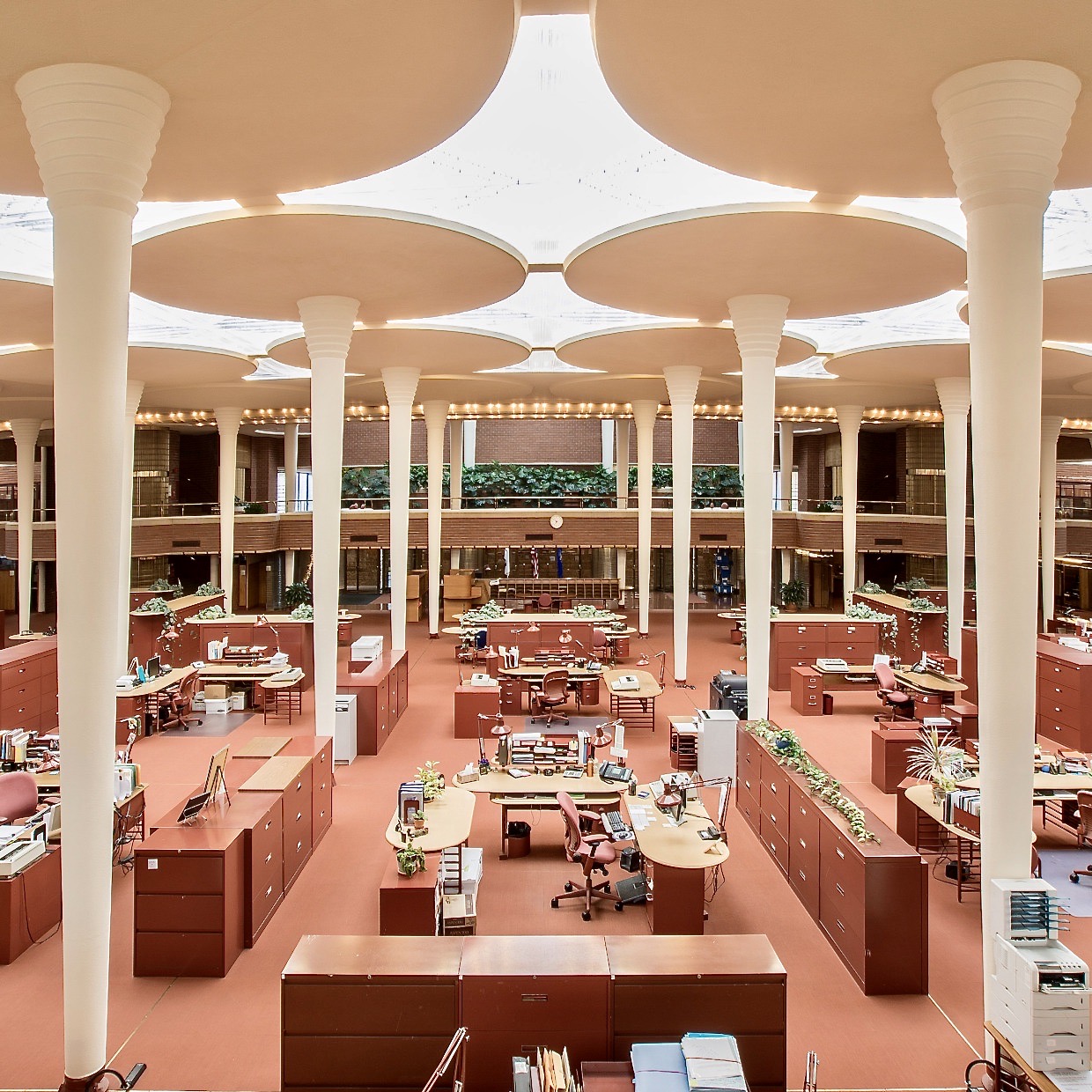
In his visually stunning documentary on Frank Lloyd Wright, a Welsh architect named Jonathan Adams visits some of Wright’s finest buildings. Upon entering the ‘great workroom’ of the S C Johnson (Wax) Company headquarters building, he gives voice to what is surely a very common response to that amazing space – ‘this may be the most beautiful room in America.’

Among the several features of this sublime interior that evoke praise are the lithe columns supporting the large expanse of pyrex glass tubing, the warmly colored horizontal flow of the brick balconies and walkways, and the architect’s complementary attention to the color of the furniture and carpeting, the originals of which were all designed by Wright. As we see in so many of his buildings, ‘Cherokee’ (or iron oxide) red as well as limestone-reminiscent cream and ochre are primary features of his color palette.

Wright had in mind the vertical strength of tree trunks when designing the columns, and the large disc shaped platforms at their top combine to suggest a canopy of trees between which filtered daylight descends. At the same time, he also spoke of the columns as being like lily pads rising to the surface of a pond, to receive the nourishing light above. Although both of these metaphorical references seem apt to me, the interior of this expansive space is evocative of the great gothic medieval cathedrals and their clerestory windows, especially in connection with Wright’s profound sensitivity to the power of natural light. The priority he gave to natural light, as well as to its spiritual significance, is evident in his design for one of his earliest public buildings, Unity Temple, in Oak Park, Illinois. How wonderful it is that Wright can help us celebrate the experientially redemptive abundance of light, even on a dark winter day.

In a prior blog post I referred to how our engagement with the appearance of, and the spaces within, a building can have the effect of uplifting our souls and of enlarging our view of the world. By this, I was reflecting on how encountering great works of architecture can enrich our sense of community, as well as our regard for the pursuit of beauty, goodness, truth and other recognized virtues. Primary among these is joy.

Our contemporary sense of the word joy is often limited to a feeling that happens to us. But, as Thomas Aquinas is remembered to have observed long ago, “joy is the noblest human act.” Yes, we can feel joy. But we can also rejoice at the presence of sublime beauty, whether divinely created or humanly made. As a prayer to God for the newly baptized puts it, “Give them… the gift of joy and wonder in all your works.”

Virtues like beauty and goodness can also be described as ‘natural authorities.’ This is because they help make our responses to these qualities in things and people, and our subsequent actions, intelligible. For example, we enter and behold a profoundly beautiful space like the ‘great workroom’ at the Johnson Wax building. Our encounter with its beauty ‘authorizes’ or makes intelligible our response to it as we experience and express joy and wonder. Our encounter with this beauty can also prompt an appreciative regard for how our lives in community can be enhanced. Here, the experience of human-created beauty evokes our joyful apprehension of the beauty of our Creator, and of our Creator’s handiwork all around us as well as within us. Most appropriately, we rejoice at what we behold.


Notes: The SC Johnson company headquarters building in Racine, Wisconsin (1936-39), is typically referred to by its original common designation, the Johnson Wax building and tower. The company welcomes visitors and offers tours. The F.L. Wright-designed furniture that is seen on these tours was manufactured by the Steelcase company in Grand Rapids, MI. Wright’s Unity Temple dates back to 1905-08 and is still in use for congregational worship today. The prayer for the newly baptized is found on p. 308 of The Book of Common Prayer. Oliver O’Donovan’s book, Resurrection and Moral Order, is the source for my use of the concept of ‘natural authorities.’

Beauty in Architecture for Public Places


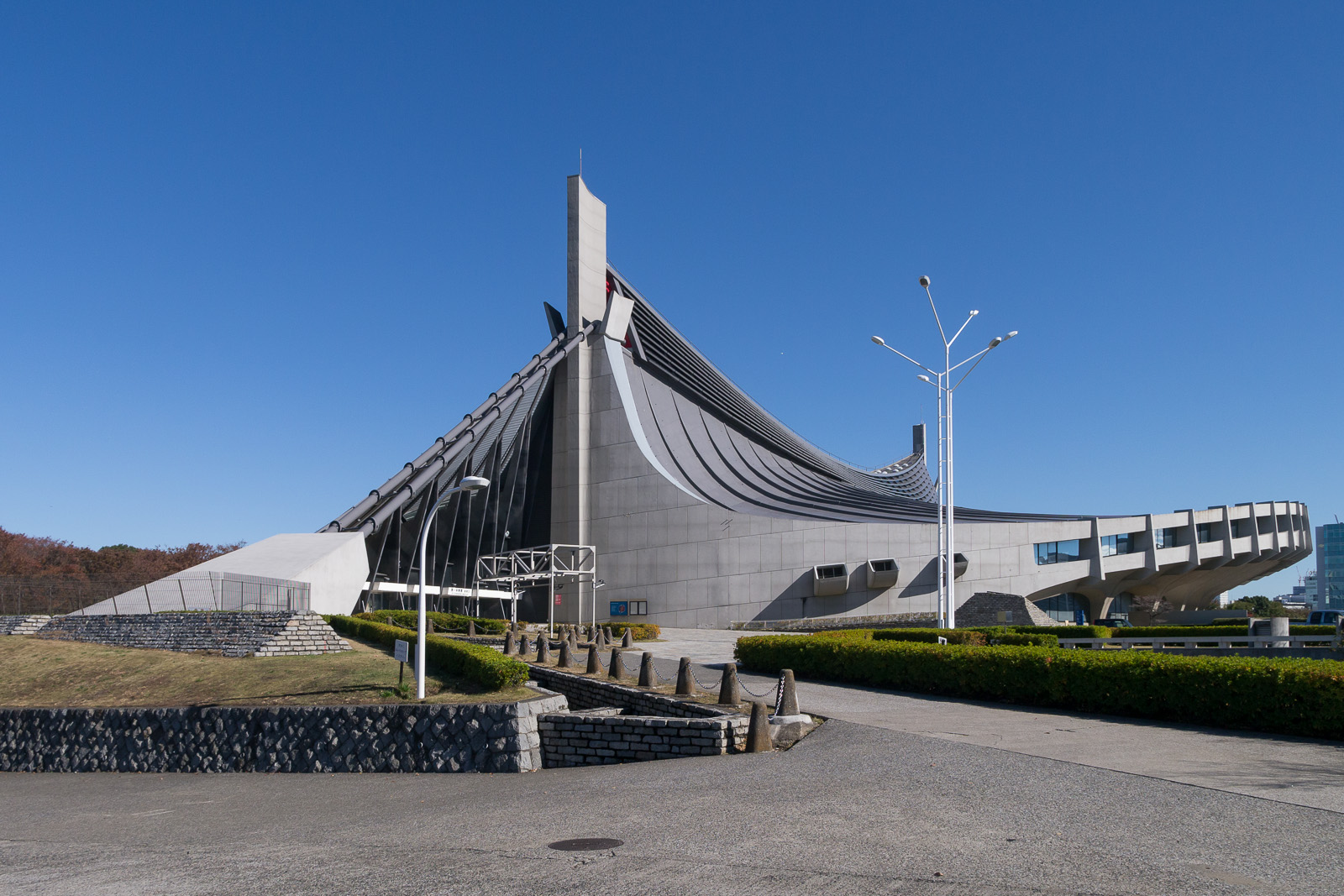
By 1964, as Tokyo prepared for that summer’s Olympic Games, I had been in Japan for five years. Our family lived not far from the stunning Olympic Pool building designed and being built by the Japanese architect, Kenzo Tange. I remember seeing it on our Sunday train journeys to church. Some 60 years after construction on it began, the lyrical design of this timelessly modern building continues to awe visitors. No longer housing swimming and diving pools, the building has been designated for use as a gymnasium during the (now postponed) 2020 Tokyo Olympic Games.

Tange’s Olympic Pool has long been one of my favorite works of architecture. Walking or driving around its perimeter provides an experience akin to walking around a large Alexander Calder stabile or one of Henry Moore’s more abstract sculptures. I think it is due to the building’s long arcing lines, made possible by structural cables employing catenary curves. These elements continue to give the 1964 Olympic Pool building a very contemporary appearance. More subtle are the distinctively Japanese features of the building, which are less obvious to western observers. The protruding portion of the two principal vertical columns, the horizontal panels between them mimicking a formal roof cap, as well as the upward curve of the outward edge of the roofline, bear an affinity with aspects of the nearby Meiji Shrine. Note the small but significant wing-like flares adjacent to the twin upward columns in Tange’s design.

I reflect on this building when I think of what might best be called public architecture. By this, I mean public buildings such as airport concourses, courthouses and even hospitals. The debate on federal architecture generated by the recently-leaked draft executive order has had at least one benefit. The evolving discussion has raised the profile of our consideration of beauty in relation to buildings intended to serve, and perhaps also to enhance, our common life as fellow citizens. Whatever one may think of that draft executive order’s commendation of classicism as a design criteria for high costing federal buildings (those over $50 million), we can surely agree that striving for beauty is of significant value within our communities, however that quality may be defined.

Think of the last time that you felt your soul uplifted and your view of the world enlarged by your engagement with a building’s facade, and your movement through its interior space. By this, I am referring to an experience that transcends one of marveling at the scale and complexity of some architectural achievement, and the intellectual pleasure such an encounter might provide. Instead, I am pointing to the way that works of architecture can enhance our sense of community, as well as our regard for the pursuit of beauty, goodness, truth, and other recognized virtues. We might expect these qualities to be evident in buildings designed for public worship. But do we also expect them to be features of our encounter with a government or publicly-funded new courthouse, airport terminal or sports arena? I think it is right that we should.


The photos featured here are creative commons licensed photos of Kenzo Tange’s beautiful building designed and built for the swimming and diving pool events at the 1964 Tokyo Olympic Games.

The Beauty of ‘Wright’

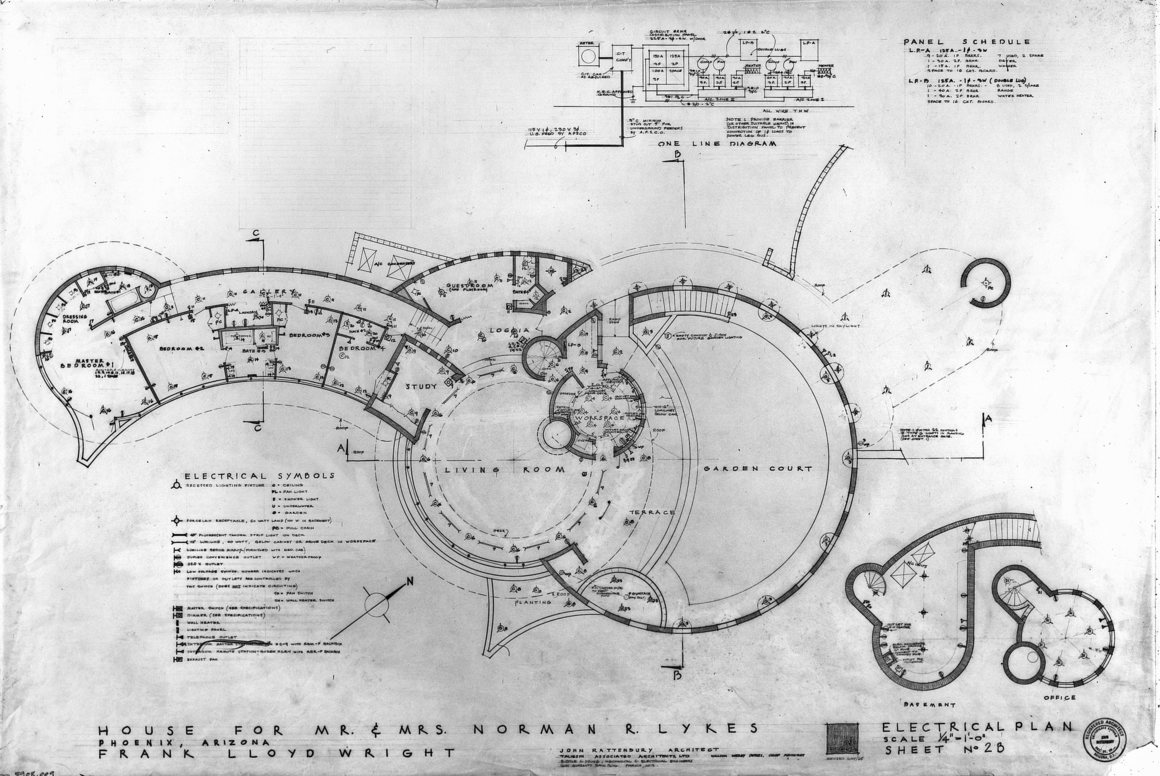
Exterior and plan of the Lykes house in Phoenix

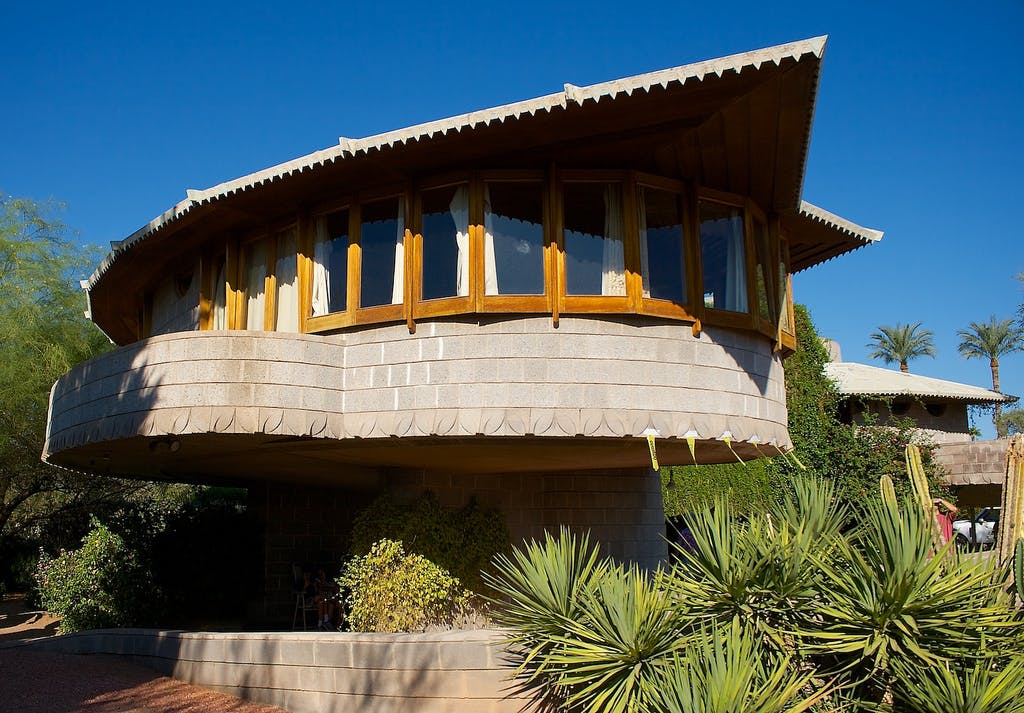
Before my conversion to following a greater ‘master,’ I have been devoted since at least 8th grade to the alluring architectural vision expressed in the work of Frank Lloyd Wright. In Wright’s buildings, drawings, and writings, I have found a compelling, nature-shaped understanding of how we might best engage the challenge of inhabiting this world. As expressed by Wright, flourishing as a human being means consciously living in accord with the order and beauty of what believers refer to as Creation. In connection with this vision, FLW may have been the first to use the phrase, ‘an organic architecture.’

Exterior and interior of David Wright house, also in Phoenix

An old adage reminds us that imitation is the sincerest form of flattery, and imitate Wright I did. In my desire to become an architect through the traditional route of apprenticeship leading to licensing, I began developing basic drafting skills in junior high and designing house after house. All the while, Wright’s life and work became my principal reference point. Just as many of my schoolmates memorized the career statistics of favorite baseball or football players, I could quote a parallel set of statistics related to Wright’s major projects, such as the height, diameter and weight-bearing capacity of the columns in his internationally recognized Johnson Wax building in Racine. Perhaps it was the influence of having visited his Imperial Hotel in Tokyo while growing up in Japan, as well as having a compatible aesthetic temperament. Yet, whatever the source, from my earliest appreciation for Wright’s buildings to this day, I have simply loved his architectural work. To me, Wright’s vision almost always seems ‘right.’

I state this fully aware of the perceived and actual shortcomings of many of ‘the master’s’ most well-known buildings. A favorite story is attributed to Mr. S.C. Johnson, owner of the company building mentioned above as well as of a stunning large estate home designed for him by Wright, “Wingspread.” Apparently, at a dinner hosted by Johnson for several distinguished guests, the roof over the dining room began to leak (a notorious feature of some of Wright’s structures), causing a drip onto the host’s head. Johnson is remembered for having telephoned the architect at that moment, complaining about the leak. Wright responded by saying, “well, Sam, move your chair!”

The realization of Wright’s stunning architectural vision, expressed in such things as curved walls, daring roof lines, and dramatically extended cantilevered terraces, often relied upon the patronage and funding provided by wealthy clients. Throughout history, great artists have depended upon the same. But we should not overlook Wright’s committed pursuit of the opportunity to design and build beautiful-yet-affordable homes for clients with ‘ordinary’ incomes (e.g., the “Usonian” houses). Not only do we find many of these homes preserved and valued in our communities, but the design principles evident within them have influenced countless examples of contractor-designed homes of lesser architectural interest.

The pursuit of human flourishing within the beauty and order of God’s Creation is a wonderful thing to behold. As Irenaeus put it centuries ago, ‘the glory of God is the human person fully alive.’ And the human person is most fully alive when flourishing within the beauty of God’s handiwork, and within our creative tributes to it.