If reading this by email, please tap the title at the top to open your browser for the best experience. Then, clicking individual pictures will reveal higher resolution images.
In more than one way, Allan West is an unusual artist. His life and work have been deeply imbued by the spiritual aesthetics of Japanese culture and its traditional art of painting. For over forty years, he has dedicated himself to Nihonga, the less and less practiced method of painting using minerals for pigments, mixed with the liquid medium of a glue made from deer protein. This approach to painting has been practiced consistently in Japan, where luminous paintings from the 11th century can still be appreciated for their original beauty. The closest parallel in Western art is egg tempera painting, in which painters in earlier centuries mixed pigment with egg yolks instead of the modern practice of mixing pigments with oil or an acrylic medium.
Allan West was born and grew up in Washington, D.C., and his sojourn in Japan began in a period of mission work there as a member of the Latter Day Saints. Two factors transformed the vector of his life. He came to realize that he had an affinity with Japanese culture, especially with its artistic tradition, and he was struck by the Japanese sensitivity to living in harmony as much as is possible with the natural world.
More particularly, with his memory of pursuing painting from the time of his childhood, he recalls his own experiments with mixing pigments with various liquids to achieve a more fluid paint medium. This predisposed him to accept an observation offered by a viewer of his early work, who told him that his preferred approach to painting had a long tradition in Japan. As a result, West moved to Japan in 1987, with his wife and children, to learn from that tradition. He has lived and worked in Tokyo, ever since.

In a short video introduction to the artist, released by the Prime Minister’s Office in Japan, Allan West shares the following about his life’s work (screenshot above, and link below):
I use the Japanese painting technique to express the beauty and essence of the natural seasons. It has been 40 years since I moved to Japan, attracted by the traditional pigments and techniques of Japanese painting. Japanese natural materials can retain their clear vibrancy for more than a thousand years. I’m proud to inherit the tradition of Japanese painting and its wisdom that cherishes nature’s beauty and harmony with humankind. Through my art I’d like to convey the appeal of Japanese culture to the world.
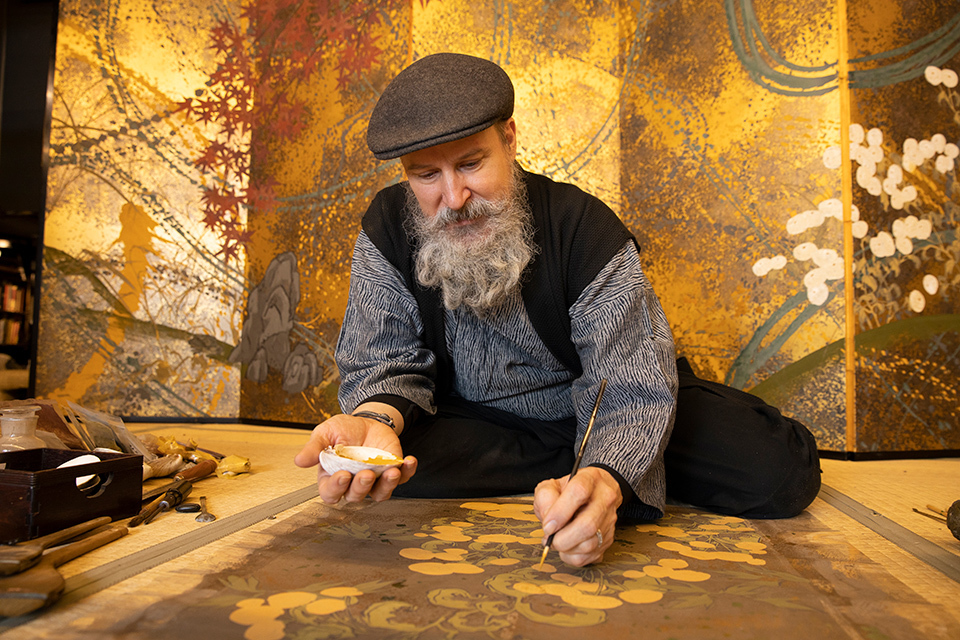
With these few words, spoken in a soft and nuanced voice in the video, Allan West is saying much. Having returned to Japan with the intent of learning a method or a technique, he had the sensitivity to realize that he needed to learn the Japanese language and let its culture become ingrained within him in order for him to be able to practice Nihonga painting with some degree of integrity. The photo below contains a number of important cues concerning what West has received and learned from the tradition of which he describes himself as an inheritor.

Allan West paints sitting on the floor in a Japanese way, on mats woven from rice-straw. As has been noted, the paints he uses are made up of ground minerals mixed with a glue-like medium of deer protein, paints which he values for their fluid quality. Hence, the surfaces that are to be painted need also to rest upon the floor, to avoid the paint running. Many of the surfaces upon which West works are large in size, like the sometimes wall-sized decorative folding screens for which he has become known. To be able to paint such expansive surfaces in their totality, instead of panel by panel, the artist designed a narrow rolling platform, allowing him to reach any area of a full-sized screen (as in the image above). This photo also displays West’s use of vibrant mineral-based colors as well as metalic foils and powders, such as gold leaf, some of which are found in the glass containers on the shelves behind him.
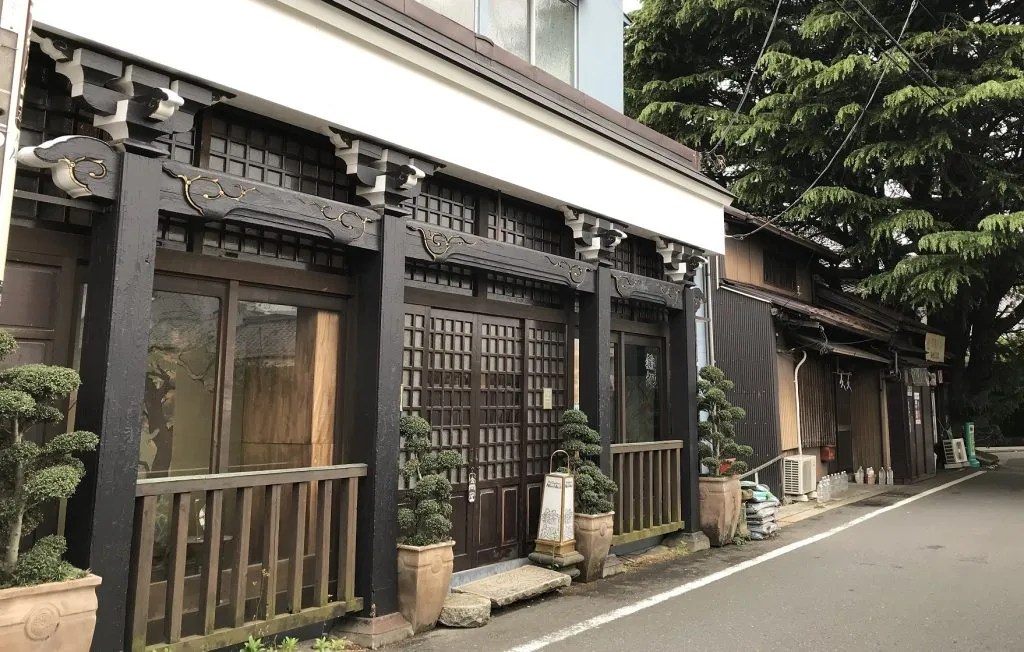
Allan West’s present Yanaka, Tokyo, studio
Unlike some artists, both Western and Asian, Allan West welcomes visitors to his studio, and actively encourages those who are curious not only to view his art, but to witness his creative process. To this end, his present studio, much modified into a traditional Japanese-looking structure from its prior use as an automotive maintenance facility, has large and welcoming sliding panels and windows, through which those walking by can view him painting. Through providing this access to his creative work, he hopes to promote a sustainable future for Nihonga, and to persuade Japanese visitors in particular that even an American immigrant can appreciate, learn, and become proficient in an ancient Japanese art form.
The following images provide examples of Allan West’s beautiful work:


The following image displays the interior of Allan West’s attractive and welcoming studio and gallery building:
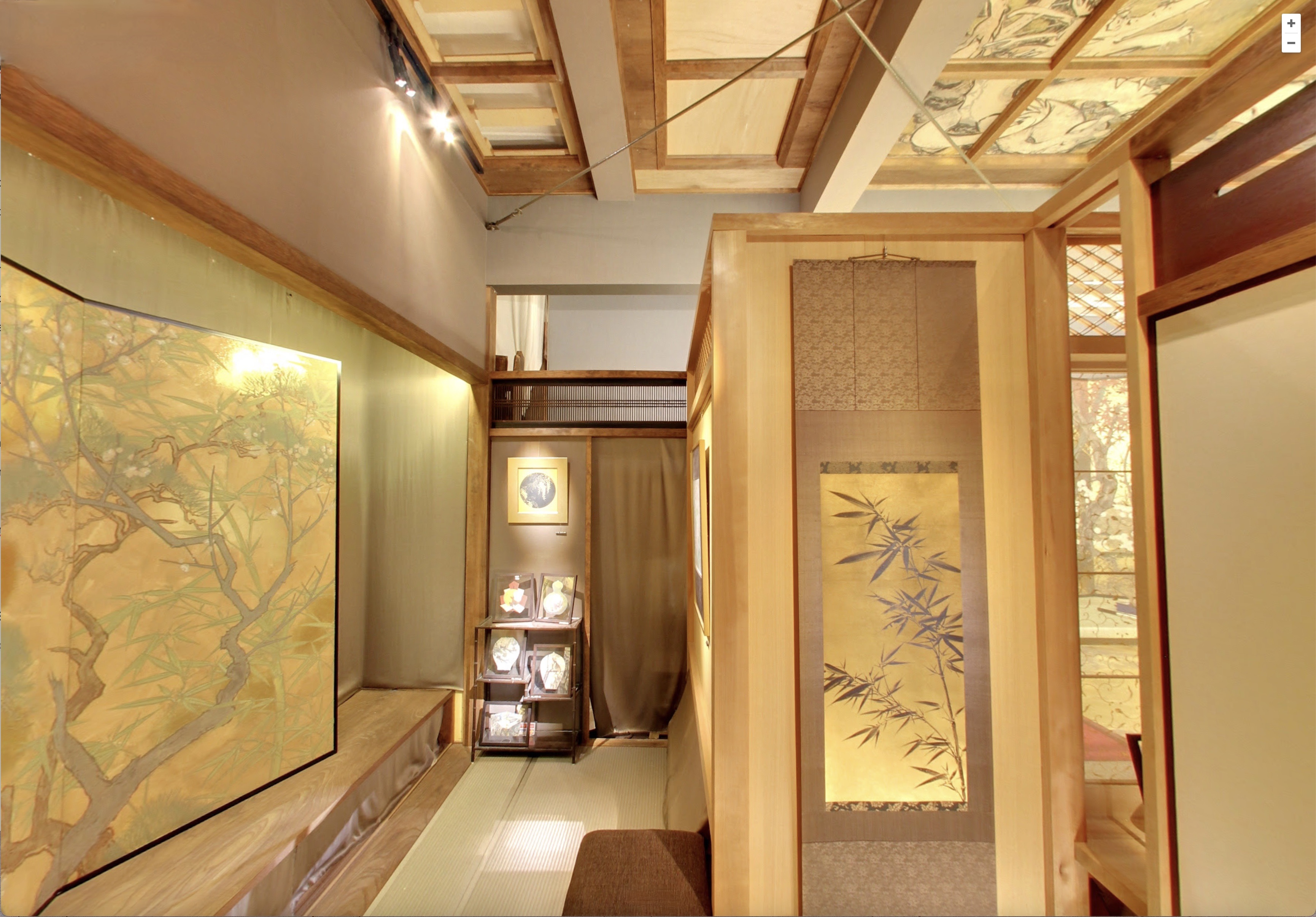
Readers who wish to become more acquainted with Allan West and his work might view the YouTube video mentioned above (the link is here). Allan West’s studio and gallery can also be visited in a virtual way by clicking this link.
 Toward Beauty