If reading this by email, please tap the title at the top to open your browser for the best experience. Then, clicking individual pictures will reveal higher resolution images.

In an updated preface to his book, A Place of My Own: the Architecture of Daydreams, Michael Pollan laments how some readers approach his book expecting something like a “how to” guide to building their own writer’s hut or shack. Though he does provide a wealth of detail concerning the construction methods he used, the book’s richness lies in its thoughtful engagement with the idea of human shelter and its function in architecture. Of particular note is the attention he gives to the French writer, Gaston Bachelard, whose book, The Poetics of Space, prompts a good deal of reflection by Pollan. The author quotes Bachelard with words that obviously inspired the subtitle of A Place of My Own: “I should say: the house shelters daydreaming, the house protects the dreamer, the house allows one to dream in peace.”
Michael Pollan dreams of building and inhabiting what we might call his own writer’s studio in the woods behind his Connecticut home. As he muses about its possibilities, he considers potential designs in dialogue with his chosen site for the small building. From a book by the English geographer, Jay Appleton, he gleans the insight that ideal human shelters provide two dialectically interconnected values, ‘prospect’ and ‘refuge.’ A shelter conducive for human flourishing provides both the opportunity to view and appreciate one’s surroundings while at the same time providing a secure resting place. Achieving these twin goals becomes one of Pollan’s priorities for his little writing hut.
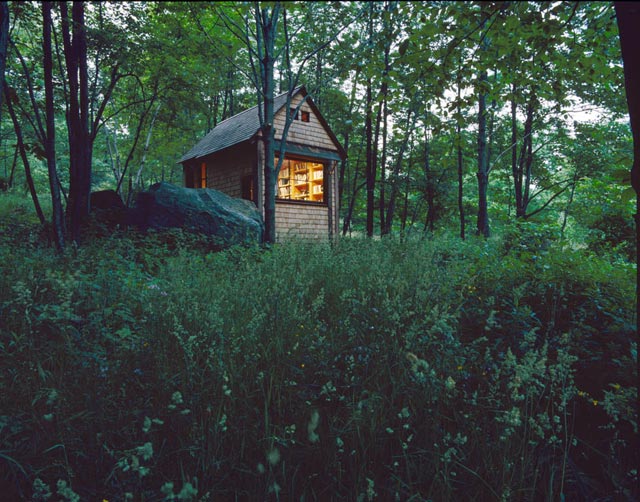
At the same time, while embarking upon this project to build his place for writing, he acknowledges that the endeavor also provides the occasion for him to examine the idea of architecture, and its contemporary role in Western society. He discovers – through a gift subscription to Progressive Architecture magazine – that the field has increasingly become focused on the exploration and expression of ideas, leaving behind a principal focus upon providing beautiful yet practically useful spaces and structures for human habitation and work.
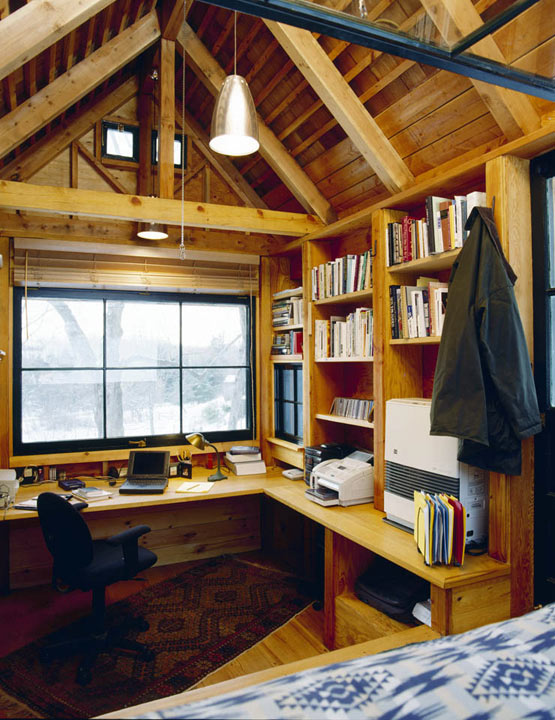
The interior of Michael Pollan’s writing house (note the daybed in the foreground)
Pollan realizes that what he wants to build is not something that points to something else, or to a set of ideas and concepts (as is the case with some contemporary practitioners in the field of design). Instead, he wants a structure that he can use for everyday work, for reading, and as a place where occasionally he can have a nap. With his aversion to the little building becoming an artistic statement rather than something truly useful, Pollan’s book reminds me of a principal theme in Tom Wolfe’s splendid little book, From Bauhaus to Our House.
Especially in the first two chapters, Michael Pollan offers a set of thought provoking and historically informed reflections on the nature and purpose of architecture, which are shaped in a writerly way. As much as I was drawn to the concrete aspects of his project – as in his account of his search for the ideal design of the window through which he would look while writing – I found his engagement with the theoretical aspects of the project to be very compelling. A good example of the latter is his reflection on our conscious experience of form and pattern in buildings, and our unconscious experience of the spaces we encounter and through which we move. Other examples include the role of feng shui in his selection of a site for his project, as well his explanation of the function of the Golden Section (or Divine Proportion, 1/1.618) in deciding the parameters of the rectangle for his floor plan.
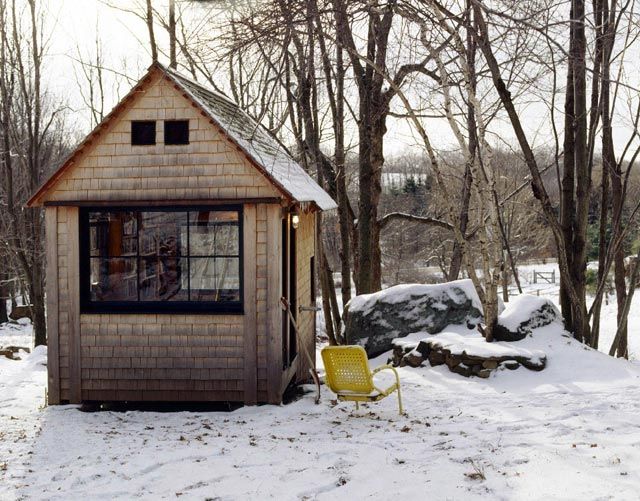
Most of all, I appreciate Pollan’s delineation of the difference between the 20th century modernist or International Style approach to architecture, which abstractly stressed universality of form and consistent design elements regardless of a building’s context, with the architecture of someone like Frank Lloyd Wright, who focused on the connection between his buildings and their location within their chosen sites and his intentional employment of local materials. Pollan offers an insightful two-columned table to illustrate the difference between the two, with the first (stressing universality) labeled, “There,” and the second (stressing locality) labeled, “Here.”
All in all, he has given us a finely written book.

 Toward Beauty
I love the intentionality of what he has designed in that it appears to strip down the space to accommodate the intended purpose, to think and write. I imagine that the window location allows him to see the seasonal changes and the changes that naturally occur in the landscape as things grow and as they deteriorate. But most of all, the daybed!
I appreciate your observations about his structure, and fully agree with you about the daybed!
I built this little ‘house’ for a neighbour who was a teenager at the time. I took the photos of me sitting in the house writing a sermon, although it was never ‘mine.’ The architecture and wood-craft was definitely of the ‘wood-butcher’ variety. The little house still stands but the teen is now a grown-up living far away.
Shalom, Curt
Thanks for offering this. I look forward to seeing the photos!
Curt Gesch cgesch63@gmail.com Fri, Oct 4, 6:48â¯AM (5 days ago) to comment+eg8i0z47x6-8b14-a860znhztu [image: Reuben’s sermon-making house 035.jpg][image: makita makes better sermons.jpg] [image: Reuben’s sermon-making house 031.jpg]Makitas make better sermons, I’ve found. I hope these come through this time. cg
Thanks for making the effort ~ Still not seeing the photo, and am not sure how one posts a photo in reply to a blog post!
I never cease to learn something from your posts and their somewhat varied topics. Thanks, Stephen.
Thank you!