If reading this by email, please tap the title at the top to open your browser for the best experience. Then, clicking individual pictures will reveal higher resolution images.

If you wanted to buy a guide to help you identify birds, what would you choose? A book with glossy photographs showing birds as found in nature? Or would you choose an artist’s rendition of those same birds abstracted from their natural setting? Without considering the question closely, I suspect that I am not alone in being one who would choose the former for what seems an obvious reason, that photographs purport to capture reality in what we call an objective way. And when seeking to identify birds, correct apprehension of reality is what we are after. Paradoxically, Roger Tory Peterson’s, Field Guide to the Birds, first published in 1934, has long been valued precisely because his paintings and notes may aid accurate identification of birds to a greater degree than can be obtained by studying photographs.
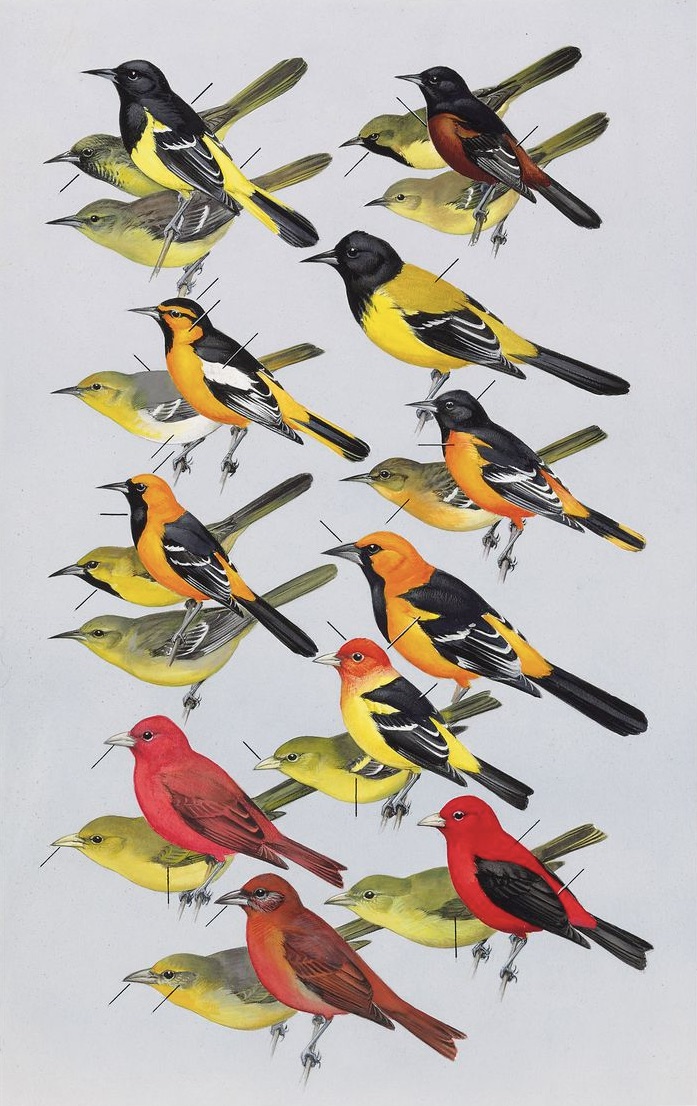
As we also find in the presumed intent of more recent, photo-based, bird books, Peterson’s aim was to help us see, and then upon seeing, correctly identify the birds we have apprehended in our sights. Yet, Peterson, a much-regarded pioneer in the environmental movement, sought to aid our perception by prioritizing the various unique properties of individual species, and then to highlight those features that distinguish them from other birds. With the aid of his editors and book designers, he helped to achieve these goals by adding small black lines or dashes pointing to various parts of each bird on the color illustration pages displaying his paintings.
These small lines correspond to observation notes in the text, signaling to the reader the principal identification marks and points of difference between various similar-looking species of birds (see below). His creation of this method for the identification of observed field marks in birds has come to be called the Peterson Identification System.
A pre-publication page from Peterson’s Field Guide. Note the small black lines or dashes, explained above.
The paradoxical limitation that may accompany a photographic guide to birds is that a photograph captures an object in only one posture in one moment of time. Photographs are also dependent upon existing light conditions, and where the object of attention may also visually be obscured or overwhelmed by its larger context.
With paintings, Peterson may have been better able to help us see three dimensional aspects of the birds he portrayed while yet employing a two dimensional medium, in part because those birds are presented against a non-distracting neutral background. By painting rather than photographing, he was able to emphasize and enhance certain features of birds, such as subtle areas of color and the impact of light upon them, to a greater extent than would have been possible with the photographic means available to him at the time. In the process, Peterson demonstrated a consistently high degree of proficiency in his work of illustration, while also achieving what are arguably finished works of art that help us perceive beauty in the natural world around us.

The Finches page from my grandfather’s 1959 edition of Peterson’s Field Guide

Note: Having featured Peterson’s work, there are many newer bird identification books being published, and they are worth exploring when someone seeks a reliable birding guide. For many people of my generation, Peterson’s work will always be on the shelf, given its art rather than his having employed photo-based images, especially since his books are so widely available. I am proud to have and use my grandfather’s annotated copy (above), with his sightings noted on numerous pages going back to the 1960’s.
I am conscious of the fact that I featured multiple color photos of the Common Nighthawk in my prior post, as well as having offered a substantial amount of information about this particular species. If bird guides were to offer an equivalent kind and amount of coverage of every species commonly observed, they would be immense, and very expensive!

Roger Tory Peterson (1908-1996). It is one thing to be serious about one’s life work, and another to be able to laugh about it!
 Toward Beauty