If reading this by email, please tap the title at the top to open your browser for the best experience. Then, clicking individual pictures will reveal higher resolution images.
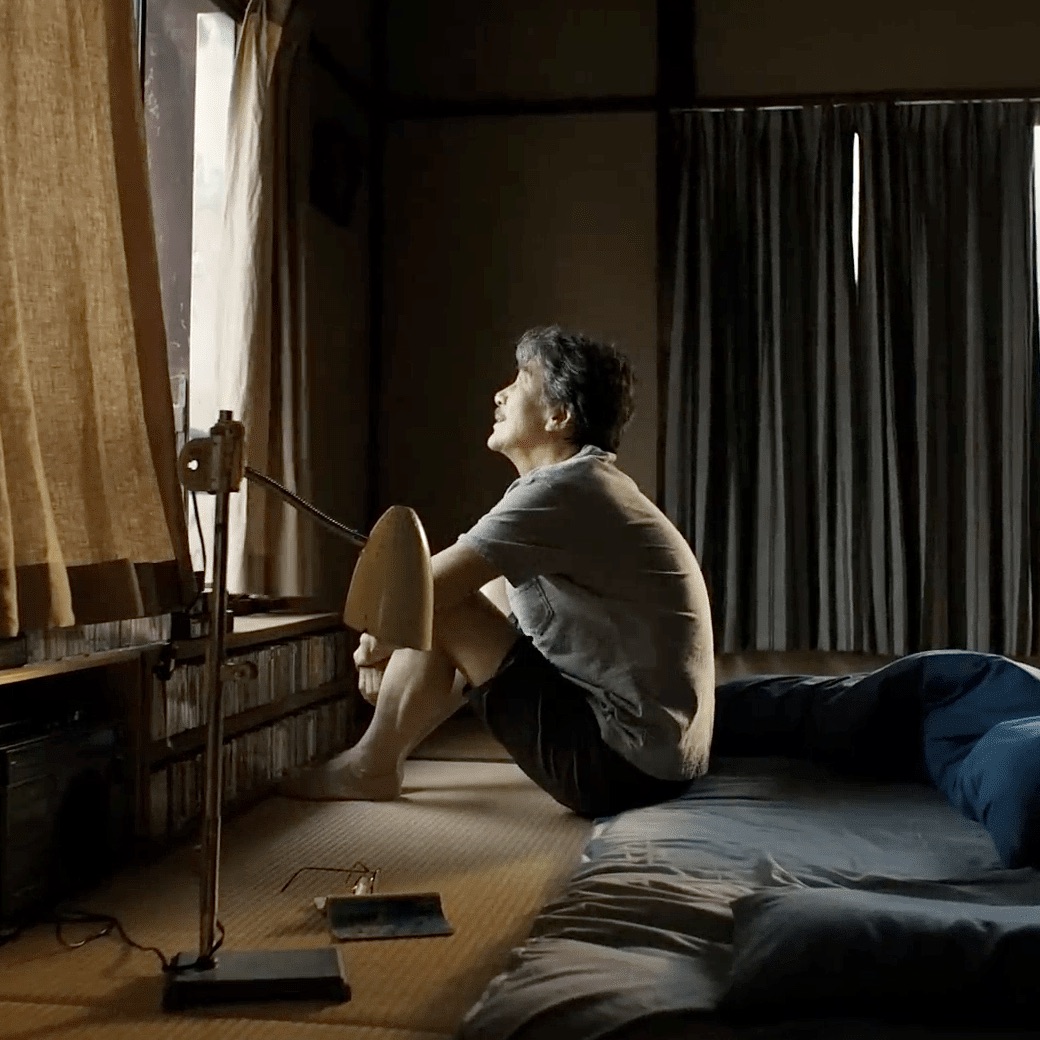
Actor Koji Yakusho portraying Hirayama looking upwards, in the film Perfect Days
An improbable premise underlies the remarkable film, Perfect Days, and it is displayed in two principal ways. A Tokyo public toilet cleaner has a positive attitude, even a cheerful spirit, as he approaches his daily routine of attending to places where other people leave their waste. And yet, the primary places where this man is lucky to work are the architecturally significant public toilets commissioned and built for the 2020 Tokyo Olympics. The film portrays these places well. Some have suggested that the architectural features of these structures may have inspired the movie’s production. Nevertheless, the film is centered upon one man’s approach to how he lives every day.
He is a man about whom we know only his surname, and we learn more about his daily routine than we do about his inner life. The latter, his interests and perhaps aspirations, are suggested by the books he reads and the music to which he listens while driving. Many scenes depict him at his work. But the film does this in ways that do not romanticize his occupation, while he is shown cleaning and polishing toilet bowls and seats, as well as sinks and other aspects of plumbing. The film skillfully negotiates the ambiguous terrain lying between a heroic portrayal of an apparently righteous man, and a sentimental celebration of an unreal figure.

A montage of some of the public toilets featured in Perfect Days
The approach to life epitomized by Hirayama in the film is one of contentment. He models someone who accepts the limitations presented by the contexts in which many of us live, and he displays an openness to unexpected moments of discovered and quiet beauty. The film is not overtly spiritual. Yet, these qualities may represent – to some Western viewers like me – compelling reflections of Japanese culture as it has been shaped by Buddhism.
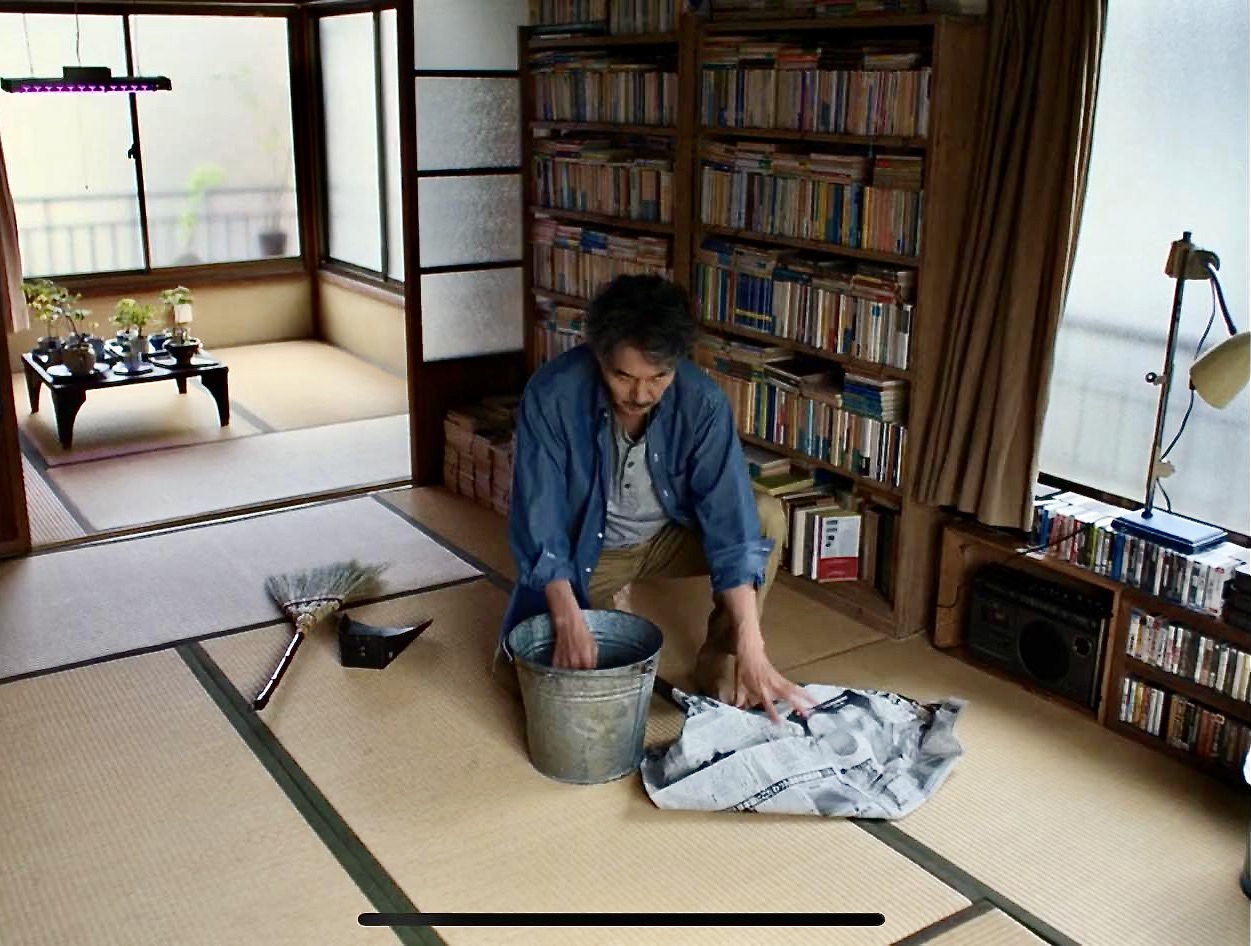
Hirayama at work on a hobby, Bonsai
In addition to the overt paradoxes at the heart of the film – a happy toilet cleaner and beautiful public toilets – the film subtly presents other aspects of Japanese society that Western visitors might notice. In what may surprise many who are not of Japanese heritage, regarding a very private culture where people typically meet one another in commercial establishments rather than in personal dwelling places, public baths with full nudity are common. I experienced occasional visits to public baths in my youth, growing up in Japan.

Hirayama in the neighborhood bath house
And within the context of this very private culture, some Tokyo public restrooms were created with transparent glass walls, appearing to risk users to full disclosure (the glass walls magically become opaque when the doors are locked).

Three motifs or tropes in the film are memorable. Hirayama is portrayed as always looking up to the sky when emerging from his home in the morning on his way to work, and is also seen gazing upwards (as in the photo at the top of this post). This suggests that he unconsciously senses a connection with something bigger than himself, and this may be the source of his frequently displayed habit of smiling at others.
Another motif, surely related to the first, is the employment of black and white sequences that portray flickering images, usually of dappled sunlight glimpsed through tree limbs, which Hirayama captures with his old-fashioned film camera. Most often, he seems to take these photos during his lunch breaks in a local park. In relation to these images, the movie highlights the Japanese word, and concept, of komorebi, which in a single word expresses the idea of sunshine filtering through the leaves of trees overhead.
The third is the employment by the movie makers of the Sumida River in Tokyo, long celebrated in Japanese art, over which we see Hirayama cross while walking, driving, or biking. The river appears to symbolize a form of divide between the part of the city where his small apartment is located, and the more elegant commercial district where he usually works.
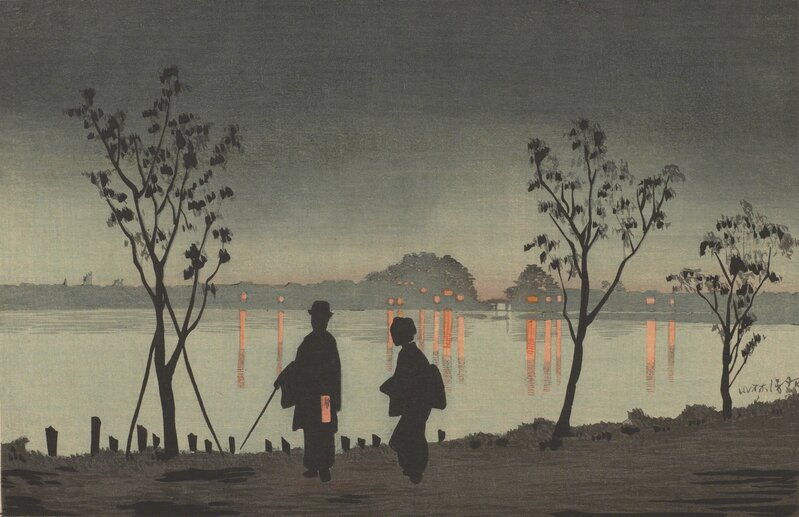
My favorite image of Tokyo’s Sumida River in art, a woodblock print by Kobayashi, Kiyochika ({1847-1915} name in traditional Japanese order)
These juxtapositions in Perfect Days of contrasting details, color versus black and white, and interior privacy and public life, along with the harmony in which they are presented, distinguish this film. To me, it is remarkable that this movie was made by a Western filmmaker, regardless of the assistance provided by Japanese colleagues. A studied sensitivity to what I know about Japanese culture is evident in the film’s portrayal of this fictional character in improbable circumstances, as it invites us to discover – along with Hirayama – beauty in the most unexpected places.

Hirayama, gazing upwards, holding his old-fashioned film camera
 Toward Beauty
Wow, Uncle Stephen! You continue to expand my world through meaningful social media & have reminded me to find my contentment through my faith & all God provides as I sit in the companionship of my rescue dogs & catch a glimpse of the clear, warm Albuquerque day through my window. Thank you!
Thank you, Beth. With your lifelong work of helping many peoples and their or others’ loved animals in need, in substantive ways, I appreciate this. And, here from a moist, humid, storm-prone Louisiana, I envy your clear, warm (and I assume, dry) day in ABQ!
Thank you for another wonderful post, Stephen! I have rented the movie and plan to watch it tonight, reflecting on the sharp insights you made — and always have!
Thank you! I was quite moved by it, especially because of the familiar sites and circumstances it portrayed in the country where I grew up. I hope you enjoy it.
Thank you, Stephen, for another wonderful blog! I have rented the movie and am planning to watch it tonight. I will look for the juxtapositions between it and your sharp insights!
Thanks for your review; it sounds lovely, albeit that it is about a toilet cleaner. I look forward to finding it on a streaming service.
I think you will appreciate it! We found it on a common streaming service for a modest rental fee.