If reading this by email, please tap the title at the top to open your browser for the best experience. Then, clicking individual pictures will reveal higher resolution images.
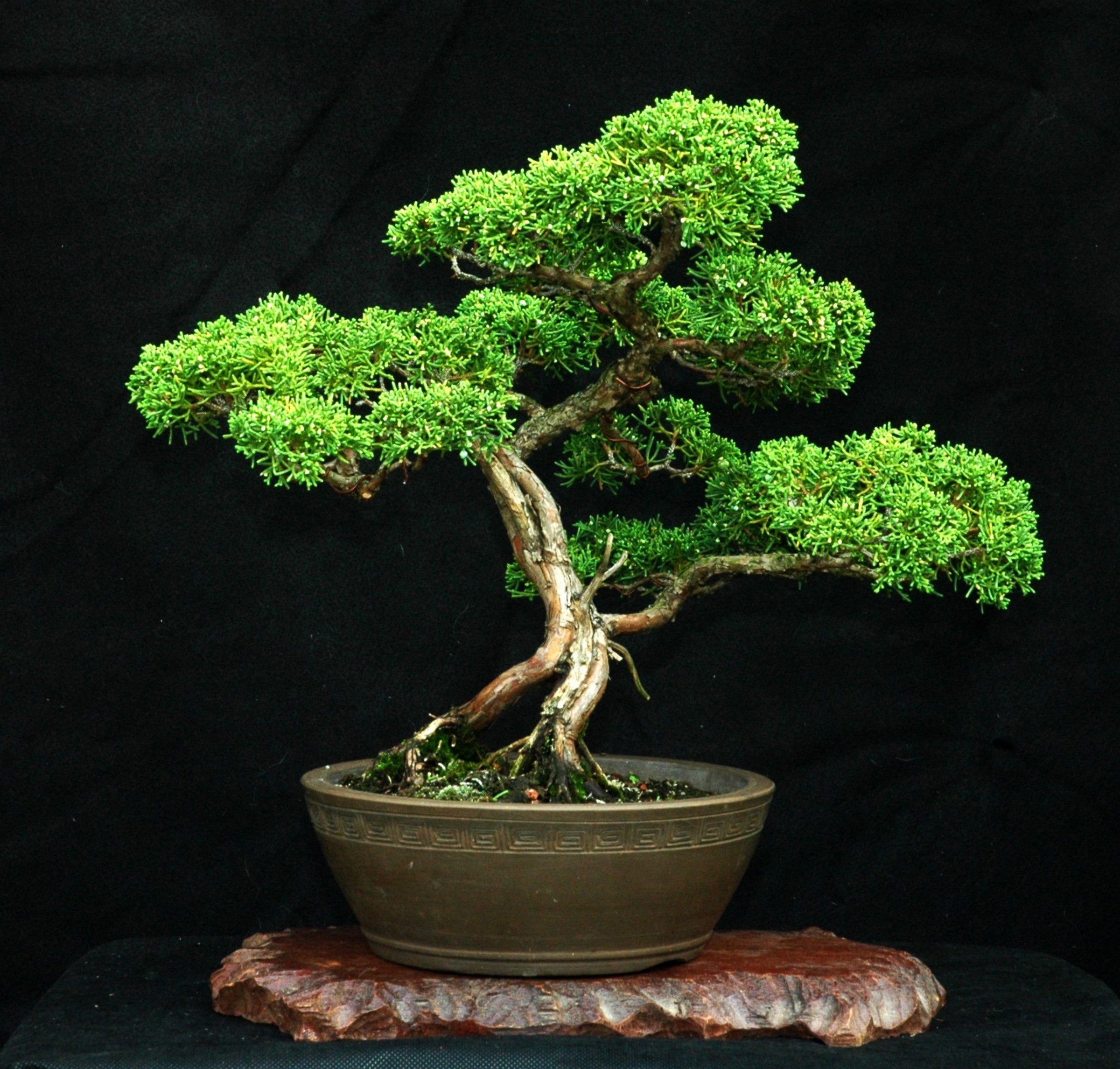
A local plant and garden center recently offered an introductory workshop on Bonsai, the Japanese and originally Chinese art of propagating and arranging miniature versions of living plants and trees. Upon registration for this workshop (and for a relatively modest fee), participants would be provided with a starter plant, a container for the project, and the basic tools and materials with which to begin their own Bonsai arrangement. With my childhood in Japan, and my interest in the arts, I jumped at the opportunity to learn some basic principles of Bonsai, an art which I have admired for many years. Nevertheless, I have been largely ignorant of the mechanics of this aesthetically-pleasing horticultural practice. Attending the workshop, I was not disappointed by the learning opportunity offered.
Upon going to our assigned places after arriving, each of us found a potted portulacaria afra, a succulent commonly called dwarf jade plant or elephant bush (photo below). We also found a glazed ceramic container, plant medium, and basic tools with which to create our first attempt at a genuine Bonsai arrangement. My potted starter plant was in a 6” plastic pot, about 18” – 24” in height, and root-bound in its container.

An example of portulacaria afra
Our first step in the process was to prepare the pot or container to receive the plant. I learned that the most useful plant containers have two drain holes, as well as two very small holes for upright wires. The photo below shows my pot after attaching the wires and screens.

Wires secure small mesh screens over drain holes, while a longer U-shaped wire emerges from below, to help secure the plant
Our next step was to remove the plant from its plastic pot, and determine where the upper primary roots lay. We were then asked to remove almost all of the former potting soil material (identified as pine bark mulch), and then to anticipate trimming the roots. Here, I found my first challenge. As an amateur gardener, disturbing the roots of a plant – much less removing the planting medium in which it has been nurtured – hit me as strongly counter-intuitive. Yet, this was actively encouraged.

A participant’s plant after removal of most of the original planting medium, before cutting extraneous roots
After initial preparation of the plant, we had our third challenge. This was to cut and shape the remaining exposed roots in such a way that the plant might sit well in the provided pot. The overall natural shape of the plant provided a starting point. But an aesthetic judgment was also needed for how this particular plant would best sit in this particular container. Here, I was beginning to discern how at first seemingly mysterious Bonsai practices become compelling to so many people. There appeared to be at least thirty or more participants in this workshop, on a Tuesday evening before the 4th of July!
So, how might my particular plant best fit in my provided pot?

How I situated my plant in the pot, secured by the upright wires
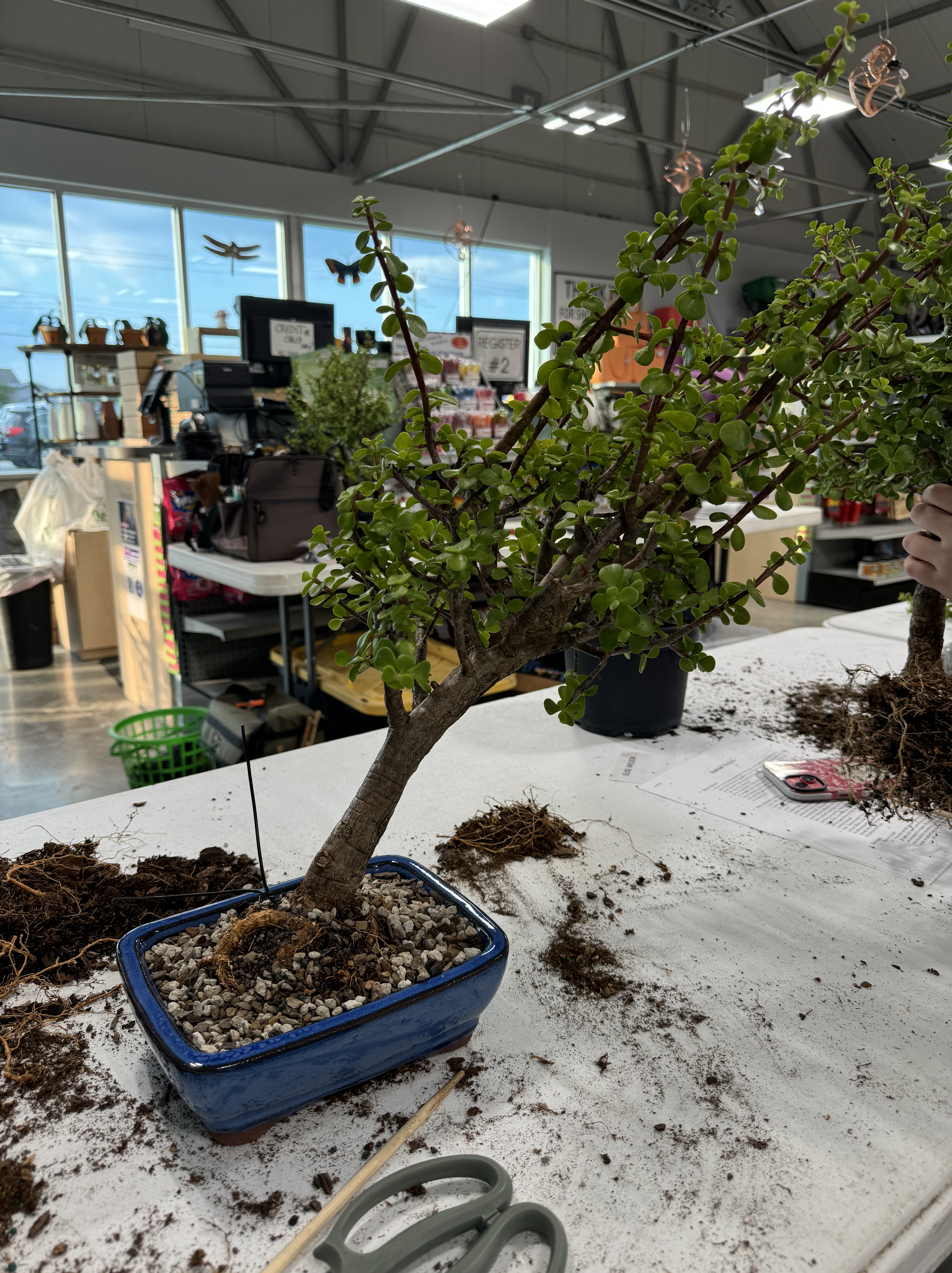
My plant before I trimmed the upper stems
Then came the most challenging aspect of Bonsai for me as a beginner. How should I trim the top of the plant, and to what extent should I prune back the stems and leaves? The main lesson I received here was this: do not be afraid of pruning!
Indeed, with the art of Bonsai, and apparently according to recognized horticultural principles, the more we prune our Bonsai plants, we will find a real diminishment in the size of the leaves as the organism grows!
Here, below, is a photo of my Bonsai plant project at home, after some significant pruning.
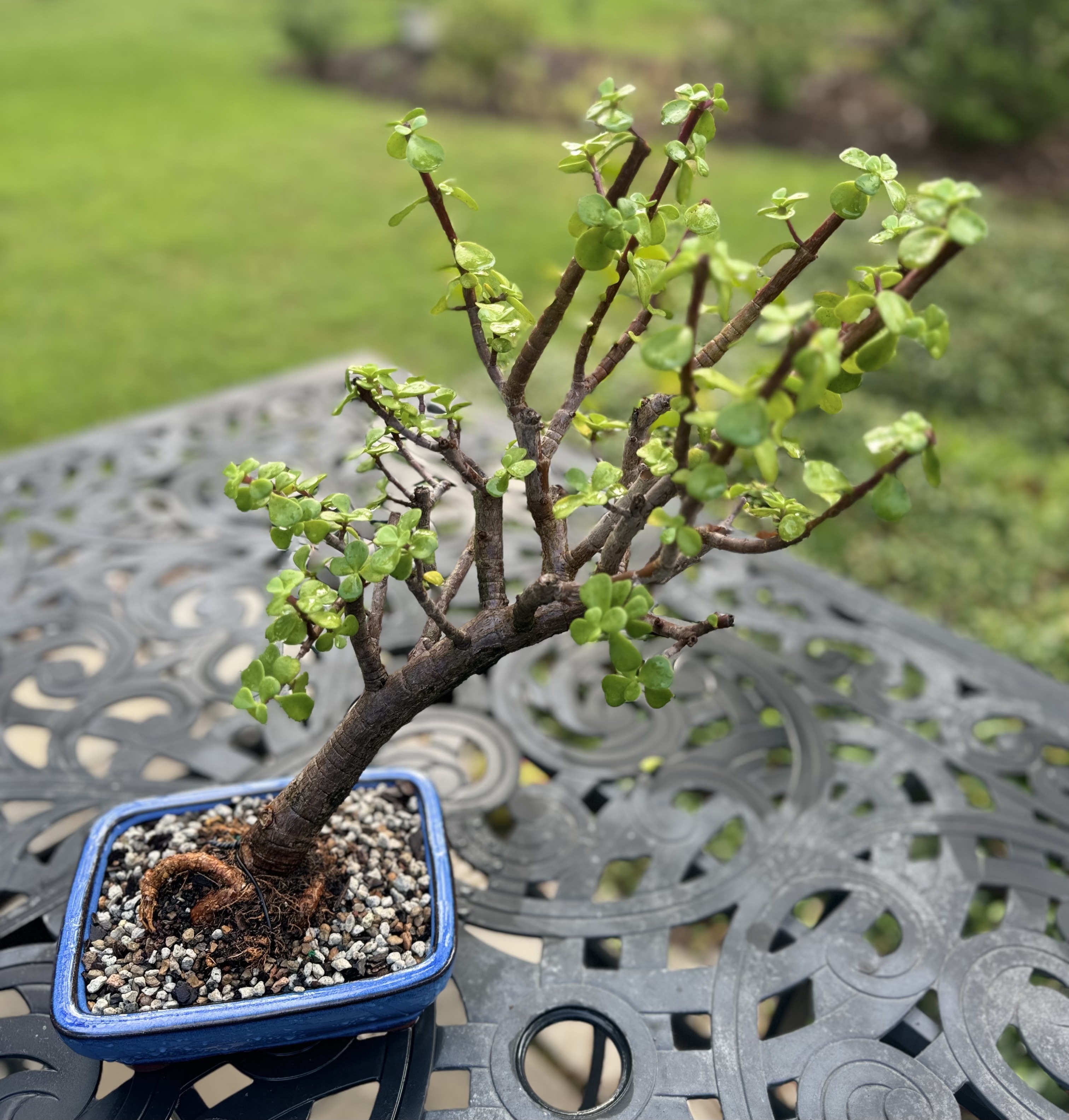
The ‘windswept’ natural posture of the potted plant appealed to me, and I want to accentuate this by continuing to allow for the lean of the plant (to the right, in this photo), while counter-balancing this lean by promoting growth toward the opposite direction. As my recent mentors stressed, pruning will be everything!
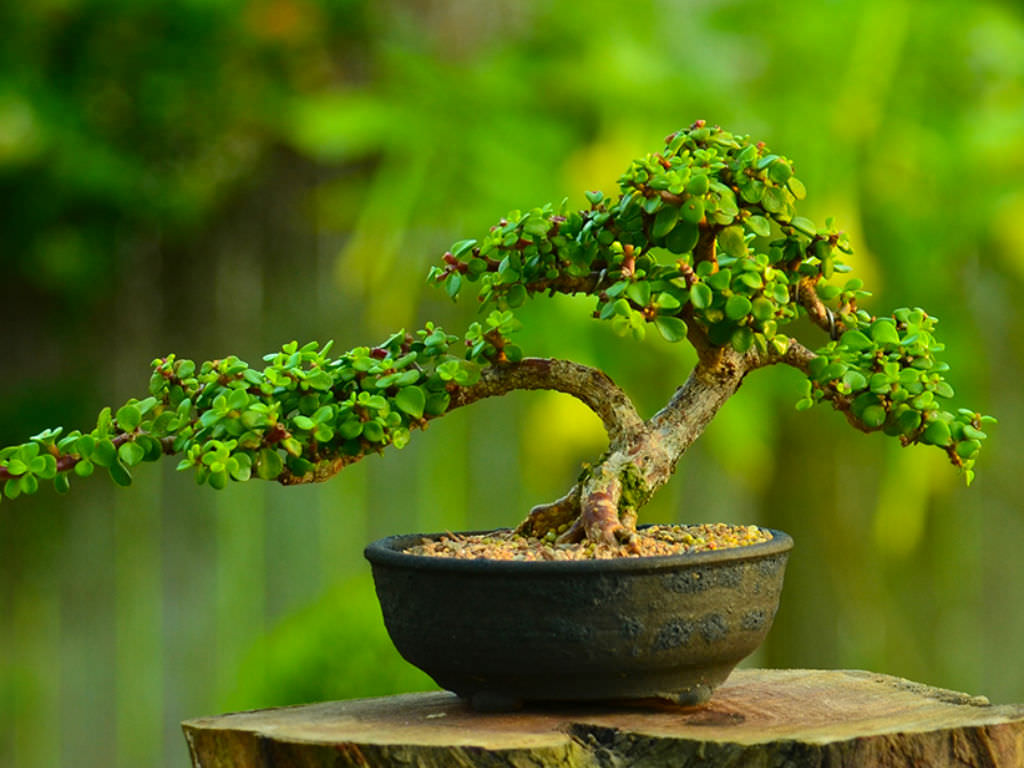
What my portulacaria afra might look like some day
Note: as mysterious as this art-form may seem to Westerners, it is accessible to beginners in terms of method, materials, and technique. Ask your local plant and garden store about it!
 Toward Beauty
It looks like I can finally leave a comment! Thanks for this post, Stephen! I’ve been entranced with bonsai for years but have never ‘taken the plunge!’ This might move me in the direction of action!❤️
I hope this does help move you in that direction. I think you will find it to be a very pleasing and peaceful activity, and much more ‘doable’ than it may seem at first!
Fascinating!!
Bruce
<
div>
Sent from my iPhone
<
div dir=”ltr”>
<
blockquote type=”cite”>
I think you would enjoy creating one of these!