James Tissot

Our Beauty in His Eyes

Art_Tissot_Brooklyn_Museum_-_What_Our_Lord_Saw_from_the_Cross_(Ce_que_voyait_Notre-Seigneur_sur_la_Croix)_360KB

We are accustomed to looking up at him on the cross. Good Friday may prompt us, at least for a moment, to allow a reverse in the direction of the gaze.

For we are the objects of his attention, and of his love. If we discern anything about the meaning of Holy week, and the events within it, it is this: He acted for us, and not for himself. And God was in him, as he did so.

James Tissot pictures Jesus’ view from the cross on that dark afternoon, two thousand years ago. Just below his feet, he saw Mary Magdalene, prostrate with grief, showing her love for him. Just behind her, cloaked in dark blue and white, is his mother, hand across her heart, experiencing the sorrow it had been predicted she would endure. And to the left of Mary, in Jesus’ vision, we see the beloved disciple, John, in a white outer cloak over a green tunic. These three, and the two others behind Mary, are sympathetic figures. They have come to be by him in his darkest hour.

Others in Jesus’ field of vision may vary in their sympathies with his suffering. The Roman soldier cloaked in red could be the centurion, about whom we read in the Passion narratives. Standing by the cross, Tissot depicts him with a pained look on his face. He is beginning to realize that Jesus was innocent of the charges brought against him. By contrast, the two other soldiers near him appear either puzzled or disgusted by the whole situation.

As we survey this scene portraying Jesus’ field of vision from the cross, we cannot miss the group of men on horseback in the middle-ground. They are Scribes or Sadducees, those with power and wealth in the city, who had argued for his crucifixion. Some are shown taunting him. Some appear self-satisfied. And at least one is looking up at the darkening sky, which is already putting the upper edge of the scene in shadow.

He has acted for all these people, and especially for the ones who have turned against him. He looks upon them with love, and with a plea for God’s forgiveness. He knows what is in people’s hearts. What we so often forget is that he knows us better than we know ourselves. We may not understand how he knows us; but we do know that he knows us. We know that he loves us. And this is enough.

This is not a time for us to ponder the unknowability of God. This is a time to focus on our vulnerability, and our total knowability in God’s eyes. It is a time in which to contemplate the complete self-revealing of God, by Christ, for us. And to remember that he did this on a cross.


James Tissot, What Our Lord Saw From the Cross. For a link to my Good Friday homily, from which this is adapted, please click here.
Revealing Glory

Art_Tissot_we-would-see-jesus-tissot


James Tissot was a successful French painter and illustrator, whose beautiful paintings of boats and ships I particularly admire. His earlier work reminds me of that of other 19th century high society painters like John Singer Sargent. In 1871, Tissot moved to London where he acquired a reputation for his paintings of elegant and fashionably-dressed women. The waiting room of his studio was remembered as always having a bottle of iced champagne available to callers.

Returning to Paris in 1885, Tissot exhibited 15 large paintings under the title of The Women of Paris. Like the work of other artists of the time, his paintings reflected the influence of Japanese prints. That same year, he experienced a re-conversion to the Roman Catholic Church, which transformed his life and his art.

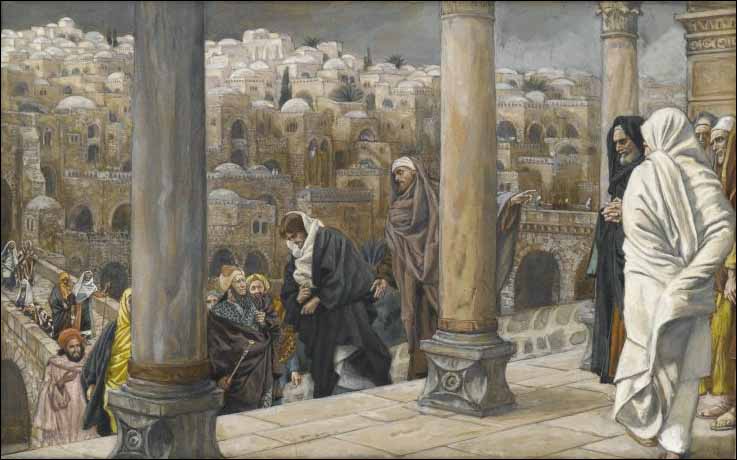
Some Greeks have come to Jerusalem for the Passover, and ask to see Jesus. Notice how Tissot portrays much more than the immediate scene of the conversation, displaying his immense interest in the history and archaeology of Jerusalem. He imagines the Greeks approaching on an arched causeway over the Tyropoeon valley, on the southwest side of the Temple Mount. They are walking up to what might have been the most dramatic entrance to the Temple. Finding a fellow visitor who speaks Greek, they tell Philip why they have come. “Sir,” they say; “we wish to see Jesus!”

Tissot portrays Jesus in his customary way, as a rabbi clothed in white, and the painting is faithful to the scene as John presents it. Tissot therefore does not show Jesus moving toward the inquiring Greeks. Instead, as John tells us, when he hears that the Greeks want to see him, Jesus responds to Philip and Andrew in a curiously indirect way. Drawing upon an image in the book of Daniel, he says, “the hour has come for the Son of Man to be glorified.” Jesus speaks of his death and his vocation, which he says is centered on God’s glorification.

Here, we begin to make sense of why Tissot portrays the Greek visitor’s arrival from Jesus’ perspective, from the vantage point on top of that southwest corner of the Temple Mount, looking out between Hellenic columns toward Mt. Zion. The occasion has deep significance, not just for Greek visitors. It has significance for all of Jerusalem, and everyone who has come for the great festival. And it has implications for the whole world, lying over and beyond the hills of this city. Here, on a dramatic high point on the Temple Mount, as Jesus stands in the place associated with God’s own glory, a voice from heaven speaks of his glorification. The Gentile foreigners whom he has drawn to himself are a sign, a sign of all those who will be drawn to him, when his glory is revealed on the cross.


James Tissot, “We Would See Jesus,” from his multi-volume, The Life of Christ. The Gospel passage to which this image refers is John 12:20-33. For a link to my Sunday homily, developing these themes, please click here.