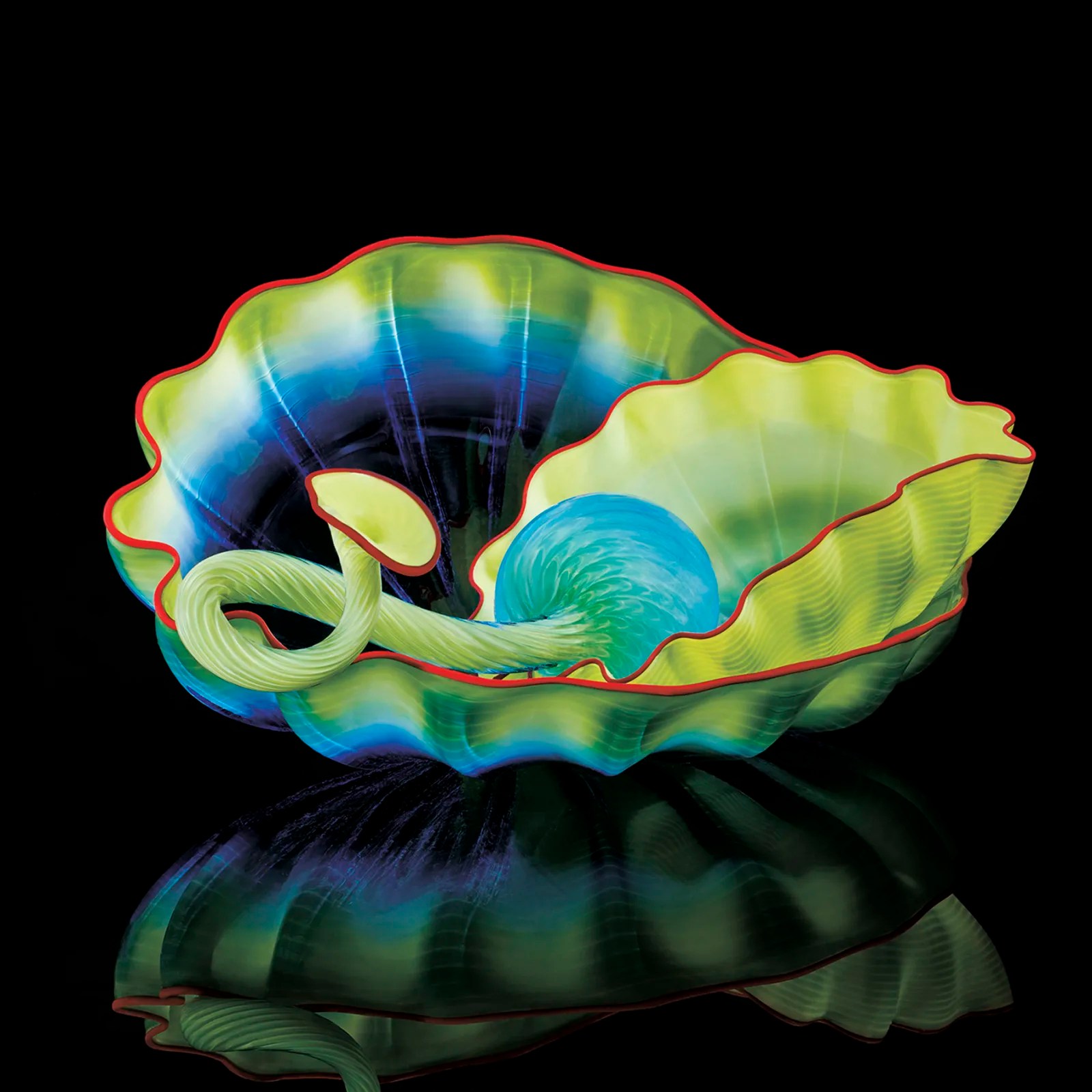
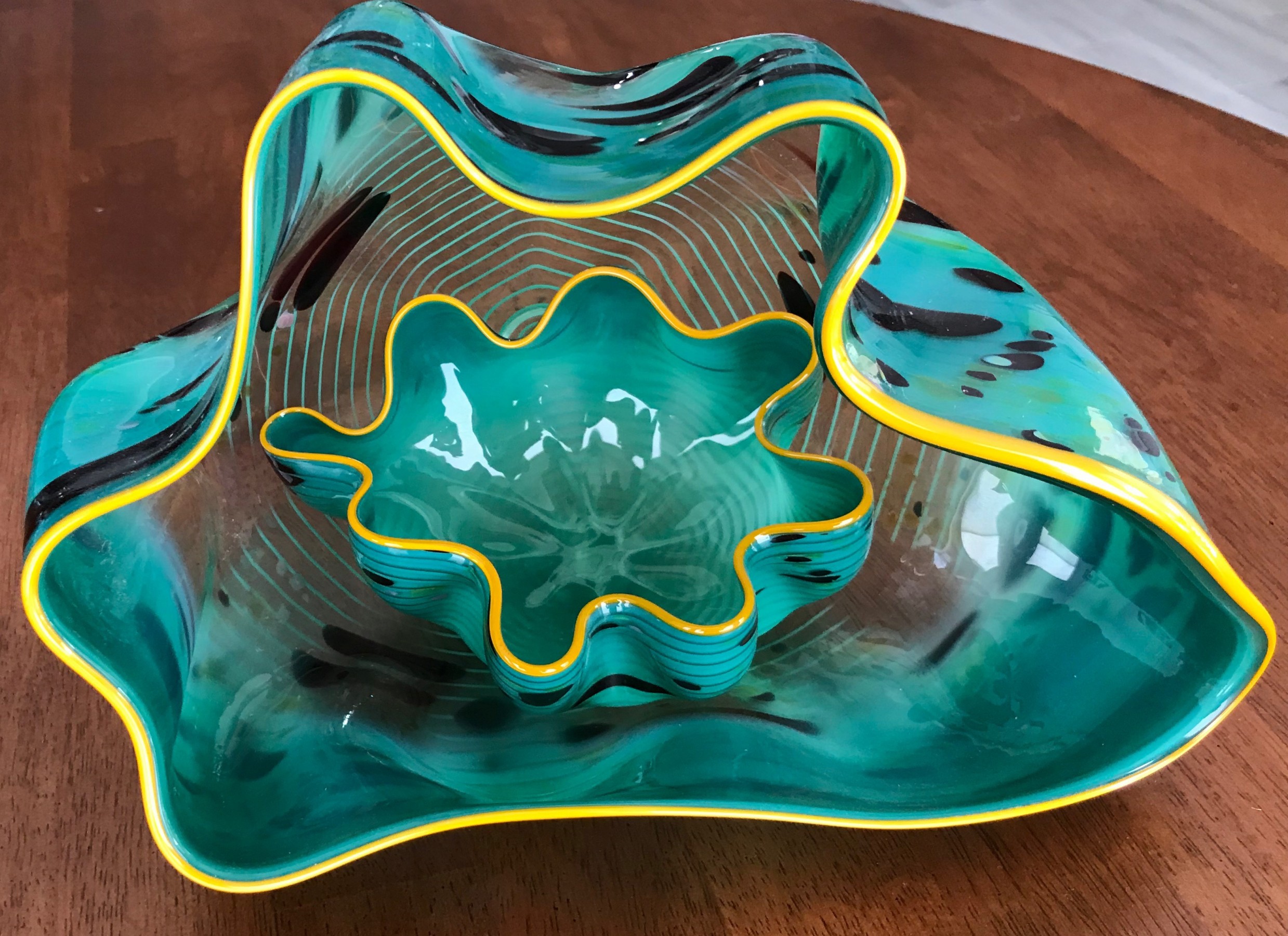
Dale Chihuly

Chihuly Garden & Glass ~ Seattle

[If reading this by email, please tap the title at the top to open your browser for the best experience. Then, clicking individual pictures will reveal higher resolution images.]


On a recent trip to Seattle I visited the Chihuly Garden & Glass exhibit at Seattle Center. This collection of Dale Chihuly’s glass work, which includes both large and small objects and installations, provides a splendid way to become familiar with what the artist has accomplished so far over the course of his career. The extensive exhibit gives the visitor an excellent introduction to the methods that Chihuly has employed when embarking upon various projects and insight about how he has revolutionized many aspects of contemporary glass making.

An initial large room contains a display of smaller Chihuly creations set within the context of a selection of his baskets and related objects from First Nations peoples, as well as an assemblage of his large framed photographic prints of Native American individuals by Edward Curtis.

A large gallery within the exhibit features Chihuly’s Mille Fiori (a thousand flowers in Italian), inspired by memories of his mother’s garden. An information panel indicates that the pieces in this installation, gathered from several series of his prior work, “rely less on tools and more on the use of fire, gravity and centrifugal force.”
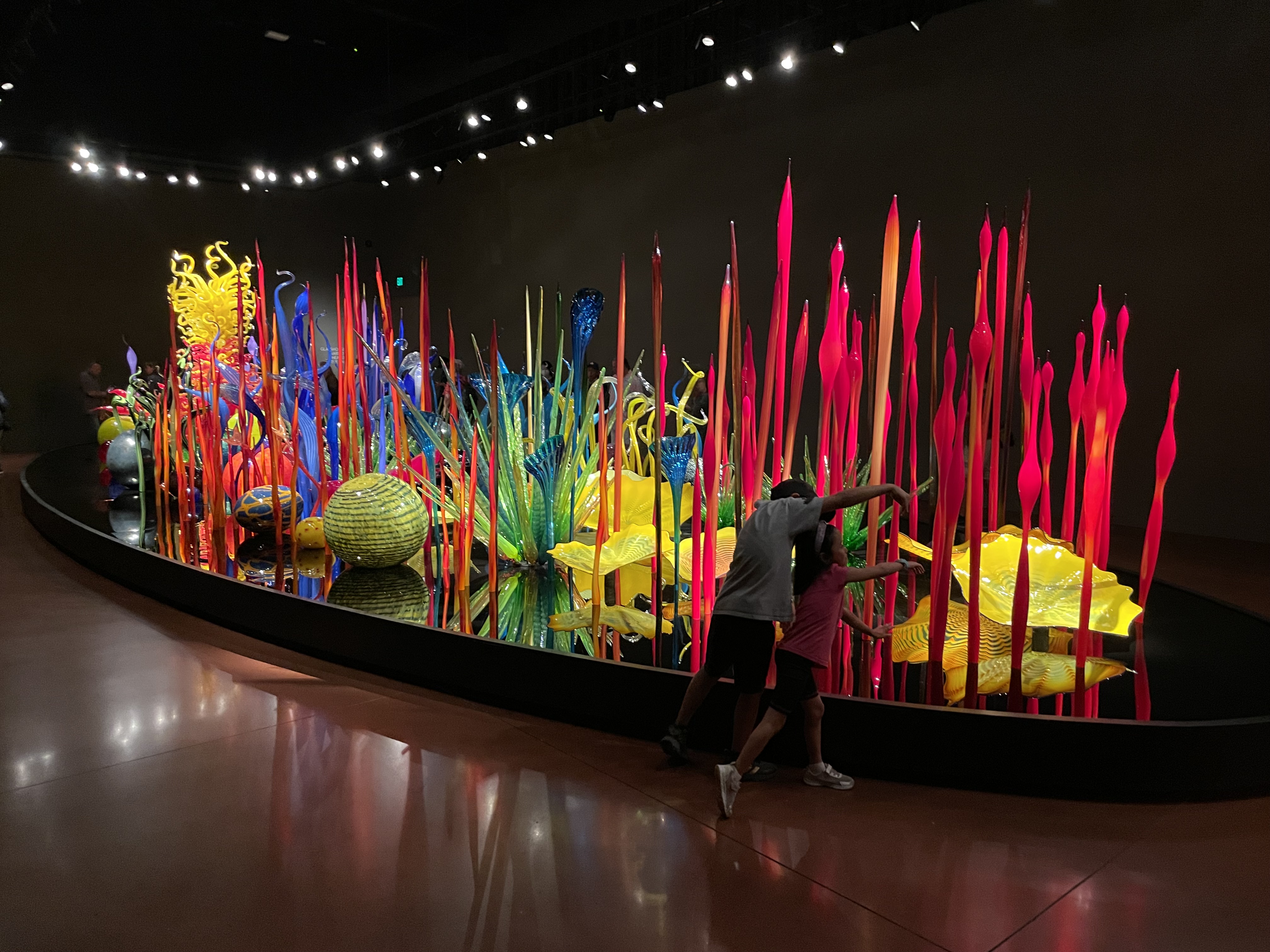
Two youngsters enjoying engagement with Mille Fiori while helping to provide us with an indication of the assemblage’s scale.

A display titled Ikebana and Float Boats is featured in a subsequent room. Having pursued glass making in Seattle and in Venice, both near significant bodies of water, Chihuly experimented with glass objects thrown into a river in Finland, where youth from the area in wooden boats helped retrieve them. Intrigued by the interaction between the objects, the light above, and the water below, the artist continued to develop these interests after traveling to the Japanese island of Niijima. There he became reacquainted with the glass globes traditionally employed by Japanese fishermen as floats for their nets, which he had first seen as a youth beach combing on Puget Sound. At the same time, Chihuly was inspired by the Japanese art of flower arranging, called Ikebana. He combined his interest in the glass globes with the inspiration provided by Ikebana and imaginatively adapted these forms within boat-shaped structures that have been displayed in galleries and upon ponds.

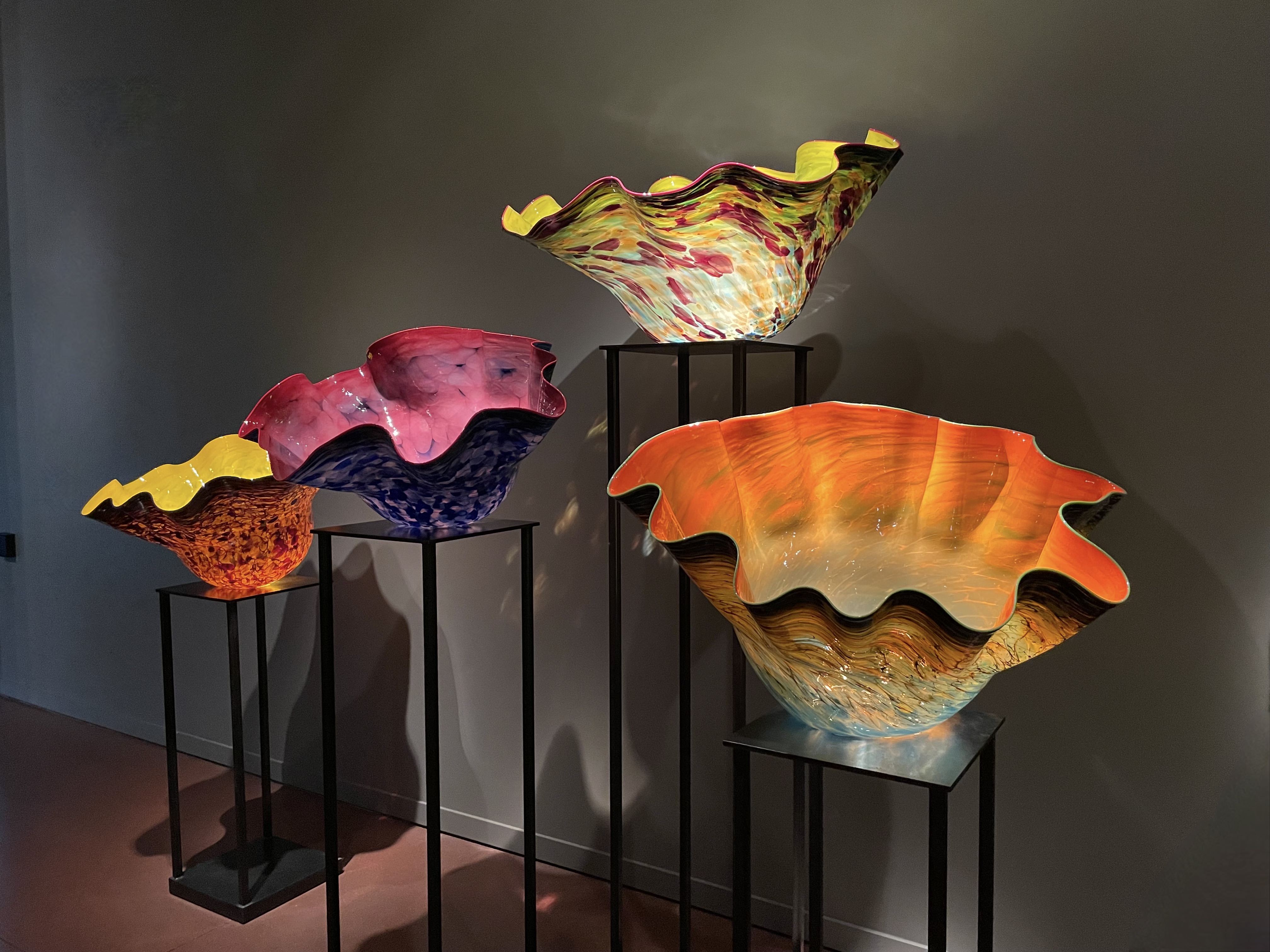
Another gallery space features large bowl-like objects from Chihuly’s Macchia series. As a guide at the Chihuly exhibit makes clear, no one has yet been able to produce a truly black form of glass. Yet, Chihuly has come close with his occasional use of very dark blue and purple. Through his Macchia series, he sought to incorporate every one of the other 300 colors that are available for glass making. Noticing that colors within stained glass windows often appear more alive when illuminated from behind by the diffused light of a bright cloudy sky, Chihuly began to experiment with including a white layer within objects between the inner and outer colored layers of glass. The presence of speckles and striations of additional colors results from when molten glass is rolled on a flat metal surface that has been sprinkled with multiple-colored bits of glass.
Near the end of a tour through the exhibit one finds a courtyard where an informative glassblowing demonstration is offered, which brings alive some of the challenges inherent in working with this medium.
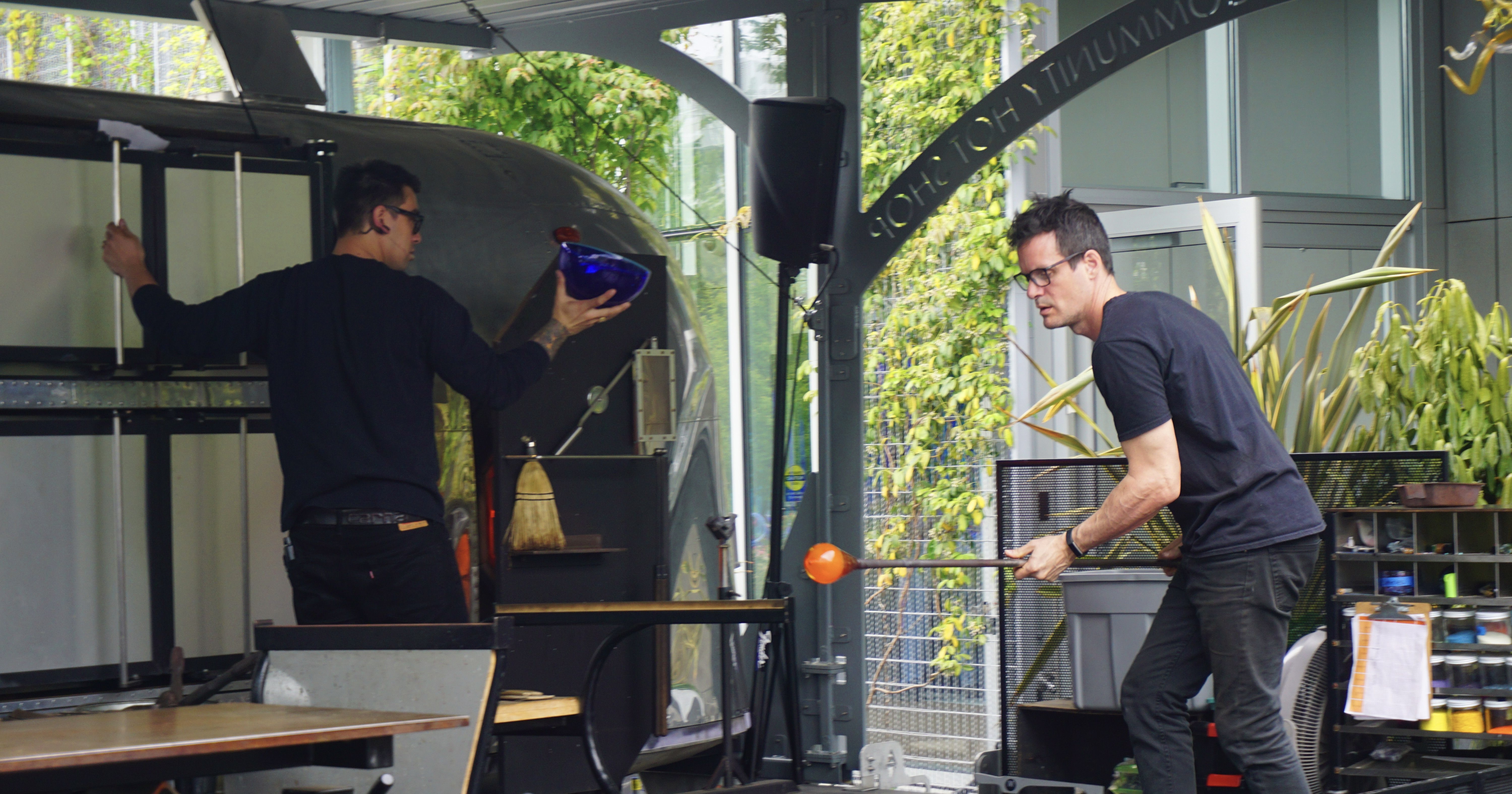
Chihuly Garden & Glass provides a lively sense of the remarkable extent of the artist’s output, and the breadth of his highly imaginative vision for what can be done with glass as an art form. The exhibit is well worth a visit for those able to travel to the Seattle area.

Chihuly’s Glass Installations

[If reading this by email, please tap the title at the top to open your browser for the best experience. Then, clicking individual pictures will reveal higher resolution images.]

Marine Blue and Citron Tower, by Dale Chihuly, installed in 2021 at Taliesin West, Arizona


The making of art glass, especially when glassblowing, begins with glass melted in a furnace heated to over 2,000 degrees f. by gas-powered flames. As the artist works with the material, additional quantities of glass shards are typically added to the furnace. The added glass may be clear or colored, especially when recycled glass is employed, and other ingredients can be added to achieve a desired hue or tint.

Once, when my glassblowing instructor was scooping shards of recycled material into the flames, he accidentally lost grip of the metal scoop, which fell into the molten glass. To his delight, this produced a most beautiful and unexpected yellow color in the subsequently formed glass objects. Of particular note in Chihuly’s work is the conjunction of multiple colors, and the agate-like striations involving both colored and clear portions of glass.


At the most basic level, glassblowing involves attaching a glob of molten glass to the end of a tube-like metal pipe, which is then spun while air is introduced into it. At first this creates a globe-shaped object. Spinning the material fixed to the pipe can have an effect like that of a spinning pottery wheel upon wet clay. In both cases, the material can be formed into a symmetrical mass. But it can also be spun out of shape into a mess.

Whereas hands are used in ceramics to do the primary shaping, with molten glass a number of tools are employed to achieve various effects. These include assorted molds which Chihuly and his assistants may use to produce the rippled edges in some of his finished pieces like those depicted below. Wooden paddles, tweezers, cutting shears, and a variety of other tools are used in the process of shaping the very hot glassware while it is being formed, sometimes pulling and stretching it, at other times changing its orientation by causing parts of a piece to turn in on themselves. All the while the glassware artist must periodically reintroduce the work in progress into the open end of the furnace, or apply a torch to its surface, so as to keep the material hot and malleable.

Lower image: A portion of Chihuly’s Persian Ceiling, lit from above

In recent years, Chihuly has become known for his sometimes massive installations of glass. These often involve a seemingly uncountable number of objects linked together by an upright frame, suspended from a rack, or cradled from below. Viewers might encounter these installations indoors where they are displayed as a chandelier might be hung, or placed in an outdoor setting.


With his artistic exploration of the possibilities inherent in the manipulation of molten glass, and by pushing the parameters of what conceivably may be accomplished through working with this medium, Chihuly has created a huge portfolio of truly remarkable work. Of note is the way that so many of his pieces simultaneously have a sophistication that appeals to specialists and collectors, while at the same time being works of art that bring delight and wonder to children as well as to those who may not credit themselves with being aesthetically aware or sensitive. Dale Chihuly has effectively devoted his career to helping others encounter and perceive beauty in new and unexpected ways.

Another Chihuly installation, Fire Amber Herons, at Frank Lloyd Wrights’ Taliesin West

Dale Chihuly and the Art of Glass

[If reading this by email, please tap the title at the top to open your browser for the best experience. Then, clicking individual pictures will reveal higher resolution images.]

Paprika Persian, by Dale Chihuly


Many of us associate glass as a material for art with beautiful stained glass windows, or with fine cut-glass objects. Yet, until the widespread impact of modern art, stained glass has most often been characterized by the two dimensional pictorial representation of biblical or historical figures and events. And decorative glass objects, especially when fashioned from clear leaded glass, have until recent times come largely in the form of functional vessels like vases and decanters.

The career of Dale Chihuly has coincided with a renewed interest in the artistic potential of glass when applied as a medium beyond the parameters associated with everyday objects. It was not until the second half of the twentieth century that many college and university art departments offered courses in and provided studios for work with glass beyond the design and making of windows, as well as for other materials such as fibers (e.g., weaving). This may have been due to a historic assumption that glassblowing and textiles, along with pottery, are best understood as being within the category of ‘crafts’ rather than as fine arts.

For these and other reasons, encountering the fruit of Chihuly’s longterm exploration of glass and its aesthetic possibilities can lead to an experience of stunning discovery. As we have seen regarding the evolution of David Shaner’s ceramics, Chihuly has moved far beyond producing beautiful but also utility-oriented objects, toward what may be more properly termed glass sculpture. Throughout the range of Chihuly’s work with glass we find a number of features that deserve to be noted. These include his appreciation for the capacity of color, form, texture, arrangement of parts, and scale to evoke interest and delight.

Capri Blue Seaform

Seagrass Seaform

Chihuly’s use of color immediately captures our attention as we view his work. Unlike the challenge faced by those who draw or paint, where choosing and mixing color is a more direct process, color selection and its manipulation within molten glass is more complicated. In glass making, as it is for ceramicists who work with glazes, the artist must attend, at least at a basic level, to some chemistry, the physical plasticity of the material, and be open to chance regarding both.

Another noteworthy feature of Chihuly’s glassware is his intentional inclusion of areas of opacity, translucence, and transparency. With all three of these variables, his manipulation of surface reflectivity – a property often associated with high quality glass – deepens our appreciation for his work. He achieves beautiful effects when he allows these differing aspects of his materials to appear adjacent to one another in the same finished pieces. I find this to be especially apparent in the two pieces depicted immediately below.

Two sculptural glass works by Dale Chihuly (name and date uncertain)

An additional feature of Chihuly’s mature glass work is the variability of the form and of the shape of the objects he has created. As the artist’s portfolio has expanded with the development of his career, he has moved well beyond the pursuit of symmetry, practical utility, and manageable size, with regard to the items he has fashioned. This is especially true of the large scale installations to be featured in a subsequent post.

Given all this, the name Chihuly has become synonymous with paradigm-shifting glasswork that is vibrant and joyfully attractive.

Dale Chihuly with one of his large glass installations in the background