Uncategorized

The Beauty of Her Gaze


Henry Moore was perhaps the most well-known British sculptor of the 20th century. As happened with some American artists during WWII, Moore was engaged to use his artistic skills as part of his nation’s war effort. His drawings of people sheltering in the London Tube tunnels during the bombing were compelling. And they had a great effect on a certain priest who was considering commissioning a sculpture. In particular, Henry Moore’s way of depicting mothers holding their children struck this priest as indicating a great sensitivity. This led him to hire Moore to carve a large stone Madonna and Child for St. Matthew’s, Northampton.

Though Henry Moore was not a practicing Christian, he was rather thoughtful about the spiritual dimension of this important commission. He was already making sculptures in a modern manner tending toward abstraction (see his St. Paul’s Cathedral, London, Mother and Child). And yet, he knew that this piece had in some way to be different. At the time, he wrote that, unlike secular sculpture, this piece “could not be too abstract or it would have forgone the traditional deep meaning of the subject.” Here is how he described his thinking about the project:

I began thinking of the ‘Madonna and Child’ for St Matthew’s by considering in what ways a Madonna and Child differs from a carving of just a ‘Mother and Child’ – that is by considering how in my opinion religious art differs from secular art. It’s not easy to describe in words what this difference is, except by saying in general terms that the ‘Madonna and Child’ should have an austerity and a nobility and some touch of grandeur (even hieratic {or ‘priestly’} aloofness), which is missing in the ‘everyday’ Mother and Child idea.

Humanly accessible, and yet spiritually apart, might be another way of capturing Henry Moore’s thought here. Like some other artists, Moore achieves this human accessibility by building upon an important strand of Christian spirituality. Mary provides and becomes our human connection with the incarnate Holy One. In this sense, Mary is not only the mother of our Lord, but also the mother of our faith. Look at her posture, in this photo of Moore’s sculpture. As I understand it, a person walking forward seeking to view this work up close, advances along an aisle that is to the side of the sculpture. And so, Mary’s face and gaze engage the approaching viewer. This connection is therefore established before the visitor stands face to face with the representation of the Christ child. To extend this idea, the Church as our mother, engages and upholds us as we approach the mystery of Mary’s God-given child.


This post is based on my homily for the First Sunday After Christmas, December 30, 2018, which can be accessed by clicking here.  Other homilies of mine may be accessed by clicking here. The Revised Common Lectionary, which specifies the readings for Sundays and other Holy Days, can be accessed by clicking here.

The Beauty of the Nativity


Christmas celebrates how, through Jesus’ visitation and by his presence within us, our Lord joins us. With him we are changed from all that is merely human, toward being more than simply human. He transforms us beyond the limits of what we presently know. And he fulfills the potential that our loving God has placed within us. This is why we gather to celebrate the Nativity on what is often a day other than Sunday. Because we yearn for more.

St. Francis of Assisi figured this out long ago. In what some mistakenly call the ‘dark ages,’ he perceived a light-filled truth. Blessed Francis figured out that every one of us, educated or uneducated, rich like his father or poor like himself… that every one of us needs something. We need not only to hear The Great Story at some point in our lives. We need to hear The Story over and over again. And not only hear it, but also see it. And when we hear and see the story again and again, its truth has great power to overcome our spiritual deafness and blindness, and soak into our dry hearts and minds. It is to blessed Francis that we owe having nativity scenes in our churches and homes. And it is to Francis that we owe including nativity ‘plays’ in our liturgy at Christmas. Christmas is all about how the great thing that we seek has come near, into our midst, available to our experience.

In the painting above, James Tissot has beautifully captured St. Francis’ insight about the nativity scene. Notice how unearthly light radiates outward from the holy child. At the bidding of angels, lowly shepherds have come looking for him. What joy warms their hearts in this fulfillment of their search ~ the same fulfillment we can find for our own unceasing search. Their joy can be ours, as we reflect on what we hope for by our celebration of Jesus’ birth.

The Great One who was, and is, and is to come, is here! He is here in love because he will always be with us. As the Gospels promise, we find in the Nativity the fulfillment of our abiding human desire ~ our desire for true meaning and purpose, and lasting love. We discover it in God’s self-revealing, and in the manifestation of the Spirit’s presence. Paradoxically, we find God’s presence in the most vulnerable form of human presence ~ in a baby born in the filth of a stable, where animals are brought in from the harsh and inhospitable winter fields around us.

And so, our Christmas discovery begins when we acknowledge that we yearn for more than what we apprehend every day. In the face of Jesus, we meet the fulfillment of our yearning. For in him we find abiding love, true meaning and purpose.


This post is based on my homily for Christmas Eve, December 1624 2018, which can be accessed by clicking here.  Other homilies of mine may be accessed by clicking here. The Revised Common Lectionary, which specifies the readings for Sundays and other Holy Days, can be accessed by clicking here.

The Paradoxical Beauty of Hope


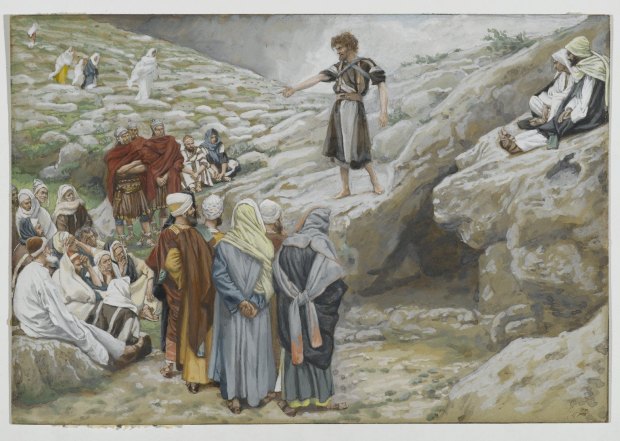
As all four Gospels attest, John the Baptizer’s ministry occurs in the wilderness around the Jordan River. This requires people to go out to him. James Tissot’s painting of the scene nicely captures the drama of their interaction. For as the artist depicts, people do not casually encounter John in the public square or marketplace, but out in a barren region to which they deliberately have to travel. Therefore, in addition to those who have come out with malice, many journey to John with a genuine curiosity and a sincere spirit of inquiry.

Luke reports how John greets these people in an apparently hostile way: “You brood of vipers! Who warned you to flee the wrath to come?” As we see in the painting, among them are various officials and soldiers. Surprisingly, they don’t turn and leave when they perceive the prophet’s scorn. Instead, they respond with a question: “What then should we do?” To which John responds with concise, practical —but also unexpected— advice. He does not tell the tax collectors to stop serving the infidel foreign regime occupying their historic lands. Nor does John tell the soldiers to abandon their compromised relationship with the Roman-supported local authorities. Instead, he counsels them on how to behave ethically, while they remain in their present roles! Astonishing!

And John says all this in the context of predicting the Coming One, the one who will baptize with the Holy Spirit and with fire. This will be the true Messiah, who will manifest his vocation by wielding a “winnowing fork in his hand.” He will “clear the threshing floor and… gather the wheat into his granary; [while] the chaff he will burn with unquenchable fire.” Paradoxically, Luke refers to these dramatic and threatening predictions as the proclamation of good news.

The appointed Lectionary readings from Paul and Luke, for the third Sunday of Advent, complement a reading from Zephaniah. For the prophet speaks of “the king of Israel, the Lord” who is in our midst ~ “a warrior who gives victory,” and who renews us in his love. Zephaniah urges us to rejoice, and not to fear, while he points to the implications of God’s mission for the world. Prefiguring Paul’s later words in Philippians 4, which encourage us to rejoice and not fear anything, Zephaniah challenges us to practice the virtue of hope. Like faith and charitable love, hope is a gift of the Holy Spirit. Though it is a gift, we need to put it into practice. Hope, faith and charitable love are therefore more than feelings, more than passing sentiments. And we should expect to see these beautiful signs of the Spirit’s movement in our churches. We notice them as we are lifted up by a rising tide ~ the rising tide of the Holy Spirit’s presence in our midst.


This post is based on my homily for Advent 3, December 16, 2018, which can be accessed by clicking here.  Other homilies of mine may be accessed by clicking here. The Revised Common Lectionary, which specifies the readings for Sundays and other Holy Days, can be accessed by clicking here.

The Beauty of Tides


I have recently been re-reading the Napoleonic era seafaring novels of Patrick O’Brian. Though there are 21 of them, for some of us, they are read all too quickly. You may remember the Russell Crowe movie, Master and Commander, which was based on the series. A frequent theme in these books concerns the flow of the tide, and how the tide waits for no one. Because we don’t control the tide, it behooves us to live in accord with it. Where waters are tidal, sea levels rise and fall every day. An incoming tide is a rising tide, and an outgoing tide is falling one. Back in the days of sailing ships, a vessel heading for the high seas would float out on a falling tide, carrying the ship with it. On the other hand, a returning ship, when entering a harbor, would be carried in on a rising tide.

This example of tides provides a metaphor for phases in the life of a church. At my own parish, we have been experiencing a time of significant change. For churches, change can be measured in different ways ~ in the number of members, the average attendance, or by donor giving levels. Other things are harder to measure, like spiritual growth. Consistent with the patterns of nature, many churches experience the equivalent of both rising and falling tides. And like the patterns of nature, they involve factors beyond our control.

Advent provides a helpful reference point for considering these variables. Advent means that something is arriving, appearing or emerging. For with Advent, a new church year arrives. We hear Gospel-beginning narratives about the appearing of John the Baptizer. And we hear about the Son of Man coming at the end of time, and his revealing of the fullness of God’s Kingdom. In every Gospel, John the Baptizer plays a key role in the arrival of God’s long-awaited glory. Given these positive Advent themes, we can associate this season of promise with a rising, or incoming tide. We are, as it were, flowing in to a harbor of hope.

The photographer Dewitt Jones teaches that the times of greatest change are also the times of greatest potential. And so, we have a choice about how we see things. For change can mean a gain, just as much as it can mean a loss. So, do we focus on the change that is from something in the past? Or do we focus on the change that is to something ahead? In other words —and relevant to my own parish as well as many others— do we see our churches riding a receding tide, measured by factors like a decrease in membership and attendance? Or, do we see ourselves being lifted by an incoming tide, measured by rising giving and spiritual growth? These are among our most important questions.


This post is based on my homily for Advent 2, December 9, 2018, which can be accessed by clicking here.  Other homilies of mine may be accessed by clicking here. The photos above are used under the Creative Commons Attribution-Share Alike 3.0 Unported license, the source for which can be found by clicking here. Dewitt Jones’ work can be accessed by clicking here.
The Beauty of His Return


Here we see a remarkable painting by Richard Mudariki. He is a black African, born in Zimbabwe, who later moved to South Africa. His painting is titled, The Last Judgement (2013), and it is obviously indebted to its namesake mural by Michelangelo. Yet, given the recognizable figures Mudariki has portrayed, his painting is obviously political in its conception. With this particular content, his title may seem ironic or even cynical. Especially because the painting diverges from recognizable biblical imagery, and appears to deviate from traditional Christian doctrine. And yet, if this is how we perceive it, our response may be based on an unexamined assumption. For when we think about the Last Judgement, and what it calls to account, we may have too narrow a starting point. Because our ‘final accounting before God’ will be about much more than simply our personal sins and private shortcomings.

At first it seems incongruous for the artist to portray Nelson Mandela in the central position where, following Michelangelo, we expect to see our Lord. The image of Queen Elizabeth, next to him, compounds our surprise. She has been placed in the position given to Mary, the Lord’s mother, in Michelangelo’s famous mural. Here, once again, our assumptions may be getting in the way. Whereas Michelangelo, following the tradition, set out to depict the entirety of the Last Judgement, Richard Mudariki is exploring a more limited and symbolic aspect of it. His rationale for portraying the scene in this way, may become clearer to us by considering a historical approach to the liturgy of Christian burial.

The casket of a priest is brought into a church for a funeral in a markedly different way from how a lay person’s casket is brought in. A lay person’s body is brought in feet first. So his or her body is poised facing liturgical east ~ the direction of the resurrection and Christ ‘s return at the end of time. But a priest ‘s body is brought in head first. This symbolizes how, at the second coming and the Final Judgement, priests face their people. This models our accountability, not only to our Lord but also to our people, whose spiritual care has been entrusted to us. Therefore, symbolically, we face them, rather than our Lord, at the Last Judgment.

And so, according to this interpretation, recognizable political and religious figures like Nelson Mandela, Mother Teresa and Archbishop Tutu face us, the viewers of this painting. They all may appear worthy in our eyes. Yet, also facing us are upside-down figures like Adolf Hitler and, perhaps surprisingly, Margaret Thatcher. They are depicted as descending to be among the damned, when the final trumpets are blown, to be in the company of Che Guevara and Mao Tse Tung. In their affirmation or in their condemnation, all these figures face us because of the ‘ministry’ of public leadership that was entrusted to them.


This post is based on my homily for Advent 1, December 2, 2018, which can be accessed by clicking here.  Other homilies of mine may be accessed by clicking here.
The Beauty of Christ the King


The glorious authority of Christ the King is beautifully portrayed in the Ghent Altarpiece, by Van Eyck, among the greatest works of European art. We see the one who sacrificed himself, by becoming like a lamb led to slaughter. The “mystic lamb” is now sovereign over the cosmos, with the crowns of this world’s kings at his feet. Robed in what Charles Wesley called “dreadful majesty,” he now blesses the world with his upheld hand.

Believing in Christ the King involves believing not only that we are presently one with him, in the Spirit. It also involves believing that he will come again in glory. For he will bring to completion and fulfillment –in our experience– all that he accomplished through his death, resurrection and ascension. Drawing again upon Charles Wesley’s paraphrase of Revelation 1, it means believing that when “Christ the Lord returns to reign, [e]very eye shall… behold him…; [even] those who set at nought and sold him, pierced and nailed him to the tree.”

We may be tempted to lament that we do not see him now, and that we have to wait. But we do see him ~ in the ways that he has chosen to reveal himself ~ in ourselves and in each other. Most especially, we see him in the sacrament of the Eucharist, our foretaste of the full revealing of his glory.

Now, to call Christ the “King,” and to say that “he shall come again,” may seem like abstract statements, disconnected from our lives. Yet, we can ask a question that makes these statements concrete. Let’s ask ourselves this: who reigns, or who exercises sovereignty over my life? Who is truly king of my life, every day? In principle, we may say that it is Jesus. But in practice, it’s not so simple. For the answer about who really functions as king in my life, is not likely to be him, but me! In other words, Christ may be King. But I act and live like the kind of prideful prince who can’t wait to take over, and who behaves as if he already has.

And so we need to remember this: in principle, God has crowned Christ as King, and will never dethrone him. Yet, in practice, we are able to push Christ aside from sovereignty over our lives, or at least ignore his power. At the same time, since he is already Christ the King, we can honor him as sovereign over ourselves. His glory then replenishes our poverty of spirit, and transforms the emptiness of our virtue. In the process, the reality of his kingship does not change. Yet the actuality of his meaning for us grows profoundly, every day.


This post is based on my homily for the Feast of Christ the King, November 25, 2018, which can be accessed by clicking here.  Other homilies of mine may be accessed by clicking here.

The Beauty of Being Within God’s Loving Regard


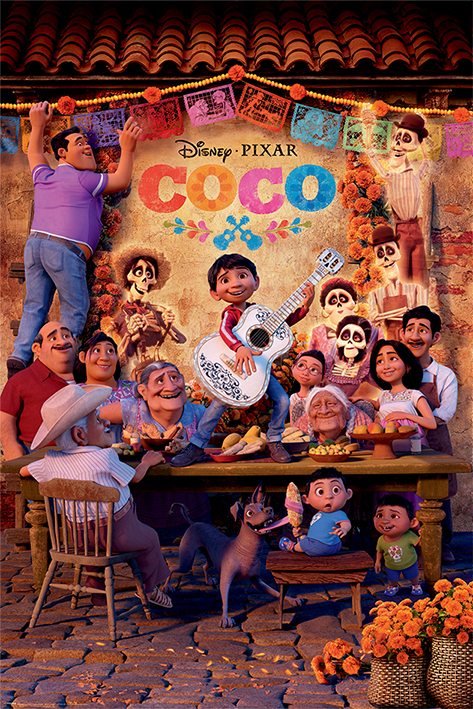
Recently, a friend suggested that I watch the Disney Pixar film, Coco. He commended it because the movie connects directly with the celebration of the great feast of All Saints. Coco also bears upon our observance of All Soul’s Day and All Hallow’s Eve (or Halloween). The movie is set in a traditional Mexican village on the eve of All Saints. In Latin America, and especially in Mexican culture, this feast is traditionally called Día de Muertos, or the Day of the Dead. At the heart of the film, and at the center of All Saints, is a reality ~ the reality of our continuing fellowship and communion with those who have died and gone before us. This is why, in the revised Lectionary, the readings for All Saints are among those also designated for funerals.

Coco draws us into recognizing how myths, whether ancient or modern, powerfully present truths we already know. We find this, of course, in the opening chapters of Genesis. But we also find how myths play a role in our secular culture. We are enchanted by narrative, and charmed by stunning visual imagery. And we are touched when we are reminded by how family and community relationships shape us. Yet, to refer to biblical and other stories as involving myth, we need to be very clear that the power of myth depends upon the power of truth. {In effect, not all myths are ‘real;’ not all news conveys ‘truth‘}. And so, because human connections are real in our life experience, we are moved by representations of them in ancient Scriptures, as well as in modern literature and the visual arts. What is true, has always been true.

And what surely has always been true, for the peoples of the world, is this: we do not want to be alone. We do not want to be separated from our families and our friends. And if either family or friends, or both, have been hurtful to us, we still yearn for ideal examples of them —especially when hopeful images of these relationships give us strength to hold our current experience to account.

So, if we don’t want to be separated from our families and friends, we also yearn for a connection with our heritage. We value the history of our family and our many forebears, as well as of our communities. Coco the movie plays upon this wonderful aspect of our human experience.

And yet, while commending Coco, I do not think we should accept uncritically every aspect of this delightful film’s story. For Coco contains a notable divergence from traditional Judaism and Christianity. The movie portrays —as being central to the observance of the Day of the Dead— a particular belief. It is this ~ that, if we are not remembered by others, we cease to exist. Yet, as faithful Christians and Jews believe, we are always known and remembered by God, even if our family or our community forgets us! Even if we cease to exist for them, we never cease to exist in God’s loving regard for us.


This post is based on my homily for All Saints Sunday, November 4, 2018, which can be accessed by clicking here. The image above is an image found on the internet related to promotion of the film, CocoOther homilies of mine may be accessed by clicking here.

The Beauty of What He Would Do For Us


Here we see James Tissot’s marvelous painting of a Gospel scene, which portrays Matthew’s telling of the story. Matthew mentions two blind men calling out to Jesus. Yet, Mark chooses to focus on just one of them, whom he names as Bartimaeus. But the scene largely remains the same in both Gospels. Jesus and his followers are in Jericho, on their way up to Jerusalem. They are approaching his triumphal entry into the Holy City on what we now call Palm Sunday.

I like to think of the man on the right, in this painting, as Bartimaeus, who –as Mark suggests– lost his sight at an earlier point in his life. Tissot depicts the other man’s eyes as covered, in the way that some sight-impaired people wear sunglasses. Perhaps that other man had been blind from birth. If so, He provides a contrast to Bartimaeus. Noticing this may help us appreciate the symbolic dimension of blindness and sight at the center of Mark’s Gospel. And it will help us attend to his deeper meaning. For Bartimaeus had sight earlier in life and then lost it. Now, when encountering Jesus, his ability to see is restored.

Let’s recall how, in the immediately prior story in Mark, James and John act pridefully when approaching Jesus. Do you remember the question Jesus asked them? He asked James and John, “What do you want me to do for you?”

It’s no coincidence then, that Mark, in his follow-on story, records what Jesus asks blind Bartimaeus. It’s the same question: “what do you want me to do for you?” As Mark presents the two successive and paired stories, I wonder if we perceive the parallel between them. First, we hear James and John blindly ask Jesus to share in his glory. When answering the two spiritually-unseeing disciples, Jesus provides a forceful correction, if not also a rebuke. Then, in the following story, when Bartimaeus perceptively asks for the recovery of his sight, Jesus responds mercifully to the physically blind man.

This tells us something rather important. For if we talk to our Lord at all, like the disciples we probably make requests of him. And, what we ask Jesus to do may, or may not, be in accord with his will for us; and it may not fit with God’s plans for us. James and John asked for something that diminished their experience of participating in God’s Kingdom. Whereas Bartimaeus asked for something that opened up the fullness of the Kingdom. And, it made him “well.”

We can then draw out the implications of this contrast. Because Jesus is not just ‘the answer to all our questions.’ Jesus also acts as ‘the question who prompts our best answers.’

In other words, Jesus asks us the same question: What do you want me to do for you? This could be his most challenging question to us as the people of God, and not just to us as individuals! So then, if we could ask him for only one thing, what would it be?


This post is based on my homily for Sunday, October 28, 2018, which can be accessed by clicking here. The image above is James Tissot’s painting, titled The Two Blind Men at JerichoOther homilies of mine may be accessed by clicking here.


The Unexpected Beauty of Ransom


In late 1987, two American college students were exploring the jungles of Columbia. After obtaining a canoe, they embarked upon the Putumayo River and strayed into territory held by a Marxist rebel army. Formally known as FARC, these guerrilla soldiers abducted the students and held them captive for ten months in various jungle camps. By chance, I met the parents of one of them about a month after their capture.

At first, the FARC guerrillas thought the two men were CIA agents, though the students soon corrected this. But then their captors came to see them as hostages with economic value. Soon, their parents hired an American explorer, who found the hostages and their captors. After four months of negotiations, conducted by a Roman Catholic bishop, the students were released and taken to the American Embassy in Bogata.

For privacy and security, the family did not publicize the terms of release for the young explorers. But I believe it involved the payment of money, probably a lot of it. Ransom is a way to describe this kind of payment, where something valuable is exchanged for the freedom of captives. I have included here a copy of John Everett Millais’ painting, The Ransom. In it, we see an artist’s rendering of this kind of exchange, where a father hands over of fistful of jewelry to some men who have taken his daughters hostage. Revolutionaries and criminals have long used ransom as an efficient means of fund-raising, especially when their captives come from wealthy families or are politically well-connected. Google “hostage ransom” and you will find numerous cases.

Clearly, when payments are made to captors, the purpose is not to honor or reward the hostage-takers, even if providing money reinforces the logic of hostage-taking. Instead, these payments reflect an abiding concern for those who are held captive, awaiting redemption. We find another example of this in the ransom of the journalist, Amanda Lindhout, who was kidnapped in Somalia in 2008. The owner of the Calgary Flames hockey team, who did not know Amanda, was moved to pay around $750,000 to secure her freedom.

These contemporary examples of ransom are from a secular context. Yet, the concept of ransom is deeply rooted in our Judeo-Christian tradition, and it shapes how we understand redemption. A much-loved Advent hymn begins this way: “O come, O come, Emmanuel, and ransom captive Israel…” In the Old Testament, God’s promises inspire hope for the possibility of ransom, while God’s judgment warns of withholding ransom. The Psalmist sings the hope, “that God will ransom my soul from the power of Sheol…” And the prophet Hosea speaks the threat: “Shall I ransom them from… Death? … Compassion is hidden from my eyes.”

These observations help us understand Jesus’ words in Mark’s Gospel, when he speaks to his slow-to-understand disciples. As Jesus tells them, “the Son of Man came not to be served but to serve, and to give his life as a ransom for many.” We can find an unexpected beauty here in his reference to ransom, and to his sacrificial offering of himself.


This post is based on my homily for Sunday, October 21, 2018, which can be accessed by clicking here. The image above is the painting by John Even Millais, titled The Ransom (1860-02). Other homilies of mine may be accessed by clicking here.


The Beauty of Offering and Sacrifice


What does it mean to give ‘our all’ to God? And why would we want to do that? There are basically two approaches to answering these questions. Do we seek to have our present reasoning justified? Or, do we seek to have our hearts changed?

Consider the life of the early Christian saint, Anthony of Egypt. His parents had died, leaving him considerable wealth and the care of his sister. As he was walking to church one day, he was reflecting on the meaning of Jesus’ words, “Sell all that you have, and give to the poor, … and come, follow me.” Arriving at church, he heard the preacher speak about the same Bible passage. Anthony took this Gospel to heart, believing it applied directly to him. As a result, he gave away his land to the poor tenants who lived on it, and sold the rest of his possessions. Then, after arranging for his sister’s care, Anthony went into the desert to live and pray in extreme simplicity.

Years later, Anthony’s holy example of a life centered on God attracted followers who gathered around him in desert caves. Among those who imitated him by selling their belongings, Anthony noticed something odd. All of them had given up what they owned, and literally had nothing. But many of them couldn’t stop thinking about what they had given away. They had parted with their material possessions; yet, they had not let go of them spiritually!

Anthony’s story provides a concrete vindication of Jesus’ teaching concerning the things we consider to be most important and valuable. For we soon find ourselves justifying our attachment to them. In other words, ‘where our treasure is, there our hearts will be also.” Or, from an Appreciative Inquiry point of view, wherever our attention is focused, there we will direct our energy. So, let’s ask this: what is most important to us? And what is most important for us?

Here, I invite you to reflect on Heinrich Hoffman’s painting, shown above. This is one of the most-often reproduced images of Jesus’ face. It beautifully illustrates Mark’s comment about how, when the rich young man sought to justify himself, “Jesus loved him.” And yet, notice how that young man looks away from Jesus’ gaze.

When Peter said to Jesus, “Lord, we have left everything to follow you,” he was not speaking lightly, but literally. He and his brother Andrew, as well as James and John, had left their fathers, their family employment and their sources of income. Their example provides a huge challenge for every subsequent follower of the Nazarene Rabbi.


This post is based on my homily for Sunday, October 14, 2018, which can be accessed by clicking here. The image above is Heinrich Hoffman’s painting, Christ and the Rich Young Ruler. Other homilies of mine may be accessed by clicking here.