[If reading this by email, please tap the title at the top to open your browser for the best experience. Then, clicking individual pictures will reveal higher resolution images.
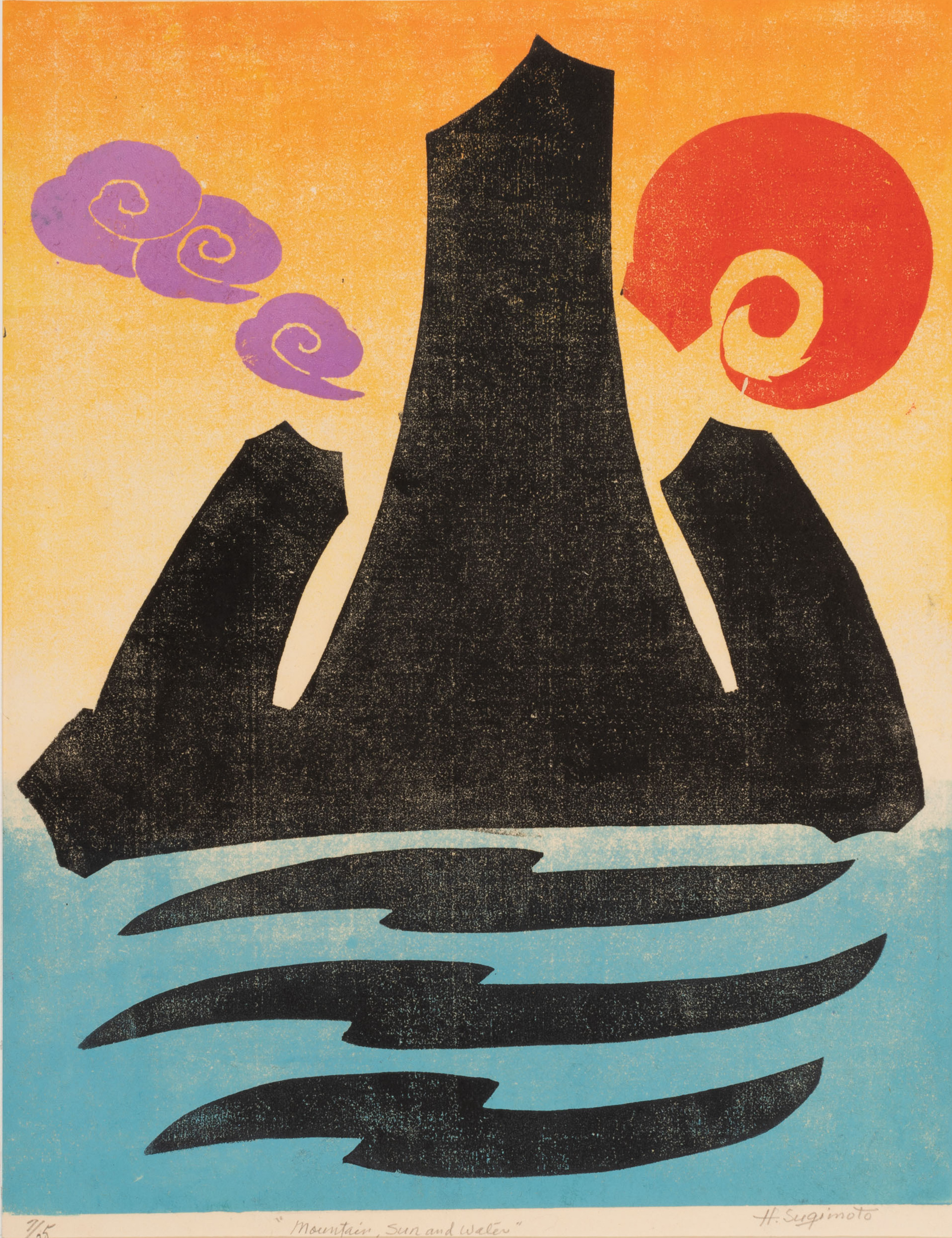
Henry Sugimoto, Untitled (Sun, Mountain and Clouds, Reflection on the Sea), ca 1965
I was delighted recently to discover the Japanese American National Museum (JANM), and their collection of artwork by Henry Sugimoto. Henry Sugimoto was born in Japan in 1900, the grandson of a samurai (Japanese military nobility) who most likely was alive at the time of the opening of Japan to commerce with the West by Commodore Perry in 1854. This fact, coupled with that of Sugimoto’s national heritage, would have made him – along with many others – suspect in American government eyes after Pearl Harbor.

Henry Sugimoto with his parents, before their immigration to the United States
Despite his father’s immigration to the United States before World War I, and their willingness to assimilate into American society and receive citizenship, the Sugimotos, like so many Japanese, found themselves rounded up in by our government in 1942. Henry’s family was sent away with one suitcase each from California to a detention camp in Arkansas. Such forced moves in many cases led to the unexpected forfeiture of family property and possessions. Henry Sugimoto lost a large collection of his artwork, auctioned off without his permission or knowledge while he – as an American citizen – was forcibly detained.

Self-Portrait in Camp, 1943
In JANM’s Sugimoto collection, we find several categories among his artwork. The largest is comprised of his oil paintings, many of which are skillfully rendered. I find some of them stylistically indebted to paintings that he studied in Paris by well-known late 19th and early 20th century Europeans.

Fresno Assembly Camp – Peaches, 1942
Others works, exhibiting a freer style he employed in his drawings and paintings of his fellow camp detainees, seem to reflect more of Sugimoto’s own painterly sensibility. Perhaps this was a visual artist’s equivalent of a writer coming to find his or her own voice.

The Mess Hall, 1942
Another significant body of work in the Sugimoto collection is composed of block prints. They include a few that reflect his travels to Europe and his life in New York City. Notable among his prints are his later black and white depictions of detainee life in the crudely appointed Japanese American ‘relocation centers.’ Gradually freed up from the constraints imposed by other employment, Sugimoto shows himself in his mature work to be an accomplished graphic artist, expressing an authentic personal vision.

Riverside Drive and Church (New York City), ca 1965

Back of WRA Truck, 1960’s

Thinking of Him, 1960’s
Other prints include some beautiful, and to my eyes, very Japanese-looking images with a modernist bent, characterized by an elegant simplicity of composition and color palette. The Sugimoto print shown at the top of a mountain set against the sea shadowed by a setting sun is suggestive of the famed Mt Fuji, visible from the Japanese coast. These later pieces by Sugimoto are my favorites among his artwork, and seem most reflective of an aesthetic sensibility associated with his native Japanese background.

Dawn (undated)

Gate of Yashiro (what may be the oldest Shinto shrine in Japan), undated

Untitled (color block print), undated
Though fully Americanized following his own immigration to America at the age of 18, Henry Sugimoto retained a deep sensitivity to the language, culture, and traditions of the land of his birth. One example of this can be found in another print featuring the setting sun and a mountain, like the image at the top of this page. The print below demonstrates how the Japanese Kanji character, Yama (for mountain, as in Fuji Yama), inspired his portrayal of a peak set against the evening sun, and reflected off the surface of the sea. Sugimoto’s interest in this word and its written form is surely no coincidence given that he was born and lived until he was 18 in Wakayama, Japan. Wakayama is the conjunction of the Japanese words for ‘mountain’ and ‘youthful.’
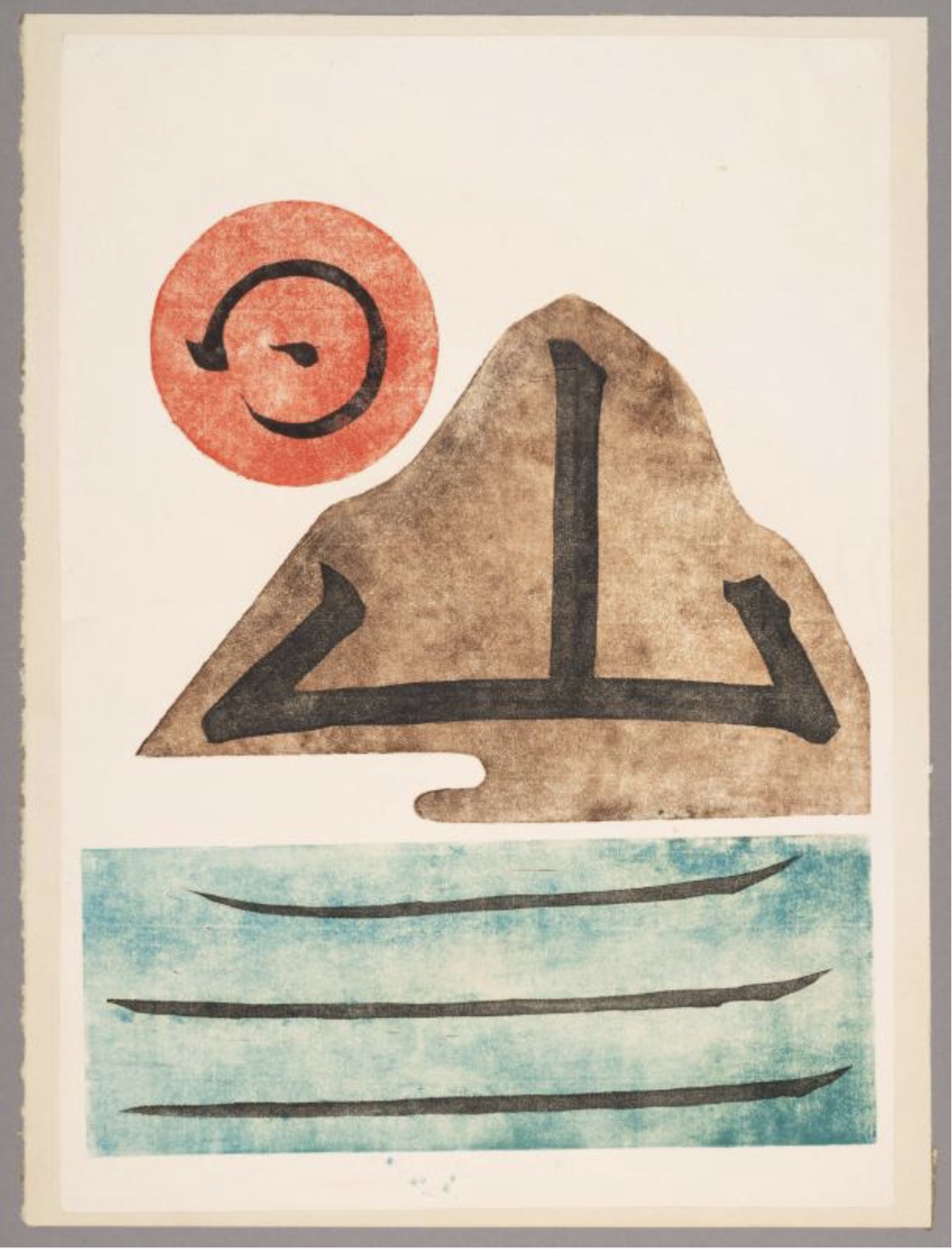
Untitled (featuring the Japanese pictographic Kanji character for Yama, or mountain), undated
These and other works by Sugimoto, along with biographical information, can be found on the website for the Japanese American National Museum (www.janm.org). The museum has an informative documentary video, Harsh Canvas: The Art & Life of Henry Sugimoto, which features his artistic work and introduces viewers to some of his family and to places where he lived and worked. It can be found on YouTube.
 Toward Beauty