If reading this by email, please tap the title at the top to open your browser for the best experience. Then, clicking individual pictures will reveal higher resolution images.

William Blake, The Ancient of Days (one of numerous hand-colored prints)
I like to use a couple of throw-away lines: First, the world was here before we were here to notice it (or try to describe and evaluate its various facets). And, second, God was here before we were ever able to think the thought, much less give value to or try to describe this fundamental insight. And so, the world had God-given beauty and value before we were here to notice such things. To put this matter in the formal terms I propose that we recover, we were objects of God’s subjectivity before God ever became an object of ours. These insights ought to be primary in our outlook upon the world, and upon our lives within it.
The stark alternative to what these throw-away lines represent is the view that the world, its meaning and any purposes within it, and or God, came to have significance if not also actuality, when we chose to notice or imagine such things.
I have written before urging recognition of how beauty exists apart from the ‘eyes of the beholder.’ This is to say that the reality of beauty transcends the perception and apprehension processes of the one who beholds it. Another way to say this is to contend that beauty has objective reality. But what do we mean when we say something is objective?
Here, I would like to commend an insight regarding this word, ‘objective,’ and its pair, ‘subjective,’ terms we may use too casually. For we tend to employ these words most often to characterize two different aspects of how we perceive matters that come before us. One we regard as being oriented toward what is factual; we use the second to refer to that which is subject to the variability of emotions and sentiments that are particular to ourselves.
We need to recover a prior sense of what these two words, objective and subjective, can mean. We can return to using the word objective, not first to refer to the fact-oriented aspect of our consciousness of the world, but as referring primarily to the world itself and to the things within it. In this recovered use of these terms, the objective can best designate the objects of perception. And the second term, the subjective, can best represent the subject of our perceptions (us).
We can, of course, have ‘subjective’ notions about the objects of our perception, while we can also seek to be more accurate in our sense of those things that we perceive. Accurate description and evaluation of the objects of our perception are aided by comparative reference to the perceptions of those same things by others, and thus are aided by an effort to step beyond notions that are particular to ourselves and to our private experience of them.
In this respect, the practice of good science shares a basic property with the practice of good religion. Both seek to describe what is true, and what is in accord with reality.
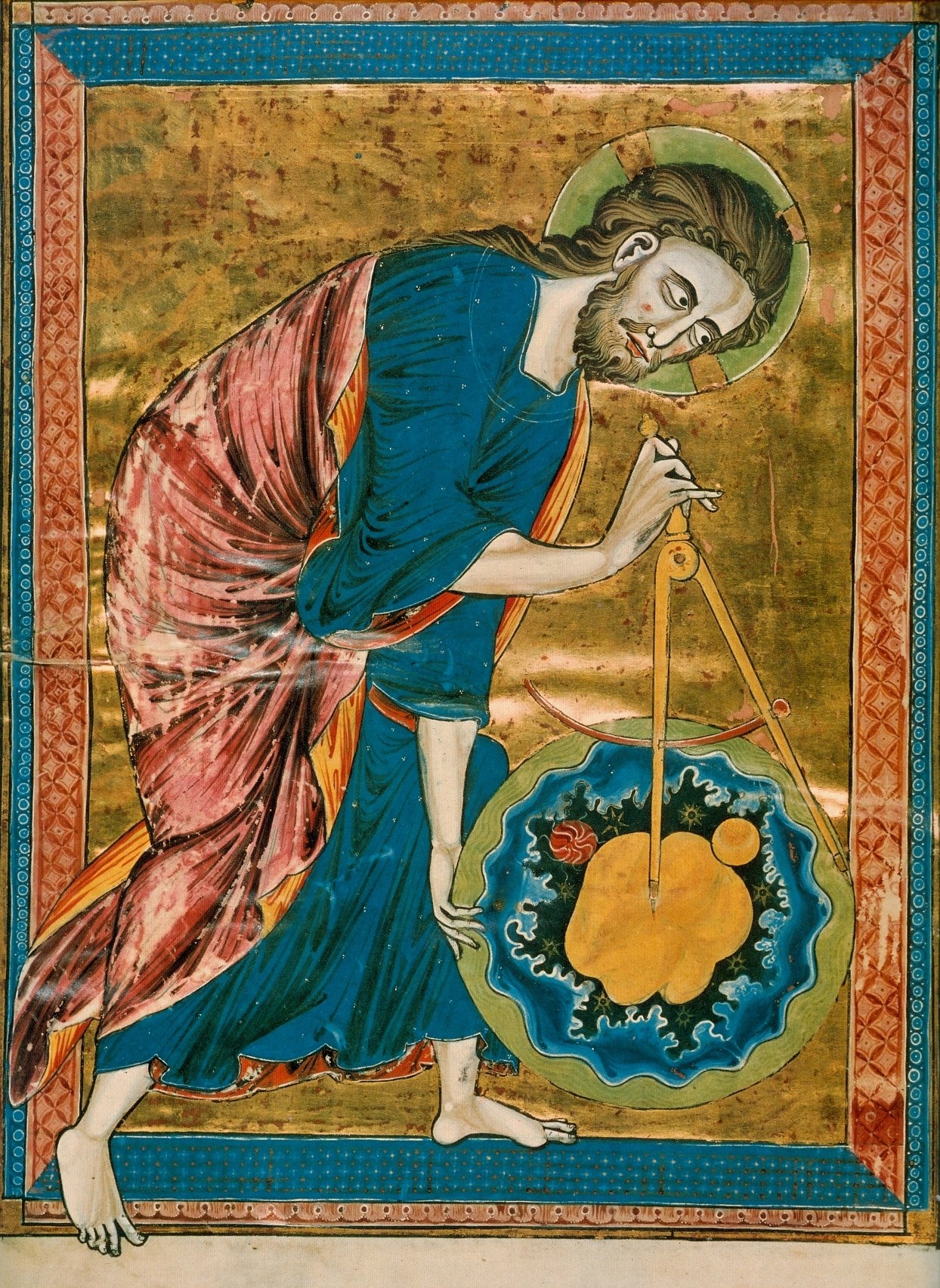
God the Geometer (from a medieval manuscript)
In perhaps an overly simplistic summary, the choice between these two outlooks upon ‘what is,’ emerged with what we now call the Enlightenment, and the development of what we now call ‘natural science.’ And yet, the emergence of modern science, and the world view which it has come to nurture, lies in pre-modern theism, in the ancient and primal belief that before all things, was and is God. And that God was and is the author of what the medievals called the Book of Nature, who was also the author of the Book of Scripture. Two books with overlapping significance, by one Author, about all that was, and is, and ever shall be.
Among the works of this author, and behind or within them, are ideas, ideas latent in the mind of the Author. And preeminent among these ideas are Beauty, Goodness, and Truth. These ideas represent the highest things we cannot not know, especially if we seek to have our minds shaped by the mind of the Author of all things. Beauty, Goodness, and Truth, are therefore – as we like to say and think – objective. That is, they are among the highest, most valuable and excellent, objects of our perception. And whether we grasp their significance, and how we grasp their significance, as fellow-subjects of their perception, can of course be – as we like to say and think – subjective.

William Blake, Newton as A Divine Geometer
Nevertheless, the objects of our perception ought to govern and discipline our shared and comparative perception – as fellow-subjects – of Beauty, Goodness, and Truth. This is the beauty of human objectivity and of subjectivity.
 Toward Beauty