If reading this by email, please tap the title at the top to open your browser for the best experience. Then, clicking individual pictures will reveal higher resolution images.

Michael John Trotta introducing his choral work, “Requiem,” in a YouTube video
Recently, I had the providential opportunity to meet Baton Rouge resident, and LSU School of Music doctoral recipient, Michael John Trotta. Only later did I learn of his impressive and internationally recognized accomplishments. Four albums incorporating recordings of his musical work can be found on Spotify, among them his stirring and evocative setting for the traditional Latin Requiem. Through subsequent messaging with him, I learned of the recording session that he directed this year of his “Requiem,” with the London Symphony Orchestra and the London Voices. It is a beautiful work of music, all the more meaningful for him and subsequent listeners in that the recording was made in support of the charity, Hospice UK.

A recent screenshot from Spotify featuring the music of Michael John Trotta
Michael John Trotta writes passionate and lyrical sacred music – a series of words not everyone will string together. Reflecting on his music, I am aware of my inclination to find verbal analogies rooted in the visual arts. And so, parallel to how some painters, sensitive to the role of light in our perception of color, seek to mix several colors to achieve a particular hue, Trotta’s choral music strikes me as an effort to express a wide and full spectrum of harmonious sound.
My initial perception of his compositions, that he presents sacred music that is passionate and lyrical, may also be akin to my use of the word beauty in connection with the paintings of Jackson Pollack. In both cases, I may be expressing an unexpected conjunction of ideas that can, I believe, properly belong together. Trotta’s musical works inspire me to write about them in this way.
Those who love to hear large groups of voices singing in harmonic patterns, especially of examples from Renaissance and early English vocal music, as well as modern compositions influenced by them, may find a similar pleasure in hearing his work. For me, this is due to how Trotta’s original choral music and his arrangements provide a moving and also meditative listening experience.
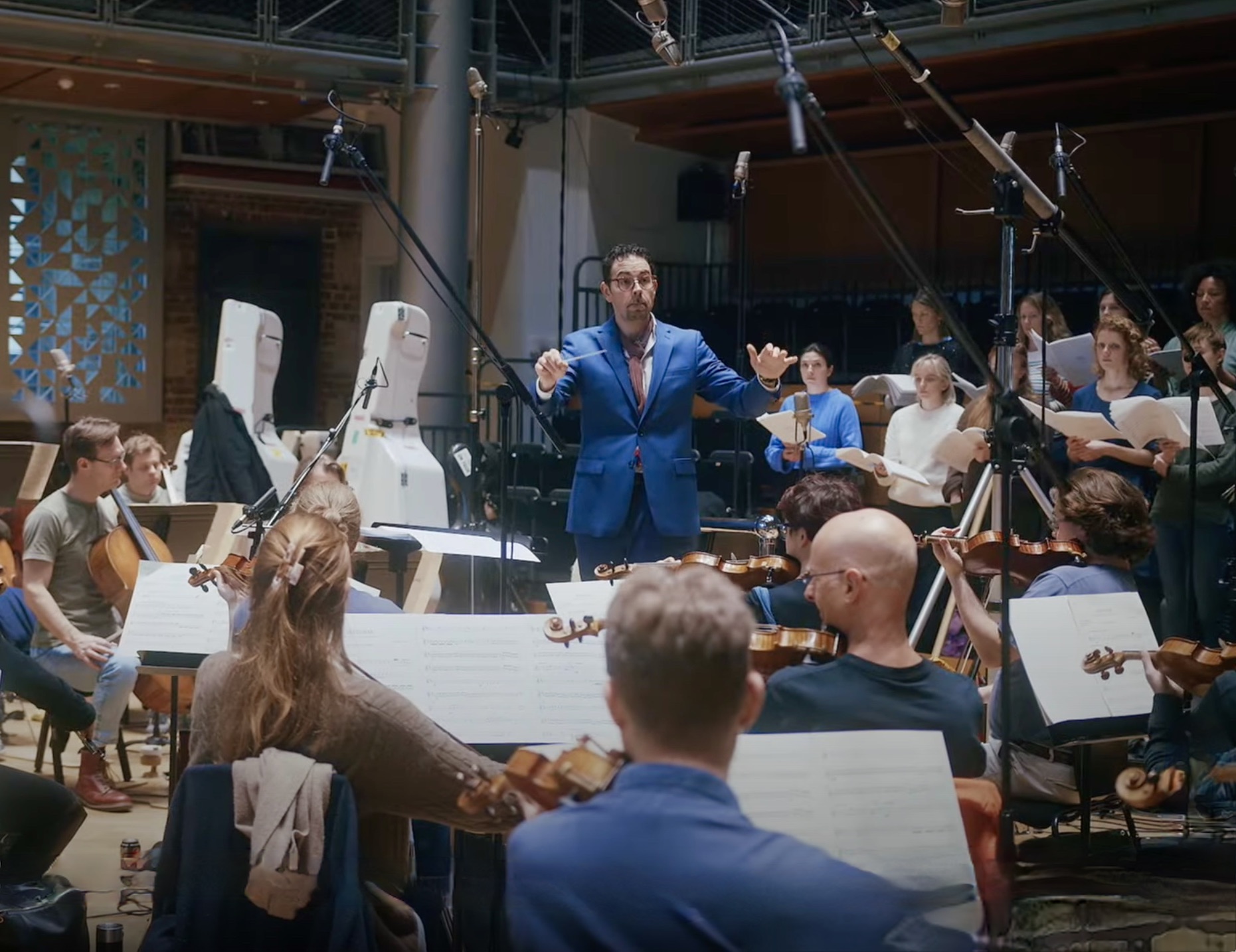
Trotta conducting the London Symphony Orchestra and London Voices while recording his “Requiem”
As an amateur listener, I find that Trotta’s compositions and arrangements are evocative of traditional art forms without sounding imitative. Composed in creative dialogue with musical history, his work retains what we might call a traditional ‘vocabulary.’ This may have parallels with what we can discern in various works by contemporary practitioners of other art forms. Parallel examples of an engagement with traditional elements in an artistic field may include composition and subject matter in painting; ornament or the lack of it and the use of certain structural elements in architecture; as well as selected harmonic patterns and chord sequences in music.

Nigel Short leading the ensemble, Tenebrae, accompanied by organ, while recording “Requiem” in the parish Church of St. John the Evangelist, Islington, North London
Michael John Trotta’s music helps support my renewed sense of confidence that contemporary artists and composers, as well as writers, can utilize and work creatively with inherited forms of expression and yet present new, fresh and compelling compositions. Trotta may epitomize the wisdom expressed by Jesus in another context, that “every scribe {or composer} who has been trained for the kingdom of heaven is like a master of a house, who brings out of his treasure what is new and what is old (Mt. 13:52).”

Michael John Trotta, in Carnegie Hall, conducting the premier of his compositional setting for the traditional Septem Verba Ultima (The Seven Last Words {of Christ})
The pieces that Trotta has composed and or arranged are not only musically harmonious, but also spiritually congruent with what we know about the grace-filled peace and presence of God. Michael John Trotta’s approach to the art of music can broaden our appreciation not only for beauty expressed in the past, but also for beauty as it may be presented anew today. I am very encouraged by my new experience of historically informed music that Trotta’s compositional work has opened for me.
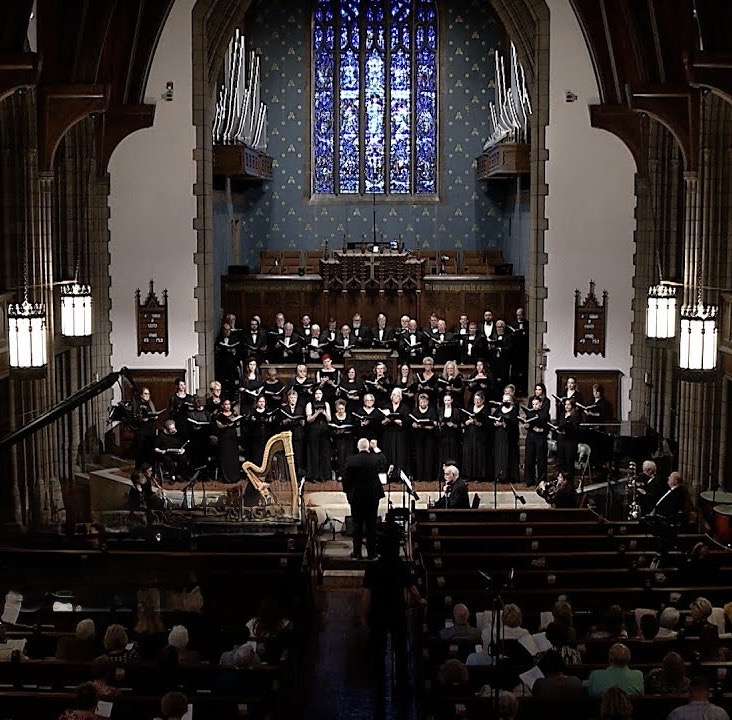
A performance of Michael John Trotta’s” Requiem,” Sunday, April 21, 2024 at Tabernacle Presbyterian Church in Indianapolis, Indiana
Since first posting this piece I have corrected a couple of the details mentioned in two of the photo captions.
 Toward Beauty
I will look forward to listening to his music. Thanks for this.